SUDECK’S OSTEODYSTROPHY
DR BIPUL BORTHAKUR
PROFESSOR, DEPT. OF ORTHOPAEDICS,
SILCHAR MEDICAL COLLEGE AND HOSPITAL.
LEARNING OBJECTIVES
 DEFINITION
 CLASSIFICATION
 RISK FACTORS AND PATHOPHHYSIOLOGY
 STAGING
 CLINICAL FEATURES AND DIAGNOSTIC CRITERIA
 MANAGEMENT
DEFINTION
 “ Chronic progressive disease with an array of painful conditions that are
characterized by a continuing ( spontaneous or evoked) regional pain that is
disproportionate in time or degree to the course of any known trauma or other lesion. “
 Pain distributed in specific nerve territory or dermatome .
 Predominance of abnormal sensory, motor, sudomotor, vasomotor or trophic changes
including osteoporosis.
SYNONYMS
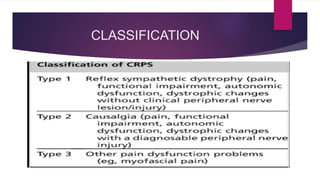
 Complex regional pain syndrome.
 Reflex sympathetic dystrophy.
 Sudecks atrophy.
 Causalgia.
 Algodystrophy.
 Algoneurodystrophy.
 Post traumatic pain syndrome.
 Painful post traumatic dystrophy.
CLASSIFICATION
EPIDEMIOLOGY
 Females commonly affected
 Incidence increases with age
 60% occur in the upper extremity
 40% occur in the lower extremity
RISK FACTORS
 Actual cause is not known
 Trauma
 Surgery.
 Prolonged immobilization.
 Anxiety or depression.
 Use of ACE inhibitors at the time of trauma.
 History of asthma or migraines.
 Smoking
 Fibromyalgia.
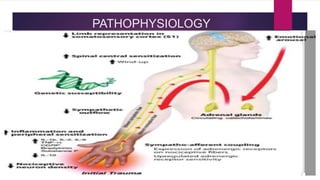
PATHOPHYSIOLOGY
LANK-FORD AND EVANS STAGING
CLINICAL FEATURES
 Stage One(Acute stage – 6 to 8 weeks after inury)
1. Warmth,
2. Coolness,
3. Burning pain,
4. Increased sensitivity to touch,
5. Increased pain with hyperalgesia ,
6. Accelerated hair and nail growth
7. Tenderness and stiffness of joints
8. Bone changes on X-ray
9. Decreased sympathetic activity.
Dystrophic changes.
Stage 2 - Dystrophic changes
Pain is constant – throbbing, burning, aching, exaggerated by stimuli.
Affected limb may still have oedema, cool, mottled appearance.
Nails – brittle and ridged.
Pain and stiffness of joint persists.
Muscle – tremor and wasting.
 Psychological distress sets in due to loss of pain relief.
 Changes in body perceptions.
 Increased sympathetic activity.
Atrophic changes
Stage 3 Atrophic changes
 Typically the patient has had CRPS for more than 3 years.
Pain is still constant
 Skin is cool, thin and shiny.
 Atrophy of limbs with contracture of joints .
 Muscle wasting.
 Increase in osteoporosis.
 Extreme osteopenia on xray.
Diagnosis
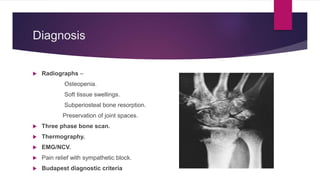
 Radiographs –
Osteopenia.
Soft tissue swellings.
Subperiosteal bone resorption.
Preservation of joint spaces.
 Three phase bone scan.
 Thermography.
 EMG/NCV.
 Pain relief with sympathetic block.
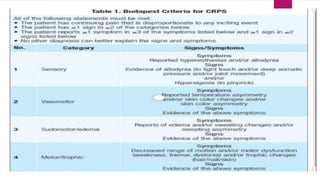
 Budapest diagnostic criteria
Diagnosis
 Cardinal signs of RSD
 Pain
 swelling
 Stiffness
 discoloration
out of proportion
Diagnosis
 The diagnostic test
 Invasive procedure by blocking the sympathetic nerves and improvement of the
symptoms
Diagnosis
DIFFERENTIAL DIAGNOSIS
 Soft tissue infections.
 Malingering.
 Psychiatric disease.
 Neuropathic pain.
 Chronic pain.
 Raynaud disease.
 Thoracic outlet syndrome.
 Arterial insufficiency.
 Erythromelalgia.
TREATMENT
 Prevention - Vitamin C
 Non operative-
1. Physical therapy and pharmacological treatments.
NSAIDs, alpha blockers, beta blockers, Calcitonin, corticosteroids, anti arrhythmic drugs, mirror box therapy
sometimes help pyschologically etc.,
2. Nerve stimulation – mainly on the distribution of nerve.
Transcutaneous electric stimulation
Peripheral nerve stimulation.
Spinal cord stimulation.
TREATMENT
 Prevention - Vitamin C
 Non operative-
3. Nerve blockade-
Agent used - anesthetics lidocaine , bupivacaine
Stellate ganglion block for upper extremity.
Lumbar spinal blockade for lower extremity.
4. Oral steroids and even epidural steroid may be helpful
TREATMENT
 Chemical sympathectomy
Agent used- alcohol and phenol.
 Operative Management –
Surgical sympathectomy – ideal for patients who had a response
to sympathetic block.
Methods- a. Excision
b. Electrocautery.
TREATMENT
 Sometimes patient explains the severe pain in a particular area
 Examples like release of carpal tunnel, may remarkably improve this situation
 Painful triggering point
PROGNOSIS
EIF TREATMENT STARTED -
 WITHIN FIRST 3 MONTHS – GOOD PROGNOSIS
 DELAYED TREATMENT – BAD PROGNOSIS DUE TO QUICK SPREAD TO
ENTIRE LIMB RESULTING IN IRREVERSIBLE CHANGES IN BONE,
NERVE AND MUSCLE
– LIMB RESULTING IN IRREVERSIBLE CHANGES IN BONE, NERVE
AND MUSCLE
THANK YOU

Sudeck's osteodystrophy - Dr Bipul Borthakur

  • 1.
    SUDECK’S OSTEODYSTROPHY DR BIPULBORTHAKUR PROFESSOR, DEPT. OF ORTHOPAEDICS, SILCHAR MEDICAL COLLEGE AND HOSPITAL.
  • 2.
    LEARNING OBJECTIVES  DEFINITION CLASSIFICATION  RISK FACTORS AND PATHOPHHYSIOLOGY  STAGING  CLINICAL FEATURES AND DIAGNOSTIC CRITERIA  MANAGEMENT
  • 3.
    DEFINTION  “ Chronicprogressive disease with an array of painful conditions that are characterized by a continuing ( spontaneous or evoked) regional pain that is disproportionate in time or degree to the course of any known trauma or other lesion. “  Pain distributed in specific nerve territory or dermatome .  Predominance of abnormal sensory, motor, sudomotor, vasomotor or trophic changes including osteoporosis.
  • 4.
    SYNONYMS  Complex regionalpain syndrome.  Reflex sympathetic dystrophy.  Sudecks atrophy.  Causalgia.  Algodystrophy.  Algoneurodystrophy.  Post traumatic pain syndrome.  Painful post traumatic dystrophy.
  • 5.
  • 6.
    EPIDEMIOLOGY  Females commonlyaffected  Incidence increases with age  60% occur in the upper extremity  40% occur in the lower extremity
  • 7.
    RISK FACTORS  Actualcause is not known  Trauma  Surgery.  Prolonged immobilization.  Anxiety or depression.  Use of ACE inhibitors at the time of trauma.  History of asthma or migraines.  Smoking  Fibromyalgia.
  • 8.
  • 9.
  • 10.
    CLINICAL FEATURES  StageOne(Acute stage – 6 to 8 weeks after inury) 1. Warmth, 2. Coolness, 3. Burning pain, 4. Increased sensitivity to touch, 5. Increased pain with hyperalgesia , 6. Accelerated hair and nail growth 7. Tenderness and stiffness of joints 8. Bone changes on X-ray 9. Decreased sympathetic activity.
  • 11.
    Dystrophic changes. Stage 2- Dystrophic changes Pain is constant – throbbing, burning, aching, exaggerated by stimuli. Affected limb may still have oedema, cool, mottled appearance. Nails – brittle and ridged. Pain and stiffness of joint persists. Muscle – tremor and wasting.  Psychological distress sets in due to loss of pain relief.  Changes in body perceptions.  Increased sympathetic activity.
  • 12.
    Atrophic changes Stage 3Atrophic changes  Typically the patient has had CRPS for more than 3 years. Pain is still constant  Skin is cool, thin and shiny.  Atrophy of limbs with contracture of joints .  Muscle wasting.  Increase in osteoporosis.  Extreme osteopenia on xray.
  • 13.
    Diagnosis  Radiographs – Osteopenia. Softtissue swellings. Subperiosteal bone resorption. Preservation of joint spaces.  Three phase bone scan.  Thermography.  EMG/NCV.  Pain relief with sympathetic block.  Budapest diagnostic criteria
  • 14.
    Diagnosis  Cardinal signsof RSD  Pain  swelling  Stiffness  discoloration out of proportion
  • 15.
    Diagnosis  The diagnostictest  Invasive procedure by blocking the sympathetic nerves and improvement of the symptoms
  • 16.
  • 17.
    DIFFERENTIAL DIAGNOSIS  Softtissue infections.  Malingering.  Psychiatric disease.  Neuropathic pain.  Chronic pain.  Raynaud disease.  Thoracic outlet syndrome.  Arterial insufficiency.  Erythromelalgia.
  • 18.
    TREATMENT  Prevention -Vitamin C  Non operative- 1. Physical therapy and pharmacological treatments. NSAIDs, alpha blockers, beta blockers, Calcitonin, corticosteroids, anti arrhythmic drugs, mirror box therapy sometimes help pyschologically etc., 2. Nerve stimulation – mainly on the distribution of nerve. Transcutaneous electric stimulation Peripheral nerve stimulation. Spinal cord stimulation.
  • 19.
    TREATMENT  Prevention -Vitamin C  Non operative- 3. Nerve blockade- Agent used - anesthetics lidocaine , bupivacaine Stellate ganglion block for upper extremity. Lumbar spinal blockade for lower extremity. 4. Oral steroids and even epidural steroid may be helpful
  • 20.
    TREATMENT  Chemical sympathectomy Agentused- alcohol and phenol.  Operative Management – Surgical sympathectomy – ideal for patients who had a response to sympathetic block. Methods- a. Excision b. Electrocautery.
  • 21.
    TREATMENT  Sometimes patientexplains the severe pain in a particular area  Examples like release of carpal tunnel, may remarkably improve this situation  Painful triggering point
  • 22.
    PROGNOSIS EIF TREATMENT STARTED-  WITHIN FIRST 3 MONTHS – GOOD PROGNOSIS  DELAYED TREATMENT – BAD PROGNOSIS DUE TO QUICK SPREAD TO ENTIRE LIMB RESULTING IN IRREVERSIBLE CHANGES IN BONE, NERVE AND MUSCLE – LIMB RESULTING IN IRREVERSIBLE CHANGES IN BONE, NERVE AND MUSCLE
  • 23.