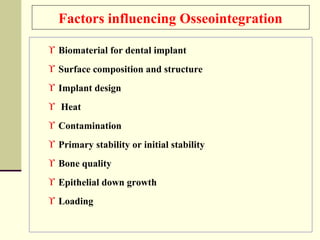
OSSEOINTEGRATION
The Amphora


       Peter Apelgren
Contents
Introduction
Historical review
Definition
Bone density classification
Biological considerations for
osseointegration
ϒ Bone implant interface
ϒ Bone remodeling
ϒ Foreign body reaction
…
ϒ Bone to implant interface
ϒ Mechanism of osseointegration
ϒ Ultrastructure in osseointegration
ϒ Destruction of osseointegration
ϒ Soft tissue implant interface
ϒ Peri-implant membrane
ϒ Disease activity in peri-implant tissue
ϒ Neuromuscular system as it relates to the implant
….

 Factors influencing osseointegration
 Osseointegration vs biointegration
 Success criteria for osseointegrated implants
 Clinical applications of osseointegration
 Future of osseointegration
 Summary & Conclusion
 References
Introduction

The ideal goal of modern dentistry is to restore the
patient to normal contour, function………..

Implant dentistry is unique because of its ability to
achieve this goal regardless of the stomatognathic
system.
…..

  The primary function of an implant is to act as an
  abutment for prosthetic device.

  The present surge in the use of implants was
  initiated by Branemark (1952)………..

  Described the relationship between titanium and
  bone for which they coined the term

  osseointegration.
Definition
The word osseointegration consists of “OS”
the Latin word for bone and “integration”
derived from Latin word meaning the state of
being combined into a complete whole.


Osseointegration is defined as a direct bone
anchorage to an implant body which can
provide a foundation to support a prosthesis.
ϒ “Direct structural and functional connection between

  ordered, living bone and surface of a load carrying implant ”.
…..


 American Academy of Implant Dentistry

 defined it as “contact established without

 interposition of non bone tissue between

 normal remodeled bone and on implant

 entailing a sustained transfer and

 distribution of load from the implant to and

 within bone tissue”.
Historical Review


ϒ The concept of osseointegration was developed and the term was
  coined by Dr. Per-Ingvar Branemark,

ϒ Professor at the institute for Applied Biotechnology, University of
  Goteborg, Sweden.
Initial concept of osseointegration stemmed
from vital microscopic studies of
microcirculation in bone repair mechanisms.
Titanium chamber was surgically inserted
into the tibia of of a rabbit.
It was considered the best material for
artificial tooth root replacement.
…..
 Many studies followed involving titanium
 implants being placed into jaws of dogs.
 Direct bone anchorage has been shown to
 be very strong. A force of over 100kg was
 applied to dislodge an implant.
 Based on such a consequence the
 foundation for Osseo integration and the
 Branemark implant system was established
 in 1952.
Studies on humans were

conducted by means of an

implant optical titanium chamber

in a twin pedicle skin tube on the

inside of the left upper arm of

volunteers.

Tissue reactions were studied in

long term experiments.

All this lead to the treatment of

first edentulous patient in 1965.
History of Branemark system categorized in
three stages
ϒ Early stage (1965-1968)
ϒ Developmental stage (1968-1971)
ϒ Production stage (1971 – present)
Bone density classification (Misch)
Biological Considerations for
                  Osseointegration
Bone implant interface
ϒ When compared to compact bone
  spongy bone has less density and
  hardness is not a stable base for
  primary fixture fixation.
ϒ In the mandible the spongy bone
  is more dense than maxilla.
ϒ With primary fixation in
  compact bone, osseointegration
  in the maxilla require a longer
  healing period.
Bone remodeling
  Osseointegration requires new bone formation
  around the fixture. A process resulting from
  remodeling within bone tissue.
  Osteoblastic and osteoclastic activity helps
  maintain blood calcium without change in
  quantity of bone.
…..
 To maintain a constant level of bone
 remodeling there should be proper local
 stimulation, crucial levels of thyroid
 hormone, calcitonin and vitamin D.
 Occlusion or occlusal force stimulus are
 both important to optimal bone remodeling.
Foreign body reaction

 Organization or an antigen antibody

 reaction occurs when a foreign body is

 present in the body.

 This reaction occurs in the presence of a

 protein but with implant materials devoid

 of proteins no antigen antibody reaction.
…..

 When titanium is used no foreign body reaction are

 seen.

 The implant material is an important factor for

 Osseo integration to occur.
Bone to implant interface
  Two basic theories
   ϒ Fibro-osseous integration by Linkow, James & Weis
   ϒ Osseointegration by Branemark


   ϒ Meffert divided osseointegration


   Adaptive osseointegration        Biointegration
American Academy of implant dentistry defined

fibrous integration as tissue to implant contact with

healthy dense collagenous tissue between the

implant and bone.
…..
 The fibers are arranged irregularly, parallel to the

 implant body, when forces are applied they are not

 transmitted through the fibers.

 So no bone remodeling expected in fibro-

 integration.
Ichida & Caputo (1986) used photo-elastic analysis to
study the stress concentration along the implant
threads and sharp edges when a connective tissue like
structure was included in the analysis.
Even stress distribution was seen when there was
direct contact with a bone like structure.
They concluded that implants with fibro-osseous
integration had a tendency of increased mobility.
A direct bone implant interface occurs when an
implant is allowed to heal in bone undisturbed.


Main factors affecting osseointegration include
ϒ Implant oxide layer contamination.
ϒ Poor temperature control during drilling.
……

A minimum of 3 month healing in mandible and 6
months in maxilla is necessary before load is
applied.
If osseointegration does not occur or a fibrous
connective tissue forms around the implant
organization process continues.
Biological process of implant osseointegration


The healing process of implant
system is similar to primary
bone healing.
Titanium dental implants show
three stages of healing.
…..

 OSTEOPHYLLIC STAGE
 ϒ When a implant is placed into the cancellous marrow
   space blood is initially present between implant and
   bone.
 ϒ Only a small amount of bone is in contact with the
   implant surface; the rest is exposed to extracellular
   fluids.
 ϒ Generalized inflammatory response to the surgical
   insult.
…..
ϒ By the end of first week, inflammatory cells are
  responding to foreign antigens.
ϒ Vascular ingrowth from the surrounding vital tissues
  begins by third day.
ϒ A mature vascular network forms by 3 weeks.
ϒ Ossification also begins during the first week and the
  initial response observed in the migration of osteoblasts
  from the trabacular bone which can be due to the
  release of BMP’s.
ϒ The osteophyllic phase lasts about 1 month.
OSTEOCONDUCTIVE PHASE
ϒOnce they reach the implant, the bone cells spread
along the metal surface laying down osteoid.

ϒInitially this is an immature connective tissue
matrix and bone deposited is a thin layer of woven
bone called foot plate.
…..
 ϒ Fibro-cartilaginous callus is eventually
  remodeled into bone callus.
 ϒ This process occurs during the next 3 months
 ϒ Four months after implant placement the
   maximum surface area is covered by bone.
OSTEOADAPTIVE PHASE
ϒ The final phase begins approximately 4 months after
  implant placement.

ϒ Once loaded implants do not gain or loose bone contact but
  the foot plates thicken in response and some reorientation of
  the vascular pattern may be seen.
…..

 ϒ Grafted bone integrates to a higher degree than the
   natural host bone to the implant.

 ϒ To achieve optimal results an osseointegration period
   of 4 months is recommended for implants in graft
   bone and 4 to 8 months for implant placed in normal
   bone.
Ultrastructure in osseointegration

ϒ Osseointegrated fixtures
  under occlusal loads are
  surrounded by cortical and
  spongy bone.


ϒ The cortical bone to fixture
  surface interface has
  canaliculi participating in
  electrolyte transportation
  near oxide layer.
….

Osseointegration in spongy bone occurs as
bone trabaculae approaches the fixture and
come into intimate contact with oxide layer.
Ground substance forms and fills spaces
between bone trabeculae this fuses with
oxide layer.
Destruction of Osseointegration
The main contributing factor to bone resorption are
local inflammation from plaque and trauma from
occlusion
ϒ Direct action of plaque products induces formation of
  osteoclasts.
ϒ Plaque products at directly on bone destroying it
  through a non cellular mechanism.
ϒ Stimulate gingival cells, which release mediators for
  osteoclast formation.
ϒ Plaque causes gingival cells to release agents which act as
  cofactors in bone resorption and which destroy bone by
  direct chemical action without osteoclasts.
Bone resorption can be caused by premature
loading.
12 months following fixture insertion vertical
bone loss is observed due to traumatic
surgical procedure.
ϒ Vertical bone loss approximately 1 to 1.5 mm in first year
ϒ Marginal bone loss is 0.05 to 0.1 mm in first year
ϒ These measurements can be used a reference and in a
  bone loss condition should be evaluated to minimize
  failure.
Peri-implant membrane

ϒ With the osseointegrated implant
  the abutment to fixture junction
  corresponds to cementoenamel
  junction present in natural
  dentition.

ϒ Peri-implant membrane is similar
  to that present in natural
  dentition, consisting of peri-
  implant free gingiva.
….

The sulcular epithelium forms the peri-
implant gingival crevice and junctional
epithelium attaches to the abutment forming
a cuff.

With a tight cuff and filamentous attachment
a membrane is sealed tightly and
functionally to the abutment surface.
Disease activity in peri-implant tissue

The fibrous connective tissue capsule
formed around an implant generally has low
differentiating capabilities such that it also
has less resistance against bacterial bi-
products and does not respond well to
occlusal stimulation.


An osseointegrated implant has periosteum
directly covering the neck of the fixture.
Which may act as a barrier against
inflammation.
….

Although the abutment to junctional epithelium
attachment is not strong, a connective tissue band
is tightly attached to the abutment surface and acts
as resistant barrier.
The neuromuscular system as it relates to the
             osseointegrated implant

A fixture site does not have periodontal ligament but
has nerve endings located near the fixture, sensing
pain and temperature.
Patients with osseointegrated implants have a high
threshold and low sensitivity for discriminating
thickness.
…..

 As the periodontal ligament is lost the
 fixture remains with reduce amount of
 receptors.
 Impulses from the fixture sites are
 transmitted through motor nucleus of
 trigeminal nerve.
Osseointegration Vs Biointegration


dePutter et al in 1985 observed that there are two ways
of implant anchorage

Mechanical and Bioactive
Mechanical retention

metallic substrate system such as titanium
or titanium alloy.

The retention is based on undercut forms
such as vents, slots, dimples, screws etc.,

Direct contact between the dioxide layer on
the titanium and bone with no chemical
bonding.
Bioactive retention

Bioactivity
ϒ characteristic of an implant material that allows attachment to
  living tissues, whereas a non bioactive material would form a
  loosely adherent layer of fibrous tissue at the implant interface


Bioactive retention is achieved with

bioactive materials such as hydroxyapatite

(HA), which bond directly to bone
Plasma spraying & ion sputter coating

Two techniques used to coat metallic implants
with HA.
Plasma spraying

Involves heating the HA by a plasma flame

at a temperature of approximately 15,000° C

to 20,000°C.

The HA is then propelled onto the implant

body in an inert environment like argon, to a

thickness of 50 to 100 μm.
Ion-sputter coating

Process by which a thin, dense layer of HA can be
coated onto an implant substrate.

Directing an ion beam at a solid-phase HA block,

Vaporising it to create a plasma and then
recondensing this plasma on the implant.

Bone formation and maturation occurs at a faster
rate in the initial phases on HA coated implants
than on non-coated implants
Advantages of increased surface roughness of Cp Ti
                     implant

 Increased surface area of the implant adjacent to

 bone.

 Improved cell attachment to the implant surface.

 Increased bone present at the implant surface.

 Increased biomechanical interactions of the implant

 with bone.

 Promoted inflammation of the periimplant area.
Clinical advantages of TPS or HA coatings

  Increased surface area

  Increased roughness for initial     stability

  Stronger bone-to- implant interface

Additional advantages of HA over TPS include the

  following

   ϒ Faster healing bone interface

   ϒ Increased gap healing between bone and       HA

   ϒ Stronger interface than TPS
Disadvantages of Coatings

Flaking, cracking, or scaling upon insertion

Increased plaque retention when placed above the

bone.

Increased bacteria adhesion and acts as a nidus for

infection

Complications of treating the failing implants

Increased cost
Factors influencing Osseointegration

ϒ Biomaterial for dental implant
ϒ Surface composition and structure
ϒ Implant design
ϒ Heat
ϒ Contamination
ϒ Primary stability or initial stability
ϒ Bone quality
ϒ Epithelial down growth
ϒ Loading
1.Biomaterial for dental implant


Implants must not induce a host immune
response Titanium and certain calcium-
phosphate ceramics are biocompatible
and do not stimulate a foreign body
rejection reaction.
2. Surface   composition and structure
ϒ It is thought that cp Ti owes its ability to form an
  osseointegrated interface to the tough and relatively
  inert oxide layer, which forms very rapidly on its
  surface.

ϒ This surface has been described as osseoconductive,
  that is, conducive to bone formation

ϒ Other substrates also have this property and may also
  stimulate bone formation, a property known as
  osseoinduction
3. Implant Design


The vast majority of commercially available
implants claiming osseointegration status
are cylindrical in shape.

Their design may be threaded or else lack
similar microscopic retentive/stabilization
aspects
4. Heat
Heating of bone to a temperature in
excess of 47°C during implant surgery can
result in cell death and denaturation of
collagen.
As a result, osseointegration may not
occur, instead the implant becomes
surrounded by a fibrous capsule and the
shear strength of the implant-host
interface is significantly reduced.
5. Contamination
ϒ Contamination of the implant site by organic and inorganic
  debris can prejudice the achievement of osseointegration.

ϒ Material such as necrotic tissue, bacteria, chemical reagents
  and debris from drills can all be harmful in this respect.
6. Primary stability or Initial stability


ϒ It is known that where an implant fits tightly into its
  osteotomy site then osseointegration is more likely to
  occur.
ϒ This is often referred to as primary stability, and where
  an implant body has this attribute when first placed
  failure is less probable.
ϒ This property is related to the quality of fit of the
  implant, its shape, and bone morphology and density.
7. Bone quality

It is a function of bone density, anatomy and volume, and
 has been described using a number of indices.
  ϒ The classifications of Lekholm & Zarb and of Cawood &
    Howell are widely used to describe bone quality and
    quantity.
  ϒ The former relates to the thickness and density of cortical
    and Cancellous bone,
  ϒ and the latter to the amount of bone resorption.
  ϒ Bone volume does not by itself influence osseointegration,
    but is an important determinant of implant placement
8. Epithelial   down growth
ϒ Early implant designs were often associated with down
  growth of oral epithelium, which eventually exteriorized
  the device.
ϒ When the newer generation of cp Ti devices was
  introduced great care was taken to prevent this by
  initially covering the implant body with oral mucosa
  while osseointegration occurred.
ϒ The implant body was then exposed and a superstructure
  added, since it was known that the osseointegrated
  interface was resistant to epithelial down growth.
9. Loading schemes
ϒ Delayed loading: The prosthesis is attached at the
  second procedure after a conventional healing
  period of 3 to 6 months 8, 23.
ϒ Early loading: The prosthesis is attached during a
  second procedure, earlier than the conventional
  healing period of 3 to 6 months. Time of loading
  should be stated in days to weeks 8, 23.
ϒ Immediate / Direct loading: The prosthesis is
  attached to the implants the same day the implants
  are placed.
Success criteria for Osseo integrated
                Implants
ϒ Durability
ϒ Bone loss
ϒ Gingival health
ϒ Pocket depth
ϒ Effect of adjacent teeth
ϒ Functions
ϒ Esthetics
ϒ Presence of infection
ϒ Intrusion on the mandibular canal
ϒ Patient emotional and psychological attitude
Revised criteria for implant success

ϒ Individual unattached implant is immobile when
  tested clinically.
ϒ No evidence of peri implant radiolucency is present as
  assessed on an undistorted radiograph.
ϒ Mean vertical bone loss is less than 0.2 mm after 1st
  year of service.
ϒ No persistent pain, discomfort or infection.
ϒ A success rate of 85% at the end of a 5-year
  observation period and 80% at the end of a 10-year
  period are minimum levels of success.
Clinical applications of osseointegration
…..
Delicate touch
Futuristic concepts of Osseointegration

     OSSEOPERCEPTION
      ϒ The interaction between
         the osseointegrated
         fixture bone tissue,
         receptor systems and
         nervous system has to be
         studied.
  “Owing to the nature of osseointegration it is not easy to
 dissect the system of anchorage from the clinical level down
to the molecular level or even the real interface which is still
                       largely a mystery”
Summary
Mechanism of Osseointegration
              Blood clot (between fixture & bone)

             Clot transformed by phagocytic cell
                         (1st to 3rd day)

                      Procallus formation
             (containing fibroblasts & phagocytes)

         Procallus becomes dense connective tissue
         (Differentiation of osteoblasts & fibroblasts)

              Callus (Osteoblasts on the fixture)

      Fibro cartilagenous callus (between fixture & bone)

              Bone callus (Penetrates & matures)

Prosthesis attached to the fixtures stimulating bone remodeling
It is because of the attention to training, research & clinical
studies that osseointegration has now become an accepted part of
the treatment regime in many countries world wide and no longer
regarded as the last resort when all else has failed but often as a
                        treatment of choice
References
ϒ Hobo, Ichida, Garcia “Osseointegration and occlusal
  rehabilitation” Quintessence Publishing.
ϒ Jan Lindhe “Clinical periodontology and implant
  dentistry” 4th edition, Blackwell Publishing.
ϒ Elaine McClarence “Branemark and the development of
  osseointegration” Quintessence publication
ϒ Carl E. Misch “Implant dentistry” 2nd edition, Mosby.
ϒ Hubertus Spiekermann “Color atlas of dental medicine
  implantology” Theime Publishers.
…..
 ϒ Charles M.Weis “Principles and practice of implant
   dentistry” Mosby.
 ϒ Charles Babbush “Dental implants the art and
   science” W.B. Saunders.
 ϒ Per Ingvar Branemark “Osseointegration and its
   experimental background” JPD 1983 Vol. 50, 399-410.
 ϒ Hanson, Alberktson “Structural aspects of the
   interface between tissue and titanium implants” JPD
   1983 vol. 50, 108-113.
….
ϒ T. Alberktson “Osseointegrated dental implants” DCNA Vol.
  30, Jan 1986, 151-189.
ϒ Richard Palmer “Introduction to dental implants” BDJ, Vol.
  187, 1999, 127-132.
ϒ Geroge A. Zarb “Osseointegrated dental implants:
  Preliminary report on a replication study”. JPD 1983, Vol
  50, 271-276.
ϒ Bergman “Evaluation of the results of treatment with
  osseointegrated implants by the Swedish National Board of
  Health and Welfare”. JPD 1983, vol. 50, 114-116.
Thank you

Osseointegration final

  • 1.
  • 2.
    The Amphora Peter Apelgren
  • 3.
    Contents Introduction Historical review Definition Bone densityclassification Biological considerations for osseointegration ϒ Bone implant interface ϒ Bone remodeling ϒ Foreign body reaction
  • 4.
    … ϒ Bone toimplant interface ϒ Mechanism of osseointegration ϒ Ultrastructure in osseointegration ϒ Destruction of osseointegration ϒ Soft tissue implant interface ϒ Peri-implant membrane ϒ Disease activity in peri-implant tissue ϒ Neuromuscular system as it relates to the implant
  • 5.
    …. Factors influencingosseointegration Osseointegration vs biointegration Success criteria for osseointegrated implants Clinical applications of osseointegration Future of osseointegration Summary & Conclusion References
  • 6.
    Introduction The ideal goalof modern dentistry is to restore the patient to normal contour, function……….. Implant dentistry is unique because of its ability to achieve this goal regardless of the stomatognathic system.
  • 7.
    ….. Theprimary function of an implant is to act as an abutment for prosthetic device. The present surge in the use of implants was initiated by Branemark (1952)……….. Described the relationship between titanium and bone for which they coined the term osseointegration.
  • 8.
    Definition The word osseointegrationconsists of “OS” the Latin word for bone and “integration” derived from Latin word meaning the state of being combined into a complete whole. Osseointegration is defined as a direct bone anchorage to an implant body which can provide a foundation to support a prosthesis. ϒ “Direct structural and functional connection between ordered, living bone and surface of a load carrying implant ”.
  • 9.
    ….. American Academyof Implant Dentistry defined it as “contact established without interposition of non bone tissue between normal remodeled bone and on implant entailing a sustained transfer and distribution of load from the implant to and within bone tissue”.
  • 10.
    Historical Review ϒ Theconcept of osseointegration was developed and the term was coined by Dr. Per-Ingvar Branemark, ϒ Professor at the institute for Applied Biotechnology, University of Goteborg, Sweden.
  • 11.
    Initial concept ofosseointegration stemmed from vital microscopic studies of microcirculation in bone repair mechanisms. Titanium chamber was surgically inserted into the tibia of of a rabbit. It was considered the best material for artificial tooth root replacement.
  • 12.
    ….. Many studiesfollowed involving titanium implants being placed into jaws of dogs. Direct bone anchorage has been shown to be very strong. A force of over 100kg was applied to dislodge an implant. Based on such a consequence the foundation for Osseo integration and the Branemark implant system was established in 1952.
  • 13.
    Studies on humanswere conducted by means of an implant optical titanium chamber in a twin pedicle skin tube on the inside of the left upper arm of volunteers. Tissue reactions were studied in long term experiments. All this lead to the treatment of first edentulous patient in 1965.
  • 14.
    History of Branemarksystem categorized in three stages ϒ Early stage (1965-1968) ϒ Developmental stage (1968-1971) ϒ Production stage (1971 – present)
  • 15.
  • 16.
    Biological Considerations for Osseointegration Bone implant interface ϒ When compared to compact bone spongy bone has less density and hardness is not a stable base for primary fixture fixation. ϒ In the mandible the spongy bone is more dense than maxilla. ϒ With primary fixation in compact bone, osseointegration in the maxilla require a longer healing period.
  • 17.
    Bone remodeling Osseointegration requires new bone formation around the fixture. A process resulting from remodeling within bone tissue. Osteoblastic and osteoclastic activity helps maintain blood calcium without change in quantity of bone.
  • 18.
    ….. To maintaina constant level of bone remodeling there should be proper local stimulation, crucial levels of thyroid hormone, calcitonin and vitamin D. Occlusion or occlusal force stimulus are both important to optimal bone remodeling.
  • 19.
    Foreign body reaction Organization or an antigen antibody reaction occurs when a foreign body is present in the body. This reaction occurs in the presence of a protein but with implant materials devoid of proteins no antigen antibody reaction.
  • 20.
    ….. When titaniumis used no foreign body reaction are seen. The implant material is an important factor for Osseo integration to occur.
  • 21.
    Bone to implantinterface Two basic theories ϒ Fibro-osseous integration by Linkow, James & Weis ϒ Osseointegration by Branemark ϒ Meffert divided osseointegration Adaptive osseointegration Biointegration
  • 22.
    American Academy ofimplant dentistry defined fibrous integration as tissue to implant contact with healthy dense collagenous tissue between the implant and bone.
  • 23.
    ….. The fibersare arranged irregularly, parallel to the implant body, when forces are applied they are not transmitted through the fibers. So no bone remodeling expected in fibro- integration.
  • 24.
    Ichida & Caputo(1986) used photo-elastic analysis to study the stress concentration along the implant threads and sharp edges when a connective tissue like structure was included in the analysis. Even stress distribution was seen when there was direct contact with a bone like structure. They concluded that implants with fibro-osseous integration had a tendency of increased mobility.
  • 25.
    A direct boneimplant interface occurs when an implant is allowed to heal in bone undisturbed. Main factors affecting osseointegration include ϒ Implant oxide layer contamination. ϒ Poor temperature control during drilling.
  • 26.
    …… A minimum of3 month healing in mandible and 6 months in maxilla is necessary before load is applied. If osseointegration does not occur or a fibrous connective tissue forms around the implant organization process continues.
  • 27.
    Biological process ofimplant osseointegration The healing process of implant system is similar to primary bone healing. Titanium dental implants show three stages of healing.
  • 28.
    ….. OSTEOPHYLLIC STAGE ϒ When a implant is placed into the cancellous marrow space blood is initially present between implant and bone. ϒ Only a small amount of bone is in contact with the implant surface; the rest is exposed to extracellular fluids. ϒ Generalized inflammatory response to the surgical insult.
  • 29.
    ….. ϒ By theend of first week, inflammatory cells are responding to foreign antigens. ϒ Vascular ingrowth from the surrounding vital tissues begins by third day. ϒ A mature vascular network forms by 3 weeks. ϒ Ossification also begins during the first week and the initial response observed in the migration of osteoblasts from the trabacular bone which can be due to the release of BMP’s. ϒ The osteophyllic phase lasts about 1 month.
  • 30.
    OSTEOCONDUCTIVE PHASE ϒOnce theyreach the implant, the bone cells spread along the metal surface laying down osteoid. ϒInitially this is an immature connective tissue matrix and bone deposited is a thin layer of woven bone called foot plate.
  • 31.
    ….. ϒ Fibro-cartilaginouscallus is eventually remodeled into bone callus. ϒ This process occurs during the next 3 months ϒ Four months after implant placement the maximum surface area is covered by bone.
  • 32.
    OSTEOADAPTIVE PHASE ϒ Thefinal phase begins approximately 4 months after implant placement. ϒ Once loaded implants do not gain or loose bone contact but the foot plates thicken in response and some reorientation of the vascular pattern may be seen.
  • 33.
    ….. ϒ Graftedbone integrates to a higher degree than the natural host bone to the implant. ϒ To achieve optimal results an osseointegration period of 4 months is recommended for implants in graft bone and 4 to 8 months for implant placed in normal bone.
  • 34.
    Ultrastructure in osseointegration ϒOsseointegrated fixtures under occlusal loads are surrounded by cortical and spongy bone. ϒ The cortical bone to fixture surface interface has canaliculi participating in electrolyte transportation near oxide layer.
  • 35.
    …. Osseointegration in spongybone occurs as bone trabaculae approaches the fixture and come into intimate contact with oxide layer. Ground substance forms and fills spaces between bone trabeculae this fuses with oxide layer.
  • 36.
    Destruction of Osseointegration Themain contributing factor to bone resorption are local inflammation from plaque and trauma from occlusion ϒ Direct action of plaque products induces formation of osteoclasts. ϒ Plaque products at directly on bone destroying it through a non cellular mechanism. ϒ Stimulate gingival cells, which release mediators for osteoclast formation.
  • 37.
    ϒ Plaque causesgingival cells to release agents which act as cofactors in bone resorption and which destroy bone by direct chemical action without osteoclasts. Bone resorption can be caused by premature loading. 12 months following fixture insertion vertical bone loss is observed due to traumatic surgical procedure. ϒ Vertical bone loss approximately 1 to 1.5 mm in first year ϒ Marginal bone loss is 0.05 to 0.1 mm in first year ϒ These measurements can be used a reference and in a bone loss condition should be evaluated to minimize failure.
  • 38.
    Peri-implant membrane ϒ Withthe osseointegrated implant the abutment to fixture junction corresponds to cementoenamel junction present in natural dentition. ϒ Peri-implant membrane is similar to that present in natural dentition, consisting of peri- implant free gingiva.
  • 39.
    …. The sulcular epitheliumforms the peri- implant gingival crevice and junctional epithelium attaches to the abutment forming a cuff. With a tight cuff and filamentous attachment a membrane is sealed tightly and functionally to the abutment surface.
  • 40.
    Disease activity inperi-implant tissue The fibrous connective tissue capsule formed around an implant generally has low differentiating capabilities such that it also has less resistance against bacterial bi- products and does not respond well to occlusal stimulation. An osseointegrated implant has periosteum directly covering the neck of the fixture. Which may act as a barrier against inflammation.
  • 41.
    …. Although the abutmentto junctional epithelium attachment is not strong, a connective tissue band is tightly attached to the abutment surface and acts as resistant barrier.
  • 42.
    The neuromuscular systemas it relates to the osseointegrated implant A fixture site does not have periodontal ligament but has nerve endings located near the fixture, sensing pain and temperature. Patients with osseointegrated implants have a high threshold and low sensitivity for discriminating thickness.
  • 43.
    ….. As theperiodontal ligament is lost the fixture remains with reduce amount of receptors. Impulses from the fixture sites are transmitted through motor nucleus of trigeminal nerve.
  • 44.
    Osseointegration Vs Biointegration dePutteret al in 1985 observed that there are two ways of implant anchorage Mechanical and Bioactive
  • 45.
    Mechanical retention metallic substratesystem such as titanium or titanium alloy. The retention is based on undercut forms such as vents, slots, dimples, screws etc., Direct contact between the dioxide layer on the titanium and bone with no chemical bonding.
  • 46.
    Bioactive retention Bioactivity ϒ characteristicof an implant material that allows attachment to living tissues, whereas a non bioactive material would form a loosely adherent layer of fibrous tissue at the implant interface Bioactive retention is achieved with bioactive materials such as hydroxyapatite (HA), which bond directly to bone
  • 47.
    Plasma spraying &ion sputter coating Two techniques used to coat metallic implants with HA.
  • 48.
    Plasma spraying Involves heatingthe HA by a plasma flame at a temperature of approximately 15,000° C to 20,000°C. The HA is then propelled onto the implant body in an inert environment like argon, to a thickness of 50 to 100 μm.
  • 49.
    Ion-sputter coating Process bywhich a thin, dense layer of HA can be coated onto an implant substrate. Directing an ion beam at a solid-phase HA block, Vaporising it to create a plasma and then recondensing this plasma on the implant. Bone formation and maturation occurs at a faster rate in the initial phases on HA coated implants than on non-coated implants
  • 50.
    Advantages of increasedsurface roughness of Cp Ti implant Increased surface area of the implant adjacent to bone. Improved cell attachment to the implant surface. Increased bone present at the implant surface. Increased biomechanical interactions of the implant with bone. Promoted inflammation of the periimplant area.
  • 51.
    Clinical advantages ofTPS or HA coatings Increased surface area Increased roughness for initial stability Stronger bone-to- implant interface Additional advantages of HA over TPS include the following ϒ Faster healing bone interface ϒ Increased gap healing between bone and HA ϒ Stronger interface than TPS
  • 52.
    Disadvantages of Coatings Flaking,cracking, or scaling upon insertion Increased plaque retention when placed above the bone. Increased bacteria adhesion and acts as a nidus for infection Complications of treating the failing implants Increased cost
  • 53.
    Factors influencing Osseointegration ϒBiomaterial for dental implant ϒ Surface composition and structure ϒ Implant design ϒ Heat ϒ Contamination ϒ Primary stability or initial stability ϒ Bone quality ϒ Epithelial down growth ϒ Loading
  • 54.
    1.Biomaterial for dentalimplant Implants must not induce a host immune response Titanium and certain calcium- phosphate ceramics are biocompatible and do not stimulate a foreign body rejection reaction.
  • 55.
    2. Surface composition and structure ϒ It is thought that cp Ti owes its ability to form an osseointegrated interface to the tough and relatively inert oxide layer, which forms very rapidly on its surface. ϒ This surface has been described as osseoconductive, that is, conducive to bone formation ϒ Other substrates also have this property and may also stimulate bone formation, a property known as osseoinduction
  • 56.
    3. Implant Design Thevast majority of commercially available implants claiming osseointegration status are cylindrical in shape. Their design may be threaded or else lack similar microscopic retentive/stabilization aspects
  • 57.
    4. Heat Heating ofbone to a temperature in excess of 47°C during implant surgery can result in cell death and denaturation of collagen. As a result, osseointegration may not occur, instead the implant becomes surrounded by a fibrous capsule and the shear strength of the implant-host interface is significantly reduced.
  • 58.
    5. Contamination ϒ Contaminationof the implant site by organic and inorganic debris can prejudice the achievement of osseointegration. ϒ Material such as necrotic tissue, bacteria, chemical reagents and debris from drills can all be harmful in this respect.
  • 59.
    6. Primary stabilityor Initial stability ϒ It is known that where an implant fits tightly into its osteotomy site then osseointegration is more likely to occur. ϒ This is often referred to as primary stability, and where an implant body has this attribute when first placed failure is less probable. ϒ This property is related to the quality of fit of the implant, its shape, and bone morphology and density.
  • 60.
    7. Bone quality Itis a function of bone density, anatomy and volume, and has been described using a number of indices. ϒ The classifications of Lekholm & Zarb and of Cawood & Howell are widely used to describe bone quality and quantity. ϒ The former relates to the thickness and density of cortical and Cancellous bone, ϒ and the latter to the amount of bone resorption. ϒ Bone volume does not by itself influence osseointegration, but is an important determinant of implant placement
  • 61.
    8. Epithelial down growth ϒ Early implant designs were often associated with down growth of oral epithelium, which eventually exteriorized the device. ϒ When the newer generation of cp Ti devices was introduced great care was taken to prevent this by initially covering the implant body with oral mucosa while osseointegration occurred. ϒ The implant body was then exposed and a superstructure added, since it was known that the osseointegrated interface was resistant to epithelial down growth.
  • 62.
    9. Loading schemes ϒDelayed loading: The prosthesis is attached at the second procedure after a conventional healing period of 3 to 6 months 8, 23. ϒ Early loading: The prosthesis is attached during a second procedure, earlier than the conventional healing period of 3 to 6 months. Time of loading should be stated in days to weeks 8, 23. ϒ Immediate / Direct loading: The prosthesis is attached to the implants the same day the implants are placed.
  • 63.
    Success criteria forOsseo integrated Implants ϒ Durability ϒ Bone loss ϒ Gingival health ϒ Pocket depth ϒ Effect of adjacent teeth ϒ Functions ϒ Esthetics ϒ Presence of infection ϒ Intrusion on the mandibular canal ϒ Patient emotional and psychological attitude
  • 64.
    Revised criteria forimplant success ϒ Individual unattached implant is immobile when tested clinically. ϒ No evidence of peri implant radiolucency is present as assessed on an undistorted radiograph. ϒ Mean vertical bone loss is less than 0.2 mm after 1st year of service. ϒ No persistent pain, discomfort or infection. ϒ A success rate of 85% at the end of a 5-year observation period and 80% at the end of a 10-year period are minimum levels of success.
  • 65.
    Clinical applications ofosseointegration
  • 66.
  • 67.
  • 68.
    Futuristic concepts ofOsseointegration OSSEOPERCEPTION ϒ The interaction between the osseointegrated fixture bone tissue, receptor systems and nervous system has to be studied. “Owing to the nature of osseointegration it is not easy to dissect the system of anchorage from the clinical level down to the molecular level or even the real interface which is still largely a mystery”
  • 69.
  • 70.
    Mechanism of Osseointegration Blood clot (between fixture & bone) Clot transformed by phagocytic cell (1st to 3rd day) Procallus formation (containing fibroblasts & phagocytes) Procallus becomes dense connective tissue (Differentiation of osteoblasts & fibroblasts) Callus (Osteoblasts on the fixture) Fibro cartilagenous callus (between fixture & bone) Bone callus (Penetrates & matures) Prosthesis attached to the fixtures stimulating bone remodeling
  • 71.
    It is becauseof the attention to training, research & clinical studies that osseointegration has now become an accepted part of the treatment regime in many countries world wide and no longer regarded as the last resort when all else has failed but often as a treatment of choice
  • 72.
    References ϒ Hobo, Ichida,Garcia “Osseointegration and occlusal rehabilitation” Quintessence Publishing. ϒ Jan Lindhe “Clinical periodontology and implant dentistry” 4th edition, Blackwell Publishing. ϒ Elaine McClarence “Branemark and the development of osseointegration” Quintessence publication ϒ Carl E. Misch “Implant dentistry” 2nd edition, Mosby. ϒ Hubertus Spiekermann “Color atlas of dental medicine implantology” Theime Publishers.
  • 73.
    ….. ϒ CharlesM.Weis “Principles and practice of implant dentistry” Mosby. ϒ Charles Babbush “Dental implants the art and science” W.B. Saunders. ϒ Per Ingvar Branemark “Osseointegration and its experimental background” JPD 1983 Vol. 50, 399-410. ϒ Hanson, Alberktson “Structural aspects of the interface between tissue and titanium implants” JPD 1983 vol. 50, 108-113.
  • 74.
    …. ϒ T. Alberktson“Osseointegrated dental implants” DCNA Vol. 30, Jan 1986, 151-189. ϒ Richard Palmer “Introduction to dental implants” BDJ, Vol. 187, 1999, 127-132. ϒ Geroge A. Zarb “Osseointegrated dental implants: Preliminary report on a replication study”. JPD 1983, Vol 50, 271-276. ϒ Bergman “Evaluation of the results of treatment with osseointegrated implants by the Swedish National Board of Health and Welfare”. JPD 1983, vol. 50, 114-116.
  • 75.