OSSEOINTEGRATED
DENTAL IMPLANT
DR. MD. SHAHIDUL ISLAM
BDS, MS
Assistant Professor & Head
Department of Prosthodontics
Rangpur Dental College & Hospital
MAKING SENSE OF OSSEOINTEGRATION
 Direct bone anchorage to an implant which can
provide a foundation to support a prosthesis
smshaheen0407@yahoo.com
2
HISTORY
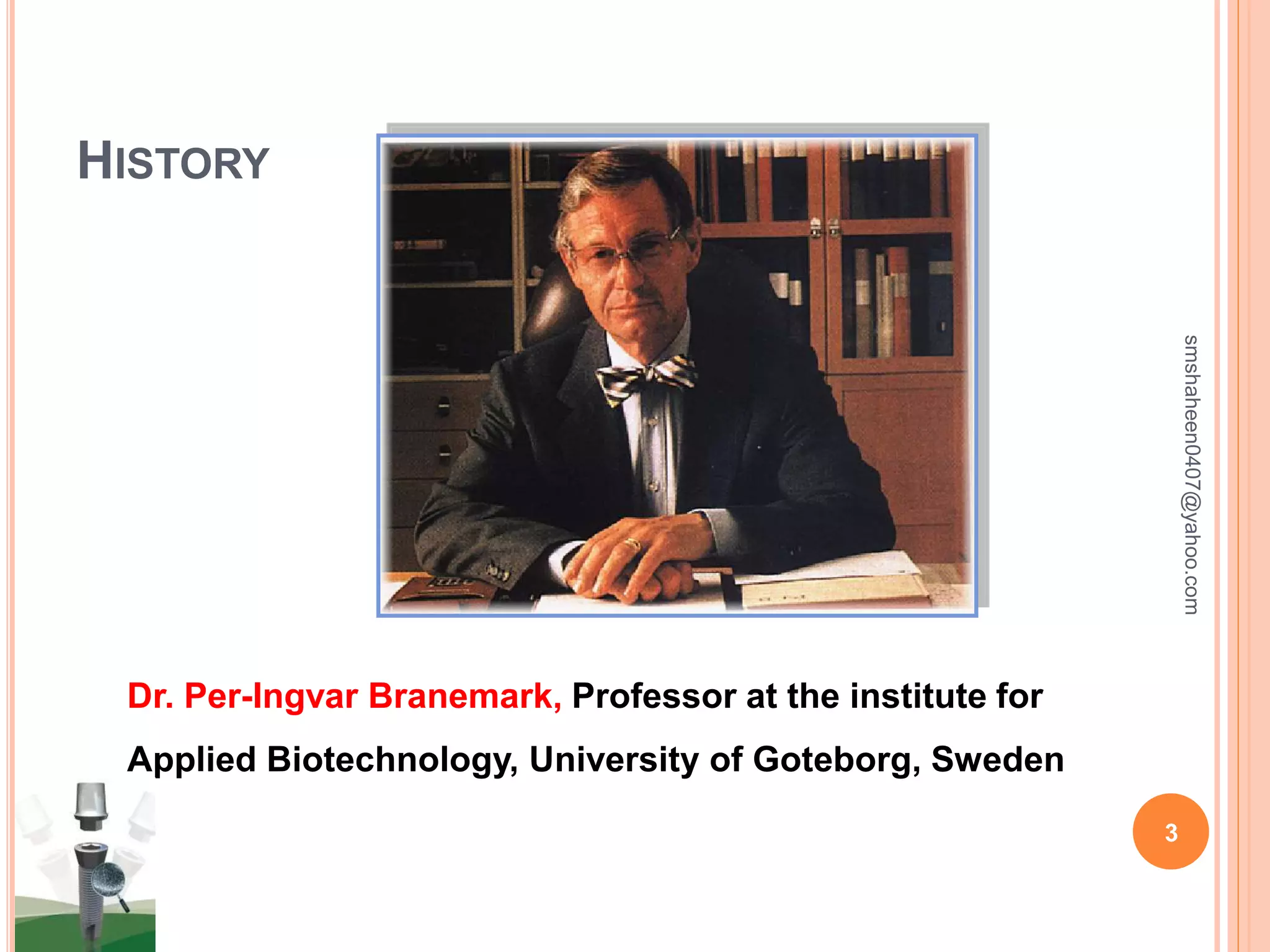
Dr. Per-Ingvar Branemark, Professor at the institute for
Applied Biotechnology, University of Goteborg, Sweden
3
smshaheen0407@yahoo.com
4
smshaheen0407@yahoo.com
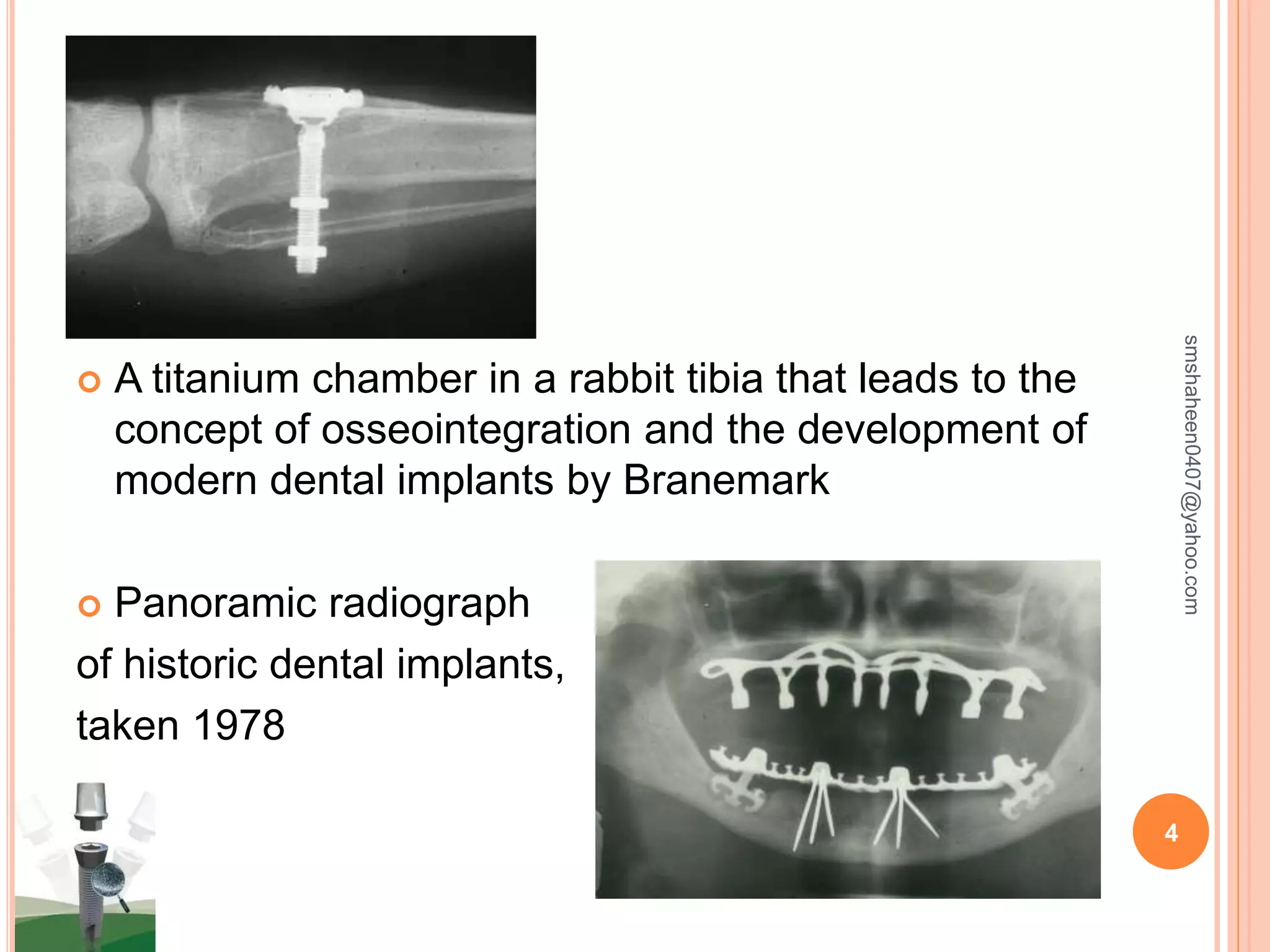
 A titanium chamber in a rabbit tibia that leads to the
concept of osseointegration and the development of
modern dental implants by Branemark
 Panoramic radiograph
of historic dental implants,
taken 1978
 Per-Ingvar Brånemark in 1952
 Early stage (1965-1968)
 Developmental stage (1968-1971)
 Production stage (1971-)
smshaheen0407@yahoo.com
5
STRUCTURES
 Crown
 Neck/ abutment
 Root/fixure
smshaheen0407@yahoo.com
6
KEY FACTORS OSSEOINTEGRATION
 Material: commercially pure titanium
 Fixture design: precision fit in vital bone
 Prevention of heat generation during drilling
 Healing period
 Surgical procedure
 Implant bed
smshaheen0407@yahoo.com
7
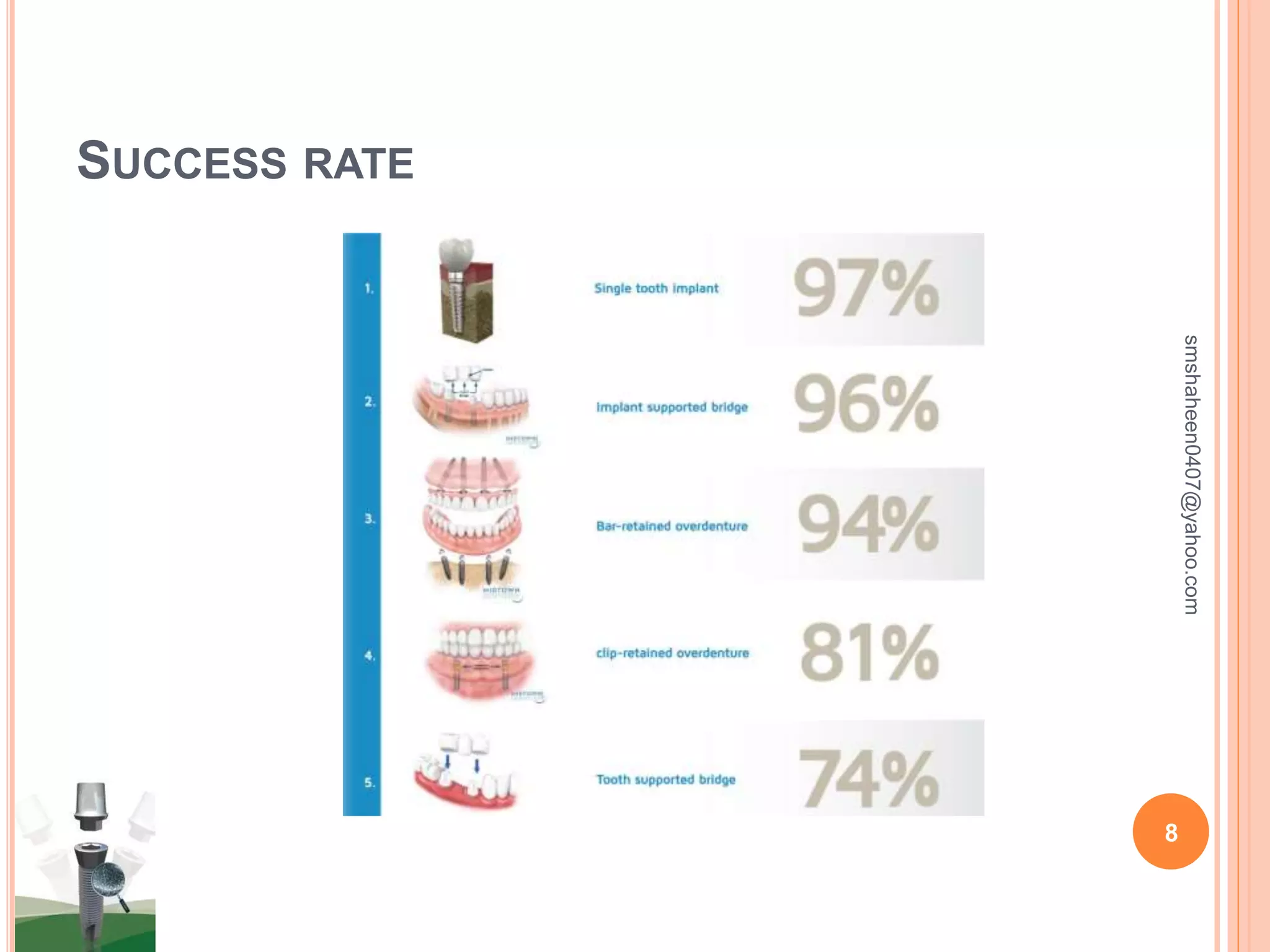
SUCCESS RATE
smshaheen0407@yahoo.com
8
BIOLOGICAL CONSIDERATION
 Quality of Bone
 Bone remodeling
 Foreign body reaction
 Bone to implant interface
 Mechanism of osseointegration
 Soft tissue implant interface
 Peri-implant membrane
 Neuromuscular system
smshaheen0407@yahoo.com
9
QUALITY OF BONE
smshaheen0407@yahoo.com
10
D1
D21
D2
D3
D2
D31
D2
D3
D3
D4
D3
D4
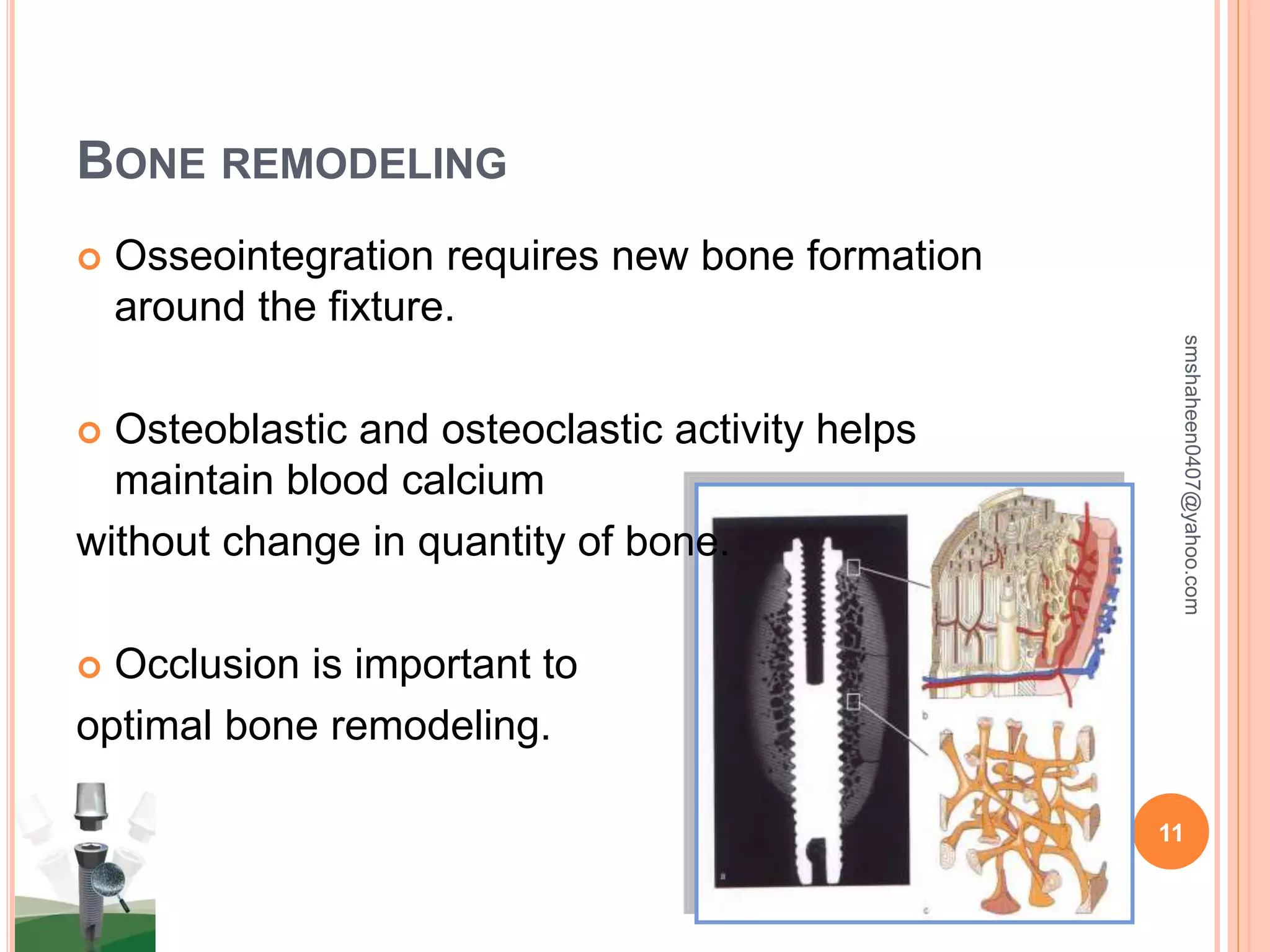
BONE REMODELING
 Osseointegration requires new bone formation
around the fixture.
 Osteoblastic and osteoclastic activity helps
maintain blood calcium
without change in quantity of bone.
 Occlusion is important to
optimal bone remodeling.
smshaheen0407@yahoo.com
11
FOREIGN BODY REACTION
 This reaction occurs in the presence of a
protein but with implant materials devoid of
proteins no antigen antibody reaction.
 When titanium is used no foreign body
reaction are seen.
 The implant material is an important factor
for Osseo integration to occur.
smshaheen0407@yahoo.com
12
BONE TO IMPLANT INTERFACE
 Spongy bone is not a stable base for primary
fixture fixation comparing with compact bone
 In the mandible the bone is more dense than
maxilla.
 The maxilla require a longer healing period.
smshaheen0407@yahoo.com
13
 Two basic theories
 Fibro-osseous integration
 Fibrous integration as tissue to implant contact with
healthy dense collagenous tissue between the implant
and bone
 The fibers are arranged irregularly, parallel to the
implant body, when forces are applied they are not
transmitted through the fibers.
 So no bone remodeling expected in fibro-integration.
Osseointegration
14
smshaheen0407@yahoo.com
 Osseointegration
 A direct bone implant interface occurs when an implant is allowed
to heal in bone undisturbed.
 Main factors affecting osseointegration include
 Implant oxide layer contamination.
 Poor temperature control during drilling.
15
smshaheen0407@yahoo.com
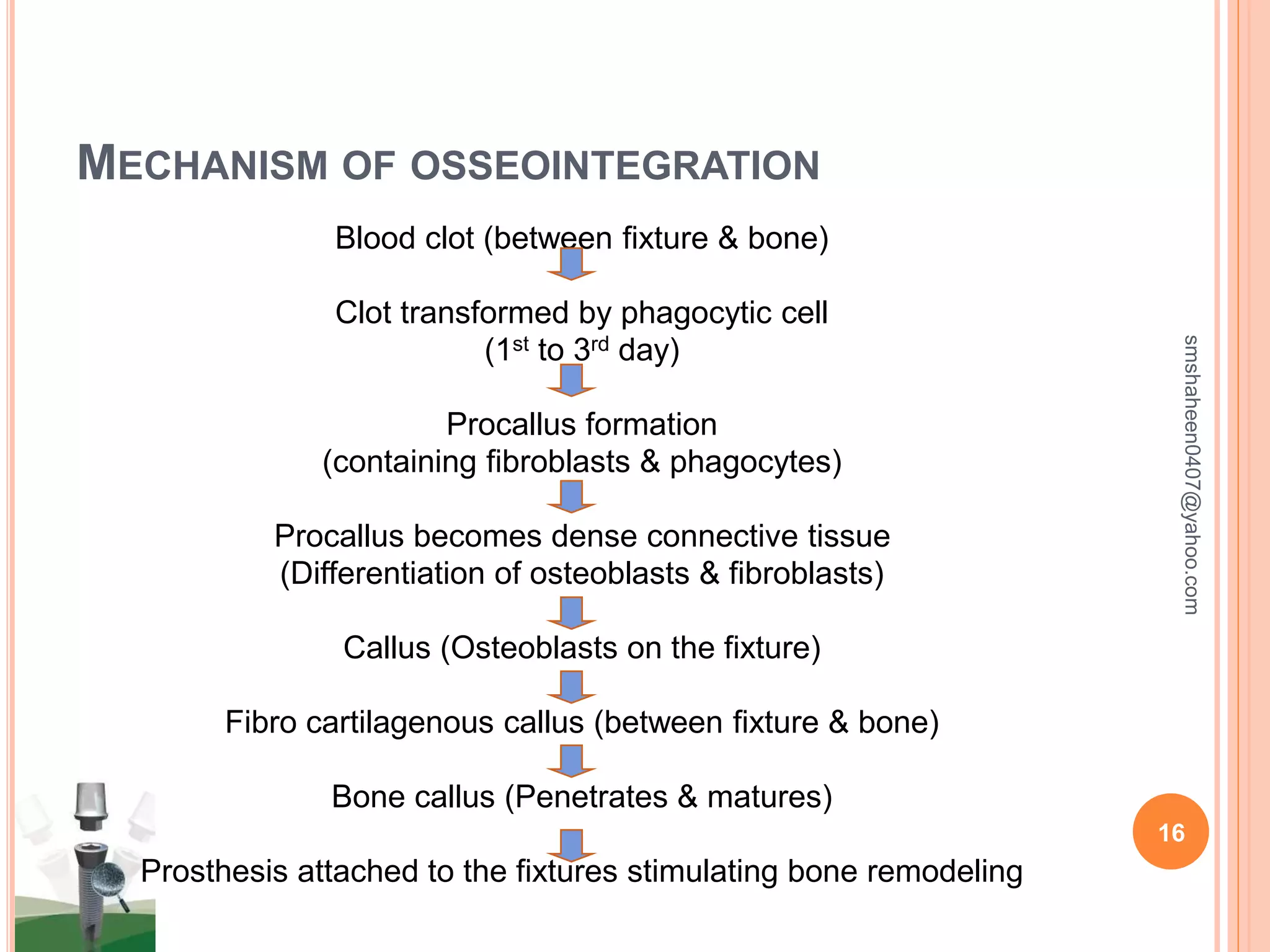
MECHANISM OF OSSEOINTEGRATION
16
smshaheen0407@yahoo.com
Blood clot (between fixture & bone)
Clot transformed by phagocytic cell
(1st to 3rd day)
Procallus formation
(containing fibroblasts & phagocytes)
Procallus becomes dense connective tissue

(Differentiation of osteoblasts & fibroblasts)
Callus (Osteoblasts on the fixture)
Fibro cartilagenous callus (between fixture & bone)
Bone callus (Penetrates & matures)
Prosthesis attached to the fixtures stimulating bone remodeling
EXAMINATION
 Edentulous area
 Edentulous span
 Vertical height of jaw bone
 Bucco-lingual width & mesio-distal width of jaw
bone
 Relation to vital structure
 X-ray, CTScan
smshaheen0407@yahoo.com
17
INDICATIONS & CONTRAINDICATIONS
smshaheen0407@yahoo.com
18
SUCCESS CRITERIA
 Durability
 Bone loss
 Gingival health
 Pocket depth
 Effect of adjacent teeth
 Functions
 Esthetics
 Presence of infection
 Intrusion on the mandibular canal
 Patient emotional and psychological attitude
smshaheen0407@yahoo.com
19
 Individual unattached implant is immobile when
tested clinically.
 No evidence of peri implant radiolucency is present
as assessed on an undistorted radiograph.
 Mean vertical bone loss is less than 0.2 mm after 1st
year of service.
 No persistent pain, discomfort or infection.
 A success rate of 85% at the end of a 5-year
observation period and 80% at the end of a 10-year
period are minimum levels of success.
smshaheen0407@yahoo.com
20
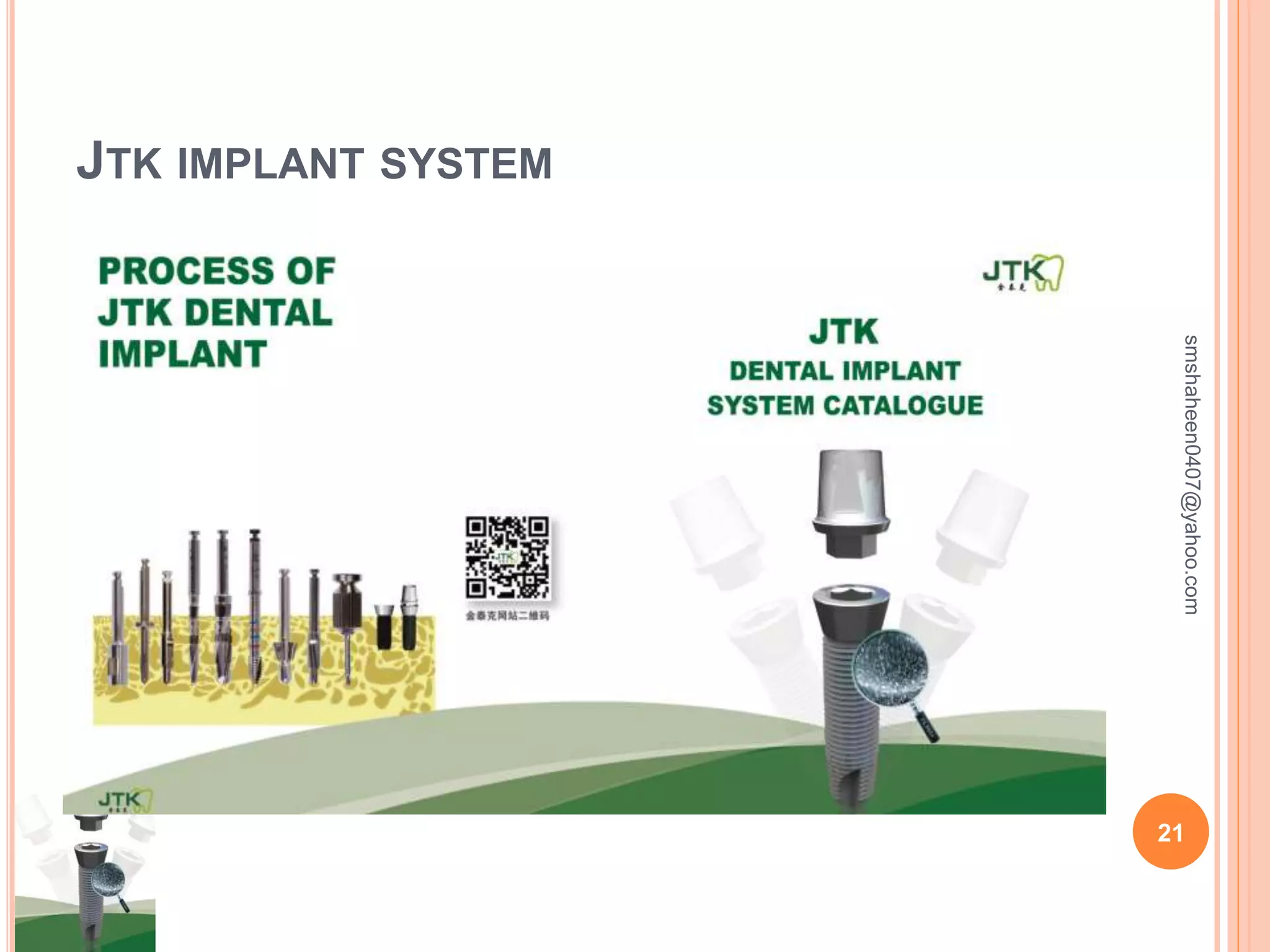
JTK IMPLANT SYSTEM
smshaheen0407@yahoo.com
21
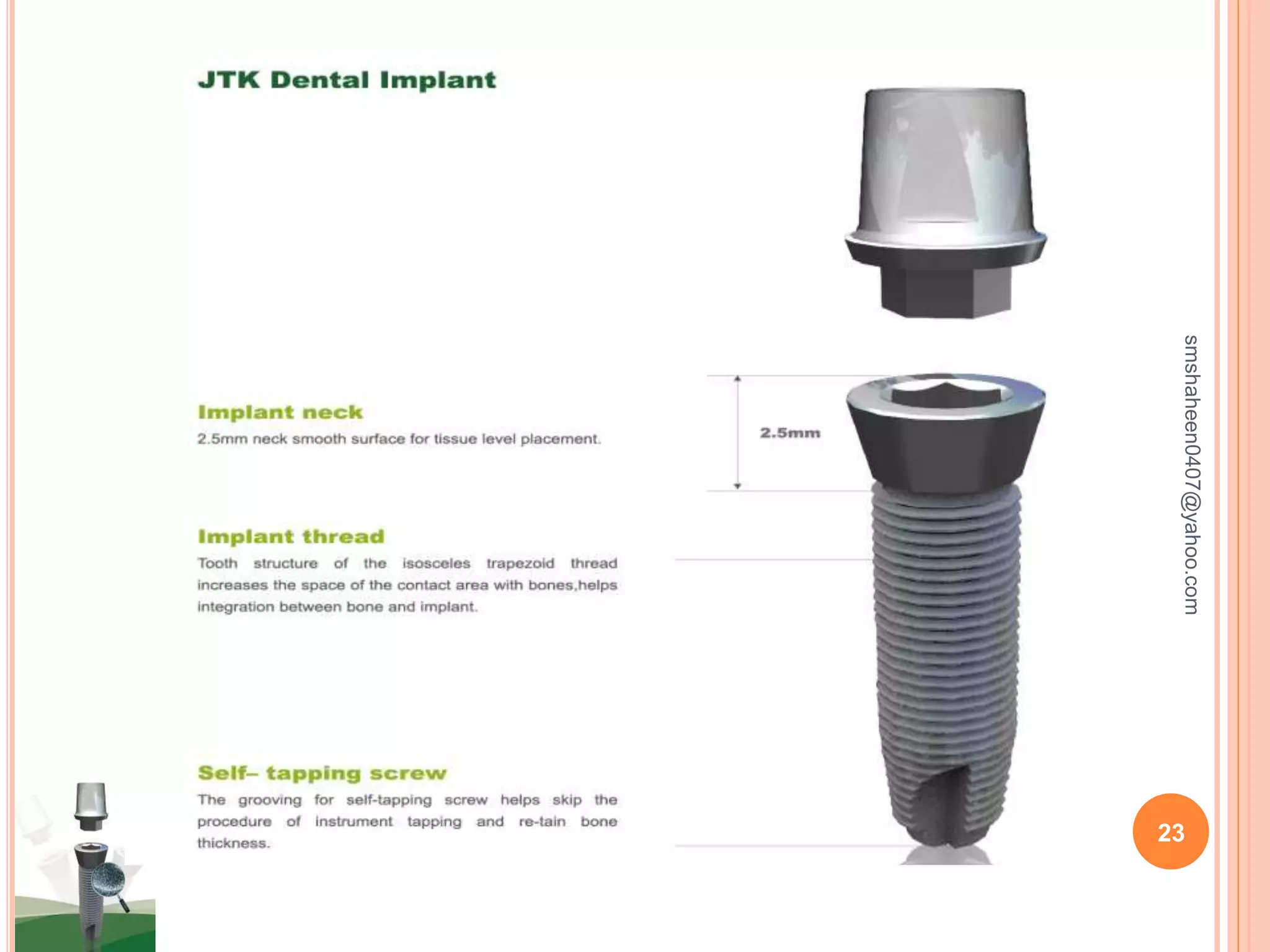
Unalloyed titanium
Biocompatible
Fatigue resistant
Erosion resistant
Stable
Best biomechanic functions
smshaheen0407@yahoo.com
22
smshaheen0407@yahoo.com
23
24
smshaheen0407@yahoo.com
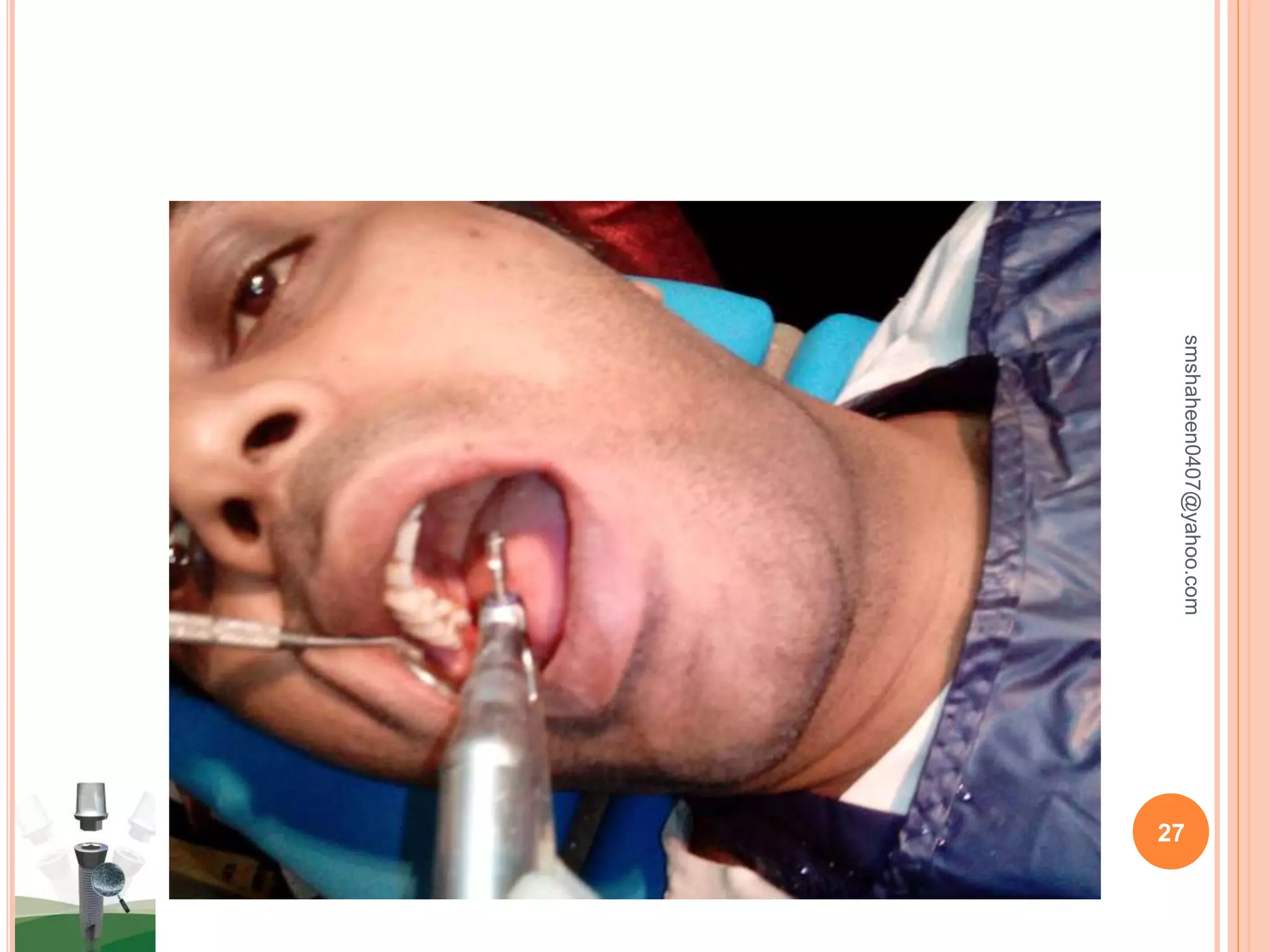
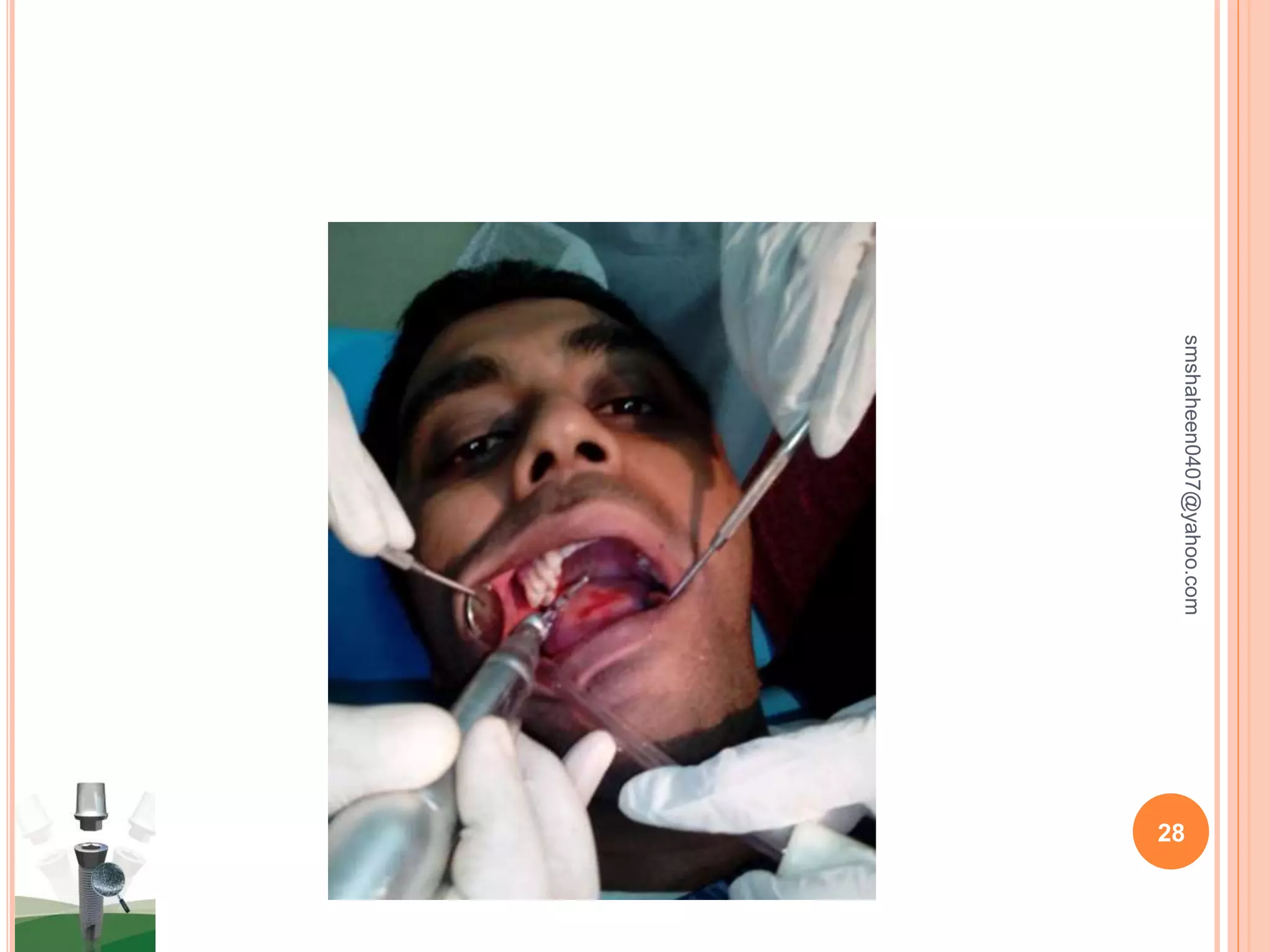
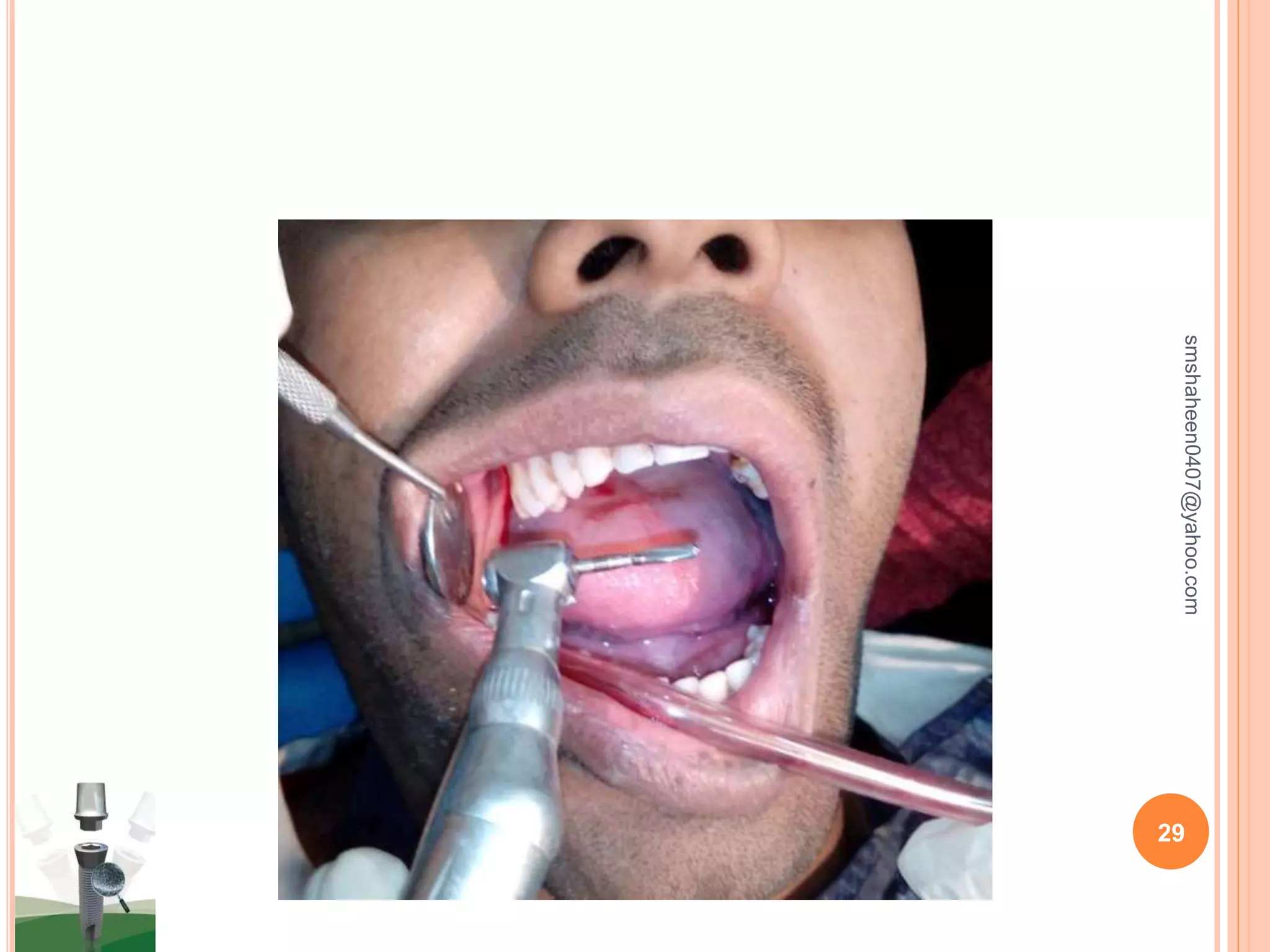
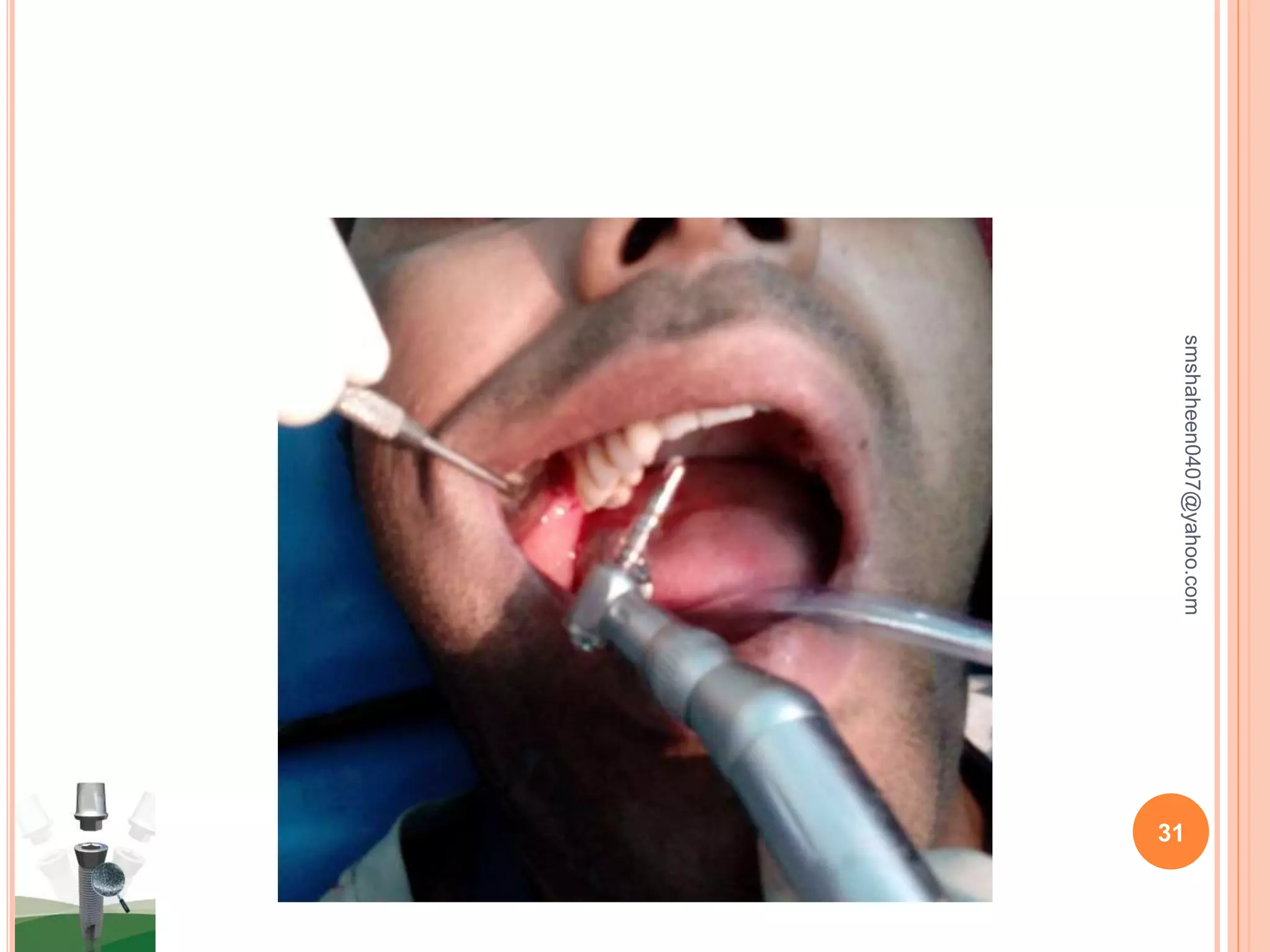
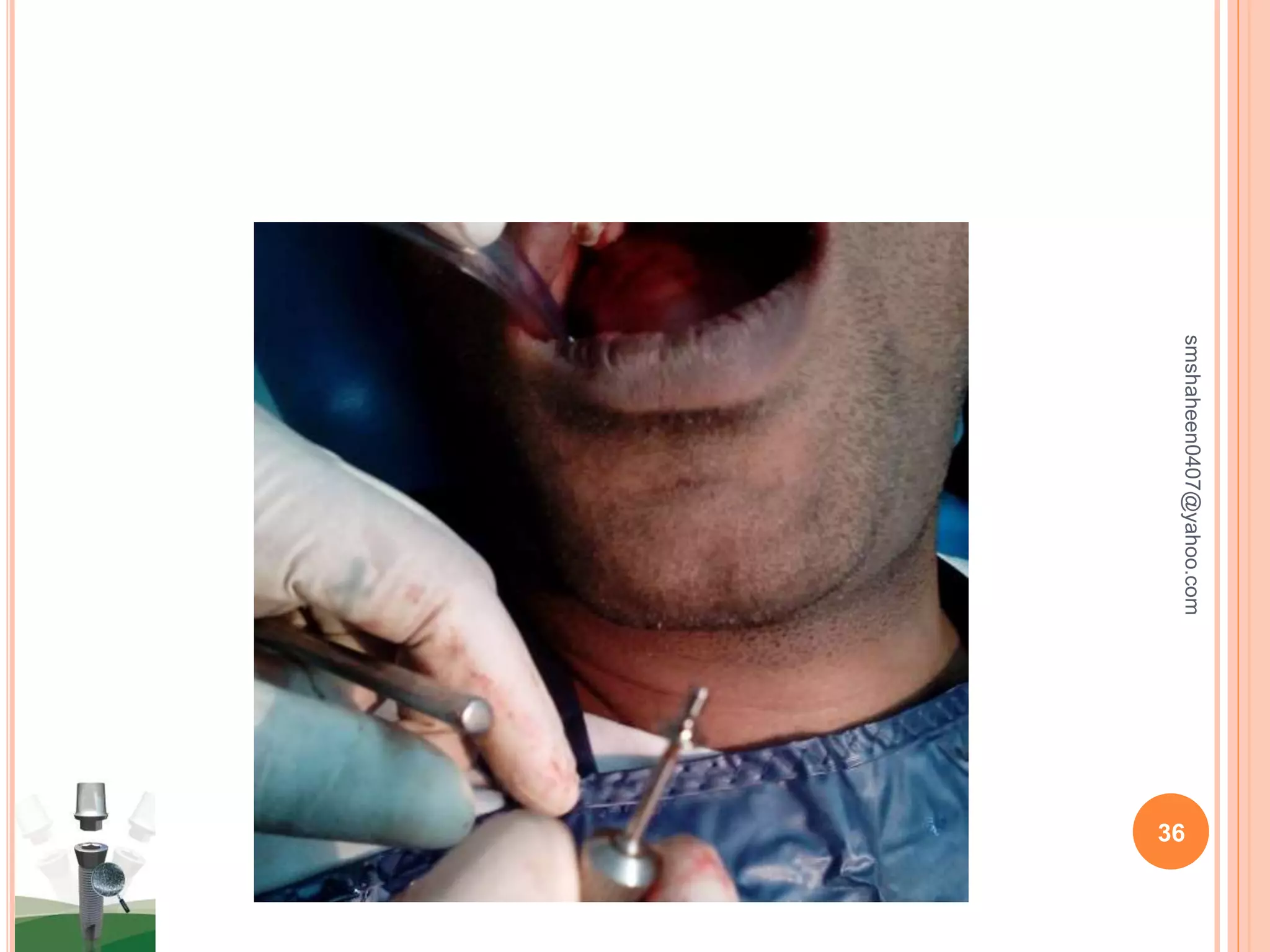
CLINICAL PROCEDURE
 Asepsis
 LA
 Tissue punching & removing
 Locator drill
 Straight drill
 Taper drill
 Implant placement
 Cover screw
 Uncover the implant (after healing)
 Abutment insertion
 Impression
 Prosthesis fabrication insertion 25
smshaheen0407@yahoo.com
26
smshaheen0407@yahoo.com
27
smshaheen0407@yahoo.com
28
smshaheen0407@yahoo.com
29
smshaheen0407@yahoo.com
30
smshaheen0407@yahoo.com
31
smshaheen0407@yahoo.com
32
smshaheen0407@yahoo.com
33
smshaheen0407@yahoo.com
34
smshaheen0407@yahoo.com
35
smshaheen0407@yahoo.com
36
smshaheen0407@yahoo.com
37
smshaheen0407@yahoo.com

Osseointegration