IMPLANT MATERIALS 
DR RITESH SHIWAKOTI
๏‚— IMPLANT โ€“ is defined as insertion of any object 
or a material , which is alloplastic in nature either 
partially or completely into the body for therapeutic , 
experimental , diagnostic or prosthetic purpose .
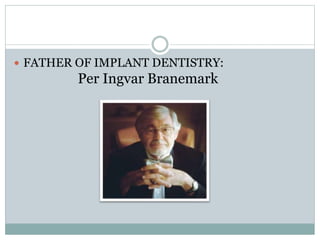
๏‚— FATHER OF IMPLANT DENTISTRY: 
Per Ingvar Branemark
Advantage of Implant 
๏‚— To overcome the drawbacks of removable 
prostheses 
๏‚— Bone maintenance of height and width 
๏‚— Ideally esthetic tooth positioning 
๏‚— Improved psychological health 
๏‚— Increased stability in chewing 
๏‚— Increased retention 
๏‚— Eliminates need to involve adjacent teeth
Materials used in the fabrication of the implant can be 
generally classified into two different ways : 
1. Chemical point โ€“ metals and ceramics 
2. Biological point โ€“ biodynamic materials : 
biotolerant , bioinhert , bioactive.
Materials regardless of use fall into four different 
categories : 
1. Metal and metal alloys : metals that are used in 
implants are titanium , tantalum , and alloys Ti-Al- 
Va , Co-Cr-Mb , Fe-Co-Ni 
2. Ceramics 
3. Synthetic polymers 
4. Natural materials
Bioinhert materials allow close approximation of 
bones in their surface leading to contact 
osteogenesis. 
These materials allow formation of new bone in their 
surface and ion exchange with the tissue leads to the 
formation of chemical bonding along the interface 
bonding osteogenesis.
Biotolerant are those that are not necessarily rejected 
when implanted into the living tissiue. 
They are human bone morphogenetic protein-2( rh 
BMP-2 ) which includes bone formation de nevo. 
Biomemtic are tissue interegated engineered materials 
design to mimic specific biologic processes and help 
optimize the healing/regenerative response of the 
host microenviroment.
Bioinhert and bioactive materials are also called 
osteoconductive meaning that they can act as 
scaffolds allowing bone growth on their surfaces.
Factors affecting implant biomaterials 
1. Mechanical 
2. Chemical 
3. Electrical and 
4. Surface specific properties
Chemical factors: 
Corrosion : loss of metallic ions from the surface of the 
metal to the surrounding enviroment. 
๏‚— General : occurs when the metal is immersed into an 
electrolyte solution. 
๏‚— Pitting : occurs in an implant with a small surface pit 
placed in a solution. 
๏‚— Crevice : occurs in the bone-implant interface or an 
implant device where an overlay or composite type 
surface exist on metallic substrate in a tissue/fluid 
environment with minimal surface , little or no oxygen 
may be present in the crevice.
Surface โ€“ specific factors 
Event at the bone-implant interface: 
The performance of the implant can be classified in 
terms of : 
1. The response of the host to the implant 
2. The behaviour of the material in the host
Material response: The event that occurs 
immediately upon implantation of metals i.e. Results 
in release of proteins to the blood from the wound 
surface and cellular activity in the interfacial region. 
Host response: Involves series of cellular and matrix 
events ideally culminating in tissue healing leading 
to intimate apposition of the bone to the 
biomaterials i.e. Osseo integration.
Electrical factors 
Physiochemical method: 
1. Surface energy 
2. Surface charge 
3. Surface composition are the three factors that aim 
to improve the bone implant interface.
Morphologic method : 
Alteration in biomaterials surface morphology and 
roughness have been used to influence the cells and 
tissue response to the implant. 
Biochemical method: 
The goal is to immobilize protein, enzyme or peptide 
on biomaterials for the purpose of inducing specific 
cell and tissue response.
Mechanical properties 
Properties considered are: 
1. Modulus of elasticity 
2. Tensile strength 
3. Compressive strength 
4. Elongation and 
5. Metallurgy
Classification of implant 
1. Based on implant design 
2. Based on attachment mechanism 
3. Based on macroscopic body design 
4. Based on the surface of the implant 
5. Based on the type of the material
Classification based on implant design: 
1. Endosteal 
1. Ramus frame 
2. Root form 
3. Blade form 
2. Sub-periosteal 
3. Transosteal 
4. Intramucosal
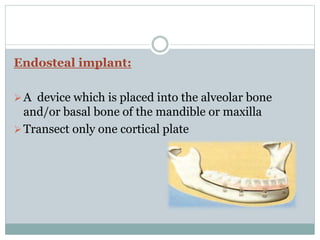
Endosteal implant: 
๏ƒ˜ A device which is placed into the alveolar bone 
and/or basal bone of the mandible or maxilla 
๏ƒ˜Transect only one cortical plate
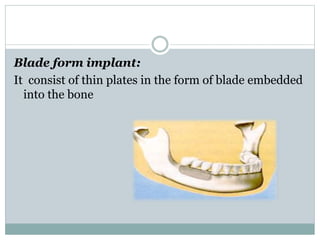
Blade form implant: 
It consist of thin plates in the form of blade embedded 
into the bone
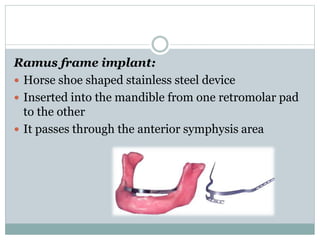
Ramus frame implant: 
๏‚— Horse shoe shaped stainless steel device 
๏‚— Inserted into the mandible from one retromolar pad 
to the other 
๏‚— It passes through the anterior symphysis area
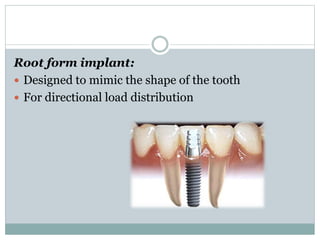
Root form implant: 
๏‚— Designed to mimic the shape of the tooth 
๏‚— For directional load distribution
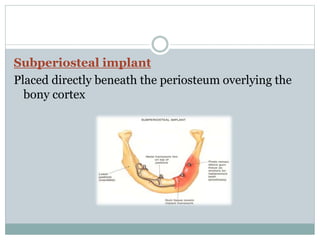
Subperiosteal implant 
Placed directly beneath the periosteum overlying the 
bony cortex
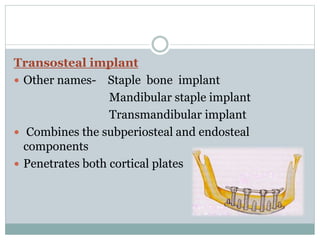
Transosteal implant 
๏‚— Other names- Staple bone implant 
Mandibular staple implant 
Transmandibular implant 
๏‚— Combines the subperiosteal and endosteal 
components 
๏‚— Penetrates both cortical plates
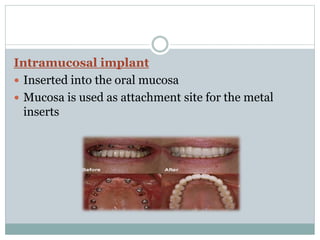
Intramucosal implant 
๏‚— Inserted into the oral mucosa 
๏‚— Mucosa is used as attachment site for the metal 
inserts
Classification based on attachment mechanism 
1. Osseointegration 
2. Fibro-integration
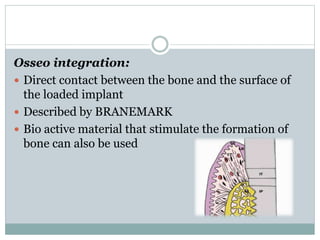
Osseo integration: 
๏‚— Direct contact between the bone and the surface of 
the loaded implant 
๏‚— Described by BRANEMARK 
๏‚— Bio active material that stimulate the formation of 
bone can also be used
๏‚— Biological considerations for 
osseointegration 
๏‚ก Bone implant interface 
๏‚ก Bone remodeling 
๏‚ก Foreign body reaction
๏‚ก Bone to implant interface 
๏‚ก Mechanism of osseointegration 
๏‚ก Ultrastructure in osseointegration 
๏‚ก Destruction of osseointegration 
๏‚ก Soft tissue implant interface 
๏‚ก Peri-implant membrane 
๏‚ก Disease activity in peri-implant tissue 
๏‚ก Neuromuscular system as it relates to the 
implant
๏‚— Osseointegration is defined as a direct bone 
anchorage to an implant body which can 
provide a foundation to support a prosthesis. 
๏‚ก โ€œDirect structural and functional connection between ordered, living bone and 
surface of a load carrying implantโ€.
๏‚— American Academy of Implant Dentistry defined it as โ€œcontact 
established without interposition of non bone tissue between 
normal remodeled bone and on implant entailing a sustained 
transfer and distribution of load from the implant to and within 
bone tissueโ€.
Biological Considerations for 
Osseointegration 
๏‚— Bone implant interface 
๏‚ก When compared to compact bone spongy bone has 
less density and hardness is not a stable base for 
primary fixture fixation. 
๏‚ก In the mandible the spongy bone is more dense than 
maxilla. 
๏‚ก With primary fixation in compact bone, 
osseointegration in the maxilla require a longer 
healing period.
Bone remodelling 
๏‚— Osseointegration requires new bone 
formation around the fixture. A process 
resulting from remodeling within bone 
tissue. 
๏‚— Osteoblastic and osteoclastic activity helps 
maintain blood calcium without change in 
quantity of bone
๏‚— To maintain a constant level of bone 
remodeling there should be proper local 
stimulation, crucial levels of thyroid 
hormone, calcitonin and vitamin D. 
๏‚— Occlusion or occlusal force stimulus are both 
important to optimal bone remodeling
Foreign body reaction 
๏‚— Organization or an antigen antibody reaction 
occurs when a foreign body is present in the 
body. 
๏‚— This reaction occurs in the presence of a protein 
but with implant materials devoid of proteins no 
antigen antibody reaction
๏‚— When titanium is used no foreign body 
reaction are seen. 
๏‚— The implant material is an important factor 
for Osseo integration to occur.
Biological process of implant 
osseointegration 
๏‚— The healing process of implant system is 
similar to primary bone healing. 
๏‚— Titanium dental implants show three stages 
of healing
๏‚— OSTEOPHYLLIC STAGE 
๏‚ก When a implant is placed into the cancellous 
marrow space blood is initially present between 
implant and bone. 
๏‚ก Only a small amount of bone is in contact with 
the implant surface; the rest is exposed to 
extracellular fluids. 
๏‚ก Generalized inflammatory response to the 
surgical insult.
๏‚ก By the end of first week, inflammatory cells are 
responding to foreign antigens. 
๏‚ก Vascular ingrowth from the surrounding vital tissues 
begins by third day. 
๏‚ก A mature vascular network forms by 3 weeks. 
๏‚ก Ossification also begins during the first week and the 
initial response observed in the migration of 
osteoblasts from the trabacular bone which can be 
due to the release of BMPโ€™s. 
๏‚ก The osteophyllic phase lasts about 1 month.
๏‚—OSTEOCONDUCTIVE PHASE 
๏‚กOnce they reach the implant, the bone 
cells spread along the metal surface laying 
down osteoid. 
๏‚กInitially this is an immature connective 
tissue matrix and bone deposited is a thin 
layer of woven bone called foot plate
๏‚ก Fibro-cartilaginous callus is eventually 
remodeled into bone callus. 
๏‚ก This process occurs during the next 3 
months 
๏‚ก Four months after implant placement the 
maximum surface area is covered by 
bone.
๏‚— OSTEOADAPTIVE PHASE 
๏‚ก The final phase begins approximately 4 months 
after implant placement. 
๏‚ก Once loaded implants do not gain or loose bone 
contact but the foot plates thicken in response 
and some reorientation of the vascular pattern 
may be seen
๏‚ก Grafted bone integrates to a higher degree than 
the natural host bone to the implant. 
๏‚ก To achieve optimal results an osseointegration 
period of 4 months is recommended for implants 
in graft bone and 4 to 8 months for implant 
placed in normal bone.
๏‚— Bioactivity 
๏‚ก characteristic of an implant material that allows attachment to 
living tissues, whereas a non bioactive material would form a 
loosely adherent layer of fibrous tissue at the implant 
interface 
๏‚— Bioactive retention is achieved with bioactive 
materials such as hydroxyapatite (HA), which 
bond directly to bone
Factors influencing Osseointegration 
๏‚ก Biomaterial for dental implant 
๏‚ก Surface composition and structure 
๏‚ก Implant design 
๏‚ก Heat 
๏‚ก Contamination 
๏‚ก Primary stability or initial stability 
๏‚ก Bone quality 
๏‚ก Epithelial down growth 
๏‚ก Loading
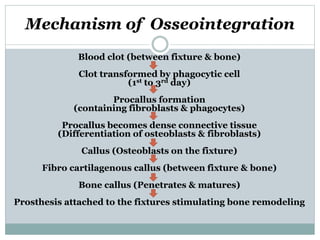
Mechanism of Osseointegration 
Blood clot (between fixture & bone) 
Clot transformed by phagocytic cell 
(1st to 3rd day) 
Procallus formation 
(containing fibroblasts & phagocytes) 
Procallus becomes dense connective tissue 
(Differentiation of osteoblasts & fibroblasts) 
Callus (Osteoblasts on the fixture) 
Fibro cartilagenous callus (between fixture & bone) 
Bone callus (Penetrates & matures) 
Prosthesis attached to the fixtures stimulating bone remodeling
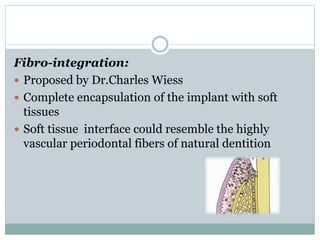
Fibro-integration: 
๏‚— Proposed by Dr.Charles Wiess 
๏‚— Complete encapsulation of the implant with soft 
tissues 
๏‚— Soft tissue interface could resemble the highly 
vascular periodontal fibers of natural dentition
Classification based on implant materials 
1. Metallic implant 
2. Ceramic and ceramic coated 
3. Polymer and 
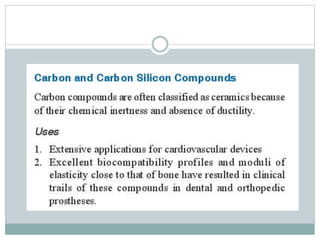
4. Carbon compound
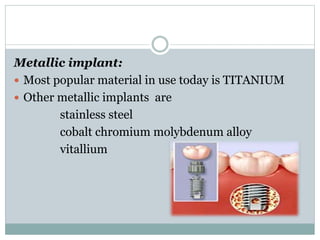
Metallic implant: 
๏‚— Most popular material in use today is TITANIUM 
๏‚— Other metallic implants are 
stainless steel 
cobalt chromium molybdenum alloy 
vitallium
Metals and alloys in implants 
Dental implants are constructed using metals and 
alloys. These include titanium , tantalum , and alloys 
of aluminium , vanadium , cobalt , chromium , 
molybdenum and nickel. 
These materials are generally selected on the basis of 
their strength. 
The precious metals generally used in restoration such 
as gold, platinum and their alloys are less frequently 
used as dental implant.
Titanium 
๏‚— Discovered in 1789 by Wilhelm Gregor. 
๏‚— Represents only 6% of the earth crust. 
๏‚— Industrial use started 60 years ago with use in 
aerospace and defence because of it's light weight, 
high strength and high melting point. 
๏‚— Used as biomaterials in dental implants ,orthopaedic 
and cardiovascular applications. 
๏‚— Excellent biocompatibility, corrosion resistance, and 
desirable physical and mechanical properties.
Dr. Wilhelm Kroll is known as the father of titanium 
dentistry. 
He successfully developed the deoxidation process of 
titanium tetrachloride through a reduction process 
with magnesium and sodium. 
The result was a titanium sponge that could be melted 
in an induction casting furnace into a solid alloy and 
produced in long cast solid bars
General properties of titanium 
๏ƒ˜ Melting point is 1680 degree 
๏ƒ˜ High tensile strength 
๏ƒ˜ Highly ductile 
๏ƒ˜ Highly rigidity due to high modulus of elasticity 
๏ƒ˜Low weight 
๏ƒ˜ High corrosion resistance
American society for testing materials (ASTM) 
classified titanium into grades; which vary according 
to oxygen(0.18-0.40 wt%) iron (0.20-0.50 wt%) and 
other impurities which includes nitrogen , carbon , 
and hydrogen. 
Grade I is the purest and softest form , and have 
moderately high tensile strength. 
As the grade goes up, the stronger the titanium 
becomes 
Grade V contains aluminum and vanadium along with 
titanium, making it stronger than grades I-IV
Advantage 
๏‚— Strong 
๏‚— Lightweight 
๏‚— Corrosion Resistant 
๏‚— Cost-efficient 
๏‚— Non-toxic 
๏‚— Biocompatible (non-toxic AND not rejected by the body) 
๏‚— Long-lasting 
๏‚— Non-ferromagnetic 
๏‚— Osseointegrated (the joining of bone with artificial 
implant) 
๏‚— Long range availability 
๏‚— Flexibility and elasticity rivals that of human bone
Medical grade titanium is used in producing: 
๏‚— Pins 
๏‚— Bone plates 
๏‚— Screws 
๏‚— Bars 
๏‚— Rods 
๏‚— Wires 
๏‚— Posts 
๏‚— Expandable rib cages 
๏‚— Spinal fusion cages 
๏‚— Finger and toe replacements 
๏‚— Maxio-facial prosthetics
It is used to create a number titanium surgical devices: 
๏‚— Surgical forceps 
๏‚— Retractors 
๏‚— Surgical tweezers 
๏‚— Suture instruments 
๏‚— Scissors 
๏‚— Needle and micro needle holders 
๏‚— Dental scalers 
๏‚— Dental elevators 
๏‚— Dental drills 
๏‚— Lasik eye surgery equipment 
๏‚— Laser electrodes 
๏‚— Vena cava clips
๏‚— Dental Titanium 
๏‚— Titanium has the ability to fuse together with living bone. This 
property makes it a huge benefit in the world of dentistry. 
๏‚— Titanium dental implants have become the most widely 
accepted and successfully used type of implant due to its 
propensity to osseointegrate. 
๏‚— When bone forming cells attach themselves to the titanium 
implant, a structural and functional bridge forms between the 
bodyโ€™s bone and the newly implanted, foreign object. 
๏‚— Titanium orthodontic braces are also growing in popularity. 
They are stronger, more secure and lighter than their steel 
counterparts.
Future of Bio-medical Titanium 
๏‚— It is expected that use within the biomedical industry 
will only continue to grow for titanium in the coming 
years. With the baby-boomer demographic 
continuing to age and our health industry pushing 
for people to live more active lives, itโ€™s only logical 
that the medical industry will continue researching 
new and innovative uses for this popular metal alloy. 
And with health care reform a current major issue, 
titaniumโ€™s cost-efficiency adds even more appeal to 
those looking to cut health care costs.
๏‚— Alfa-bio, Bredent, Nobel Biocare are the most widely 
used dental implants.
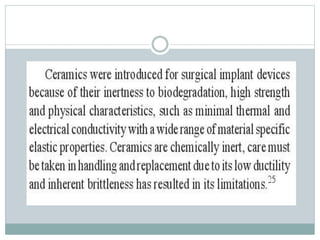
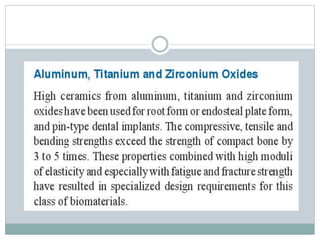
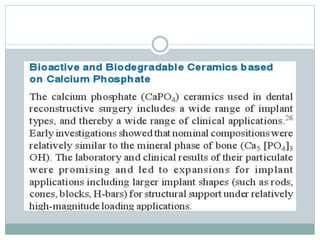
Ceramic 
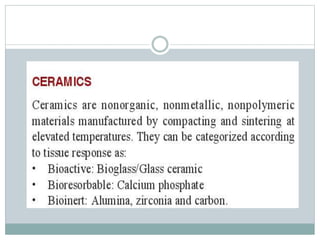
Bioceramics and bioglasses are ceramic materials 
that are biocompatible Bioceramics are an important 
subset of biomaterials. 
Bioceramics range in biocompatibility from the 
ceramicoxides, which are inert in the body, to the 
other extreme of resorbable materials, which are 
eventually replaced by the materials which they were 
used to repair.
๏‚— Bioceramics are used in many types of medical 
procedures. A primary medical procedures where 
they are used is as surgical implants. 
๏‚— Though some bioceramics are flexible. The ceramic 
materials used are not the same as porcelain type 
ceramic materials. 
๏‚— Rather bioceramics are closely related to either the 
body's own materials, or are extremely durable metal 
oxide
Available 
1)Specialty steels 
2) Cobalt base alloys 
3) Titanium and titanium alloys 
4) NiTiNOL 
5) Zirconium alloys
Uses 
๏‚— Ceramics are now commonly used in the medical 
fields as dental, and bone implants. 
๏‚— Artificial teeth, and bones are relatively 
commonplace. 
๏‚— Surgical cermets are used regularly. Joint 
replacements are commonly coated with bioceramic 
materials to reduce wear and inflammatory 
response. 
๏‚— Other examples of medical uses for bioceramics are 
in pacemakers, kidney dialysis machines, and 
respirators.
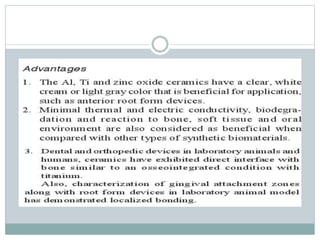
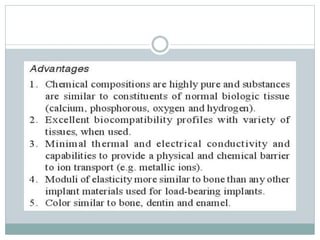
Advantages 
๏‚— Porous, strong and non-brittle composition 
๏‚— Rapid fibrovascularization 
๏‚— No risk of disease-transmission 
๏‚— Lightweight and easy to insert during surgery 
๏‚— Easy to suture to extra ocular muscles 
๏‚— Effortlessly hand-drilled without crumbling 
๏‚— Non-dissolving 
๏‚— Does not release soluble components 
๏‚— Does not cause excessive tissue inflammation
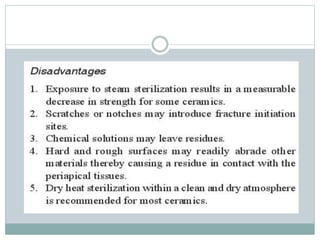
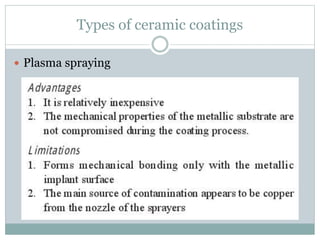
Types of ceramic coatings 
๏‚— Plasma spraying
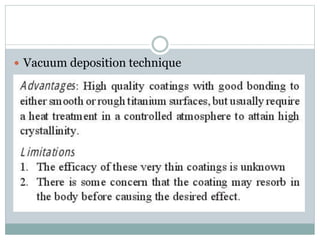
๏‚— Vacuum deposition technique
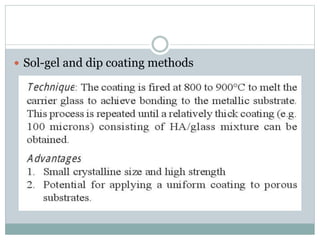
๏‚— Sol-gel and dip coating methods
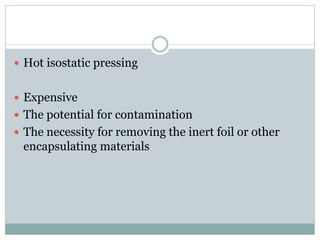
๏‚— Hot isostatic pressing 
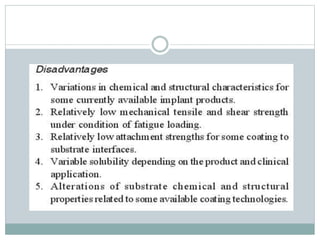
๏‚— Expensive 
๏‚— The potential for contamination 
๏‚— The necessity for removing the inert foil or other 
encapsulating materials
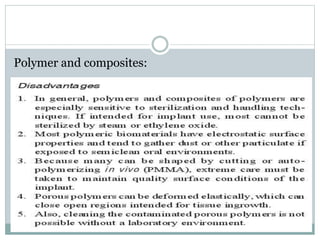
Polymer and composites:
Implant materials
Implant materials
Implant materials

Implant materials

  • 1.
    IMPLANT MATERIALS DRRITESH SHIWAKOTI
  • 2.
    ๏‚— IMPLANT โ€“is defined as insertion of any object or a material , which is alloplastic in nature either partially or completely into the body for therapeutic , experimental , diagnostic or prosthetic purpose .
  • 3.
    ๏‚— FATHER OFIMPLANT DENTISTRY: Per Ingvar Branemark
  • 4.
    Advantage of Implant ๏‚— To overcome the drawbacks of removable prostheses ๏‚— Bone maintenance of height and width ๏‚— Ideally esthetic tooth positioning ๏‚— Improved psychological health ๏‚— Increased stability in chewing ๏‚— Increased retention ๏‚— Eliminates need to involve adjacent teeth
  • 5.
    Materials used inthe fabrication of the implant can be generally classified into two different ways : 1. Chemical point โ€“ metals and ceramics 2. Biological point โ€“ biodynamic materials : biotolerant , bioinhert , bioactive.
  • 6.
    Materials regardless ofuse fall into four different categories : 1. Metal and metal alloys : metals that are used in implants are titanium , tantalum , and alloys Ti-Al- Va , Co-Cr-Mb , Fe-Co-Ni 2. Ceramics 3. Synthetic polymers 4. Natural materials
  • 7.
    Bioinhert materials allowclose approximation of bones in their surface leading to contact osteogenesis. These materials allow formation of new bone in their surface and ion exchange with the tissue leads to the formation of chemical bonding along the interface bonding osteogenesis.
  • 8.
    Biotolerant are thosethat are not necessarily rejected when implanted into the living tissiue. They are human bone morphogenetic protein-2( rh BMP-2 ) which includes bone formation de nevo. Biomemtic are tissue interegated engineered materials design to mimic specific biologic processes and help optimize the healing/regenerative response of the host microenviroment.
  • 9.
    Bioinhert and bioactivematerials are also called osteoconductive meaning that they can act as scaffolds allowing bone growth on their surfaces.
  • 10.
    Factors affecting implantbiomaterials 1. Mechanical 2. Chemical 3. Electrical and 4. Surface specific properties
  • 11.
    Chemical factors: Corrosion: loss of metallic ions from the surface of the metal to the surrounding enviroment. ๏‚— General : occurs when the metal is immersed into an electrolyte solution. ๏‚— Pitting : occurs in an implant with a small surface pit placed in a solution. ๏‚— Crevice : occurs in the bone-implant interface or an implant device where an overlay or composite type surface exist on metallic substrate in a tissue/fluid environment with minimal surface , little or no oxygen may be present in the crevice.
  • 12.
    Surface โ€“ specificfactors Event at the bone-implant interface: The performance of the implant can be classified in terms of : 1. The response of the host to the implant 2. The behaviour of the material in the host
  • 13.
    Material response: Theevent that occurs immediately upon implantation of metals i.e. Results in release of proteins to the blood from the wound surface and cellular activity in the interfacial region. Host response: Involves series of cellular and matrix events ideally culminating in tissue healing leading to intimate apposition of the bone to the biomaterials i.e. Osseo integration.
  • 14.
    Electrical factors Physiochemicalmethod: 1. Surface energy 2. Surface charge 3. Surface composition are the three factors that aim to improve the bone implant interface.
  • 15.
    Morphologic method : Alteration in biomaterials surface morphology and roughness have been used to influence the cells and tissue response to the implant. Biochemical method: The goal is to immobilize protein, enzyme or peptide on biomaterials for the purpose of inducing specific cell and tissue response.
  • 16.
    Mechanical properties Propertiesconsidered are: 1. Modulus of elasticity 2. Tensile strength 3. Compressive strength 4. Elongation and 5. Metallurgy
  • 17.
    Classification of implant 1. Based on implant design 2. Based on attachment mechanism 3. Based on macroscopic body design 4. Based on the surface of the implant 5. Based on the type of the material
  • 18.
    Classification based onimplant design: 1. Endosteal 1. Ramus frame 2. Root form 3. Blade form 2. Sub-periosteal 3. Transosteal 4. Intramucosal
  • 19.
    Endosteal implant: ๏ƒ˜A device which is placed into the alveolar bone and/or basal bone of the mandible or maxilla ๏ƒ˜Transect only one cortical plate
  • 20.
    Blade form implant: It consist of thin plates in the form of blade embedded into the bone
  • 21.
    Ramus frame implant: ๏‚— Horse shoe shaped stainless steel device ๏‚— Inserted into the mandible from one retromolar pad to the other ๏‚— It passes through the anterior symphysis area
  • 22.
    Root form implant: ๏‚— Designed to mimic the shape of the tooth ๏‚— For directional load distribution
  • 23.
    Subperiosteal implant Placeddirectly beneath the periosteum overlying the bony cortex
  • 24.
    Transosteal implant ๏‚—Other names- Staple bone implant Mandibular staple implant Transmandibular implant ๏‚— Combines the subperiosteal and endosteal components ๏‚— Penetrates both cortical plates
  • 25.
    Intramucosal implant ๏‚—Inserted into the oral mucosa ๏‚— Mucosa is used as attachment site for the metal inserts
  • 26.
    Classification based onattachment mechanism 1. Osseointegration 2. Fibro-integration
  • 27.
    Osseo integration: ๏‚—Direct contact between the bone and the surface of the loaded implant ๏‚— Described by BRANEMARK ๏‚— Bio active material that stimulate the formation of bone can also be used
  • 28.
    ๏‚— Biological considerationsfor osseointegration ๏‚ก Bone implant interface ๏‚ก Bone remodeling ๏‚ก Foreign body reaction
  • 29.
    ๏‚ก Bone toimplant interface ๏‚ก Mechanism of osseointegration ๏‚ก Ultrastructure in osseointegration ๏‚ก Destruction of osseointegration ๏‚ก Soft tissue implant interface ๏‚ก Peri-implant membrane ๏‚ก Disease activity in peri-implant tissue ๏‚ก Neuromuscular system as it relates to the implant
  • 30.
    ๏‚— Osseointegration isdefined as a direct bone anchorage to an implant body which can provide a foundation to support a prosthesis. ๏‚ก โ€œDirect structural and functional connection between ordered, living bone and surface of a load carrying implantโ€.
  • 31.
    ๏‚— American Academyof Implant Dentistry defined it as โ€œcontact established without interposition of non bone tissue between normal remodeled bone and on implant entailing a sustained transfer and distribution of load from the implant to and within bone tissueโ€.
  • 32.
    Biological Considerations for Osseointegration ๏‚— Bone implant interface ๏‚ก When compared to compact bone spongy bone has less density and hardness is not a stable base for primary fixture fixation. ๏‚ก In the mandible the spongy bone is more dense than maxilla. ๏‚ก With primary fixation in compact bone, osseointegration in the maxilla require a longer healing period.
  • 33.
    Bone remodelling ๏‚—Osseointegration requires new bone formation around the fixture. A process resulting from remodeling within bone tissue. ๏‚— Osteoblastic and osteoclastic activity helps maintain blood calcium without change in quantity of bone
  • 34.
    ๏‚— To maintaina constant level of bone remodeling there should be proper local stimulation, crucial levels of thyroid hormone, calcitonin and vitamin D. ๏‚— Occlusion or occlusal force stimulus are both important to optimal bone remodeling
  • 35.
    Foreign body reaction ๏‚— Organization or an antigen antibody reaction occurs when a foreign body is present in the body. ๏‚— This reaction occurs in the presence of a protein but with implant materials devoid of proteins no antigen antibody reaction
  • 36.
    ๏‚— When titaniumis used no foreign body reaction are seen. ๏‚— The implant material is an important factor for Osseo integration to occur.
  • 37.
    Biological process ofimplant osseointegration ๏‚— The healing process of implant system is similar to primary bone healing. ๏‚— Titanium dental implants show three stages of healing
  • 38.
    ๏‚— OSTEOPHYLLIC STAGE ๏‚ก When a implant is placed into the cancellous marrow space blood is initially present between implant and bone. ๏‚ก Only a small amount of bone is in contact with the implant surface; the rest is exposed to extracellular fluids. ๏‚ก Generalized inflammatory response to the surgical insult.
  • 39.
    ๏‚ก By theend of first week, inflammatory cells are responding to foreign antigens. ๏‚ก Vascular ingrowth from the surrounding vital tissues begins by third day. ๏‚ก A mature vascular network forms by 3 weeks. ๏‚ก Ossification also begins during the first week and the initial response observed in the migration of osteoblasts from the trabacular bone which can be due to the release of BMPโ€™s. ๏‚ก The osteophyllic phase lasts about 1 month.
  • 40.
    ๏‚—OSTEOCONDUCTIVE PHASE ๏‚กOncethey reach the implant, the bone cells spread along the metal surface laying down osteoid. ๏‚กInitially this is an immature connective tissue matrix and bone deposited is a thin layer of woven bone called foot plate
  • 41.
    ๏‚ก Fibro-cartilaginous callusis eventually remodeled into bone callus. ๏‚ก This process occurs during the next 3 months ๏‚ก Four months after implant placement the maximum surface area is covered by bone.
  • 42.
    ๏‚— OSTEOADAPTIVE PHASE ๏‚ก The final phase begins approximately 4 months after implant placement. ๏‚ก Once loaded implants do not gain or loose bone contact but the foot plates thicken in response and some reorientation of the vascular pattern may be seen
  • 43.
    ๏‚ก Grafted boneintegrates to a higher degree than the natural host bone to the implant. ๏‚ก To achieve optimal results an osseointegration period of 4 months is recommended for implants in graft bone and 4 to 8 months for implant placed in normal bone.
  • 44.
    ๏‚— Bioactivity ๏‚กcharacteristic of an implant material that allows attachment to living tissues, whereas a non bioactive material would form a loosely adherent layer of fibrous tissue at the implant interface ๏‚— Bioactive retention is achieved with bioactive materials such as hydroxyapatite (HA), which bond directly to bone
  • 45.
    Factors influencing Osseointegration ๏‚ก Biomaterial for dental implant ๏‚ก Surface composition and structure ๏‚ก Implant design ๏‚ก Heat ๏‚ก Contamination ๏‚ก Primary stability or initial stability ๏‚ก Bone quality ๏‚ก Epithelial down growth ๏‚ก Loading
  • 46.
    Mechanism of Osseointegration Blood clot (between fixture & bone) Clot transformed by phagocytic cell (1st to 3rd day) Procallus formation (containing fibroblasts & phagocytes) Procallus becomes dense connective tissue (Differentiation of osteoblasts & fibroblasts) Callus (Osteoblasts on the fixture) Fibro cartilagenous callus (between fixture & bone) Bone callus (Penetrates & matures) Prosthesis attached to the fixtures stimulating bone remodeling
  • 47.
    Fibro-integration: ๏‚— Proposedby Dr.Charles Wiess ๏‚— Complete encapsulation of the implant with soft tissues ๏‚— Soft tissue interface could resemble the highly vascular periodontal fibers of natural dentition
  • 48.
    Classification based onimplant materials 1. Metallic implant 2. Ceramic and ceramic coated 3. Polymer and 4. Carbon compound
  • 49.
    Metallic implant: ๏‚—Most popular material in use today is TITANIUM ๏‚— Other metallic implants are stainless steel cobalt chromium molybdenum alloy vitallium
  • 50.
    Metals and alloysin implants Dental implants are constructed using metals and alloys. These include titanium , tantalum , and alloys of aluminium , vanadium , cobalt , chromium , molybdenum and nickel. These materials are generally selected on the basis of their strength. The precious metals generally used in restoration such as gold, platinum and their alloys are less frequently used as dental implant.
  • 51.
    Titanium ๏‚— Discoveredin 1789 by Wilhelm Gregor. ๏‚— Represents only 6% of the earth crust. ๏‚— Industrial use started 60 years ago with use in aerospace and defence because of it's light weight, high strength and high melting point. ๏‚— Used as biomaterials in dental implants ,orthopaedic and cardiovascular applications. ๏‚— Excellent biocompatibility, corrosion resistance, and desirable physical and mechanical properties.
  • 52.
    Dr. Wilhelm Krollis known as the father of titanium dentistry. He successfully developed the deoxidation process of titanium tetrachloride through a reduction process with magnesium and sodium. The result was a titanium sponge that could be melted in an induction casting furnace into a solid alloy and produced in long cast solid bars
  • 53.
    General properties oftitanium ๏ƒ˜ Melting point is 1680 degree ๏ƒ˜ High tensile strength ๏ƒ˜ Highly ductile ๏ƒ˜ Highly rigidity due to high modulus of elasticity ๏ƒ˜Low weight ๏ƒ˜ High corrosion resistance
  • 54.
    American society fortesting materials (ASTM) classified titanium into grades; which vary according to oxygen(0.18-0.40 wt%) iron (0.20-0.50 wt%) and other impurities which includes nitrogen , carbon , and hydrogen. Grade I is the purest and softest form , and have moderately high tensile strength. As the grade goes up, the stronger the titanium becomes Grade V contains aluminum and vanadium along with titanium, making it stronger than grades I-IV
  • 55.
    Advantage ๏‚— Strong ๏‚— Lightweight ๏‚— Corrosion Resistant ๏‚— Cost-efficient ๏‚— Non-toxic ๏‚— Biocompatible (non-toxic AND not rejected by the body) ๏‚— Long-lasting ๏‚— Non-ferromagnetic ๏‚— Osseointegrated (the joining of bone with artificial implant) ๏‚— Long range availability ๏‚— Flexibility and elasticity rivals that of human bone
  • 56.
    Medical grade titaniumis used in producing: ๏‚— Pins ๏‚— Bone plates ๏‚— Screws ๏‚— Bars ๏‚— Rods ๏‚— Wires ๏‚— Posts ๏‚— Expandable rib cages ๏‚— Spinal fusion cages ๏‚— Finger and toe replacements ๏‚— Maxio-facial prosthetics
  • 57.
    It is usedto create a number titanium surgical devices: ๏‚— Surgical forceps ๏‚— Retractors ๏‚— Surgical tweezers ๏‚— Suture instruments ๏‚— Scissors ๏‚— Needle and micro needle holders ๏‚— Dental scalers ๏‚— Dental elevators ๏‚— Dental drills ๏‚— Lasik eye surgery equipment ๏‚— Laser electrodes ๏‚— Vena cava clips
  • 58.
    ๏‚— Dental Titanium ๏‚— Titanium has the ability to fuse together with living bone. This property makes it a huge benefit in the world of dentistry. ๏‚— Titanium dental implants have become the most widely accepted and successfully used type of implant due to its propensity to osseointegrate. ๏‚— When bone forming cells attach themselves to the titanium implant, a structural and functional bridge forms between the bodyโ€™s bone and the newly implanted, foreign object. ๏‚— Titanium orthodontic braces are also growing in popularity. They are stronger, more secure and lighter than their steel counterparts.
  • 59.
    Future of Bio-medicalTitanium ๏‚— It is expected that use within the biomedical industry will only continue to grow for titanium in the coming years. With the baby-boomer demographic continuing to age and our health industry pushing for people to live more active lives, itโ€™s only logical that the medical industry will continue researching new and innovative uses for this popular metal alloy. And with health care reform a current major issue, titaniumโ€™s cost-efficiency adds even more appeal to those looking to cut health care costs.
  • 60.
    ๏‚— Alfa-bio, Bredent,Nobel Biocare are the most widely used dental implants.
  • 61.
    Ceramic Bioceramics andbioglasses are ceramic materials that are biocompatible Bioceramics are an important subset of biomaterials. Bioceramics range in biocompatibility from the ceramicoxides, which are inert in the body, to the other extreme of resorbable materials, which are eventually replaced by the materials which they were used to repair.
  • 62.
    ๏‚— Bioceramics areused in many types of medical procedures. A primary medical procedures where they are used is as surgical implants. ๏‚— Though some bioceramics are flexible. The ceramic materials used are not the same as porcelain type ceramic materials. ๏‚— Rather bioceramics are closely related to either the body's own materials, or are extremely durable metal oxide
  • 63.
    Available 1)Specialty steels 2) Cobalt base alloys 3) Titanium and titanium alloys 4) NiTiNOL 5) Zirconium alloys
  • 64.
    Uses ๏‚— Ceramicsare now commonly used in the medical fields as dental, and bone implants. ๏‚— Artificial teeth, and bones are relatively commonplace. ๏‚— Surgical cermets are used regularly. Joint replacements are commonly coated with bioceramic materials to reduce wear and inflammatory response. ๏‚— Other examples of medical uses for bioceramics are in pacemakers, kidney dialysis machines, and respirators.
  • 65.
    Advantages ๏‚— Porous,strong and non-brittle composition ๏‚— Rapid fibrovascularization ๏‚— No risk of disease-transmission ๏‚— Lightweight and easy to insert during surgery ๏‚— Easy to suture to extra ocular muscles ๏‚— Effortlessly hand-drilled without crumbling ๏‚— Non-dissolving ๏‚— Does not release soluble components ๏‚— Does not cause excessive tissue inflammation
  • 74.
    Types of ceramiccoatings ๏‚— Plasma spraying
  • 75.
  • 76.
    ๏‚— Sol-gel anddip coating methods
  • 77.
    ๏‚— Hot isostaticpressing ๏‚— Expensive ๏‚— The potential for contamination ๏‚— The necessity for removing the inert foil or other encapsulating materials
  • 84.