Chapter-5
Applications of Electromagnetic Waves
Microwave Oven
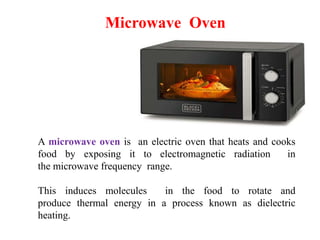
A microwave oven is an electric oven that heats and cooks
food by exposing it to electromagnetic radiation in
the microwave frequency range.
This induces molecules in the food to rotate and
produce thermal energy in a process known as dielectric
heating.
Principle of Microwave Oven
A microwave oven heats food by passing microwave radiation
through it. Microwaves are a form of nonionizing
electromagnetic radiation with a frequency in the so-
called microwave range(300 MHz to 300 GHz).
Water, fat, and other substances in the food absorb energy
from the microwaves in a process called dielectric heating.
Many molecules (such as those of water) are electric dipoles,
meaning that they have a partial positive charge at one end
and a partial negative charge at the other, and therefore rotate
as they try to align themselves with the alternating electric
field of the microwaves.
Molecules rotations, vibrations and/or translation hit other
molecules and put them into motion, thus dispersing energy.
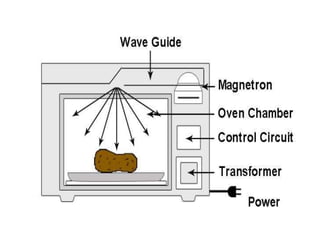
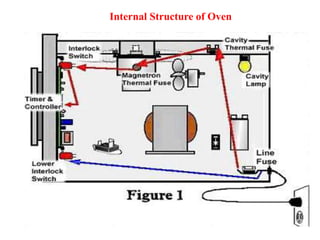
Internal Structure of Oven
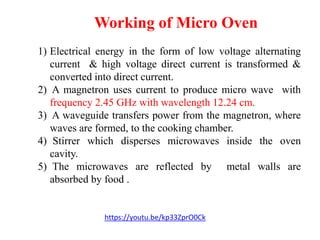
Working of Micro Oven
https://youtu.be/kp33ZprO0Ck
1) Electrical energy in the form of low voltage alternating
current & high voltage direct current is transformed &
converted into direct current.
2) A magnetron uses current to produce micro wave with
frequency 2.45 GHz with wavelength 12.24 cm.
3) A waveguide transfers power from the magnetron, where
waves are formed, to the cooking chamber.
4) Stirrer which disperses microwaves inside the oven
cavity.
5) The microwaves are reflected by metal walls are
absorbed by food .
Effects On Food and Nutrients
Does not reduce the nutritional value of foods any more than
conventional cooking.
 In fact, foods cooked in a microwave oven may keep more of
their vitamins and minerals, because microwave ovens can cook
more quickly and without adding water.
Glass, paper, ceramic, or plastic containers are used in
microwave cooking because microwaves pass through these
materials.
Metal pans or aluminum foil should also not be used in a
microwave oven, as the microwaves are reflected off these
materials causing the food to cook unevenly and possibly
damaging the oven.
Materials Used for for Cooking
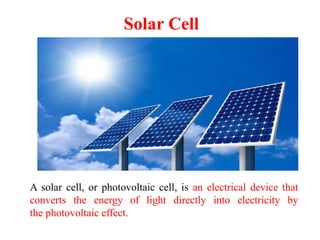
Solar Cell
A solar cell, or photovoltaic cell, is an electrical device that
converts the energy of light directly into electricity by
the photovoltaic effect.
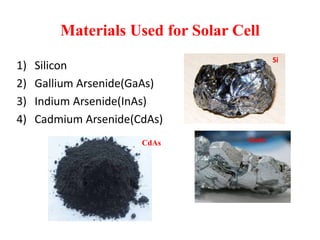
Materials Used for Solar Cell
1) Silicon
2) Gallium Arsenide(GaAs)
3) Indium Arsenide(InAs)
4) Cadmium Arsenide(CdAs)
Si
GaAs
CdAs
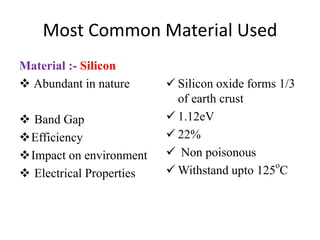
Most Common Material Used
Material :- Silicon
 Abundant in nature
 Band Gap
Efficiency
Impact on environment
 Electrical Properties
 Silicon oxide forms 1/3
of earth crust
 1.12eV
 22%
 Non poisonous
 Withstand upto 125
o
C
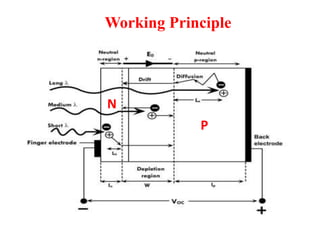
Working Principle
P
N
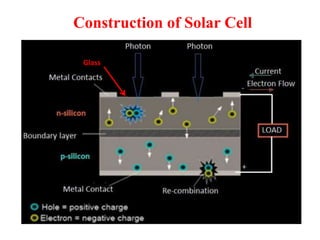
Construction of Solar Cell
Glass
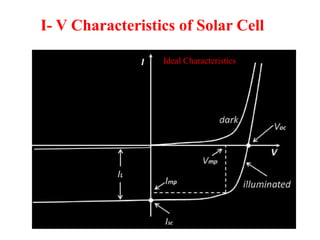
I- V Characteristics of Solar Cell
Ideal Characteristics
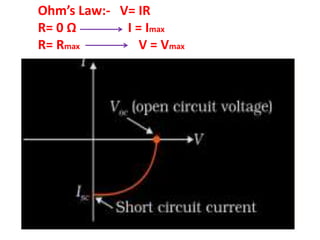
Ohm’s Law:- V= IR
R= 0 Ω I = Imax
R= Rmax V = Vmax
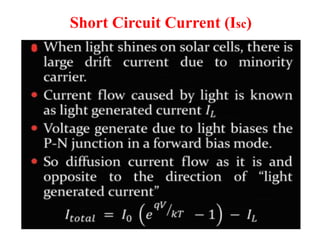
Short Circuit Current (Isc)
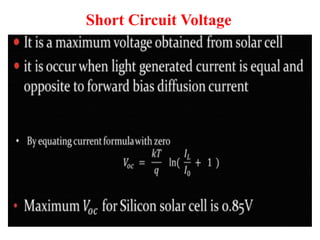
Short Circuit Voltage
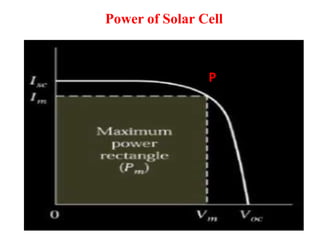
P
Power of Solar Cell
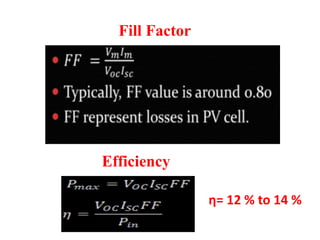
Fill Factor
Efficiency
η= 12 % to 14 %
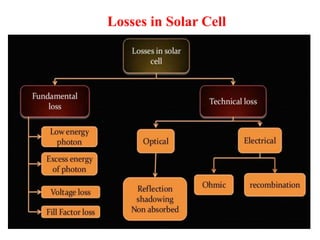
Losses in Solar Cell
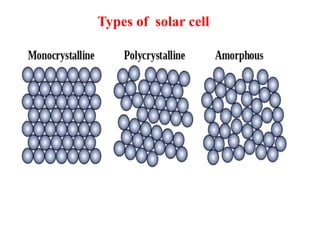
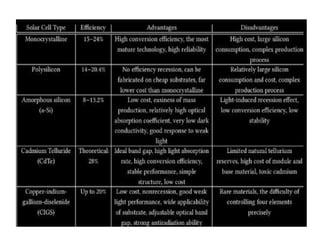
Types of solar cell
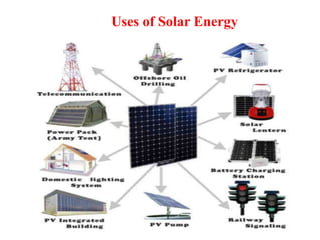
Uses of Solar Energy
X- Ray Radiography
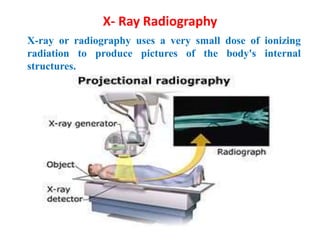
X-ray or radiography uses a very small dose of ionizing
radiation to produce pictures of the body's internal
structures.
During a radiographic procedure, an x-ray beam is passed
through the body.
A portion of the x-rays are absorbed or scattered by the
internal structure and the remaining x-ray pattern is
transmitted to a detector so that an image may be recorded for
later evaluation.
The recoding of the pattern may occur on film or through
electronic means.
It is used to diagnose or treat patients by recording images of
the internal structure of the body to assess the presence or
absence of disease, foreign objects, and structural damage or
anomaly.
 Dental examination
Mammography
Orthopedic evaluations
 To get idea about the structure of matter
Bone fractures
Uses Of X - Ray
Infections (such as pneumonia)
Calcifications ( kidney stones or vascular calcifications)
Some tumors
Arthritis in joints
Bone loss (such as osteoporosis)
Dental issues
Heart problems
Blood vessel blockages
Digestive problems
Applications of electromagnetic waves

Applications of electromagnetic waves

  • 1.
  • 2.
    Microwave Oven A microwaveoven is an electric oven that heats and cooks food by exposing it to electromagnetic radiation in the microwave frequency range. This induces molecules in the food to rotate and produce thermal energy in a process known as dielectric heating.
  • 3.
    Principle of MicrowaveOven A microwave oven heats food by passing microwave radiation through it. Microwaves are a form of nonionizing electromagnetic radiation with a frequency in the so- called microwave range(300 MHz to 300 GHz). Water, fat, and other substances in the food absorb energy from the microwaves in a process called dielectric heating. Many molecules (such as those of water) are electric dipoles, meaning that they have a partial positive charge at one end and a partial negative charge at the other, and therefore rotate as they try to align themselves with the alternating electric field of the microwaves. Molecules rotations, vibrations and/or translation hit other molecules and put them into motion, thus dispersing energy.
  • 5.
  • 6.
    Working of MicroOven https://youtu.be/kp33ZprO0Ck 1) Electrical energy in the form of low voltage alternating current & high voltage direct current is transformed & converted into direct current. 2) A magnetron uses current to produce micro wave with frequency 2.45 GHz with wavelength 12.24 cm. 3) A waveguide transfers power from the magnetron, where waves are formed, to the cooking chamber. 4) Stirrer which disperses microwaves inside the oven cavity. 5) The microwaves are reflected by metal walls are absorbed by food .
  • 7.
    Effects On Foodand Nutrients Does not reduce the nutritional value of foods any more than conventional cooking.  In fact, foods cooked in a microwave oven may keep more of their vitamins and minerals, because microwave ovens can cook more quickly and without adding water. Glass, paper, ceramic, or plastic containers are used in microwave cooking because microwaves pass through these materials. Metal pans or aluminum foil should also not be used in a microwave oven, as the microwaves are reflected off these materials causing the food to cook unevenly and possibly damaging the oven. Materials Used for for Cooking
  • 8.
    Solar Cell A solarcell, or photovoltaic cell, is an electrical device that converts the energy of light directly into electricity by the photovoltaic effect.
  • 9.
    Materials Used forSolar Cell 1) Silicon 2) Gallium Arsenide(GaAs) 3) Indium Arsenide(InAs) 4) Cadmium Arsenide(CdAs) Si GaAs CdAs
  • 10.
    Most Common MaterialUsed Material :- Silicon  Abundant in nature  Band Gap Efficiency Impact on environment  Electrical Properties  Silicon oxide forms 1/3 of earth crust  1.12eV  22%  Non poisonous  Withstand upto 125 o C
  • 11.
  • 12.
  • 13.
    I- V Characteristicsof Solar Cell Ideal Characteristics
  • 14.
    Ohm’s Law:- V=IR R= 0 Ω I = Imax R= Rmax V = Vmax
  • 15.
  • 16.
  • 17.
  • 18.
  • 19.
  • 20.
  • 22.
  • 23.
    X- Ray Radiography X-rayor radiography uses a very small dose of ionizing radiation to produce pictures of the body's internal structures.
  • 24.
    During a radiographicprocedure, an x-ray beam is passed through the body. A portion of the x-rays are absorbed or scattered by the internal structure and the remaining x-ray pattern is transmitted to a detector so that an image may be recorded for later evaluation. The recoding of the pattern may occur on film or through electronic means.
  • 25.
    It is usedto diagnose or treat patients by recording images of the internal structure of the body to assess the presence or absence of disease, foreign objects, and structural damage or anomaly.  Dental examination Mammography Orthopedic evaluations  To get idea about the structure of matter Bone fractures Uses Of X - Ray
  • 26.
    Infections (such aspneumonia) Calcifications ( kidney stones or vascular calcifications) Some tumors Arthritis in joints Bone loss (such as osteoporosis) Dental issues Heart problems Blood vessel blockages Digestive problems