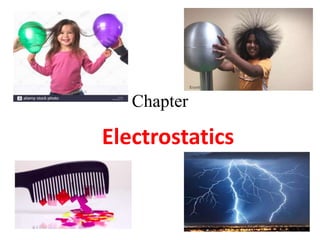
Chapter
Electrostatics
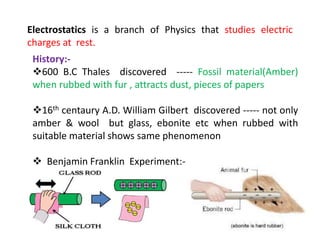
Electrostatics is a branch of Physics that studies electric
charges at rest.
History:-
600 B.C Thales discovered ----- Fossil material(Amber)
when rubbed with fur , attracts dust, pieces of papers
16th centaury A.D. William Gilbert discovered ----- not only
amber & wool but glass, ebonite etc when rubbed with
suitable material shows same phenomenon
 Benjamin Franklin Experiment:-
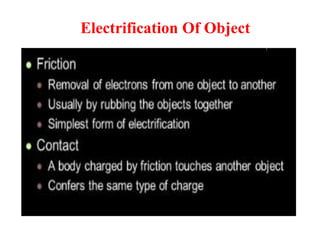
Electrification Of Object
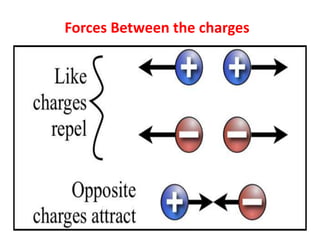
Forces Between the charges
Coulomb’s Law
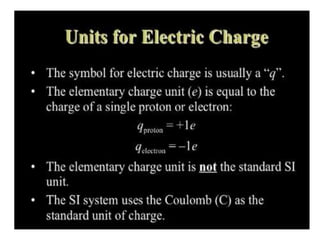
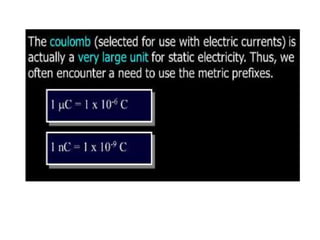
1 Coulomb
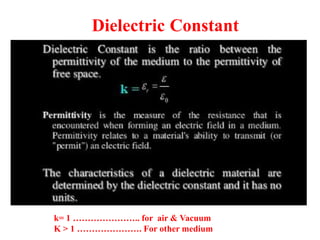
Dielectric Constant
k= 1 ………………….. for air & Vacuum
K > 1 …………………. For other medium
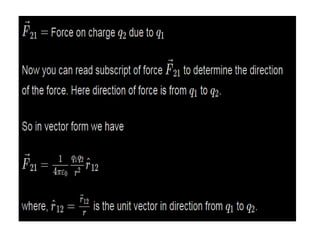
Coulomb’s Law in Vector Form:-
LIKE CHARGES
F12 = - F21
r12 = - r21
UNLIKE CHARGES
r12 = - r21
F12 = - F21
Similarly, F14, F15, …………can be written
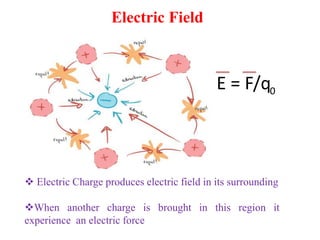
Electric Field
 Electric Charge produces electric field in its surrounding
When another charge is brought in this region it
experience an electric force
E = F/q0
Electric Intensity
Dimension [M1L1 T-3 A-1]
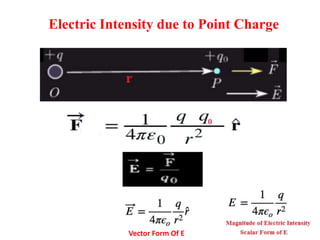
Electric Intensity due to Point Charge
Vector Form Of E
Line Charge Distribution
Unit :- Coulomb/meter
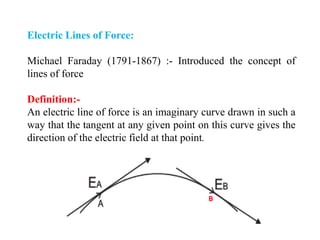
Electric Lines of Force:
Michael Faraday (1791-1867) :- Introduced the concept of
lines of force
Definition:-
An electric line of force is an imaginary curve drawn in such a
way that the tangent at any given point on this curve gives the
direction of the electric field at that point.
B
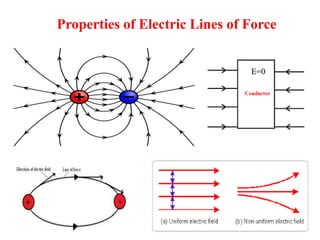
Properties of Electric Lines of Force
Electric Flux
Number of lines of force = (E).(Area)
Φ = E• A
S
Number of lines of force = (E).(Area)
Φ = E• A
dΦE = E• ds = Eds Cosθ
S.I Unit :- N m2 / C Or V m
Gauss' Law
The total electric flux through any closed surface equals the
net charge enclosed by the surface divided by ε0
Gauss' law is analogous to Coulomb’s law in the sense that it
too expresses the relationship between electric field and
electric charge.
Gauss' law provides equivalent method for finding electric
intensity
Electrostatics

Electrostatics