Operating Systems Principles Memory Management Lecture 7: Physical Memory 主講人:虞台文
Content Preparing a Program for Execution  Program Transformations  Logical-to-Physical Address Binding Memory Partitioning Schemes Fixed Partitions  Variable Partitions Allocation Strategies for Variable Partitions Dealing with Insufficient Memory  Memory Hierarchy
Operating Systems Principles Memory Management Lecture 7: Physical Memory Preparing a Program for Execution
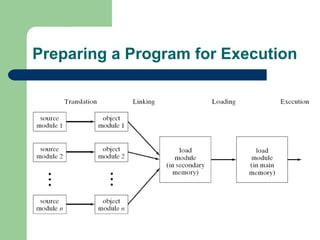
Preparing a Program for Execution
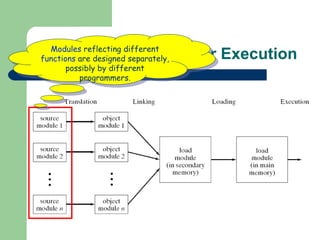
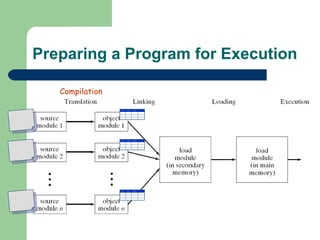
Preparing a Program for Execution Modules  reflecting different  functions  are designed separately, possibly by different programmers.
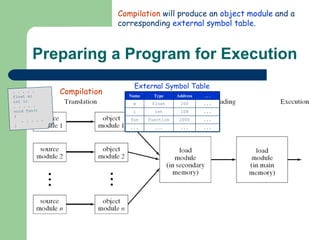
Preparing a Program for Execution Compilation External Symbol Table Compilation  will produce an  object module  and a corresponding  external symbol table .
Preparing a Program for Execution Compilation
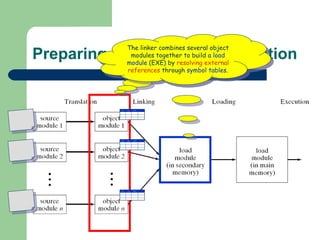
Preparing a Program for Execution The linker combines several object modules together to build a  load module  (EXE) by  resolving external references  through  symbol tables .
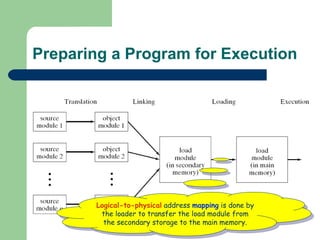
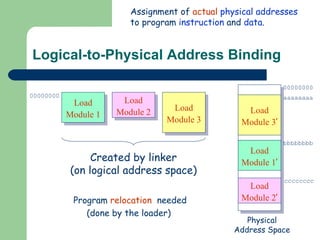
Preparing a Program for Execution Logical-to-physical  address  mapping  is done by the loader to transfer the load module from the secondary storage to the main memory.
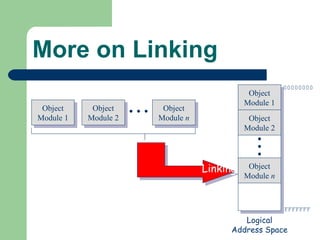
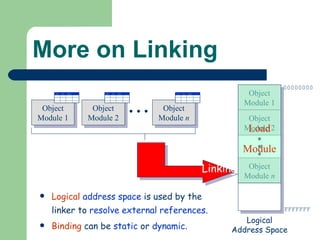
More on Linking Object Module 1 Object Module 2 Object Module  n Logical Address Space Object Module 1 Object Module 2 Object Module  n Linking 00000000 FFFFFFF
More on Linking Logical  address space  is used by the linker to  resolve external references . Binding  can be  static  or  dynamic .  Object Module 1 Object Module 2 Object Module  n Logical Address Space Object Module 1 Object Module 2 Object Module  n Linking Load Module 00000000 FFFFFFF
Logical-to-Physical Address Binding Load Module 1 Physical Address Space Load Module 2 Load Module 3 Load Module 3 ’ Load Module 2 ’ Load Module 1 ’ 00000000 Created by linker (on logical address space) 00000000 aaaaaaaa bbbbbbbb cccccccc Assignment of  actual   physical addresses  to program  instruction  and  data . Program  relocation   needed (done by the loader)
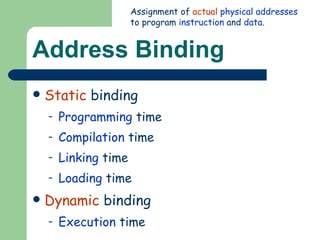
Address Binding Static  binding Programming  time Compilation  time Linking  time Loading  time Dynamic  binding Execution  time Assignment of  actual   physical addresses  to program  instruction  and  data .
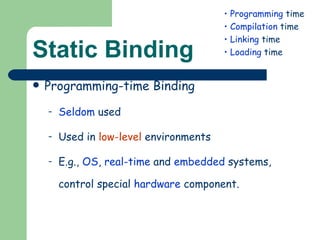
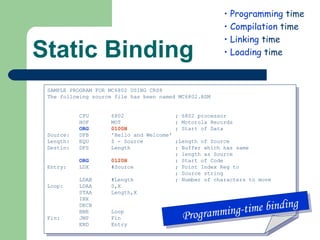
Static Binding Programming-time Binding Seldom  used Used in  low-level  environments E.g.,  OS ,  real-time  and  embedded  systems, control special  hardware  component. Programming  time Compilation  time Linking  time Loading  time
Static Binding SAMPLE PROGRAM FOR MC6802 USING CRS8 The following source file has been named MC6802.ASM  CPU 6802 ; 6802 processor HOF MOT  ; Motorola Records  ORG 0100H  ; Start of Data Source: DFB 'Hello and Welcome' Length: EQU $ - Source  ;Length of Source Destin: DFS Length ; Buffer which has same  ; length as Source ORG 0120H ; Start of Code Entry: LDX #Source ; Point Index Reg to  ; Source string LDAB #Length ; Number of characters to move Loop: LDAA 0,X STAA Length,X INX DECB BNE Loop Fin: JMP Fin END Entry Programming-time binding Programming  time Compilation  time Linking  time Loading  time
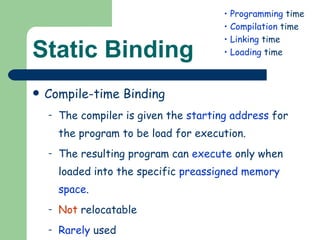
Static Binding Compile-time Binding The compiler is given the  starting address  for the program to be load for execution. The resulting program can  execute  only when loaded into the specific  preassigned memory space . Not  relocatable Rarely  used Programming  time Compilation  time Linking  time Loading  time
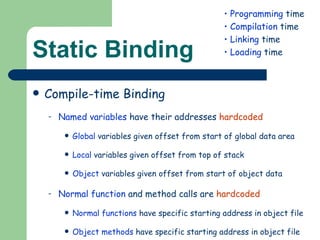
Static Binding Compile-time Binding Named variables  have their addresses  hardcoded Global  variables given offset from start of global data area  Local  variables given offset from top of stack  Object  variables given offset from start of object data  Normal function  and method calls are  hardcoded Normal functions  have specific starting address in object file  Object methods  have specific starting address in object file Programming  time Compilation  time Linking  time Loading  time
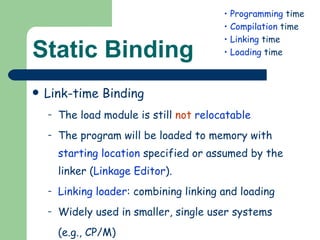
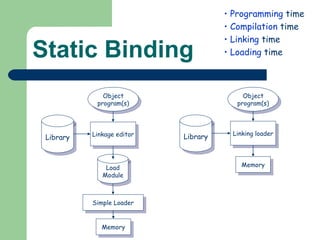
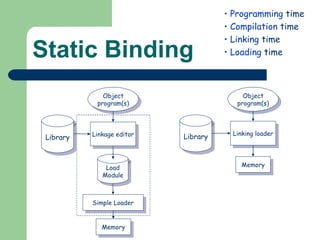
Static Binding Link-time Binding The load module is still  not   relocatable The program will be loaded to memory with  starting location  specified or assumed by the linker ( Linkage Editor ). Linking loader : combining linking and loading Widely used in smaller, single user systems  (e.g., CP/M) Programming  time Compilation  time Linking  time Loading  time
Static Binding Programming  time Compilation  time Linking  time Loading  time Object program(s) Linkage editor Library Simple Loader Memory Object program(s) Linking loader Memory Library Load Module
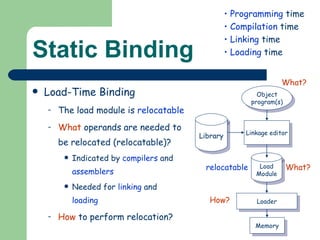
Static Binding Load-Time Binding The load module is  relocatable What  operands are needed to be relocated (relocatable)? Indicated by  compilers  and  assemblers Needed for  linking  and  loading How  to perform relocation? Programming  time Compilation  time Linking  time Loading  time Object program(s) Linkage editor Library Loader Memory relocatable What? How? What? Load Module
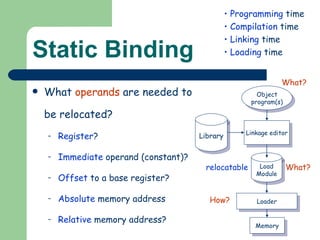
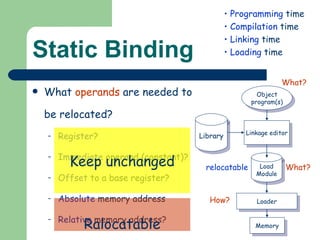
Static Binding What  operands  are needed to be relocated? Register ? Immediate  operand (constant)? Offset  to a base register? Absolute  memory address Relative  memory address? Programming  time Compilation  time Linking  time Loading  time Object program(s) Linkage editor Library Loader Memory relocatable What? How? What? Load Module
Static Binding What  operands  are needed to be relocated? Register ? Immediate  operand (constant)? Offset  to a base register? Absolute  memory address Relative  memory address? Programming  time Compilation  time Linking  time Loading  time Object program(s) Linkage editor Library Loader Memory relocatable What? How? What? Keep unchanged Ralocatable Load Module
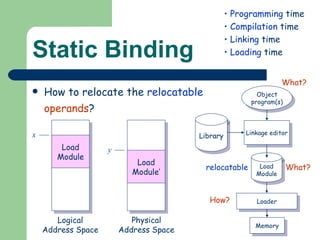
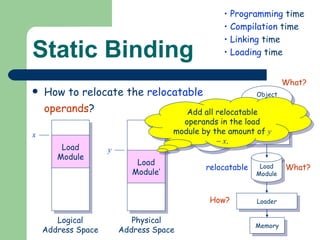
Static Binding How to relocate the  relocatable   operands ? Programming  time Compilation  time Linking  time Loading  time Object program(s) Linkage editor Library Loader Memory relocatable What? How? What? Logical Address Space Physical Address Space Load Module Load Module’ Load Module x y
Static Binding How to relocate the  relocatable   operands ? Object program(s) Linkage editor Library Loader Memory relocatable What? How? What? Logical Address Space Physical Address Space Load Module Load Module’ Add all relocatable operands in the load module by the amount of   y      x . Programming  time Compilation  time Linking  time Loading  time Load Module x y
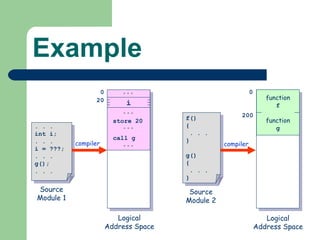
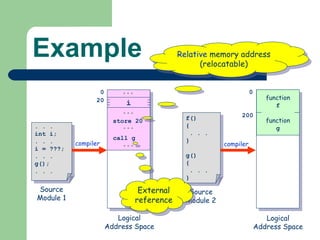
Example . . . int i; . . . i = ???; . . . g(); . . . Logical Address Space f() { . . . } g() { . . . } Logical Address Space Source Module 1 Source Module 2 0 20 i store 20 call g 0 200 function f function g compiler compiler
Example . . . int i; . . . i = ???; . . . g(); . . . Logical Address Space f() { . . . } g() { . . . } Logical Address Space Source Module 1 Source Module 2 Relative  memory address (relocatable) External reference 0 20 i store 20 call g 0 200 function f function g compiler compiler
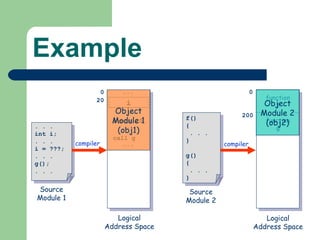
Example . . . int i; . . . i = ???; . . . g(); . . . Logical Address Space f() { . . . } g() { . . . } Logical Address Space Source Module 1 Source Module 2 Object Module 1 (obj1) Object Module 2 (obj2) 0 20 i store 20 call g 0 200 function f function g compiler compiler
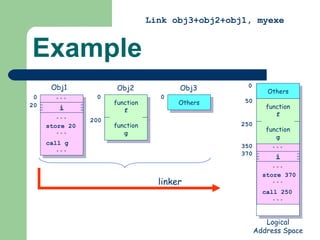
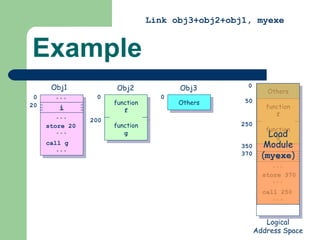
Example Obj1 Obj2 Obj3 Link obj3+obj2+obj1, myexe Logical Address Space 0 20 i store 20 call g 0 200 function f function g 0 Others 0 Others 50 250 function f function g 350 370 i store 370 call 250 linker
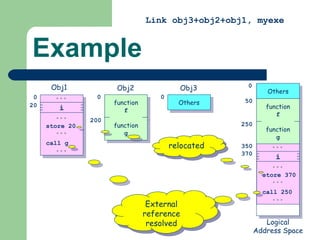
Example Obj1 Obj2 Obj3 Link obj3+obj2+obj1, myexe Logical Address Space relocated External reference resolved 0 20 i store 20 call g 0 200 function f function g 0 Others 0 Others 50 250 function f function g 350 370 i store 370 call 250
Example Obj1 Obj2 Obj3 Logical Address Space Load Module ( myexe ) Link obj3+obj2+obj1, myexe 0 20 i store 20 call g 0 200 function f function g 0 Others 0 Others 50 250 function f function g 350 370 i store 370 call 250
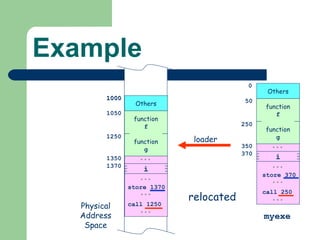
Example myexe Physical Address Space 1000 1000 relocated 0 Others 50 250 function f function g 350 370 i store 370 call 250 Others 1050 1250 function f function g 1350 1370 i store 1370 call 1250 loader
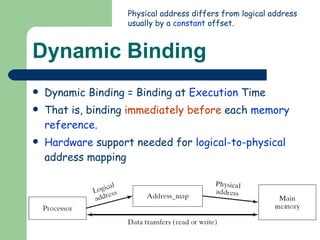
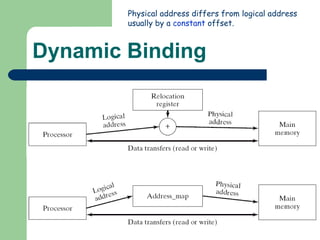
Dynamic Binding Dynamic Binding = Binding at  Execution  Time That is, binding  immediately   before  each  memory reference. Hardware  support needed for  logical-to-physical  address mapping Physical address differs from logical address usually by a  constant  offset.
Dynamic Binding Physical address differs from logical address usually by a  constant  offset.
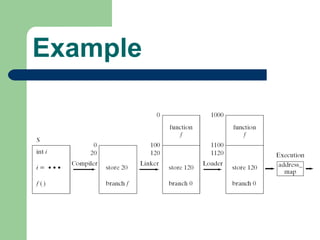
Example
Operating Systems Principles Memory Management Lecture 7: Physical Memory Memory Partitioning Schemes
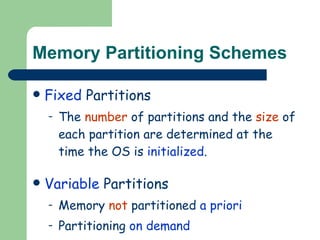
Memory Partitioning Schemes Fixed  Partitions The  number  of partitions and the  size  of each partition are determined at the time the OS is  initialized . Variable  Partitions Memory  not  partitioned  a priori Partitioning  on demand
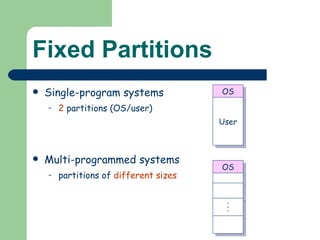
Fixed Partitions Single-program systems 2  partitions (OS/user) Multi-programmed systems partitions of  different sizes OS User OS . . .
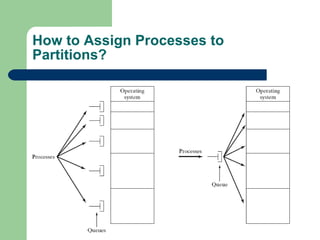
How to Assign Processes to Partitions?
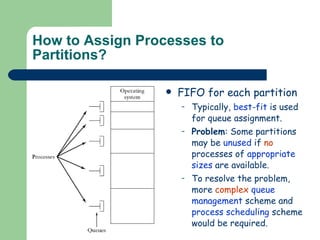
How to Assign Processes to Partitions? FIFO for each partition Typically,  best-fit  is used for queue assignment. Problem : Some partitions may be  unused  if  no  processes of  appropriate sizes  are available. To resolve the problem, more  complex   queue management  scheme and  process scheduling  scheme would be required.
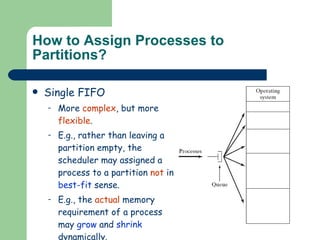
How to Assign Processes to Partitions? Single FIFO More  complex , but more  flexible . E.g., rather than leaving a partition empty, the scheduler may assigned a process to a partition  not  in  best-fit  sense. E.g., the  actual  memory requirement of a process may  grow  and  shrink  dynamically.
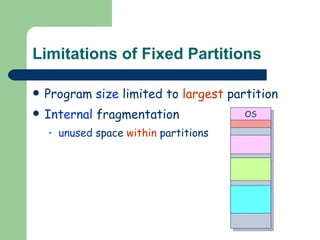
Limitations of Fixed Partitions Program  size  limited to  largest  partition Internal  fragmentation unused  space  within  partitions OS
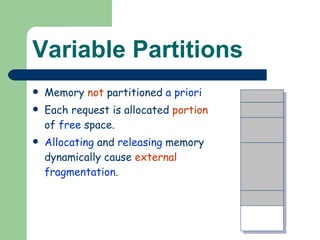
Variable Partitions Memory  not  partitioned  a priori Each request is allocated  portion  of  free  space. Allocating  and  releasing  memory dynamically cause  external   fragmentation .
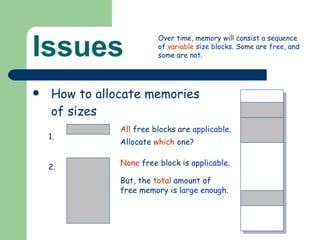
Issues How to allocate memories of sizes All  free blocks are  applicable . None  free block is  applicable . But, the  total  amount of free memory is  large enough . Allocate  which  one? Over time, memory will consist a sequence of  variable  size blocks . Some are  free , and some are  not .
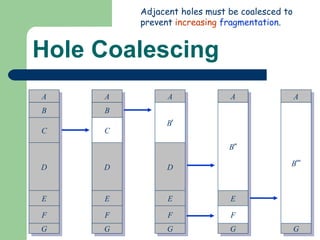
Hole Coalescing A B D E C F A B D E C F A B D E C F B ’ A D E F B ’ B ’’ G G G G A E F B ’’ G B ’’’ Adjacent holes must be coalesced to prevent  increasing   fragmentation .
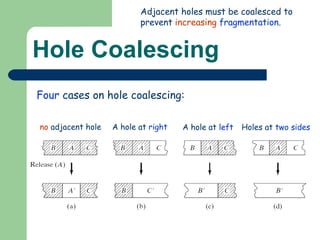
Hole Coalescing Adjacent holes must be coalesced to prevent  increasing   fragmentation . Four  cases on hole coalescing: no  adjacent hole A hole at  right A hole at  left Holes at  two sides
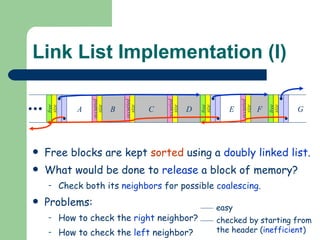
Link List Implementation (I) Free blocks are kept  sorted  using a  doubly linked list . What would be done to  release  a block of memory? Check both its  neighbors  for possible  coalescing . Problems:  How to check the  right  neighbor?  How to check the  left  neighbor? G A B C D E F free free free occupied occupied occupied occupied size size size size size size size easy checked by starting from the header ( inefficient )
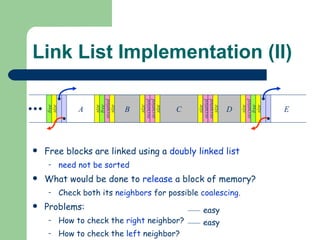
Link List Implementation (II) Free blocks are linked using a  doubly linked list  need not be sorted What would be done to  release  a block of memory? Check both its  neighbors  for possible  coalescing . Problems:  How to check the  right  neighbor?  How to check the  left  neighbor? E A B free occupied size size free size occupied size C occupied size occupied size D occupied size occupied size free size easy easy
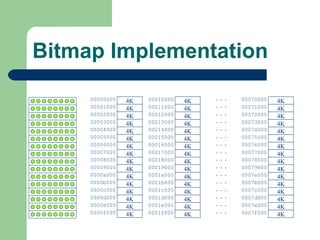
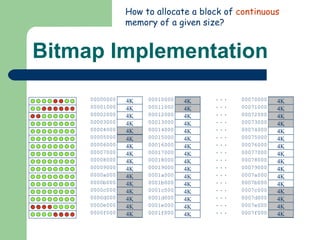
Bitmap Implementation Memory divided into  fix-size  blocks Each block represented by a  0/1  bit in a binary string: the “ bitmap ” Can be implemented as  char  or  int  array Operations use bit  masks Release :   B[i] = B[i] & '11011111' Allocate :   B[i] = B[i] | '11000000' Search : Repeatedly, Check left-most bit and Shift mask right:   TEST = B[i] & '10000000' Free Allocated
Bitmap Implementation Memory divided into  fix-size  blocks Each block represented by a  0/1  bit in a binary string: the “ bitmap ” Can be implemented as  char  or  int  array Operations use bit  masks Release :   B[i] = B[i] & '11 0 11111' Allocate :   B[i] = B[i] | ' 11 000000' Search : Repeatedly, Check left-most bit and Shift mask right:   TEST = B[i] & ' 1 0000000'
Bitmap Implementation 4K 00000000 4K 4K 4K 4K 4K 4K 4K 4K 4K 4K 4K 4K 4K 4K 4K 00001000 00002000 00003000 00004000 00005000 00006000 00007000 00008000 00009000 0000a000 0000b000 0000c000 0000d000 0000e000 0000f000 4K 00010000 4K 4K 4K 4K 4K 4K 4K 4K 4K 4K 4K 4K 4K 4K 4K 00011000 00012000 00013000 00014000 00015000 00016000 00017000 00018000 00019000 0001a000 0001b000 0001c000 0001d000 0001e000 0001f000 4K 00070000 4K 4K 4K 4K 4K 4K 4K 4K 4K 4K 4K 4K 4K 4K 4K 00071000 00072000 00073000 00074000 00075000 00076000 00077000 00078000 00079000 0007a000 0007b000 0007c000 0007d000 0007e000 0007f000                                                                                                                
Bitmap Implementation 4K 4K 4K 4K 4K 4K 4K 4K 4K 4K 4K 4K 4K 4K 4K 4K 4K 4K How to allocate a block of  continuous  memory of a given size? 4K 00000000 4K 4K 4K 4K 4K 4K 4K 4K 4K 4K 4K 4K 4K 4K 4K 00001000 00002000 00003000 00004000 00005000 00006000 00007000 00008000 00009000 0000a000 0000b000 0000c000 0000d000 0000e000 0000f000 4K 00010000 4K 4K 4K 4K 4K 4K 4K 4K 4K 4K 4K 4K 4K 4K 4K 00011000 00012000 00013000 00014000 00015000 00016000 00017000 00018000 00019000 0001a000 0001b000 0001c000 0001d000 0001e000 0001f000 4K 00070000 4K 4K 4K 4K 4K 4K 4K 4K 4K 4K 4K 4K 4K 4K 4K 00071000 00072000 00073000 00074000 00075000 00076000 00077000 00078000 00079000 0007a000 0007b000 0007c000 0007d000 0007e000 0007f000                                                                                                                
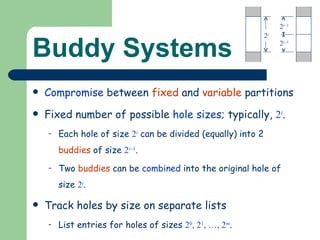
Buddy Systems Compromise  between  fixed  and  variable  partitions Fixed number of possible  hole sizes ; typically,  2 i . Each hole of size  2 i   can be divided (equally) into 2  buddies  of size  2 i  1 . Two  buddies  can be  combined  into the original hole of size  2 i . Track holes by size on separate lists List entries for holes of sizes  2 0 , 2 1 , …, 2 m . 2 i 2 i  1 2 i  1
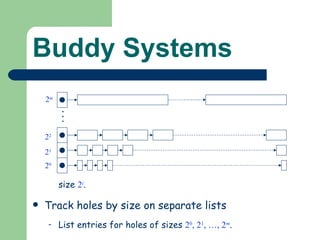
Buddy Systems Compromise  between  fixed  and  variable  partitions Fixed number of possible  hole sizes ; typically,  2 i . Each hole of size  2 i   can be divided (equally) into 2  buddies  of size  2 i  1 . Two  buddies  can be  combined  into the original hole of size  2 i . Track holes by size on separate lists List entries for holes of sizes  2 0 , 2 1 , …, 2 m . . . . 2 0 2 1 2 2 2 m
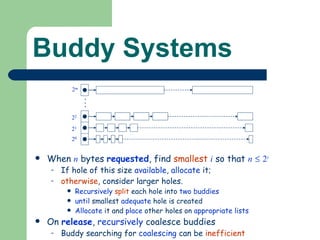
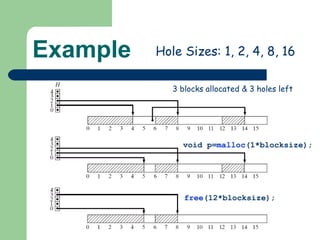
Buddy Systems When  n  bytes  requested , find  smallest   i  so that  n      2 i If hole of this size  available ,  allocate  it; otherwise , consider larger holes. Recursively   split  each hole into  two buddies until  smallest  adequate  hole is created Allocate  it and  place  other holes on  appropriate   lists On  release ,  recursively  coalesce buddies Buddy searching for  coalescing  can be  inefficient
Example void p= malloc (1*blocksize); free (12*blocksize); Hole Sizes: 1, 2, 4, 8, 16 3 blocks allocated & 3 holes left
Operating Systems Principles Memory Management Lecture 7: Physical Memory Allocation Strategies for Variable Partitions
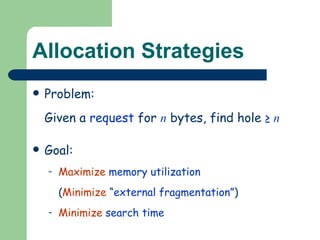
Allocation Strategies Problem:  Given a  request  for  n  bytes, find hole  ≥  n Goal:  Maximize   memory utilization ( Minimize  “ external fragmentation ”) Minimize   search time
Common Allocation Strategies First-fit:  Always  start  from the  beginning  of free-list Simplest Generally the  best  choice Next-fit:  Rotating-first-fit  (Resume search) Improves distribution of holes Best-fit:  Closest  fit  Avoid breaking up large holes. Worst-fit: Largest  fit Avoid leaving tiny hole fragments
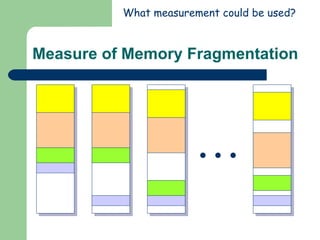
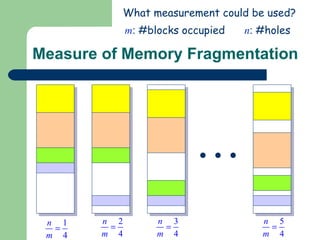
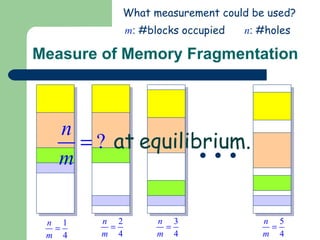
Measure of Memory Fragmentation What measurement could be used?
Measure of Memory Fragmentation What measurement could be used? m :  #blocks occupied n :  #holes
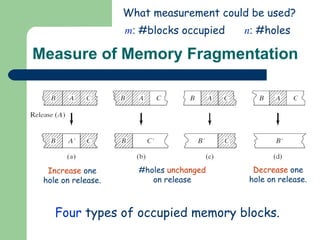
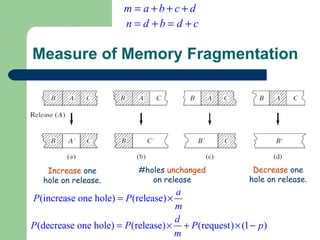
Measure of Memory Fragmentation What measurement could be used? m :  #blocks occupied n :  #holes Four  types of occupied memory blocks. Increase  one hole on release. #holes  unchanged  on release Decrease  one hole on release.
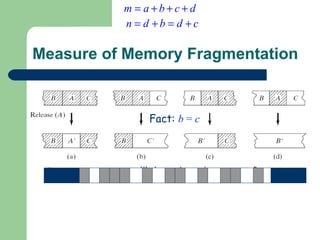
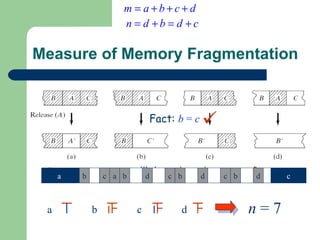
Measure of Memory Fragmentation What measurement could be used? m :  #blocks occupied n :  #holes Increase  one hole on release. #holes  unchanged  on release Decrease  one hole on release. Let  a ,  b ,  c ,  d  be the average number of  occupied  blocks of each type in memory during  equilibrium . Fact:  b  =  c
Measure of Memory Fragmentation Increase  one hole on release. #holes  unchanged  on release Decrease  one hole on release. Fact:  b  =  c
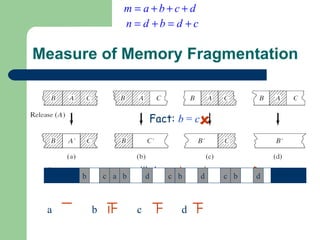
Measure of Memory Fragmentation Increase  one hole on release. #holes  unchanged  on release Decrease  one hole on release. Fact:  b  =  c b c a b d c b d c b d a b c d 
Measure of Memory Fragmentation Increase  one hole on release. #holes  unchanged  on release Decrease  one hole on release. Fact:  b  =  c b c a b d c b d c b d a b c d a c  n  = 7
Measure of Memory Fragmentation Increase  one hole on release. #holes  unchanged  on release Decrease  one hole on release.
Measure of Memory Fragmentation Increase  one hole on release. #holes  unchanged  on release Decrease  one hole on release. p : The probability that the  request  memory size  doesn’t  match any  hole  size. Fact:  p     1 .
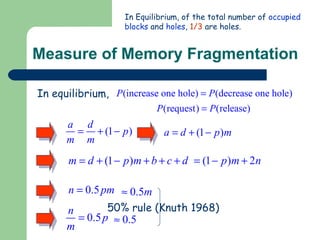
Measure of Memory Fragmentation In equilibrium,
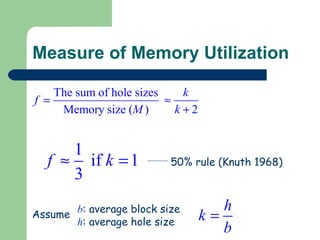
Measure of Memory Fragmentation In equilibrium, 50% rule (Knuth 1968) In Equilibrium, of the total number of  occupied   blocks  and  holes ,  1/3  are holes.
Measure of Memory Utilization In equilibrium, 50% rule (Knuth 1968) In Equilibrium, of the total number of  occupied   blocks  and  holes ,  1/3  are holes. How much memory is wasted? (average) hole_size  is not the same as (average) block_size
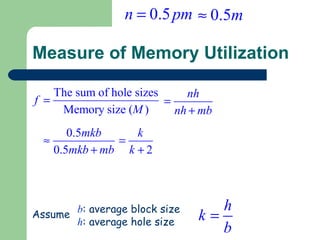
Measure of Memory Utilization Assume b : average block size h : average hole size
Measure of Memory Utilization Assume b : average block size h : average hole size 50% rule (Knuth 1968)
Measure of Memory Utilization Assume b : average block size h : average hole size We want to minimize the value of   f. It is equivalent to  minimize  k . How to know the value of   k ?
Measure of Memory Utilization Simulations  by  Knuth  (1968) provide an answer. k  depends on the ratio of  b / M , e.g., b      M /10 ,  k  = 0.22      f     0.1 b      M /3 ,  k  = 2      f     0.5 Assume b : average block size h : average hole size How to know the value of   k ?
Measure of Memory Utilization Assume b : average block size h : average hole size Conclusion:  M  must be  large  relative to  b , otherwise much of main memory will remain unused.
Operating Systems Principles Memory Management Lecture 7: Physical Memory Dealing with Insufficient Memory
Managing Insufficient Memory What to be done? when the total size of  free memory  is large  enough  while the memory requirement of a process  exceeds  the size of the  largest partition when new process arrives with  insufficient  free memory? When the memory requirement is  larger  than the  physical memory size .
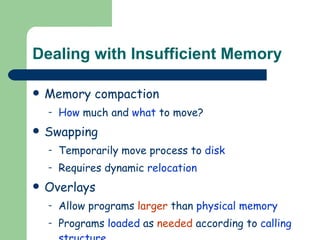
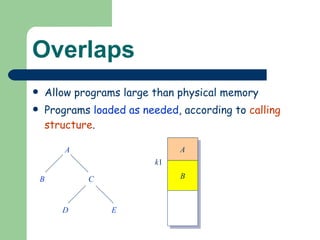
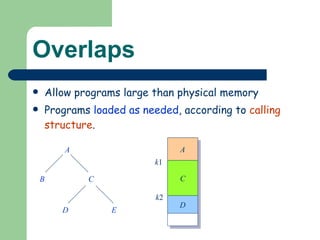
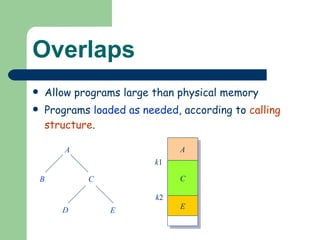
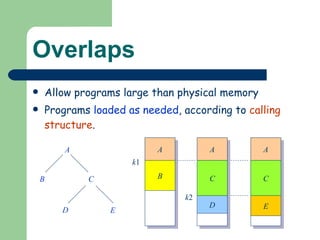
Dealing with Insufficient Memory Memory compaction How  much and  what  to move? Swapping Temporarily move process to  disk Requires dynamic  relocation Overlays Allow programs  larger  than  physical memory Programs  loaded  as  needed  according to  calling structure .
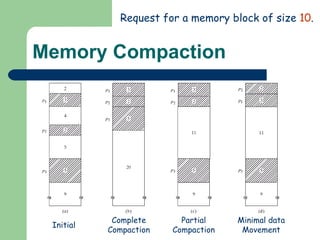
Memory Compaction Request for a memory block of size  10 . Initial Complete Compaction Partial Compaction Minimal data Movement
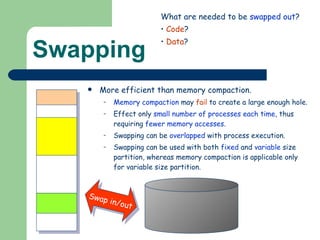
Swapping More efficient than memory compaction. Memory compaction  may  fail  to create a large enough hole. Effect only  small number of processes each time , thus requiring  fewer memory accesses . Swapping can be  overlapped  with process execution. Swapping can be used with both  fixed  and  variable  size partition, whereas memory compaction is applicable only for variable size partition. Swap in/out What are needed to be  swapped out ? Code ? Data ?
Overlaps Allow programs large than physical memory Programs  loaded as needed , according to  calling structure . A B C D E A k 1 B
Overlaps Allow programs large than physical memory Programs  loaded as needed , according to  calling structure . A B C D E A k 1 B C k 2 D
Overlaps Allow programs large than physical memory Programs  loaded as needed , according to  calling structure . A B C D E A k 1 B C k 2 D E
Overlaps Allow programs large than physical memory Programs  loaded as needed , according to  calling structure . A B C D E A k 1 B A C k 2 D A B C E
Operating Systems Principles Memory Management Lecture 7: Physical Memory Memory Hierarchy
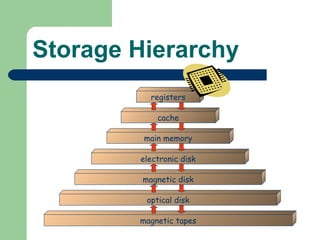
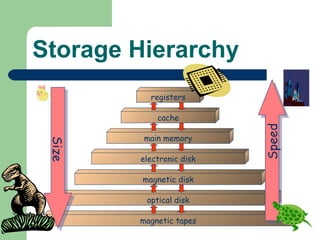
Storage Hierarchy registers cache main memory electronic disk magnetic disk optical disk magnetic tapes
Storage Hierarchy registers cache main memory electronic disk magnetic disk optical disk magnetic tapes Speed Size
Memory Hierarchy Design Principles  Make the Common Case Fast  Principle of Locality  Smaller is Faster

Os7 2

  • 1.
    Operating Systems PrinciplesMemory Management Lecture 7: Physical Memory 主講人:虞台文
  • 2.
    Content Preparing aProgram for Execution Program Transformations Logical-to-Physical Address Binding Memory Partitioning Schemes Fixed Partitions Variable Partitions Allocation Strategies for Variable Partitions Dealing with Insufficient Memory Memory Hierarchy
  • 3.
    Operating Systems PrinciplesMemory Management Lecture 7: Physical Memory Preparing a Program for Execution
  • 4.
    Preparing a Programfor Execution
  • 5.
    Preparing a Programfor Execution Modules reflecting different functions are designed separately, possibly by different programmers.
  • 6.
    Preparing a Programfor Execution Compilation External Symbol Table Compilation will produce an object module and a corresponding external symbol table .
  • 7.
    Preparing a Programfor Execution Compilation
  • 8.
    Preparing a Programfor Execution The linker combines several object modules together to build a load module (EXE) by resolving external references through symbol tables .
  • 9.
    Preparing a Programfor Execution Logical-to-physical address mapping is done by the loader to transfer the load module from the secondary storage to the main memory.
  • 10.
    More on LinkingObject Module 1 Object Module 2 Object Module n Logical Address Space Object Module 1 Object Module 2 Object Module n Linking 00000000 FFFFFFF
  • 11.
    More on LinkingLogical address space is used by the linker to resolve external references . Binding can be static or dynamic . Object Module 1 Object Module 2 Object Module n Logical Address Space Object Module 1 Object Module 2 Object Module n Linking Load Module 00000000 FFFFFFF
  • 12.
    Logical-to-Physical Address BindingLoad Module 1 Physical Address Space Load Module 2 Load Module 3 Load Module 3 ’ Load Module 2 ’ Load Module 1 ’ 00000000 Created by linker (on logical address space) 00000000 aaaaaaaa bbbbbbbb cccccccc Assignment of actual physical addresses to program instruction and data . Program relocation needed (done by the loader)
  • 13.
    Address Binding Static binding Programming time Compilation time Linking time Loading time Dynamic binding Execution time Assignment of actual physical addresses to program instruction and data .
  • 14.
    Static Binding Programming-timeBinding Seldom used Used in low-level environments E.g., OS , real-time and embedded systems, control special hardware component. Programming time Compilation time Linking time Loading time
  • 15.
    Static Binding SAMPLEPROGRAM FOR MC6802 USING CRS8 The following source file has been named MC6802.ASM CPU 6802 ; 6802 processor HOF MOT ; Motorola Records ORG 0100H ; Start of Data Source: DFB 'Hello and Welcome' Length: EQU $ - Source ;Length of Source Destin: DFS Length ; Buffer which has same ; length as Source ORG 0120H ; Start of Code Entry: LDX #Source ; Point Index Reg to ; Source string LDAB #Length ; Number of characters to move Loop: LDAA 0,X STAA Length,X INX DECB BNE Loop Fin: JMP Fin END Entry Programming-time binding Programming time Compilation time Linking time Loading time
  • 16.
    Static Binding Compile-timeBinding The compiler is given the starting address for the program to be load for execution. The resulting program can execute only when loaded into the specific preassigned memory space . Not relocatable Rarely used Programming time Compilation time Linking time Loading time
  • 17.
    Static Binding Compile-timeBinding Named variables have their addresses hardcoded Global variables given offset from start of global data area Local variables given offset from top of stack Object variables given offset from start of object data Normal function and method calls are hardcoded Normal functions have specific starting address in object file Object methods have specific starting address in object file Programming time Compilation time Linking time Loading time
  • 18.
    Static Binding Link-timeBinding The load module is still not relocatable The program will be loaded to memory with starting location specified or assumed by the linker ( Linkage Editor ). Linking loader : combining linking and loading Widely used in smaller, single user systems (e.g., CP/M) Programming time Compilation time Linking time Loading time
  • 19.
    Static Binding Programming time Compilation time Linking time Loading time Object program(s) Linkage editor Library Simple Loader Memory Object program(s) Linking loader Memory Library Load Module
  • 20.
    Static Binding Programming time Compilation time Linking time Loading time Object program(s) Linkage editor Library Simple Loader Memory Object program(s) Linking loader Memory Library Load Module
  • 21.
    Static Binding Load-TimeBinding The load module is relocatable What operands are needed to be relocated (relocatable)? Indicated by compilers and assemblers Needed for linking and loading How to perform relocation? Programming time Compilation time Linking time Loading time Object program(s) Linkage editor Library Loader Memory relocatable What? How? What? Load Module
  • 22.
    Static Binding What operands are needed to be relocated? Register ? Immediate operand (constant)? Offset to a base register? Absolute memory address Relative memory address? Programming time Compilation time Linking time Loading time Object program(s) Linkage editor Library Loader Memory relocatable What? How? What? Load Module
  • 23.
    Static Binding What operands are needed to be relocated? Register ? Immediate operand (constant)? Offset to a base register? Absolute memory address Relative memory address? Programming time Compilation time Linking time Loading time Object program(s) Linkage editor Library Loader Memory relocatable What? How? What? Keep unchanged Ralocatable Load Module
  • 24.
    Static Binding Howto relocate the relocatable operands ? Programming time Compilation time Linking time Loading time Object program(s) Linkage editor Library Loader Memory relocatable What? How? What? Logical Address Space Physical Address Space Load Module Load Module’ Load Module x y
  • 25.
    Static Binding Howto relocate the relocatable operands ? Object program(s) Linkage editor Library Loader Memory relocatable What? How? What? Logical Address Space Physical Address Space Load Module Load Module’ Add all relocatable operands in the load module by the amount of y  x . Programming time Compilation time Linking time Loading time Load Module x y
  • 26.
    Example . .. int i; . . . i = ???; . . . g(); . . . Logical Address Space f() { . . . } g() { . . . } Logical Address Space Source Module 1 Source Module 2 0 20 i store 20 call g 0 200 function f function g compiler compiler
  • 27.
    Example . .. int i; . . . i = ???; . . . g(); . . . Logical Address Space f() { . . . } g() { . . . } Logical Address Space Source Module 1 Source Module 2 Relative memory address (relocatable) External reference 0 20 i store 20 call g 0 200 function f function g compiler compiler
  • 28.
    Example . .. int i; . . . i = ???; . . . g(); . . . Logical Address Space f() { . . . } g() { . . . } Logical Address Space Source Module 1 Source Module 2 Object Module 1 (obj1) Object Module 2 (obj2) 0 20 i store 20 call g 0 200 function f function g compiler compiler
  • 29.
    Example Obj1 Obj2Obj3 Link obj3+obj2+obj1, myexe Logical Address Space 0 20 i store 20 call g 0 200 function f function g 0 Others 0 Others 50 250 function f function g 350 370 i store 370 call 250 linker
  • 30.
    Example Obj1 Obj2Obj3 Link obj3+obj2+obj1, myexe Logical Address Space relocated External reference resolved 0 20 i store 20 call g 0 200 function f function g 0 Others 0 Others 50 250 function f function g 350 370 i store 370 call 250
  • 31.
    Example Obj1 Obj2Obj3 Logical Address Space Load Module ( myexe ) Link obj3+obj2+obj1, myexe 0 20 i store 20 call g 0 200 function f function g 0 Others 0 Others 50 250 function f function g 350 370 i store 370 call 250
  • 32.
    Example myexe PhysicalAddress Space 1000 1000 relocated 0 Others 50 250 function f function g 350 370 i store 370 call 250 Others 1050 1250 function f function g 1350 1370 i store 1370 call 1250 loader
  • 33.
    Dynamic Binding DynamicBinding = Binding at Execution Time That is, binding immediately before each memory reference. Hardware support needed for logical-to-physical address mapping Physical address differs from logical address usually by a constant offset.
  • 34.
    Dynamic Binding Physicaladdress differs from logical address usually by a constant offset.
  • 35.
  • 36.
    Operating Systems PrinciplesMemory Management Lecture 7: Physical Memory Memory Partitioning Schemes
  • 37.
    Memory Partitioning SchemesFixed Partitions The number of partitions and the size of each partition are determined at the time the OS is initialized . Variable Partitions Memory not partitioned a priori Partitioning on demand
  • 38.
    Fixed Partitions Single-programsystems 2 partitions (OS/user) Multi-programmed systems partitions of different sizes OS User OS . . .
  • 39.
    How to AssignProcesses to Partitions?
  • 40.
    How to AssignProcesses to Partitions? FIFO for each partition Typically, best-fit is used for queue assignment. Problem : Some partitions may be unused if no processes of appropriate sizes are available. To resolve the problem, more complex queue management scheme and process scheduling scheme would be required.
  • 41.
    How to AssignProcesses to Partitions? Single FIFO More complex , but more flexible . E.g., rather than leaving a partition empty, the scheduler may assigned a process to a partition not in best-fit sense. E.g., the actual memory requirement of a process may grow and shrink dynamically.
  • 42.
    Limitations of FixedPartitions Program size limited to largest partition Internal fragmentation unused space within partitions OS
  • 43.
    Variable Partitions Memory not partitioned a priori Each request is allocated portion of free space. Allocating and releasing memory dynamically cause external fragmentation .
  • 44.
    Issues How toallocate memories of sizes All free blocks are applicable . None free block is applicable . But, the total amount of free memory is large enough . Allocate which one? Over time, memory will consist a sequence of variable size blocks . Some are free , and some are not .
  • 45.
    Hole Coalescing AB D E C F A B D E C F A B D E C F B ’ A D E F B ’ B ’’ G G G G A E F B ’’ G B ’’’ Adjacent holes must be coalesced to prevent increasing fragmentation .
  • 46.
    Hole Coalescing Adjacentholes must be coalesced to prevent increasing fragmentation . Four cases on hole coalescing: no adjacent hole A hole at right A hole at left Holes at two sides
  • 47.
    Link List Implementation(I) Free blocks are kept sorted using a doubly linked list . What would be done to release a block of memory? Check both its neighbors for possible coalescing . Problems: How to check the right neighbor? How to check the left neighbor? G A B C D E F free free free occupied occupied occupied occupied size size size size size size size easy checked by starting from the header ( inefficient )
  • 48.
    Link List Implementation(II) Free blocks are linked using a doubly linked list need not be sorted What would be done to release a block of memory? Check both its neighbors for possible coalescing . Problems: How to check the right neighbor? How to check the left neighbor? E A B free occupied size size free size occupied size C occupied size occupied size D occupied size occupied size free size easy easy
  • 49.
    Bitmap Implementation Memorydivided into fix-size blocks Each block represented by a 0/1 bit in a binary string: the “ bitmap ” Can be implemented as char or int array Operations use bit masks Release : B[i] = B[i] & '11011111' Allocate : B[i] = B[i] | '11000000' Search : Repeatedly, Check left-most bit and Shift mask right: TEST = B[i] & '10000000' Free Allocated
  • 50.
    Bitmap Implementation Memorydivided into fix-size blocks Each block represented by a 0/1 bit in a binary string: the “ bitmap ” Can be implemented as char or int array Operations use bit masks Release : B[i] = B[i] & '11 0 11111' Allocate : B[i] = B[i] | ' 11 000000' Search : Repeatedly, Check left-most bit and Shift mask right: TEST = B[i] & ' 1 0000000'
  • 51.
    Bitmap Implementation 4K00000000 4K 4K 4K 4K 4K 4K 4K 4K 4K 4K 4K 4K 4K 4K 4K 00001000 00002000 00003000 00004000 00005000 00006000 00007000 00008000 00009000 0000a000 0000b000 0000c000 0000d000 0000e000 0000f000 4K 00010000 4K 4K 4K 4K 4K 4K 4K 4K 4K 4K 4K 4K 4K 4K 4K 00011000 00012000 00013000 00014000 00015000 00016000 00017000 00018000 00019000 0001a000 0001b000 0001c000 0001d000 0001e000 0001f000 4K 00070000 4K 4K 4K 4K 4K 4K 4K 4K 4K 4K 4K 4K 4K 4K 4K 00071000 00072000 00073000 00074000 00075000 00076000 00077000 00078000 00079000 0007a000 0007b000 0007c000 0007d000 0007e000 0007f000                                                
  • 52.
    Bitmap Implementation 4K4K 4K 4K 4K 4K 4K 4K 4K 4K 4K 4K 4K 4K 4K 4K 4K 4K How to allocate a block of continuous memory of a given size? 4K 00000000 4K 4K 4K 4K 4K 4K 4K 4K 4K 4K 4K 4K 4K 4K 4K 00001000 00002000 00003000 00004000 00005000 00006000 00007000 00008000 00009000 0000a000 0000b000 0000c000 0000d000 0000e000 0000f000 4K 00010000 4K 4K 4K 4K 4K 4K 4K 4K 4K 4K 4K 4K 4K 4K 4K 00011000 00012000 00013000 00014000 00015000 00016000 00017000 00018000 00019000 0001a000 0001b000 0001c000 0001d000 0001e000 0001f000 4K 00070000 4K 4K 4K 4K 4K 4K 4K 4K 4K 4K 4K 4K 4K 4K 4K 00071000 00072000 00073000 00074000 00075000 00076000 00077000 00078000 00079000 0007a000 0007b000 0007c000 0007d000 0007e000 0007f000                                                
  • 53.
    Buddy Systems Compromise between fixed and variable partitions Fixed number of possible hole sizes ; typically, 2 i . Each hole of size 2 i can be divided (equally) into 2 buddies of size 2 i  1 . Two buddies can be combined into the original hole of size 2 i . Track holes by size on separate lists List entries for holes of sizes 2 0 , 2 1 , …, 2 m . 2 i 2 i  1 2 i  1
  • 54.
    Buddy Systems Compromise between fixed and variable partitions Fixed number of possible hole sizes ; typically, 2 i . Each hole of size 2 i can be divided (equally) into 2 buddies of size 2 i  1 . Two buddies can be combined into the original hole of size 2 i . Track holes by size on separate lists List entries for holes of sizes 2 0 , 2 1 , …, 2 m . . . . 2 0 2 1 2 2 2 m
  • 55.
    Buddy Systems When n bytes requested , find smallest i so that n  2 i If hole of this size available , allocate it; otherwise , consider larger holes. Recursively split each hole into two buddies until smallest adequate hole is created Allocate it and place other holes on appropriate lists On release , recursively coalesce buddies Buddy searching for coalescing can be inefficient
  • 56.
    Example void p=malloc (1*blocksize); free (12*blocksize); Hole Sizes: 1, 2, 4, 8, 16 3 blocks allocated & 3 holes left
  • 57.
    Operating Systems PrinciplesMemory Management Lecture 7: Physical Memory Allocation Strategies for Variable Partitions
  • 58.
    Allocation Strategies Problem: Given a request for n bytes, find hole ≥ n Goal: Maximize memory utilization ( Minimize “ external fragmentation ”) Minimize search time
  • 59.
    Common Allocation StrategiesFirst-fit: Always start from the beginning of free-list Simplest Generally the best choice Next-fit: Rotating-first-fit (Resume search) Improves distribution of holes Best-fit: Closest fit Avoid breaking up large holes. Worst-fit: Largest fit Avoid leaving tiny hole fragments
  • 60.
    Measure of MemoryFragmentation What measurement could be used?
  • 61.
    Measure of MemoryFragmentation What measurement could be used? m : #blocks occupied n : #holes
  • 62.
    Measure of MemoryFragmentation What measurement could be used? m : #blocks occupied n : #holes
  • 63.
    Measure of MemoryFragmentation What measurement could be used? m : #blocks occupied n : #holes Four types of occupied memory blocks. Increase one hole on release. #holes unchanged on release Decrease one hole on release.
  • 64.
    Measure of MemoryFragmentation What measurement could be used? m : #blocks occupied n : #holes Increase one hole on release. #holes unchanged on release Decrease one hole on release. Let a , b , c , d be the average number of occupied blocks of each type in memory during equilibrium . Fact: b = c
  • 65.
    Measure of MemoryFragmentation Increase one hole on release. #holes unchanged on release Decrease one hole on release. Fact: b = c
  • 66.
    Measure of MemoryFragmentation Increase one hole on release. #holes unchanged on release Decrease one hole on release. Fact: b = c b c a b d c b d c b d a b c d 
  • 67.
    Measure of MemoryFragmentation Increase one hole on release. #holes unchanged on release Decrease one hole on release. Fact: b = c b c a b d c b d c b d a b c d a c  n = 7
  • 68.
    Measure of MemoryFragmentation Increase one hole on release. #holes unchanged on release Decrease one hole on release.
  • 69.
    Measure of MemoryFragmentation Increase one hole on release. #holes unchanged on release Decrease one hole on release. p : The probability that the request memory size doesn’t match any hole size. Fact: p  1 .
  • 70.
    Measure of MemoryFragmentation In equilibrium,
  • 71.
    Measure of MemoryFragmentation In equilibrium, 50% rule (Knuth 1968) In Equilibrium, of the total number of occupied blocks and holes , 1/3 are holes.
  • 72.
    Measure of MemoryUtilization In equilibrium, 50% rule (Knuth 1968) In Equilibrium, of the total number of occupied blocks and holes , 1/3 are holes. How much memory is wasted? (average) hole_size is not the same as (average) block_size
  • 73.
    Measure of MemoryUtilization Assume b : average block size h : average hole size
  • 74.
    Measure of MemoryUtilization Assume b : average block size h : average hole size 50% rule (Knuth 1968)
  • 75.
    Measure of MemoryUtilization Assume b : average block size h : average hole size We want to minimize the value of f. It is equivalent to minimize k . How to know the value of k ?
  • 76.
    Measure of MemoryUtilization Simulations by Knuth (1968) provide an answer. k depends on the ratio of b / M , e.g., b  M /10 , k = 0.22  f  0.1 b  M /3 , k = 2  f  0.5 Assume b : average block size h : average hole size How to know the value of k ?
  • 77.
    Measure of MemoryUtilization Assume b : average block size h : average hole size Conclusion: M must be large relative to b , otherwise much of main memory will remain unused.
  • 78.
    Operating Systems PrinciplesMemory Management Lecture 7: Physical Memory Dealing with Insufficient Memory
  • 79.
    Managing Insufficient MemoryWhat to be done? when the total size of free memory is large enough while the memory requirement of a process exceeds the size of the largest partition when new process arrives with insufficient free memory? When the memory requirement is larger than the physical memory size .
  • 80.
    Dealing with InsufficientMemory Memory compaction How much and what to move? Swapping Temporarily move process to disk Requires dynamic relocation Overlays Allow programs larger than physical memory Programs loaded as needed according to calling structure .
  • 81.
    Memory Compaction Requestfor a memory block of size 10 . Initial Complete Compaction Partial Compaction Minimal data Movement
  • 82.
    Swapping More efficientthan memory compaction. Memory compaction may fail to create a large enough hole. Effect only small number of processes each time , thus requiring fewer memory accesses . Swapping can be overlapped with process execution. Swapping can be used with both fixed and variable size partition, whereas memory compaction is applicable only for variable size partition. Swap in/out What are needed to be swapped out ? Code ? Data ?
  • 83.
    Overlaps Allow programslarge than physical memory Programs loaded as needed , according to calling structure . A B C D E A k 1 B
  • 84.
    Overlaps Allow programslarge than physical memory Programs loaded as needed , according to calling structure . A B C D E A k 1 B C k 2 D
  • 85.
    Overlaps Allow programslarge than physical memory Programs loaded as needed , according to calling structure . A B C D E A k 1 B C k 2 D E
  • 86.
    Overlaps Allow programslarge than physical memory Programs loaded as needed , according to calling structure . A B C D E A k 1 B A C k 2 D A B C E
  • 87.
    Operating Systems PrinciplesMemory Management Lecture 7: Physical Memory Memory Hierarchy
  • 88.
    Storage Hierarchy registerscache main memory electronic disk magnetic disk optical disk magnetic tapes
  • 89.
    Storage Hierarchy registerscache main memory electronic disk magnetic disk optical disk magnetic tapes Speed Size
  • 90.
    Memory Hierarchy DesignPrinciples Make the Common Case Fast Principle of Locality Smaller is Faster