Many-Cores for the
Masses: Optimizing
Large Scale Science
Applications on Cori
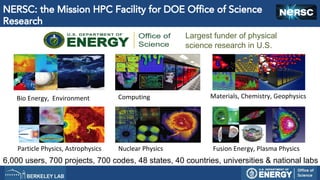
NERSC: the Mission HPC Facility for DOE Office of Science
Research
Bio Energy, Environment Computing
Particle Physics, Astrophysics
Largest funder of physical
science research in U.S.
Nuclear Physics
6,000 users, 700 projects, 700 codes, 48 states, 40 countries, universities & national labs
Materials, Chemistry, Geophysics
Fusion Energy, Plasma Physics
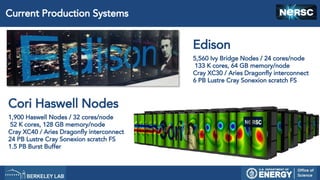
Current Production Systems
Edison
5,560 Ivy Bridge Nodes / 24 cores/node
133 K cores, 64 GB memory/node
Cray XC30 / Aries Dragonfly interconnect
6 PB Lustre Cray Sonexion scratch FS
Cori Haswell Nodes
1,900 Haswell Nodes / 32 cores/node
52 K cores, 128 GB memory/node
Cray XC40 / Aries Dragonfly interconnect
24 PB Lustre Cray Sonexion scratch FS
1.5 PB Burst Buffer
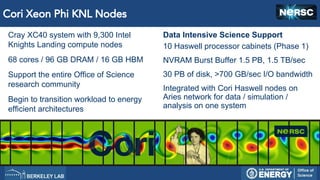
Cori Xeon Phi KNL Nodes
Cray XC40 system with 9,300 Intel
Knights Landing compute nodes
68 cores / 96 GB DRAM / 16 GB HBM
Support the entire Office of Science
research community
Begin to transition workload to energy
efficient architectures
Data Intensive Science Support
10 Haswell processor cabinets (Phase 1)
NVRAM Burst Buffer 1.5 PB, 1.5 TB/sec
30 PB of disk, >700 GB/sec I/O bandwidth
Integrated with Cori Haswell nodes on
Aries network for data / simulation /
analysis on one system
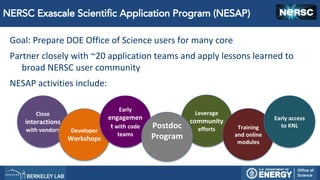
NERSC Exascale Scientific Application Program (NESAP)
Goal: Prepare DOE Office of Science users for many core
Partner closely with ~20 application teams and apply lessons learned to
broad NERSC user community
NESAP activities include:
Leverage
community
efforts
Close
interactions
with vendors Developer
Workshops
Early
engagemen
t with code
teams
Postdoc
Program
Training
and online
modules
Early access
to KNL
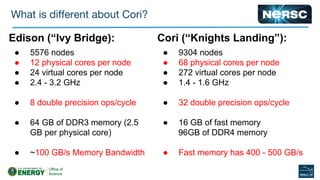
Edison (“Ivy Bridge):
● 5576 nodes
● 12 physical cores per node
● 24 virtual cores per node
● 2.4 - 3.2 GHz
● 8 double precision ops/cycle
● 64 GB of DDR3 memory (2.5
GB per physical core)
● ~100 GB/s Memory Bandwidth
Cori (“Knights Landing”):
● 9304 nodes
● 68 physical cores per node
● 272 virtual cores per node
● 1.4 - 1.6 GHz
● 32 double precision ops/cycle
● 16 GB of fast memory
96GB of DDR4 memory
● Fast memory has 400 - 500 GB/s
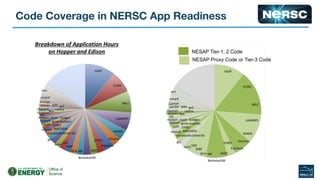
Breakdown of Application Hours
on Hopper and Edison
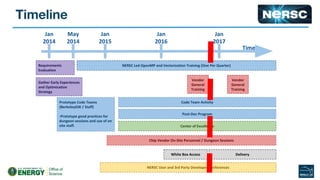
Time
Jan
2014
May
2014
Jan
2015
Jan
2016
Jan
2017
Prototype Code Teams
(BerkeleyGW / Staff)
-Prototype good practices for
dungeon sessions and use of on
site staff.
Requirements
Evaluation
Gather Early Experiences
and Optimization
Strategy
Vendor
General
Training
Vendor
General
Training
NERSC Led OpenMP and Vectorization Training (One Per Quarter)
Post-Doc Program
NERSC User and 3rd Party Developer Conferences
Code Team Activity
Chip Vendor On-Site Personnel / Dungeon Sessions
Center of Excellence
White Box Access Delivery
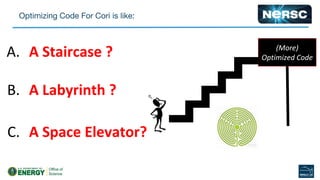
A. A Staircase ?
B. A Labyrinth ?
C. A Space Elevator?
(More)
Optimized Code
- 12 -
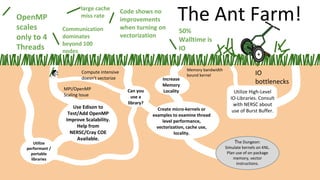
MPI/OpenMP
Scaling Issue
IO
bottlenecks
Use Edison to
Test/Add OpenMP
Improve Scalability.
Help from
NERSC/Cray COE
Available.
Utilize High-Level
IO-Libraries. Consult
with NERSC about
use of Burst Buffer.
Utilize
performant /
portable
libraries
The Dungeon:
Simulate kernels on KNL.
Plan use of on package
memory, vector
instructions.
The Ant Farm!Communication
dominates
beyond 100
nodes
Code shows no
improvements
when turning on
vectorization
OpenMP
scales
only to 4
Threads
large cache
miss rate
50%
Walltime is
IO
Compute intensive
doesn’t vectorize
Can you
use a
library?
Create micro-kernels or
examples to examine thread
level performance,
vectorization, cache use,
locality.
Increase
Memory
Locality
Memory bandwidth
bound kernel
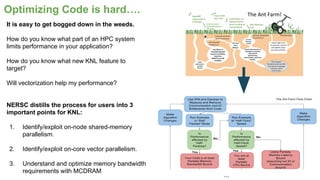
It is easy to get bogged down in the weeds.
How do you know what part of an HPC system
limits performance in your application?
How do you know what new KNL feature to
target?
Will vectorization help my performance?
NERSC distills the process for users into 3
important points for KNL:
1. Identify/exploit on-node shared-memory
parallelism.
2. Identify/exploit on-core vector parallelism.
3. Understand and optimize memory bandwidth
requirements with MCDRAM
Optimizing Code is hard….
...
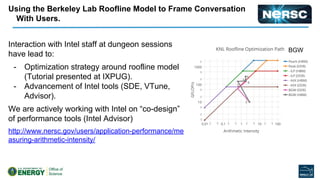
Using the Berkeley Lab Roofline Model to Frame Conversation
With Users.
Interaction with Intel staff at dungeon sessions
have lead to:
- Optimization strategy around roofline model
(Tutorial presented at IXPUG).
- Advancement of Intel tools (SDE, VTune,
Advisor).
We are actively working with Intel on “co-design”
of performance tools (Intel Advisor)
http://www.nersc.gov/users/application-performance/me
asuring-arithmetic-intensity/
BGW
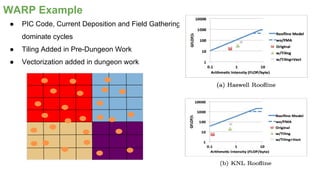
WARP Example
● PIC Code, Current Deposition and Field Gathering
dominate cycles
● Tiling Added in Pre-Dungeon Work
● Vectorization added in dungeon work
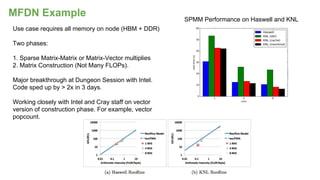
MFDN Example
Use case requires all memory on node (HBM + DDR)
Two phases:
1. Sparse Matrix-Matrix or Matrix-Vector multiplies
2. Matrix Construction (Not Many FLOPs).
Major breakthrough at Dungeon Session with Intel.
Code sped up by > 2x in 3 days.
Working closely with Intel and Cray staff on vector
version of construction phase. For example, vector
popcount.
SPMM Performance on Haswell and KNL
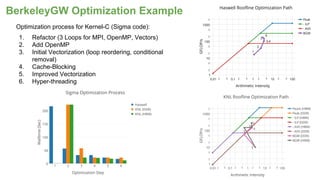
BerkeleyGW Optimization Example
Optimization process for Kernel-C (Sigma code):
1. Refactor (3 Loops for MPI, OpenMP, Vectors)
2. Add OpenMP
3. Initial Vectorization (loop reordering, conditional
removal)
4. Cache-Blocking
5. Improved Vectorization
6. Hyper-threading
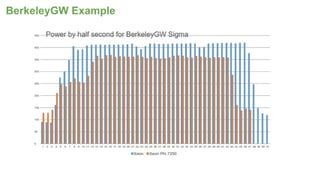
BerkeleyGW Example
● Edison (Ivy Bridge) and Cori (KNL)
● 2 Nodes, 1 core per node
● Bandwidth
○ Point-to-point (pp)
○ Streaming (bw)
○ Bi-directional streaming (bibw)
● Latency
○ Point-to-Point
● Data collected in quad, flat mode
KNL single core:
● Bandwidth is ~0.8x that of Ivy Bridge
● Latency is ~2x higher
MPI Micro-benchmarks
Using OSU MPI benchmark suite:
http://mvapich.cse.ohio-state.edu/benchmarks/
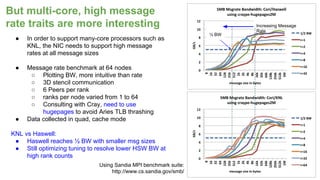
● In order to support many-core processors such as
KNL, the NIC needs to support high message
rates at all message sizes
● Message rate benchmark at 64 nodes
○ Plotting BW, more intuitive than rate
○ 3D stencil communication
○ 6 Peers per rank
○ ranks per node varied from 1 to 64
○ Consulting with Cray, need to use
hugepages to avoid Aries TLB thrashing
● Data collected in quad, cache mode
KNL vs Haswell:
● Haswell reaches ½ BW with smaller msg sizes
● Still optimizing tuning to resolve lower HSW BW at
high rank counts
But multi-core, high message
rate traits are more interesting
Using Sandia MPI benchmark suite:
http://www.cs.sandia.gov/smb/
Increasing Message
Rate
½ BW
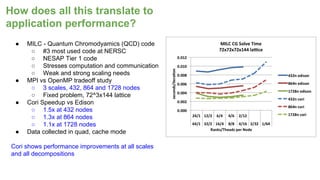
● MILC - Quantum Chromodyamics (QCD) code
○ #3 most used code at NERSC
○ NESAP Tier 1 code
○ Stresses computation and communication
○ Weak and strong scaling needs
● MPI vs OpenMP tradeoff study
○ 3 scales, 432, 864 and 1728 nodes
○ Fixed problem, 72^3x144 lattice
● Cori Speedup vs Edison
○ 1.5x at 432 nodes
○ 1.3x at 864 nodes
○ 1.1x at 1728 nodes
● Data collected in quad, cache mode
Cori shows performance improvements at all scales
and all decompositions
How does all this translate to
application performance?
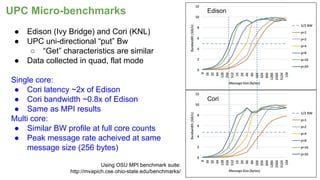
● Edison (Ivy Bridge) and Cori (KNL)
● UPC uni-directional “put” Bw
○ “Get” characteristics are similar
● Data collected in quad, flat mode
Single core:
● Cori latency ~2x of Edison
● Cori bandwidth ~0.8x of Edison
● Same as MPI results
Multi core:
● Similar BW profile at full core counts
● Peak message rate acheived at same
message size (256 bytes)
UPC Micro-benchmarks
Using OSU MPI benchmark suite:
http://mvapich.cse.ohio-state.edu/benchmarks/
Edison
Cori
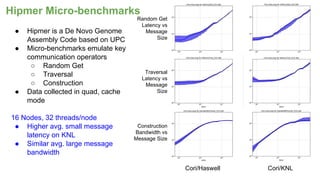
● Hipmer is a De Novo Genome
Assembly Code based on UPC
● Micro-benchmarks emulate key
communication operators
○ Random Get
○ Traversal
○ Construction
● Data collected in quad, cache
mode
16 Nodes, 32 threads/node
● Higher avg. small message
latency on KNL
● Similar avg. large message
bandwidth
Hipmer Micro-benchmarks
Cori/Haswell Cori/KNL
Random Get
Latency vs
Message
Size
Traversal
Latency vs
Message
Size
Construction
Bandwidth vs
Message Size
Manycores for the Masses

Manycores for the Masses

  • 1.
    Many-Cores for the Masses:Optimizing Large Scale Science Applications on Cori
  • 3.
    NERSC: the MissionHPC Facility for DOE Office of Science Research Bio Energy, Environment Computing Particle Physics, Astrophysics Largest funder of physical science research in U.S. Nuclear Physics 6,000 users, 700 projects, 700 codes, 48 states, 40 countries, universities & national labs Materials, Chemistry, Geophysics Fusion Energy, Plasma Physics
  • 4.
    Current Production Systems Edison 5,560Ivy Bridge Nodes / 24 cores/node 133 K cores, 64 GB memory/node Cray XC30 / Aries Dragonfly interconnect 6 PB Lustre Cray Sonexion scratch FS Cori Haswell Nodes 1,900 Haswell Nodes / 32 cores/node 52 K cores, 128 GB memory/node Cray XC40 / Aries Dragonfly interconnect 24 PB Lustre Cray Sonexion scratch FS 1.5 PB Burst Buffer
  • 5.
    Cori Xeon PhiKNL Nodes Cray XC40 system with 9,300 Intel Knights Landing compute nodes 68 cores / 96 GB DRAM / 16 GB HBM Support the entire Office of Science research community Begin to transition workload to energy efficient architectures Data Intensive Science Support 10 Haswell processor cabinets (Phase 1) NVRAM Burst Buffer 1.5 PB, 1.5 TB/sec 30 PB of disk, >700 GB/sec I/O bandwidth Integrated with Cori Haswell nodes on Aries network for data / simulation / analysis on one system
  • 6.
    NERSC Exascale ScientificApplication Program (NESAP) Goal: Prepare DOE Office of Science users for many core Partner closely with ~20 application teams and apply lessons learned to broad NERSC user community NESAP activities include: Leverage community efforts Close interactions with vendors Developer Workshops Early engagemen t with code teams Postdoc Program Training and online modules Early access to KNL
  • 8.
    Edison (“Ivy Bridge): ●5576 nodes ● 12 physical cores per node ● 24 virtual cores per node ● 2.4 - 3.2 GHz ● 8 double precision ops/cycle ● 64 GB of DDR3 memory (2.5 GB per physical core) ● ~100 GB/s Memory Bandwidth Cori (“Knights Landing”): ● 9304 nodes ● 68 physical cores per node ● 272 virtual cores per node ● 1.4 - 1.6 GHz ● 32 double precision ops/cycle ● 16 GB of fast memory 96GB of DDR4 memory ● Fast memory has 400 - 500 GB/s
  • 9.
    Breakdown of ApplicationHours on Hopper and Edison
  • 10.
    Time Jan 2014 May 2014 Jan 2015 Jan 2016 Jan 2017 Prototype Code Teams (BerkeleyGW/ Staff) -Prototype good practices for dungeon sessions and use of on site staff. Requirements Evaluation Gather Early Experiences and Optimization Strategy Vendor General Training Vendor General Training NERSC Led OpenMP and Vectorization Training (One Per Quarter) Post-Doc Program NERSC User and 3rd Party Developer Conferences Code Team Activity Chip Vendor On-Site Personnel / Dungeon Sessions Center of Excellence White Box Access Delivery
  • 11.
    A. A Staircase? B. A Labyrinth ? C. A Space Elevator? (More) Optimized Code
  • 12.
    - 12 - MPI/OpenMP ScalingIssue IO bottlenecks Use Edison to Test/Add OpenMP Improve Scalability. Help from NERSC/Cray COE Available. Utilize High-Level IO-Libraries. Consult with NERSC about use of Burst Buffer. Utilize performant / portable libraries The Dungeon: Simulate kernels on KNL. Plan use of on package memory, vector instructions. The Ant Farm!Communication dominates beyond 100 nodes Code shows no improvements when turning on vectorization OpenMP scales only to 4 Threads large cache miss rate 50% Walltime is IO Compute intensive doesn’t vectorize Can you use a library? Create micro-kernels or examples to examine thread level performance, vectorization, cache use, locality. Increase Memory Locality Memory bandwidth bound kernel
  • 13.
    It is easyto get bogged down in the weeds. How do you know what part of an HPC system limits performance in your application? How do you know what new KNL feature to target? Will vectorization help my performance? NERSC distills the process for users into 3 important points for KNL: 1. Identify/exploit on-node shared-memory parallelism. 2. Identify/exploit on-core vector parallelism. 3. Understand and optimize memory bandwidth requirements with MCDRAM Optimizing Code is hard…. ...
  • 14.
    Using the BerkeleyLab Roofline Model to Frame Conversation With Users. Interaction with Intel staff at dungeon sessions have lead to: - Optimization strategy around roofline model (Tutorial presented at IXPUG). - Advancement of Intel tools (SDE, VTune, Advisor). We are actively working with Intel on “co-design” of performance tools (Intel Advisor) http://www.nersc.gov/users/application-performance/me asuring-arithmetic-intensity/ BGW
  • 20.
    WARP Example ● PICCode, Current Deposition and Field Gathering dominate cycles ● Tiling Added in Pre-Dungeon Work ● Vectorization added in dungeon work
  • 21.
    MFDN Example Use caserequires all memory on node (HBM + DDR) Two phases: 1. Sparse Matrix-Matrix or Matrix-Vector multiplies 2. Matrix Construction (Not Many FLOPs). Major breakthrough at Dungeon Session with Intel. Code sped up by > 2x in 3 days. Working closely with Intel and Cray staff on vector version of construction phase. For example, vector popcount. SPMM Performance on Haswell and KNL
  • 22.
    BerkeleyGW Optimization Example Optimizationprocess for Kernel-C (Sigma code): 1. Refactor (3 Loops for MPI, OpenMP, Vectors) 2. Add OpenMP 3. Initial Vectorization (loop reordering, conditional removal) 4. Cache-Blocking 5. Improved Vectorization 6. Hyper-threading
  • 23.
  • 27.
    ● Edison (IvyBridge) and Cori (KNL) ● 2 Nodes, 1 core per node ● Bandwidth ○ Point-to-point (pp) ○ Streaming (bw) ○ Bi-directional streaming (bibw) ● Latency ○ Point-to-Point ● Data collected in quad, flat mode KNL single core: ● Bandwidth is ~0.8x that of Ivy Bridge ● Latency is ~2x higher MPI Micro-benchmarks Using OSU MPI benchmark suite: http://mvapich.cse.ohio-state.edu/benchmarks/
  • 28.
    ● In orderto support many-core processors such as KNL, the NIC needs to support high message rates at all message sizes ● Message rate benchmark at 64 nodes ○ Plotting BW, more intuitive than rate ○ 3D stencil communication ○ 6 Peers per rank ○ ranks per node varied from 1 to 64 ○ Consulting with Cray, need to use hugepages to avoid Aries TLB thrashing ● Data collected in quad, cache mode KNL vs Haswell: ● Haswell reaches ½ BW with smaller msg sizes ● Still optimizing tuning to resolve lower HSW BW at high rank counts But multi-core, high message rate traits are more interesting Using Sandia MPI benchmark suite: http://www.cs.sandia.gov/smb/ Increasing Message Rate ½ BW
  • 29.
    ● MILC -Quantum Chromodyamics (QCD) code ○ #3 most used code at NERSC ○ NESAP Tier 1 code ○ Stresses computation and communication ○ Weak and strong scaling needs ● MPI vs OpenMP tradeoff study ○ 3 scales, 432, 864 and 1728 nodes ○ Fixed problem, 72^3x144 lattice ● Cori Speedup vs Edison ○ 1.5x at 432 nodes ○ 1.3x at 864 nodes ○ 1.1x at 1728 nodes ● Data collected in quad, cache mode Cori shows performance improvements at all scales and all decompositions How does all this translate to application performance?
  • 30.
    ● Edison (IvyBridge) and Cori (KNL) ● UPC uni-directional “put” Bw ○ “Get” characteristics are similar ● Data collected in quad, flat mode Single core: ● Cori latency ~2x of Edison ● Cori bandwidth ~0.8x of Edison ● Same as MPI results Multi core: ● Similar BW profile at full core counts ● Peak message rate acheived at same message size (256 bytes) UPC Micro-benchmarks Using OSU MPI benchmark suite: http://mvapich.cse.ohio-state.edu/benchmarks/ Edison Cori
  • 31.
    ● Hipmer isa De Novo Genome Assembly Code based on UPC ● Micro-benchmarks emulate key communication operators ○ Random Get ○ Traversal ○ Construction ● Data collected in quad, cache mode 16 Nodes, 32 threads/node ● Higher avg. small message latency on KNL ● Similar avg. large message bandwidth Hipmer Micro-benchmarks Cori/Haswell Cori/KNL Random Get Latency vs Message Size Traversal Latency vs Message Size Construction Bandwidth vs Message Size