4. The OS Kernel 4.1 Kernel Definitions and Objects 4.2 Queue Structures 4.3 Threads 4.4 Implementing Processes and Threads Process and Thread Descriptors Implementing the Operations 4.5 Implementing Synchronization and Communication Mechanisms Semaphores and Locks Building Monitor Primitives Clock and Time Management Communications Kernel 4.6 Interrupt Handling
Kernel Definitions and Objects Basic set of objects, primitives,  data structures, processes Rest of OS is built on top of kernel Kernel defines/provides  mechanisms to implement various  policies Process and thread management Interrupt and trap handling Resource management Input/output
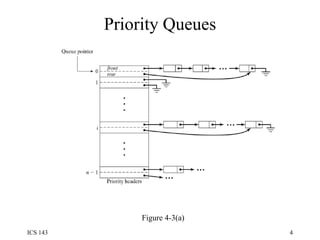
Queues OS needs many different queues Single-level queues Implemented as array Fixed size Efficient for simple FIFO operations Implemented as linked list Unbounded size More overhead, but more flexible operations
Priority Queues Figure 4-3(a)
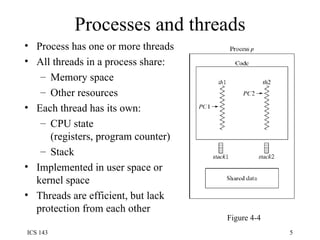
Processes and threads Process has one or more threads All threads in a process share: Memory space Other resources Each thread has its own: CPU state (registers, program counter) Stack Implemented in user space or kernel space Threads are efficient, but lack protection from each other Figure 4-4
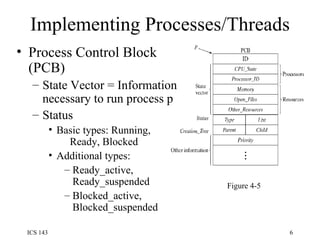
Implementing Processes/Threads Process Control Block (PCB) State Vector = Information necessary to run process p Status Basic types: Running,   Ready, Blocked Additional types: Ready_active,  Ready_suspended Blocked_active,  Blocked_suspended Figure 4-5
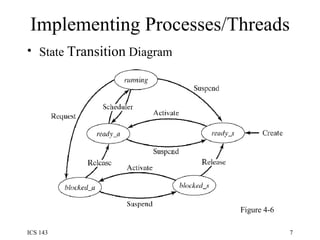
Implementing Processes/Threads State  Transition  Diagram Figure 4-6
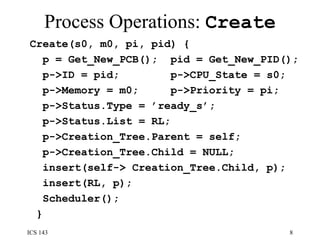
Process Operations:  Create Create(s0, m0, pi, pid) {  p = Get_New_PCB();  pid = Get_New_PID();  p->ID = pid;  p->CPU_State = s0;  p->Memory = m0;  p->Priority = pi;  p->Status.Type = ’ready_s’;  p->Status.List = RL;  p->Creation_Tree.Parent = self;  p->Creation_Tree.Child = NULL;  insert(self-> Creation_Tree.Child, p);  insert(RL, p); Scheduler();  }
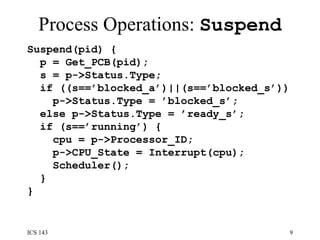
Process Operations:  Suspend Suspend(pid) {  p = Get_PCB(pid);  s = p->Status.Type;  if ((s==’blocked_a’)||(s==’blocked_s’)) p->Status.Type = ’blocked_s’; else p->Status.Type = ’ready_s’; if (s==’running’) { cpu = p->Processor_ID;  p->CPU_State = Interrupt(cpu); Scheduler(); }  }
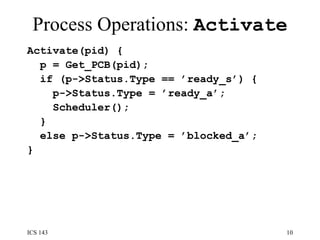
Process Operations:  Activate Activate(pid) {  p = Get_PCB(pid);  if (p->Status.Type == ’ready_s’) { p->Status.Type = ’ready_a’;  Scheduler();  }  else p->Status.Type = ’blocked_a’; }
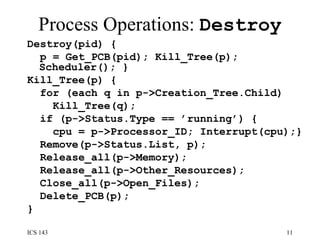
Process Operations:  Destroy Destroy(pid) {  p = Get_PCB(pid); Kill_Tree(p); Scheduler(); }  Kill_Tree(p) {  for (each q in p->Creation_Tree.Child) Kill_Tree(q);  if (p->Status.Type == ’running’) { cpu = p->Processor_ID; Interrupt(cpu);} Remove(p->Status.List, p);  Release_all(p->Memory);  Release_all(p->Other_Resources); Close_all(p->Open_Files);  Delete_PCB(p);  }
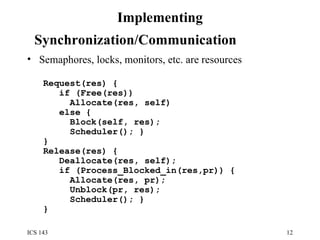
Implementing Synchronization/Communication   Semaphores, locks, monitors, etc. are resources Request(res) { if (Free(res)) Allocate(res, self) else { Block(self, res); Scheduler(); } } Release(res) { Deallocate(res, self); if (Process_Blocked_in(res,pr)) { Allocate(res, pr); Unblock(pr, res); Scheduler(); } }
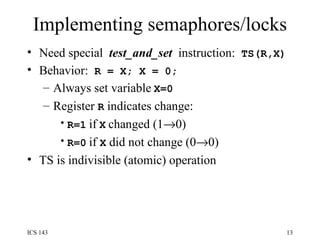
Implementing semaphores/locks Need special  test_and_set  instruction:  TS(R,X) Behavior:  R = X; X = 0; Always set variable   X=0 Register  R  indicates change: R=1   if   X   changed (1  0) R=0   if  X  did not change (0  0) TS is indivisible (atomic) operation
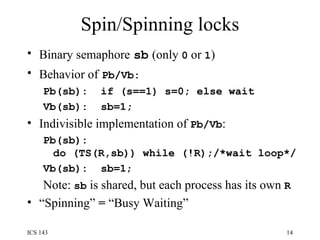
Spin/Spinning locks Binary semaphore   sb   (only  0  or  1 ) Behavior of   Pb/Vb: Pb(sb):  if (s==1) s=0; else wait Vb(sb):  sb=1; Indivisible implementation of  Pb/Vb : Pb(sb): do (TS(R,sb)) while (!R);/*wait loop*/ Vb(sb):  sb=1 ; Note:  sb  is shared, but each process has its own  R “ Spinning”  =  “Busy Waiting”
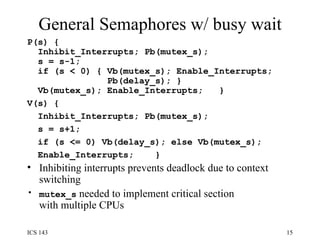
General Semaphores w/ busy wait P(s) {  Inhibit_Interrupts; Pb(mutex_s);  s = s-1;  if (s < 0) { Vb(mutex_s); Enable_Interrupts;  Pb(delay_s); }  Vb(mutex_s); Enable_Interrupts;  } V(s) {  Inhibit_Interrupts; Pb(mutex_s);  s = s+1;  if (s <= 0) Vb(delay_s); else Vb(mutex_s);  Enable_Interrupts;  } Inhibiting interrupts prevents deadlock due to context switching mutex_s  needed to implement critical section with multiple CPUs
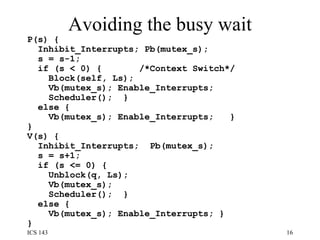
Avoiding the busy wait P(s) {  Inhibit_Interrupts; Pb(mutex_s);  s = s-1;  if (s < 0) {  /*Context Switch*/  Block(self, Ls);  Vb(mutex_s); Enable_Interrupts; Scheduler();  }  else {  Vb(mutex_s); Enable_Interrupts;  }  } V(s) {  Inhibit_Interrupts;  Pb(mutex_s);  s = s+1;  if (s <= 0) {  Unblock(q, Ls);  Vb(mutex_s);  Scheduler();  }  else {  Vb(mutex_s); Enable_Interrupts; }  }
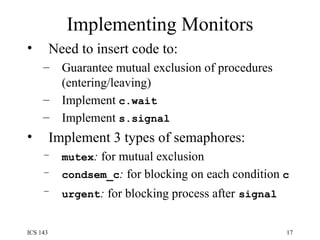
Implementing Monitors Need to insert code to: Guarantee mutual exclusion of procedures (entering/leaving) Implement  c.wait Implement  s.signal Implement 3 types of semaphores: mutex :  for mutual exclusion condsem_c :  for blocking on each condition  c urgent :  for blocking process after   signal
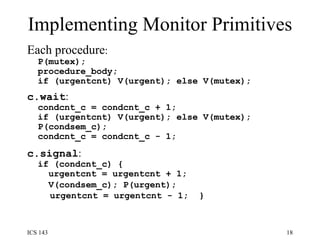
Implementing Monitor Primitives Each procedure : P(mutex);  procedure_body;  if (urgentcnt) V(urgent); else V(mutex);   c.wait : condcnt_c = condcnt_c + 1;  if (urgentcnt) V(urgent); else V(mutex);  P(condsem_c);  condcnt_c = condcnt_c - 1;   c.signal : if (condcnt_c) {  urgentcnt = urgentcnt + 1;  V(condsem_c); P(urgent);   urgentcnt = urgentcnt - 1;  }
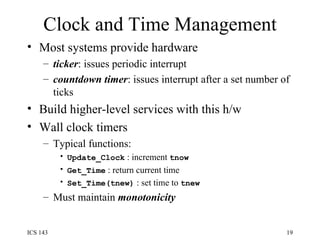
Clock and Time Management Most systems provide hardware ticker : issues periodic interrupt  countdown timer : issues interrupt after a set number of ticks Build higher-level services with this h/w Wall clock timers Typical functions: Update_Clock  : increment  tnow Get_Time  : return current time Set_Time(tnew)  : set time to  tnew Must maintain  monotonicity
Clock and Time Management Countdown timers Main use: as alarm clocks Typical function: Delay(tdel)   block process for   tdel   time units Implementation using hardware countdown: Delay(tdel) { Set_Timer(tdel);  /*set hardware timer*/ P(delsem);  /*wait for interrupt*/ } Timeout() {  /*called at interrupt*/ V(delsem); }
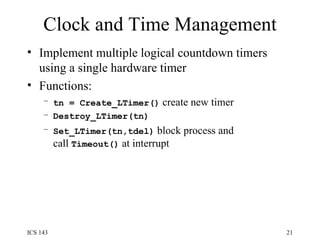
Clock and Time Management Implement multiple logical countdown timers using a single hardware timer Functions: tn = Create_LTimer()  create new timer Destroy_LTimer(tn) Set_LTimer(tn,tdel)  block process and call  Timeout()  at interrupt
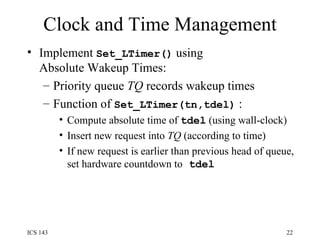
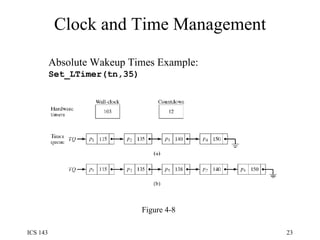
Clock and Time Management Implement  Set_LTimer()  using Absolute Wakeup Times: Priority queue  TQ  records wakeup times Function of  Set_LTimer(tn,tdel)   : Compute absolute time of  tdel  (using wall-clock) Insert new request into  TQ  (according to time) If new request is earlier than previous head of queue, set hardware countdown to  tdel
Clock and Time Management Figure 4-8 Absolute Wakeup Times Example: Set_LTimer(tn,35)
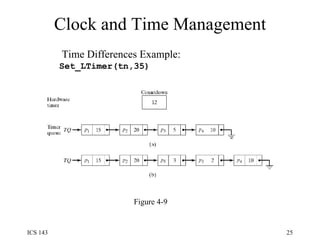
Clock and time management Implement  Set_LTimer()  using  Time Differences Priority queue  TQ  records only time increments, no wall-clock is needed Function of  Set_LTimer(tn,tdel) Find the two elements  L  and  R  between which tdel  is to be inserted (add differences until tdel  is reached) split the current difference between  L  and  R into difference between  L  and new element and difference between new element and  R
Clock and Time Management Time Differences Example: Set_LTimer(tn,35) Figure 4-9
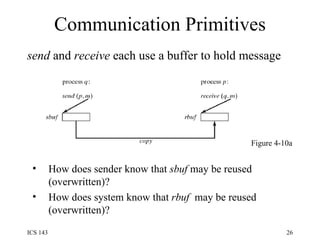
Communication Primitives send  and  receive  each use a buffer to hold message Figure 4-10a How does sender know that  sbuf  may be reused (overwritten)? How does system know that  rbuf   may be reused (overwritten)?
Communication Primitives Reusing  sbuf : Use blocking send:   reuse as soon as  send  returns Provide a flag or interrupt   for system to indicate release of  sbuf Reusing  rbuf : Provide a flag   for sender to indicate release of  rbuf Solutions are awkward
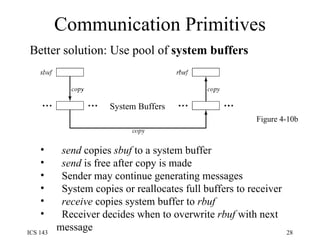
Communication Primitives Better solution: Use pool of  system buffers Figure 4-10b send  copies  sbuf  to a system buffer send  is free after copy is made Sender may continue generating messages System copies or reallocates full buffers to receiver receive  copies system buffer to  rbuf Receiver decides when to overwrite  rbuf  with next message System Buffers
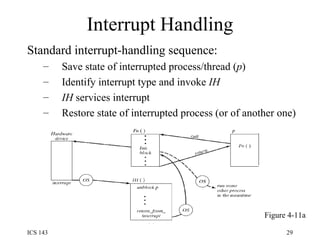
Interrupt Handling Standard interrupt-handling sequence: Save state of interrupted process/thread ( p ) Identify interrupt type and invoke  IH IH  services interrupt Restore state of interrupted process (or of another one) Figure 4-11a
Interrupt Handling Main challenges: Fn  must be able to block itself on a given event. Lowest-level  Fn  is generally provided by OS IH  must be able to unblock  p  and to return from interrupt. IH  is generally provided by OS
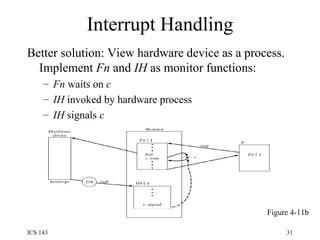
Interrupt Handling Better solution: View hardware device as a process. Implement  Fn  and  IH  as monitor functions: Fn  waits on  c IH  invoked by hardware process IH  signals  c Figure 4-11b

Os4

  • 1.
    4. The OSKernel 4.1 Kernel Definitions and Objects 4.2 Queue Structures 4.3 Threads 4.4 Implementing Processes and Threads Process and Thread Descriptors Implementing the Operations 4.5 Implementing Synchronization and Communication Mechanisms Semaphores and Locks Building Monitor Primitives Clock and Time Management Communications Kernel 4.6 Interrupt Handling
  • 2.
    Kernel Definitions andObjects Basic set of objects, primitives, data structures, processes Rest of OS is built on top of kernel Kernel defines/provides mechanisms to implement various policies Process and thread management Interrupt and trap handling Resource management Input/output
  • 3.
    Queues OS needsmany different queues Single-level queues Implemented as array Fixed size Efficient for simple FIFO operations Implemented as linked list Unbounded size More overhead, but more flexible operations
  • 4.
  • 5.
    Processes and threadsProcess has one or more threads All threads in a process share: Memory space Other resources Each thread has its own: CPU state (registers, program counter) Stack Implemented in user space or kernel space Threads are efficient, but lack protection from each other Figure 4-4
  • 6.
    Implementing Processes/Threads ProcessControl Block (PCB) State Vector = Information necessary to run process p Status Basic types: Running, Ready, Blocked Additional types: Ready_active, Ready_suspended Blocked_active, Blocked_suspended Figure 4-5
  • 7.
    Implementing Processes/Threads State Transition Diagram Figure 4-6
  • 8.
    Process Operations: Create Create(s0, m0, pi, pid) { p = Get_New_PCB(); pid = Get_New_PID(); p->ID = pid; p->CPU_State = s0; p->Memory = m0; p->Priority = pi; p->Status.Type = ’ready_s’; p->Status.List = RL; p->Creation_Tree.Parent = self; p->Creation_Tree.Child = NULL; insert(self-> Creation_Tree.Child, p); insert(RL, p); Scheduler(); }
  • 9.
    Process Operations: Suspend Suspend(pid) { p = Get_PCB(pid); s = p->Status.Type; if ((s==’blocked_a’)||(s==’blocked_s’)) p->Status.Type = ’blocked_s’; else p->Status.Type = ’ready_s’; if (s==’running’) { cpu = p->Processor_ID; p->CPU_State = Interrupt(cpu); Scheduler(); } }
  • 10.
    Process Operations: Activate Activate(pid) { p = Get_PCB(pid); if (p->Status.Type == ’ready_s’) { p->Status.Type = ’ready_a’; Scheduler(); } else p->Status.Type = ’blocked_a’; }
  • 11.
    Process Operations: Destroy Destroy(pid) { p = Get_PCB(pid); Kill_Tree(p); Scheduler(); } Kill_Tree(p) { for (each q in p->Creation_Tree.Child) Kill_Tree(q); if (p->Status.Type == ’running’) { cpu = p->Processor_ID; Interrupt(cpu);} Remove(p->Status.List, p); Release_all(p->Memory); Release_all(p->Other_Resources); Close_all(p->Open_Files); Delete_PCB(p); }
  • 12.
    Implementing Synchronization/Communication Semaphores, locks, monitors, etc. are resources Request(res) { if (Free(res)) Allocate(res, self) else { Block(self, res); Scheduler(); } } Release(res) { Deallocate(res, self); if (Process_Blocked_in(res,pr)) { Allocate(res, pr); Unblock(pr, res); Scheduler(); } }
  • 13.
    Implementing semaphores/locks Needspecial test_and_set instruction: TS(R,X) Behavior: R = X; X = 0; Always set variable X=0 Register R indicates change: R=1 if X changed (1  0) R=0 if X did not change (0  0) TS is indivisible (atomic) operation
  • 14.
    Spin/Spinning locks Binarysemaphore sb (only 0 or 1 ) Behavior of Pb/Vb: Pb(sb): if (s==1) s=0; else wait Vb(sb): sb=1; Indivisible implementation of Pb/Vb : Pb(sb): do (TS(R,sb)) while (!R);/*wait loop*/ Vb(sb): sb=1 ; Note: sb is shared, but each process has its own R “ Spinning” = “Busy Waiting”
  • 15.
    General Semaphores w/busy wait P(s) { Inhibit_Interrupts; Pb(mutex_s); s = s-1; if (s < 0) { Vb(mutex_s); Enable_Interrupts; Pb(delay_s); } Vb(mutex_s); Enable_Interrupts; } V(s) { Inhibit_Interrupts; Pb(mutex_s); s = s+1; if (s <= 0) Vb(delay_s); else Vb(mutex_s); Enable_Interrupts; } Inhibiting interrupts prevents deadlock due to context switching mutex_s needed to implement critical section with multiple CPUs
  • 16.
    Avoiding the busywait P(s) { Inhibit_Interrupts; Pb(mutex_s); s = s-1; if (s < 0) { /*Context Switch*/ Block(self, Ls); Vb(mutex_s); Enable_Interrupts; Scheduler(); } else { Vb(mutex_s); Enable_Interrupts; } } V(s) { Inhibit_Interrupts; Pb(mutex_s); s = s+1; if (s <= 0) { Unblock(q, Ls); Vb(mutex_s); Scheduler(); } else { Vb(mutex_s); Enable_Interrupts; } }
  • 17.
    Implementing Monitors Needto insert code to: Guarantee mutual exclusion of procedures (entering/leaving) Implement c.wait Implement s.signal Implement 3 types of semaphores: mutex : for mutual exclusion condsem_c : for blocking on each condition c urgent : for blocking process after signal
  • 18.
    Implementing Monitor PrimitivesEach procedure : P(mutex); procedure_body; if (urgentcnt) V(urgent); else V(mutex); c.wait : condcnt_c = condcnt_c + 1; if (urgentcnt) V(urgent); else V(mutex); P(condsem_c); condcnt_c = condcnt_c - 1; c.signal : if (condcnt_c) { urgentcnt = urgentcnt + 1; V(condsem_c); P(urgent); urgentcnt = urgentcnt - 1; }
  • 19.
    Clock and TimeManagement Most systems provide hardware ticker : issues periodic interrupt countdown timer : issues interrupt after a set number of ticks Build higher-level services with this h/w Wall clock timers Typical functions: Update_Clock : increment tnow Get_Time : return current time Set_Time(tnew) : set time to tnew Must maintain monotonicity
  • 20.
    Clock and TimeManagement Countdown timers Main use: as alarm clocks Typical function: Delay(tdel) block process for tdel time units Implementation using hardware countdown: Delay(tdel) { Set_Timer(tdel); /*set hardware timer*/ P(delsem); /*wait for interrupt*/ } Timeout() { /*called at interrupt*/ V(delsem); }
  • 21.
    Clock and TimeManagement Implement multiple logical countdown timers using a single hardware timer Functions: tn = Create_LTimer() create new timer Destroy_LTimer(tn) Set_LTimer(tn,tdel) block process and call Timeout() at interrupt
  • 22.
    Clock and TimeManagement Implement Set_LTimer() using Absolute Wakeup Times: Priority queue TQ records wakeup times Function of Set_LTimer(tn,tdel) : Compute absolute time of tdel (using wall-clock) Insert new request into TQ (according to time) If new request is earlier than previous head of queue, set hardware countdown to tdel
  • 23.
    Clock and TimeManagement Figure 4-8 Absolute Wakeup Times Example: Set_LTimer(tn,35)
  • 24.
    Clock and timemanagement Implement Set_LTimer() using Time Differences Priority queue TQ records only time increments, no wall-clock is needed Function of Set_LTimer(tn,tdel) Find the two elements L and R between which tdel is to be inserted (add differences until tdel is reached) split the current difference between L and R into difference between L and new element and difference between new element and R
  • 25.
    Clock and TimeManagement Time Differences Example: Set_LTimer(tn,35) Figure 4-9
  • 26.
    Communication Primitives send and receive each use a buffer to hold message Figure 4-10a How does sender know that sbuf may be reused (overwritten)? How does system know that rbuf may be reused (overwritten)?
  • 27.
    Communication Primitives Reusing sbuf : Use blocking send: reuse as soon as send returns Provide a flag or interrupt for system to indicate release of sbuf Reusing rbuf : Provide a flag for sender to indicate release of rbuf Solutions are awkward
  • 28.
    Communication Primitives Bettersolution: Use pool of system buffers Figure 4-10b send copies sbuf to a system buffer send is free after copy is made Sender may continue generating messages System copies or reallocates full buffers to receiver receive copies system buffer to rbuf Receiver decides when to overwrite rbuf with next message System Buffers
  • 29.
    Interrupt Handling Standardinterrupt-handling sequence: Save state of interrupted process/thread ( p ) Identify interrupt type and invoke IH IH services interrupt Restore state of interrupted process (or of another one) Figure 4-11a
  • 30.
    Interrupt Handling Mainchallenges: Fn must be able to block itself on a given event. Lowest-level Fn is generally provided by OS IH must be able to unblock p and to return from interrupt. IH is generally provided by OS
  • 31.
    Interrupt Handling Bettersolution: View hardware device as a process. Implement Fn and IH as monitor functions: Fn waits on c IH invoked by hardware process IH signals c Figure 4-11b