Operating Systems Principles Memory Management Lecture 9: Sharing of Code and Data in Main Memory 主講人:虞台文
Content Single-Copy Sharing  Reasons of Sharing  Requirements for Sharing  Static Linking and Sharing  Sharing in Systems w/o Segmentation or Paging  Sharing in Paging Systems  Sharing in Segmented Systems  Dynamic Linking and Sharing  Principles of Distributed Shared Memory (DSM)  The User's View of DSM  Implementations of DSM  Implementing Unstructured DSM  Implementing Structured DSM
Operating Systems Principles Memory Management Lecture 9: Sharing of Code and Data in Main Memory Single-Copy Sharing
Sharing Reusing  Software Modules Individual software modules are  constructed separately . Develop applications by  linking  with other well-developed  software modules . Reduce  software developing  cost . Each process owns  private copy  of shared objects Single-Copy  Sharing Processes  share  a single copy of  code  or  data  in memory Why ? What ? How ?
Why? Processes need to  access  common  data , e.g., Communication  btw producer & consumer Cooperation  among divide-and-conquer processes Competition  on resources Better  utilization  of memory (code & data) Several active processes use the same code or data at the same time, e.g.,  many users  running the same  editor  or  debugger  in a  time-sharing system   Without  sharing,  memory requirement  would  increase  dramatically and, thus,  reduce  the number of login  users . increase  I/O overhead  to load excess copies increase the  page fault rate  and, thus, the risk of  thrashing .
What? OS  kernel   routines   I/O  drivers System  services , e.g., memory  management and  file  manipulation routines. System  utilities , e.g., Compiler ,  linker ,  loader  and  debugger . User-lever  applications A single copy of  the same code  applies to  different data sets .
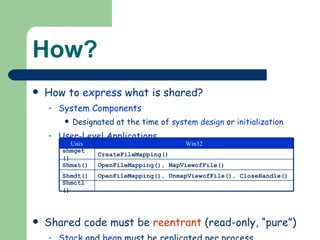
How? How to  express  what is shared? System Components Designated at the time of  system design  or  initialization User-Level Applications Shared code must be  reentrant  (read-only, “pure”) Stack  and  heap  must be replicated per process OpenFileMapping(),  UnmapViewofFile (), CloseHandle() Shmdt () Shmctl () OpenFileMapping (),  MapViewofFile () Shmat () CreateFileMapping () shmget () Win32 Unix
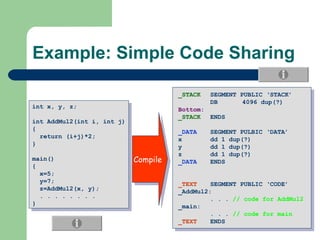
Example: Simple Code Sharing _STACK SEGMENT PUBLIC ‘STACK’ DB 4096 dup(?) Bottom: _STACK ENDS _DATA SEGMENT PULBIC ‘DATA’ x dd 1 dup(?) y dd 1 dup(?) z dd 1 dup(?) _DATA ENDS _TEXT   SEGMENT PUBLIC ‘CODE’ _AddMul2: . . .  // code for AddMul2 _main: . . .  // code for main _TEXT ENDS int x, y, z; int AddMul2(int i, int j) { return (i+j)*2; } main() { x=5; y=7; z=AddMul2(x, y); . . . . . . . . } Compile
Example: Simple Code Sharing _STACK SEGMENT PUBLIC ‘STACK’ DB 4096 dup(?) Bottom: _STACK ENDS _DATA SEGMENT PULBIC ‘DATA’ x dd 1 dup(?) y dd 1 dup(?) z dd 1 dup(?) _DATA ENDS _TEXT   SEGMENT PUBLIC ‘CODE’ _AddMul2: . . .  // code for AddMul2 _main: . . .  // code for main _TEXT ENDS int x, y, z; int AddMul2(int i, int j) { return (i+j)*2; } main() { x=5; y=7; z=AddMul2(x, y); . . . . . . . . } _main: mov  ds:[x],5 mov  ds:[y],7 push ds:[y] push ds:[x] call _AddMul2 add  esp,8 mov  ds:[z],eax . . . . . .
Example: Simple Code Sharing _STACK SEGMENT PUBLIC ‘STACK’ DB 4096 dup(?) Bottom: _STACK ENDS _DATA SEGMENT PULBIC ‘DATA’ x dd 1 dup(?) y dd 1 dup(?) z dd 1 dup(?) _DATA ENDS _TEXT   SEGMENT PUBLIC ‘CODE’ _AddMul2: . . .  // code for AddMul2 _main: . . .  // code for main _TEXT ENDS int x, y, z; int AddMul2(int i, int j) { return (i+j)*2; } main() { x=5; y=7; z=AddMul2(x, y); . . . . . . . . } _main: mov  ds:[x],5 mov  ds:[y],7 push ds:[y] push ds:[x] call _AddMul2 add  esp,8 mov  ds:[z],eax . . . . . . . . . esp
Example: Simple Code Sharing _STACK SEGMENT PUBLIC ‘STACK’ DB 4096 dup(?) Bottom: _STACK ENDS _DATA SEGMENT PULBIC ‘DATA’ x dd 1 dup(?) y dd 1 dup(?) z dd 1 dup(?) _DATA ENDS _TEXT   SEGMENT PUBLIC ‘CODE’ _AddMul2: . . .  // code for AddMul2 _main: . . .  // code for main _TEXT ENDS int x, y, z; int AddMul2(int i, int j) { return (i+j)*2; } main() { x=5; y=7; z=AddMul2(x, y); . . . . . . . . } _main: mov  ds:[x],5 mov  ds:[y],7 push ds:[y] push ds:[x] call _AddMul2 add  esp,8 mov  ds:[z],eax . . . . . . 5 . . . esp
Example: Simple Code Sharing _STACK SEGMENT PUBLIC ‘STACK’ DB 4096 dup(?) Bottom: _STACK ENDS _DATA SEGMENT PULBIC ‘DATA’ x dd 1 dup(?) y dd 1 dup(?) z dd 1 dup(?) _DATA ENDS _TEXT   SEGMENT PUBLIC ‘CODE’ _AddMul2: . . .  // code for AddMul2 _main: . . .  // code for main _TEXT ENDS int x, y, z; int AddMul2(int i, int j) { return (i+j)*2; } main() { x=5; y=7; z=AddMul2(x, y); . . . . . . . . } _main: mov  ds:[x],5 mov  ds:[y],7 push ds:[y] push ds:[x] call _AddMul2 add  esp,8 mov  ds:[z],eax . . . . . . 5 7 . . . esp
Example: Simple Code Sharing _STACK SEGMENT PUBLIC ‘STACK’ DB 4096 dup(?) Bottom: _STACK ENDS _DATA SEGMENT PULBIC ‘DATA’ x dd 1 dup(?) y dd 1 dup(?) z dd 1 dup(?) _DATA ENDS _TEXT   SEGMENT PUBLIC ‘CODE’ _AddMul2: . . .  // code for AddMul2 _main: . . .  // code for main _TEXT ENDS int x, y, z; int AddMul2(int i, int j) { return (i+j)*2; } main() { x=5; y=7; z=AddMul2(x, y); . . . . . . . . } _main: mov  ds:[x],5 mov  ds:[y],7 push ds:[y] push ds:[x] call _AddMul2 add  esp,8 mov  ds:[z],eax . . . . . . 5 7 . . . esp 7
Example: Simple Code Sharing _STACK SEGMENT PUBLIC ‘STACK’ DB 4096 dup(?) Bottom: _STACK ENDS _DATA SEGMENT PULBIC ‘DATA’ x dd 1 dup(?) y dd 1 dup(?) z dd 1 dup(?) _DATA ENDS _TEXT   SEGMENT PUBLIC ‘CODE’ _AddMul2: . . .  // code for AddMul2 _main: . . .  // code for main _TEXT ENDS int x, y, z; int AddMul2(int i, int j) { return (i+j)*2; } main() { x=5; y=7; z=AddMul2(x, y); . . . . . . . . } _main: mov  ds:[x],5 mov  ds:[y],7 push ds:[y] push ds:[x] call _AddMul2 add  esp,8 mov  ds:[z],eax . . . . . . 5 7 . . . esp 7 5
Example: Simple Code Sharing _STACK SEGMENT PUBLIC ‘STACK’ DB 4096 dup(?) Bottom: _STACK ENDS _DATA SEGMENT PULBIC ‘DATA’ x dd 1 dup(?) y dd 1 dup(?) z dd 1 dup(?) _DATA ENDS _TEXT   SEGMENT PUBLIC ‘CODE’ _AddMul2: . . .  // code for AddMul2 _main: . . .  // code for main _TEXT ENDS int x, y, z; int AddMul2(int i, int j) { return (i+j)*2; } main() { x=5; y=7; z=AddMul2(x, y); . . . . . . . . } _main: mov  ds:[x],5 mov  ds:[y],7 push ds:[y] push ds:[x] call _AddMul2 add  esp,8 mov  ds:[z],eax . . . . . . 5 7 . . . Return Address esp 7 5 Return Address
Example: Simple Code Sharing _STACK SEGMENT PUBLIC ‘STACK’ DB 4096 dup(?) Bottom: _STACK ENDS _DATA SEGMENT PULBIC ‘DATA’ x dd 1 dup(?) y dd 1 dup(?) z dd 1 dup(?) _DATA ENDS _TEXT   SEGMENT PUBLIC ‘CODE’ _AddMul2: . . .  // code for AddMul2 _main: . . .  // code for main _TEXT ENDS int x, y, z; int AddMul2(int i, int j) { return (i+j)*2; } main() { x=5; y=7; z=AddMul2(x, y); . . . . . . . . } _AddMul2: push ebp mov  ebp,esp mov  eax, [bp+8] add  eax, [bp+8+4] shl  eax, 1 mov  esp,ebp pop  ebp ret . . . 5 7 esp 7 5 Return Address
Example: Simple Code Sharing _STACK SEGMENT PUBLIC ‘STACK’ DB 4096 dup(?) Bottom: _STACK ENDS _DATA SEGMENT PULBIC ‘DATA’ x dd 1 dup(?) y dd 1 dup(?) z dd 1 dup(?) _DATA ENDS _TEXT   SEGMENT PUBLIC ‘CODE’ _AddMul2: . . .  // code for AddMul2 _main: . . .  // code for main _TEXT ENDS int x, y, z; int AddMul2(int i, int j) { return (i+j)*2; } main() { x=5; y=7; z=AddMul2(x, y); . . . . . . . . } _AddMul2: push ebp mov  ebp,esp mov  eax, [bp+8] add  eax, [bp+8+4] shl  eax, 1 mov  esp,ebp pop  ebp ret . . . 5 7 esp 7 5 Return Address old ebp
Example: Simple Code Sharing _STACK SEGMENT PUBLIC ‘STACK’ DB 4096 dup(?) Bottom: _STACK ENDS _DATA SEGMENT PULBIC ‘DATA’ x dd 1 dup(?) y dd 1 dup(?) z dd 1 dup(?) _DATA ENDS _TEXT   SEGMENT PUBLIC ‘CODE’ _AddMul2: . . .  // code for AddMul2 _main: . . .  // code for main _TEXT ENDS int x, y, z; int AddMul2(int i, int j) { return (i+j)*2; } main() { x=5; y=7; z=AddMul2(x, y); . . . . . . . . } _AddMul2: push ebp mov  ebp,esp mov  eax, [bp+8] add  eax, [bp+8+4] shl  eax, 1 mov  esp,ebp pop  ebp ret . . . 5 7 i j esp 7 5 Return Address old ebp ebp ebp+8 ebp+12
Example: Simple Code Sharing _STACK SEGMENT PUBLIC ‘STACK’ DB 4096 dup(?) Bottom: _STACK ENDS _DATA SEGMENT PULBIC ‘DATA’ x dd 1 dup(?) y dd 1 dup(?) z dd 1 dup(?) _DATA ENDS _TEXT   SEGMENT PUBLIC ‘CODE’ _AddMul2: . . .  // code for AddMul2 _main: . . .  // code for main _TEXT ENDS int x, y, z; int AddMul2(int i, int j) { return (i+j)*2; } main() { x=5; y=7; z=AddMul2(x, y); . . . . . . . . } _AddMul2: push ebp mov  ebp,esp mov  eax, [bp+8] add  eax, [bp+8+4] shl  eax, 1 mov  esp,ebp pop  ebp ret . . . 5 7 i j eax= 5 7 5 Return Address old ebp ebp ebp+8 ebp+12
Example: Simple Code Sharing _STACK SEGMENT PUBLIC ‘STACK’ DB 4096 dup(?) Bottom: _STACK ENDS _DATA SEGMENT PULBIC ‘DATA’ x dd 1 dup(?) y dd 1 dup(?) z dd 1 dup(?) _DATA ENDS _TEXT   SEGMENT PUBLIC ‘CODE’ _AddMul2: . . .  // code for AddMul2 _main: . . .  // code for main _TEXT ENDS int x, y, z; int AddMul2(int i, int j) { return (i+j)*2; } main() { x=5; y=7; z=AddMul2(x, y); . . . . . . . . } _AddMul2: push ebp mov  ebp,esp mov  eax, [bp+8] add  eax, [bp+8+4] shl  eax, 1 mov  esp,ebp pop  ebp ret . . . 5 7 i j eax= 12 7 5 Return Address old ebp ebp ebp+8 ebp+12
Example: Simple Code Sharing _STACK SEGMENT PUBLIC ‘STACK’ DB 4096 dup(?) Bottom: _STACK ENDS _DATA SEGMENT PULBIC ‘DATA’ x dd 1 dup(?) y dd 1 dup(?) z dd 1 dup(?) _DATA ENDS _TEXT   SEGMENT PUBLIC ‘CODE’ _AddMul2: . . .  // code for AddMul2 _main: . . .  // code for main _TEXT ENDS int x, y, z; int AddMul2(int i, int j) { return (i+j)*2; } main() { x=5; y=7; z=AddMul2(x, y); . . . . . . . . } _AddMul2: push ebp mov  ebp,esp mov  eax, [bp+8] add  eax, [bp+8+4] shl  eax, 1 mov  esp,ebp pop  ebp ret . . . 5 7 i j eax= 24 7 5 Return Address old ebp ebp ebp+8 ebp+12
Example: Simple Code Sharing _STACK SEGMENT PUBLIC ‘STACK’ DB 4096 dup(?) Bottom: _STACK ENDS _DATA SEGMENT PULBIC ‘DATA’ x dd 1 dup(?) y dd 1 dup(?) z dd 1 dup(?) _DATA ENDS _TEXT   SEGMENT PUBLIC ‘CODE’ _AddMul2: . . .  // code for AddMul2 _main: . . .  // code for main _TEXT ENDS int x, y, z; int AddMul2(int i, int j) { return (i+j)*2; } main() { x=5; y=7; z=AddMul2(x, y); . . . . . . . . } _AddMul2: push ebp mov  ebp,esp mov  eax, [bp+8] add  eax, [bp+8+4] shl  eax, 1 mov  esp,ebp pop  ebp ret . . . 5 7 i j eax= 24 7 5 Return Address old ebp ebp ebp+8 ebp+12 esp
Example: Simple Code Sharing _STACK SEGMENT PUBLIC ‘STACK’ DB 4096 dup(?) Bottom: _STACK ENDS _DATA SEGMENT PULBIC ‘DATA’ x dd 1 dup(?) y dd 1 dup(?) z dd 1 dup(?) _DATA ENDS _TEXT   SEGMENT PUBLIC ‘CODE’ _AddMul2: . . .  // code for AddMul2 _main: . . .  // code for main _TEXT ENDS int x, y, z; int AddMul2(int i, int j) { return (i+j)*2; } main() { x=5; y=7; z=AddMul2(x, y); . . . . . . . . } _AddMul2: push ebp mov  ebp,esp mov  eax, [bp+8] add  eax, [bp+8+4] shl  eax, 1 mov  esp,ebp pop  ebp ret . . . 5 7 eax= 24 7 5 Return Address old ebp esp
Example: Simple Code Sharing _STACK SEGMENT PUBLIC ‘STACK’ DB 4096 dup(?) Bottom: _STACK ENDS _DATA SEGMENT PULBIC ‘DATA’ x dd 1 dup(?) y dd 1 dup(?) z dd 1 dup(?) _DATA ENDS _TEXT   SEGMENT PUBLIC ‘CODE’ _AddMul2: . . .  // code for AddMul2 _main: . . .  // code for main _TEXT ENDS int x, y, z; int AddMul2(int i, int j) { return (i+j)*2; } main() { x=5; y=7; z=AddMul2(x, y); . . . . . . . . } _AddMul2: push ebp mov  ebp,esp mov  eax, [bp+8] add  eax, [bp+8+4] shl  eax, 1 mov  esp,ebp pop  ebp ret . . . 5 7 eax= 24 _main: mov  ds:[x],5 mov  ds:[y],7 push ds:[y] push ds:[x] call _AddMul2 add  esp,8 mov  ds:[z],eax . . . . . . 7 5 Return Address esp Return Address
Example: Simple Code Sharing _STACK SEGMENT PUBLIC ‘STACK’ DB 4096 dup(?) Bottom: _STACK ENDS _DATA SEGMENT PULBIC ‘DATA’ x dd 1 dup(?) y dd 1 dup(?) z dd 1 dup(?) _DATA ENDS _TEXT   SEGMENT PUBLIC ‘CODE’ _AddMul2: . . .  // code for AddMul2 _main: . . .  // code for main _TEXT ENDS int x, y, z; int AddMul2(int i, int j) { return (i+j)*2; } main() { x=5; y=7; z=AddMul2(x, y); . . . . . . . . } . . . 5 7 eax= 24 _main: mov  ds:[x],5 mov  ds:[y],7 push ds:[y] push ds:[x] call _AddMul2 add  esp,8 mov  ds:[z],eax . . . . . . 7 5 esp
Example: Simple Code Sharing _STACK SEGMENT PUBLIC ‘STACK’ DB 4096 dup(?) Bottom: _STACK ENDS _DATA SEGMENT PULBIC ‘DATA’ x dd 1 dup(?) y dd 1 dup(?) z dd 1 dup(?) _DATA ENDS _TEXT   SEGMENT PUBLIC ‘CODE’ _AddMul2: . . .  // code for AddMul2 _main: . . .  // code for main _TEXT ENDS int x, y, z; int AddMul2(int i, int j) { return (i+j)*2; } main() { x=5; y=7; z=AddMul2(x, y); . . . . . . . . } . . . 5 7 eax= 24 _main: mov  ds:[x],5 mov  ds:[y],7 push ds:[y] push ds:[x] call _AddMul2 add  esp,8 mov  ds:[z],eax . . . . . . 24 esp
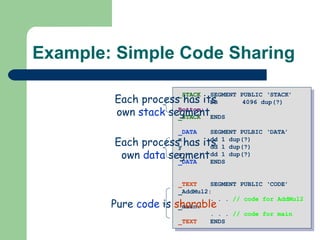
Example: Simple Code Sharing _STACK SEGMENT PUBLIC ‘STACK’ DB 4096 dup(?) Bottom: _STACK ENDS _DATA SEGMENT PULBIC ‘DATA’ x dd 1 dup(?) y dd 1 dup(?) z dd 1 dup(?) _DATA ENDS _TEXT   SEGMENT PUBLIC ‘CODE’ _AddMul2: . . .  // code for AddMul2 _main: . . .  // code for main _TEXT ENDS Pure  code  is  sharable   Each process has its  own  stack  segment  Each process has its  own  data  segment
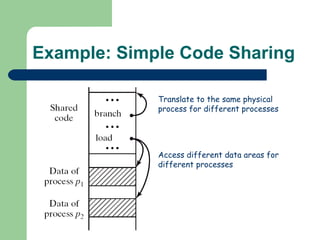
Example: Simple Code Sharing Translate to the same physical process for different processes Access different data areas for different processes
Linking and Sharing Sharing  are closely related to  linking Linking resolves  external   references Sharing  links  to the  same  module Static  linking/sharing: Resolve references  before  execution  starts Dynamic  linking/sharing: Resolve references  while   executing
Operating Systems Principles Memory Management Lecture 9: Sharing of Code and Data in Main Memory Static Linking and Sharing
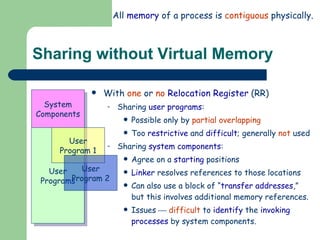
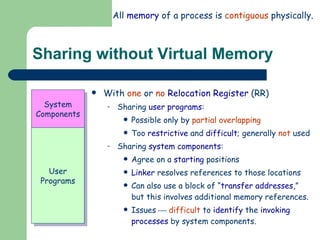
Sharing without Virtual Memory With  one  or  no   Relocation Register  (RR) Sharing  user programs : Possible only by  partial overlapping Too  restrictive  and  difficult ; generally  not  used Sharing  system components : Agree on a  starting  positions Linker  resolves references to those locations Can also use a block of “ transfer addresses ,” but this involves additional memory references. Issues     difficult  to  identify  the  invoking processes  by system components. Physical Memory System Components User Programs All  memory  of a process is  contiguous  physically. User Program 1 User Program 2
Sharing without Virtual Memory With  one  or  no   Relocation Register  (RR) Sharing  user programs : Possible only by  partial overlapping Too  restrictive  and  difficult ; generally  not  used Sharing  system components : Agree on a  starting  positions Linker  resolves references to those locations Can also use a block of “ transfer addresses ,” but this involves additional memory references. Issues     difficult  to  identify  the  invoking processes  by system components. Physical Memory System Components User Programs All  memory  of a process is  contiguous  physically.
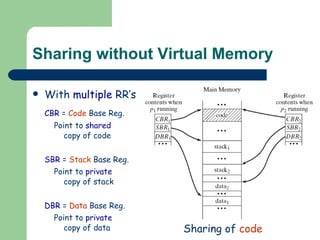
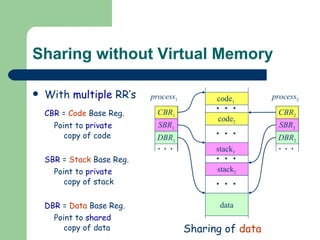
Sharing without Virtual Memory With  multiple  RR’s CBR  =  Code  Base Reg.   Point to  shared   copy of code SBR  =  Stack  Base Reg.   Point to  private   copy of stack DBR  =  Data  Base Reg.   Point to  private   copy of data Sharing of  code
Sharing without Virtual Memory With  multiple  RR’s CBR  =  Code  Base Reg.   Point to  private   copy of code SBR  =  Stack  Base Reg.   Point to  private   copy of stack DBR  =  Data  Base Reg.   Point to  shared   copy of data Sharing of  data code 1   code 2        stack 1   stack 2        data                      CBR 1 SBR 1 DBR 1        CBR 2 SBR 2 DBR 2 process 1 process 2
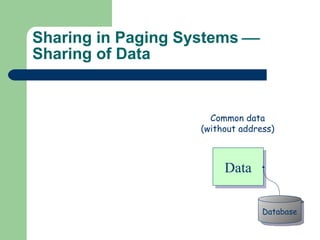
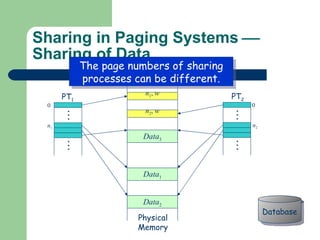
Sharing in Paging Systems   Sharing of Data Data Common data (without address) Database
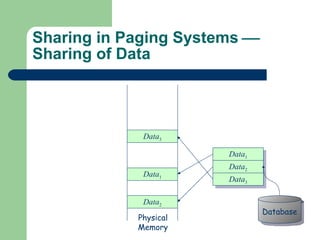
Sharing in Paging Systems   Sharing of Data Data Data 1 Data 2 Data 3 Data 2 Data 3 Data 1 Database Physical Memory
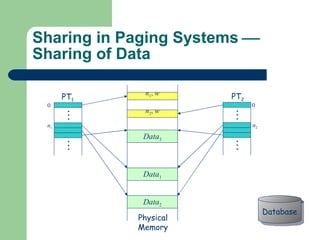
Sharing in Paging Systems   Sharing of Data Data 2 Data 3 Data 1 n 2 ,  w n 1 ,  w Physical Memory . . . . . . PT 1 0 n 1 . . . . . . PT 2 0 n 2 Database
Sharing in Paging Systems   Sharing of Data Data 2 Data 3 Data 1 . . . . . . PT 1 0 n 1 . . . . . . PT 2 0 n 2 n 2 ,  w n 1 ,  w The page numbers of sharing processes can be different. Physical Memory Database
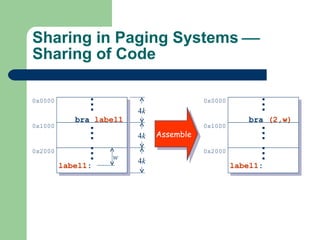
Sharing in Paging Systems   Sharing of Code Assemble bra  label1 label1 :  . . . . . . . . . 0x0000 0x2000 0x1000 4 k 4 k 4 k w bra  (2,w) label1 :  . . . . . . . . . 0x0000 0x2000 0x1000
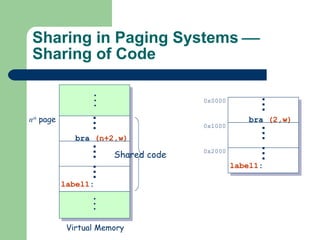
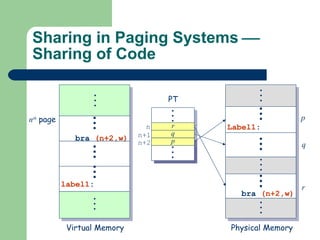
Sharing in Paging Systems   Sharing of Code Virtual Memory n th   page Shared code bra  (2,w) label1 :  . . . . . . . . . 0x0000 0x2000 0x1000 bra  (n+2,w) label1 :  . . . . . . . . .
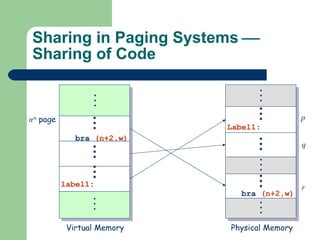
Sharing in Paging Systems   Sharing of Code Virtual Memory n th   page Physical Memory p q r bra  (n+2,w) label1 :  . . . . . . . . . bra  (n+2,w) . . . . . . Label1 :  . . .
Sharing in Paging Systems   Sharing of Code Virtual Memory n th   page Physical Memory p q r bra  (n+2,w) label1 :  . . . . . . . . . bra  (n+2,w) . . . . . . Label1 :  . . . r q p n n+1 n+2 PT
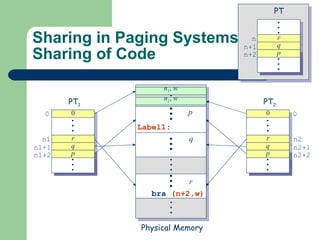
Sharing in Paging Systems   Sharing of Code n 2 ,  w n 1 ,  w p q r bra  (n+2,w) . . . . . . Label1 :  . . . Physical Memory r q p n1 n1+1 n1+2 PT 1 0 0 r q p n2 n2+1 n2+2 PT 2 0 0 r q p n n+1 n+2 PT
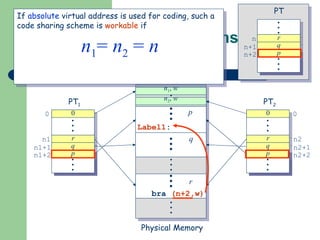
Sharing in Paging Systems   Sharing of Code n 2 ,  w n 1 ,  w p q r If  absolute  virtual address is used for coding, such a code sharing scheme is  workable  if n 1 =  n 2  =  n bra  (n+2,w) . . . . . . Label1 :  . . . Physical Memory r q p n1 n1+1 n1+2 PT 1 0 0 r q p n2 n2+1 n2+2 PT 2 0 0 r q p n n+1 n+2 PT
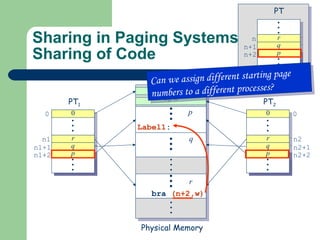
Sharing in Paging Systems   Sharing of Code n 2 ,  w n 1 ,  w r q p n1 n1+1 n1+2 PT 1 0 0 r q p n2 n2+1 n2+2 PT 2 0 0 r q p n n+1 n+2 PT p q r Can we assign different starting page numbers to a different processes? bra  (n+2,w) . . . . . . Label1 :  . . . Physical Memory
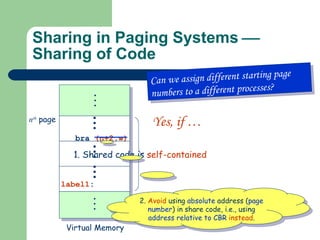
Sharing in Paging Systems   Sharing of Code Virtual Memory n th   page 1. Shared code is  self-contained Can we assign different starting page numbers to a different processes? 2.  Avoid  using  absolute  address ( page number ) in share code, i.e., using  address relative to CBR   instead . Yes, if … bra  (n+2,w) label1 :  . . . . . . . . .
Sharing in Paging Systems   Short Summary PT entries of  different   processes  point to the  same   page frame Data  pages:  No  Restrictions Code  pages:  Must have the  same   page numbers  in  all   PTs . For  generalization , avoid using page numbers in shared code ( self-contained ), i.e.,  using address relative to CBR  instead.
Sharing in Paging Systems   Short Summary PT entries of  different   processes  point to the  same   page frame Data  pages:  No  Restrictions Code  pages:  Must have the  same   page numbers  in  all   PTs . How  to know the page numbers of shared components? Solutions : The total set of  shared modules  is  known a priori . Resolved by an  effective   loader   done  just-in-time  and only  once .
Dynamic Linking via Transfer Vector ... bri tv[i]  ... bri tv[i]  ... Transfer  Vectors  Currently  Executing  Code  Linking  just-in-time  and only  once . call the same shared function by  indirect  branch instruction. ... ... stub stub stub stub 0 1 i n  1
Dynamic Linking via Transfer Vector ... bri tv[i]  ... bri tv[i]  ... Transfer  Vectors  Currently  Executing  Code  Linking  just-in-time  and only  once . ... ... stub stub stub stub 0 1 i n  1 When the shared function is called  first time , the external reference is  resolved  by the corresponding  stub .
Dynamic Linking via Transfer Vector ... bri tv[i]  ... bri tv[i]  ... Transfer  Vectors  Currently  Executing  Code  Linking  just-in-time  and only  once . ... ... stub stub stub stub 0 1 i n  1 When the shared function is called  first time , the external reference is  resolved  by the corresponding  stub . Shared code When the external reference is  resolved , the stub  replaces  the corresponding transfer vector to point to the shared code.
Dynamic Linking via Transfer Vector ... bri tv[i]  ... bri tv[i]  ... Transfer  Vectors  Currently  Executing  Code  Linking  just-in-time  and only  once . ... ... stub stub stub stub 0 1 i n  1 Shared code Once the external reference is resolved, it can be  used directly later on . Used by  Win32  and  POSIX  ( DLLs ).
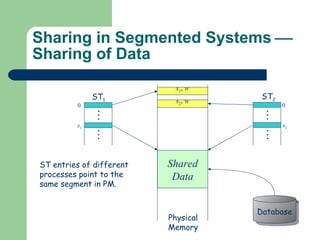
Sharing in Segmented Systems Much  the  same  as with  paged systems Using segments instead of pages Actually , simpler and  more elegant  because segments represent  logical  program entities.
Sharing in Segmented Systems   Sharing of Data Shared Data s 2 ,  w s 1 ,  w ST entries of different processes point to the same segment in PM. Database Physical Memory . . . . . . ST 1 0 s 1 . . . . . . ST 2 0 s 2
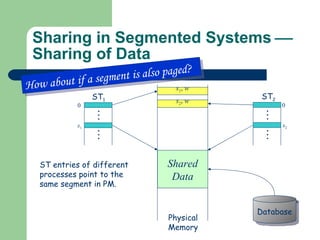
Sharing in Segmented Systems   Sharing of Data Shared Data s 2 ,  w s 1 ,  w ST entries of different processes point to the same segment in PM. How about if a segment is also paged? Database Physical Memory . . . . . . ST 1 0 s 1 . . . . . . ST 2 0 s 2
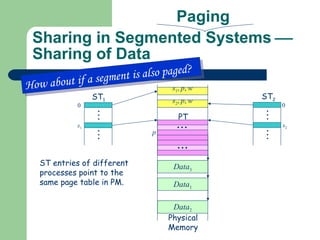
Sharing in Segmented Systems   Sharing of Data s 2 ,  p ,  w s 1 ,  p ,  w ST entries of different processes point to the same page table in PM. Data 2 Data 3 Data 1 PT How about if a segment is also paged? Physical Memory . . . . . . ST 1 0 s 1 . . . . . . ST 2 0 s 2 p Paging
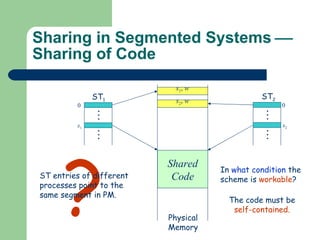
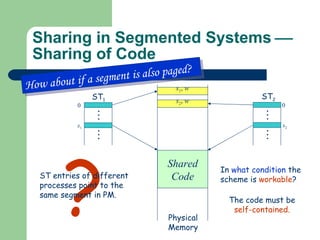
Sharing in Segmented Systems   Sharing of Code ? Shared Code s 2 ,  w s 1 ,  w ST entries of different processes point to the same segment in PM. In  what condition  the scheme is  workable ? The code must be  self-contained. Physical Memory . . . . . . ST 1 0 s 1 . . . . . . ST 2 0 s 2
Sharing in Segmented Systems   Sharing of Code ? Shared Code s 2 ,  w s 1 ,  w ST entries of different processes point to the same segment in PM. How about if a segment is also paged? In  what condition  the scheme is  workable ? The code must be  self-contained. Physical Memory . . . . . . ST 1 0 s 1 . . . . . . ST 2 0 s 2
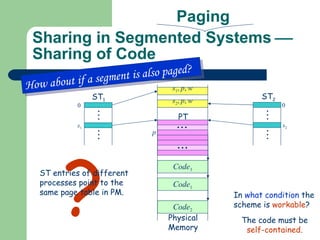
Sharing in Segmented Systems   Sharing of Code ? In  what condition  the scheme is  workable ? s 2 ,  p ,  w s 1 ,  p ,  w ST entries of different processes point to the same page table in PM. Code 2 Code 3 Code 1 PT How about if a segment is also paged? The code must be  self-contained. Physical Memory . . . . . . ST 1 0 s 1 . . . . . . ST 2 0 s 2 p Paging
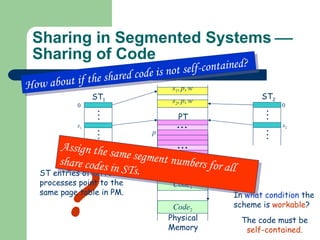
Sharing in Segmented Systems   Sharing of Code ? In  what condition  the scheme is  workable ? s 2 ,  p ,  w s 1 ,  p ,  w ST entries of different processes point to the same page table in PM. Code 2 Code 3 Code 1 PT How about if the shared code is not self-contained? The code must be  self-contained. Assign the same segment numbers for all share codes in STs. Physical Memory . . . . . . ST 1 0 s 1 . . . . . . ST 2 0 s 2 p
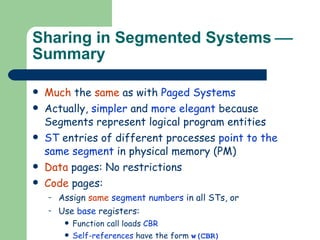
Sharing in Segmented Systems   Summary Much  the  same  as with  Paged Systems Actually,  simpler  and  more elegant  because Segments represent logical program entities ST  entries of different processes  point to the same segment  in physical memory (PM) Data  pages: No restrictions Code  pages:  Assign  same  segment numbers  in all STs, or Use  base  registers: Function call loads  CBR   Self-references  have the form  w(CBR) Other  references have the form  (s,w)
Operating Systems Principles Memory Management Lecture 9: Sharing of Code and Data in Main Memory Dynamic Linking and Sharing
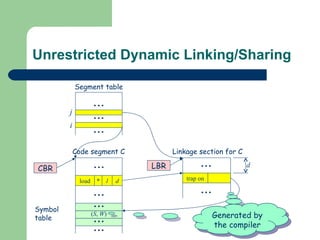
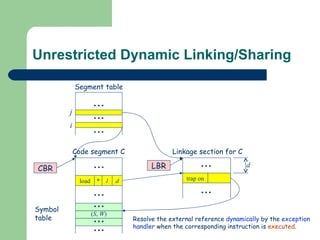
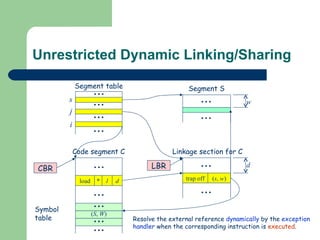
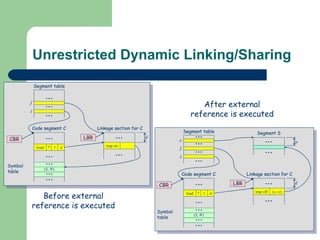
Unrestricted Dynamic Linking/Sharing Segmentation  facilitates to implement a  fully general scheme  of  dynamic linking  and  sharing . Any  two processes (user or system) can  share   any  portion of their space. Pioneered in the  MULTICS  operating system.
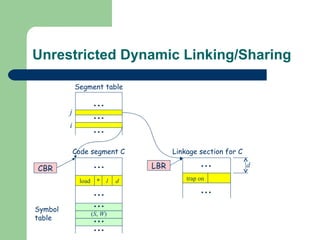
Unrestricted Dynamic Linking/Sharing Symbol table i j Segment table Code segment C load * l d ( S ,  W ) Linkage section for C CBR trap on d LBR
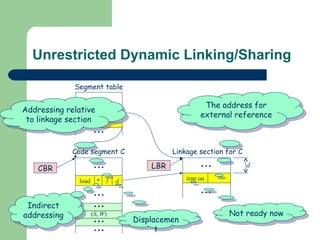
Unrestricted Dynamic Linking/Sharing ( S ,  W ) trap on Symbol table Addressing relative to linkage section Displacement Indirect addressing The address for external reference Not ready now i j Segment table Code segment C load * l d Linkage section for C CBR d LBR
Unrestricted Dynamic Linking/Sharing ( S ,  W ) trap on Symbol table Generated by the compiler i j Segment table Code segment C load * l d Linkage section for C CBR d LBR
Unrestricted Dynamic Linking/Sharing ( S ,  W ) Symbol table Resolve the external reference  dynamically  by the  exception handler  when the corresponding instruction is  executed . i j Segment table Code segment C load * l d Linkage section for C CBR trap on d LBR
Unrestricted Dynamic Linking/Sharing ( S ,  W ) Symbol table Resolve the external reference  dynamically  by the  exception handler  when the corresponding instruction is  executed . trap off ( s ,  w ) s i j Segment table Code segment C load * l d Linkage section for C CBR trap on d LBR Segment S w
Unrestricted Dynamic Linking/Sharing Before external reference is executed After external reference is executed
Operating Systems Principles Memory Management Lecture 9: Sharing of Code and Data in Main Memory Principles of Distributed Shared Memory (DSM)
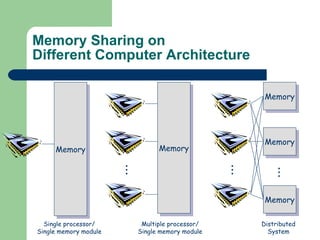
Memory Sharing on Different Computer Architecture Single processor/ Single memory module Multiple processor/ Single memory module Distributed System Memory Memory Memory Memory Memory
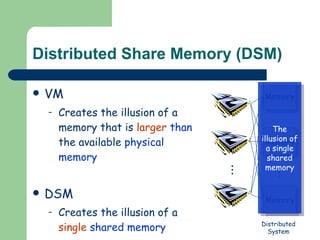
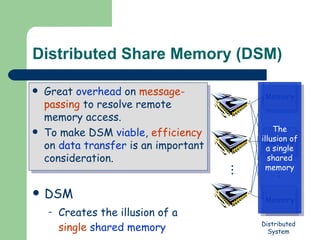
Distributed Share Memory (DSM) VM Creates the illusion of a memory that is  larger  than  the available  physical memory DSM Creates the illusion of a  single  shared memory Memory Memory Memory Distributed System The illusion of a single shared memory
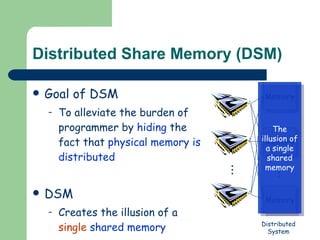
Distributed Share Memory (DSM) Goal of DSM To alleviate the burden of programmer by  hiding  the fact that  physical memory is distributed DSM Creates the illusion of a  single  shared memory Memory Memory Memory Distributed System The illusion of a single shared memory
Distributed Share Memory (DSM) Goal of DSM To alleviate the burden of programmer by  hiding  the fact that  physical memory is distributed DSM Creates the illusion of a  single  shared memory Memory Memory Memory Distributed System The illusion of a single shared memory Great  overhead  on  message-passing  to resolve remote memory access. To make DSM  viable ,  efficiency  on  data transfer  is an important consideration.
How to implement transfers efficiently? Two  approaches: Optimize  the  implementation Exploiting  locality  of reference or using  data replication Most important with  Unstructured DSM Restrict  the  full generality  of the DSM  Exploiting what the  user knows Basic to  Structured DSM
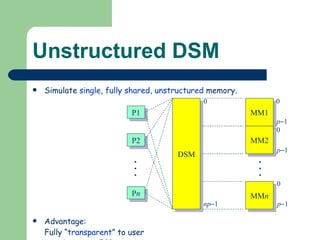
Unstructured DSM Simulate  single ,  fully shared ,  unstructured  memory. Advantage:  Fully “ transparent ” to user Disadvantage:  Efficiency P1 P2 P n MM1 MM2 MM n 0 p  1 0 p  1 0 p  1 DSM 0 np  1
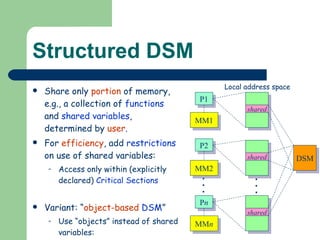
Structured DSM Share only  portion  of memory, e.g., a collection of  functions  and  shared variables , determined by  user . For  efficiency , add  restrictions  on use of shared variables: Access only within (explicitly declared)  Critical Sections Variant: “ object-based  DSM ” Use “objects” instead of shared variables: P1 P2 P n Local address space shared shared shared MM1 MM2 MM n DSM
Operating Systems Principles Memory Management Lecture 9: Sharing of Code and Data in Main Memory Implementations of DSM
Implementations of DSM Implementing  Unstructured  DSM Granularity  of data transfers Replication  of data Memory  consistency Tracking  data Implementing  Structured  DSM Critical-section  based Object  based
Implementing Unstructured DSM     Granularity  of Data Transfers Transfer too  little : Time  wasted  in  latency  (startup cost) Transfer too  much : Time  wasted  in  transfer False sharing A  nature  choice is to use the  page size  (or its multiple) as the  granularity  for transfer.
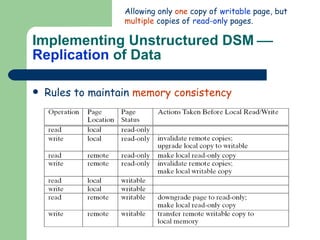
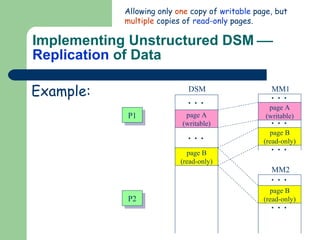
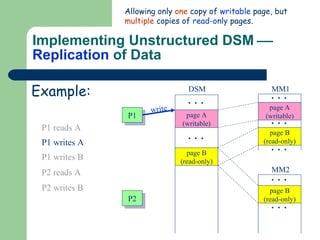
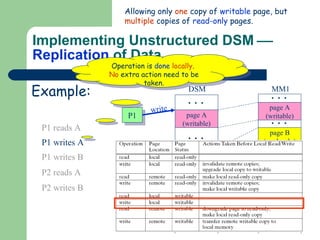
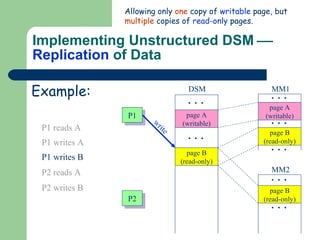
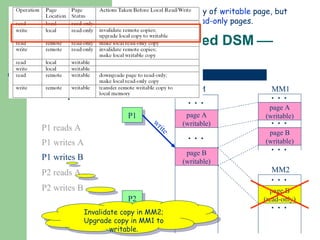
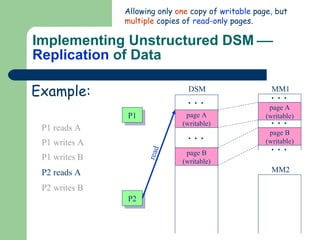
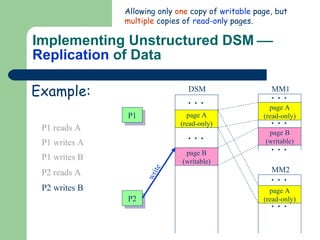
Implementing Unstructured DSM     Replication  of Data What action should be taken when a  page fault ? Two possible choices: Move  the page from the remote to the requesting processor Problems: Heavy network traffic, trashing, and delay Make a copy  of the page from the remote to the requesting processor Advantages: decrease network traffic, less trashing, and reduce delay Issue: How to maintain  memory consistency ? Read  work fine     no  action needed Writes  require  others  to  update  or  invalidate .
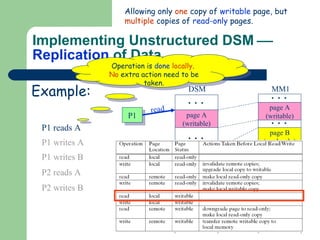
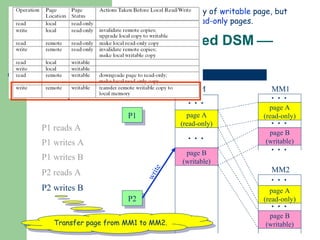
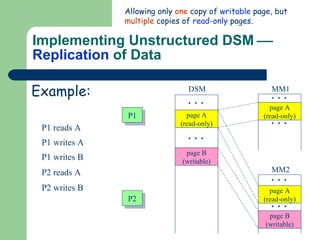
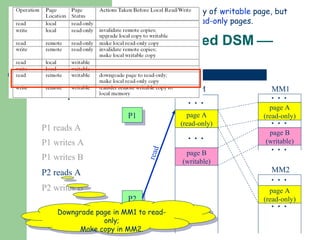
Implementing Unstructured DSM     Replication  of Data Rules to maintain  memory consistency   Allowing only  one  copy of  writable  page, but  multiple  copies of  read-only  pages.
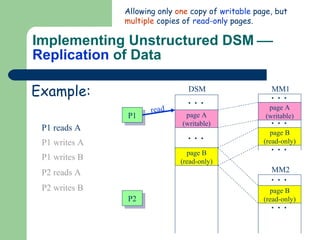
Implementing Unstructured DSM     Replication  of Data Allowing only  one  copy of  writable  page, but  multiple  copies of  read-only  pages. Example: P1 P2 MM1 MM2 page A (writable) page B (read-only) page B (read-only) DSM page A (writable) page B (read-only)
Implementing Unstructured DSM     Replication  of Data Allowing only  one  copy of  writable  page, but  multiple  copies of  read-only  pages. Example: MM1 MM2 page A (writable) page B (read-only) page B (read-only) DSM page A (writable) page B (read-only) P1 P2 P1 reads A P1 writes A P1 writes B P2 reads A P2 writes B read
Implementing Unstructured DSM     Replication  of Data Allowing only  one  copy of  writable  page, but  multiple  copies of  read-only  pages. Example: MM1 MM2 page A (writable) page B (read-only) page B (read-only) DSM page A (writable) page B (read-only) P1 P2 P1 reads A P1 writes A P1 writes B P2 reads A P2 writes B Operation is  done   locally .  No  extra action need to be taken. read
Implementing Unstructured DSM     Replication  of Data Allowing only  one  copy of  writable  page, but  multiple  copies of  read-only  pages. Example: MM1 MM2 page A (writable) page B (read-only) page B (read-only) DSM page A (writable) page B (read-only) P1 P2 P1 reads A P1 writes A P1 writes B P2 reads A P2 writes B write
Implementing Unstructured DSM     Replication  of Data Allowing only  one  copy of  writable  page, but  multiple  copies of  read-only  pages. Example: MM1 MM2 page A (writable) page B (read-only) page B (read-only) DSM page A (writable) page B (read-only) P1 P2 P1 reads A P1 writes A P1 writes B P2 reads A P2 writes B Operation is  done   locally .  No  extra action need to be taken. write
Implementing Unstructured DSM     Replication  of Data Allowing only  one  copy of  writable  page, but  multiple  copies of  read-only  pages. Example: MM1 MM2 page A (writable) page B (read-only) page B (read-only) DSM page A (writable) page B (read-only) P1 P2 P1 reads A P1 writes A P1 writes B P2 reads A P2 writes B write
Implementing Unstructured DSM     Replication  of Data Allowing only  one  copy of  writable  page, but  multiple  copies of  read-only  pages. Example: MM1 MM2 page A (writable) page B (read-only) page B (read-only) DSM page A (writable) page B (read-only) P1 P2 P1 reads A P1 writes A P1 writes B P2 reads A P2 writes B Invalidate copy in MM2; Upgrade copy in MM1 to writable. page B (writable) page B (writable) write
Implementing Unstructured DSM     Replication  of Data Allowing only  one  copy of  writable  page, but  multiple  copies of  read-only  pages. Example: MM1 MM2 page A (writable) page B (read-only) DSM page A (writable) page B (read-only) P1 P2 P1 reads A P1 writes A P1 writes B P2 reads A P2 writes B page B (writable) page B (writable) read
Implementing Unstructured DSM     Replication  of Data Allowing only  one  copy of  writable  page, but  multiple  copies of  read-only  pages. Example: MM1 MM2 page A (writable) DSM page A (writable) P1 P2 P1 reads A P1 writes A P1 writes B P2 reads A P2 writes B page B (writable) page B (writable) Downgrade page in MM1 to read-only; Make copy in MM2. page A (read-only) page A (read-only) page A (read-only) read
Implementing Unstructured DSM     Replication  of Data Allowing only  one  copy of  writable  page, but  multiple  copies of  read-only  pages. Example: MM1 MM2 DSM P1 P2 P1 reads A P1 writes A P1 writes B P2 reads A P2 writes B page B (writable) page B (writable) page A (read-only) page A (read-only) page A (read-only) write
Implementing Unstructured DSM     Replication  of Data Allowing only  one  copy of  writable  page, but  multiple  copies of  read-only  pages. Example: MM1 MM2 DSM P1 P2 P1 reads A P1 writes A P1 writes B P2 reads A P2 writes B page B (writable) page B (writable) page A (read-only) page A (read-only) page A (read-only) page B (writable) Transfer page from MM1 to MM2. write
Implementing Unstructured DSM     Replication  of Data Allowing only  one  copy of  writable  page, but  multiple  copies of  read-only  pages. Example: MM1 MM2 DSM P1 P2 P1 reads A P1 writes A P1 writes B P2 reads A P2 writes B page B (writable) page A (read-only) page A (read-only) page A (read-only) page B (writable)
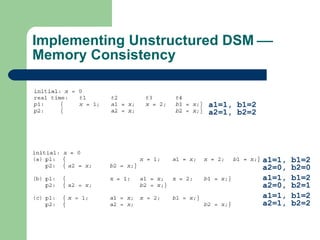
Implementing Unstructured DSM     Memory Consistency a1=1, b1=2 a2=1, b2=2 a1=1, b1=2 a2=0, b2=0 a1=1, b1=2 a2=0, b2=1 a1=1, b1=2 a2=1, b2=2
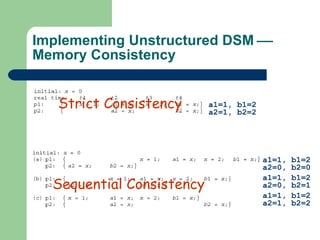
Implementing Unstructured DSM     Memory Consistency a1=1, b1=2 a2=1, b2=2 a1=1, b1=2 a2=0, b2=0 a1=1, b1=2 a2=0, b2=1 a1=1, b1=2 a2=1, b2=2 Strict Consistency Sequential Consistency
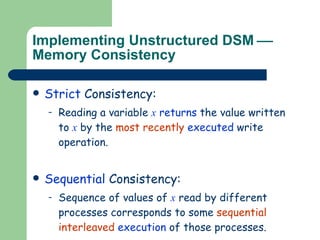
Implementing Unstructured DSM     Memory Consistency Strict  Consistency: Reading a variable  x   returns  the value written to  x  by the  most recently  executed  write operation. Sequential  Consistency: Sequence of values of  x  read by different processes corresponds to some  sequential interleaved  execution  of those processes.
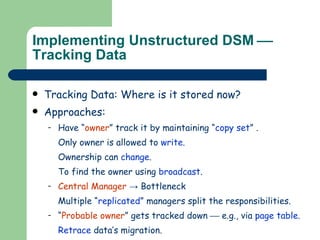
Implementing Unstructured DSM     Tracking Data Tracking Data: Where is it stored now? Approaches: Have “ owner ” track it by maintaining “ copy   set ” . Only owner is allowed to  write . Ownership can  change . To find the owner using  broadcast . Central Manager  -> Bottleneck Multiple “ replicated ”   managers split the responsibilities. “ Probable owner ” gets tracked down    e.g., via  page table . Retrace  data’s migration. Update links  traversed to show current owner.
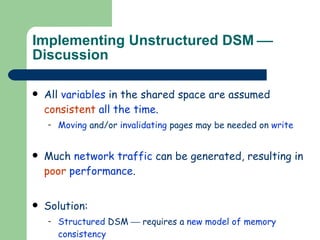
Implementing Unstructured DSM     Discussion All  variables  in the shared space are assumed  consistent  all the time . Moving  and/or  invalidating  pages may be needed on  write Much  network traffic  can be generated, resulting in  poor  performance . Solution: Structured  DSM    requires a  new model of memory consistency
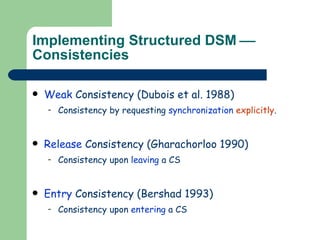
Implementing Structured DSM     Consistencies Weak  Consistency (Dubois et al. 1988) Consistency by requesting  synchronization   explicitly . Release  Consistency (Gharachorloo 1990) Consistency upon  leaving  a CS Entry  Consistency (Bershad 1993) Consistency upon  entering  a CS
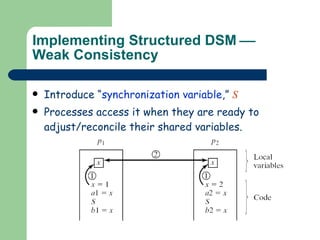
Implementing Structured DSM     Weak Consistency  Introduce “ synchronization variable ,”  S Processes access it when they are ready to adjust/reconcile their shared variables.
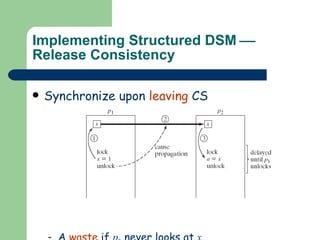
Implementing Structured DSM     Release Consistency  Synchronize upon  leaving  CS A  waste  if  p 2  never looks at   x .
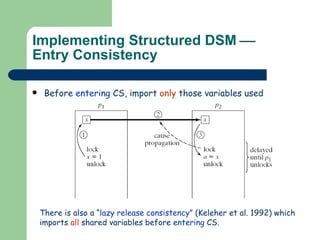
Implementing Structured DSM     Entry Consistency  Before  entering  CS, import  only  those variables used There is also a “ lazy release consistency ” (Keleher et al. 1992) which imports  all  shared variables before  entering  CS.
Object-Based DSM An object encapsulates  data  and  methods . Can use  remote method invocation (like remote procedure calls, covered earlier) instead of copying or moving an object into local memory. One can  move  an object to  improve  performance.

Os9 2

  • 1.
    Operating Systems PrinciplesMemory Management Lecture 9: Sharing of Code and Data in Main Memory 主講人:虞台文
  • 2.
    Content Single-Copy Sharing Reasons of Sharing Requirements for Sharing Static Linking and Sharing Sharing in Systems w/o Segmentation or Paging Sharing in Paging Systems Sharing in Segmented Systems Dynamic Linking and Sharing Principles of Distributed Shared Memory (DSM) The User's View of DSM Implementations of DSM Implementing Unstructured DSM Implementing Structured DSM
  • 3.
    Operating Systems PrinciplesMemory Management Lecture 9: Sharing of Code and Data in Main Memory Single-Copy Sharing
  • 4.
    Sharing Reusing Software Modules Individual software modules are constructed separately . Develop applications by linking with other well-developed software modules . Reduce software developing cost . Each process owns private copy of shared objects Single-Copy Sharing Processes share a single copy of code or data in memory Why ? What ? How ?
  • 5.
    Why? Processes needto access common data , e.g., Communication btw producer & consumer Cooperation among divide-and-conquer processes Competition on resources Better utilization of memory (code & data) Several active processes use the same code or data at the same time, e.g., many users running the same editor or debugger in a time-sharing system Without sharing, memory requirement would increase dramatically and, thus, reduce the number of login users . increase I/O overhead to load excess copies increase the page fault rate and, thus, the risk of thrashing .
  • 6.
    What? OS kernel routines I/O drivers System services , e.g., memory management and file manipulation routines. System utilities , e.g., Compiler , linker , loader and debugger . User-lever applications A single copy of the same code applies to different data sets .
  • 7.
    How? How to express what is shared? System Components Designated at the time of system design or initialization User-Level Applications Shared code must be reentrant (read-only, “pure”) Stack and heap must be replicated per process OpenFileMapping(), UnmapViewofFile (), CloseHandle() Shmdt () Shmctl () OpenFileMapping (), MapViewofFile () Shmat () CreateFileMapping () shmget () Win32 Unix
  • 8.
    Example: Simple CodeSharing _STACK SEGMENT PUBLIC ‘STACK’ DB 4096 dup(?) Bottom: _STACK ENDS _DATA SEGMENT PULBIC ‘DATA’ x dd 1 dup(?) y dd 1 dup(?) z dd 1 dup(?) _DATA ENDS _TEXT SEGMENT PUBLIC ‘CODE’ _AddMul2: . . . // code for AddMul2 _main: . . . // code for main _TEXT ENDS int x, y, z; int AddMul2(int i, int j) { return (i+j)*2; } main() { x=5; y=7; z=AddMul2(x, y); . . . . . . . . } Compile
  • 9.
    Example: Simple CodeSharing _STACK SEGMENT PUBLIC ‘STACK’ DB 4096 dup(?) Bottom: _STACK ENDS _DATA SEGMENT PULBIC ‘DATA’ x dd 1 dup(?) y dd 1 dup(?) z dd 1 dup(?) _DATA ENDS _TEXT SEGMENT PUBLIC ‘CODE’ _AddMul2: . . . // code for AddMul2 _main: . . . // code for main _TEXT ENDS int x, y, z; int AddMul2(int i, int j) { return (i+j)*2; } main() { x=5; y=7; z=AddMul2(x, y); . . . . . . . . } _main: mov ds:[x],5 mov ds:[y],7 push ds:[y] push ds:[x] call _AddMul2 add esp,8 mov ds:[z],eax . . . . . .
  • 10.
    Example: Simple CodeSharing _STACK SEGMENT PUBLIC ‘STACK’ DB 4096 dup(?) Bottom: _STACK ENDS _DATA SEGMENT PULBIC ‘DATA’ x dd 1 dup(?) y dd 1 dup(?) z dd 1 dup(?) _DATA ENDS _TEXT SEGMENT PUBLIC ‘CODE’ _AddMul2: . . . // code for AddMul2 _main: . . . // code for main _TEXT ENDS int x, y, z; int AddMul2(int i, int j) { return (i+j)*2; } main() { x=5; y=7; z=AddMul2(x, y); . . . . . . . . } _main: mov ds:[x],5 mov ds:[y],7 push ds:[y] push ds:[x] call _AddMul2 add esp,8 mov ds:[z],eax . . . . . . . . . esp
  • 11.
    Example: Simple CodeSharing _STACK SEGMENT PUBLIC ‘STACK’ DB 4096 dup(?) Bottom: _STACK ENDS _DATA SEGMENT PULBIC ‘DATA’ x dd 1 dup(?) y dd 1 dup(?) z dd 1 dup(?) _DATA ENDS _TEXT SEGMENT PUBLIC ‘CODE’ _AddMul2: . . . // code for AddMul2 _main: . . . // code for main _TEXT ENDS int x, y, z; int AddMul2(int i, int j) { return (i+j)*2; } main() { x=5; y=7; z=AddMul2(x, y); . . . . . . . . } _main: mov ds:[x],5 mov ds:[y],7 push ds:[y] push ds:[x] call _AddMul2 add esp,8 mov ds:[z],eax . . . . . . 5 . . . esp
  • 12.
    Example: Simple CodeSharing _STACK SEGMENT PUBLIC ‘STACK’ DB 4096 dup(?) Bottom: _STACK ENDS _DATA SEGMENT PULBIC ‘DATA’ x dd 1 dup(?) y dd 1 dup(?) z dd 1 dup(?) _DATA ENDS _TEXT SEGMENT PUBLIC ‘CODE’ _AddMul2: . . . // code for AddMul2 _main: . . . // code for main _TEXT ENDS int x, y, z; int AddMul2(int i, int j) { return (i+j)*2; } main() { x=5; y=7; z=AddMul2(x, y); . . . . . . . . } _main: mov ds:[x],5 mov ds:[y],7 push ds:[y] push ds:[x] call _AddMul2 add esp,8 mov ds:[z],eax . . . . . . 5 7 . . . esp
  • 13.
    Example: Simple CodeSharing _STACK SEGMENT PUBLIC ‘STACK’ DB 4096 dup(?) Bottom: _STACK ENDS _DATA SEGMENT PULBIC ‘DATA’ x dd 1 dup(?) y dd 1 dup(?) z dd 1 dup(?) _DATA ENDS _TEXT SEGMENT PUBLIC ‘CODE’ _AddMul2: . . . // code for AddMul2 _main: . . . // code for main _TEXT ENDS int x, y, z; int AddMul2(int i, int j) { return (i+j)*2; } main() { x=5; y=7; z=AddMul2(x, y); . . . . . . . . } _main: mov ds:[x],5 mov ds:[y],7 push ds:[y] push ds:[x] call _AddMul2 add esp,8 mov ds:[z],eax . . . . . . 5 7 . . . esp 7
  • 14.
    Example: Simple CodeSharing _STACK SEGMENT PUBLIC ‘STACK’ DB 4096 dup(?) Bottom: _STACK ENDS _DATA SEGMENT PULBIC ‘DATA’ x dd 1 dup(?) y dd 1 dup(?) z dd 1 dup(?) _DATA ENDS _TEXT SEGMENT PUBLIC ‘CODE’ _AddMul2: . . . // code for AddMul2 _main: . . . // code for main _TEXT ENDS int x, y, z; int AddMul2(int i, int j) { return (i+j)*2; } main() { x=5; y=7; z=AddMul2(x, y); . . . . . . . . } _main: mov ds:[x],5 mov ds:[y],7 push ds:[y] push ds:[x] call _AddMul2 add esp,8 mov ds:[z],eax . . . . . . 5 7 . . . esp 7 5
  • 15.
    Example: Simple CodeSharing _STACK SEGMENT PUBLIC ‘STACK’ DB 4096 dup(?) Bottom: _STACK ENDS _DATA SEGMENT PULBIC ‘DATA’ x dd 1 dup(?) y dd 1 dup(?) z dd 1 dup(?) _DATA ENDS _TEXT SEGMENT PUBLIC ‘CODE’ _AddMul2: . . . // code for AddMul2 _main: . . . // code for main _TEXT ENDS int x, y, z; int AddMul2(int i, int j) { return (i+j)*2; } main() { x=5; y=7; z=AddMul2(x, y); . . . . . . . . } _main: mov ds:[x],5 mov ds:[y],7 push ds:[y] push ds:[x] call _AddMul2 add esp,8 mov ds:[z],eax . . . . . . 5 7 . . . Return Address esp 7 5 Return Address
  • 16.
    Example: Simple CodeSharing _STACK SEGMENT PUBLIC ‘STACK’ DB 4096 dup(?) Bottom: _STACK ENDS _DATA SEGMENT PULBIC ‘DATA’ x dd 1 dup(?) y dd 1 dup(?) z dd 1 dup(?) _DATA ENDS _TEXT SEGMENT PUBLIC ‘CODE’ _AddMul2: . . . // code for AddMul2 _main: . . . // code for main _TEXT ENDS int x, y, z; int AddMul2(int i, int j) { return (i+j)*2; } main() { x=5; y=7; z=AddMul2(x, y); . . . . . . . . } _AddMul2: push ebp mov ebp,esp mov eax, [bp+8] add eax, [bp+8+4] shl eax, 1 mov esp,ebp pop ebp ret . . . 5 7 esp 7 5 Return Address
  • 17.
    Example: Simple CodeSharing _STACK SEGMENT PUBLIC ‘STACK’ DB 4096 dup(?) Bottom: _STACK ENDS _DATA SEGMENT PULBIC ‘DATA’ x dd 1 dup(?) y dd 1 dup(?) z dd 1 dup(?) _DATA ENDS _TEXT SEGMENT PUBLIC ‘CODE’ _AddMul2: . . . // code for AddMul2 _main: . . . // code for main _TEXT ENDS int x, y, z; int AddMul2(int i, int j) { return (i+j)*2; } main() { x=5; y=7; z=AddMul2(x, y); . . . . . . . . } _AddMul2: push ebp mov ebp,esp mov eax, [bp+8] add eax, [bp+8+4] shl eax, 1 mov esp,ebp pop ebp ret . . . 5 7 esp 7 5 Return Address old ebp
  • 18.
    Example: Simple CodeSharing _STACK SEGMENT PUBLIC ‘STACK’ DB 4096 dup(?) Bottom: _STACK ENDS _DATA SEGMENT PULBIC ‘DATA’ x dd 1 dup(?) y dd 1 dup(?) z dd 1 dup(?) _DATA ENDS _TEXT SEGMENT PUBLIC ‘CODE’ _AddMul2: . . . // code for AddMul2 _main: . . . // code for main _TEXT ENDS int x, y, z; int AddMul2(int i, int j) { return (i+j)*2; } main() { x=5; y=7; z=AddMul2(x, y); . . . . . . . . } _AddMul2: push ebp mov ebp,esp mov eax, [bp+8] add eax, [bp+8+4] shl eax, 1 mov esp,ebp pop ebp ret . . . 5 7 i j esp 7 5 Return Address old ebp ebp ebp+8 ebp+12
  • 19.
    Example: Simple CodeSharing _STACK SEGMENT PUBLIC ‘STACK’ DB 4096 dup(?) Bottom: _STACK ENDS _DATA SEGMENT PULBIC ‘DATA’ x dd 1 dup(?) y dd 1 dup(?) z dd 1 dup(?) _DATA ENDS _TEXT SEGMENT PUBLIC ‘CODE’ _AddMul2: . . . // code for AddMul2 _main: . . . // code for main _TEXT ENDS int x, y, z; int AddMul2(int i, int j) { return (i+j)*2; } main() { x=5; y=7; z=AddMul2(x, y); . . . . . . . . } _AddMul2: push ebp mov ebp,esp mov eax, [bp+8] add eax, [bp+8+4] shl eax, 1 mov esp,ebp pop ebp ret . . . 5 7 i j eax= 5 7 5 Return Address old ebp ebp ebp+8 ebp+12
  • 20.
    Example: Simple CodeSharing _STACK SEGMENT PUBLIC ‘STACK’ DB 4096 dup(?) Bottom: _STACK ENDS _DATA SEGMENT PULBIC ‘DATA’ x dd 1 dup(?) y dd 1 dup(?) z dd 1 dup(?) _DATA ENDS _TEXT SEGMENT PUBLIC ‘CODE’ _AddMul2: . . . // code for AddMul2 _main: . . . // code for main _TEXT ENDS int x, y, z; int AddMul2(int i, int j) { return (i+j)*2; } main() { x=5; y=7; z=AddMul2(x, y); . . . . . . . . } _AddMul2: push ebp mov ebp,esp mov eax, [bp+8] add eax, [bp+8+4] shl eax, 1 mov esp,ebp pop ebp ret . . . 5 7 i j eax= 12 7 5 Return Address old ebp ebp ebp+8 ebp+12
  • 21.
    Example: Simple CodeSharing _STACK SEGMENT PUBLIC ‘STACK’ DB 4096 dup(?) Bottom: _STACK ENDS _DATA SEGMENT PULBIC ‘DATA’ x dd 1 dup(?) y dd 1 dup(?) z dd 1 dup(?) _DATA ENDS _TEXT SEGMENT PUBLIC ‘CODE’ _AddMul2: . . . // code for AddMul2 _main: . . . // code for main _TEXT ENDS int x, y, z; int AddMul2(int i, int j) { return (i+j)*2; } main() { x=5; y=7; z=AddMul2(x, y); . . . . . . . . } _AddMul2: push ebp mov ebp,esp mov eax, [bp+8] add eax, [bp+8+4] shl eax, 1 mov esp,ebp pop ebp ret . . . 5 7 i j eax= 24 7 5 Return Address old ebp ebp ebp+8 ebp+12
  • 22.
    Example: Simple CodeSharing _STACK SEGMENT PUBLIC ‘STACK’ DB 4096 dup(?) Bottom: _STACK ENDS _DATA SEGMENT PULBIC ‘DATA’ x dd 1 dup(?) y dd 1 dup(?) z dd 1 dup(?) _DATA ENDS _TEXT SEGMENT PUBLIC ‘CODE’ _AddMul2: . . . // code for AddMul2 _main: . . . // code for main _TEXT ENDS int x, y, z; int AddMul2(int i, int j) { return (i+j)*2; } main() { x=5; y=7; z=AddMul2(x, y); . . . . . . . . } _AddMul2: push ebp mov ebp,esp mov eax, [bp+8] add eax, [bp+8+4] shl eax, 1 mov esp,ebp pop ebp ret . . . 5 7 i j eax= 24 7 5 Return Address old ebp ebp ebp+8 ebp+12 esp
  • 23.
    Example: Simple CodeSharing _STACK SEGMENT PUBLIC ‘STACK’ DB 4096 dup(?) Bottom: _STACK ENDS _DATA SEGMENT PULBIC ‘DATA’ x dd 1 dup(?) y dd 1 dup(?) z dd 1 dup(?) _DATA ENDS _TEXT SEGMENT PUBLIC ‘CODE’ _AddMul2: . . . // code for AddMul2 _main: . . . // code for main _TEXT ENDS int x, y, z; int AddMul2(int i, int j) { return (i+j)*2; } main() { x=5; y=7; z=AddMul2(x, y); . . . . . . . . } _AddMul2: push ebp mov ebp,esp mov eax, [bp+8] add eax, [bp+8+4] shl eax, 1 mov esp,ebp pop ebp ret . . . 5 7 eax= 24 7 5 Return Address old ebp esp
  • 24.
    Example: Simple CodeSharing _STACK SEGMENT PUBLIC ‘STACK’ DB 4096 dup(?) Bottom: _STACK ENDS _DATA SEGMENT PULBIC ‘DATA’ x dd 1 dup(?) y dd 1 dup(?) z dd 1 dup(?) _DATA ENDS _TEXT SEGMENT PUBLIC ‘CODE’ _AddMul2: . . . // code for AddMul2 _main: . . . // code for main _TEXT ENDS int x, y, z; int AddMul2(int i, int j) { return (i+j)*2; } main() { x=5; y=7; z=AddMul2(x, y); . . . . . . . . } _AddMul2: push ebp mov ebp,esp mov eax, [bp+8] add eax, [bp+8+4] shl eax, 1 mov esp,ebp pop ebp ret . . . 5 7 eax= 24 _main: mov ds:[x],5 mov ds:[y],7 push ds:[y] push ds:[x] call _AddMul2 add esp,8 mov ds:[z],eax . . . . . . 7 5 Return Address esp Return Address
  • 25.
    Example: Simple CodeSharing _STACK SEGMENT PUBLIC ‘STACK’ DB 4096 dup(?) Bottom: _STACK ENDS _DATA SEGMENT PULBIC ‘DATA’ x dd 1 dup(?) y dd 1 dup(?) z dd 1 dup(?) _DATA ENDS _TEXT SEGMENT PUBLIC ‘CODE’ _AddMul2: . . . // code for AddMul2 _main: . . . // code for main _TEXT ENDS int x, y, z; int AddMul2(int i, int j) { return (i+j)*2; } main() { x=5; y=7; z=AddMul2(x, y); . . . . . . . . } . . . 5 7 eax= 24 _main: mov ds:[x],5 mov ds:[y],7 push ds:[y] push ds:[x] call _AddMul2 add esp,8 mov ds:[z],eax . . . . . . 7 5 esp
  • 26.
    Example: Simple CodeSharing _STACK SEGMENT PUBLIC ‘STACK’ DB 4096 dup(?) Bottom: _STACK ENDS _DATA SEGMENT PULBIC ‘DATA’ x dd 1 dup(?) y dd 1 dup(?) z dd 1 dup(?) _DATA ENDS _TEXT SEGMENT PUBLIC ‘CODE’ _AddMul2: . . . // code for AddMul2 _main: . . . // code for main _TEXT ENDS int x, y, z; int AddMul2(int i, int j) { return (i+j)*2; } main() { x=5; y=7; z=AddMul2(x, y); . . . . . . . . } . . . 5 7 eax= 24 _main: mov ds:[x],5 mov ds:[y],7 push ds:[y] push ds:[x] call _AddMul2 add esp,8 mov ds:[z],eax . . . . . . 24 esp
  • 27.
    Example: Simple CodeSharing _STACK SEGMENT PUBLIC ‘STACK’ DB 4096 dup(?) Bottom: _STACK ENDS _DATA SEGMENT PULBIC ‘DATA’ x dd 1 dup(?) y dd 1 dup(?) z dd 1 dup(?) _DATA ENDS _TEXT SEGMENT PUBLIC ‘CODE’ _AddMul2: . . . // code for AddMul2 _main: . . . // code for main _TEXT ENDS Pure code is sharable Each process has its own stack segment Each process has its own data segment
  • 28.
    Example: Simple CodeSharing Translate to the same physical process for different processes Access different data areas for different processes
  • 29.
    Linking and SharingSharing are closely related to linking Linking resolves external references Sharing links to the same module Static linking/sharing: Resolve references before execution starts Dynamic linking/sharing: Resolve references while executing
  • 30.
    Operating Systems PrinciplesMemory Management Lecture 9: Sharing of Code and Data in Main Memory Static Linking and Sharing
  • 31.
    Sharing without VirtualMemory With one or no Relocation Register (RR) Sharing user programs : Possible only by partial overlapping Too restrictive and difficult ; generally not used Sharing system components : Agree on a starting positions Linker resolves references to those locations Can also use a block of “ transfer addresses ,” but this involves additional memory references. Issues  difficult to identify the invoking processes by system components. Physical Memory System Components User Programs All memory of a process is contiguous physically. User Program 1 User Program 2
  • 32.
    Sharing without VirtualMemory With one or no Relocation Register (RR) Sharing user programs : Possible only by partial overlapping Too restrictive and difficult ; generally not used Sharing system components : Agree on a starting positions Linker resolves references to those locations Can also use a block of “ transfer addresses ,” but this involves additional memory references. Issues  difficult to identify the invoking processes by system components. Physical Memory System Components User Programs All memory of a process is contiguous physically.
  • 33.
    Sharing without VirtualMemory With multiple RR’s CBR = Code Base Reg. Point to shared copy of code SBR = Stack Base Reg. Point to private copy of stack DBR = Data Base Reg. Point to private copy of data Sharing of code
  • 34.
    Sharing without VirtualMemory With multiple RR’s CBR = Code Base Reg. Point to private copy of code SBR = Stack Base Reg. Point to private copy of stack DBR = Data Base Reg. Point to shared copy of data Sharing of data code 1 code 2    stack 1 stack 2    data          CBR 1 SBR 1 DBR 1    CBR 2 SBR 2 DBR 2 process 1 process 2
  • 35.
    Sharing in PagingSystems  Sharing of Data Data Common data (without address) Database
  • 36.
    Sharing in PagingSystems  Sharing of Data Data Data 1 Data 2 Data 3 Data 2 Data 3 Data 1 Database Physical Memory
  • 37.
    Sharing in PagingSystems  Sharing of Data Data 2 Data 3 Data 1 n 2 , w n 1 , w Physical Memory . . . . . . PT 1 0 n 1 . . . . . . PT 2 0 n 2 Database
  • 38.
    Sharing in PagingSystems  Sharing of Data Data 2 Data 3 Data 1 . . . . . . PT 1 0 n 1 . . . . . . PT 2 0 n 2 n 2 , w n 1 , w The page numbers of sharing processes can be different. Physical Memory Database
  • 39.
    Sharing in PagingSystems  Sharing of Code Assemble bra label1 label1 : . . . . . . . . . 0x0000 0x2000 0x1000 4 k 4 k 4 k w bra (2,w) label1 : . . . . . . . . . 0x0000 0x2000 0x1000
  • 40.
    Sharing in PagingSystems  Sharing of Code Virtual Memory n th page Shared code bra (2,w) label1 : . . . . . . . . . 0x0000 0x2000 0x1000 bra (n+2,w) label1 : . . . . . . . . .
  • 41.
    Sharing in PagingSystems  Sharing of Code Virtual Memory n th page Physical Memory p q r bra (n+2,w) label1 : . . . . . . . . . bra (n+2,w) . . . . . . Label1 : . . .
  • 42.
    Sharing in PagingSystems  Sharing of Code Virtual Memory n th page Physical Memory p q r bra (n+2,w) label1 : . . . . . . . . . bra (n+2,w) . . . . . . Label1 : . . . r q p n n+1 n+2 PT
  • 43.
    Sharing in PagingSystems  Sharing of Code n 2 , w n 1 , w p q r bra (n+2,w) . . . . . . Label1 : . . . Physical Memory r q p n1 n1+1 n1+2 PT 1 0 0 r q p n2 n2+1 n2+2 PT 2 0 0 r q p n n+1 n+2 PT
  • 44.
    Sharing in PagingSystems  Sharing of Code n 2 , w n 1 , w p q r If absolute virtual address is used for coding, such a code sharing scheme is workable if n 1 = n 2 = n bra (n+2,w) . . . . . . Label1 : . . . Physical Memory r q p n1 n1+1 n1+2 PT 1 0 0 r q p n2 n2+1 n2+2 PT 2 0 0 r q p n n+1 n+2 PT
  • 45.
    Sharing in PagingSystems  Sharing of Code n 2 , w n 1 , w r q p n1 n1+1 n1+2 PT 1 0 0 r q p n2 n2+1 n2+2 PT 2 0 0 r q p n n+1 n+2 PT p q r Can we assign different starting page numbers to a different processes? bra (n+2,w) . . . . . . Label1 : . . . Physical Memory
  • 46.
    Sharing in PagingSystems  Sharing of Code Virtual Memory n th page 1. Shared code is self-contained Can we assign different starting page numbers to a different processes? 2. Avoid using absolute address ( page number ) in share code, i.e., using address relative to CBR instead . Yes, if … bra (n+2,w) label1 : . . . . . . . . .
  • 47.
    Sharing in PagingSystems  Short Summary PT entries of different processes point to the same page frame Data pages: No Restrictions Code pages: Must have the same page numbers in all PTs . For generalization , avoid using page numbers in shared code ( self-contained ), i.e., using address relative to CBR instead.
  • 48.
    Sharing in PagingSystems  Short Summary PT entries of different processes point to the same page frame Data pages: No Restrictions Code pages: Must have the same page numbers in all PTs . How to know the page numbers of shared components? Solutions : The total set of shared modules is known a priori . Resolved by an effective loader  done just-in-time and only once .
  • 49.
    Dynamic Linking viaTransfer Vector ... bri tv[i] ... bri tv[i] ... Transfer Vectors Currently Executing Code Linking just-in-time and only once . call the same shared function by indirect branch instruction. ... ... stub stub stub stub 0 1 i n  1
  • 50.
    Dynamic Linking viaTransfer Vector ... bri tv[i] ... bri tv[i] ... Transfer Vectors Currently Executing Code Linking just-in-time and only once . ... ... stub stub stub stub 0 1 i n  1 When the shared function is called first time , the external reference is resolved by the corresponding stub .
  • 51.
    Dynamic Linking viaTransfer Vector ... bri tv[i] ... bri tv[i] ... Transfer Vectors Currently Executing Code Linking just-in-time and only once . ... ... stub stub stub stub 0 1 i n  1 When the shared function is called first time , the external reference is resolved by the corresponding stub . Shared code When the external reference is resolved , the stub replaces the corresponding transfer vector to point to the shared code.
  • 52.
    Dynamic Linking viaTransfer Vector ... bri tv[i] ... bri tv[i] ... Transfer Vectors Currently Executing Code Linking just-in-time and only once . ... ... stub stub stub stub 0 1 i n  1 Shared code Once the external reference is resolved, it can be used directly later on . Used by Win32 and POSIX ( DLLs ).
  • 53.
    Sharing in SegmentedSystems Much the same as with paged systems Using segments instead of pages Actually , simpler and more elegant because segments represent logical program entities.
  • 54.
    Sharing in SegmentedSystems  Sharing of Data Shared Data s 2 , w s 1 , w ST entries of different processes point to the same segment in PM. Database Physical Memory . . . . . . ST 1 0 s 1 . . . . . . ST 2 0 s 2
  • 55.
    Sharing in SegmentedSystems  Sharing of Data Shared Data s 2 , w s 1 , w ST entries of different processes point to the same segment in PM. How about if a segment is also paged? Database Physical Memory . . . . . . ST 1 0 s 1 . . . . . . ST 2 0 s 2
  • 56.
    Sharing in SegmentedSystems  Sharing of Data s 2 , p , w s 1 , p , w ST entries of different processes point to the same page table in PM. Data 2 Data 3 Data 1 PT How about if a segment is also paged? Physical Memory . . . . . . ST 1 0 s 1 . . . . . . ST 2 0 s 2 p Paging
  • 57.
    Sharing in SegmentedSystems  Sharing of Code ? Shared Code s 2 , w s 1 , w ST entries of different processes point to the same segment in PM. In what condition the scheme is workable ? The code must be self-contained. Physical Memory . . . . . . ST 1 0 s 1 . . . . . . ST 2 0 s 2
  • 58.
    Sharing in SegmentedSystems  Sharing of Code ? Shared Code s 2 , w s 1 , w ST entries of different processes point to the same segment in PM. How about if a segment is also paged? In what condition the scheme is workable ? The code must be self-contained. Physical Memory . . . . . . ST 1 0 s 1 . . . . . . ST 2 0 s 2
  • 59.
    Sharing in SegmentedSystems  Sharing of Code ? In what condition the scheme is workable ? s 2 , p , w s 1 , p , w ST entries of different processes point to the same page table in PM. Code 2 Code 3 Code 1 PT How about if a segment is also paged? The code must be self-contained. Physical Memory . . . . . . ST 1 0 s 1 . . . . . . ST 2 0 s 2 p Paging
  • 60.
    Sharing in SegmentedSystems  Sharing of Code ? In what condition the scheme is workable ? s 2 , p , w s 1 , p , w ST entries of different processes point to the same page table in PM. Code 2 Code 3 Code 1 PT How about if the shared code is not self-contained? The code must be self-contained. Assign the same segment numbers for all share codes in STs. Physical Memory . . . . . . ST 1 0 s 1 . . . . . . ST 2 0 s 2 p
  • 61.
    Sharing in SegmentedSystems  Summary Much the same as with Paged Systems Actually, simpler and more elegant because Segments represent logical program entities ST entries of different processes point to the same segment in physical memory (PM) Data pages: No restrictions Code pages: Assign same segment numbers in all STs, or Use base registers: Function call loads CBR Self-references have the form w(CBR) Other references have the form (s,w)
  • 62.
    Operating Systems PrinciplesMemory Management Lecture 9: Sharing of Code and Data in Main Memory Dynamic Linking and Sharing
  • 63.
    Unrestricted Dynamic Linking/SharingSegmentation facilitates to implement a fully general scheme of dynamic linking and sharing . Any two processes (user or system) can share any portion of their space. Pioneered in the MULTICS operating system.
  • 64.
    Unrestricted Dynamic Linking/SharingSymbol table i j Segment table Code segment C load * l d ( S , W ) Linkage section for C CBR trap on d LBR
  • 65.
    Unrestricted Dynamic Linking/Sharing( S , W ) trap on Symbol table Addressing relative to linkage section Displacement Indirect addressing The address for external reference Not ready now i j Segment table Code segment C load * l d Linkage section for C CBR d LBR
  • 66.
    Unrestricted Dynamic Linking/Sharing( S , W ) trap on Symbol table Generated by the compiler i j Segment table Code segment C load * l d Linkage section for C CBR d LBR
  • 67.
    Unrestricted Dynamic Linking/Sharing( S , W ) Symbol table Resolve the external reference dynamically by the exception handler when the corresponding instruction is executed . i j Segment table Code segment C load * l d Linkage section for C CBR trap on d LBR
  • 68.
    Unrestricted Dynamic Linking/Sharing( S , W ) Symbol table Resolve the external reference dynamically by the exception handler when the corresponding instruction is executed . trap off ( s , w ) s i j Segment table Code segment C load * l d Linkage section for C CBR trap on d LBR Segment S w
  • 69.
    Unrestricted Dynamic Linking/SharingBefore external reference is executed After external reference is executed
  • 70.
    Operating Systems PrinciplesMemory Management Lecture 9: Sharing of Code and Data in Main Memory Principles of Distributed Shared Memory (DSM)
  • 71.
    Memory Sharing onDifferent Computer Architecture Single processor/ Single memory module Multiple processor/ Single memory module Distributed System Memory Memory Memory Memory Memory
  • 72.
    Distributed Share Memory(DSM) VM Creates the illusion of a memory that is larger than the available physical memory DSM Creates the illusion of a single shared memory Memory Memory Memory Distributed System The illusion of a single shared memory
  • 73.
    Distributed Share Memory(DSM) Goal of DSM To alleviate the burden of programmer by hiding the fact that physical memory is distributed DSM Creates the illusion of a single shared memory Memory Memory Memory Distributed System The illusion of a single shared memory
  • 74.
    Distributed Share Memory(DSM) Goal of DSM To alleviate the burden of programmer by hiding the fact that physical memory is distributed DSM Creates the illusion of a single shared memory Memory Memory Memory Distributed System The illusion of a single shared memory Great overhead on message-passing to resolve remote memory access. To make DSM viable , efficiency on data transfer is an important consideration.
  • 75.
    How to implementtransfers efficiently? Two approaches: Optimize the implementation Exploiting locality of reference or using data replication Most important with Unstructured DSM Restrict the full generality of the DSM Exploiting what the user knows Basic to Structured DSM
  • 76.
    Unstructured DSM Simulate single , fully shared , unstructured memory. Advantage: Fully “ transparent ” to user Disadvantage: Efficiency P1 P2 P n MM1 MM2 MM n 0 p  1 0 p  1 0 p  1 DSM 0 np  1
  • 77.
    Structured DSM Shareonly portion of memory, e.g., a collection of functions and shared variables , determined by user . For efficiency , add restrictions on use of shared variables: Access only within (explicitly declared) Critical Sections Variant: “ object-based DSM ” Use “objects” instead of shared variables: P1 P2 P n Local address space shared shared shared MM1 MM2 MM n DSM
  • 78.
    Operating Systems PrinciplesMemory Management Lecture 9: Sharing of Code and Data in Main Memory Implementations of DSM
  • 79.
    Implementations of DSMImplementing Unstructured DSM Granularity of data transfers Replication of data Memory consistency Tracking data Implementing Structured DSM Critical-section based Object based
  • 80.
    Implementing Unstructured DSM  Granularity of Data Transfers Transfer too little : Time wasted in latency (startup cost) Transfer too much : Time wasted in transfer False sharing A nature choice is to use the page size (or its multiple) as the granularity for transfer.
  • 81.
    Implementing Unstructured DSM  Replication of Data What action should be taken when a page fault ? Two possible choices: Move the page from the remote to the requesting processor Problems: Heavy network traffic, trashing, and delay Make a copy of the page from the remote to the requesting processor Advantages: decrease network traffic, less trashing, and reduce delay Issue: How to maintain memory consistency ? Read work fine  no action needed Writes require others to update or invalidate .
  • 82.
    Implementing Unstructured DSM  Replication of Data Rules to maintain memory consistency Allowing only one copy of writable page, but multiple copies of read-only pages.
  • 83.
    Implementing Unstructured DSM  Replication of Data Allowing only one copy of writable page, but multiple copies of read-only pages. Example: P1 P2 MM1 MM2 page A (writable) page B (read-only) page B (read-only) DSM page A (writable) page B (read-only)
  • 84.
    Implementing Unstructured DSM  Replication of Data Allowing only one copy of writable page, but multiple copies of read-only pages. Example: MM1 MM2 page A (writable) page B (read-only) page B (read-only) DSM page A (writable) page B (read-only) P1 P2 P1 reads A P1 writes A P1 writes B P2 reads A P2 writes B read
  • 85.
    Implementing Unstructured DSM  Replication of Data Allowing only one copy of writable page, but multiple copies of read-only pages. Example: MM1 MM2 page A (writable) page B (read-only) page B (read-only) DSM page A (writable) page B (read-only) P1 P2 P1 reads A P1 writes A P1 writes B P2 reads A P2 writes B Operation is done locally . No extra action need to be taken. read
  • 86.
    Implementing Unstructured DSM  Replication of Data Allowing only one copy of writable page, but multiple copies of read-only pages. Example: MM1 MM2 page A (writable) page B (read-only) page B (read-only) DSM page A (writable) page B (read-only) P1 P2 P1 reads A P1 writes A P1 writes B P2 reads A P2 writes B write
  • 87.
    Implementing Unstructured DSM  Replication of Data Allowing only one copy of writable page, but multiple copies of read-only pages. Example: MM1 MM2 page A (writable) page B (read-only) page B (read-only) DSM page A (writable) page B (read-only) P1 P2 P1 reads A P1 writes A P1 writes B P2 reads A P2 writes B Operation is done locally . No extra action need to be taken. write
  • 88.
    Implementing Unstructured DSM  Replication of Data Allowing only one copy of writable page, but multiple copies of read-only pages. Example: MM1 MM2 page A (writable) page B (read-only) page B (read-only) DSM page A (writable) page B (read-only) P1 P2 P1 reads A P1 writes A P1 writes B P2 reads A P2 writes B write
  • 89.
    Implementing Unstructured DSM  Replication of Data Allowing only one copy of writable page, but multiple copies of read-only pages. Example: MM1 MM2 page A (writable) page B (read-only) page B (read-only) DSM page A (writable) page B (read-only) P1 P2 P1 reads A P1 writes A P1 writes B P2 reads A P2 writes B Invalidate copy in MM2; Upgrade copy in MM1 to writable. page B (writable) page B (writable) write
  • 90.
    Implementing Unstructured DSM  Replication of Data Allowing only one copy of writable page, but multiple copies of read-only pages. Example: MM1 MM2 page A (writable) page B (read-only) DSM page A (writable) page B (read-only) P1 P2 P1 reads A P1 writes A P1 writes B P2 reads A P2 writes B page B (writable) page B (writable) read
  • 91.
    Implementing Unstructured DSM  Replication of Data Allowing only one copy of writable page, but multiple copies of read-only pages. Example: MM1 MM2 page A (writable) DSM page A (writable) P1 P2 P1 reads A P1 writes A P1 writes B P2 reads A P2 writes B page B (writable) page B (writable) Downgrade page in MM1 to read-only; Make copy in MM2. page A (read-only) page A (read-only) page A (read-only) read
  • 92.
    Implementing Unstructured DSM  Replication of Data Allowing only one copy of writable page, but multiple copies of read-only pages. Example: MM1 MM2 DSM P1 P2 P1 reads A P1 writes A P1 writes B P2 reads A P2 writes B page B (writable) page B (writable) page A (read-only) page A (read-only) page A (read-only) write
  • 93.
    Implementing Unstructured DSM  Replication of Data Allowing only one copy of writable page, but multiple copies of read-only pages. Example: MM1 MM2 DSM P1 P2 P1 reads A P1 writes A P1 writes B P2 reads A P2 writes B page B (writable) page B (writable) page A (read-only) page A (read-only) page A (read-only) page B (writable) Transfer page from MM1 to MM2. write
  • 94.
    Implementing Unstructured DSM  Replication of Data Allowing only one copy of writable page, but multiple copies of read-only pages. Example: MM1 MM2 DSM P1 P2 P1 reads A P1 writes A P1 writes B P2 reads A P2 writes B page B (writable) page A (read-only) page A (read-only) page A (read-only) page B (writable)
  • 95.
    Implementing Unstructured DSM  Memory Consistency a1=1, b1=2 a2=1, b2=2 a1=1, b1=2 a2=0, b2=0 a1=1, b1=2 a2=0, b2=1 a1=1, b1=2 a2=1, b2=2
  • 96.
    Implementing Unstructured DSM  Memory Consistency a1=1, b1=2 a2=1, b2=2 a1=1, b1=2 a2=0, b2=0 a1=1, b1=2 a2=0, b2=1 a1=1, b1=2 a2=1, b2=2 Strict Consistency Sequential Consistency
  • 97.
    Implementing Unstructured DSM  Memory Consistency Strict Consistency: Reading a variable x returns the value written to x by the most recently executed write operation. Sequential Consistency: Sequence of values of x read by different processes corresponds to some sequential interleaved execution of those processes.
  • 98.
    Implementing Unstructured DSM  Tracking Data Tracking Data: Where is it stored now? Approaches: Have “ owner ” track it by maintaining “ copy set ” . Only owner is allowed to write . Ownership can change . To find the owner using broadcast . Central Manager -> Bottleneck Multiple “ replicated ” managers split the responsibilities. “ Probable owner ” gets tracked down  e.g., via page table . Retrace data’s migration. Update links traversed to show current owner.
  • 99.
    Implementing Unstructured DSM  Discussion All variables in the shared space are assumed consistent all the time . Moving and/or invalidating pages may be needed on write Much network traffic can be generated, resulting in poor performance . Solution: Structured DSM  requires a new model of memory consistency
  • 100.
    Implementing Structured DSM  Consistencies Weak Consistency (Dubois et al. 1988) Consistency by requesting synchronization explicitly . Release Consistency (Gharachorloo 1990) Consistency upon leaving a CS Entry Consistency (Bershad 1993) Consistency upon entering a CS
  • 101.
    Implementing Structured DSM  Weak Consistency Introduce “ synchronization variable ,” S Processes access it when they are ready to adjust/reconcile their shared variables.
  • 102.
    Implementing Structured DSM  Release Consistency Synchronize upon leaving CS A waste if p 2 never looks at x .
  • 103.
    Implementing Structured DSM  Entry Consistency Before entering CS, import only those variables used There is also a “ lazy release consistency ” (Keleher et al. 1992) which imports all shared variables before entering CS.
  • 104.
    Object-Based DSM Anobject encapsulates data and methods . Can use remote method invocation (like remote procedure calls, covered earlier) instead of copying or moving an object into local memory. One can move an object to improve performance.