OPERATING SYSTEMS
(CSC 2205)
Instructor: Mr. Khwaja Bilal Hassan
BS CS UET Peshawar
M.Phil. CS Quaid-e-Azam University Islamabad
Lecture#12
Memory Management
1
Agenda for Today
 What is memory management
 Source code to execution
 Address binding
 Logical and physical address spaces
 Dynamic loading, dynamic linking,
and overlays
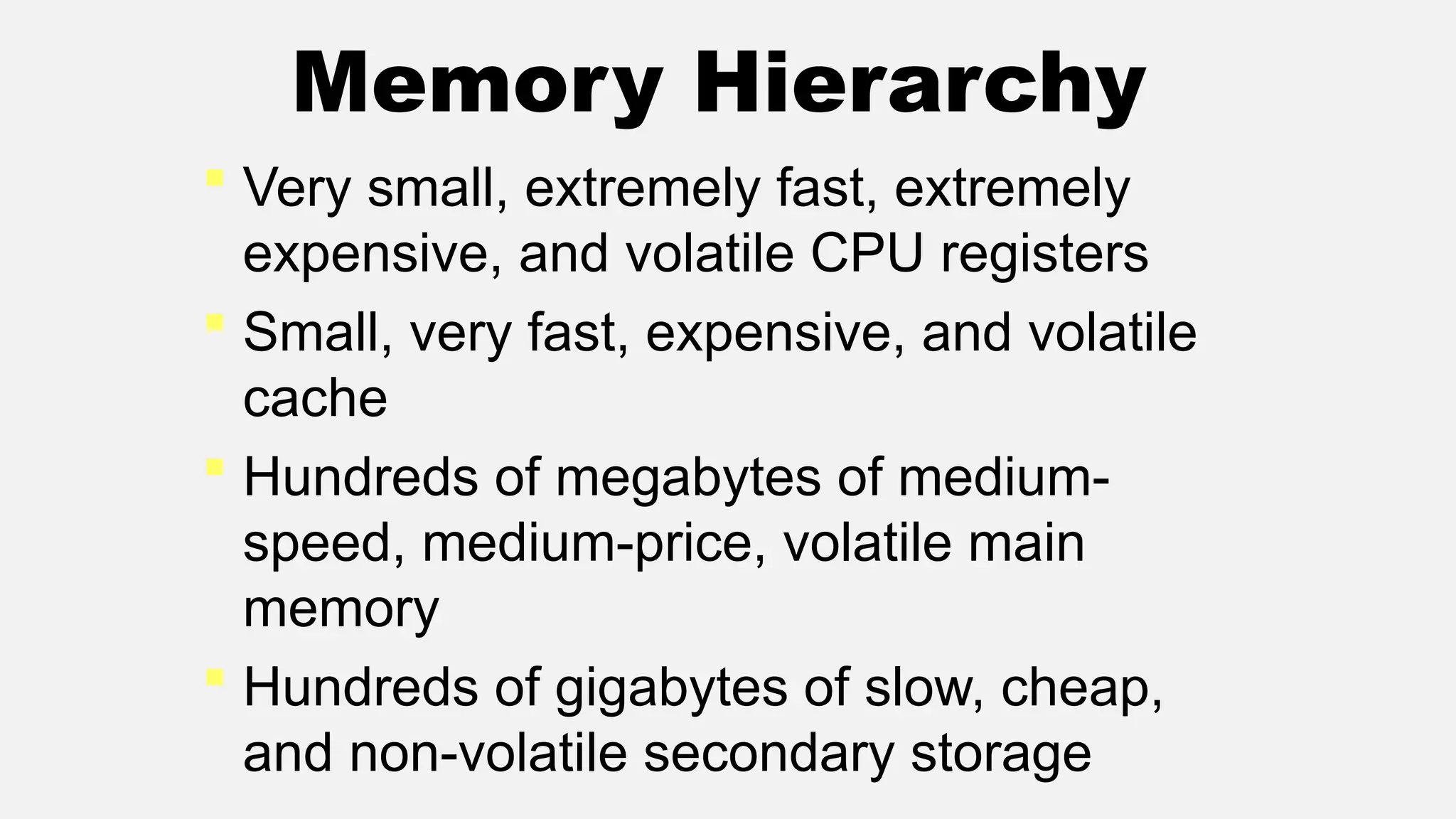
Memory Hierarchy
 Very small, extremely fast, extremely
expensive, and volatile CPU registers
 Small, very fast, expensive, and volatile
cache
 Hundreds of megabytes of medium-
speed, medium-price, volatile main
memory
 Hundreds of gigabytes of slow, cheap,
and non-volatile secondary storage
Purpose of Memory
Management
To ensure fair, secure,
orderly, and efficient use
of memory
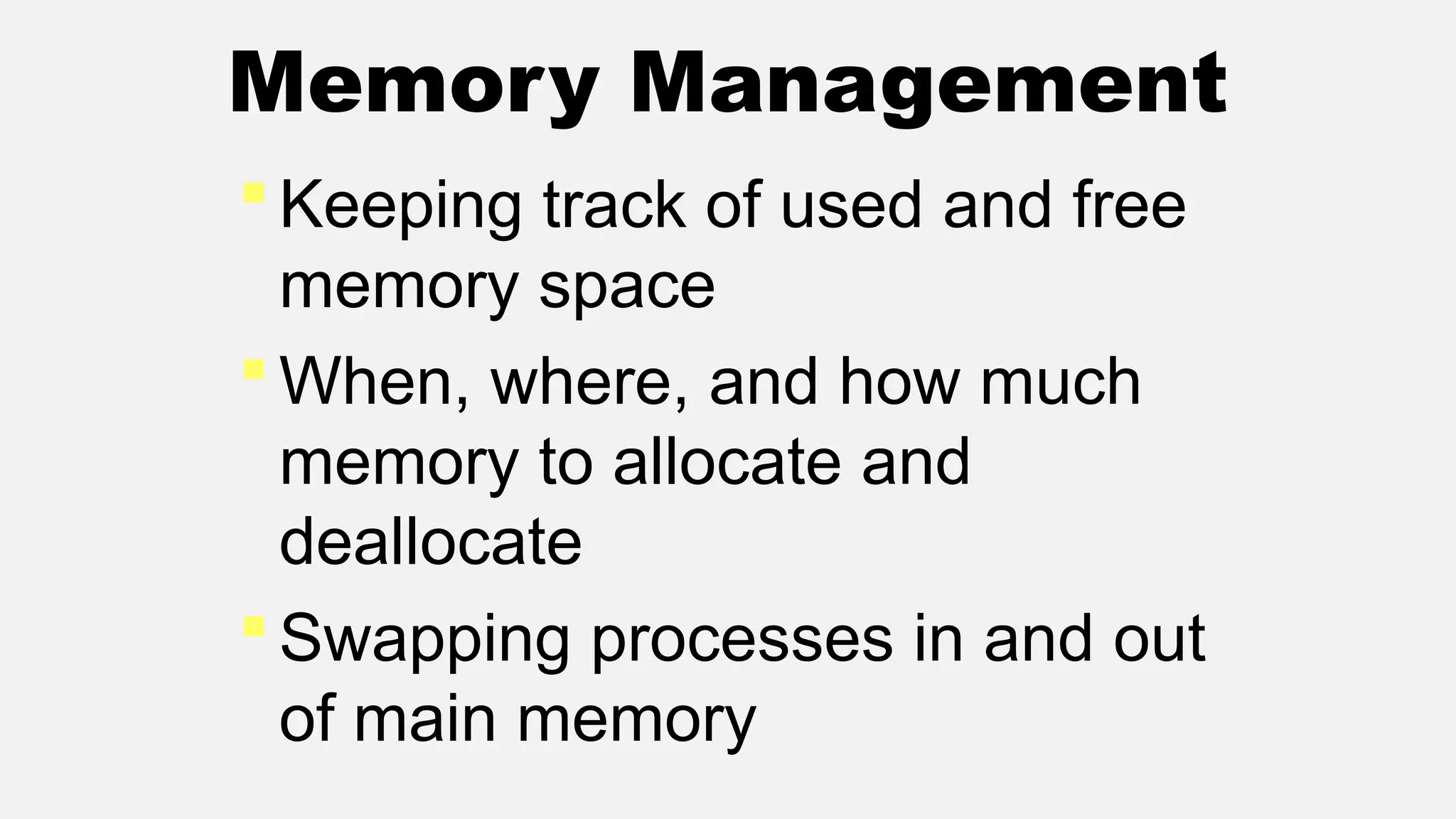
Memory Management
Keeping track of used and free
memory space
When, where, and how much
memory to allocate and
deallocate
Swapping processes in and out
of main memory
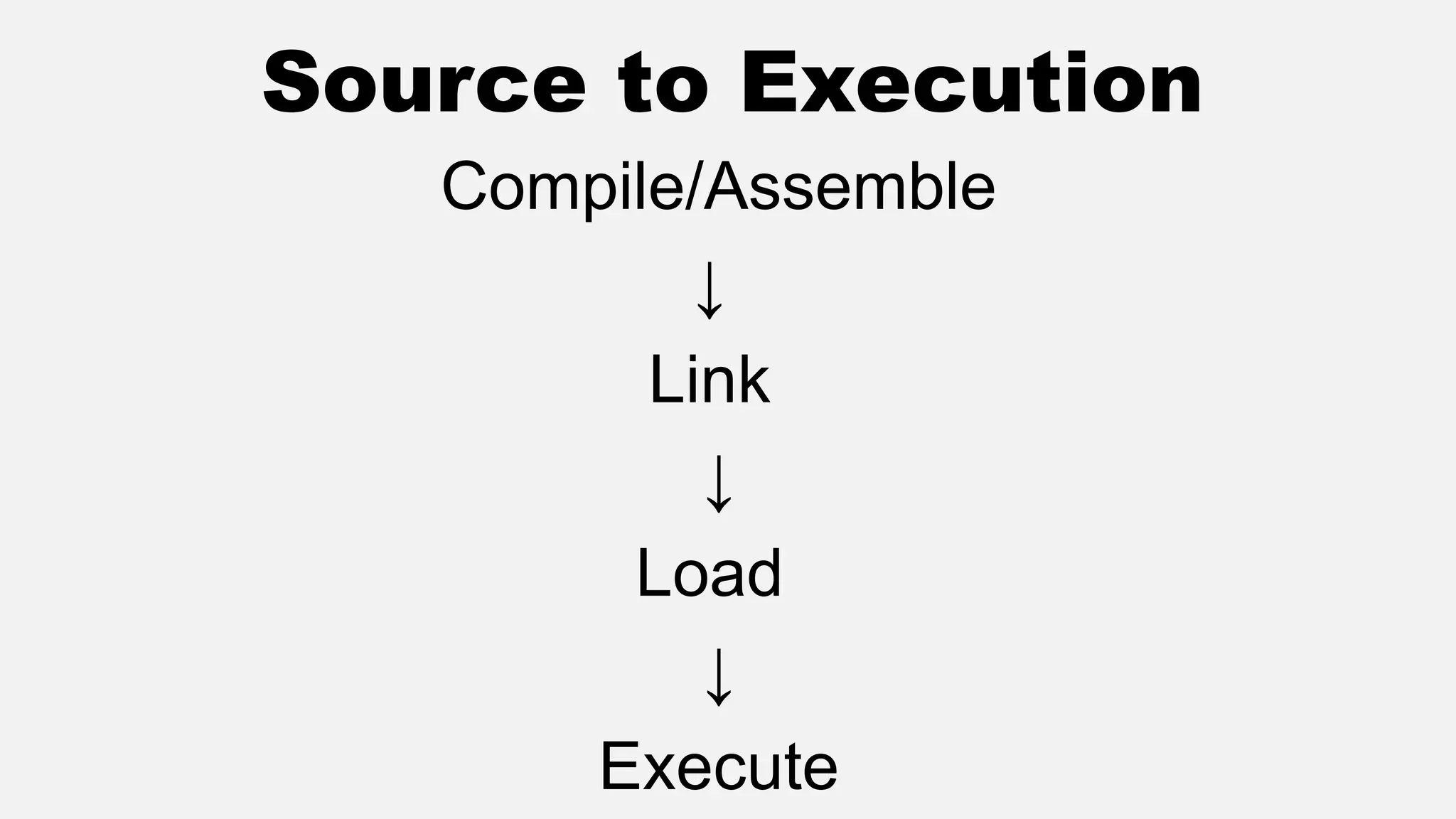
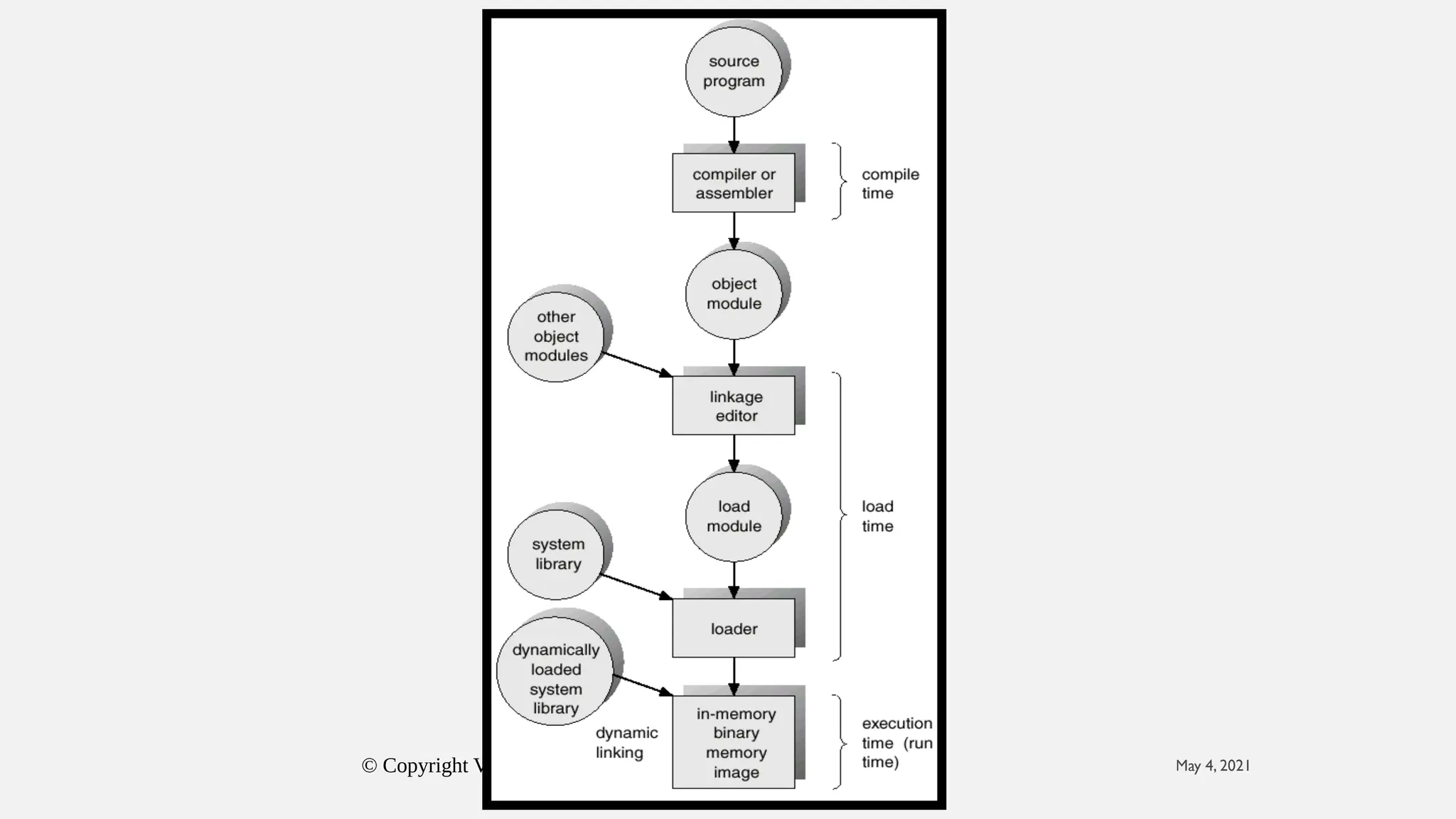
Source to Execution
Compile/Assemble
↓
Link
↓
Load
↓
Execute
© Copyright Virtual University of Pakistan May 4, 2021
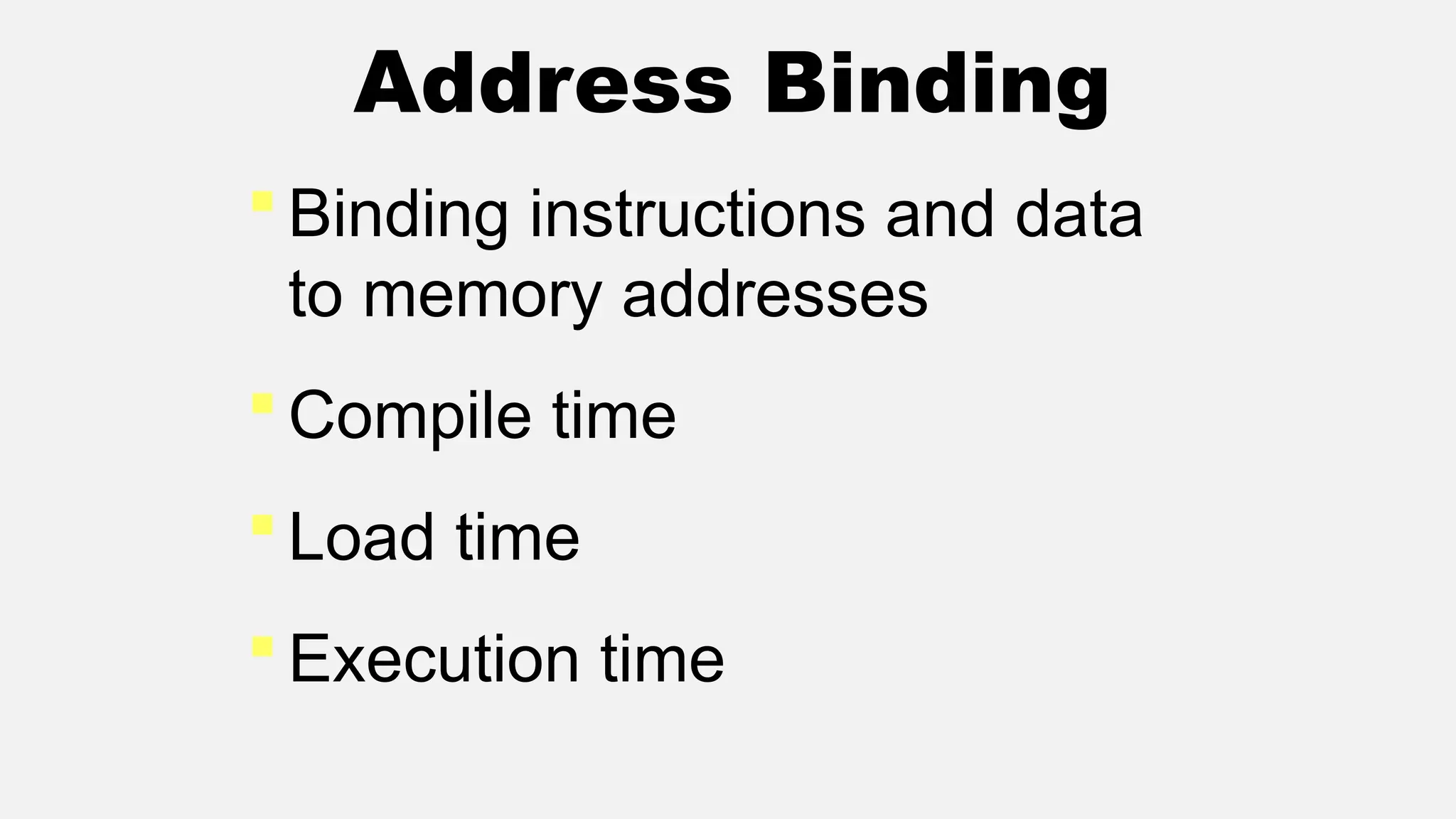
 Binding instructions and data
to memory addresses
 Compile time
 Load time
 Execution time
Address Binding
 Compile time: If you know at
compile time where the
process will reside in memory,
the absolute code can be
generated. Process must
reside in the same memory
region for it to execute
correctly.
Address Binding
 Load time: If the location of a
process in memory is not known
at compile time, then the
compiler must generate re-
locatable code. In this case the
final binding is delayed until load
time. Process can be loaded in
different memory regions.
Address Binding
Address Binding
 Execution time: If the process
can be moved during its
execution from one memory
region to another, then binding
must be delayed until run time.
Special hardware must be
available for this to work.
Logical and Physical
Addresses
 Logical address: An address
generated by the process/CPU;
refers to an instruction or data in
the process
 Physical address: An address for
a main memory location where
instruction or data resides
Logical and Physical
Address Spaces
 The set of all logical addresses
generated by a process comprises
its logical address space.
 The set of physical addresses
corresponding to these logical
addresses comprises the physical
address space for the process.
Logical and Physical
Address Spaces
 The run-time mapping from
logical to physical addresses is
done by a piece of the CPU
hardware, called the memory
management unit (MMU).
Example
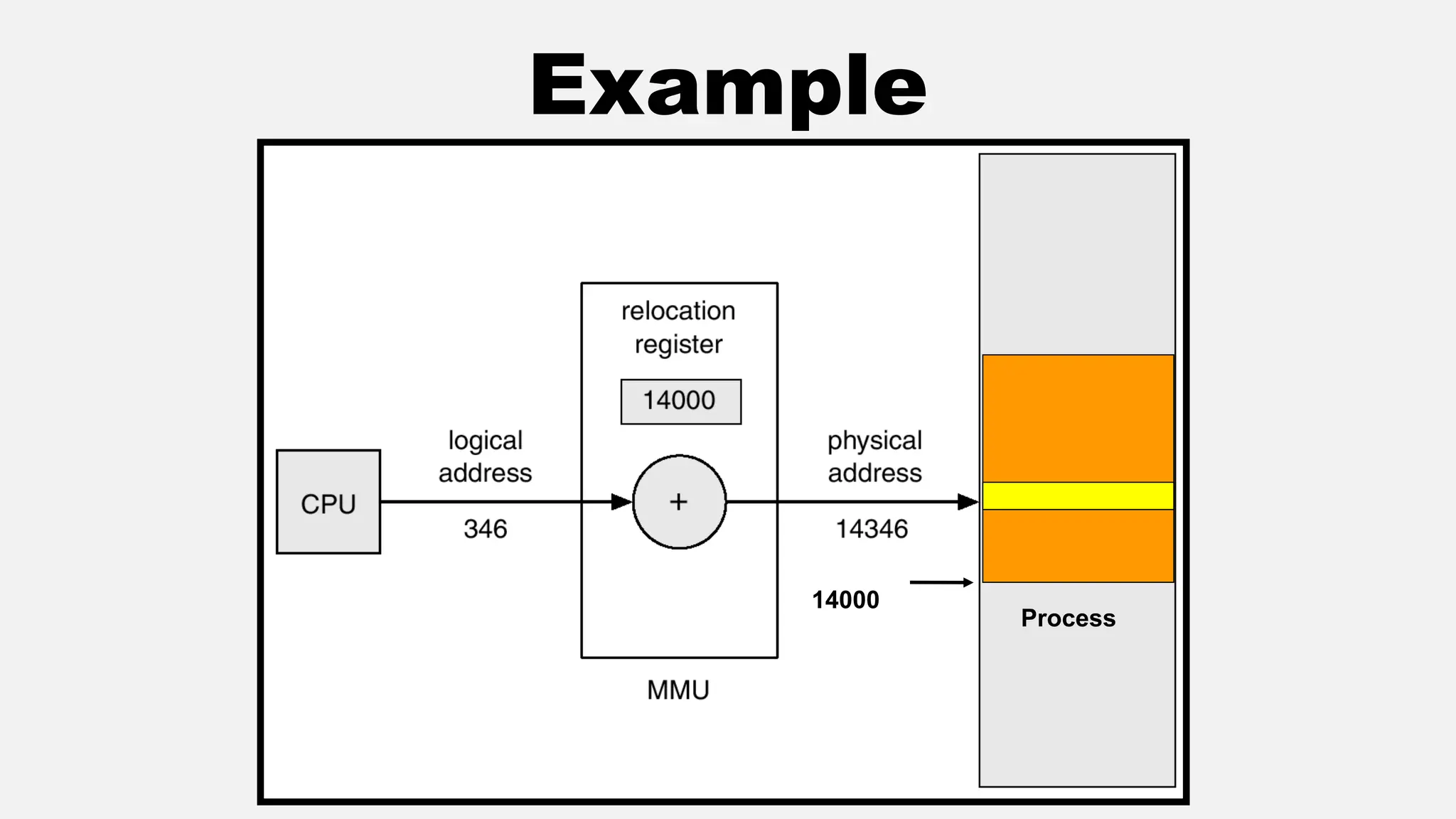
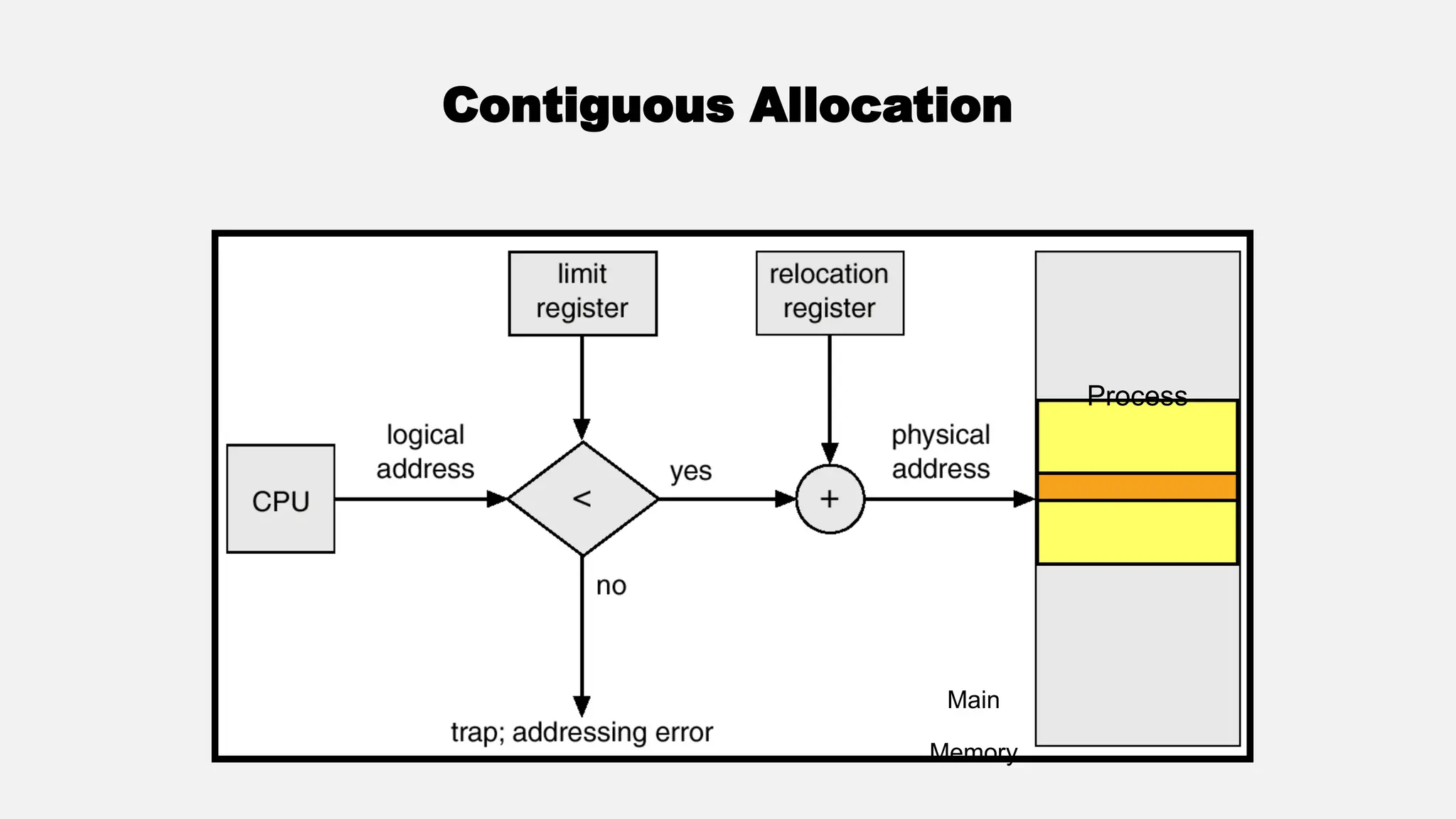
 The base register is called the
relocation register.
 The value in the relocation
register is added to every
address generated by a user
process at the time it is sent to
memory.
Example
14000
Process
Example
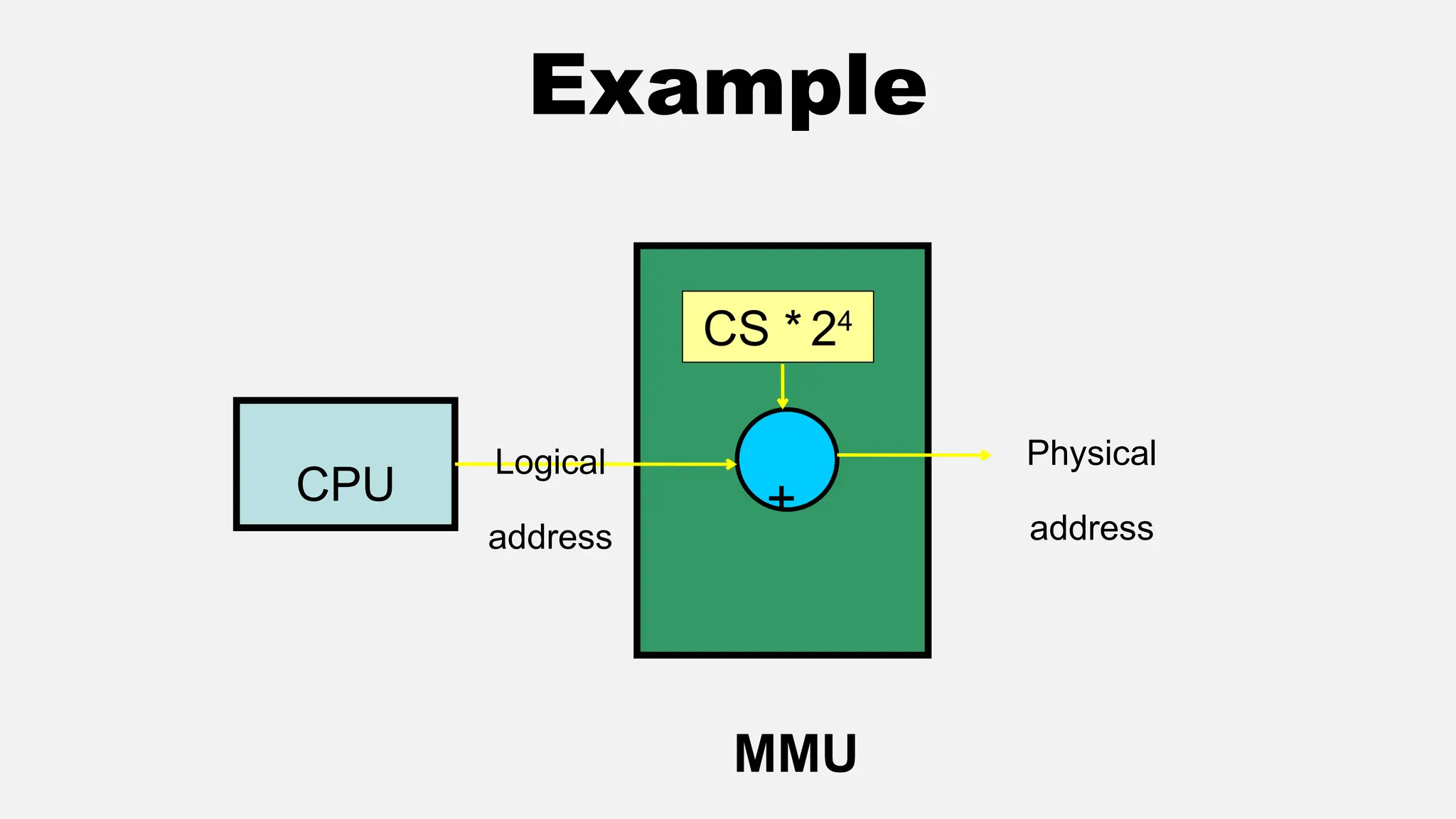
 In i8086, the logical address of
the next instruction is specified by
the value of instruction pointer
(IP). The physical address for the
instruction is computed by shifting
the code segment register (CS)
left by four bits and adding IP to it.
Example
CPU
CS * 24
+
MMU
Logical
address
Physical
address
Example
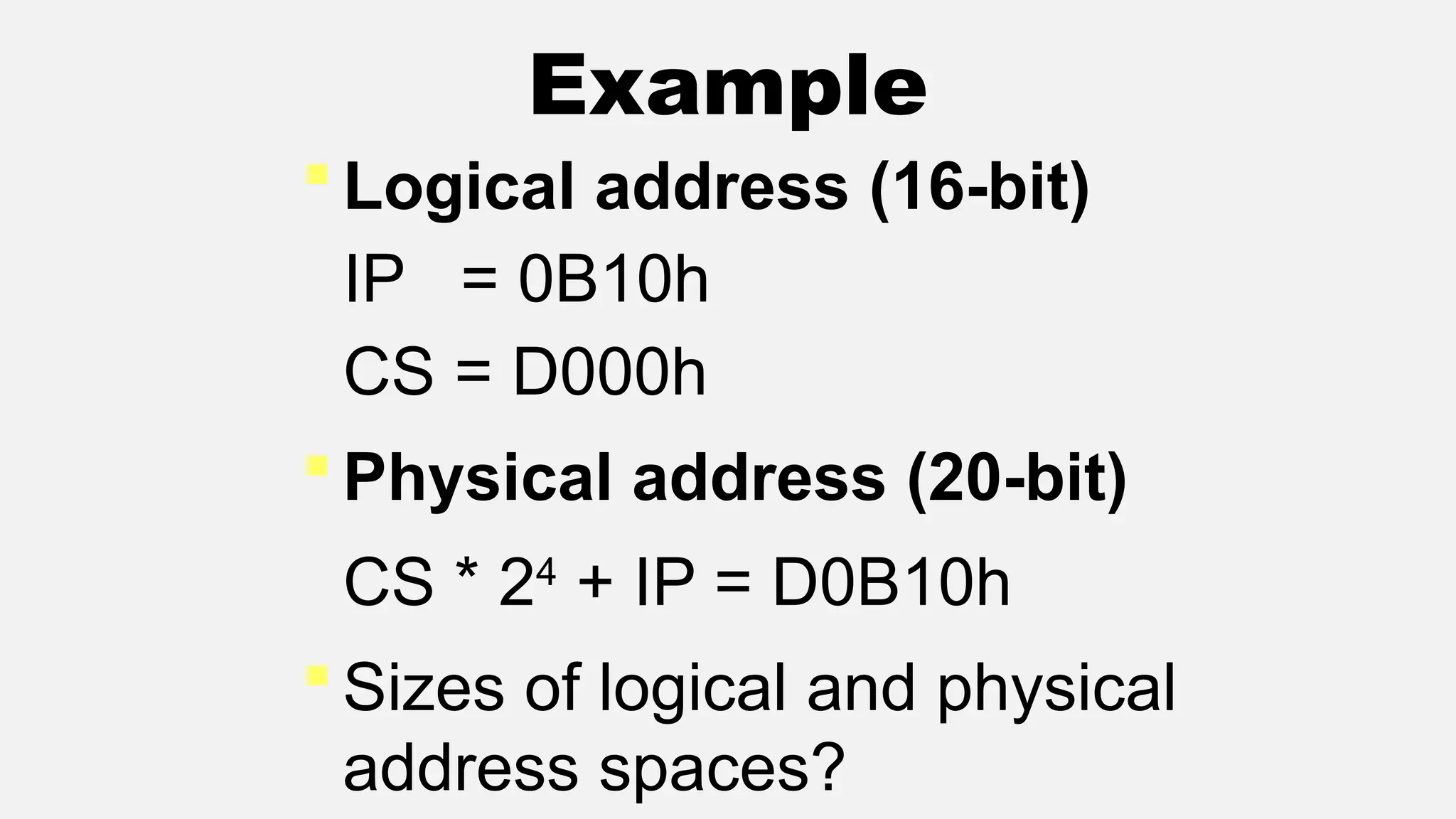
 Logical address (16-bit)
IP = 0B10h
CS = D000h
 Physical address (20-bit)
CS * 24
+ IP = D0B10h
 Sizes of logical and physical
address spaces?
Dynamic Loading
With dynamic loading, a routine
is not loaded into the main
memory until it is called.
All routines are kept on the disk
in a re-locatable format.
The main program is loaded
into memory and is executed
Dynamic Loading
Advantages
Potentially less time needed to
load a program
Potentially less memory space
needed
Disadvantage
Run-time activity
Dynamic Linking
In static linking, system
language libraries are linked
at compile time and, like any
other object module, are
combined by the loader into
the binary image
Dynamic Linking
 In dynamic linking, linking is
postponed until run-time.
 A library call is replaced by a
piece of code, called stub,
which is used to locate
memory-resident library routine
Dynamic Linking
During execution of a process,
stub is replaced by the address
of the relevant library code and
the code is executed
If library code is not in memory,
it is loaded at this time
Dynamic Linking
Advantages
Potentially less time needed to
load a program
Potentially less memory space
needed
Less disk space needed to
store binaries
Dynamic Linking
Disadvantages
Time-consuming run-time activity,
resulting in slower program
execution
gcc compiler
Dynamic linking by default
-static option allows static
linking
Overlays
 Allow a process to be larger
than the amount of memory
allocated to it
 Keep in memory only those
instructions and data that are
needed at any given time
Overlays
 When other instructions are
needed, they are loaded into the
space occupied previously by
instructions that are no longer
needed
 Implemented by user
 Programming design of overlay
structure is complex and not
possible in all cases
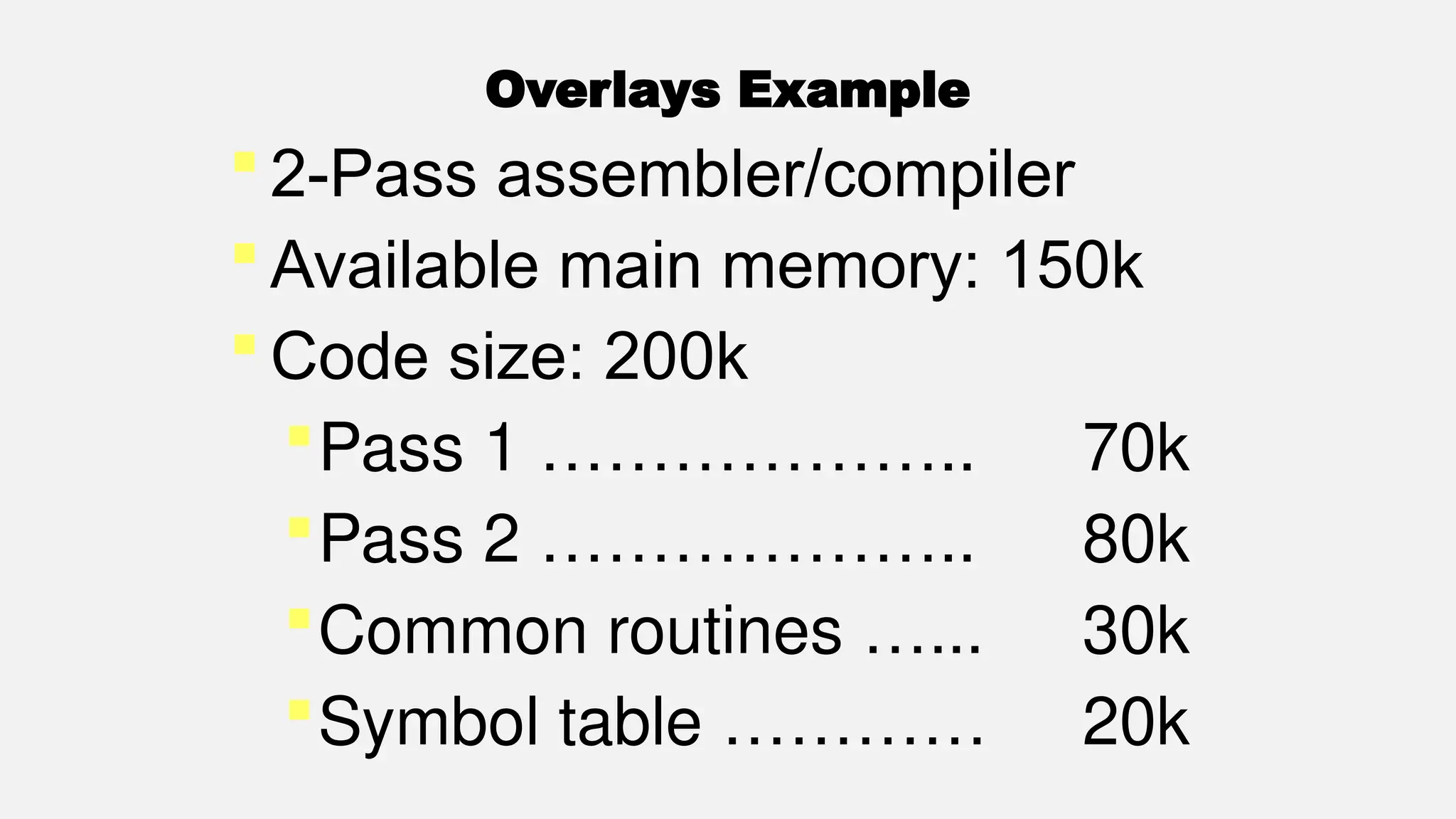
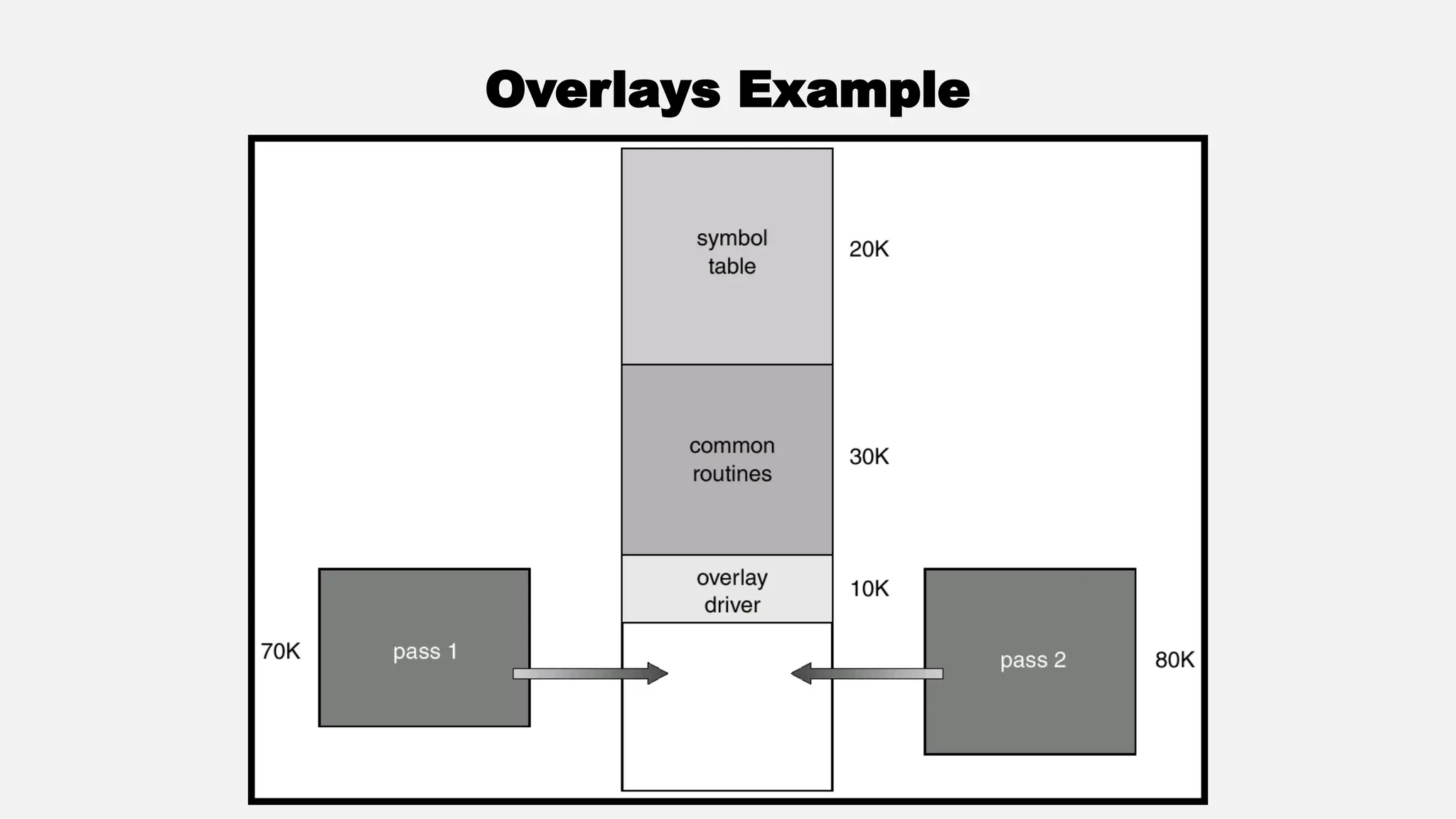
Overlays Example
 2-Pass assembler/compiler
 Available main memory: 150k
 Code size: 200k
Pass 1 ……………….. 70k
Pass 2 ……………….. 80k
Common routines …... 30k
Symbol table ………… 20k
Overlays Example
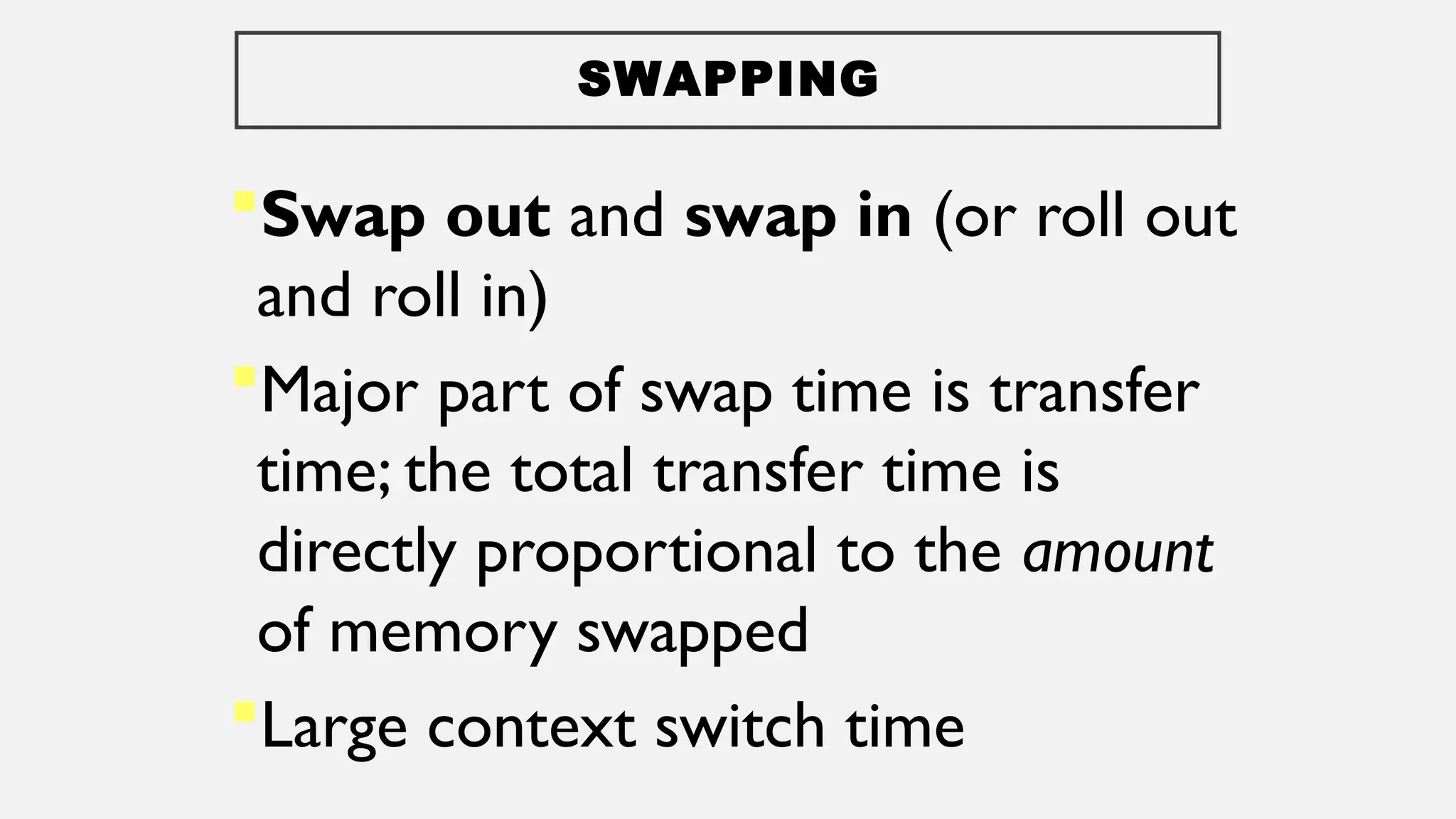
SWAPPING
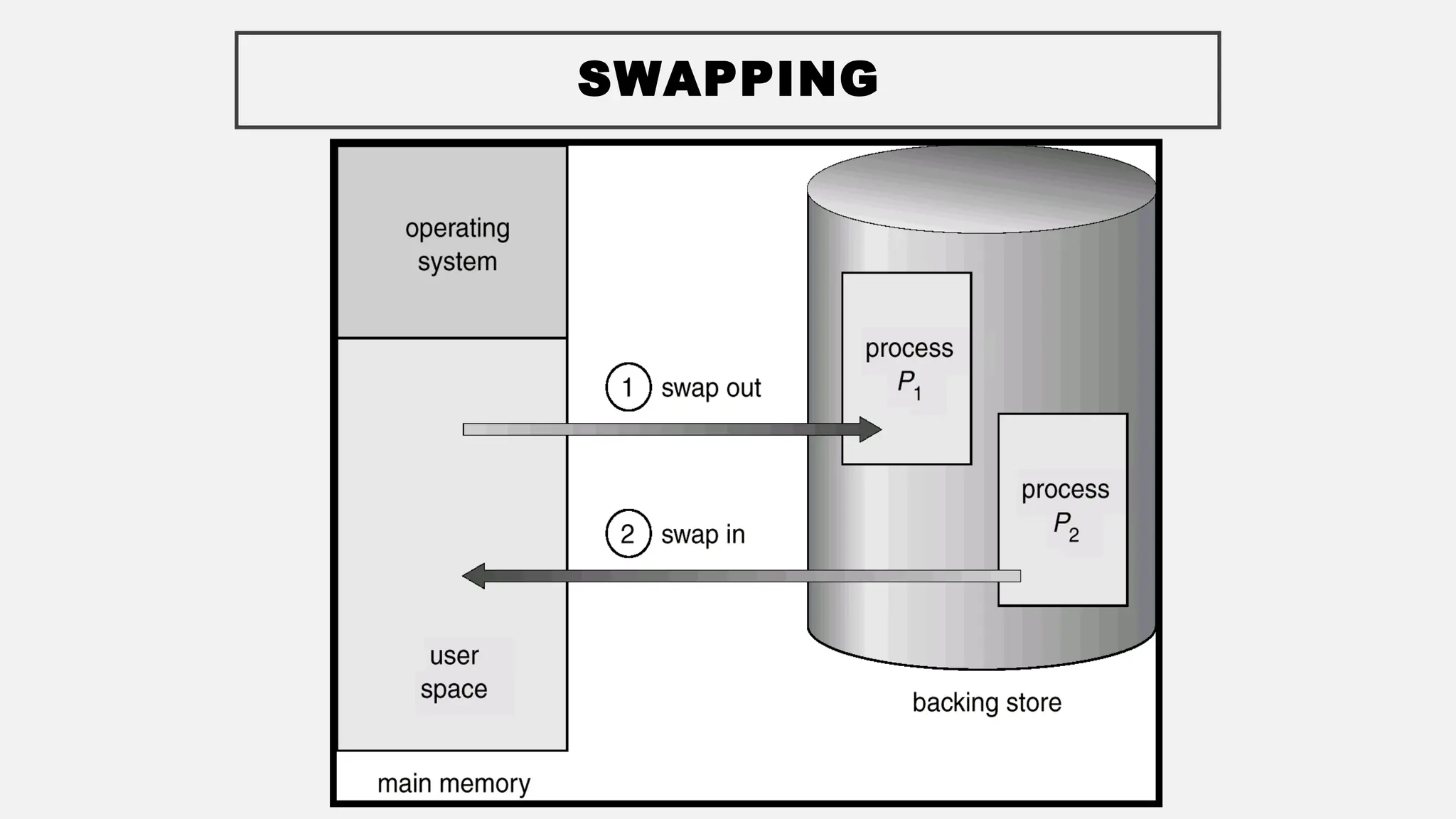
Swap out and swap in (or roll out
and roll in)
Major part of swap time is transfer
time; the total transfer time is
directly proportional to the amount
of memory swapped
Large context switch time
SWAPPING
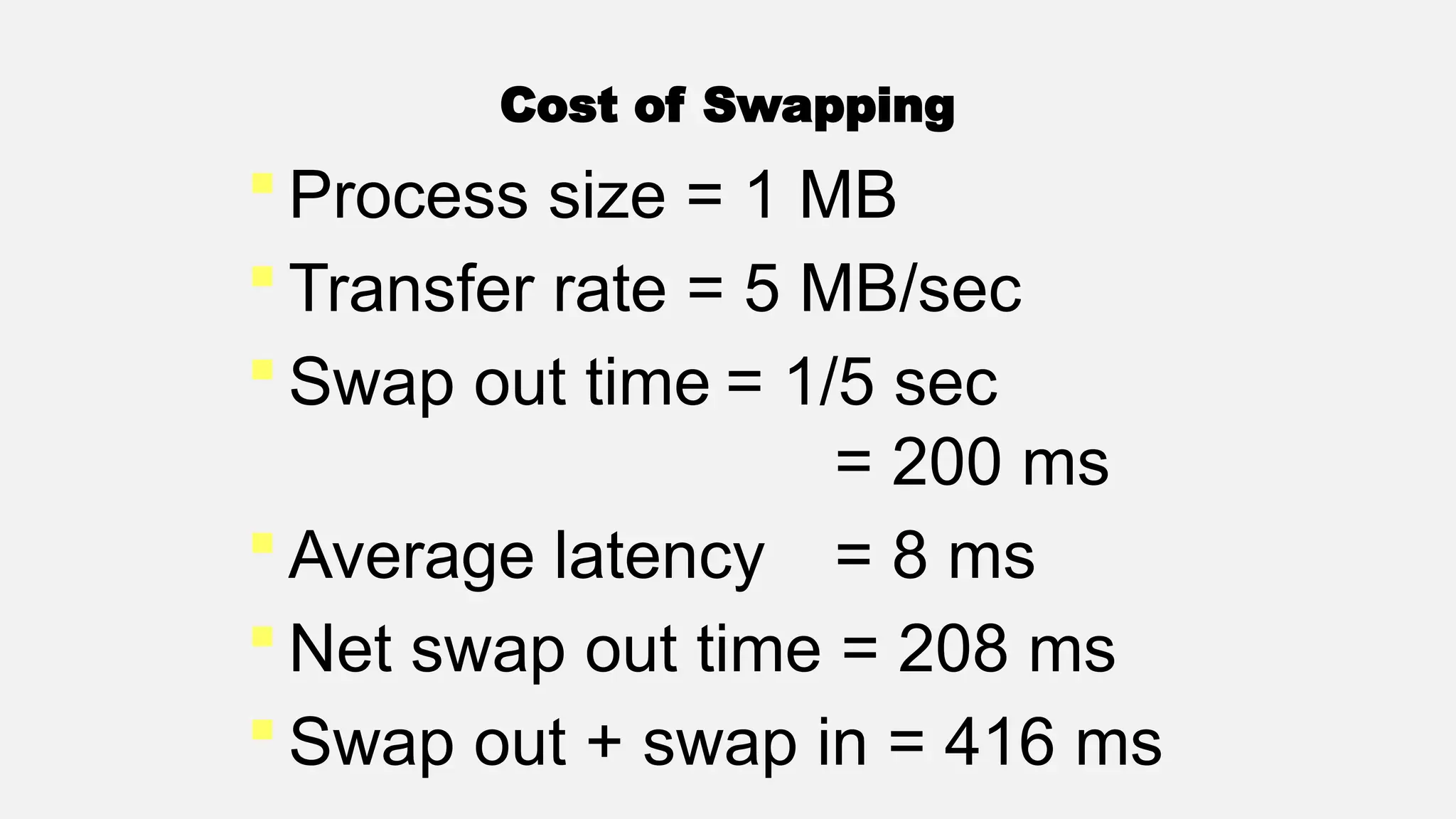
Cost of Swapping
 Process size = 1 MB
 Transfer rate = 5 MB/sec
 Swap out time = 1/5 sec
= 200 ms
 Average latency = 8 ms
 Net swap out time = 208 ms
 Swap out + swap in = 416 ms
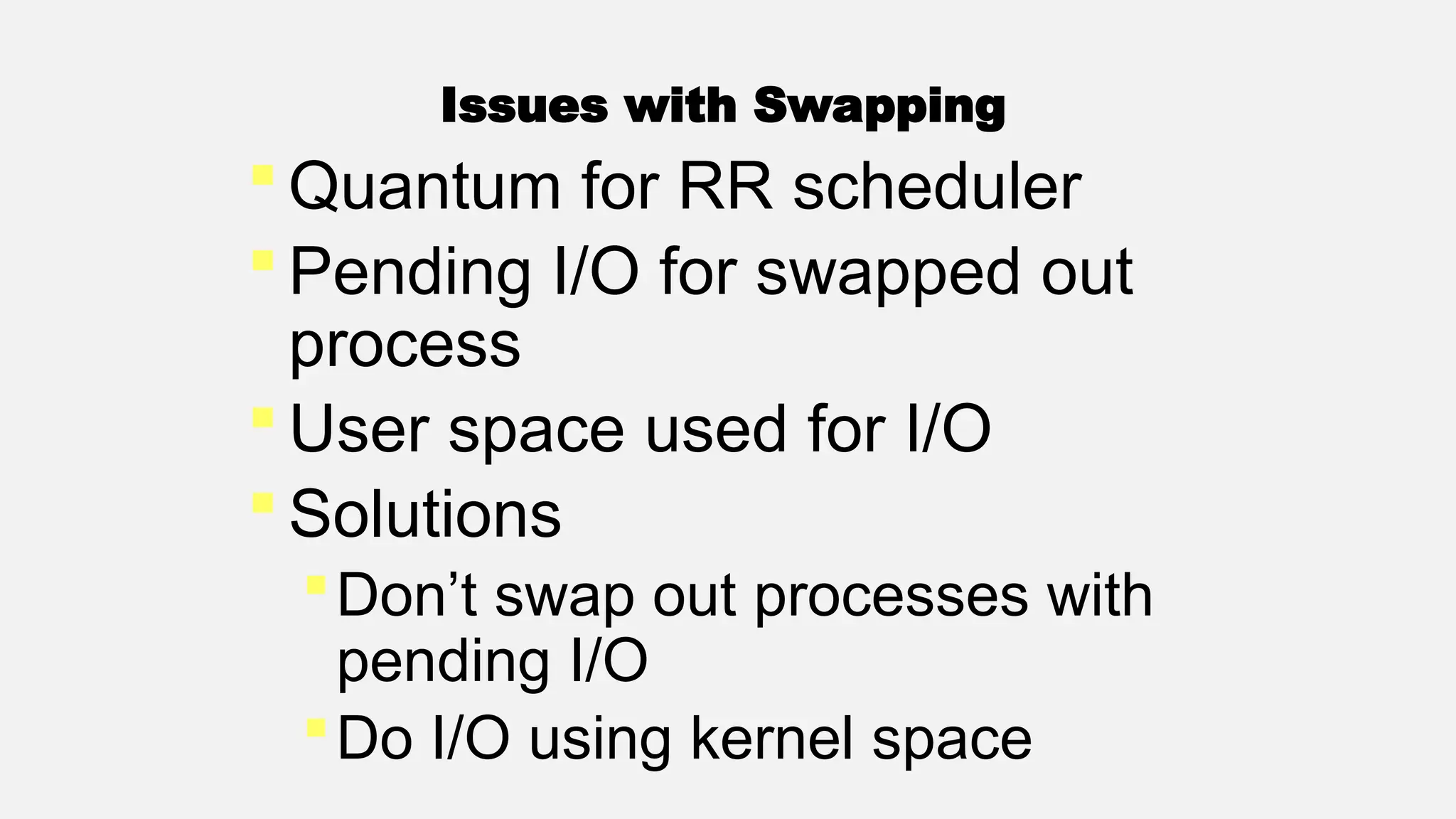
Issues with Swapping
 Quantum for RR scheduler
 Pending I/O for swapped out
process
 User space used for I/O
 Solutions
Don’t swap out processes with
pending I/O
Do I/O using kernel space
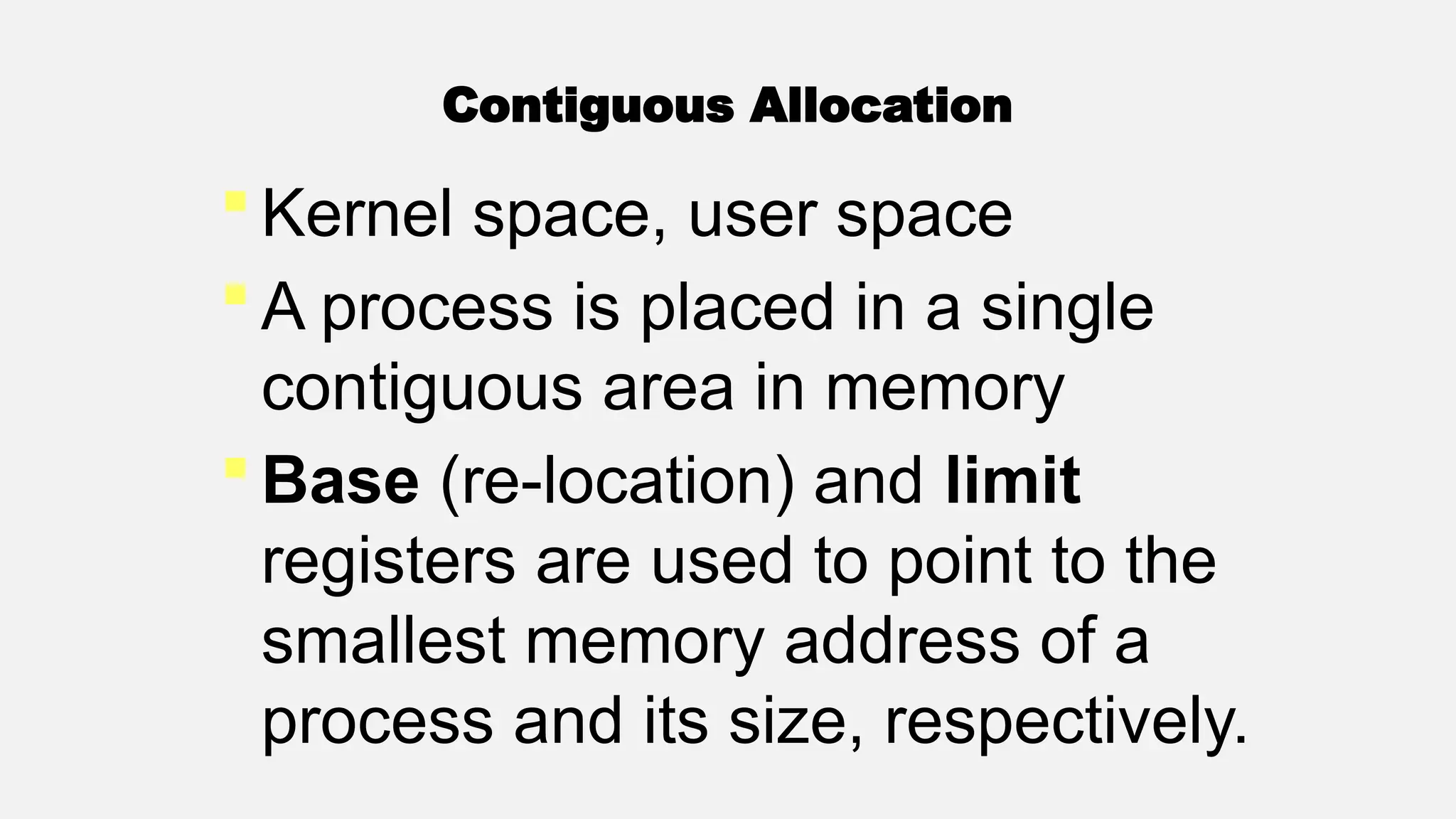
Contiguous Allocation
 Kernel space, user space
 A process is placed in a single
contiguous area in memory
 Base (re-location) and limit
registers are used to point to the
smallest memory address of a
process and its size, respectively.
Contiguous Allocation
Main
Memory
Process
MFT
 Multiprogramming with fixed
tasks (MFT)
 Memory is divided into several
fixed-size partitions.
 Each partition may contain
exactly one process/task.
MFT
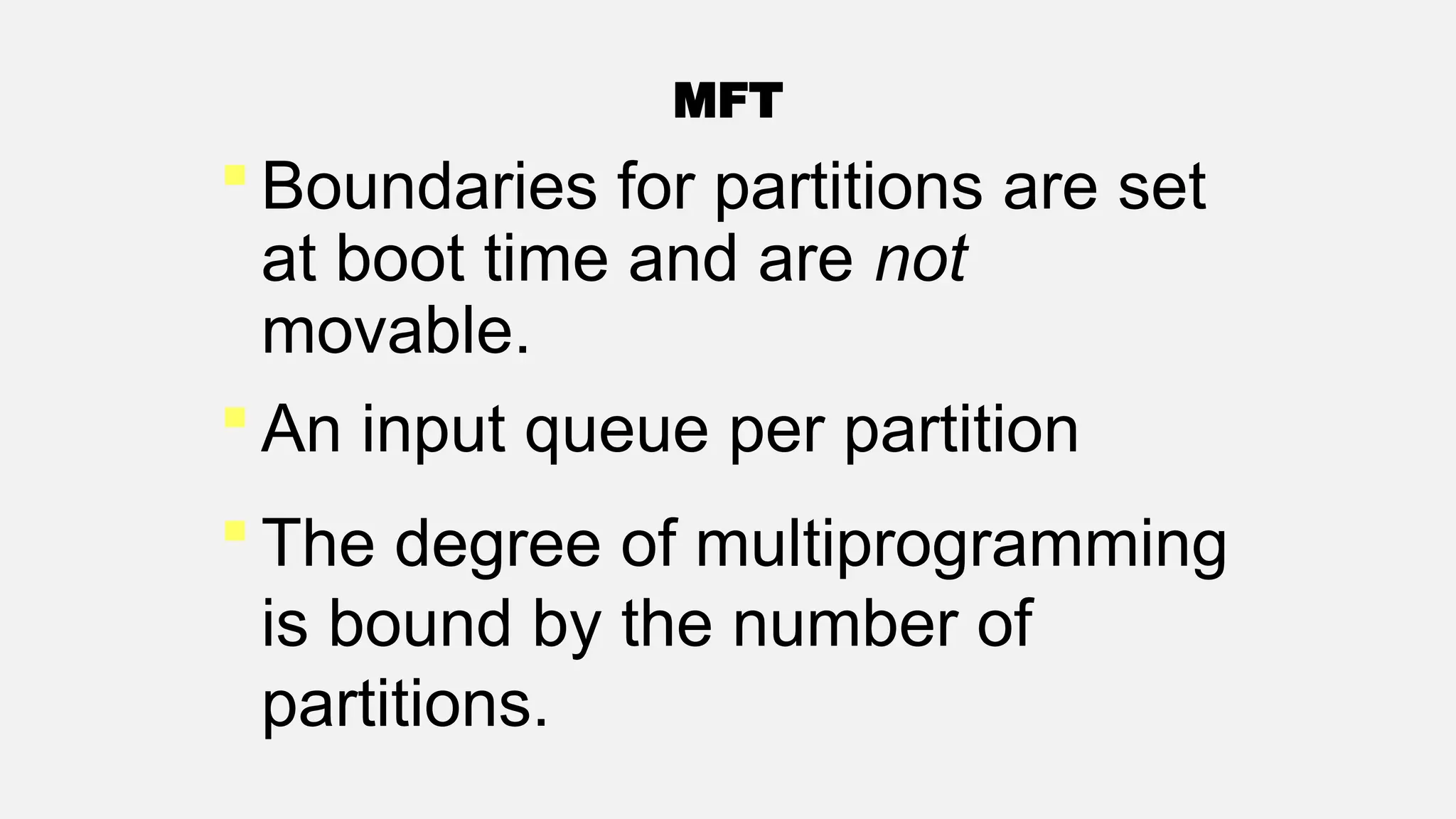
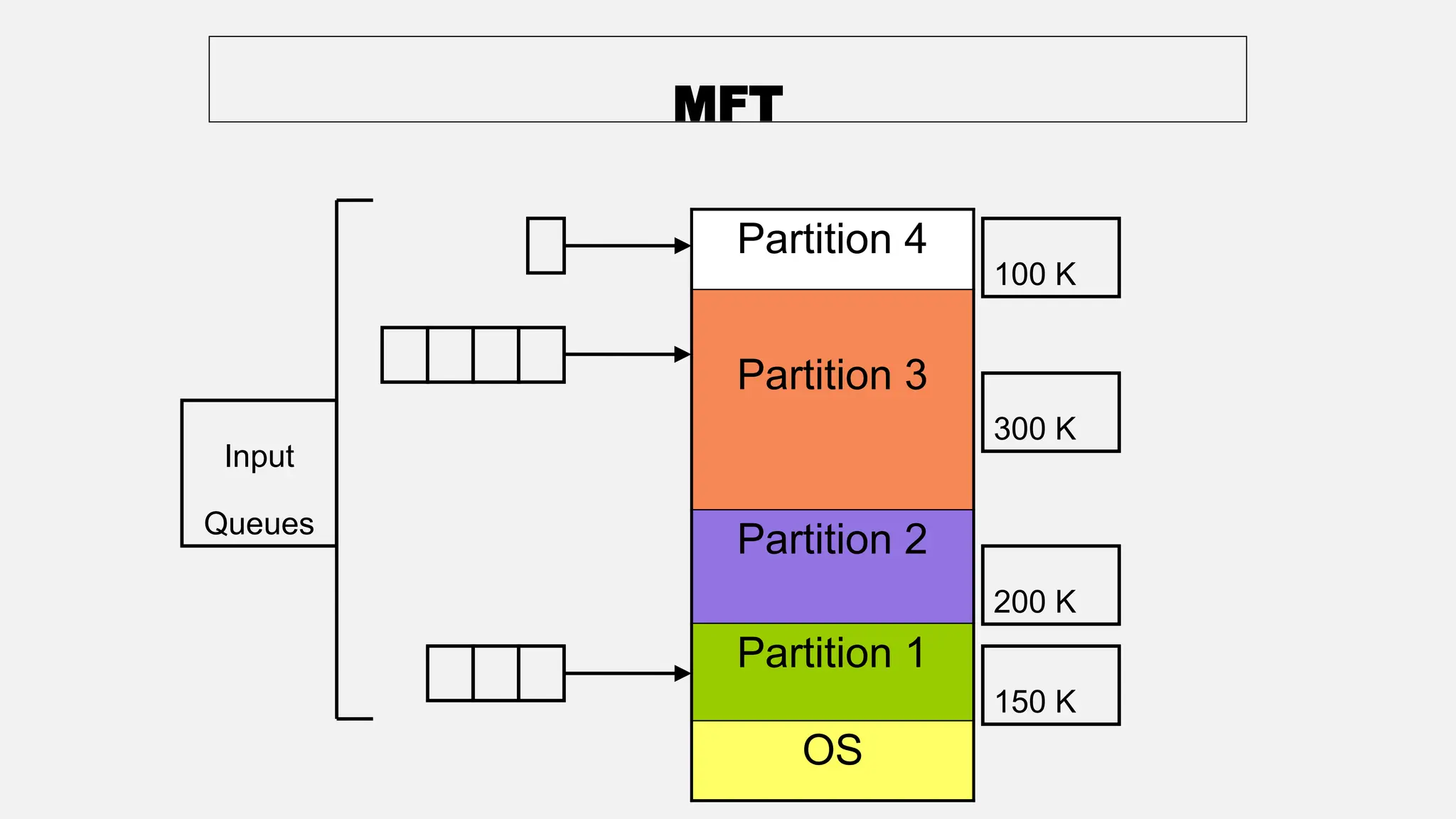
 Boundaries for partitions are set
at boot time and are not
movable.
 An input queue per partition
 The degree of multiprogramming
is bound by the number of
partitions.
Partition 4
Partition 3
Partition 2
Partition 1
OS
MFT
100 K
300 K
200 K
150 K
Input
Queues
 Potential for wasted memory
space—an empty partition but
no process in the associated
queue
 Load-time address binding
MFT With Multiple Input Queues
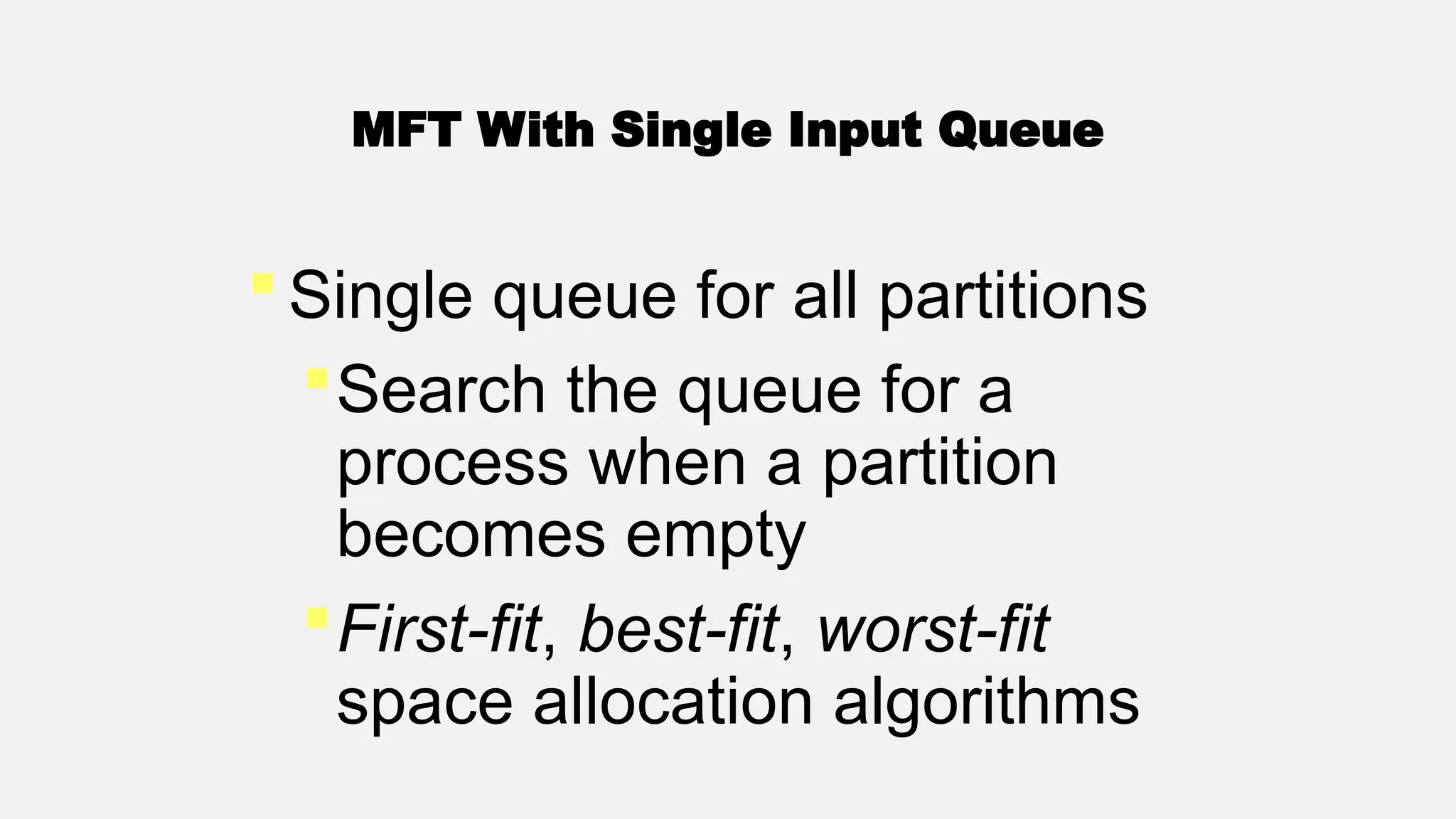
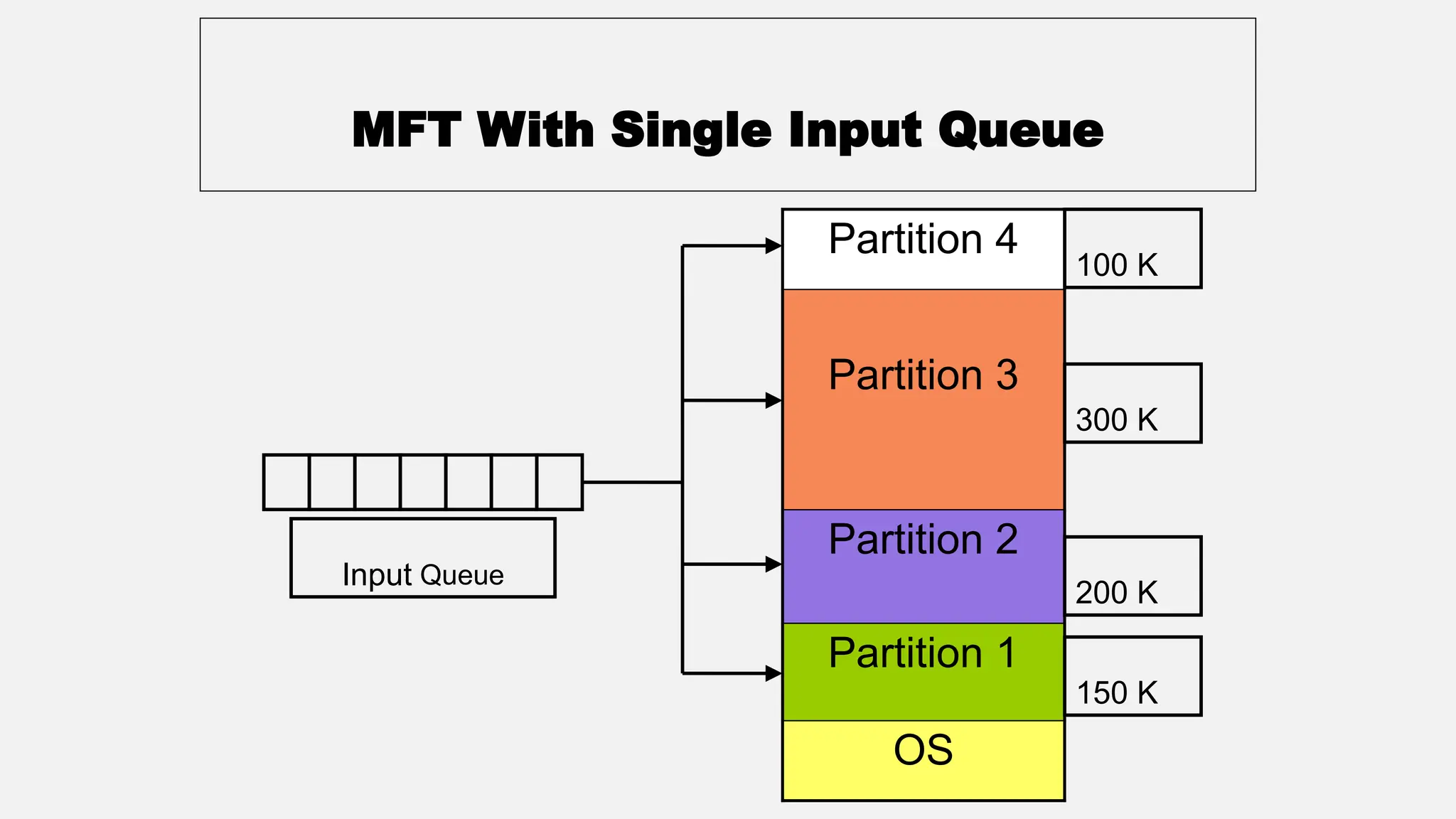
 Single queue for all partitions
Search the queue for a
process when a partition
becomes empty
First-fit, best-fit, worst-fit
space allocation algorithms
MFT With Single Input Queue
Partition 4
Partition 3
Partition 2
Partition 1
OS
100 K
300 K
200 K
150 K
Input Queue
MFT With Single Input Queue
43
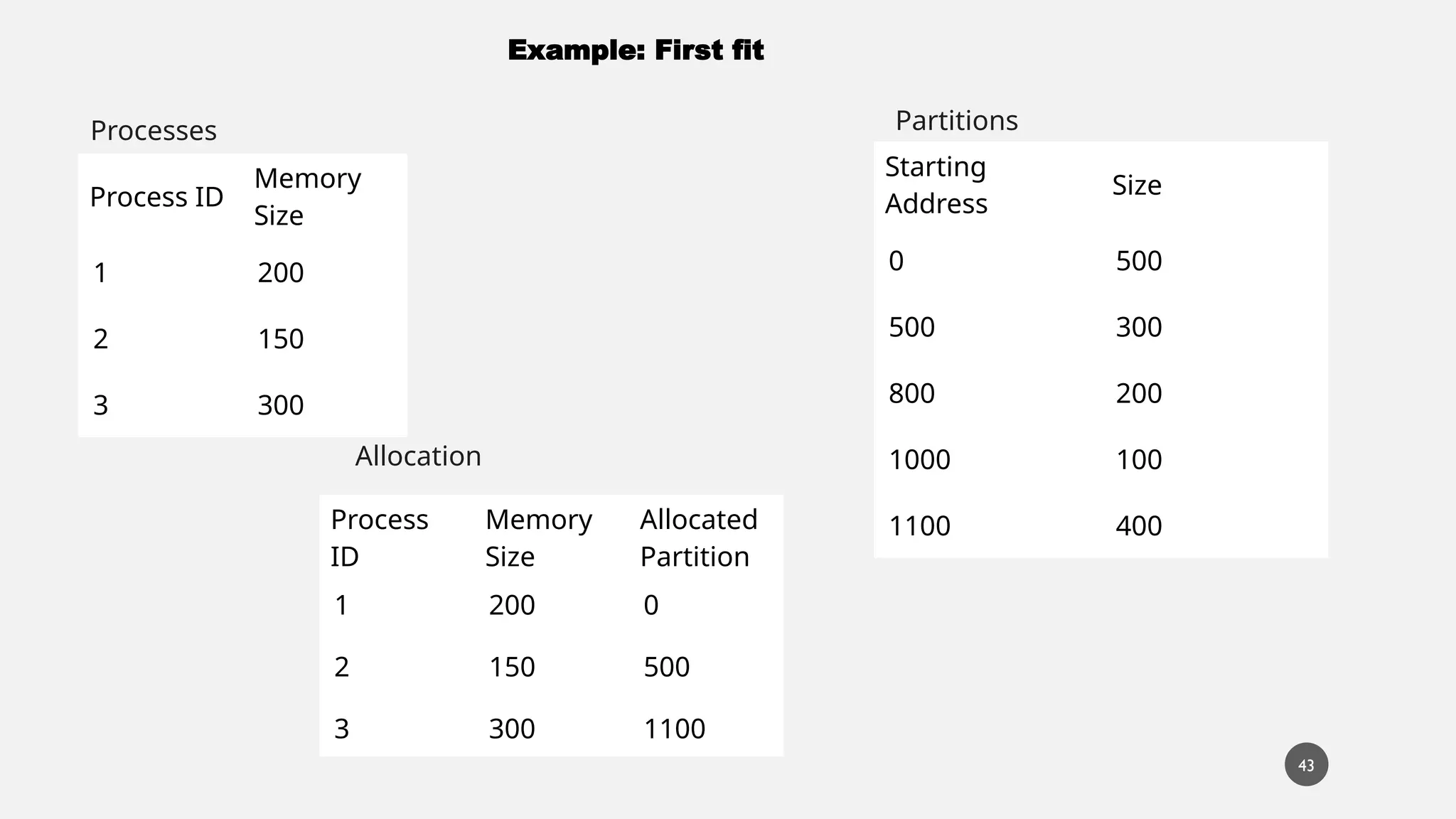
Process ID
Memory
Size
1 200
2 150
3 300
Starting
Address
Size
0 500
500 300
800 200
1000 100
1100 400
Processes
Example: First fit
Partitions
Process
ID
Memory
Size
Allocated
Partition
1 200 0
2 150 500
3 300 1100
Allocation
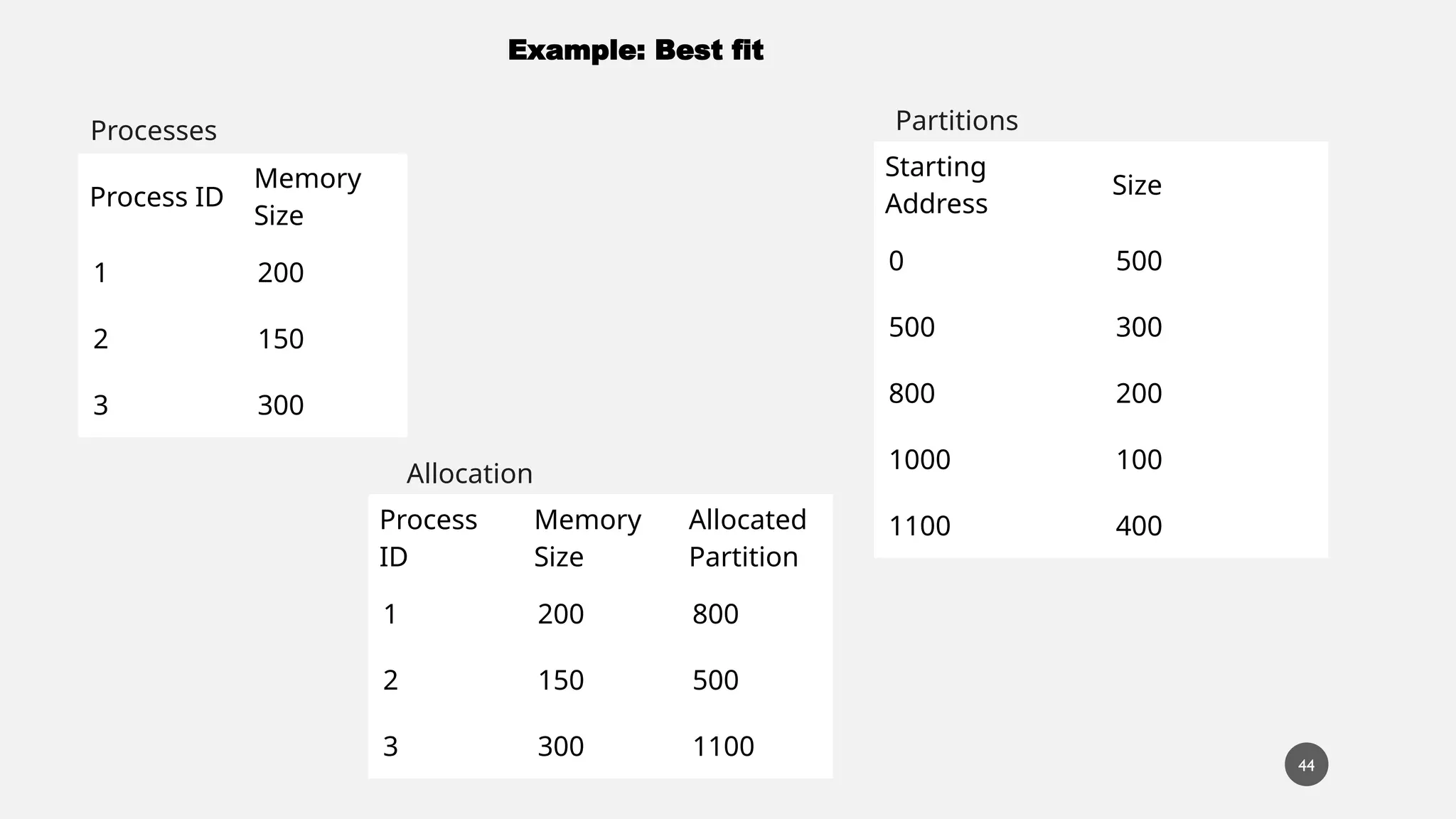
44
Process
ID
Memory
Size
Allocated
Partition
1 200 800
2 150 500
3 300 1100
Process ID
Memory
Size
1 200
2 150
3 300
Starting
Address
Size
0 500
500 300
800 200
1000 100
1100 400
Processes
Example: Best fit
Partitions
Allocation
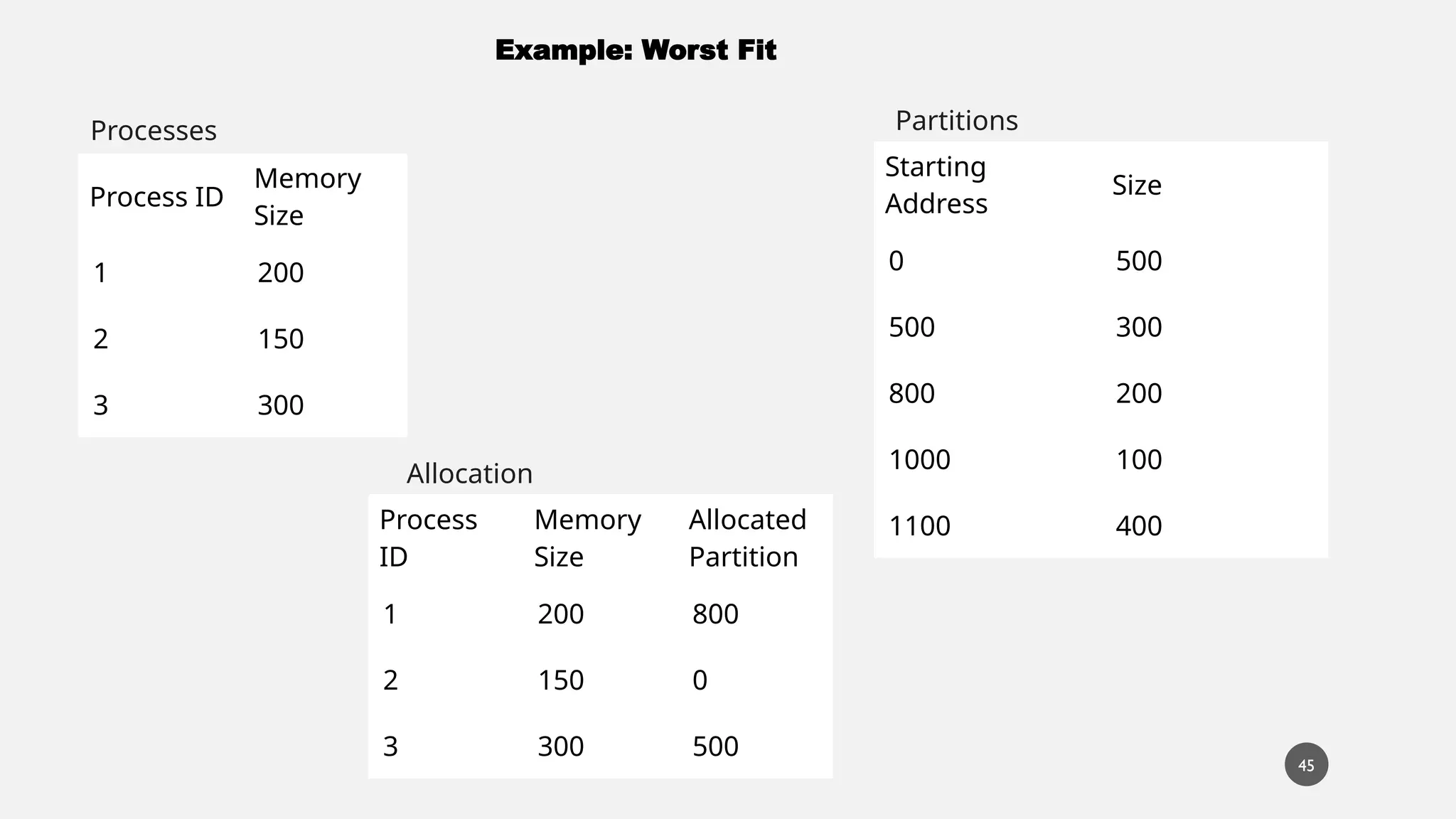
45
Process
ID
Memory
Size
Allocated
Partition
1 200 800
2 150 0
3 300 500
Process ID
Memory
Size
1 200
2 150
3 300
Starting
Address
Size
0 500
500 300
800 200
1000 100
1100 400
Processes
Example: Worst Fit
Partitions
Allocation
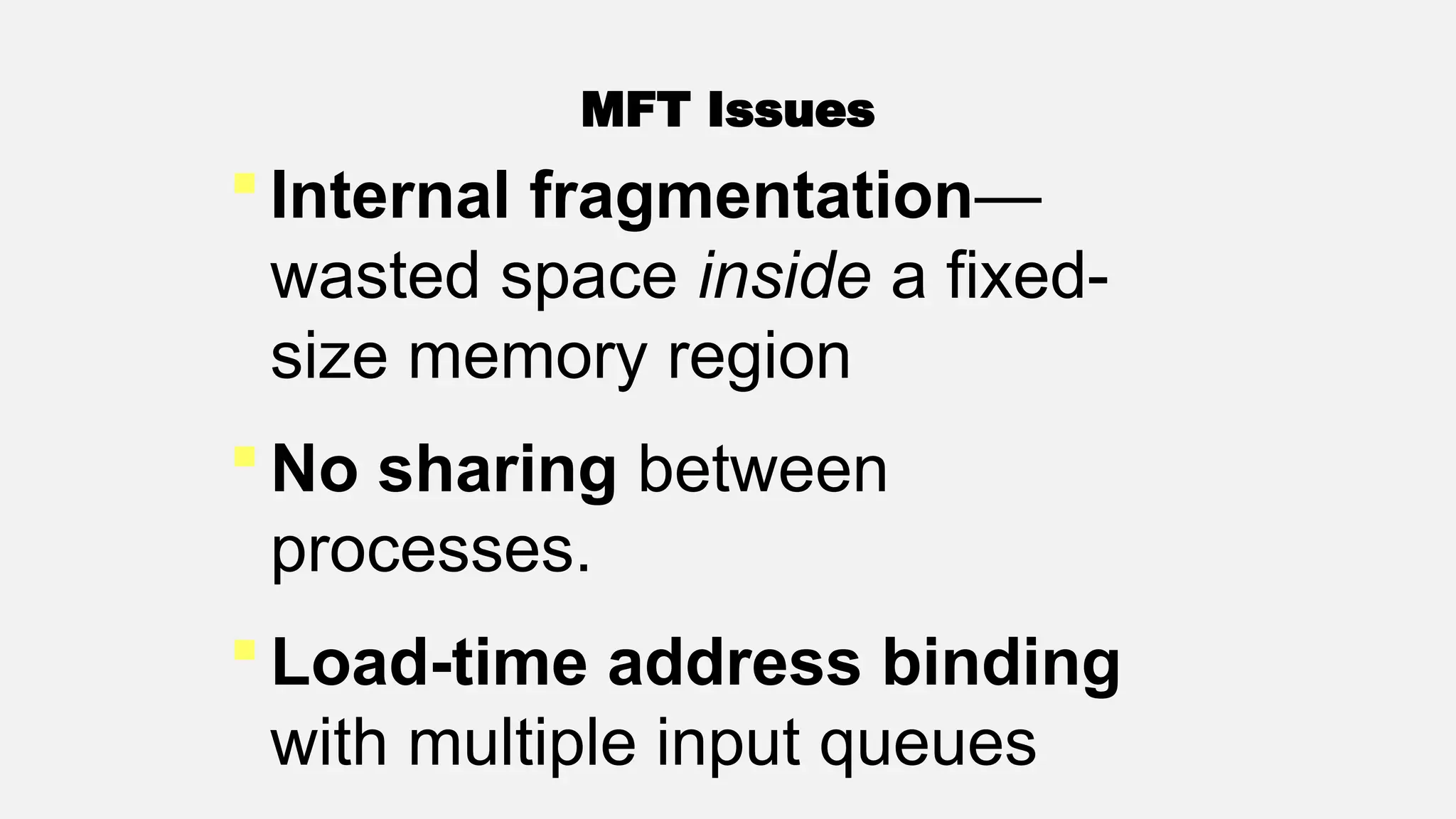
 Internal fragmentation—
wasted space inside a fixed-
size memory region
 No sharing between
processes.
 Load-time address binding
with multiple input queues
MFT Issues

Week 12 Operating System Lectures lec 2.pptx

  • 1.
    OPERATING SYSTEMS (CSC 2205) Instructor:Mr. Khwaja Bilal Hassan BS CS UET Peshawar M.Phil. CS Quaid-e-Azam University Islamabad Lecture#12 Memory Management 1
  • 2.
    Agenda for Today What is memory management  Source code to execution  Address binding  Logical and physical address spaces  Dynamic loading, dynamic linking, and overlays
  • 3.
    Memory Hierarchy  Verysmall, extremely fast, extremely expensive, and volatile CPU registers  Small, very fast, expensive, and volatile cache  Hundreds of megabytes of medium- speed, medium-price, volatile main memory  Hundreds of gigabytes of slow, cheap, and non-volatile secondary storage
  • 4.
    Purpose of Memory Management Toensure fair, secure, orderly, and efficient use of memory
  • 5.
    Memory Management Keeping trackof used and free memory space When, where, and how much memory to allocate and deallocate Swapping processes in and out of main memory
  • 6.
  • 7.
    © Copyright VirtualUniversity of Pakistan May 4, 2021
  • 8.
     Binding instructionsand data to memory addresses  Compile time  Load time  Execution time Address Binding
  • 9.
     Compile time:If you know at compile time where the process will reside in memory, the absolute code can be generated. Process must reside in the same memory region for it to execute correctly. Address Binding
  • 10.
     Load time:If the location of a process in memory is not known at compile time, then the compiler must generate re- locatable code. In this case the final binding is delayed until load time. Process can be loaded in different memory regions. Address Binding
  • 11.
    Address Binding  Executiontime: If the process can be moved during its execution from one memory region to another, then binding must be delayed until run time. Special hardware must be available for this to work.
  • 12.
    Logical and Physical Addresses Logical address: An address generated by the process/CPU; refers to an instruction or data in the process  Physical address: An address for a main memory location where instruction or data resides
  • 13.
    Logical and Physical AddressSpaces  The set of all logical addresses generated by a process comprises its logical address space.  The set of physical addresses corresponding to these logical addresses comprises the physical address space for the process.
  • 14.
    Logical and Physical AddressSpaces  The run-time mapping from logical to physical addresses is done by a piece of the CPU hardware, called the memory management unit (MMU).
  • 15.
    Example  The baseregister is called the relocation register.  The value in the relocation register is added to every address generated by a user process at the time it is sent to memory.
  • 16.
  • 17.
    Example  In i8086,the logical address of the next instruction is specified by the value of instruction pointer (IP). The physical address for the instruction is computed by shifting the code segment register (CS) left by four bits and adding IP to it.
  • 18.
  • 19.
    Example  Logical address(16-bit) IP = 0B10h CS = D000h  Physical address (20-bit) CS * 24 + IP = D0B10h  Sizes of logical and physical address spaces?
  • 20.
    Dynamic Loading With dynamicloading, a routine is not loaded into the main memory until it is called. All routines are kept on the disk in a re-locatable format. The main program is loaded into memory and is executed
  • 21.
    Dynamic Loading Advantages Potentially lesstime needed to load a program Potentially less memory space needed Disadvantage Run-time activity
  • 22.
    Dynamic Linking In staticlinking, system language libraries are linked at compile time and, like any other object module, are combined by the loader into the binary image
  • 23.
    Dynamic Linking  Indynamic linking, linking is postponed until run-time.  A library call is replaced by a piece of code, called stub, which is used to locate memory-resident library routine
  • 24.
    Dynamic Linking During executionof a process, stub is replaced by the address of the relevant library code and the code is executed If library code is not in memory, it is loaded at this time
  • 25.
    Dynamic Linking Advantages Potentially lesstime needed to load a program Potentially less memory space needed Less disk space needed to store binaries
  • 26.
    Dynamic Linking Disadvantages Time-consuming run-timeactivity, resulting in slower program execution gcc compiler Dynamic linking by default -static option allows static linking
  • 27.
    Overlays  Allow aprocess to be larger than the amount of memory allocated to it  Keep in memory only those instructions and data that are needed at any given time
  • 28.
    Overlays  When otherinstructions are needed, they are loaded into the space occupied previously by instructions that are no longer needed  Implemented by user  Programming design of overlay structure is complex and not possible in all cases
  • 29.
    Overlays Example  2-Passassembler/compiler  Available main memory: 150k  Code size: 200k Pass 1 ……………….. 70k Pass 2 ……………….. 80k Common routines …... 30k Symbol table ………… 20k
  • 30.
  • 31.
    SWAPPING Swap out andswap in (or roll out and roll in) Major part of swap time is transfer time; the total transfer time is directly proportional to the amount of memory swapped Large context switch time
  • 32.
  • 33.
    Cost of Swapping Process size = 1 MB  Transfer rate = 5 MB/sec  Swap out time = 1/5 sec = 200 ms  Average latency = 8 ms  Net swap out time = 208 ms  Swap out + swap in = 416 ms
  • 34.
    Issues with Swapping Quantum for RR scheduler  Pending I/O for swapped out process  User space used for I/O  Solutions Don’t swap out processes with pending I/O Do I/O using kernel space
  • 35.
    Contiguous Allocation  Kernelspace, user space  A process is placed in a single contiguous area in memory  Base (re-location) and limit registers are used to point to the smallest memory address of a process and its size, respectively.
  • 36.
  • 37.
    MFT  Multiprogramming withfixed tasks (MFT)  Memory is divided into several fixed-size partitions.  Each partition may contain exactly one process/task.
  • 38.
    MFT  Boundaries forpartitions are set at boot time and are not movable.  An input queue per partition  The degree of multiprogramming is bound by the number of partitions.
  • 39.
    Partition 4 Partition 3 Partition2 Partition 1 OS MFT 100 K 300 K 200 K 150 K Input Queues
  • 40.
     Potential forwasted memory space—an empty partition but no process in the associated queue  Load-time address binding MFT With Multiple Input Queues
  • 41.
     Single queuefor all partitions Search the queue for a process when a partition becomes empty First-fit, best-fit, worst-fit space allocation algorithms MFT With Single Input Queue
  • 42.
    Partition 4 Partition 3 Partition2 Partition 1 OS 100 K 300 K 200 K 150 K Input Queue MFT With Single Input Queue
  • 43.
    43 Process ID Memory Size 1 200 2150 3 300 Starting Address Size 0 500 500 300 800 200 1000 100 1100 400 Processes Example: First fit Partitions Process ID Memory Size Allocated Partition 1 200 0 2 150 500 3 300 1100 Allocation
  • 44.
    44 Process ID Memory Size Allocated Partition 1 200 800 2150 500 3 300 1100 Process ID Memory Size 1 200 2 150 3 300 Starting Address Size 0 500 500 300 800 200 1000 100 1100 400 Processes Example: Best fit Partitions Allocation
  • 45.
    45 Process ID Memory Size Allocated Partition 1 200 800 2150 0 3 300 500 Process ID Memory Size 1 200 2 150 3 300 Starting Address Size 0 500 500 300 800 200 1000 100 1100 400 Processes Example: Worst Fit Partitions Allocation
  • 46.
     Internal fragmentation— wastedspace inside a fixed- size memory region  No sharing between processes.  Load-time address binding with multiple input queues MFT Issues