Operating System 32
Logical versus physical address
Prof Neeraj Bhargava
Vaibhav Khanna
Department of Computer Science
School of Engineering and Systems Sciences
Maharshi Dayanand Saraswati University Ajmer
Memory Management
• How to utilize memory optimally by manipulating objects in
the memory is referred to as memory management.
• Program must be brought (from disk) into memory and
placed within a process for it to be run
• Main memory and registers are only storage CPU can
access directly
• Memory unit only sees a stream of addresses + read
requests, or address + data and write requests
• Register access in one CPU clock (or less)
• Main memory can take many cycles, causing a stall
• Cache sits between main memory and CPU registers
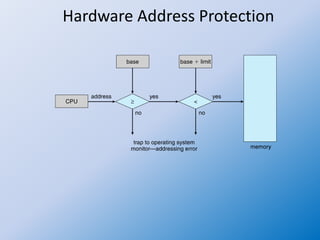
• Protection of memory required to ensure correct operation
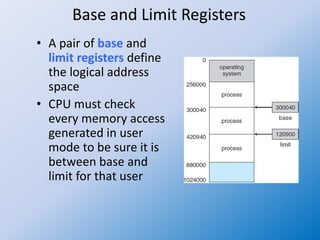
Base and Limit Registers
• A pair of base and
limit registers define
the logical address
space
• CPU must check
every memory access
generated in user
mode to be sure it is
between base and
limit for that user
Hardware Address Protection
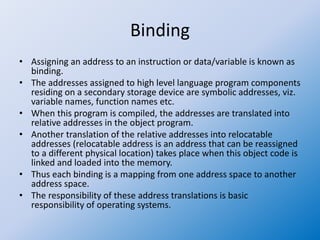
Binding
• Assigning an address to an instruction or data/variable is known as
binding.
• The addresses assigned to high level language program components
residing on a secondary storage device are symbolic addresses, viz.
variable names, function names etc.
• When this program is compiled, the addresses are translated into
relative addresses in the object program.
• Another translation of the relative addresses into relocatable
addresses (relocatable address is an address that can be reassigned
to a different physical location) takes place when this object code is
linked and loaded into the memory.
• Thus each binding is a mapping from one address space to another
address space.
• The responsibility of these address translations is basic
responsibility of operating systems.
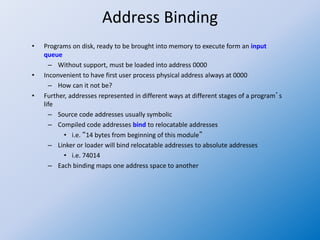
Address Binding
• Programs on disk, ready to be brought into memory to execute form an input
queue
– Without support, must be loaded into address 0000
• Inconvenient to have first user process physical address always at 0000
– How can it not be?
• Further, addresses represented in different ways at different stages of a program’s
life
– Source code addresses usually symbolic
– Compiled code addresses bind to relocatable addresses
• i.e. “14 bytes from beginning of this module”
– Linker or loader will bind relocatable addresses to absolute addresses
• i.e. 74014
– Each binding maps one address space to another
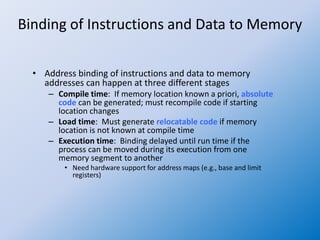
Binding of Instructions and Data to Memory
• Address binding of instructions and data to memory
addresses can happen at three different stages
– Compile time: If memory location known a priori, absolute
code can be generated; must recompile code if starting
location changes
– Load time: Must generate relocatable code if memory
location is not known at compile time
– Execution time: Binding delayed until run time if the
process can be moved during its execution from one
memory segment to another
• Need hardware support for address maps (e.g., base and limit
registers)
Multistep Processing of a User Program
Logical vs. Physical Address Space
• The concept of a logical address space that is bound to a
separate physical address space is central to proper
memory management
– Logical address – generated by the CPU; also referred to as
virtual address
– Physical address – address seen by the memory unit
• Logical and physical addresses are the same in compile-
time and load-time address-binding schemes; logical
(virtual) and physical addresses differ in execution-time
address-binding scheme
• Logical address space is the set of all logical addresses
generated by a program
• Physical address space is the set of all physical addresses
generated by a program
Memory-Management Unit (MMU)
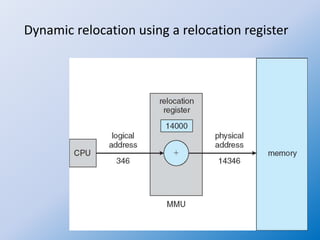
• Hardware device that at run time maps virtual to physical
address
• Many methods possible, covered in the rest of this
chapter
• To start, consider simple scheme where the value in the
relocation register is added to every address generated
by a user process at the time it is sent to memory
– Base register now called relocation register
– MS-DOS on Intel 80x86 used 4 relocation registers
• The user program deals with logical addresses; it never
sees the real physical addresses
– Execution-time binding occurs when reference is made to
location in memory
– Logical address bound to physical addresses
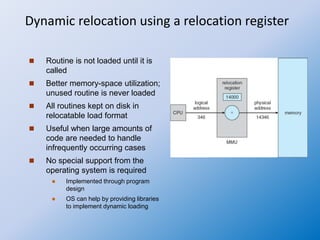
Dynamic relocation using a relocation register
 Routine is not loaded until it is
called
 Better memory-space utilization;
unused routine is never loaded
 All routines kept on disk in
relocatable load format
 Useful when large amounts of
code are needed to handle
infrequently occurring cases
 No special support from the
operating system is required
 Implemented through program
design
 OS can help by providing libraries
to implement dynamic loading
Dynamic relocation using a relocation register
Dynamic Linking
• Static linking – system libraries and program code
combined by the loader into the binary program image
• Dynamic linking –linking postponed until execution time
• Small piece of code, stub, used to locate the appropriate
memory-resident library routine
• Stub replaces itself with the address of the routine, and
executes the routine
• Operating system checks if routine is in processes’
memory address
– If not in address space, add to address space
• Dynamic linking is particularly useful for libraries
• System also known as shared libraries
• Consider applicability to patching system libraries
– Versioning may be needed
Assignment
• Explain the concept and need of Memory
Management
• Explain Address Binding
• What Logical vs. Physical Address Space and
explain role of Memory Management Unit.

Operating system 32 logical versus physical address

  • 1.
    Operating System 32 Logicalversus physical address Prof Neeraj Bhargava Vaibhav Khanna Department of Computer Science School of Engineering and Systems Sciences Maharshi Dayanand Saraswati University Ajmer
  • 2.
    Memory Management • Howto utilize memory optimally by manipulating objects in the memory is referred to as memory management. • Program must be brought (from disk) into memory and placed within a process for it to be run • Main memory and registers are only storage CPU can access directly • Memory unit only sees a stream of addresses + read requests, or address + data and write requests • Register access in one CPU clock (or less) • Main memory can take many cycles, causing a stall • Cache sits between main memory and CPU registers • Protection of memory required to ensure correct operation
  • 3.
    Base and LimitRegisters • A pair of base and limit registers define the logical address space • CPU must check every memory access generated in user mode to be sure it is between base and limit for that user
  • 4.
  • 5.
    Binding • Assigning anaddress to an instruction or data/variable is known as binding. • The addresses assigned to high level language program components residing on a secondary storage device are symbolic addresses, viz. variable names, function names etc. • When this program is compiled, the addresses are translated into relative addresses in the object program. • Another translation of the relative addresses into relocatable addresses (relocatable address is an address that can be reassigned to a different physical location) takes place when this object code is linked and loaded into the memory. • Thus each binding is a mapping from one address space to another address space. • The responsibility of these address translations is basic responsibility of operating systems.
  • 6.
    Address Binding • Programson disk, ready to be brought into memory to execute form an input queue – Without support, must be loaded into address 0000 • Inconvenient to have first user process physical address always at 0000 – How can it not be? • Further, addresses represented in different ways at different stages of a program’s life – Source code addresses usually symbolic – Compiled code addresses bind to relocatable addresses • i.e. “14 bytes from beginning of this module” – Linker or loader will bind relocatable addresses to absolute addresses • i.e. 74014 – Each binding maps one address space to another
  • 7.
    Binding of Instructionsand Data to Memory • Address binding of instructions and data to memory addresses can happen at three different stages – Compile time: If memory location known a priori, absolute code can be generated; must recompile code if starting location changes – Load time: Must generate relocatable code if memory location is not known at compile time – Execution time: Binding delayed until run time if the process can be moved during its execution from one memory segment to another • Need hardware support for address maps (e.g., base and limit registers)
  • 8.
  • 9.
    Logical vs. PhysicalAddress Space • The concept of a logical address space that is bound to a separate physical address space is central to proper memory management – Logical address – generated by the CPU; also referred to as virtual address – Physical address – address seen by the memory unit • Logical and physical addresses are the same in compile- time and load-time address-binding schemes; logical (virtual) and physical addresses differ in execution-time address-binding scheme • Logical address space is the set of all logical addresses generated by a program • Physical address space is the set of all physical addresses generated by a program
  • 10.
    Memory-Management Unit (MMU) •Hardware device that at run time maps virtual to physical address • Many methods possible, covered in the rest of this chapter • To start, consider simple scheme where the value in the relocation register is added to every address generated by a user process at the time it is sent to memory – Base register now called relocation register – MS-DOS on Intel 80x86 used 4 relocation registers • The user program deals with logical addresses; it never sees the real physical addresses – Execution-time binding occurs when reference is made to location in memory – Logical address bound to physical addresses
  • 11.
    Dynamic relocation usinga relocation register  Routine is not loaded until it is called  Better memory-space utilization; unused routine is never loaded  All routines kept on disk in relocatable load format  Useful when large amounts of code are needed to handle infrequently occurring cases  No special support from the operating system is required  Implemented through program design  OS can help by providing libraries to implement dynamic loading
  • 12.
    Dynamic relocation usinga relocation register
  • 13.
    Dynamic Linking • Staticlinking – system libraries and program code combined by the loader into the binary program image • Dynamic linking –linking postponed until execution time • Small piece of code, stub, used to locate the appropriate memory-resident library routine • Stub replaces itself with the address of the routine, and executes the routine • Operating system checks if routine is in processes’ memory address – If not in address space, add to address space • Dynamic linking is particularly useful for libraries • System also known as shared libraries • Consider applicability to patching system libraries – Versioning may be needed
  • 14.
    Assignment • Explain theconcept and need of Memory Management • Explain Address Binding • What Logical vs. Physical Address Space and explain role of Memory Management Unit.