Problematic Scenario
-Count is initially 0
Consumer reads the count-
-Producer produces the item, inserts it, and
increments count to 1
-Producer executes wakeup, but there is no
waiting consumer (at this point)
PRODUCER CONSUMER
PROBLEM
-Consumer continues its execution and
goes to sleep
-Consumer stays blocked forever
unnecessarily
-Main problem: wakeup was lost
THE PRODUCER/CONSUMER PROBLEM
WITH DIAGRAM
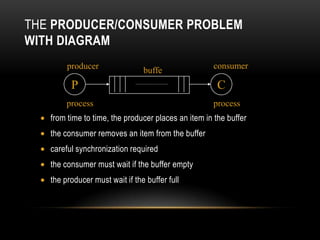
from time to time, the producer places an item in the buffer
the consumer removes an item from the buffer
careful synchronization required
the consumer must wait if the buffer empty
the producer must wait if the buffer full
producer
process
consumer
process
P
buffe
r
C
typical solution would involve a shared variable count
also known as the Bounded Buffer problem
Example: in UNIX shell
eqn myfile.t | troff
5
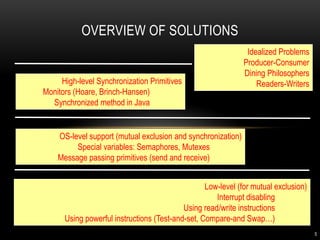
OVERVIEW OF SOLUTIONS
Low-level (for mutual exclusion)
Interrupt disabling
Using read/write instructions
Using powerful instructions (Test-and-set, Compare-and Swap…)
OS-level support (mutual exclusion and synchronization)
Special variables: Semaphores, Mutexes
Message passing primitives (send and receive)
High-level Synchronization Primitives
Monitors (Hoare, Brinch-Hansen)
Synchronized method in Java
Idealized Problems
Producer-Consumer
Dining Philosophers
Readers-Writers
6
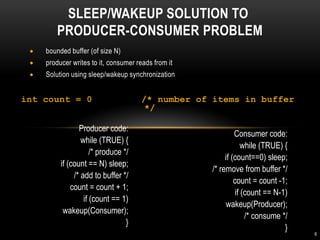
SLEEP/WAKEUP SOLUTION TO
PRODUCER-CONSUMER PROBLEM
bounded buffer (of size N)
producer writes to it, consumer reads from it
Solution using sleep/wakeup synchronization
int count = 0 /* number of items in buffer
*/
Producer code:
while (TRUE) {
/* produce */
if (count == N) sleep;
/* add to buffer */
count = count + 1;
if (count == 1)
wakeup(Consumer);
}
Consumer code:
while (TRUE) {
if (count==0) sleep;
/* remove from buffer */
count = count -1;
if (count == N-1)
wakeup(Producer);
/* consume */
}

Producer Consumer Problem

  • 1.
    Problematic Scenario -Count isinitially 0 Consumer reads the count- -Producer produces the item, inserts it, and increments count to 1 -Producer executes wakeup, but there is no waiting consumer (at this point) PRODUCER CONSUMER PROBLEM
  • 2.
    -Consumer continues itsexecution and goes to sleep -Consumer stays blocked forever unnecessarily -Main problem: wakeup was lost
  • 3.
    THE PRODUCER/CONSUMER PROBLEM WITHDIAGRAM from time to time, the producer places an item in the buffer the consumer removes an item from the buffer careful synchronization required the consumer must wait if the buffer empty the producer must wait if the buffer full producer process consumer process P buffe r C
  • 4.
    typical solution wouldinvolve a shared variable count also known as the Bounded Buffer problem Example: in UNIX shell eqn myfile.t | troff
  • 5.
    5 OVERVIEW OF SOLUTIONS Low-level(for mutual exclusion) Interrupt disabling Using read/write instructions Using powerful instructions (Test-and-set, Compare-and Swap…) OS-level support (mutual exclusion and synchronization) Special variables: Semaphores, Mutexes Message passing primitives (send and receive) High-level Synchronization Primitives Monitors (Hoare, Brinch-Hansen) Synchronized method in Java Idealized Problems Producer-Consumer Dining Philosophers Readers-Writers
  • 6.
    6 SLEEP/WAKEUP SOLUTION TO PRODUCER-CONSUMERPROBLEM bounded buffer (of size N) producer writes to it, consumer reads from it Solution using sleep/wakeup synchronization int count = 0 /* number of items in buffer */ Producer code: while (TRUE) { /* produce */ if (count == N) sleep; /* add to buffer */ count = count + 1; if (count == 1) wakeup(Consumer); } Consumer code: while (TRUE) { if (count==0) sleep; /* remove from buffer */ count = count -1; if (count == N-1) wakeup(Producer); /* consume */ }