Semaphore in nachos
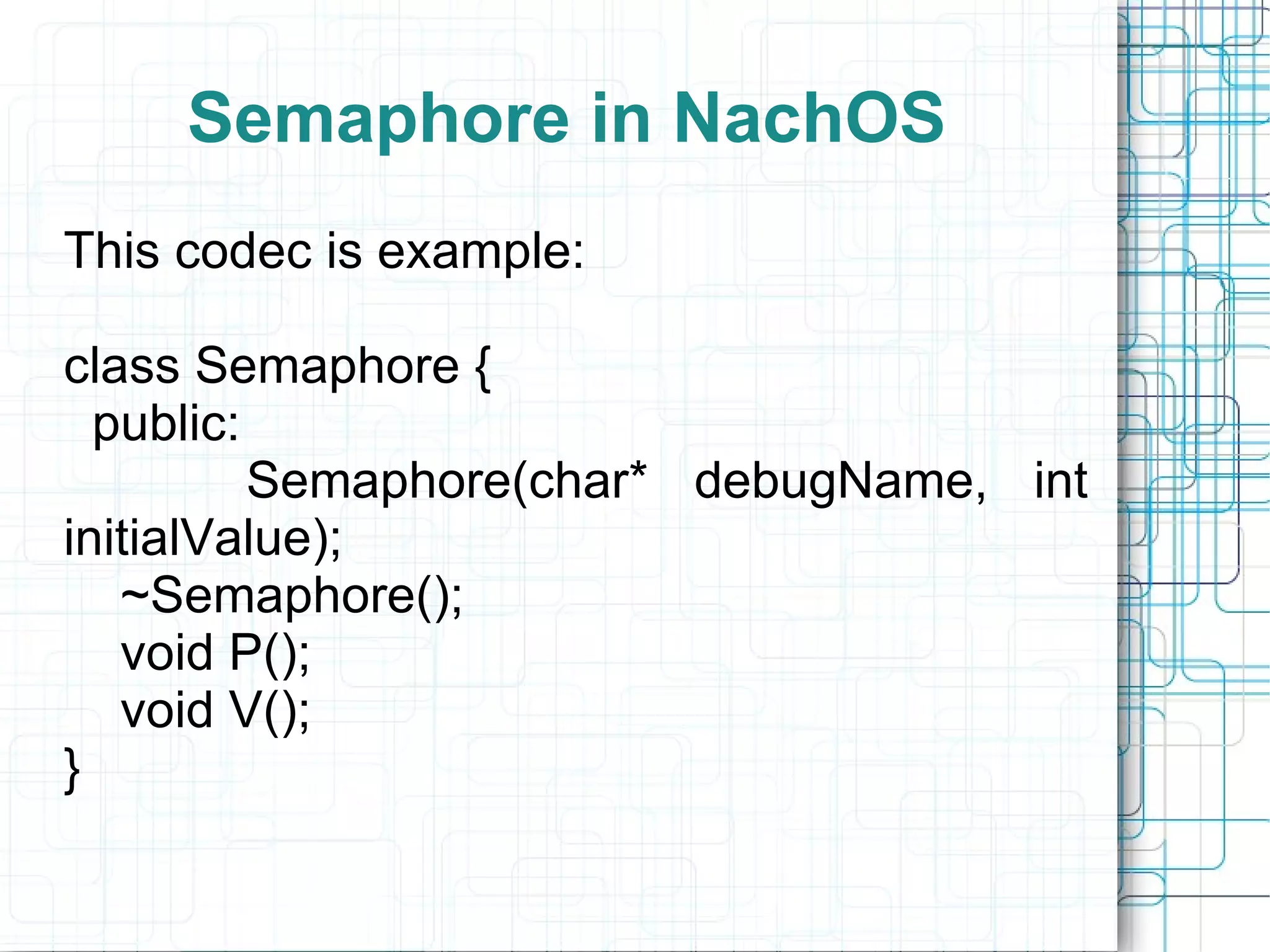
Semaphore in NachOS This codec is example: class Semaphore { public: Semaphore(char* debugName, int initialValue);  ~Semaphore();  void P(); void V(); }
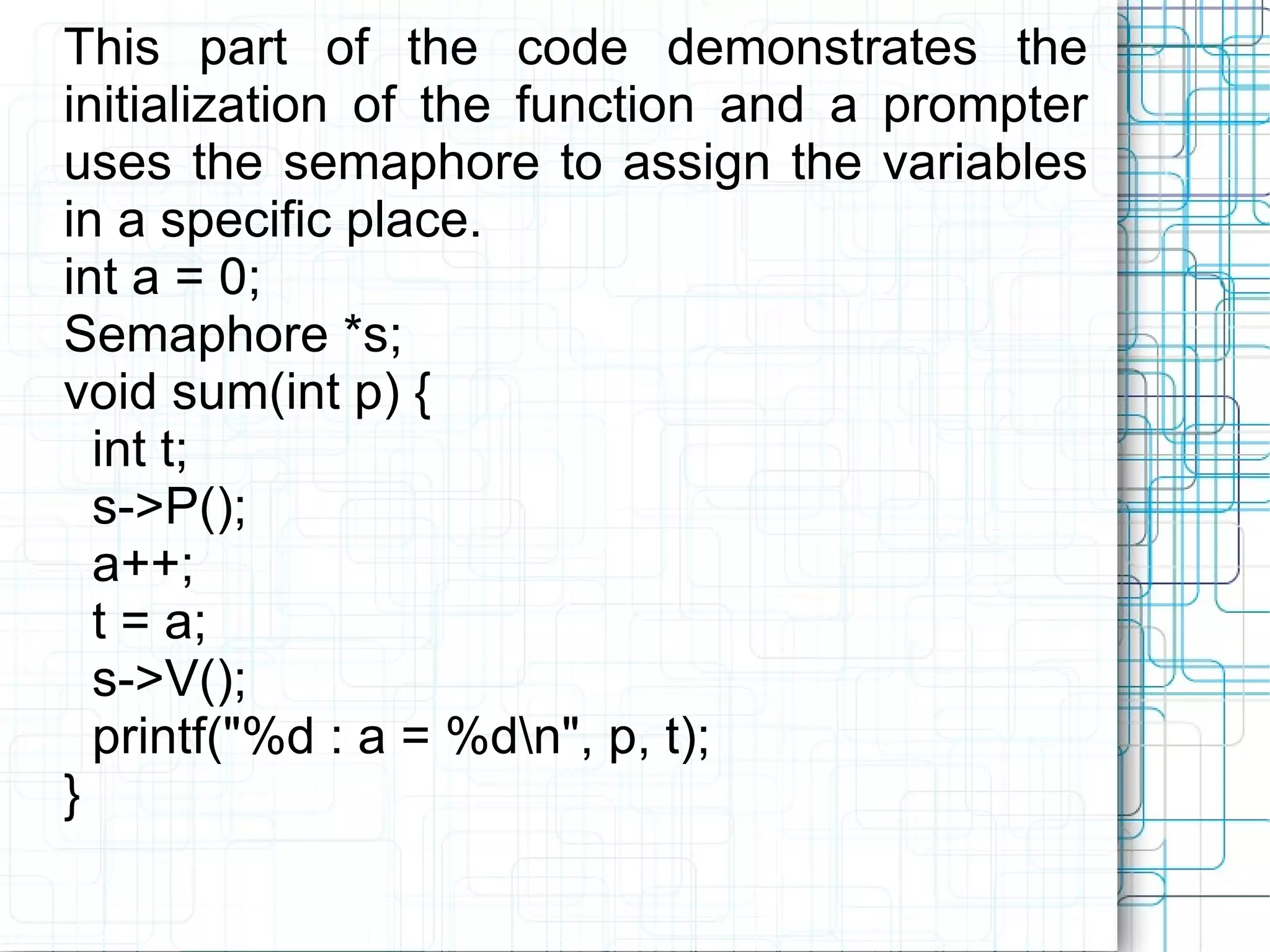
This part of the code demonstrates the initialization of the function and a prompter uses the semaphore to assign the variables in a specific place. int a = 0; Semaphore *s; void sum(int p) { int t; s->P(); a++; t = a; s->V(); printf("%d : a = %d\n", p, t); }
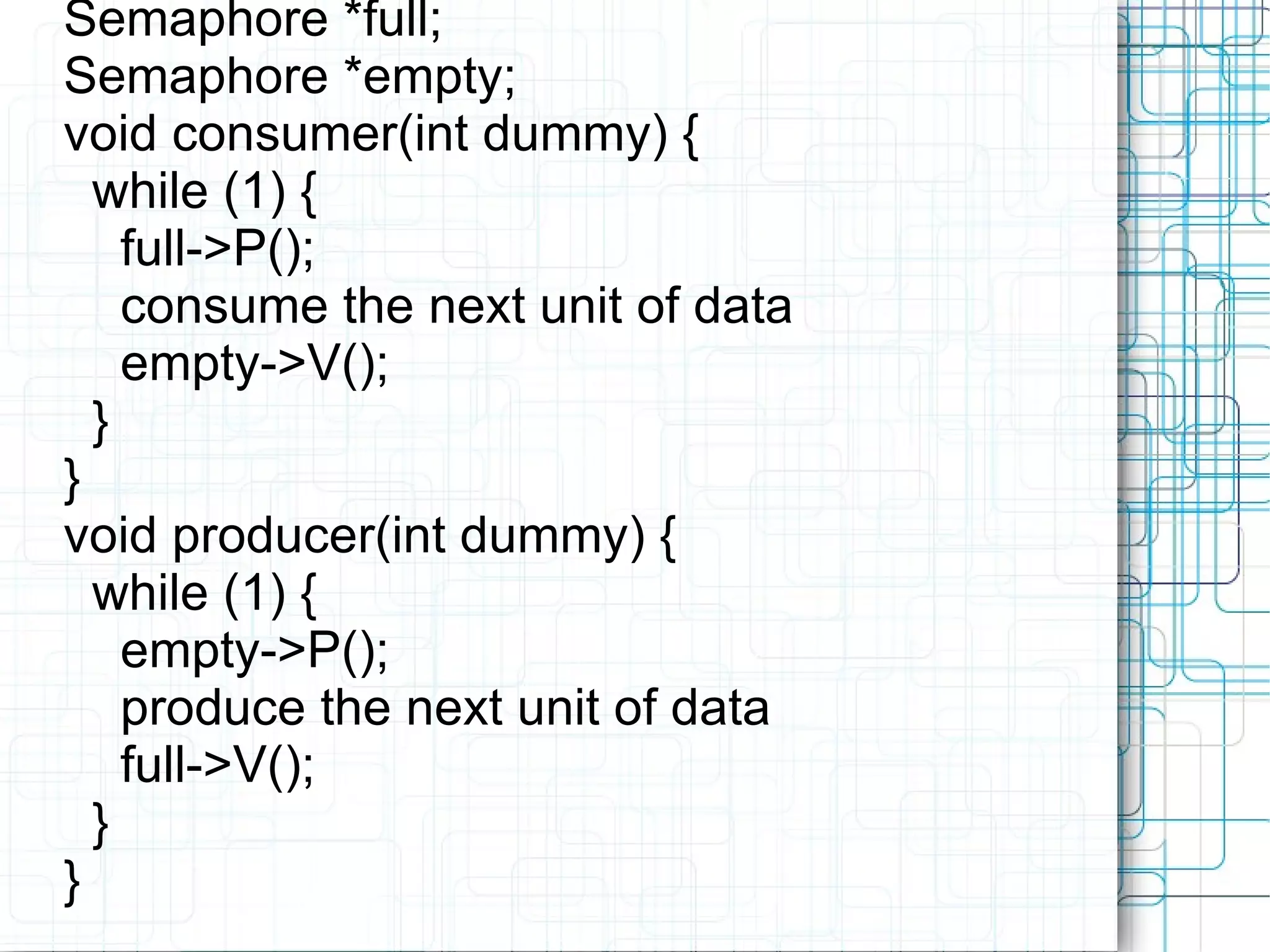
Semaphore *full; Semaphore *empty; void consumer(int dummy) { while (1) { full->P(); consume the next unit of data empty->V(); } } void producer(int dummy) { while (1) { empty->P(); produce the next unit of data full->V(); } }
In the previous slide it appears since there is realized the process of the producer and the consumer and of since they are called the functions P () and V () to give the step to every process and in the following slide it appears since they get about themselves to call in the principal function.
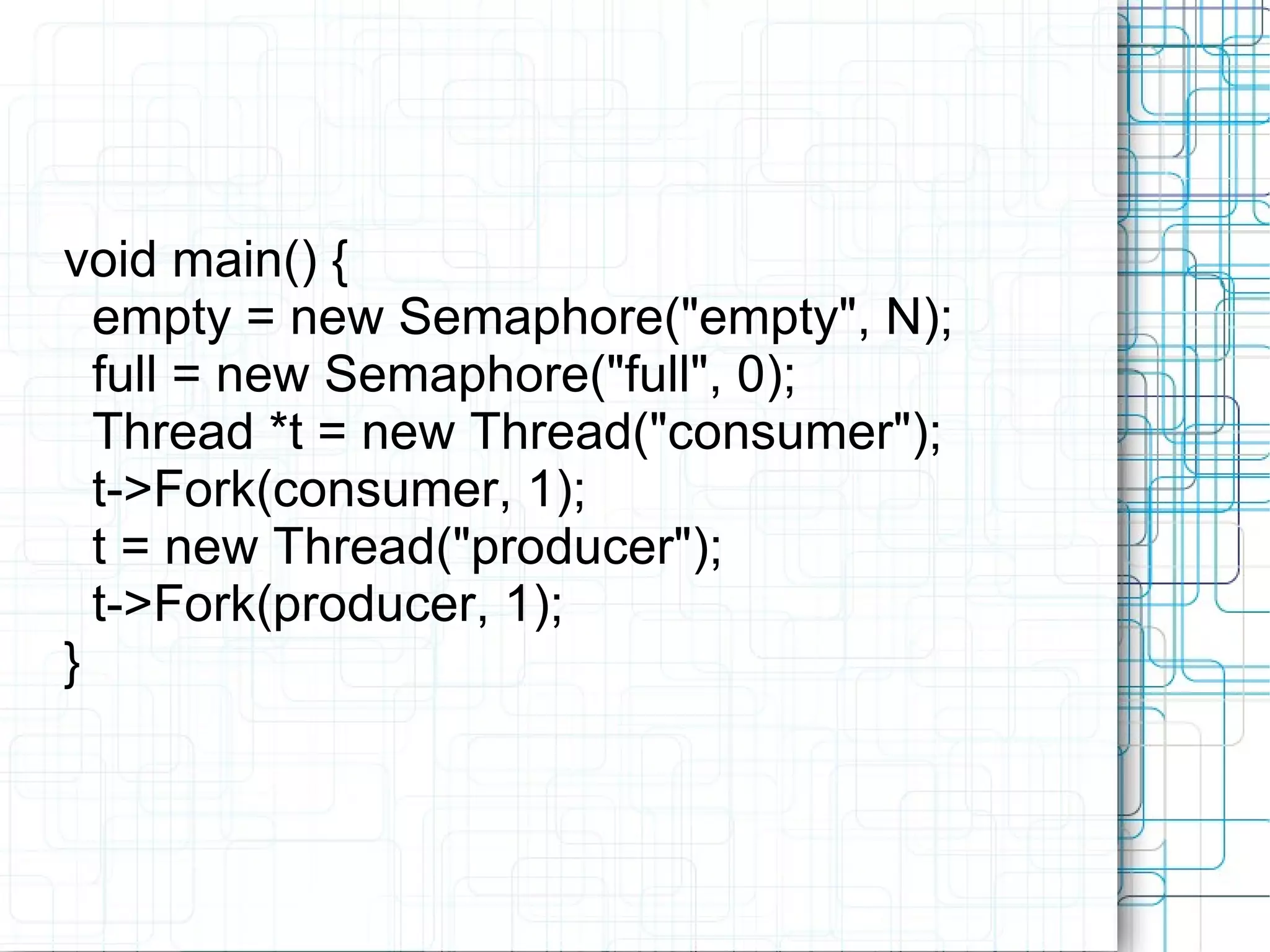
void main() { empty = new Semaphore("empty", N); full = new Semaphore("full", 0); Thread *t = new Thread("consumer"); t->Fork(consumer, 1); t = new Thread("producer"); t->Fork(producer, 1); }
Video example http://www.youtube.com/watch?v=Kg9lQGdipZ4

Semaphore

  • 1.
  • 2.
    Semaphore in NachOSThis codec is example: class Semaphore { public: Semaphore(char* debugName, int initialValue); ~Semaphore(); void P(); void V(); }
  • 3.
    This part ofthe code demonstrates the initialization of the function and a prompter uses the semaphore to assign the variables in a specific place. int a = 0; Semaphore *s; void sum(int p) { int t; s->P(); a++; t = a; s->V(); printf("%d : a = %d\n", p, t); }
  • 4.
    Semaphore *full; Semaphore*empty; void consumer(int dummy) { while (1) { full->P(); consume the next unit of data empty->V(); } } void producer(int dummy) { while (1) { empty->P(); produce the next unit of data full->V(); } }
  • 5.
    In the previousslide it appears since there is realized the process of the producer and the consumer and of since they are called the functions P () and V () to give the step to every process and in the following slide it appears since they get about themselves to call in the principal function.
  • 6.
    void main() {empty = new Semaphore("empty", N); full = new Semaphore("full", 0); Thread *t = new Thread("consumer"); t->Fork(consumer, 1); t = new Thread("producer"); t->Fork(producer, 1); }
  • 7.