Classical Problem Of
Synchronization
Submitted To: Namita mam
Submitted By:- Shakshi Kanwar Ranawat
Contents Of Discussion
 The Dining-Philosophers Problem
 The Reader Writers Problem
 The Bounded Buffer Problem
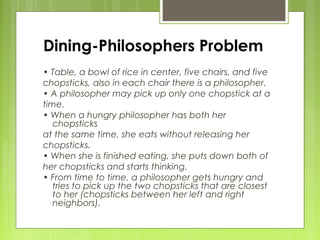
Dining-Philosophers Problem:
Rice
Dining-Philosophers Problem
• Table, a bowl of rice in center, five chairs, and five
chopsticks, also in each chair there is a philosopher.
• A philosopher may pick up only one chopstick at a
time.
• When a hungry philosopher has both her
chopsticks
at the same time, she eats without releasing her
chopsticks.
• When she is finished eating, she puts down both of
her chopsticks and starts thinking.
• From time to time, a philosopher gets hungry and
tries to pick up the two chopsticks that are closest
to her (chopsticks between her left and right
neighbors).
The Structure of philosopher i
do{
wait(chopstick[i]);
wait(chopstick[(i+1)%5]);
….
//eat
…..
signal(chopstick[i]);
signal(chopstick[(i+1)%5]);
…..
//think
…..
}while(TRUE);
Dining-Philosophers Problem (Cont.)
Solution:
 Present each chopstick by a semaphore.
 A philosopher tries to grab the chopstick by
executing a wait operation on that semaphore.
 She releases her chopsticks by executing the
signal operation on the appropriate semaphores.
This solution guarantees that no two neighbors are
eating simultaneously, but it could cause a
deadlock.
Suppose all five philosophers become hungry
simultaneously, and each grabs her left chopstick.
When each philosopher tries to grab her right
chopstick, she will cause the possibility that the
philosophers will starve to death.
Dining-Philosophers Problem (Cont.)
 We present a solution to the dining-philosophers
problem that ensure freedom from deadlock.
– Allow at most 4 philosophers to be sitting
simultaneously at the table.
– Allow a philosopher to pick up her chopstick only if
both chopsticks are available.
– An odd philosopher picks up first her left chopstick
and then her right chopstick, whereas, an even
philosopher picks up her right chopstick first and
then her left chopstick.
• Note: A deadlock-free solution does not necessarily
eliminate the possibility of starvation.
A semaphore solution:
// represent each chopstick with a semaphore
Semaphore chopstick[] = new Semaphore[5]; // all = 1 initially
process philosopher_i {
while (true) {
// pick up left chopstick
chopstick[i].acquire();
Cont…
// pick up right chopstick
chopstick[(i+1) % 5].acquire();
// eat
// put down left chopstick
chopstick[i].release();
// put down right chopstick
chopstick[(i+1) % 5].release();
// think
}
}
Cont…
This solution guarantees no two neighboring philosophers eat
simultaneously, but has the possibility of creating a deadlock
Uses of semaphores
 protecting acccess to a critical section (e.g., db in the R/W
problem)
 as a mutex lock (e.g., to protect the shared variables used in
solving a probem such as readerCount above)
 to protect a relationship (e.g., empty and full as used in the
P/C problem)
 to support atomicity (e.g., you pickup either both
chopsticks as the same time or neither, you cannot pickup
just one)
Application
 The dining philosophers problem
represents a situation that can occur in
large communities of processes that share
a sizeable pool of resources.
Bounded Buffer Problem
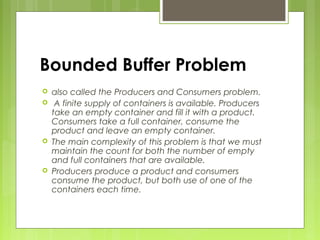
 also called the Producers and Consumers problem.
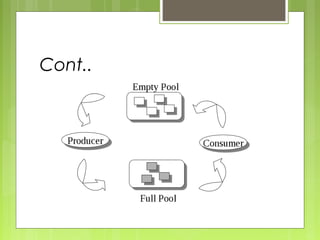
 A finite supply of containers is available. Producers
take an empty container and fill it with a product.
Consumers take a full container, consume the
product and leave an empty container.
 The main complexity of this problem is that we must
maintain the count for both the number of empty
and full containers that are available.
 Producers produce a product and consumers
consume the product, but both use of one of the
containers each time.
The Bounded Buffer Problem
Consider:
a buffer which can store n items
a producer process which creates the items (1 at a
time)
a consumer process which processes them (1 at a
time)
A producer cannot produce unless there is an
empty buffer slot to fill.
A consumer cannot consume unless there is at
least one produced item.
Cont..
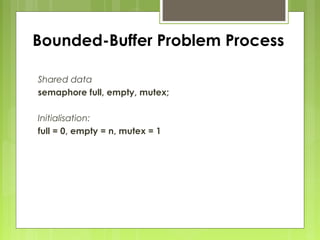
Bounded-Buffer Problem Process
Shared data
semaphore full, empty, mutex;
Initialisation:
full = 0, empty = n, mutex = 1
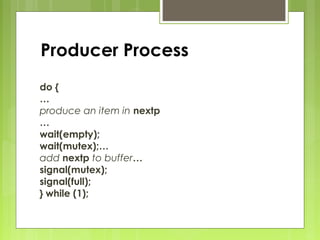
Producer Process
do {
…
produce an item in nextp
…
wait(empty);
wait(mutex);…
add nextp to buffer…
signal(mutex);
signal(full);
} while (1);
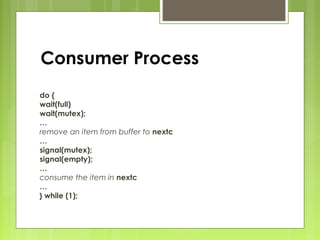
Consumer Process
do {
wait(full)
wait(mutex);
…
remove an item from buffer to nextc
…
signal(mutex);
signal(empty);
…
consume the item in nextc
…
} while (1);
Application
A pipe or other finite queue (buffer), is an
example of the bounded buffer problem.
Reader Writer Problem
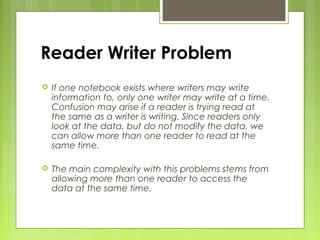
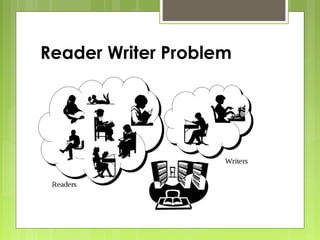
 If one notebook exists where writers may write
information to, only one writer may write at a time.
Confusion may arise if a reader is trying read at
the same as a writer is writing. Since readers only
look at the data, but do not modify the data, we
can allow more than one reader to read at the
same time.
 The main complexity with this problems stems from
allowing more than one reader to access the
data at the same time.
Reader Writer Problem
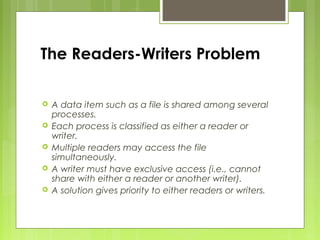
The Readers-Writers Problem
 A data item such as a file is shared among several
processes.
 Each process is classified as either a reader or
writer.
 Multiple readers may access the file
simultaneously.
 A writer must have exclusive access (i.e., cannot
share with either a reader or another writer).
 A solution gives priority to either readers or writers.
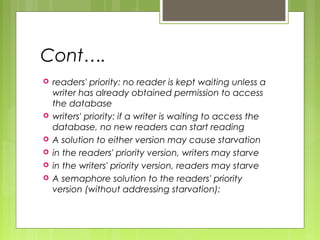
Cont….
 readers' priority: no reader is kept waiting unless a
writer has already obtained permission to access
the database
 writers' priority: if a writer is waiting to access the
database, no new readers can start reading
 A solution to either version may cause starvation
 in the readers' priority version, writers may starve
 in the writers' priority version, readers may starve
 A semaphore solution to the readers' priority
version (without addressing starvation):
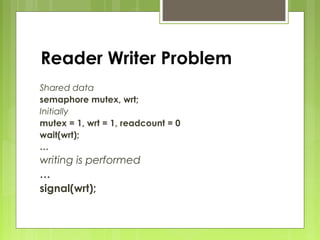
Reader Writer Problem
Shared data
semaphore mutex, wrt;
Initially
mutex = 1, wrt = 1, readcount = 0
wait(wrt);
…
writing is performed
…
signal(wrt);
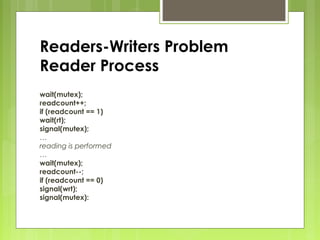
Readers-Writers Problem
Reader Process
wait(mutex);
readcount++;
if (readcount == 1)
wait(rt);
signal(mutex);
…
reading is performed
…
wait(mutex);
readcount--;
if (readcount == 0)
signal(wrt);
signal(mutex):
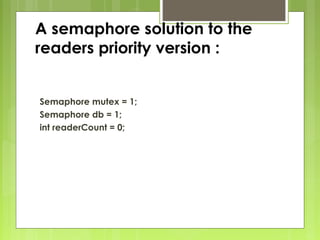
A semaphore solution to the
readers priority version :
Semaphore mutex = 1;
Semaphore db = 1;
int readerCount = 0;
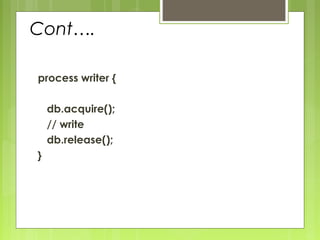
Cont….
process writer {
db.acquire();
// write
db.release();
}
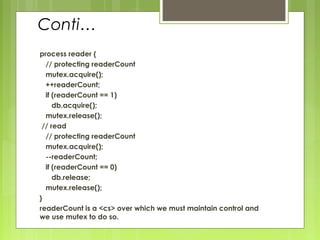
Conti…
process reader {
// protecting readerCount
mutex.acquire();
++readerCount;
if (readerCount == 1)
db.acquire();
mutex.release();
// read
// protecting readerCount
mutex.acquire();
--readerCount;
if (readerCount == 0)
db.release;
mutex.release();
}
readerCount is a <cs> over which we must maintain control and
we use mutex to do so.
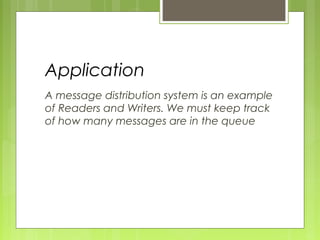
Application
A message distribution system is an example
of Readers and Writers. We must keep track
of how many messages are in the queue
Thank You for listening

Classical problem of synchronization

  • 1.
    Classical Problem Of Synchronization SubmittedTo: Namita mam Submitted By:- Shakshi Kanwar Ranawat
  • 2.
    Contents Of Discussion The Dining-Philosophers Problem  The Reader Writers Problem  The Bounded Buffer Problem
  • 3.
  • 4.
    Dining-Philosophers Problem • Table,a bowl of rice in center, five chairs, and five chopsticks, also in each chair there is a philosopher. • A philosopher may pick up only one chopstick at a time. • When a hungry philosopher has both her chopsticks at the same time, she eats without releasing her chopsticks. • When she is finished eating, she puts down both of her chopsticks and starts thinking. • From time to time, a philosopher gets hungry and tries to pick up the two chopsticks that are closest to her (chopsticks between her left and right neighbors).
  • 5.
    The Structure ofphilosopher i do{ wait(chopstick[i]); wait(chopstick[(i+1)%5]); …. //eat ….. signal(chopstick[i]); signal(chopstick[(i+1)%5]); ….. //think ….. }while(TRUE);
  • 6.
    Dining-Philosophers Problem (Cont.) Solution: Present each chopstick by a semaphore.  A philosopher tries to grab the chopstick by executing a wait operation on that semaphore.  She releases her chopsticks by executing the signal operation on the appropriate semaphores. This solution guarantees that no two neighbors are eating simultaneously, but it could cause a deadlock. Suppose all five philosophers become hungry simultaneously, and each grabs her left chopstick. When each philosopher tries to grab her right chopstick, she will cause the possibility that the philosophers will starve to death.
  • 7.
    Dining-Philosophers Problem (Cont.) We present a solution to the dining-philosophers problem that ensure freedom from deadlock. – Allow at most 4 philosophers to be sitting simultaneously at the table. – Allow a philosopher to pick up her chopstick only if both chopsticks are available. – An odd philosopher picks up first her left chopstick and then her right chopstick, whereas, an even philosopher picks up her right chopstick first and then her left chopstick. • Note: A deadlock-free solution does not necessarily eliminate the possibility of starvation.
  • 8.
    A semaphore solution: //represent each chopstick with a semaphore Semaphore chopstick[] = new Semaphore[5]; // all = 1 initially process philosopher_i { while (true) { // pick up left chopstick chopstick[i].acquire();
  • 9.
    Cont… // pick upright chopstick chopstick[(i+1) % 5].acquire(); // eat // put down left chopstick chopstick[i].release(); // put down right chopstick chopstick[(i+1) % 5].release(); // think } }
  • 10.
    Cont… This solution guaranteesno two neighboring philosophers eat simultaneously, but has the possibility of creating a deadlock
  • 11.
    Uses of semaphores protecting acccess to a critical section (e.g., db in the R/W problem)  as a mutex lock (e.g., to protect the shared variables used in solving a probem such as readerCount above)  to protect a relationship (e.g., empty and full as used in the P/C problem)  to support atomicity (e.g., you pickup either both chopsticks as the same time or neither, you cannot pickup just one)
  • 12.
    Application  The diningphilosophers problem represents a situation that can occur in large communities of processes that share a sizeable pool of resources.
  • 13.
    Bounded Buffer Problem also called the Producers and Consumers problem.  A finite supply of containers is available. Producers take an empty container and fill it with a product. Consumers take a full container, consume the product and leave an empty container.  The main complexity of this problem is that we must maintain the count for both the number of empty and full containers that are available.  Producers produce a product and consumers consume the product, but both use of one of the containers each time.
  • 14.
    The Bounded BufferProblem Consider: a buffer which can store n items a producer process which creates the items (1 at a time) a consumer process which processes them (1 at a time) A producer cannot produce unless there is an empty buffer slot to fill. A consumer cannot consume unless there is at least one produced item.
  • 15.
  • 16.
    Bounded-Buffer Problem Process Shareddata semaphore full, empty, mutex; Initialisation: full = 0, empty = n, mutex = 1
  • 17.
    Producer Process do { … producean item in nextp … wait(empty); wait(mutex);… add nextp to buffer… signal(mutex); signal(full); } while (1);
  • 18.
    Consumer Process do { wait(full) wait(mutex); … removean item from buffer to nextc … signal(mutex); signal(empty); … consume the item in nextc … } while (1);
  • 19.
    Application A pipe orother finite queue (buffer), is an example of the bounded buffer problem.
  • 20.
    Reader Writer Problem If one notebook exists where writers may write information to, only one writer may write at a time. Confusion may arise if a reader is trying read at the same as a writer is writing. Since readers only look at the data, but do not modify the data, we can allow more than one reader to read at the same time.  The main complexity with this problems stems from allowing more than one reader to access the data at the same time.
  • 21.
  • 22.
    The Readers-Writers Problem A data item such as a file is shared among several processes.  Each process is classified as either a reader or writer.  Multiple readers may access the file simultaneously.  A writer must have exclusive access (i.e., cannot share with either a reader or another writer).  A solution gives priority to either readers or writers.
  • 23.
    Cont….  readers' priority:no reader is kept waiting unless a writer has already obtained permission to access the database  writers' priority: if a writer is waiting to access the database, no new readers can start reading  A solution to either version may cause starvation  in the readers' priority version, writers may starve  in the writers' priority version, readers may starve  A semaphore solution to the readers' priority version (without addressing starvation):
  • 24.
    Reader Writer Problem Shareddata semaphore mutex, wrt; Initially mutex = 1, wrt = 1, readcount = 0 wait(wrt); … writing is performed … signal(wrt);
  • 25.
    Readers-Writers Problem Reader Process wait(mutex); readcount++; if(readcount == 1) wait(rt); signal(mutex); … reading is performed … wait(mutex); readcount--; if (readcount == 0) signal(wrt); signal(mutex):
  • 26.
    A semaphore solutionto the readers priority version : Semaphore mutex = 1; Semaphore db = 1; int readerCount = 0;
  • 27.
  • 28.
    Conti… process reader { //protecting readerCount mutex.acquire(); ++readerCount; if (readerCount == 1) db.acquire(); mutex.release(); // read // protecting readerCount mutex.acquire(); --readerCount; if (readerCount == 0) db.release; mutex.release(); } readerCount is a <cs> over which we must maintain control and we use mutex to do so.
  • 29.
    Application A message distributionsystem is an example of Readers and Writers. We must keep track of how many messages are in the queue
  • 30.
    Thank You forlistening