Classical problem of
Synchronization
• Producer-Consumer with an unbounded
buffer
• Producer-Consumer with a bounded buffer
• Reader-Writer problem
• Dining Philosopher problem
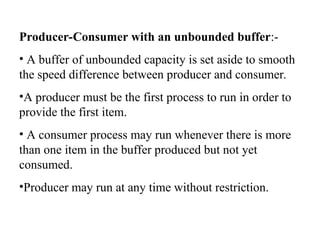
Producer-Consumer with an unbounded buffer:-
• A buffer of unbounded capacity is set aside to smooth
the speed difference between producer and consumer.
•A producer must be the first process to run in order to
provide the first item.
• A consumer process may run whenever there is more
than one item in the buffer produced but not yet
consumed.
•Producer may run at any time without restriction.
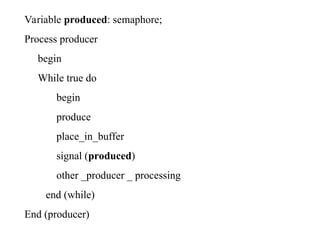
Variable produced: semaphore;
Process producer
begin
While true do
begin
produce
place_in_buffer
signal (produced)
other _producer _ processing
end (while)
End (producer)
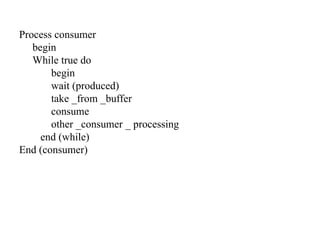
Process consumer
begin
While true do
begin
wait (produced)
take _from _buffer
consume
other _consumer _ processing
end (while)
End (consumer)
Producer-Consumer with a bounded buffer
Process producer
begin
While true do
begin
wait (mayproduced)
pitem :=produce
wait (pmutex)
buffer [ in ]:=pitem
in:=in+1
signal(pmutex)
signal (mayconsume)
other _producer _ processing
end (while)
End (producer)
Process consumer
begin
While true do
begin
wait (mayconsumed)
wait(cmutex)
citem := buffer [ out ]
out :=out +1
signal (cmutex)
signal (mayproduce)
other _consumer_processing
end (while)
End (consumer)
Reader/Writer problem
Readcount:integer
mutex,write:semaphore (binary)
Process reader
Begin
While true do
begin
wait (mutex)
readercount := readercount + 1;
if readercount = 1 then wait(write)
Signal(mutex)
……[read]……
Wait(mutex)
readercount := readercount -1;
if readercount =0 then signal(write)
Signal(mutex)
Other processing
End{while}; end {reader}
Process writer
Begin
While true do
begin
wait (write)
….[writes]……
Signal(write)
Other processing
end {while};
end {writer}
Dining Philosopher problem
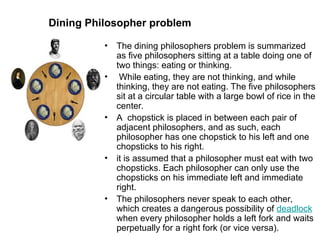
• The dining philosophers problem is summarized
as five philosophers sitting at a table doing one of
two things: eating or thinking.
• While eating, they are not thinking, and while
thinking, they are not eating. The five philosophers
sit at a circular table with a large bowl of rice in the
center.
• A chopstick is placed in between each pair of
adjacent philosophers, and as such, each
philosopher has one chopstick to his left and one
chopsticks to his right.
• it is assumed that a philosopher must eat with two
chopsticks. Each philosopher can only use the
chopsticks on his immediate left and immediate
right.
• The philosophers never speak to each other,
which creates a dangerous possibility of deadlock
when every philosopher holds a left fork and waits
perpetually for a right fork (or vice versa).
Solution :-
do {
wait (chopstick [i]);
wait (chopstick [ ( i+1 ) % 5 ]);
// eat
signal (chopstick [i]);
signal (chopstick [ ( i+1 ) % 5 ] );
//think
}while (true);
1. Allow at most four philosopher to be sitting simultaneously
2. Allow philosopher to pick up her chopsticks if both chopsticks are
available
3. Odd philosopher picks up first left and then right chopstick
What is a monitor?
• A collection of data and procedures
• High level of data abstraction tool that automatically
generates atomic operations on a given data structure
• A monitor has
 Shared data
 A set of atomic operations on that data
 A set of condition variables
Why monitors?
• Concurrency has always been an OS issue
– Resource allocation is necessary among competing
processes
– Timer interrupts
• Existing synchronization mechanisms
(semaphores, locks) are subject to hard-to-find
• Reduce probability of errors
Monitor Implementation
• Each monitor has one lock. Acquire lock when
begin a monitor operation, and release lock
when operation finishes
Rules to Follow with Monitors
• Any process can call a monitor procedure at
any time
• But only one process can be inside a monitor
at any time (mutual exclusion)
• No process can directly access a monitor’s
local variables (data encapsulation)
• A monitor may only access its local variables

Classical-Problem-of-Synchronization in OS

  • 1.
    Classical problem of Synchronization •Producer-Consumer with an unbounded buffer • Producer-Consumer with a bounded buffer • Reader-Writer problem • Dining Philosopher problem
  • 2.
    Producer-Consumer with anunbounded buffer:- • A buffer of unbounded capacity is set aside to smooth the speed difference between producer and consumer. •A producer must be the first process to run in order to provide the first item. • A consumer process may run whenever there is more than one item in the buffer produced but not yet consumed. •Producer may run at any time without restriction.
  • 3.
    Variable produced: semaphore; Processproducer begin While true do begin produce place_in_buffer signal (produced) other _producer _ processing end (while) End (producer)
  • 4.
    Process consumer begin While truedo begin wait (produced) take _from _buffer consume other _consumer _ processing end (while) End (consumer)
  • 5.
    Producer-Consumer with abounded buffer Process producer begin While true do begin wait (mayproduced) pitem :=produce wait (pmutex) buffer [ in ]:=pitem in:=in+1 signal(pmutex) signal (mayconsume) other _producer _ processing end (while) End (producer)
  • 6.
    Process consumer begin While truedo begin wait (mayconsumed) wait(cmutex) citem := buffer [ out ] out :=out +1 signal (cmutex) signal (mayproduce) other _consumer_processing end (while) End (consumer)
  • 7.
    Reader/Writer problem Readcount:integer mutex,write:semaphore (binary) Processreader Begin While true do begin wait (mutex) readercount := readercount + 1; if readercount = 1 then wait(write) Signal(mutex) ……[read]…… Wait(mutex) readercount := readercount -1; if readercount =0 then signal(write) Signal(mutex) Other processing End{while}; end {reader}
  • 8.
    Process writer Begin While truedo begin wait (write) ….[writes]…… Signal(write) Other processing end {while}; end {writer}
  • 9.
    Dining Philosopher problem •The dining philosophers problem is summarized as five philosophers sitting at a table doing one of two things: eating or thinking. • While eating, they are not thinking, and while thinking, they are not eating. The five philosophers sit at a circular table with a large bowl of rice in the center. • A chopstick is placed in between each pair of adjacent philosophers, and as such, each philosopher has one chopstick to his left and one chopsticks to his right. • it is assumed that a philosopher must eat with two chopsticks. Each philosopher can only use the chopsticks on his immediate left and immediate right. • The philosophers never speak to each other, which creates a dangerous possibility of deadlock when every philosopher holds a left fork and waits perpetually for a right fork (or vice versa).
  • 10.
    Solution :- do { wait(chopstick [i]); wait (chopstick [ ( i+1 ) % 5 ]); // eat signal (chopstick [i]); signal (chopstick [ ( i+1 ) % 5 ] ); //think }while (true); 1. Allow at most four philosopher to be sitting simultaneously 2. Allow philosopher to pick up her chopsticks if both chopsticks are available 3. Odd philosopher picks up first left and then right chopstick
  • 11.
    What is amonitor? • A collection of data and procedures • High level of data abstraction tool that automatically generates atomic operations on a given data structure • A monitor has  Shared data  A set of atomic operations on that data  A set of condition variables
  • 12.
    Why monitors? • Concurrencyhas always been an OS issue – Resource allocation is necessary among competing processes – Timer interrupts • Existing synchronization mechanisms (semaphores, locks) are subject to hard-to-find • Reduce probability of errors
  • 13.
    Monitor Implementation • Eachmonitor has one lock. Acquire lock when begin a monitor operation, and release lock when operation finishes
  • 14.
    Rules to Followwith Monitors • Any process can call a monitor procedure at any time • But only one process can be inside a monitor at any time (mutual exclusion) • No process can directly access a monitor’s local variables (data encapsulation) • A monitor may only access its local variables

Editor's Notes

  • #11 The basics of a monitor organized as a collection of data along with the associated procedures monitors provide a method for mutual exclusion ONLY ALLOWS CONTROLLED ACCESS to whatever critical resources it may be protecting has a single lock Data encapsulation...like a class
  • #12 the motivation for this research? follows our discussion on threads, concurrent programming last week. Why was Tony Hoare looking at concurrency in the early 1970's? It's not like there were multi-threaded user applications or multiprocessors then.