International Institute of Professional Studies
Operating Systems
MTech 2k17 Sem VII
PRESENTED BY -- Anushka Shastri
GUIDED BY -- Dr Kirti Mathur Ma’am
THE DINING
PHILOSOPHERS PROBLEM
What is Dining
Philosophers
Problem?
● The dining philosophers problem is a
classic synchronization problem.
● It is used to evaluate situations where
there is a need of allocating multiple
resources to multiple processes.
What is Dining
Philosophers
Problem?
● Demonstrates a large class of concurrency
control problems.
● It was designed to illustrate challenges of
avoiding deadlock.
● It was originally formulated by Edsger
Dijkstra in 1965. Later, Tony Hoare gave
the problem its present formulation.
Need of Dining
Philosopher Problem
● It is a simple representation of the
need to allocate several resources
among several processes.
● It represents a deadlock-free system.
● It ensures a starvation-free structure.
The Problem Statement
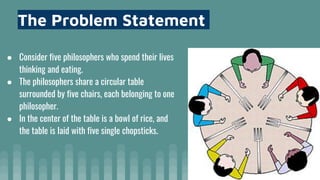
● Consider five philosophers who spend their lives
thinking and eating.
● The philosophers share a circular table
surrounded by five chairs, each belonging to one
philosopher.
● In the center of the table is a bowl of rice, and
the table is laid with five single chopsticks.
The Problem Statement
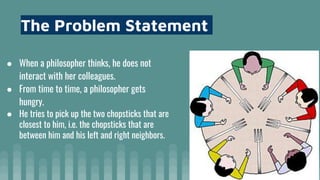
● When a philosopher thinks, he does not
interact with her colleagues.
● From time to time, a philosopher gets
hungry.
● He tries to pick up the two chopsticks that are
closest to him, i.e. the chopsticks that are
between him and his left and right neighbors.
The Problem Statement
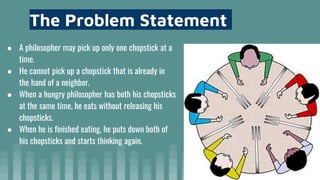
● A philosopher may pick up only one chopstick at a
time.
● He cannot pick up a chopstick that is already in
the hand of a neighbor.
● When a hungry philosopher has both his chopsticks
at the same time, he eats without releasing his
chopsticks.
● When he is finished eating, he puts down both of
his chopsticks and starts thinking again.
Lets understand the problem with a code…...
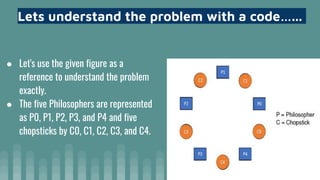
● Let's use the given figure as a
reference to understand the problem
exactly.
● The five Philosophers are represented
as P0, P1, P2, P3, and P4 and five
chopsticks by C0, C1, C2, C3, and C4.
Lets understand the problem with a code…...
Void Philosopher {
while(1) {
take_chopstick[i];
take_chopstick[(i+1) % 5] ;
... // EAT ...
put_chopstick[i];
put_chopstick[(i+1) % 5] ;
… // THINKING ..
}
}
Lets understand the problem with a code…...
● Suppose Philosopher P0 wants to eat, it will enter in Philosopher()
function, and execute take_chopstick[i] by doing this it holds C0
chopstick after that it execute take_chopstick[(i+1) % 5] by doing
this it holds C1 chopstick( since i =0, therefore (0 + 1) % 5 = 1)
● Similarly suppose now Philosopher P1 wants to eat, it will enter in
Philosopher() function, and execute take_chopstick(i) by doing this it
holds C1 chopstick after that it execute take_chopstick[(i+1) % 5]
by doing this it holds C2 chopstick( since i =1, therefore (1 + 1) % 5 =
2)
● But Practically Chopstick C1 is not available as it has already been taken
by philosopher P0, hence the above code generates problems and
produces race condition.
The solution of the Dining
Philosophers Problem
● We use a semaphore to represent a chopstick and
this truly acts as a solution of the Dining
Philosophers Problem.
● Wait and Signal operations will be used for the
solution of the Dining Philosophers Problem, for
picking a chopstick wait operation can be executed
while for releasing a chopstick signal semaphore can
be executed.
Semaphore: A semaphore S is an
integer variable, that apart from
initialization is accessed by only two
standard atomic operations - wait and
signal.
Semaphore is simply a variable that is
non-negative and shared between
threads. A semaphore is a signaling
mechanism, and a thread that is waiting
on a semaphore can be signaled by
another thread. It uses two atomic
operations, 1)wait, and 2) signal for the
process synchronization.
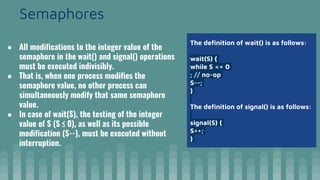
The definition of wait() is as follows:
wait(S) {
while S <= 0
; // no-op
S--;
}
The definition of signal() is as follows:
signal(S) {
S++;
}
Semaphores
● All modifications to the integer value of the
semaphore in the wait() and signal() operations
must be executed indivisibly.
● That is, when one process modifies the
semaphore value, no other process can
simultaneously modify that same semaphore
value.
● In case of wait(S), the testing of the integer
value of S (S ≤ 0), as well as its possible
modification (S--), must be executed without
interruption.
The solution of the Dining Philosophers Problem
● The structure of the chopstick is an
array of a semaphore which is
represented as shown below -
semaphore chopstick[5]
● Initially, each element of the
semaphore C0, C1, C2, C3, and C4 are
initialized to 1 as the chopsticks are on
the table and not picked up by any of
the philosophers.
Solution of Dining Philosopher Problem
void Philosopher {
while(1) {
wait( take_chopstickC[i]);
wait( take_chopstickC[(i+1) % 5] ) ;
. . EATING THE NOODLE . . .
signal( put_chopstickC[i] );
Signal( put_chopstickC[(i+1) % 5]) ;
. . . THINKING
}
}
● Let value of i = 0( initial value ), Suppose Philosopher P0 wants to
eat, it will enter in Philosopher() function, and execute wait(
take_chopstickC[i] ).
● By doing this it holds C0 chopstick and reduces semaphore C0 to 0.
● After that it execute wait( take_chopstickC[(i+1) % 5] ).
● By doing this it holds C1 chopstick( since i =0, therefore (0 + 1) %
5 = 1) and reduces semaphore C1 to 0.
Solution of Dining Philosopher Problem
● Similarly, suppose now Philosopher P1 wants to eat, it will enter in
Philosopher() function, and execute wait( take_chopstickC[i] ).
● By doing this it will try to hold C1 chopstick but will not be able to do
that, since the value of semaphore C1 has already been set to 0 by
philosopher P0.
● Therefore it will enter into an infinite loop because of which philosopher
P1 will not be able to pick chopstick C1.
Solution of Dining Philosopher Problem
● Whereas if Philosopher P2 wants to eat, it will enter in Philosopher() function, and
execute wait( take_chopstickC[i] ); by doing this it holds C2 chopstick and reduces
semaphore C2 to 0.
● After that, it executes wait( take_chopstickC[(i+1) % 5] ); by doing this it holds C3
chopstick( since i =2, therefore (2 + 1) % 5 = 3) and reduces semaphore C3 to 0.
● Hence the above code is providing a solution to the dining philosopher problem, A
philosopher can only eat if both immediate left and right chopsticks of the philosopher are
available else philosopher needs to wait. Also at one go two independent philosophers
can eat simultaneously (i.e., philosopher P0 and P2, P1 and P3 & P2 and P4 can eat
simultaneously as all are the independent processes and they are following the above
constraint of dining philosopher problem)
Solution of Dining Philosopher Problem
Drawbacks of Dining Philosopher Problem
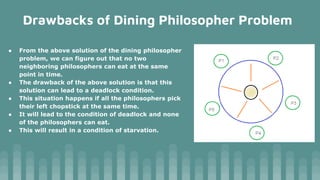
● From the above solution of the dining philosopher
problem, we can figure out that no two
neighboring philosophers can eat at the same
point in time.
● The drawback of the above solution is that this
solution can lead to a deadlock condition.
● This situation happens if all the philosophers pick
their left chopstick at the same time.
● It will lead to the condition of deadlock and none
of the philosophers can eat.
● This will result in a condition of starvation.
Possible Solutions
To avoid deadlock, some of the solutions are as follows -
➔ Maximum number of philosophers on the table should not be more than four.
◆ in this case, chopstick C4 will be available for philosopher P3, so P3 will start eating and
after the finish of his eating procedure, he will put down his both the chopstick C3 and C4,
i.e. semaphore C3 and C4 will now be incremented to 1.
◆ Now philosopher P2 which was holding chopstick C2 will also have chopstick C3 available,
hence similarly, he will put down his chopstick after eating and enable other philosophers
to eat.
➔ A philosopher at an even position should pick the right chopstick and then the left chopstick
while a philosopher at an odd position should pick the left chopstick and then the right
chopstick.
Possible Solutions
➔ Only in case if both the chopsticks ( left and right ) are available at the same time, only then a
philosopher should be allowed to pick their chopsticks
➔ All the four starting philosophers ( P0, P1, P2, and P3) should pick the left chopstick and then
the right chopstick, whereas the last philosopher P4 should pick the right chopstick and then the
left chopstick.
➔ This will force P4 to hold his right chopstick first since the right chopstick of P4 is C0, which is
already held by philosopher P0 and its value is set to 0, i.e C0 is already 0, because of which P4
will get trapped into an infinite loop and chopstick C4 remains vacant.
➔ Hence philosopher P3 has both left C3 and right C4 chopstick available, therefore it will start
eating and will put down its both chopsticks once finishes and let others eat which removes the
problem of deadlock.
Conclusion
The design of the problem was to illustrate the challenges of avoiding deadlock, a deadlock
state of a system is a state in which no progress of system is possible. Consider a proposal
where each philosopher is instructed to behave as follows:
● The philosopher is instructed to think till the left fork is available, when it is available,
hold it.
● The philosopher is instructed to think till the right fork is available, when it is available,
hold it.
● The philosopher is instructed to eat when both forks are available.
● then, put the right fork down first
● then, put the left fork down next
● repeat from the beginning.
THANK YOU

Dining philosopher problem operating system

  • 1.
    International Institute ofProfessional Studies Operating Systems MTech 2k17 Sem VII PRESENTED BY -- Anushka Shastri GUIDED BY -- Dr Kirti Mathur Ma’am THE DINING PHILOSOPHERS PROBLEM
  • 2.
    What is Dining Philosophers Problem? ●The dining philosophers problem is a classic synchronization problem. ● It is used to evaluate situations where there is a need of allocating multiple resources to multiple processes.
  • 3.
    What is Dining Philosophers Problem? ●Demonstrates a large class of concurrency control problems. ● It was designed to illustrate challenges of avoiding deadlock. ● It was originally formulated by Edsger Dijkstra in 1965. Later, Tony Hoare gave the problem its present formulation.
  • 4.
    Need of Dining PhilosopherProblem ● It is a simple representation of the need to allocate several resources among several processes. ● It represents a deadlock-free system. ● It ensures a starvation-free structure.
  • 5.
    The Problem Statement ●Consider five philosophers who spend their lives thinking and eating. ● The philosophers share a circular table surrounded by five chairs, each belonging to one philosopher. ● In the center of the table is a bowl of rice, and the table is laid with five single chopsticks.
  • 6.
    The Problem Statement ●When a philosopher thinks, he does not interact with her colleagues. ● From time to time, a philosopher gets hungry. ● He tries to pick up the two chopsticks that are closest to him, i.e. the chopsticks that are between him and his left and right neighbors.
  • 7.
    The Problem Statement ●A philosopher may pick up only one chopstick at a time. ● He cannot pick up a chopstick that is already in the hand of a neighbor. ● When a hungry philosopher has both his chopsticks at the same time, he eats without releasing his chopsticks. ● When he is finished eating, he puts down both of his chopsticks and starts thinking again.
  • 8.
    Lets understand theproblem with a code…... ● Let's use the given figure as a reference to understand the problem exactly. ● The five Philosophers are represented as P0, P1, P2, P3, and P4 and five chopsticks by C0, C1, C2, C3, and C4.
  • 9.
    Lets understand theproblem with a code…... Void Philosopher { while(1) { take_chopstick[i]; take_chopstick[(i+1) % 5] ; ... // EAT ... put_chopstick[i]; put_chopstick[(i+1) % 5] ; … // THINKING .. } }
  • 10.
    Lets understand theproblem with a code…... ● Suppose Philosopher P0 wants to eat, it will enter in Philosopher() function, and execute take_chopstick[i] by doing this it holds C0 chopstick after that it execute take_chopstick[(i+1) % 5] by doing this it holds C1 chopstick( since i =0, therefore (0 + 1) % 5 = 1) ● Similarly suppose now Philosopher P1 wants to eat, it will enter in Philosopher() function, and execute take_chopstick(i) by doing this it holds C1 chopstick after that it execute take_chopstick[(i+1) % 5] by doing this it holds C2 chopstick( since i =1, therefore (1 + 1) % 5 = 2) ● But Practically Chopstick C1 is not available as it has already been taken by philosopher P0, hence the above code generates problems and produces race condition.
  • 11.
    The solution ofthe Dining Philosophers Problem ● We use a semaphore to represent a chopstick and this truly acts as a solution of the Dining Philosophers Problem. ● Wait and Signal operations will be used for the solution of the Dining Philosophers Problem, for picking a chopstick wait operation can be executed while for releasing a chopstick signal semaphore can be executed. Semaphore: A semaphore S is an integer variable, that apart from initialization is accessed by only two standard atomic operations - wait and signal. Semaphore is simply a variable that is non-negative and shared between threads. A semaphore is a signaling mechanism, and a thread that is waiting on a semaphore can be signaled by another thread. It uses two atomic operations, 1)wait, and 2) signal for the process synchronization.
  • 12.
    The definition ofwait() is as follows: wait(S) { while S <= 0 ; // no-op S--; } The definition of signal() is as follows: signal(S) { S++; } Semaphores ● All modifications to the integer value of the semaphore in the wait() and signal() operations must be executed indivisibly. ● That is, when one process modifies the semaphore value, no other process can simultaneously modify that same semaphore value. ● In case of wait(S), the testing of the integer value of S (S ≤ 0), as well as its possible modification (S--), must be executed without interruption.
  • 13.
    The solution ofthe Dining Philosophers Problem ● The structure of the chopstick is an array of a semaphore which is represented as shown below - semaphore chopstick[5] ● Initially, each element of the semaphore C0, C1, C2, C3, and C4 are initialized to 1 as the chopsticks are on the table and not picked up by any of the philosophers.
  • 14.
    Solution of DiningPhilosopher Problem void Philosopher { while(1) { wait( take_chopstickC[i]); wait( take_chopstickC[(i+1) % 5] ) ; . . EATING THE NOODLE . . . signal( put_chopstickC[i] ); Signal( put_chopstickC[(i+1) % 5]) ; . . . THINKING } }
  • 15.
    ● Let valueof i = 0( initial value ), Suppose Philosopher P0 wants to eat, it will enter in Philosopher() function, and execute wait( take_chopstickC[i] ). ● By doing this it holds C0 chopstick and reduces semaphore C0 to 0. ● After that it execute wait( take_chopstickC[(i+1) % 5] ). ● By doing this it holds C1 chopstick( since i =0, therefore (0 + 1) % 5 = 1) and reduces semaphore C1 to 0. Solution of Dining Philosopher Problem
  • 16.
    ● Similarly, supposenow Philosopher P1 wants to eat, it will enter in Philosopher() function, and execute wait( take_chopstickC[i] ). ● By doing this it will try to hold C1 chopstick but will not be able to do that, since the value of semaphore C1 has already been set to 0 by philosopher P0. ● Therefore it will enter into an infinite loop because of which philosopher P1 will not be able to pick chopstick C1. Solution of Dining Philosopher Problem
  • 17.
    ● Whereas ifPhilosopher P2 wants to eat, it will enter in Philosopher() function, and execute wait( take_chopstickC[i] ); by doing this it holds C2 chopstick and reduces semaphore C2 to 0. ● After that, it executes wait( take_chopstickC[(i+1) % 5] ); by doing this it holds C3 chopstick( since i =2, therefore (2 + 1) % 5 = 3) and reduces semaphore C3 to 0. ● Hence the above code is providing a solution to the dining philosopher problem, A philosopher can only eat if both immediate left and right chopsticks of the philosopher are available else philosopher needs to wait. Also at one go two independent philosophers can eat simultaneously (i.e., philosopher P0 and P2, P1 and P3 & P2 and P4 can eat simultaneously as all are the independent processes and they are following the above constraint of dining philosopher problem) Solution of Dining Philosopher Problem
  • 18.
    Drawbacks of DiningPhilosopher Problem ● From the above solution of the dining philosopher problem, we can figure out that no two neighboring philosophers can eat at the same point in time. ● The drawback of the above solution is that this solution can lead to a deadlock condition. ● This situation happens if all the philosophers pick their left chopstick at the same time. ● It will lead to the condition of deadlock and none of the philosophers can eat. ● This will result in a condition of starvation.
  • 19.
    Possible Solutions To avoiddeadlock, some of the solutions are as follows - ➔ Maximum number of philosophers on the table should not be more than four. ◆ in this case, chopstick C4 will be available for philosopher P3, so P3 will start eating and after the finish of his eating procedure, he will put down his both the chopstick C3 and C4, i.e. semaphore C3 and C4 will now be incremented to 1. ◆ Now philosopher P2 which was holding chopstick C2 will also have chopstick C3 available, hence similarly, he will put down his chopstick after eating and enable other philosophers to eat. ➔ A philosopher at an even position should pick the right chopstick and then the left chopstick while a philosopher at an odd position should pick the left chopstick and then the right chopstick.
  • 20.
    Possible Solutions ➔ Onlyin case if both the chopsticks ( left and right ) are available at the same time, only then a philosopher should be allowed to pick their chopsticks ➔ All the four starting philosophers ( P0, P1, P2, and P3) should pick the left chopstick and then the right chopstick, whereas the last philosopher P4 should pick the right chopstick and then the left chopstick. ➔ This will force P4 to hold his right chopstick first since the right chopstick of P4 is C0, which is already held by philosopher P0 and its value is set to 0, i.e C0 is already 0, because of which P4 will get trapped into an infinite loop and chopstick C4 remains vacant. ➔ Hence philosopher P3 has both left C3 and right C4 chopstick available, therefore it will start eating and will put down its both chopsticks once finishes and let others eat which removes the problem of deadlock.
  • 21.
    Conclusion The design ofthe problem was to illustrate the challenges of avoiding deadlock, a deadlock state of a system is a state in which no progress of system is possible. Consider a proposal where each philosopher is instructed to behave as follows: ● The philosopher is instructed to think till the left fork is available, when it is available, hold it. ● The philosopher is instructed to think till the right fork is available, when it is available, hold it. ● The philosopher is instructed to eat when both forks are available. ● then, put the right fork down first ● then, put the left fork down next ● repeat from the beginning.
  • 22.

Editor's Notes

  • #14 Let's modify the above code of the Dining Philosopher Problem by using semaphore operations wait and signal, the desired code looks like