INTERNAL FIXATORS
RADHIKA CHINTAMANI
CONTENTS
• Definition
• Types
• Principles of surgical treatment
• Biomaterials of fracture fixation
• Biomechanics of implant design and fracture fixation
• Pins and wire fixation
• Screw fixation
• Screw and plate fixation
• Intramedullary nail fixation
• External fixation
• Prosthesis
DEFINITION
• A surgical procedure that stabilizes and joins the ends of fractured
bones by internally placed mechanical devices such as metal plates,
pins, rods, wires etc.
INTERNAL FIXATION
• Pin and wire fixation
• Screw fixation: Screws (Transcortical cross screw fixation
also called as cancellous screw or cortical screw)
• Plate and screw fixation
• Intramedullary nail fixation
LAMBOTTE’S PRINCIPLES OF SURGICAL
TREATMENT OF FRACTURES
• Anatomical reduction
• Stable internal fixation
• Preservation of blood supply
• Active, pain-free mobilization of adjacent muscles and joints
METHODS OF APPLYING
• Exposure of the fracture
• Reduction of fracture
• Provisional stabilization of fracture:
• Definitive stabilization of fracture:
BIOMATERIALS USED FOR FRACTURES
STABILIZATION
Metals
•316 stainless steel- iron,
chrominum and nickel
•titanium aluminium vanadium
alloys
•commercial pure titanium
•tantalum
Bioabsorbable materials
• Polyglycolic acid(PGA)
• Vicryl
• Polydioxanone(PDS)
• Polylevolactic acid (PLLA)
• poly(D, L-lactic acid)(PDLLA)
FACTORS AFFECTING THE BIOMECHANICAL
PROPERTIES OF BIOABSOBABLE POLYMERS
• Chemical composition
• Manufacturing processes
• Physical dimensions environmental
• Time
INDICATIONS FOR ABSORBABLE FIXATION
DEVICES
• Metatarsal osteotomies
• Metacarpal and metatarsal fusions
• Malleolar fractures
• Osteochondritis dissecans
• Fractures of radius and olecranon
• Epiphyseal fractures
• Ruptures of ulnar collateral ligament of thumb
COMPLICATIONS
• PGA- septic inflammation and sinus track formation
• Osteolysis
• Severe synovitis
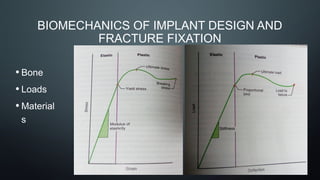
BIOMECHANICS OF IMPLANT DESIGN AND
FRACTURE FIXATION
• Bone
• Loads
• Material
s
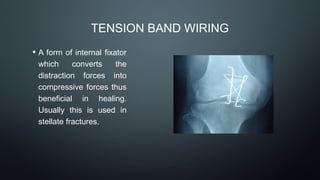
TENSION BAND WIRING
• A form of internal fixator
which converts the
distraction forces into
compressive forces thus
beneficial in healing.
Usually this is used in
stellate fractures.
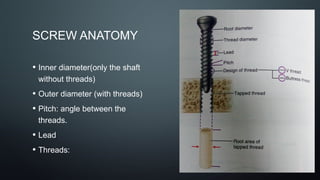
SCREW ANATOMY
• Inner diameter(only the shaft
without threads)
• Outer diameter (with threads)
• Pitch: angle between the
threads.
• Lead
• Threads:
SCREW FIXATION
Types
Machine screws
•whole length threaded
•can be self tapping
•used primarily to fasten hip compression screw devices to shaft of femur
ASIF screws
•Cortical screws
•Cancellous screws
•Self-tapping, self-drilling screws
•Locking screws
BIOMECHANICS OF SCREW FIXATION
a. To increase the strength of the screw and resist the fatigue
Increase the root diameter
b. To increase the pull out strength of screw in the bone: by increasing;
- Outer diameter
- Decreasing inner diameter
- Increasing thread density
- Increasing thickness of the cortex
- Using cortex with more density
CANNULATED SCREWS
• Space within the screw which guides the wire to reach the target.
• Features of this type of screw are:
i. Greater inner root diameter
ii. Smaller thread width
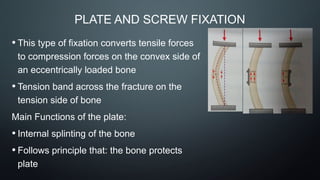
PLATE AND SCREW FIXATION
• This type of fixation converts tensile forces
to compression forces on the convex side of
an eccentrically loaded bone
• Tension band across the fracture on the
tension side of bone
Main Functions of the plate:
• Internal splinting of the bone
• Follows principle that: the bone protects
plate
• Axial compression (Key and Charnley)
• Plates- causes reduction of fracture with open techniques,
thus providing stability for early function of muscle tendon
units and joints
• Disadvantages: high chances of refracture, osteoporosis,
plate irritation and rarely immunological reaction
Functions of plate and screw fixation
• Plates- neutralize deforming forces
• Require contouring to maintain optimal stability of fracture reduction
Various Plate Designs
ON THE BASIS OF ANATOMY
• Semitubular: one third and one quarter tubular plates
• T plates
• L plates
• Spoon plates
• Dynamic compression plates
• Cobra arthrodesis plates
• Perbent periarticular plates
Functionally Plates are categorized as
• Neutralization plates
• Compression plates
• Buttress plates
• Bridge plates
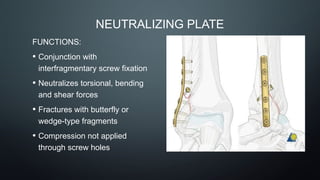
NEUTRALIZING PLATE
FUNCTIONS:
• Conjunction with
interfragmentary screw fixation
• Neutralizes torsional, bending
and shear forces
• Fractures with butterfly or
wedge-type fragments
• Compression not applied
through screw holes
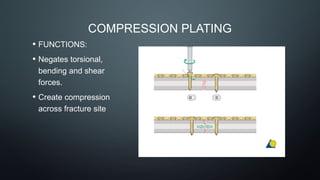
COMPRESSION PLATING
• FUNCTIONS:
• Negates torsional,
bending and shear
forces.
• Create compression
across fracture site
BUTTRESS PLATING
• Functions:
• Negates compression and shear
forces that occur with
metaphyseal-epiphyseal fractures
• Frequently used in conjunction
with interfragmentary screw
fixation
BRIDGE PLATING
FUNCTIONS:
• Used to span comminuted unstable fracture or bony defect in which
anatomical reduction and rigid stability of fracture cannot be restored
by fracture reduction
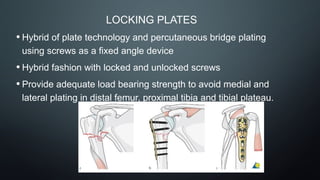
LOCKING PLATES
• Hybrid of plate technology and percutaneous bridge plating
using screws as a fixed angle device
• Hybrid fashion with locked and unlocked screws
• Provide adequate load bearing strength to avoid medial and
lateral plating in distal femur, proximal tibia and tibial plateau.
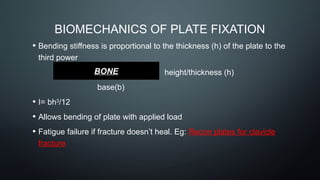
BIOMECHANICS OF PLATE FIXATION
• Bending stiffness is proportional to the thickness (h) of the plate to the
third power
height/thickness (h)
base(b)
• I= bh3
/12
• Allows bending of plate with applied load
• Fatigue failure if fracture doesn’t heal. Eg: Recon plates for clavicle
fracture
BONE
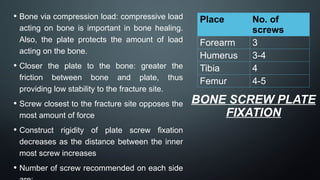
BONE SCREW PLATE
FIXATION
• Bone via compression load: compressive load
acting on bone is important in bone healing.
Also, the plate protects the amount of load
acting on the bone.
• Closer the plate to the bone: greater the
friction between bone and plate, thus
providing low stability to the fracture site.
• Screw closest to the fracture site opposes the
most amount of force
• Construct rigidity of plate screw fixation
decreases as the distance between the inner
most screw increases
• Number of screw recommended on each side
Place No. of
screws
Forearm 3
Humerus 3-4
Tibia 4
Femur 4-5
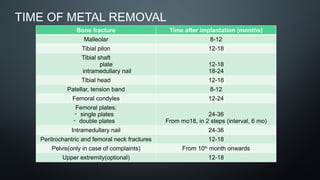
TIME OF METAL REMOVAL
Bone fracture Time after implantation (months)
Malleolar 8-12
Tibial pilon 12-18
Tibial shaft
plate
intramedullary nail
12-18
18-24
Tibial head 12-18
Patellar, tension band 8-12
Femoral condyles 12-24
Femoral plates:
- single plates
- double plates
24-36
From mo18, in 2 steps (interval, 6 mo)
Intramedullary nail 24-36
Peritrochantric and femoral neck fractures 12-18
Pelvis(only in case of complaints) From 10th
month onwards
Upper extremity(optional) 12-18
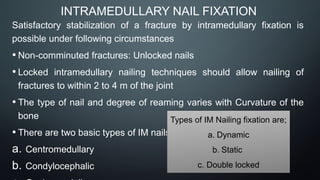
INTRAMEDULLARY NAIL FIXATION
Satisfactory stabilization of a fracture by intramedullary fixation is
possible under following circumstances
• Non-comminuted fractures: Unlocked nails
• Locked intramedullary nailing techniques should allow nailing of
fractures to within 2 to 4 m of the joint
• The type of nail and degree of reaming varies with Curvature of the
bone
• There are two basic types of IM nails;
a. Centromedullary
b. Condylocephalic
Types of IM Nailing fixation are;
a. Dynamic
b. Static
c. Double locked
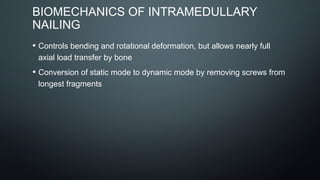
BIOMECHANICS OF INTRAMEDULLARY
NAILING
• Controls bending and rotational deformation, but allows nearly full
axial load transfer by bone
• Conversion of static mode to dynamic mode by removing screws from
longest fragments
CONTACT DETAILS
radds2009@gmail.com

Internal fixators

  • 1.
  • 2.
    CONTENTS • Definition • Types •Principles of surgical treatment • Biomaterials of fracture fixation • Biomechanics of implant design and fracture fixation • Pins and wire fixation • Screw fixation • Screw and plate fixation • Intramedullary nail fixation • External fixation • Prosthesis
  • 3.
    DEFINITION • A surgicalprocedure that stabilizes and joins the ends of fractured bones by internally placed mechanical devices such as metal plates, pins, rods, wires etc.
  • 4.
    INTERNAL FIXATION • Pinand wire fixation • Screw fixation: Screws (Transcortical cross screw fixation also called as cancellous screw or cortical screw) • Plate and screw fixation • Intramedullary nail fixation
  • 5.
    LAMBOTTE’S PRINCIPLES OFSURGICAL TREATMENT OF FRACTURES • Anatomical reduction • Stable internal fixation • Preservation of blood supply • Active, pain-free mobilization of adjacent muscles and joints
  • 6.
    METHODS OF APPLYING •Exposure of the fracture • Reduction of fracture • Provisional stabilization of fracture: • Definitive stabilization of fracture:
  • 7.
    BIOMATERIALS USED FORFRACTURES STABILIZATION Metals •316 stainless steel- iron, chrominum and nickel •titanium aluminium vanadium alloys •commercial pure titanium •tantalum Bioabsorbable materials • Polyglycolic acid(PGA) • Vicryl • Polydioxanone(PDS) • Polylevolactic acid (PLLA) • poly(D, L-lactic acid)(PDLLA)
  • 8.
    FACTORS AFFECTING THEBIOMECHANICAL PROPERTIES OF BIOABSOBABLE POLYMERS • Chemical composition • Manufacturing processes • Physical dimensions environmental • Time
  • 9.
    INDICATIONS FOR ABSORBABLEFIXATION DEVICES • Metatarsal osteotomies • Metacarpal and metatarsal fusions • Malleolar fractures • Osteochondritis dissecans • Fractures of radius and olecranon • Epiphyseal fractures • Ruptures of ulnar collateral ligament of thumb
  • 10.
    COMPLICATIONS • PGA- septicinflammation and sinus track formation • Osteolysis • Severe synovitis
  • 11.
    BIOMECHANICS OF IMPLANTDESIGN AND FRACTURE FIXATION • Bone • Loads • Material s
  • 12.
    TENSION BAND WIRING •A form of internal fixator which converts the distraction forces into compressive forces thus beneficial in healing. Usually this is used in stellate fractures.
  • 13.
    SCREW ANATOMY • Innerdiameter(only the shaft without threads) • Outer diameter (with threads) • Pitch: angle between the threads. • Lead • Threads:
  • 14.
    SCREW FIXATION Types Machine screws •wholelength threaded •can be self tapping •used primarily to fasten hip compression screw devices to shaft of femur ASIF screws •Cortical screws •Cancellous screws •Self-tapping, self-drilling screws •Locking screws
  • 15.
    BIOMECHANICS OF SCREWFIXATION a. To increase the strength of the screw and resist the fatigue Increase the root diameter b. To increase the pull out strength of screw in the bone: by increasing; - Outer diameter - Decreasing inner diameter - Increasing thread density - Increasing thickness of the cortex - Using cortex with more density
  • 16.
    CANNULATED SCREWS • Spacewithin the screw which guides the wire to reach the target. • Features of this type of screw are: i. Greater inner root diameter ii. Smaller thread width
  • 17.
    PLATE AND SCREWFIXATION • This type of fixation converts tensile forces to compression forces on the convex side of an eccentrically loaded bone • Tension band across the fracture on the tension side of bone Main Functions of the plate: • Internal splinting of the bone • Follows principle that: the bone protects plate
  • 18.
    • Axial compression(Key and Charnley) • Plates- causes reduction of fracture with open techniques, thus providing stability for early function of muscle tendon units and joints • Disadvantages: high chances of refracture, osteoporosis, plate irritation and rarely immunological reaction
  • 19.
    Functions of plateand screw fixation • Plates- neutralize deforming forces • Require contouring to maintain optimal stability of fracture reduction Various Plate Designs ON THE BASIS OF ANATOMY • Semitubular: one third and one quarter tubular plates • T plates • L plates • Spoon plates • Dynamic compression plates • Cobra arthrodesis plates • Perbent periarticular plates
  • 20.
    Functionally Plates arecategorized as • Neutralization plates • Compression plates • Buttress plates • Bridge plates
  • 21.
    NEUTRALIZING PLATE FUNCTIONS: • Conjunctionwith interfragmentary screw fixation • Neutralizes torsional, bending and shear forces • Fractures with butterfly or wedge-type fragments • Compression not applied through screw holes
  • 22.
    COMPRESSION PLATING • FUNCTIONS: •Negates torsional, bending and shear forces. • Create compression across fracture site
  • 23.
    BUTTRESS PLATING • Functions: •Negates compression and shear forces that occur with metaphyseal-epiphyseal fractures • Frequently used in conjunction with interfragmentary screw fixation
  • 24.
    BRIDGE PLATING FUNCTIONS: • Usedto span comminuted unstable fracture or bony defect in which anatomical reduction and rigid stability of fracture cannot be restored by fracture reduction
  • 25.
    LOCKING PLATES • Hybridof plate technology and percutaneous bridge plating using screws as a fixed angle device • Hybrid fashion with locked and unlocked screws • Provide adequate load bearing strength to avoid medial and lateral plating in distal femur, proximal tibia and tibial plateau.
  • 26.
    BIOMECHANICS OF PLATEFIXATION • Bending stiffness is proportional to the thickness (h) of the plate to the third power height/thickness (h) base(b) • I= bh3 /12 • Allows bending of plate with applied load • Fatigue failure if fracture doesn’t heal. Eg: Recon plates for clavicle fracture BONE
  • 27.
    BONE SCREW PLATE FIXATION •Bone via compression load: compressive load acting on bone is important in bone healing. Also, the plate protects the amount of load acting on the bone. • Closer the plate to the bone: greater the friction between bone and plate, thus providing low stability to the fracture site. • Screw closest to the fracture site opposes the most amount of force • Construct rigidity of plate screw fixation decreases as the distance between the inner most screw increases • Number of screw recommended on each side Place No. of screws Forearm 3 Humerus 3-4 Tibia 4 Femur 4-5
  • 28.
    TIME OF METALREMOVAL Bone fracture Time after implantation (months) Malleolar 8-12 Tibial pilon 12-18 Tibial shaft plate intramedullary nail 12-18 18-24 Tibial head 12-18 Patellar, tension band 8-12 Femoral condyles 12-24 Femoral plates: - single plates - double plates 24-36 From mo18, in 2 steps (interval, 6 mo) Intramedullary nail 24-36 Peritrochantric and femoral neck fractures 12-18 Pelvis(only in case of complaints) From 10th month onwards Upper extremity(optional) 12-18
  • 29.
    INTRAMEDULLARY NAIL FIXATION Satisfactorystabilization of a fracture by intramedullary fixation is possible under following circumstances • Non-comminuted fractures: Unlocked nails • Locked intramedullary nailing techniques should allow nailing of fractures to within 2 to 4 m of the joint • The type of nail and degree of reaming varies with Curvature of the bone • There are two basic types of IM nails; a. Centromedullary b. Condylocephalic Types of IM Nailing fixation are; a. Dynamic b. Static c. Double locked
  • 30.
    BIOMECHANICS OF INTRAMEDULLARY NAILING •Controls bending and rotational deformation, but allows nearly full axial load transfer by bone • Conversion of static mode to dynamic mode by removing screws from longest fragments
  • 31.