PRESENTATION ON
PRESENTEDBY:
VIDUSHI SHARMA,
M.TECH (31501104)
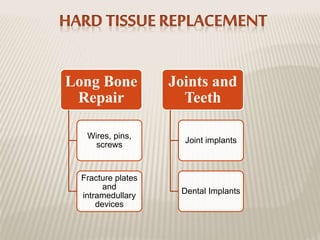
Long Bone
Repair
Wires, pins,
screws
Fracture plates
and
intramedullary
devices
Joints and
Teeth
Joint implants
Dental Implants
Bone is the only tissue able to undergo spontaneous regeneration and to remodel its
micro- and macrostructure.
This is accomplished through a delicate balance between an osteogenic (bone
forming) and osteoclastic (bone removing) process.
Wolff ’s Law of bone remodeling
Bone can adapt to a new mechanical environment by changing the equilibrium
between osteogenesis and osteoclasis. These processes will respond to changes in the
static and dynamic stress applied to bone; that is, if more stress than the
physiological is applied, the equilibrium tilts toward more osteogenic activity.
Conversely, if less stress is applied the equilibrium tilts toward osteoclastic activity.
Nature provides different types of mechanisms to repair fractures:
1. Primary Healing
2. Secondary Healing
The surgical treatments are divided into:
•external fracture fixation, which does not require opening the fracture site
•internal fracture fixation, which requires opening the fracture.
With external fracture fixation, the bone fragments are held in alignment by pins
placed through the skin onto the skeleton, structurally supported by external bars.
With internal fracture fixation, the bone fragments are held by wires, screws, plates,
and/or intramedullary devices.
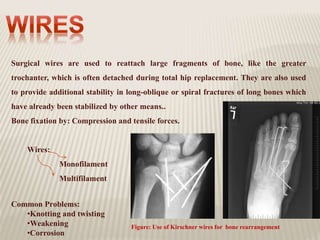
Surgical wires are used to reattach large fragments of bone, like the greater
trochanter, which is often detached during total hip replacement. They are also used
to provide additional stability in long-oblique or spiral fractures of long bones which
have already been stabilized by other means..
Bone fixation by: Compression and tensile forces.
Wires:
Monofilament
Multifilament
Common Problems:
•Knotting and twisting
•Weakening
•Corrosion
Figure: Use of Kirschner wires for bone rearrangement
•Kirschner wires or K-wires or pins are sterilized, sharpened, smooth stainless steel
pins. Introduced in 1909 by Martin Kirschner, the wires are now widely used in
orthopedics and other types of medical and veterinary surgery.
•They come in different sizes and are used to hold bone fragments together (pin
fixation) or to provide an anchor for skeletal traction.
•The pins are often driven into the bone through the skin (percutaneous pin fixation)
using a power or hand drill.
Stainless Steel 316LVM
Wire.
•For implantable medical
devices
•For fabricating
components
•Small diameter wire
•Chemical composition :
Cr, Ni, Mo, Mn.
•Suitable close-tolerance
Stainless Steel 304V
Wire.
•Chemical composition:
Chromium, Nickel,
Carbon, Manganese,
Molybdenum, Silicon,
Phosphorus, Copper,
Cobalt, Nitrogen.
•Least expensive medical
materials
•Excellenth strength
Nitinol Wire.
•Pure Titanium
•Extreme tolerance
•Does not induce toxic or
inflammatory reactions.
Biocompatibility
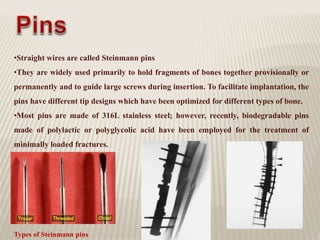
•Straight wires are called Steinmann pins
•They are widely used primarily to hold fragments of bones together provisionally or
permanently and to guide large screws during insertion. To facilitate implantation, the
pins have different tip designs which have been optimized for different types of bone.
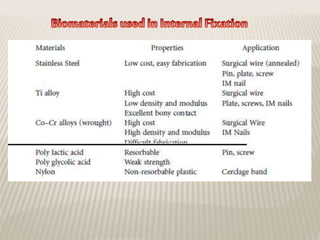
•Most pins are made of 316L stainless steel; however, recently, biodegradable pins
made of polylactic or polyglycolic acid have been employed for the treatment of
minimally loaded fractures.
Types of Steinmann pins
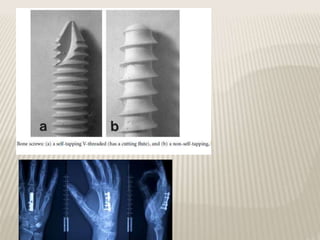
Screws are the most widely used devices for fixation of bone fragments.
There are two types of bone screws:
(1) cortical bone screws, which have small threads
(2) cancellous screws, which have large threads to get more thread-to-bone contact.
They may have either V or buttress threads.
The cortical screws are subclassified further according to their ability to penetrate:
self-tapping and nonself- tapping .
The self-tapping screws have cutting flutes which thread the pilot drill-hole during
insertion. In contrast, the non-self-tapping screws require a tapped pilot drill-hole for
insertion.
The holding power of screws can be affected by the size of the pilot drill-hole, the
depth of screw engagement, the outside diameter of the screw, and quality of the bone.
Therefore, the selection of the screw type should be based on the assessment of the
quality of the bone at the time of insertion. Under identical conditions, self-tapping
screws provide a slightly greater holding power than non-self-tapping screws
Failuremodes of InternalFixation
Devices
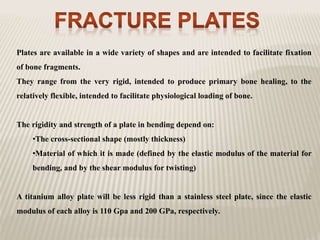
Plates are available in a wide variety of shapes and are intended to facilitate fixation
of bone fragments.
They range from the very rigid, intended to produce primary bone healing, to the
relatively flexible, intended to facilitate physiological loading of bone.
The rigidity and strength of a plate in bending depend on:
•The cross-sectional shape (mostly thickness)
•Material of which it is made (defined by the elastic modulus of the material for
bending, and by the shear modulus for twisting)
A titanium alloy plate will be less rigid than a stainless steel plate, since the elastic
modulus of each alloy is 110 Gpa and 200 GPa, respectively.
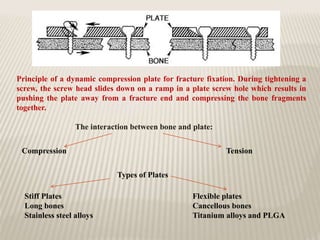
Principle of a dynamic compression plate for fracture fixation. During tightening a
screw, the screw head slides down on a ramp in a plate screw hole which results in
pushing the plate away from a fracture end and compressing the bone fragments
together.
The interaction between bone and plate:
Compression Tension
Types of Plates
Stiff Plates
Long bones
Stainless steel alloys
Flexible plates
Cancellous bones
Titanium alloys and PLGA
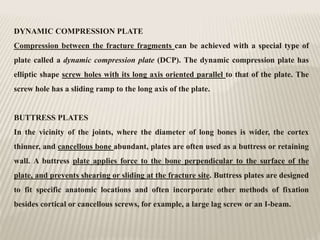
DYNAMIC COMPRESSION PLATE
Compression between the fracture fragments can be achieved with a special type of
plate called a dynamic compression plate (DCP). The dynamic compression plate has
elliptic shape screw holes with its long axis oriented parallel to that of the plate. The
screw hole has a sliding ramp to the long axis of the plate.
BUTTRESS PLATES
In the vicinity of the joints, where the diameter of long bones is wider, the cortex
thinner, and cancellous bone abundant, plates are often used as a buttress or retaining
wall. A buttress plate applies force to the bone perpendicular to the surface of the
plate, and prevents shearing or sliding at the fracture site. Buttress plates are designed
to fit specific anatomic locations and often incorporate other methods of fixation
besides cortical or cancellous screws, for example, a large lag screw or an I-beam.
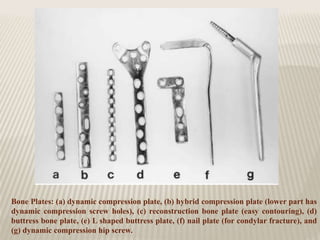
Bone Plates: (a) dynamic compression plate, (b) hybrid compression plate (lower part has
dynamic compression screw holes), (c) reconstruction bone plate (easy contouring), (d)
buttress bone plate, (e) L shaped buttress plate, (f) nail plate (for condylar fracture), and
(g) dynamic compression hip screw.
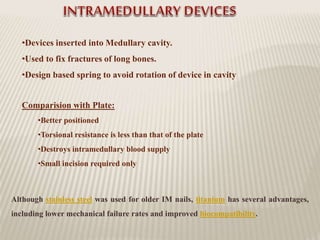
•Devices inserted into Medullary cavity.
•Used to fix fractures of long bones.
•Design based spring to avoid rotation of device in cavity
Comparision with Plate:
•Better positioned
•Torsional resistance is less than that of the plate
•Destroys intramedullary blood supply
•Small incision required only
Although stainless steel was used for older IM nails, titanium has several advantages,

including lower mechanical failure rates and improved biocompatibility.
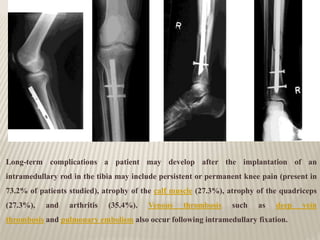
Long-term complications a patient may develop after the implantation of an
intramedullary rod in the tibia may include persistent or permanent knee pain (present in
73.2% of patients studied), atrophy of the calf muscle (27.3%), atrophy of the quadriceps
(27.3%), and arthritis (35.4%). Venous thrombosis such as deep vein
thrombosis and pulmonary embolism also occur following intramedullary fixation.
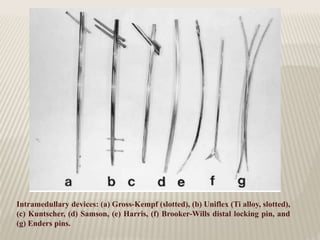
Intramedullary devices: (a) Gross-Kempf (slotted), (b) Uniflex (Ti alloy, slotted),
(c) Kuntscher, (d) Samson, (e) Harris, (f) Brooker-Wills distal locking pin, and
(g) Enders pins.
•Osteoarthritis, one of the various conditions that may cause joint degeneration
and may lead a patient to a total joint replacement By prosthetic implants.
•Under normal conditions, the functions of cartilage are to provide a congruent
articulation between bones, to transmit load across the joint, and to allow low-
friction movements between opposing joint surfaces.
•Cartilage functions as a unit with subchondral bone, which contributes to shock
absorption by undergoing viscoelastic deformation of its fine trabecular
structure.
•Total joint replacements are permanent implants, unlike those used to treat
fractures, and the extensive bone and cartilage removed during implantation
makes this procedure irreversible. Therefore, when faced with prosthesis failure
and the impossibility to reimplant, the patient will face severe shortening of the
extremity, instability or total rigidity of the joint, difficulty in ambulation, and
often will be confined to a wheel chair.
The design of an implant for joint replacement should be based on:
•The kinematics and dynamic load transfer characteristic of the joint dependent on
material properties, shape, and methods used for fixation
This is one of the most important elements that determines long-term survival of
the implant, since bone responds to changes in load transfer with a remodeling
process, mentioned earlier as Wollff ’s law. Overloading the implant-bone interface
or shielding it from load transfer may result in bone resorption and subsequent
loosening of the implant .
•The articulating surfaces of the joint should function with minimum friction and
produce the least amount of wear products.
•The implant should be securely fixed to the body as early as possible (ideally
immediately after implantation).
•Loss of tissue, especially of bone, makes re-implantation difficult and often
shortens the life span of the second joint replacement
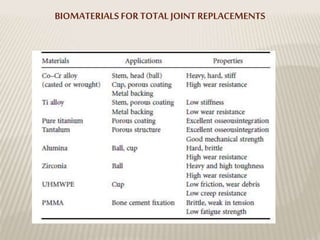
BIOMATERIALS FORTOTAL JOINT REPLACEMENTS
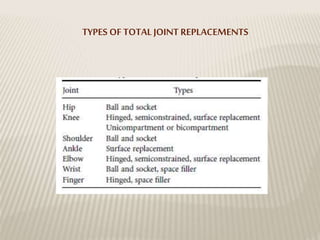
TYPES OF TOTAL JOINT REPLACEMENTS
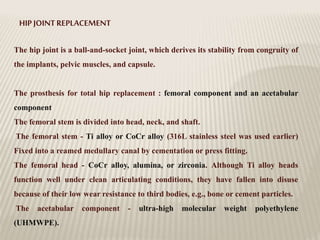
HIP JOINTREPLACEMENT
The hip joint is a ball-and-socket joint, which derives its stability from congruity of
the implants, pelvic muscles, and capsule.
The prosthesis for total hip replacement : femoral component and an acetabular
component
The femoral stem is divided into head, neck, and shaft.
The femoral stem - Ti alloy or CoCr alloy (316L stainless steel was used earlier)
Fixed into a reamed medullary canal by cementation or press fitting.
The femoral head - CoCr alloy, alumina, or zirconia. Although Ti alloy heads
function well under clean articulating conditions, they have fallen into disuse
because of their low wear resistance to third bodies, e.g., bone or cement particles.
The acetabular component - ultra-high molecular weight polyethylene
(UHMWPE).
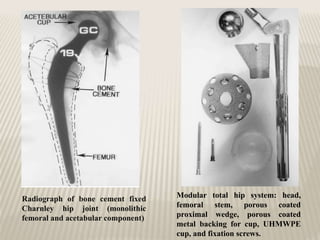
Modular total hip system: head,
femoral stem, porous coated
proximal wedge, porous coated
metal backing for cup, UHMWPE
cup, and fixation screws.
Radiograph of bone cement fixed
Charnley hip joint (monolithic
femoral and acetabular component)
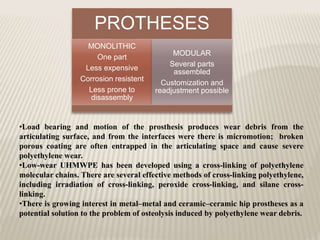
PROTHESES
MONOLITHIC
One part
Less expensive
Corrosion resistent
Less prone to
disassembly
MODULAR
Several parts
assembled
Customization and
readjustment possible
•Load bearing and motion of the prosthesis produces wear debris from the
articulating surface, and from the interfaces were there is micromotion; broken
porous coating are often entrapped in the articulating space and cause severe
polyethylene wear.
•Low-wear UHMWPE has been developed using a cross-linking of polyethylene
molecular chains. There are several effective methods of cross-linking polyethylene,
including irradiation of cross-linking, peroxide cross-linking, and silane cross-
linking.
•There is growing interest in metal–metal and ceramic–ceramic hip prostheses as a
potential solution to the problem of osteolysis induced by polyethylene wear debris.
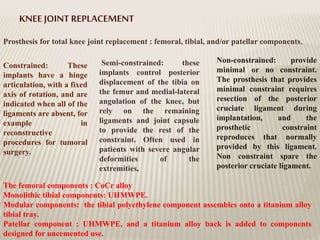
KNEE JOINT REPLACEMENT
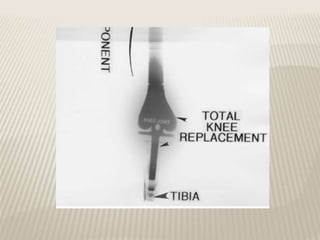
Prosthesis for total knee joint replacement : femoral, tibial, and/or patellar components.
Constrained: These
implants have a hinge
articulation, with a fixed
axis of rotation, and are
indicated when all of the
ligaments are absent, for
example in
reconstructive
procedures for tumoral
surgery.
Semi-constrained: these
implants control posterior
displacement of the tibia on
the femur and medial-lateral
angulation of the knee, but
rely on the remaining
ligaments and joint capsule
to provide the rest of the
constraint. Often used in
patients with severe angular
deformities of the
extremities,
Non-constrained: provide
minimal or no constraint.
The prosthesis that provides
minimal constraint requires
resection of the posterior
cruciate ligament during
implantation, and the
prosthetic constraint
reproduces that normally
provided by this ligament.
Non constraint spare the
posterior cruciate ligament.
The femoral components : CoCr alloy
Monolithic tibial components: UHMWPE.
Modular components: the tibial polyethylene component assembles onto a titanium alloy
tibial tray.
Patellar component : UHMWPE, and a titanium alloy back is added to components
designed for uncemented use.
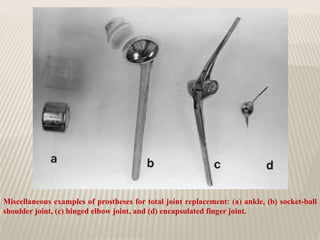
Miscellaneous examples of prostheses for total joint replacement: (a) ankle, (b) socket-ball
shoulder joint, (c) hinged elbow joint, and (d) encapsulated finger joint.
DENTAL IMPLANTS
Total tooth replacement
Endosseous Tooth Implants: Site of missing or extracted teeth to restore original
function. Mostly made up of stainless steel, Co-Cr alloy, Ti, Ti6A12V alloy, single
crystal alumina, outer coating with ceramics, pyrolytic carbon, polycrystalline
alumina and acrylic polymer composite.
Subperiosteal Implants: Framework for dentures for the edentulous alveolar
ridge. Primarily mostly made up of stainless steel, Co-Cr alloy, Ti alloy and outer
coating by inert metals or ceramics.
Hard tissue replacent

Hard tissue replacent

  • 1.
  • 2.
    Long Bone Repair Wires, pins, screws Fractureplates and intramedullary devices Joints and Teeth Joint implants Dental Implants
  • 4.
    Bone is theonly tissue able to undergo spontaneous regeneration and to remodel its micro- and macrostructure. This is accomplished through a delicate balance between an osteogenic (bone forming) and osteoclastic (bone removing) process. Wolff ’s Law of bone remodeling Bone can adapt to a new mechanical environment by changing the equilibrium between osteogenesis and osteoclasis. These processes will respond to changes in the static and dynamic stress applied to bone; that is, if more stress than the physiological is applied, the equilibrium tilts toward more osteogenic activity. Conversely, if less stress is applied the equilibrium tilts toward osteoclastic activity.
  • 5.
    Nature provides differenttypes of mechanisms to repair fractures: 1. Primary Healing 2. Secondary Healing The surgical treatments are divided into: •external fracture fixation, which does not require opening the fracture site •internal fracture fixation, which requires opening the fracture. With external fracture fixation, the bone fragments are held in alignment by pins placed through the skin onto the skeleton, structurally supported by external bars. With internal fracture fixation, the bone fragments are held by wires, screws, plates, and/or intramedullary devices.
  • 6.
    Surgical wires areused to reattach large fragments of bone, like the greater trochanter, which is often detached during total hip replacement. They are also used to provide additional stability in long-oblique or spiral fractures of long bones which have already been stabilized by other means.. Bone fixation by: Compression and tensile forces. Wires: Monofilament Multifilament Common Problems: •Knotting and twisting •Weakening •Corrosion Figure: Use of Kirschner wires for bone rearrangement
  • 7.
    •Kirschner wires orK-wires or pins are sterilized, sharpened, smooth stainless steel pins. Introduced in 1909 by Martin Kirschner, the wires are now widely used in orthopedics and other types of medical and veterinary surgery. •They come in different sizes and are used to hold bone fragments together (pin fixation) or to provide an anchor for skeletal traction. •The pins are often driven into the bone through the skin (percutaneous pin fixation) using a power or hand drill. Stainless Steel 316LVM Wire. •For implantable medical devices •For fabricating components •Small diameter wire •Chemical composition : Cr, Ni, Mo, Mn. •Suitable close-tolerance Stainless Steel 304V Wire. •Chemical composition: Chromium, Nickel, Carbon, Manganese, Molybdenum, Silicon, Phosphorus, Copper, Cobalt, Nitrogen. •Least expensive medical materials •Excellenth strength Nitinol Wire. •Pure Titanium •Extreme tolerance •Does not induce toxic or inflammatory reactions. Biocompatibility
  • 8.
    •Straight wires arecalled Steinmann pins •They are widely used primarily to hold fragments of bones together provisionally or permanently and to guide large screws during insertion. To facilitate implantation, the pins have different tip designs which have been optimized for different types of bone. •Most pins are made of 316L stainless steel; however, recently, biodegradable pins made of polylactic or polyglycolic acid have been employed for the treatment of minimally loaded fractures. Types of Steinmann pins
  • 9.
    Screws are themost widely used devices for fixation of bone fragments. There are two types of bone screws: (1) cortical bone screws, which have small threads (2) cancellous screws, which have large threads to get more thread-to-bone contact. They may have either V or buttress threads. The cortical screws are subclassified further according to their ability to penetrate: self-tapping and nonself- tapping . The self-tapping screws have cutting flutes which thread the pilot drill-hole during insertion. In contrast, the non-self-tapping screws require a tapped pilot drill-hole for insertion. The holding power of screws can be affected by the size of the pilot drill-hole, the depth of screw engagement, the outside diameter of the screw, and quality of the bone. Therefore, the selection of the screw type should be based on the assessment of the quality of the bone at the time of insertion. Under identical conditions, self-tapping screws provide a slightly greater holding power than non-self-tapping screws
  • 12.
  • 13.
    Plates are availablein a wide variety of shapes and are intended to facilitate fixation of bone fragments. They range from the very rigid, intended to produce primary bone healing, to the relatively flexible, intended to facilitate physiological loading of bone. The rigidity and strength of a plate in bending depend on: •The cross-sectional shape (mostly thickness) •Material of which it is made (defined by the elastic modulus of the material for bending, and by the shear modulus for twisting) A titanium alloy plate will be less rigid than a stainless steel plate, since the elastic modulus of each alloy is 110 Gpa and 200 GPa, respectively.
  • 14.
    Principle of adynamic compression plate for fracture fixation. During tightening a screw, the screw head slides down on a ramp in a plate screw hole which results in pushing the plate away from a fracture end and compressing the bone fragments together. The interaction between bone and plate: Compression Tension Types of Plates Stiff Plates Long bones Stainless steel alloys Flexible plates Cancellous bones Titanium alloys and PLGA
  • 15.
    DYNAMIC COMPRESSION PLATE Compressionbetween the fracture fragments can be achieved with a special type of plate called a dynamic compression plate (DCP). The dynamic compression plate has elliptic shape screw holes with its long axis oriented parallel to that of the plate. The screw hole has a sliding ramp to the long axis of the plate. BUTTRESS PLATES In the vicinity of the joints, where the diameter of long bones is wider, the cortex thinner, and cancellous bone abundant, plates are often used as a buttress or retaining wall. A buttress plate applies force to the bone perpendicular to the surface of the plate, and prevents shearing or sliding at the fracture site. Buttress plates are designed to fit specific anatomic locations and often incorporate other methods of fixation besides cortical or cancellous screws, for example, a large lag screw or an I-beam.
  • 16.
    Bone Plates: (a)dynamic compression plate, (b) hybrid compression plate (lower part has dynamic compression screw holes), (c) reconstruction bone plate (easy contouring), (d) buttress bone plate, (e) L shaped buttress plate, (f) nail plate (for condylar fracture), and (g) dynamic compression hip screw.
  • 17.
    •Devices inserted intoMedullary cavity. •Used to fix fractures of long bones. •Design based spring to avoid rotation of device in cavity Comparision with Plate: •Better positioned •Torsional resistance is less than that of the plate •Destroys intramedullary blood supply •Small incision required only Although stainless steel was used for older IM nails, titanium has several advantages, including lower mechanical failure rates and improved biocompatibility.
  • 18.
    Long-term complications apatient may develop after the implantation of an intramedullary rod in the tibia may include persistent or permanent knee pain (present in 73.2% of patients studied), atrophy of the calf muscle (27.3%), atrophy of the quadriceps (27.3%), and arthritis (35.4%). Venous thrombosis such as deep vein thrombosis and pulmonary embolism also occur following intramedullary fixation.
  • 19.
    Intramedullary devices: (a)Gross-Kempf (slotted), (b) Uniflex (Ti alloy, slotted), (c) Kuntscher, (d) Samson, (e) Harris, (f) Brooker-Wills distal locking pin, and (g) Enders pins.
  • 20.
    •Osteoarthritis, one ofthe various conditions that may cause joint degeneration and may lead a patient to a total joint replacement By prosthetic implants. •Under normal conditions, the functions of cartilage are to provide a congruent articulation between bones, to transmit load across the joint, and to allow low- friction movements between opposing joint surfaces. •Cartilage functions as a unit with subchondral bone, which contributes to shock absorption by undergoing viscoelastic deformation of its fine trabecular structure. •Total joint replacements are permanent implants, unlike those used to treat fractures, and the extensive bone and cartilage removed during implantation makes this procedure irreversible. Therefore, when faced with prosthesis failure and the impossibility to reimplant, the patient will face severe shortening of the extremity, instability or total rigidity of the joint, difficulty in ambulation, and often will be confined to a wheel chair.
  • 21.
    The design ofan implant for joint replacement should be based on: •The kinematics and dynamic load transfer characteristic of the joint dependent on material properties, shape, and methods used for fixation This is one of the most important elements that determines long-term survival of the implant, since bone responds to changes in load transfer with a remodeling process, mentioned earlier as Wollff ’s law. Overloading the implant-bone interface or shielding it from load transfer may result in bone resorption and subsequent loosening of the implant . •The articulating surfaces of the joint should function with minimum friction and produce the least amount of wear products. •The implant should be securely fixed to the body as early as possible (ideally immediately after implantation). •Loss of tissue, especially of bone, makes re-implantation difficult and often shortens the life span of the second joint replacement
  • 22.
  • 23.
    TYPES OF TOTALJOINT REPLACEMENTS
  • 24.
    HIP JOINTREPLACEMENT The hipjoint is a ball-and-socket joint, which derives its stability from congruity of the implants, pelvic muscles, and capsule. The prosthesis for total hip replacement : femoral component and an acetabular component The femoral stem is divided into head, neck, and shaft. The femoral stem - Ti alloy or CoCr alloy (316L stainless steel was used earlier) Fixed into a reamed medullary canal by cementation or press fitting. The femoral head - CoCr alloy, alumina, or zirconia. Although Ti alloy heads function well under clean articulating conditions, they have fallen into disuse because of their low wear resistance to third bodies, e.g., bone or cement particles. The acetabular component - ultra-high molecular weight polyethylene (UHMWPE).
  • 25.
    Modular total hipsystem: head, femoral stem, porous coated proximal wedge, porous coated metal backing for cup, UHMWPE cup, and fixation screws. Radiograph of bone cement fixed Charnley hip joint (monolithic femoral and acetabular component)
  • 26.
    PROTHESES MONOLITHIC One part Less expensive Corrosionresistent Less prone to disassembly MODULAR Several parts assembled Customization and readjustment possible •Load bearing and motion of the prosthesis produces wear debris from the articulating surface, and from the interfaces were there is micromotion; broken porous coating are often entrapped in the articulating space and cause severe polyethylene wear. •Low-wear UHMWPE has been developed using a cross-linking of polyethylene molecular chains. There are several effective methods of cross-linking polyethylene, including irradiation of cross-linking, peroxide cross-linking, and silane cross- linking. •There is growing interest in metal–metal and ceramic–ceramic hip prostheses as a potential solution to the problem of osteolysis induced by polyethylene wear debris.
  • 27.
    KNEE JOINT REPLACEMENT Prosthesisfor total knee joint replacement : femoral, tibial, and/or patellar components. Constrained: These implants have a hinge articulation, with a fixed axis of rotation, and are indicated when all of the ligaments are absent, for example in reconstructive procedures for tumoral surgery. Semi-constrained: these implants control posterior displacement of the tibia on the femur and medial-lateral angulation of the knee, but rely on the remaining ligaments and joint capsule to provide the rest of the constraint. Often used in patients with severe angular deformities of the extremities, Non-constrained: provide minimal or no constraint. The prosthesis that provides minimal constraint requires resection of the posterior cruciate ligament during implantation, and the prosthetic constraint reproduces that normally provided by this ligament. Non constraint spare the posterior cruciate ligament. The femoral components : CoCr alloy Monolithic tibial components: UHMWPE. Modular components: the tibial polyethylene component assembles onto a titanium alloy tibial tray. Patellar component : UHMWPE, and a titanium alloy back is added to components designed for uncemented use.
  • 28.
    Miscellaneous examples ofprostheses for total joint replacement: (a) ankle, (b) socket-ball shoulder joint, (c) hinged elbow joint, and (d) encapsulated finger joint.
  • 30.
    DENTAL IMPLANTS Total toothreplacement Endosseous Tooth Implants: Site of missing or extracted teeth to restore original function. Mostly made up of stainless steel, Co-Cr alloy, Ti, Ti6A12V alloy, single crystal alumina, outer coating with ceramics, pyrolytic carbon, polycrystalline alumina and acrylic polymer composite. Subperiosteal Implants: Framework for dentures for the edentulous alveolar ridge. Primarily mostly made up of stainless steel, Co-Cr alloy, Ti alloy and outer coating by inert metals or ceramics.