Introduction to Orthogonal Frequency
Division Multiplexing (OFDM)
Prof. Xianbin (Warren) Wang
March 2023
Outline
• What’s OFDM?
 OFDM stands for Orthogonal Frequency Division Multiplexing
 Multicarrier modulation technique
• Principles of OFDM
 Transmitter
 Receiver
• Advantages / Disadvantages
 Peak-to-Average Power Ratio
 Sensitivity to carrier frequency offset
• OFDM System Design
 Channel Estimation
 Time and Frequency Domain Synchronization
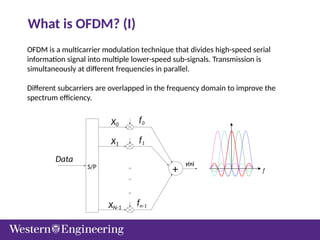
f
OFDM is a multicarrier modulation technique that divides high-speed serial
information signal into multiple lower-speed sub-signals. Transmission is
simultaneously at different frequencies in parallel.
Different subcarriers are overlapped in the frequency domain to improve the
spectrum efficiency.
What is OFDM? (I)
y(n)
f0
f1
fn-1
+
S/P
Data
X0
X1
XN-1
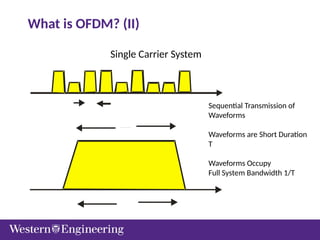
Single Carrier System
Sequential Transmission of
Waveforms
Waveforms are Short Duration
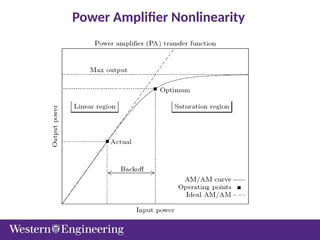
T
Waveforms Occupy
Full System Bandwidth 1/T
What is OFDM? (II)
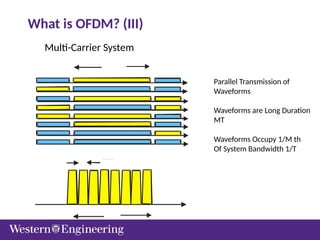
Multi-Carrier System
Parallel Transmission of
Waveforms
Waveforms are Long Duration
MT
Waveforms Occupy 1/M th
Of System Bandwidth 1/T
What is OFDM? (III)
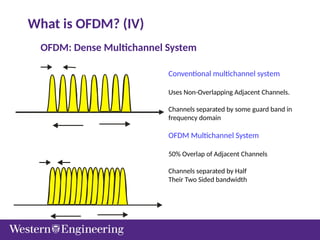
OFDM: Dense Multichannel System
Conventional multichannel system
Uses Non-Overlapping Adjacent Channels.
Channels separated by some guard band in
frequency domain
OFDM Multichannel System
50% Overlap of Adjacent Channels
Channels separated by Half
Their Two Sided bandwidth
What is OFDM? (IV)
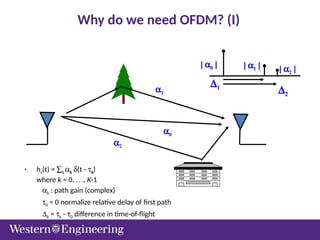
Why do we need OFDM? (I)
• hc(t) = åk ak d(t - tk)
where k = 0, …, K-1
ak : path gain (complex)
t0 = 0 normalize relative delay of first path
Dk = tk - t0 difference in time-of-flight
| a0 | | a1 | | a2 |
D1
D2
a0
a1
a2
Why do we need OFDM? (II)
-6 -4 -2 0 2 4 6
-0.2
0
0.2
0.4
0.6
0.8
1
t/Ts
2Ts 4Ts
Ts
-6 -4 -2 0 2 4 6 8
-0.5
0
0.5
1
t/T
s
-6 -4 -2 0 2 4 6 8
-0.2
0
0.2
0.4
0.6
0.8
t/T
s
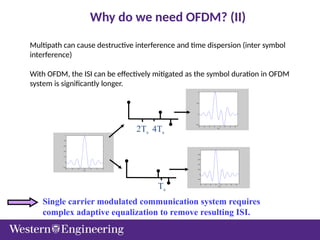
Single carrier modulated communication system requires
complex adaptive equalization to remove resulting ISI.
Multipath can cause destructive interference and time dispersion (inter symbol
interference)
With OFDM, the ISI can be effectively mitigated as the symbol duration in OFDM
system is significantly longer.
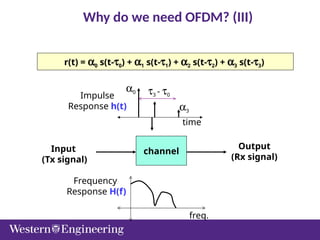
r(t) = a0 s(t-t0) + a1 s(t-t1) + a2 s(t-t2) + a3 s(t-t3)
channel
Input
(Tx signal)
Output
(Rx signal)
Impulse
Response h(t)
t3 - t0
time
a3
a0
freq.
Frequency
Response H(f)
Why do we need OFDM? (III)
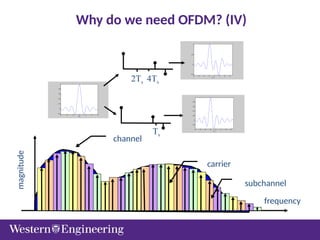
subchannel
frequency
magnitude
carrier
channel
-6 -4 -2 0 2 4 6
-0.2
0
0.2
0.4
0.6
0.8
1
t/T
s
2Ts 4Ts
Ts
-6 -4 -2 0 2 4 6 8
-0.5
0
0.5
1
t/T
s
-6 -4 -2 0 2 4 6 8
-0.2
0
0.2
0.4
0.6
0.8
t/Ts
Why do we need OFDM? (IV)
Outline
• What’s OFDM?
 OFDM stands for Orthogonal Frequency Division Multiplexing
 It’s multicarrier modulation technique
• Principles of OFDM
 Transmitter
 Receiver
• Advantages / Disadvantages
 Peak-to-Average Power Ratio
 Sensitivity to carrier frequency offset
• OFDM System Design
 Channel Estimation
 Time and Frequency Domain Synchronization
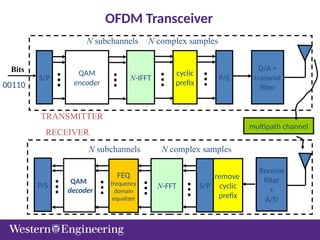
P/S
QAM
decoder
FEQ
frequency
domain
equalizer
S/P
QAM
encoder
N-IFFT
cyclic
prefix
P/S
D/A +
transmit
filter
N-FFT S/P
remove
cyclic
prefix
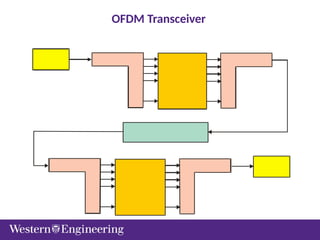
TRANSMITTER
RECEIVER
N subchannels N complex samples
N complex samples
N subchannels
Receive
filter
+
A/D
multipath channel
OFDM Transceiver
Bits
00110
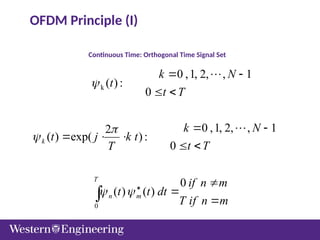
Continuous Time: Orthogonal Time Signal Set
k
0
0 ,1, 2, , 1
( ):
0
0 ,1, 2, , 1
2
( ) exp( ):
0
0
( ) ( )
k
T
n m
k N
t
t T
k N
t j k t
t T
T
if n m
t t dt
T if n m



  
 
 
 
  
 






OFDM Principle (I)
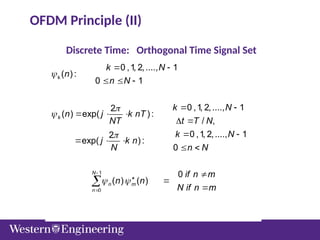
Discrete Time: Orthogonal Time Signal Set




 
   



  
 
  
 
  
 
 
  
 



 

k
1
0
0 ,1, 2,...., 1
( ) :
0 1
0 ,1, 2,...., 1
2
( ) exp( ) :
/ ,
0 ,1, 2,...., 1
2
exp( ) :
0
0
( ) ( )
: ( ) ( ) ( ) ( )
k
N
n m
n
k N k k N k
k N
n
n N
k N
n j k nT
NT t T N
k N
j k n
N n N
if n m
n n
N if n m
NOTE n n n n
OFDM Principle (II)
1
,..,
1
,
0
,
)
(
)
(
1
0
)
2
(





N
n
e
k
X
n
y
N
k
n
N
k
j

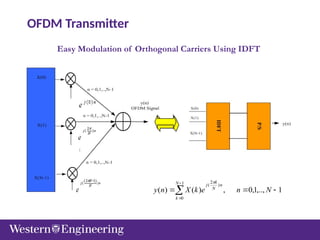
Easy Modulation of Orthogonal Carriers Using IDFT
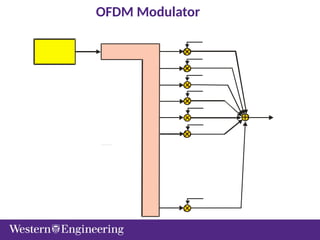
OFDM Transmitter
x(t) h(t) y(t)
t t t
t
t
Adjacent Symbols
Symbol Channel Distorted Symbol
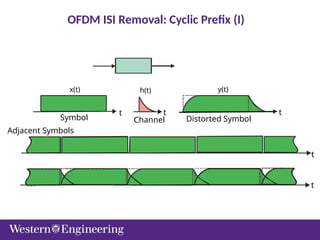
OFDM ISI Removal: Cyclic Prefix (I)
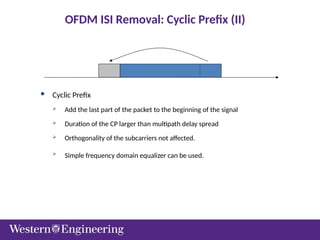
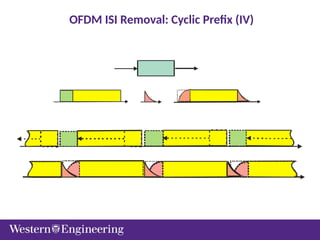
 Cyclic Prefix
 Add the last part of the packet to the beginning of the signal
 Duration of the CP larger than multipath delay spread
 Orthogonality of the subcarriers not affected.
 Simple frequency domain equalizer can be used.
OFDM ISI Removal: Cyclic Prefix (II)
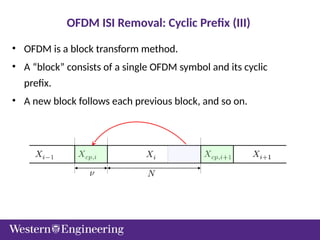
• OFDM is a block transform method.
• A “block” consists of a single OFDM symbol and its cyclic
prefix.
• A new block follows each previous block, and so on.
OFDM ISI Removal: Cyclic Prefix (III)
OFDM ISI Removal: Cyclic Prefix (IV)
Cyclic Prefix and OFDM Equalization (I)
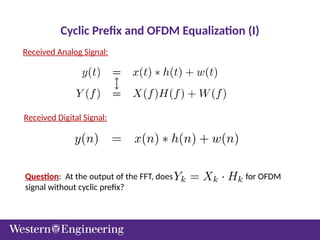
Received Analog Signal:
Received Digital Signal:
Question: At the output of the FFT, does for OFDM
signal without cyclic prefix?
Cyclic Prefix and OFDM Equalization (II)
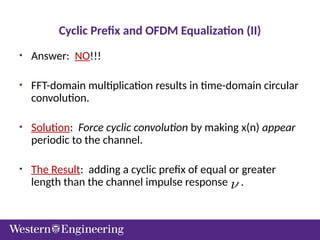
• Answer: NO!!!
• FFT-domain multiplication results in time-domain circular
convolution.
• Solution: Force cyclic convolution by making x(n) appear
periodic to the channel.
• The Result: adding a cyclic prefix of equal or greater
length than the channel impulse response .
Cyclic Prefix and OFDM Equalization (III)
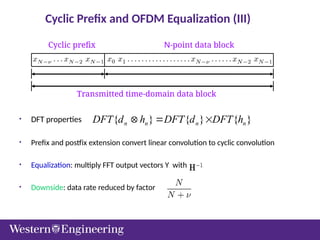
• DFT properties
• Prefix and postfix extension convert linear convolution to cyclic convolution
• Equalization: multiply FFT output vectors Y with .
• Downside: data rate reduced by factor .
}
{
}
{
}
{ n
n
n
n h
DFT
d
DFT
h
d
DFT 


Transmitted time-domain data block
Cyclic prefix N-point data block
OFDM In-band Pilots
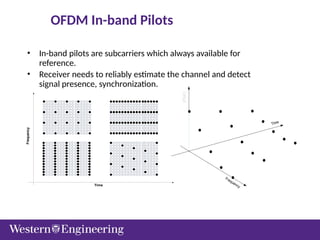
• In-band pilots are subcarriers which always available for
reference.
• Receiver needs to reliably estimate the channel and detect
signal presence, synchronization.
Time
Frequency
y(n)
y(n)
y(n)
X(0)
X(1)
X(N-1)
P
/S
D
F
T
...
y(n)
n = 0,1,..,N-1
.
.
.
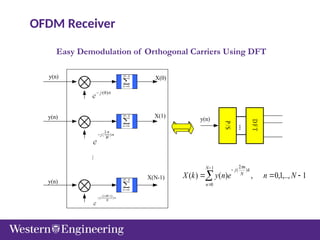
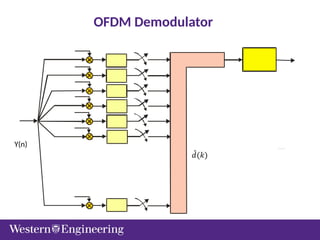
Demodulation of the the Orthogonal Carriers
1
,..,
1
,
0
,
)
(
)
(
1
0
)
2
(






N
n
e
n
y
k
X
N
n
k
N
n
j

Easy Demodulation of Orthogonal Carriers Using DFT
OFDM Receiver
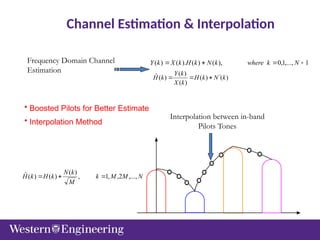
Channel Estimation & Interpolation
1
,...,
1
,
0
),
(
)
(
).
(
)
( 


 N
k
where
k
N
k
H
k
X
k
Y
)
(
)
(
)
(
)
(
)
(
ˆ k
N
k
H
k
X
k
Y
k
H 



N
M
M
k
M
k
N
k
H
k
H ,...,
2
,
,
1
,
)
(
)
(
)
(
ˆ 


Frequency Domain Channel
Estimation
Interpolation between in-band
Pilots Tones
• Boosted Pilots for Better Estimate
• Interpolation Method
OFDM Transceiver
OFDM Modulator
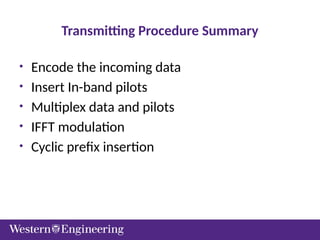
Transmitting Procedure Summary
• Encode the incoming data
• Insert In-band pilots
• Multiplex data and pilots
• IFFT modulation
• Cyclic prefix insertion
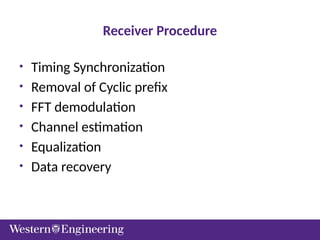
Receiver Procedure
• Timing Synchronization
• Removal of Cyclic prefix
• FFT demodulation
• Channel estimation
• Equalization
• Data recovery
OFDM Demodulator
Y(n)
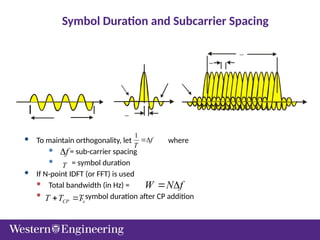
Symbol Duration and Subcarrier Spacing
 To maintain orthogonality, let where
 = sub-carrier spacing
 = symbol duration
 If N-point IDFT (or FFT) is used
 Total bandwidth (in Hz) =
 , symbol duration after CP addition
1
f
T

f

T
f
N
W 

CP s
T T T
 
Outline
• What’s OFDM?
 OFDM stands for Orthogonal Frequency Division Multiplexing
 It’s multicarrier modulation technique
• Principles of OFDM
 Transmitter
 Receiver
• Advantages / Disadvantages
 Peak-to-Average Power Ratio
 Sensitivity to carrier frequency offset
• OFDM System Design
 Channel Estimation
 Time and Frequency Domain Synchronization
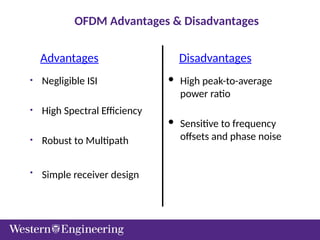
OFDM Advantages & Disadvantages
• Negligible ISI
• High Spectral Efficiency
• Robust to Multipath
• Simple receiver design
 High peak-to-average
power ratio
 Sensitive to frequency
offsets and phase noise
Advantages Disadvantages
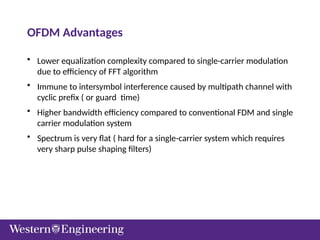
OFDM Advantages
• Lower equalization complexity compared to single-carrier modulation
due to efficiency of FFT algorithm
• Immune to intersymbol interference caused by multipath channel with
cyclic prefix ( or guard time)
• Higher bandwidth efficiency compared to conventional FDM and single
carrier modulation system
• Spectrum is very flat ( hard for a single-carrier system which requires
very sharp pulse shaping filters)
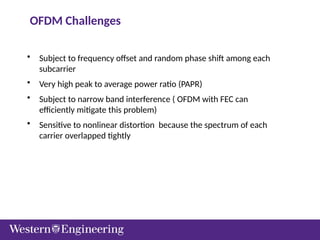
OFDM Challenges
• Subject to frequency offset and random phase shift among each
subcarrier
• Very high peak to average power ratio (PAPR)
• Subject to narrow band interference ( OFDM with FEC can
efficiently mitigate this problem)
• Sensitive to nonlinear distortion because the spectrum of each
carrier overlapped tightly
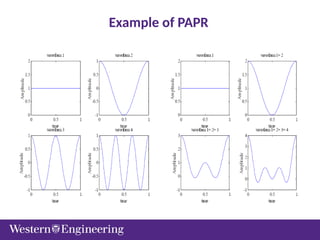
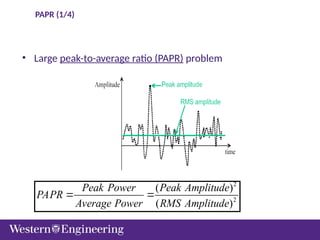
PAPR (1/4)
• Large peak-to-average ratio (PAPR) problem
2
2
( )
( )
Peak Power Peak Amplitude
PAPR
Average Power RMS Amplitude
 
PAPR(2/4)
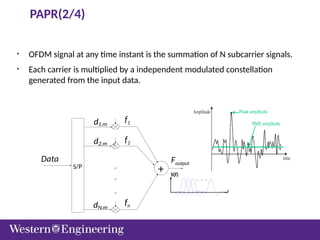
• OFDM signal at any time instant is the summation of N subcarrier signals.
• Each carrier is multiplied by a independent modulated constellation
generated from the input data.
f
S(f)
f1
f2
fn
Foutput
+
S/P
0
Data
d1.m
d2.m
dN.m
PAPR (3/4)
• High peak-to-average power ratio
– It increased complexity of the analog-to-digital and digital-
to-analog converters
– It reduced efficiency of the RF power amplifier
• The PAPR puts a stringent requirement on
the power amplifier and reduces the
efficiency in the sense that a higher input
backoff factor is needed before the peaks
in the signal experience significant
distortion due to power amplifier
nonlinearity.
PAPR (4/4)
[7]
Example of PAPR
Power Amplifier Nonlinearity
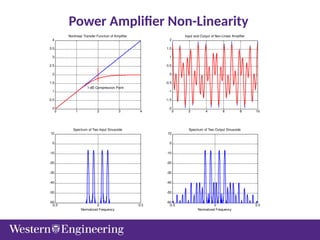
Power Amplifier Non-Linearity
0 1 2 3 4
0
0.5
1
1.5
2
2.5
3
3.5
4
Nonlinear Transfer Function of Amplifier
1-dB Compression Point
0 2 4 6 8 10
-2
-1.5
-1
-0.5
0
0.5
1
1.5
2
Input and Output of Non-Linear Amplifier
-0.5 0 0.5
-60
-50
-40
-30
-20
-10
0
10
Spectrum of Two Input Sinusoids
Normalized Frequency
-0.5 0 0.5
-60
-50
-40
-30
-20
-10
0
10
Spectrum of Two Output Sinusoids
Normalized Frequency
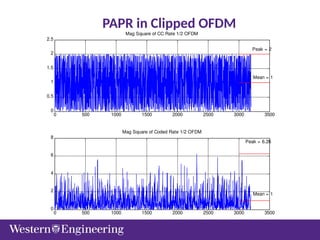
PAPR in Clipped OFDM
0 500 1000 1500 2000 2500 3000 3500
0
0.5
1
1.5
2
2.5
Mag Square of CC Rate 1/2 OFDM
0 500 1000 1500 2000 2500 3000 3500
0
2
4
6
8
Mag Square of Coded Rate 1/2 OFDM
Mean = 1
Mean = 1
Peak = 2
Peak = 6.26
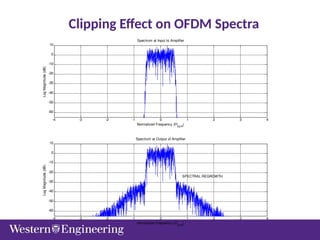
Clipping Effect on OFDM Spectra
-4 -3 -2 -1 0 1 2 3 4
-60
-50
-40
-30
-20
-10
0
10
Spectrum at Input to Amplifier
Normalized Frequency (f/fsym
)
Log
Magnitude
(dB)
-4 -3 -2 -1 0 1 2 3 4
-60
-50
-40
-30
-20
-10
0
10
Spectrum at Output of Amplifier
Normalized Frequency (f/fsym
)
Log
Magnitude
(dB)
SPECTRAL REGROWTH
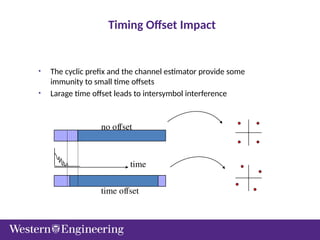
Timing Offset Impact
• The cyclic prefix and the channel estimator provide some
immunity to small time offsets
• Larage time offset leads to intersymbol interference
time
no offset
time offset
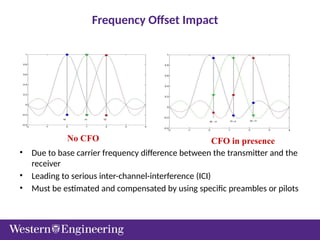
Frequency Offset Impact
• Due to base carrier frequency difference between the transmitter and the
receiver
• Leading to serious inter-channel-interference (ICI)
• Must be estimated and compensated by using specific preambles or pilots
No CFO CFO in presence
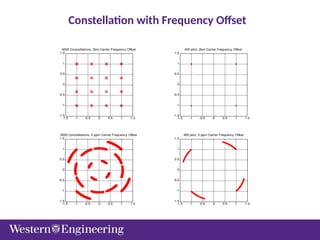
Constellation with Frequency Offset
-1.5 -1 -0.5 0 0.5 1 1.5
-1.5
-1
-0.5
0
0.5
1
1.5
5000 Constellations, Zero Carrier Frequency Offset
-1.5 -1 -0.5 0 0.5 1 1.5
-1.5
-1
-0.5
0
0.5
1
1.5
400 pilot, Zero Carrier Frequency Offset
-1.5 -1 -0.5 0 0.5 1 1.5
-1.5
-1
-0.5
0
0.5
1
1.5
5000 Constellations, 5 ppm Carrier Frequency Offset
-1.5 -1 -0.5 0 0.5 1 1.5
-1.5
-1
-0.5
0
0.5
1
1.5
400 pilot, 5 ppm Carrier Frequency Offset
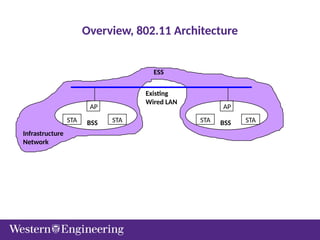
STA
STA
STA STA
AP
AP
ESS
BSS
BSS
Existing
Wired LAN
Infrastructure
Network
Overview, 802.11 Architecture
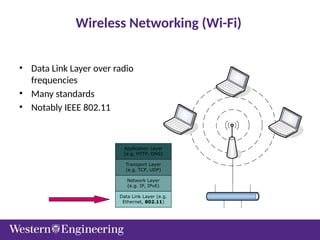
Wireless Networking (Wi-Fi)
• Data Link Layer over radio
frequencies
• Many standards
• Notably IEEE 802.11
Application Layer
(e.g. HTTP, DNS)
Transport Layer
(e.g. TCP, UDP)
Network Layer
(e.g. IP, IPv6)
Data Link Layer (e.g.
Ethernet, 802.11)
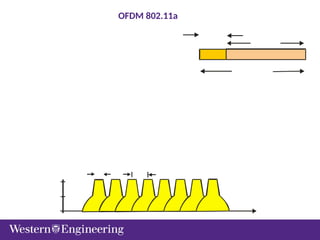
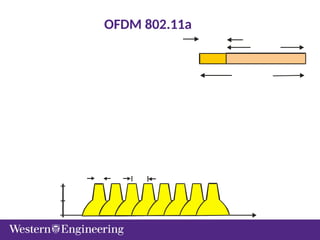
OFDM 802.11a
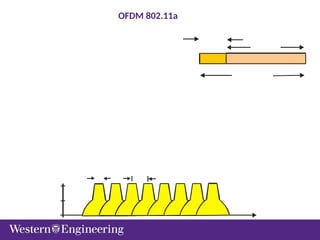
OFDM 802.11a
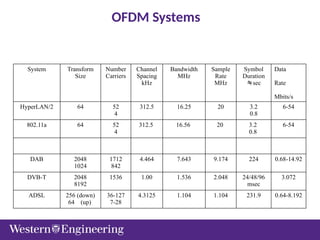
OFDM Systems
System Transform
Size
Number
Carriers
Channel
Spacing
kHz
Bandwidth
MHz
Sample
Rate
MHz
Symbol
Duration
sec
Data
Rate
Mbits/s
HyperLAN/2 64 52
4
312.5 16.25 20 3.2
0.8
6-54
802.11a 64 52
4
312.5 16.56 20 3.2
0.8
6-54
DAB 2048
1024
1712
842
4.464 7.643 9.174 224 0.68-14.92
DVB-T 2048
8192
1536 1.00 1.536 2.048 24/48/96
msec
3.072
ADSL 256 (down)
64 (up)
36-127
7-28
4.3125 1.104 1.104 231.9 0.64-8.192
OFDM 802.11a
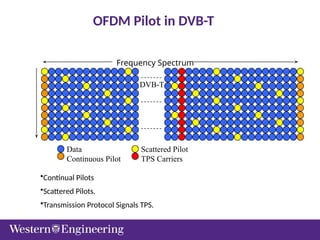
OFDM Pilot in DVB-T
DVB-T
Data
Continuous Pilot
Scattered Pilot
TPS Carriers
Frequency Spectrum
•Continual Pilots
•Scattered Pilots.
•Transmission Protocol Signals TPS.
Thank you!

Week8_ECE9308_2020_Modulation_Part_II_OFDM.pptx

  • 1.
    Introduction to OrthogonalFrequency Division Multiplexing (OFDM) Prof. Xianbin (Warren) Wang March 2023
  • 2.
    Outline • What’s OFDM? OFDM stands for Orthogonal Frequency Division Multiplexing  Multicarrier modulation technique • Principles of OFDM  Transmitter  Receiver • Advantages / Disadvantages  Peak-to-Average Power Ratio  Sensitivity to carrier frequency offset • OFDM System Design  Channel Estimation  Time and Frequency Domain Synchronization
  • 3.
    f OFDM is amulticarrier modulation technique that divides high-speed serial information signal into multiple lower-speed sub-signals. Transmission is simultaneously at different frequencies in parallel. Different subcarriers are overlapped in the frequency domain to improve the spectrum efficiency. What is OFDM? (I) y(n) f0 f1 fn-1 + S/P Data X0 X1 XN-1
  • 4.
    Single Carrier System SequentialTransmission of Waveforms Waveforms are Short Duration T Waveforms Occupy Full System Bandwidth 1/T What is OFDM? (II)
  • 5.
    Multi-Carrier System Parallel Transmissionof Waveforms Waveforms are Long Duration MT Waveforms Occupy 1/M th Of System Bandwidth 1/T What is OFDM? (III)
  • 6.
    OFDM: Dense MultichannelSystem Conventional multichannel system Uses Non-Overlapping Adjacent Channels. Channels separated by some guard band in frequency domain OFDM Multichannel System 50% Overlap of Adjacent Channels Channels separated by Half Their Two Sided bandwidth What is OFDM? (IV)
  • 7.
    Why do weneed OFDM? (I) • hc(t) = åk ak d(t - tk) where k = 0, …, K-1 ak : path gain (complex) t0 = 0 normalize relative delay of first path Dk = tk - t0 difference in time-of-flight | a0 | | a1 | | a2 | D1 D2 a0 a1 a2
  • 8.
    Why do weneed OFDM? (II) -6 -4 -2 0 2 4 6 -0.2 0 0.2 0.4 0.6 0.8 1 t/Ts 2Ts 4Ts Ts -6 -4 -2 0 2 4 6 8 -0.5 0 0.5 1 t/T s -6 -4 -2 0 2 4 6 8 -0.2 0 0.2 0.4 0.6 0.8 t/T s Single carrier modulated communication system requires complex adaptive equalization to remove resulting ISI. Multipath can cause destructive interference and time dispersion (inter symbol interference) With OFDM, the ISI can be effectively mitigated as the symbol duration in OFDM system is significantly longer.
  • 9.
    r(t) = a0s(t-t0) + a1 s(t-t1) + a2 s(t-t2) + a3 s(t-t3) channel Input (Tx signal) Output (Rx signal) Impulse Response h(t) t3 - t0 time a3 a0 freq. Frequency Response H(f) Why do we need OFDM? (III)
  • 10.
    subchannel frequency magnitude carrier channel -6 -4 -20 2 4 6 -0.2 0 0.2 0.4 0.6 0.8 1 t/T s 2Ts 4Ts Ts -6 -4 -2 0 2 4 6 8 -0.5 0 0.5 1 t/T s -6 -4 -2 0 2 4 6 8 -0.2 0 0.2 0.4 0.6 0.8 t/Ts Why do we need OFDM? (IV)
  • 11.
    Outline • What’s OFDM? OFDM stands for Orthogonal Frequency Division Multiplexing  It’s multicarrier modulation technique • Principles of OFDM  Transmitter  Receiver • Advantages / Disadvantages  Peak-to-Average Power Ratio  Sensitivity to carrier frequency offset • OFDM System Design  Channel Estimation  Time and Frequency Domain Synchronization
  • 12.
    P/S QAM decoder FEQ frequency domain equalizer S/P QAM encoder N-IFFT cyclic prefix P/S D/A + transmit filter N-FFT S/P remove cyclic prefix TRANSMITTER RECEIVER Nsubchannels N complex samples N complex samples N subchannels Receive filter + A/D multipath channel OFDM Transceiver Bits 00110
  • 13.
    Continuous Time: OrthogonalTime Signal Set k 0 0 ,1, 2, , 1 ( ): 0 0 ,1, 2, , 1 2 ( ) exp( ): 0 0 ( ) ( ) k T n m k N t t T k N t j k t t T T if n m t t dt T if n m                        OFDM Principle (I)
  • 14.
    Discrete Time: OrthogonalTime Signal Set                                          k 1 0 0 ,1, 2,...., 1 ( ) : 0 1 0 ,1, 2,...., 1 2 ( ) exp( ) : / , 0 ,1, 2,...., 1 2 exp( ) : 0 0 ( ) ( ) : ( ) ( ) ( ) ( ) k N n m n k N k k N k k N n n N k N n j k nT NT t T N k N j k n N n N if n m n n N if n m NOTE n n n n OFDM Principle (II)
  • 15.
  • 16.
    x(t) h(t) y(t) tt t t t Adjacent Symbols Symbol Channel Distorted Symbol OFDM ISI Removal: Cyclic Prefix (I)
  • 17.
     Cyclic Prefix Add the last part of the packet to the beginning of the signal  Duration of the CP larger than multipath delay spread  Orthogonality of the subcarriers not affected.  Simple frequency domain equalizer can be used. OFDM ISI Removal: Cyclic Prefix (II)
  • 18.
    • OFDM isa block transform method. • A “block” consists of a single OFDM symbol and its cyclic prefix. • A new block follows each previous block, and so on. OFDM ISI Removal: Cyclic Prefix (III)
  • 19.
    OFDM ISI Removal:Cyclic Prefix (IV)
  • 20.
    Cyclic Prefix andOFDM Equalization (I) Received Analog Signal: Received Digital Signal: Question: At the output of the FFT, does for OFDM signal without cyclic prefix?
  • 21.
    Cyclic Prefix andOFDM Equalization (II) • Answer: NO!!! • FFT-domain multiplication results in time-domain circular convolution. • Solution: Force cyclic convolution by making x(n) appear periodic to the channel. • The Result: adding a cyclic prefix of equal or greater length than the channel impulse response .
  • 22.
    Cyclic Prefix andOFDM Equalization (III) • DFT properties • Prefix and postfix extension convert linear convolution to cyclic convolution • Equalization: multiply FFT output vectors Y with . • Downside: data rate reduced by factor . } { } { } { n n n n h DFT d DFT h d DFT    Transmitted time-domain data block Cyclic prefix N-point data block
  • 23.
    OFDM In-band Pilots •In-band pilots are subcarriers which always available for reference. • Receiver needs to reliably estimate the channel and detect signal presence, synchronization. Time Frequency
  • 24.
    y(n) y(n) y(n) X(0) X(1) X(N-1) P /S D F T ... y(n) n = 0,1,..,N-1 . . . Demodulationof the the Orthogonal Carriers 1 ,.., 1 , 0 , ) ( ) ( 1 0 ) 2 (       N n e n y k X N n k N n j  Easy Demodulation of Orthogonal Carriers Using DFT OFDM Receiver
  • 25.
    Channel Estimation &Interpolation 1 ,..., 1 , 0 ), ( ) ( ). ( ) (     N k where k N k H k X k Y ) ( ) ( ) ( ) ( ) ( ˆ k N k H k X k Y k H     N M M k M k N k H k H ,..., 2 , , 1 , ) ( ) ( ) ( ˆ    Frequency Domain Channel Estimation Interpolation between in-band Pilots Tones • Boosted Pilots for Better Estimate • Interpolation Method
  • 26.
  • 27.
  • 28.
    Transmitting Procedure Summary •Encode the incoming data • Insert In-band pilots • Multiplex data and pilots • IFFT modulation • Cyclic prefix insertion
  • 29.
    Receiver Procedure • TimingSynchronization • Removal of Cyclic prefix • FFT demodulation • Channel estimation • Equalization • Data recovery
  • 30.
  • 31.
    Symbol Duration andSubcarrier Spacing  To maintain orthogonality, let where  = sub-carrier spacing  = symbol duration  If N-point IDFT (or FFT) is used  Total bandwidth (in Hz) =  , symbol duration after CP addition 1 f T  f  T f N W   CP s T T T  
  • 32.
    Outline • What’s OFDM? OFDM stands for Orthogonal Frequency Division Multiplexing  It’s multicarrier modulation technique • Principles of OFDM  Transmitter  Receiver • Advantages / Disadvantages  Peak-to-Average Power Ratio  Sensitivity to carrier frequency offset • OFDM System Design  Channel Estimation  Time and Frequency Domain Synchronization
  • 33.
    OFDM Advantages &Disadvantages • Negligible ISI • High Spectral Efficiency • Robust to Multipath • Simple receiver design  High peak-to-average power ratio  Sensitive to frequency offsets and phase noise Advantages Disadvantages
  • 34.
    OFDM Advantages • Lowerequalization complexity compared to single-carrier modulation due to efficiency of FFT algorithm • Immune to intersymbol interference caused by multipath channel with cyclic prefix ( or guard time) • Higher bandwidth efficiency compared to conventional FDM and single carrier modulation system • Spectrum is very flat ( hard for a single-carrier system which requires very sharp pulse shaping filters)
  • 35.
    OFDM Challenges • Subjectto frequency offset and random phase shift among each subcarrier • Very high peak to average power ratio (PAPR) • Subject to narrow band interference ( OFDM with FEC can efficiently mitigate this problem) • Sensitive to nonlinear distortion because the spectrum of each carrier overlapped tightly
  • 36.
    PAPR (1/4) • Largepeak-to-average ratio (PAPR) problem 2 2 ( ) ( ) Peak Power Peak Amplitude PAPR Average Power RMS Amplitude  
  • 37.
    PAPR(2/4) • OFDM signalat any time instant is the summation of N subcarrier signals. • Each carrier is multiplied by a independent modulated constellation generated from the input data. f S(f) f1 f2 fn Foutput + S/P 0 Data d1.m d2.m dN.m
  • 38.
    PAPR (3/4) • Highpeak-to-average power ratio – It increased complexity of the analog-to-digital and digital- to-analog converters – It reduced efficiency of the RF power amplifier • The PAPR puts a stringent requirement on the power amplifier and reduces the efficiency in the sense that a higher input backoff factor is needed before the peaks in the signal experience significant distortion due to power amplifier nonlinearity.
  • 39.
  • 40.
  • 41.
  • 42.
    Power Amplifier Non-Linearity 01 2 3 4 0 0.5 1 1.5 2 2.5 3 3.5 4 Nonlinear Transfer Function of Amplifier 1-dB Compression Point 0 2 4 6 8 10 -2 -1.5 -1 -0.5 0 0.5 1 1.5 2 Input and Output of Non-Linear Amplifier -0.5 0 0.5 -60 -50 -40 -30 -20 -10 0 10 Spectrum of Two Input Sinusoids Normalized Frequency -0.5 0 0.5 -60 -50 -40 -30 -20 -10 0 10 Spectrum of Two Output Sinusoids Normalized Frequency
  • 43.
    PAPR in ClippedOFDM 0 500 1000 1500 2000 2500 3000 3500 0 0.5 1 1.5 2 2.5 Mag Square of CC Rate 1/2 OFDM 0 500 1000 1500 2000 2500 3000 3500 0 2 4 6 8 Mag Square of Coded Rate 1/2 OFDM Mean = 1 Mean = 1 Peak = 2 Peak = 6.26
  • 44.
    Clipping Effect onOFDM Spectra -4 -3 -2 -1 0 1 2 3 4 -60 -50 -40 -30 -20 -10 0 10 Spectrum at Input to Amplifier Normalized Frequency (f/fsym ) Log Magnitude (dB) -4 -3 -2 -1 0 1 2 3 4 -60 -50 -40 -30 -20 -10 0 10 Spectrum at Output of Amplifier Normalized Frequency (f/fsym ) Log Magnitude (dB) SPECTRAL REGROWTH
  • 45.
    Timing Offset Impact •The cyclic prefix and the channel estimator provide some immunity to small time offsets • Larage time offset leads to intersymbol interference time no offset time offset
  • 46.
    Frequency Offset Impact •Due to base carrier frequency difference between the transmitter and the receiver • Leading to serious inter-channel-interference (ICI) • Must be estimated and compensated by using specific preambles or pilots No CFO CFO in presence
  • 47.
    Constellation with FrequencyOffset -1.5 -1 -0.5 0 0.5 1 1.5 -1.5 -1 -0.5 0 0.5 1 1.5 5000 Constellations, Zero Carrier Frequency Offset -1.5 -1 -0.5 0 0.5 1 1.5 -1.5 -1 -0.5 0 0.5 1 1.5 400 pilot, Zero Carrier Frequency Offset -1.5 -1 -0.5 0 0.5 1 1.5 -1.5 -1 -0.5 0 0.5 1 1.5 5000 Constellations, 5 ppm Carrier Frequency Offset -1.5 -1 -0.5 0 0.5 1 1.5 -1.5 -1 -0.5 0 0.5 1 1.5 400 pilot, 5 ppm Carrier Frequency Offset
  • 48.
  • 49.
    Wireless Networking (Wi-Fi) •Data Link Layer over radio frequencies • Many standards • Notably IEEE 802.11 Application Layer (e.g. HTTP, DNS) Transport Layer (e.g. TCP, UDP) Network Layer (e.g. IP, IPv6) Data Link Layer (e.g. Ethernet, 802.11)
  • 50.
  • 51.
  • 52.
    OFDM Systems System Transform Size Number Carriers Channel Spacing kHz Bandwidth MHz Sample Rate MHz Symbol Duration sec Data Rate Mbits/s HyperLAN/264 52 4 312.5 16.25 20 3.2 0.8 6-54 802.11a 64 52 4 312.5 16.56 20 3.2 0.8 6-54 DAB 2048 1024 1712 842 4.464 7.643 9.174 224 0.68-14.92 DVB-T 2048 8192 1536 1.00 1.536 2.048 24/48/96 msec 3.072 ADSL 256 (down) 64 (up) 36-127 7-28 4.3125 1.104 1.104 231.9 0.64-8.192
  • 53.
  • 54.
    OFDM Pilot inDVB-T DVB-T Data Continuous Pilot Scattered Pilot TPS Carriers Frequency Spectrum •Continual Pilots •Scattered Pilots. •Transmission Protocol Signals TPS.
  • 55.

Editor's Notes

  • #46 The effect of a time offset will be different depending on how large the offset is. If we have large offsets we will get Intersymbol interference, ISI, which will reduce the SNR. Provided that the cyclic prefix is longer then the channel impulse response we can compensate for the offset in the channel equalizer. The effect of an offset that is in the part of the cyclic prefix not affected by the pervious symbol is only a phase rotation of the signal constellation. What we want is a system design with high performance and low overhead. What this means is we want the estimates to be in this region, and we want this region to be small. This can be achieved with an accurate estimator.
  • #47 Besides CE, CFO is another issue for OFDM. CFO is caused by base carrier frequency difference between Xmit and Rcvr. When it presents, it destroys the SC orthogonality, thus leads to serious inter-channel-interference problem, as illustrated in the plots above. Therefore, CFO must be estimated and compensated.