Introduction to
OFDM
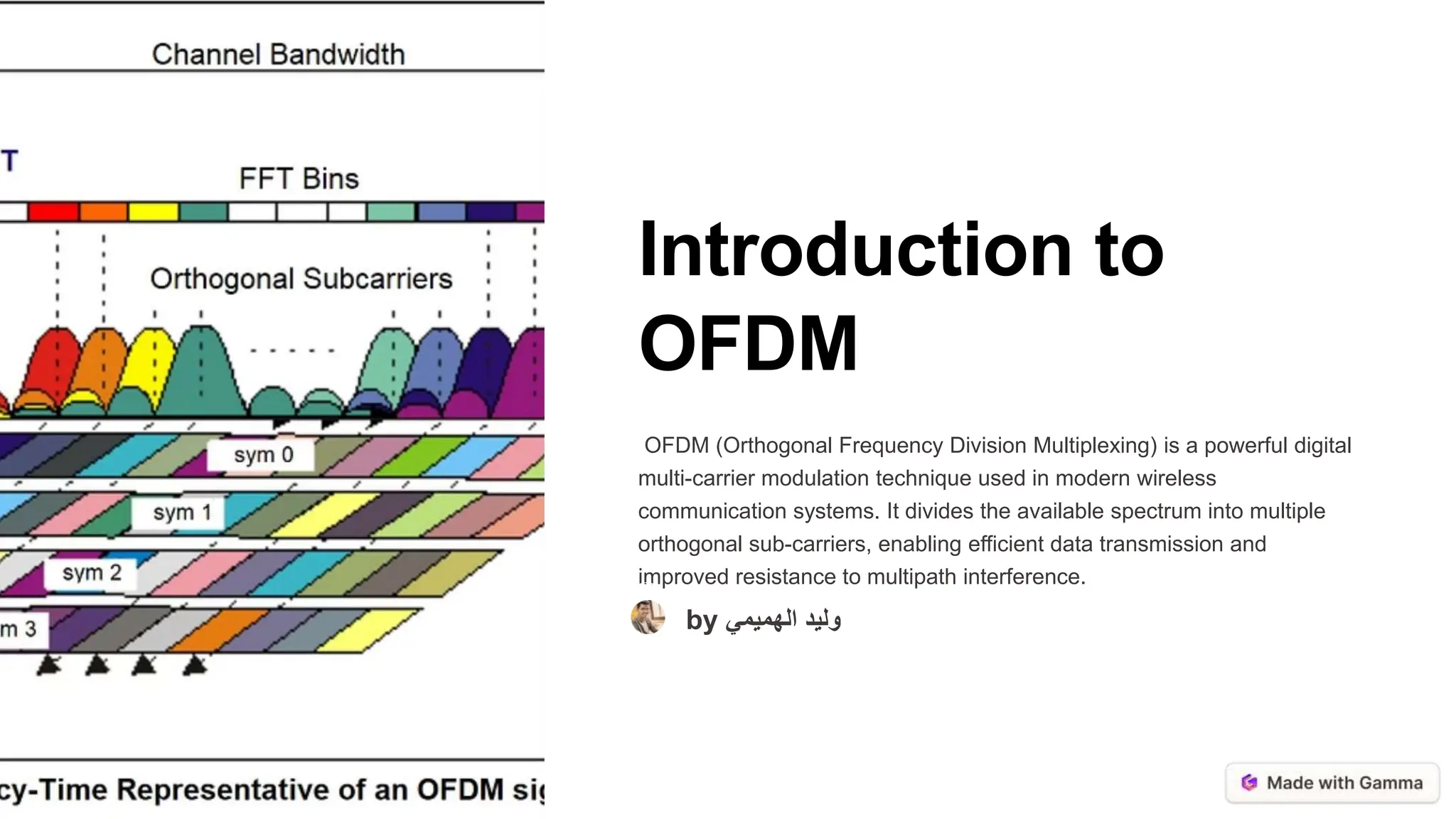
OFDM (Orthogonal Frequency Division Multiplexing) is a powerful digital
multi-carrier modulation technique used in modern wireless
communication systems. It divides the available spectrum into multiple
orthogonal sub-carriers, enabling efficient data transmission and
improved resistance to multipath interference.
by ‫وليد‬
‫الهميمي‬
Principles of OFDM
Orthogonal
Subcarriers
OFDM uses multiple
orthogonal subcarriers,
which are spaced in
frequency to avoid
interference between
them, maximizing spectral
efficiency.
Parallel Data
Transmission
The high-speed serial data
stream is split into multiple
lower-rate parallel
streams, each modulating
a separate subcarrier.
Cyclic Prefix
A cyclic prefix is added to
each OFDM symbol to
prevent inter-symbol
interference, improving
resilience to multipath
fading.
Advantages of OFDM
1 High Spectral Efficiency
OFDM's use of orthogonal subcarriers
allows for efficient utilization of the
available spectrum.
2 Resistance to Multipath
Interference
The cyclic prefix helps mitigate the
effects of multipath fading and
intersymbol interference.
3 Flexible Resource Allocation
OFDM enables dynamic and flexible
allocation of subcarriers and power,
optimizing performance.
4 Scalability and Compatibility
OFDM can be easily scaled and is
compatible with a wide range of
wireless standards.
OFDM Modulation Techniques
QPSK
Quadrature Phase Shift
Keying is a common
modulation scheme used
in OFDM systems, offering
high spectral efficiency.
QAM
Quadrature Amplitude
Modulation can be used to
further increase the data
rate by encoding more bits
per symbol.
BPSK
Binary Phase Shift Keying
is a simple modulation
technique providing robust
performance in
challenging channel
conditions.
OFDM System Architecture
Serial to
Parallel
The high-speed
data stream is
converted into
parallel lower-rate
substreams.
IFFT
The parallel
substreams are
modulated onto
orthogonal
subcarriers using
the Inverse Fast
Fourier
Transform.
Cyclic Prefix
A cyclic prefix is
added to each
OFDM symbol to
mitigate
intersymbol
interference.
Parallel to
Serial
The parallel
substreams are
combined back
into a single high-
speed data
stream.
OFDM Transceiver Design
Transmitter
The transmitter converts
the input data into
OFDM symbols,
upconverts the signal,
and transmits it over the
wireless channel.
Channel
The wireless channel
introduces various
impairments, such as
fading, noise, and
multipath interference,
which the receiver must
overcome.
Receiver
The receiver
downconverts the
signal, removes the
cyclic prefix, and
demodulates the OFDM
symbols to recover the
original data.
OFDM Applications
Wireless LANs
OFDM is a core
technology used in
Wi-Fi standards like
802.11a/g/n/ac/ax,
enabling high-
speed wireless
connectivity.
Cellular
Networks
OFDM is used in
4G LTE and 5G NR
cellular networks,
providing improved
spectral efficiency
and data rates.
Broadband
Internet
OFDM is the
modulation
technique used in
DSL (Digital
Subscriber Line)
technologies for
high-speed internet
access.
Digital
Broadcasting
OFDM is employed
in digital TV
broadcasting
standards like DVB-
T/T2, enabling
robust and efficient
transmission.
Challenges and Future Trends in
OFDM
1 Peak-to-Average Power Ratio
OFDM signals have a high peak-to-average power ratio, which can lead to
amplifier nonlinearity and efficiency issues.
2 Synchronization Sensitivity
OFDM is sensitive to timing and frequency offsets, requiring robust
synchronization techniques.
3 Increased Flexibility
Future OFDM systems will feature more flexible subcarrier spacing and
bandwidth allocation for improved spectral efficiency.

Orthogonal Frequency Division Multiplexing

  • 1.
    Introduction to OFDM OFDM (OrthogonalFrequency Division Multiplexing) is a powerful digital multi-carrier modulation technique used in modern wireless communication systems. It divides the available spectrum into multiple orthogonal sub-carriers, enabling efficient data transmission and improved resistance to multipath interference. by ‫وليد‬ ‫الهميمي‬
  • 2.
    Principles of OFDM Orthogonal Subcarriers OFDMuses multiple orthogonal subcarriers, which are spaced in frequency to avoid interference between them, maximizing spectral efficiency. Parallel Data Transmission The high-speed serial data stream is split into multiple lower-rate parallel streams, each modulating a separate subcarrier. Cyclic Prefix A cyclic prefix is added to each OFDM symbol to prevent inter-symbol interference, improving resilience to multipath fading.
  • 3.
    Advantages of OFDM 1High Spectral Efficiency OFDM's use of orthogonal subcarriers allows for efficient utilization of the available spectrum. 2 Resistance to Multipath Interference The cyclic prefix helps mitigate the effects of multipath fading and intersymbol interference. 3 Flexible Resource Allocation OFDM enables dynamic and flexible allocation of subcarriers and power, optimizing performance. 4 Scalability and Compatibility OFDM can be easily scaled and is compatible with a wide range of wireless standards.
  • 4.
    OFDM Modulation Techniques QPSK QuadraturePhase Shift Keying is a common modulation scheme used in OFDM systems, offering high spectral efficiency. QAM Quadrature Amplitude Modulation can be used to further increase the data rate by encoding more bits per symbol. BPSK Binary Phase Shift Keying is a simple modulation technique providing robust performance in challenging channel conditions.
  • 5.
    OFDM System Architecture Serialto Parallel The high-speed data stream is converted into parallel lower-rate substreams. IFFT The parallel substreams are modulated onto orthogonal subcarriers using the Inverse Fast Fourier Transform. Cyclic Prefix A cyclic prefix is added to each OFDM symbol to mitigate intersymbol interference. Parallel to Serial The parallel substreams are combined back into a single high- speed data stream.
  • 6.
    OFDM Transceiver Design Transmitter Thetransmitter converts the input data into OFDM symbols, upconverts the signal, and transmits it over the wireless channel. Channel The wireless channel introduces various impairments, such as fading, noise, and multipath interference, which the receiver must overcome. Receiver The receiver downconverts the signal, removes the cyclic prefix, and demodulates the OFDM symbols to recover the original data.
  • 7.
    OFDM Applications Wireless LANs OFDMis a core technology used in Wi-Fi standards like 802.11a/g/n/ac/ax, enabling high- speed wireless connectivity. Cellular Networks OFDM is used in 4G LTE and 5G NR cellular networks, providing improved spectral efficiency and data rates. Broadband Internet OFDM is the modulation technique used in DSL (Digital Subscriber Line) technologies for high-speed internet access. Digital Broadcasting OFDM is employed in digital TV broadcasting standards like DVB- T/T2, enabling robust and efficient transmission.
  • 8.
    Challenges and FutureTrends in OFDM 1 Peak-to-Average Power Ratio OFDM signals have a high peak-to-average power ratio, which can lead to amplifier nonlinearity and efficiency issues. 2 Synchronization Sensitivity OFDM is sensitive to timing and frequency offsets, requiring robust synchronization techniques. 3 Increased Flexibility Future OFDM systems will feature more flexible subcarrier spacing and bandwidth allocation for improved spectral efficiency.