Origin and Journey of the Nation State System  Mid 16 th  century developments in in Europe led to declaim of  old controls( of Roman Empire of Church) Search for NEW IDENTITY began and thus came the idea of NATION in to the picture. Portugal, Spain, Britain ,France were the early beginners as Monarchic States ( fre from Holy roman empire)
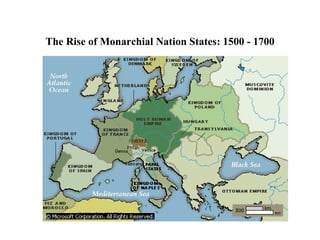
The Rise of Monarchial Nation States: 1500 - 1700
Prime Characteristics of the Nation States  Growing Bureaucratization: More and more was the need to have a centralized state. Existence of a Permanent Mercenary Army: Due to the wars, people wanted armies. Growing need to tax: In order to pay for the armies and for the wars, monarchy needed taxes.
Consequence of raise of Nation State Balance Power has shifted as each new nation state want to expand its sphere of Influence  Search for new territories has started The Ideas of Individualism and reason stated to get impetus. Colonization began to take shape
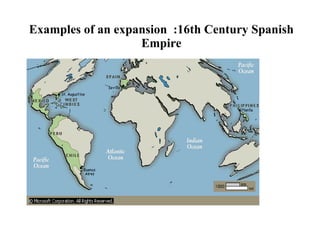
Examples of an expansion  :16th Century Spanish Empire
Phases of Development of Nation State  Treaty of Westphalia 1648 Utrecht Treaty 1713 Congress of Vienna 1815 First World War 1914-19 Second World War  1939-1945 From 1945 onwords
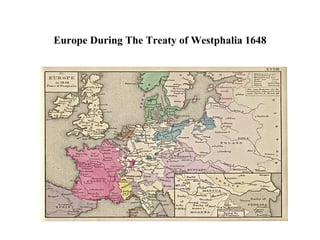
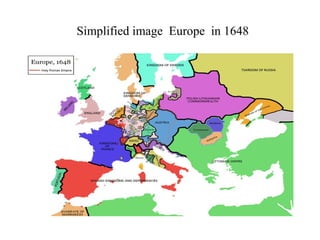
Europe During The Treaty of Westphalia 1648
Simplified image  Europe  in 1648 Size of this preview: 800 × 577 pixels
By the time of Treaty of Westphalia ( which is in modern day Germany)  England, France, Spain and Swedon were  great powers  Denmark( with Norway) ,Holland, Portugal and Switzerland were small powers Russia was yet to become power full Treaty ended thirty war within the holy roman empire and eighty years rivalry between Spain and Dutch republic
Consequences of Treaty of Westphalia  General recognition of the exclusive sovereignty of each party over its lands, people, and agents abroad, was recognised  Gave way to religious freedom: The Kingdoms  were free to follow Catholicism, Lutheranism or Calvinism
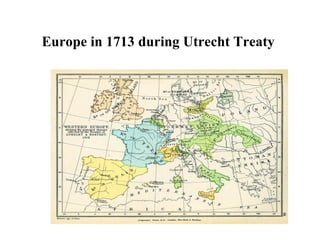
Europe in 1713 during Utrecht Treaty
Utrecht Treaty  (Utretcht is  A Dutch city)  Colonial supremacy fights for western hemisphere were on  Paved way for  alliances  and the  balance of power  as the basis of future of Nation state system  Treaties were signed between Spain, France, England ,Dutch republic etc. After this treaty till the French revolution(1789) and Raise of Napoleon Old balance of power continued in Europe
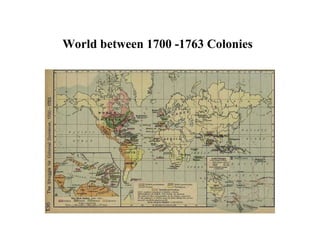
World between 1700 -1763 Colonies
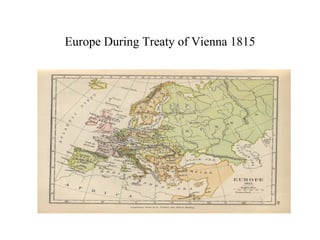
Europe During Treaty of Vienna 1815
The principal negotiators At Vienna Congress   Austria -  Metternich  Prussia-  Hardenberg and von Humbolt  Russia - Nesselrode and Rasoumoffski Great Britain-  Castlereagh, and later, Wellington  France -  Talleyrand and Dalberg
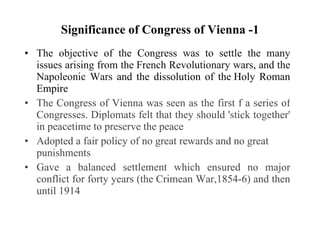
Significance of Congress of Vienna -1 The objective of the Congress was to settle the many issues arising from the French Revolutionary wars, and the Napoleonic Wars  and the dissolution of the Holy Roman Empire The Congress of Vienna was seen as the first f a series of Congresses. Diplomats felt that they should 'stick together' in peacetime to preserve the peace Adopted a fair policy of no great rewards and no great punishments Gave a balanced settlement which ensured no major conflict for forty years (the Crimean War,1854-6) and then until 1914
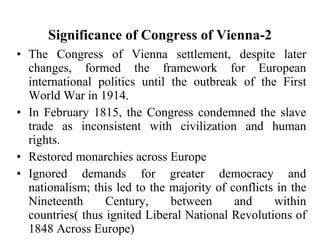
Significance of Congress of Vienna-2 The Congress of Vienna settlement, despite later changes, formed the framework for European international politics until the outbreak of the First World War in 1914. In February 1815, the Congress condemned the slave trade as inconsistent with civilization and human rights. Restored monarchies across Europe Ignored demands for greater democracy and nationalism; this led to the majority of conflicts in the Nineteenth Century, between and within countries( thus ignited Liberal National Revolutions of 1848 Across Europe)
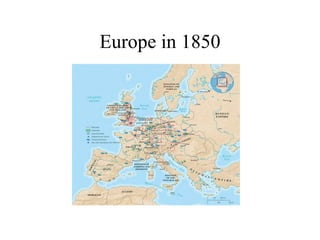
Europe in 1850
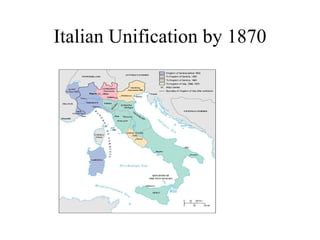
Italian Unification by 1870
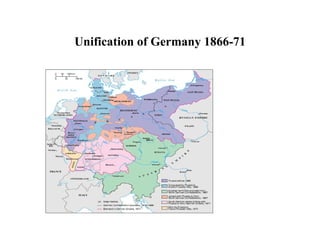
Unification of Germany 1866-71
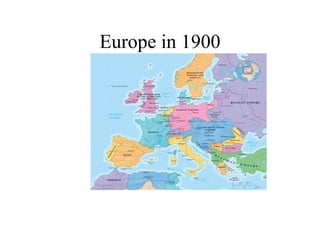
Europe in 1900
From 1815 to 1914 The Russian attempt to expand west words was stopped by Crimea war(1854-56) by Britain and France  Germany became united and started as a new power player in 1870 Italy followed the  immediately  Development of these new powers led to a a search for new balance of power in Europe   Many central American  countries got independence from Spanish control.
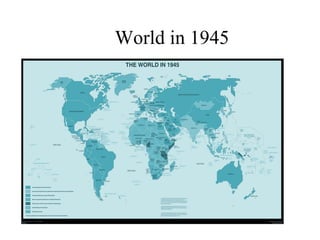
Two world wars and nation states  The first worked war spell the doom of old empires( Ottoman , astro hungarian empire)  and paved way for emergence of many nation states form the empire. Russsia in the form of USSR could still hold many nationalities in  in its fold . Yugoslavia is an exaple for a emergence of new state,   After the second world warie after 1945 war many nations in Africa Asia got independence  thus le to the in thglobe
Essential nature of modern nation sate Territoriality Sense of nationality Sovereignty Equal recognition  in the community of nations Recognition of international law
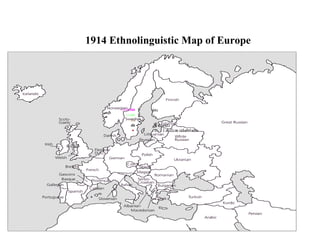
1914 Ethnolinguistic Map of Europe
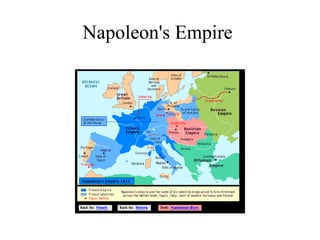
Napoleon's Empire
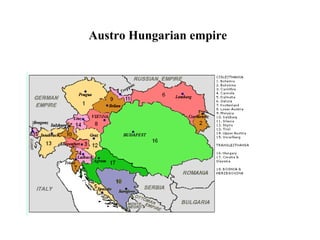
Austro Hungarian empire
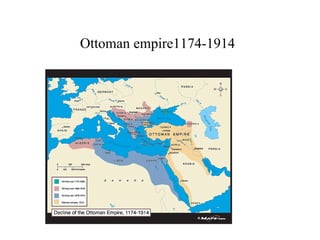
Ottoman empire1174-1914
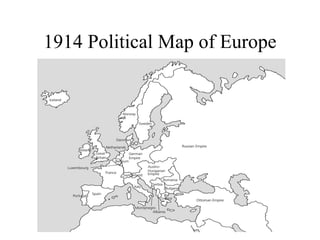
1914 Political Map of Europe
 
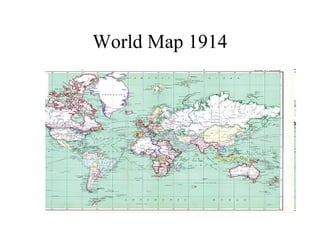
World Map 1914
World in 1945
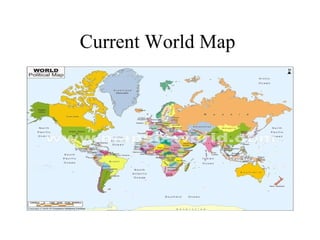
Current World Map

Origin of Nation State

  • 1.
    Origin and Journeyof the Nation State System Mid 16 th century developments in in Europe led to declaim of old controls( of Roman Empire of Church) Search for NEW IDENTITY began and thus came the idea of NATION in to the picture. Portugal, Spain, Britain ,France were the early beginners as Monarchic States ( fre from Holy roman empire)
  • 2.
    The Rise ofMonarchial Nation States: 1500 - 1700
  • 3.
    Prime Characteristics ofthe Nation States Growing Bureaucratization: More and more was the need to have a centralized state. Existence of a Permanent Mercenary Army: Due to the wars, people wanted armies. Growing need to tax: In order to pay for the armies and for the wars, monarchy needed taxes.
  • 4.
    Consequence of raiseof Nation State Balance Power has shifted as each new nation state want to expand its sphere of Influence Search for new territories has started The Ideas of Individualism and reason stated to get impetus. Colonization began to take shape
  • 5.
    Examples of anexpansion :16th Century Spanish Empire
  • 6.
    Phases of Developmentof Nation State Treaty of Westphalia 1648 Utrecht Treaty 1713 Congress of Vienna 1815 First World War 1914-19 Second World War 1939-1945 From 1945 onwords
  • 7.
    Europe During TheTreaty of Westphalia 1648
  • 8.
    Simplified image Europe in 1648 Size of this preview: 800 × 577 pixels
  • 9.
    By the timeof Treaty of Westphalia ( which is in modern day Germany) England, France, Spain and Swedon were great powers Denmark( with Norway) ,Holland, Portugal and Switzerland were small powers Russia was yet to become power full Treaty ended thirty war within the holy roman empire and eighty years rivalry between Spain and Dutch republic
  • 10.
    Consequences of Treatyof Westphalia General recognition of the exclusive sovereignty of each party over its lands, people, and agents abroad, was recognised Gave way to religious freedom: The Kingdoms were free to follow Catholicism, Lutheranism or Calvinism
  • 11.
    Europe in 1713during Utrecht Treaty
  • 12.
    Utrecht Treaty (Utretcht is A Dutch city) Colonial supremacy fights for western hemisphere were on Paved way for alliances and the balance of power as the basis of future of Nation state system Treaties were signed between Spain, France, England ,Dutch republic etc. After this treaty till the French revolution(1789) and Raise of Napoleon Old balance of power continued in Europe
  • 13.
    World between 1700-1763 Colonies
  • 14.
    Europe During Treatyof Vienna 1815
  • 15.
    The principal negotiatorsAt Vienna Congress Austria - Metternich Prussia- Hardenberg and von Humbolt Russia - Nesselrode and Rasoumoffski Great Britain- Castlereagh, and later, Wellington France - Talleyrand and Dalberg
  • 16.
    Significance of Congressof Vienna -1 The objective of the Congress was to settle the many issues arising from the French Revolutionary wars, and the Napoleonic Wars and the dissolution of the Holy Roman Empire The Congress of Vienna was seen as the first f a series of Congresses. Diplomats felt that they should 'stick together' in peacetime to preserve the peace Adopted a fair policy of no great rewards and no great punishments Gave a balanced settlement which ensured no major conflict for forty years (the Crimean War,1854-6) and then until 1914
  • 17.
    Significance of Congressof Vienna-2 The Congress of Vienna settlement, despite later changes, formed the framework for European international politics until the outbreak of the First World War in 1914. In February 1815, the Congress condemned the slave trade as inconsistent with civilization and human rights. Restored monarchies across Europe Ignored demands for greater democracy and nationalism; this led to the majority of conflicts in the Nineteenth Century, between and within countries( thus ignited Liberal National Revolutions of 1848 Across Europe)
  • 18.
  • 19.
  • 20.
  • 21.
  • 22.
    From 1815 to1914 The Russian attempt to expand west words was stopped by Crimea war(1854-56) by Britain and France Germany became united and started as a new power player in 1870 Italy followed the immediately Development of these new powers led to a a search for new balance of power in Europe Many central American countries got independence from Spanish control.
  • 23.
    Two world warsand nation states The first worked war spell the doom of old empires( Ottoman , astro hungarian empire) and paved way for emergence of many nation states form the empire. Russsia in the form of USSR could still hold many nationalities in in its fold . Yugoslavia is an exaple for a emergence of new state, After the second world warie after 1945 war many nations in Africa Asia got independence thus le to the in thglobe
  • 24.
    Essential nature ofmodern nation sate Territoriality Sense of nationality Sovereignty Equal recognition in the community of nations Recognition of international law
  • 25.
  • 26.
  • 27.
  • 28.
  • 29.
  • 30.
  • 31.
  • 32.
  • 33.

Editor's Notes

  • #3  Maps from : http://ap_history_online.tripod.com/apeh5.htm