REALISM
R E A L P O L I T I C S O R P O W E R P O L I T I C S
“ W O R L D P O L I T I C S A S T R U G G L E F O R P O W E R ” H O B B E S
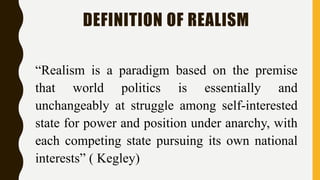
DEFINITION OF REALISM
“Realism is a paradigm based on the premise
that world politics is essentially and
unchangeably at struggle among self-interested
state for power and position under anarchy, with
each competing state pursuing its own national
interests” ( Kegley)
NAMES OF SOME FAMOUS REALIST
SCHOLARS
 Thucydides
 Thomas Hobbes
 Niccolo Machiavelli
 Morgenthau
E. H Carr
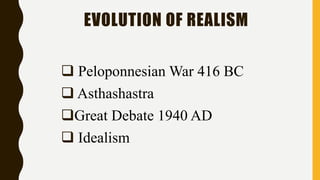
EVOLUTION OF REALISM
 Peloponnesian War 416 BC
 Asthashastra
Great Debate 1940 AD
 Idealism
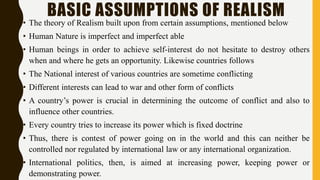
BASIC ASSUMPTIONS OF REALISM
• The theory of Realism built upon from certain assumptions, mentioned below
• Human Nature is imperfect and imperfect able
• Human beings in order to achieve self-interest do not hesitate to destroy others
when and where he gets an opportunity. Likewise countries follows
• The National interest of various countries are sometime conflicting
• Different interests can lead to war and other form of conflicts
• A country’s power is crucial in determining the outcome of conflict and also to
influence other countries.
• Every country tries to increase its power which is fixed doctrine
• Thus, there is contest of power going on in the world and this can neither be
controlled nor regulated by international law or any international organization.
• International politics, then, is aimed at increasing power, keeping power or
demonstrating power.
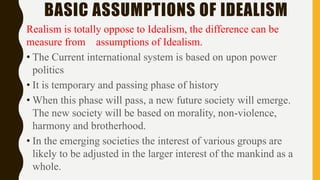
BASIC ASSUMPTIONS OF IDEALISM
Realism is totally oppose to Idealism, the difference can be
measure from assumptions of Idealism.
• The Current international system is based on upon power
politics
• It is temporary and passing phase of history
• When this phase will pass, a new future society will emerge.
The new society will be based on morality, non-violence,
harmony and brotherhood.
• In the emerging societies the interest of various groups are
likely to be adjusted in the larger interest of the mankind as a
whole.
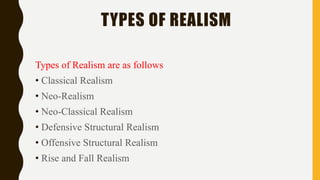
TYPES OF REALISM
Types of Realism are as follows
• Classical Realism
• Neo-Realism
• Neo-Classical Realism
• Defensive Structural Realism
• Offensive Structural Realism
• Rise and Fall Realism
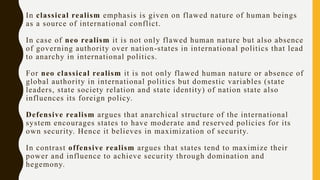
In classical realism emphasis is given on flawed nature of human beings
as a source of international conflict.
In case of neo realism it is not only flawed human nature but also absence
of governing authority over nation-states in international politics that lead
to anarchy in international politics.
For neo classical realism it is not only flawed human nature or absence of
global authority in international politics but domestic variables (state
leaders, state society relation and state identity) of nation state also
influences its foreign policy.
Defensive realism argues that anarchical structure of the international
system encourages states to have moderate and reserved policies for its
own security. Hence it believes in maximization of security.
In contrast offensive realism argues that states tend to maximize their
power and influence to achieve security through domination and
hegemony.
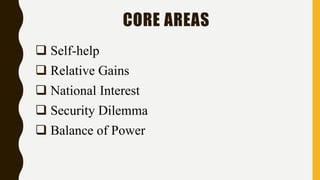
CORE AREAS
 Self-help
 Relative Gains
 National Interest
 Security Dilemma
 Balance of Power

Realism ppt

  • 1.
    REALISM R E AL P O L I T I C S O R P O W E R P O L I T I C S “ W O R L D P O L I T I C S A S T R U G G L E F O R P O W E R ” H O B B E S
  • 2.
    DEFINITION OF REALISM “Realismis a paradigm based on the premise that world politics is essentially and unchangeably at struggle among self-interested state for power and position under anarchy, with each competing state pursuing its own national interests” ( Kegley)
  • 3.
    NAMES OF SOMEFAMOUS REALIST SCHOLARS  Thucydides  Thomas Hobbes  Niccolo Machiavelli  Morgenthau E. H Carr
  • 4.
    EVOLUTION OF REALISM Peloponnesian War 416 BC  Asthashastra Great Debate 1940 AD  Idealism
  • 5.
    BASIC ASSUMPTIONS OFREALISM • The theory of Realism built upon from certain assumptions, mentioned below • Human Nature is imperfect and imperfect able • Human beings in order to achieve self-interest do not hesitate to destroy others when and where he gets an opportunity. Likewise countries follows • The National interest of various countries are sometime conflicting • Different interests can lead to war and other form of conflicts • A country’s power is crucial in determining the outcome of conflict and also to influence other countries. • Every country tries to increase its power which is fixed doctrine • Thus, there is contest of power going on in the world and this can neither be controlled nor regulated by international law or any international organization. • International politics, then, is aimed at increasing power, keeping power or demonstrating power.
  • 6.
    BASIC ASSUMPTIONS OFIDEALISM Realism is totally oppose to Idealism, the difference can be measure from assumptions of Idealism. • The Current international system is based on upon power politics • It is temporary and passing phase of history • When this phase will pass, a new future society will emerge. The new society will be based on morality, non-violence, harmony and brotherhood. • In the emerging societies the interest of various groups are likely to be adjusted in the larger interest of the mankind as a whole.
  • 7.
    TYPES OF REALISM Typesof Realism are as follows • Classical Realism • Neo-Realism • Neo-Classical Realism • Defensive Structural Realism • Offensive Structural Realism • Rise and Fall Realism
  • 8.
    In classical realismemphasis is given on flawed nature of human beings as a source of international conflict. In case of neo realism it is not only flawed human nature but also absence of governing authority over nation-states in international politics that lead to anarchy in international politics. For neo classical realism it is not only flawed human nature or absence of global authority in international politics but domestic variables (state leaders, state society relation and state identity) of nation state also influences its foreign policy. Defensive realism argues that anarchical structure of the international system encourages states to have moderate and reserved policies for its own security. Hence it believes in maximization of security. In contrast offensive realism argues that states tend to maximize their power and influence to achieve security through domination and hegemony.
  • 9.
    CORE AREAS  Self-help Relative Gains  National Interest  Security Dilemma  Balance of Power