Diplomacy
Definition. Functions. Bilateral.
Multilateral.
Diplomacy
• The application of intelligence and tact to the
conduct of relations between the governments of
independent states.
• The process of conducting communications
among states through officially recognized
representatives.
• This communication is continuous, maintained by
foreign ministers and diplomats.
• The most important tool of foreign policy.
Newer Trends in Diplomacy
• Although traditionally diplomacy was states’
concerns, there are newer trends:
1. Diplomacy conducted by non-state actors.
2. The shift of importance from bilateral towards
multilateral diplomacy.
The Origin of Diplomacy
• Associated with the existence of states, esp.,
Greek and Athenian city-states.
• Earlier, diplomats present their case in large
legislative assemblies.
• Then, permanent mission was introduced in the
15th Century.
• The first attempt to recognize a shared definition
of diplomacy was made in the Treaty of Vienna
1815.
Sources of Diplomatic Law
• International customs
• The Vienna Convention on Diplomatic Relations
1961.
Functions of Diplomacy
1. Representing state’s interests.
– Diplomats as spokesperson, channel of
communication.
2. Symbolic representation.
– Ambassador represents the Head of State in the
host state.
– Ambassador is also the personification of his/her
country.
Functions of Diplomacy
3. Obtaining/reporting Information.
– Information about the host state.
– Role of attache.
4. Policymaking
– Ambassadors became policy-makers usually in
multilateral conferences where decisions are to be
reached at the end of the conference.
Functions of Diplomacy
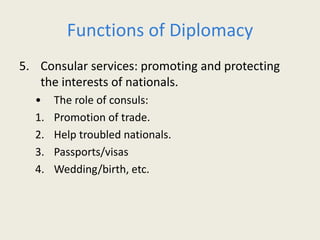
5. Consular services: promoting and protecting
the interests of nationals.
• The role of consuls:
1. Promotion of trade.
2. Help troubled nationals.
3. Passports/visas
4. Wedding/birth, etc.
Legal Aspects of Diplomacy
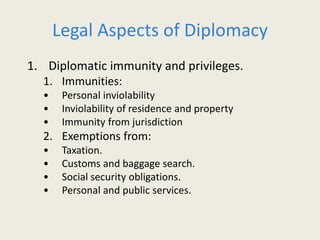
1. Diplomatic immunity and privileges.
1. Immunities:
• Personal inviolability
• Inviolability of residence and property
• Immunity from jurisdiction
2. Exemptions from:
• Taxation.
• Customs and baggage search.
• Social security obligations.
• Personal and public services.
Legal Aspects of Diplomacy
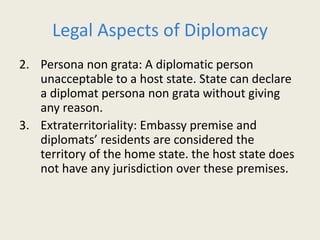
2. Persona non grata: A diplomatic person
unacceptable to a host state. State can declare
a diplomat persona non grata without giving
any reason.
3. Extraterritoriality: Embassy premise and
diplomats’ residents are considered the
territory of the home state. the host state does
not have any jurisdiction over these premises.
Legal Aspects of Diplomacy
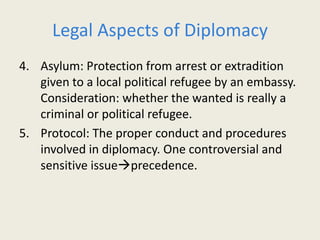
4. Asylum: Protection from arrest or extradition
given to a local political refugee by an embassy.
Consideration: whether the wanted is really a
criminal or political refugee.
5. Protocol: The proper conduct and procedures
involved in diplomacy. One controversial and
sensitive issueprecedence.
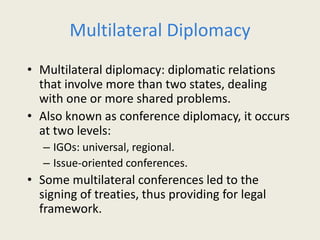
Multilateral Diplomacy
• Multilateral diplomacy: diplomatic relations
that involve more than two states, dealing
with one or more shared problems.
• Also known as conference diplomacy, it occurs
at two levels:
– IGOs: universal, regional.
– Issue-oriented conferences.
• Some multilateral conferences led to the
signing of treaties, thus providing for legal
framework.
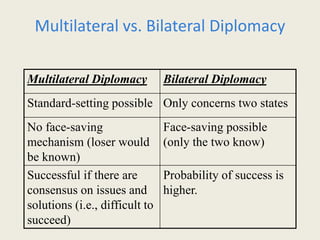
Multilateral vs. Bilateral Diplomacy
Multilateral Diplomacy Bilateral Diplomacy
Standard-setting possible Only concerns two states
No face-saving
mechanism (loser would
be known)
Face-saving possible
(only the two know)
Successful if there are
consensus on issues and
solutions (i.e., difficult to
succeed)
Probability of success is
higher.

C9 - Diplomacy

  • 1.
  • 2.
    Diplomacy • The applicationof intelligence and tact to the conduct of relations between the governments of independent states. • The process of conducting communications among states through officially recognized representatives. • This communication is continuous, maintained by foreign ministers and diplomats. • The most important tool of foreign policy.
  • 3.
    Newer Trends inDiplomacy • Although traditionally diplomacy was states’ concerns, there are newer trends: 1. Diplomacy conducted by non-state actors. 2. The shift of importance from bilateral towards multilateral diplomacy.
  • 4.
    The Origin ofDiplomacy • Associated with the existence of states, esp., Greek and Athenian city-states. • Earlier, diplomats present their case in large legislative assemblies. • Then, permanent mission was introduced in the 15th Century. • The first attempt to recognize a shared definition of diplomacy was made in the Treaty of Vienna 1815.
  • 5.
    Sources of DiplomaticLaw • International customs • The Vienna Convention on Diplomatic Relations 1961.
  • 6.
    Functions of Diplomacy 1.Representing state’s interests. – Diplomats as spokesperson, channel of communication. 2. Symbolic representation. – Ambassador represents the Head of State in the host state. – Ambassador is also the personification of his/her country.
  • 7.
    Functions of Diplomacy 3.Obtaining/reporting Information. – Information about the host state. – Role of attache. 4. Policymaking – Ambassadors became policy-makers usually in multilateral conferences where decisions are to be reached at the end of the conference.
  • 8.
    Functions of Diplomacy 5.Consular services: promoting and protecting the interests of nationals. • The role of consuls: 1. Promotion of trade. 2. Help troubled nationals. 3. Passports/visas 4. Wedding/birth, etc.
  • 9.
    Legal Aspects ofDiplomacy 1. Diplomatic immunity and privileges. 1. Immunities: • Personal inviolability • Inviolability of residence and property • Immunity from jurisdiction 2. Exemptions from: • Taxation. • Customs and baggage search. • Social security obligations. • Personal and public services.
  • 10.
    Legal Aspects ofDiplomacy 2. Persona non grata: A diplomatic person unacceptable to a host state. State can declare a diplomat persona non grata without giving any reason. 3. Extraterritoriality: Embassy premise and diplomats’ residents are considered the territory of the home state. the host state does not have any jurisdiction over these premises.
  • 11.
    Legal Aspects ofDiplomacy 4. Asylum: Protection from arrest or extradition given to a local political refugee by an embassy. Consideration: whether the wanted is really a criminal or political refugee. 5. Protocol: The proper conduct and procedures involved in diplomacy. One controversial and sensitive issueprecedence.
  • 12.
    Multilateral Diplomacy • Multilateraldiplomacy: diplomatic relations that involve more than two states, dealing with one or more shared problems. • Also known as conference diplomacy, it occurs at two levels: – IGOs: universal, regional. – Issue-oriented conferences. • Some multilateral conferences led to the signing of treaties, thus providing for legal framework.
  • 13.
    Multilateral vs. BilateralDiplomacy Multilateral Diplomacy Bilateral Diplomacy Standard-setting possible Only concerns two states No face-saving mechanism (loser would be known) Face-saving possible (only the two know) Successful if there are consensus on issues and solutions (i.e., difficult to succeed) Probability of success is higher.