•Gambella University
Mammalogy Department of Wildlife and Ecotourism by Jibril Kedir (Msc In Biodiversity Conservation and Climate Smart Agriculture)
4/29/2023
1: Introduction to Mammalogy
What does mean by Mammalogy:?
Ӑ. The word mammals derived from Latin, it means breast or teat.
Ӑ . The mammals are the highest group in the animal kingdom.
Ӑ . Young Mammals fed on milk from mammary glands, had modified sweat glands.
Ӑ . They are warm blooded, back boned animals.
4/29/2023 Mammalogy Department of Wildlife and Ecotourism by Jibril Kedir (Msc In Biodiversity Conservation and Climate Smart Agriculture)
: Basic concept of Mammalogy:?
Ӑ Mammalogy is the branch of biology, deals structure, function,
evolutionary history, Ethology, taxonomy and management of mammals.
Ӑ . About 4,200 species of mammal are there, consist of egg-laying
echidnas, platypus, pouched marsupials, tiny shrews, bats, mice, whales
etc, they are hairy, milk producing endothermic animals.
4/29/2023
Mammalogy Department of Wildlife and Ecotourism by Jibril Kedir (Msc In Biodiversity Conservation and Climate Smart
Agriculture)
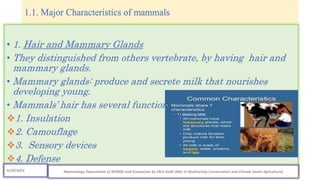
1.1. Major Characteristics of mammals
• 1. Hair and Mammary Glands
• They distinguished from others vertebrate, by having hair and
mammary glands.
• Mammary glands: produce and secrete milk that nourishes
developing young.
• Mammals’ hair has several functions,
1. Insulation
2. Camouflage
3. Sensory devices
4. Defense
Mammalogy Department of Wildlife and Ecotourism by Jibril Kedir (Msc In Biodiversity Conservation and Climate Smart Agriculture)
4/29/2023
Other Characteristics mammals
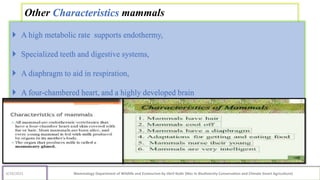
 A high metabolic rate supports endothermy,
 Specialized teeth and digestive systems,
 A diaphragm to aid in respiration,
 A four-chambered heart, and a highly developed brain
Mammalogy Department of Wildlife and Ecotourism by Jibril Kedir (Msc In Biodiversity Conservation and Climate Smart Agriculture)
4/29/2023
1. Endothermy:
 Mammals are endotherms, to mean they produce their body heat internally.
• 2. Four-chambered heart,
 With complete separation of pulmonary and systemic circulation.
• 3. An nucleate Red Blood Cells –
 Provides them more space for hemoglobin and greater capacity for
carrying oxygen.
Other Characteristics mammals
Mammalogy Department of Wildlife and Ecotourism by Jibril Kedir (Msc In Biodiversity Conservation and Climate Smart Agriculture
4/29/2023
Separate sexes
Muscular Diaphragm - used in respiration.
Facial muscles: allows for facial expression and communication.
Expanded cerebral portion of brain (particular portion called dorsal pallium)
Double occipital condyle (the point of articulation between skull and vertebral column).
Mammals have single lower jaw,
Other Characteristics mammals….
Mammalogy Department of Wildlife and Ecotourism by Jibril Kedir (Msc In Biodiversity Conservation and Climate Smart Agriculture)
4/29/2023
Other Characteristics mammals…..
Three auditory ossicles (middle ear).
Teeth with different dental characters.
Diphyodont : two generations of teeth contrasts with monophyodont and polyphyodonty.
Thecodont: – Teeth are rooted in a socket,
Heterodont:-different teeth have different shapes and functions, a opposed to homodont
(seen in some reptiles).
Mammalogy Department of Wildlife and Ecotourism by Jibril Kedir (Msc In Biodiversity Conservation and Climate Smart Agriculture)
4/29/2023
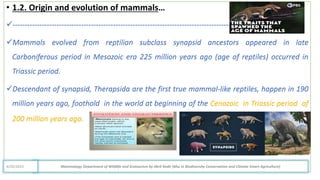
• 1.2. Origin and evolution of mammals…
----------------------------------------------------------------------------------------------
Mammals evolved from reptilian subclass synapsid ancestors appeared in late
Carboniferous period in Mesozoic era 225 million years ago (age of reptiles) occurred in
Triassic period.
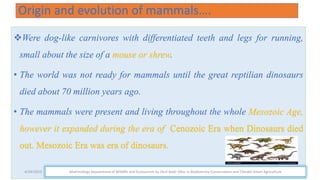
Descendant of synapsid, Therapsida are the first true mammal-like reptiles, happen in 190
million years ago, foothold in the world at beginning of the Cenozoic in Triassic period of
200 million years ago.
Mammalogy Department of Wildlife and Ecotourism by Jibril Kedir (Msc In Biodiversity Conservation and Climate Smart Agriculture)
4/29/2023
Origin and evolution of mammals….
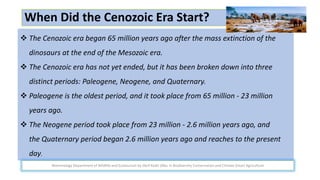
Were dog-like carnivores with differentiated teeth and legs for running,
small about the size of a mouse or shrew.
• The world was not ready for mammals until the great reptilian dinosaurs
died about 70 million years ago.
• The mammals were present and living throughout the whole Mesozoic Age,
however it expanded during the era of Cenozoic Era when Dinosaurs died
out. Mesozoic Era was era of dinosaurs.
Mammalogy Department of Wildlife and Ecotourism by Jibril Kedir (Msc In Biodiversity Conservation and Climate Smart Agriculture
4/29/2023
When Did the Cenozoic Era Start?
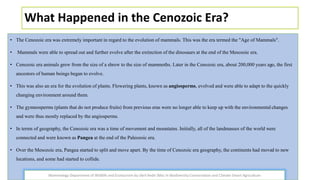
 The Cenozoic era began 65 million years ago after the mass extinction of the
dinosaurs at the end of the Mesozoic era.
 The Cenozoic era has not yet ended, but it has been broken down into three
distinct periods: Paleogene, Neogene, and Quaternary.
 Paleogene is the oldest period, and it took place from 65 million - 23 million
years ago.
 The Neogene period took place from 23 million - 2.6 million years ago, and
the Quaternary period began 2.6 million years ago and reaches to the present
day.
Mammalogy Department of Wildlife and Ecotourism by Jibril Kedir (Msc In Biodiversity Conservation and Climate Smart Agriculture
What Happened in the Cenozoic Era?
• The Cenozoic era was extremely important in regard to the evolution of mammals. This was the era termed the "Age of Mammals".
• Mammals were able to spread out and further evolve after the extinction of the dinosaurs at the end of the Mesozoic era.
• Cenozoic era animals grew from the size of a shrew to the size of mammoths. Later in the Cenozoic era, about 200,000 years ago, the first
ancestors of human beings began to evolve.
• This was also an era for the evolution of plants. Flowering plants, known as angiosperms, evolved and were able to adapt to the quickly
changing environment around them.
• The gymnosperms (plants that do not produce fruits) from previous eras were no longer able to keep up with the environmental changes
and were thus mostly replaced by the angiosperms.
• In terms of geography, the Cenozoic era was a time of movement and mountains. Initially, all of the landmasses of the world were
connected and were known as Pangea at the end of the Paleozoic era.
• Over the Mesozoic era, Pangea started to split and move apart. By the time of Cenozoic era geography, the continents had moved to new
locations, and some had started to collide.
Mammalogy Department of Wildlife and Ecotourism by Jibril Kedir (Msc In Biodiversity Conservation and Climate Smart Agriculture
4/29/2023 Mammalogy Department of Wildlife and Ecotourism by Jibril Kedir (Msc In Biodiversity Conservation and Climate Smart Agriculture
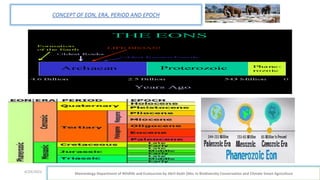
CONCEPT OF EON, ERA, PERIOD AND EPOCH
• How did the mammals manage to co-exist with the
reptiles?
The earliest mammals lived in trees and were nocturnal, searching for food (mainly
insects and plant material and perhaps reptile eggs) at night while the reptiles were
inactive.
Their life style known by large eye characteristics of the present day nocturnal primates.
By bearing their young alive, avoided they avoided hazards of having their eggs consumed
by predators.
By nourishing the young and caring for them, the parents could offer both protection and
an education.
Mammalogy Department of Wildlife and Ecotourism by Jibril Kedir (Msc In Biodiversity Conservation and Climate Smart Agriculture
4/29/2023
When and how did mammals become widely distributed and adapted to a variety
of ecological niches?
As Mammal-like reptiles died out by the end of Triassic, the mammals began to
abandoned territories and ecological niches.
Among them the modern relatives, the duck-billed platypus of Australia and two
species of spiny anteaters or echidans of Australia and New Guinea retain certain
reptilian traits.
These monotreme species lay small leathery eggs, but like all other mammals,
nurse their young with milk after hatching.
Mammalogy Department of Wildlife and Ecotourism by Jibril Kedir (Msc In Biodiversity Conservation and Climate Smart Agriculture
4/29/2023
When and how did mammals become widely distributed and
adapted to a variety of ecological niches?
Near the close of the cretaceous the first known Marsupials and placentals appeared.
Marsupials were at first more numerous and placentals relatively rare.
All these later cretaceous forms were small insectivorous types, as judged by the teeth.
Marsupials and placentals come off independently from different types of pantotheres,
The marsupials probably arising somewhat earlier than the placental mammals.
Mammalogy Department of Wildlife and Ecotourism by Jibril Kedir (Msc In Biodiversity Conservation and Climate Smart Agriculture
4/29/2023
During the Paleocene, the first period of the Cenozoic age, the placental mammals found
the world wide open for exploitation.
During the Eocene, the second period of the Cenozoic all the main orders of mammals
had been established, apparently as offshoots of the ancestral insectivores.
By the end of the cretaceous period, three main groups of mammals.
Today, these are classified in three subclasses: prototheria, Metatheria, and Eutheria.
When and how did mammals become widely distributed and adapted to a variety of ecological
niches?.....
Mammalogy Department of Wildlife and Ecotourism by Jibril Kedir (Msc In Biodiversity Conservation and Climate Smart Agriculture
4/29/2023
When and how did mammals become widely distributed and adapted to a
variety of ecological niches?...
Currently mammals inhabit virtually every corner of the earth-on the
land, in freshwater, salt water, and in air.
They range in size from the tiny pigmy shrew, weighing about 25 grams
to the blue whale, weight more than 90,000kg and is largest animal that
ever lived.
Mammalogy Department of Wildlife and Ecotourism by Jibril Kedir (Msc In Biodiversity Conservation and Climate Smart Agriculture)
4/29/2023
Why is the Cenozoic era Recognized as “the age of mammals”?
• An amazing diversification among mammals as expanded during the 65 ml
years since the Cenozoic era began,
• Increasing sophisticated temperature regulation: Allows the marsupials
and placental to live in a broader range of habitats than the monotremes.
• Increased body size: Within nearly every mammalian order there is a trend
towards larger size, apparently related to heat balance. The larger the
body, the lower the ratio of surface is to body mass.
Mammalogy Department of Wildlife and Ecotourism by Jibril Kedir (Msc In Biodiversity Conservation and Climate Smart Agriculture
4/29/2023
Diversification of tooth shapes: Mammals have evolved a wide variety of tooth shapes
and functions that correlate with food sources.
Wide, flat molars and premolars for grinding grains and grasses or for crushing bones.
Elongation and specialization of limbs: Mammals have developed diversified limb
structures that permit many different locomotory styles and behaviors.
Mammalogy Department of Wildlife and Ecotourism by Jibril Kedir (Msc In Biodiversity Conservation and Climate Smart Agriculture)
4/29/2023
Feeding Specializations in Mammals: The feeding or trophic apparatus
of a mammalian teeth and alimentary canal are adapted to its particular
feeding habit.
Based on their feeding specializations, mammals may be divided into the
three basic trophic (nutritional groups) like Omnivores, carnivores and
herbivores.
Mammalogy Department of Wildlife and Ecotourism by Jibril Kedir (Msc In Biodiversity Conservation and Climate Smart Agriculture
4/29/2023

Presentation Mammalogy-2022.pptx

  • 1.
    •Gambella University Mammalogy Departmentof Wildlife and Ecotourism by Jibril Kedir (Msc In Biodiversity Conservation and Climate Smart Agriculture) 4/29/2023
  • 2.
    1: Introduction toMammalogy What does mean by Mammalogy:? Ӑ. The word mammals derived from Latin, it means breast or teat. Ӑ . The mammals are the highest group in the animal kingdom. Ӑ . Young Mammals fed on milk from mammary glands, had modified sweat glands. Ӑ . They are warm blooded, back boned animals. 4/29/2023 Mammalogy Department of Wildlife and Ecotourism by Jibril Kedir (Msc In Biodiversity Conservation and Climate Smart Agriculture)
  • 3.
    : Basic conceptof Mammalogy:? Ӑ Mammalogy is the branch of biology, deals structure, function, evolutionary history, Ethology, taxonomy and management of mammals. Ӑ . About 4,200 species of mammal are there, consist of egg-laying echidnas, platypus, pouched marsupials, tiny shrews, bats, mice, whales etc, they are hairy, milk producing endothermic animals. 4/29/2023 Mammalogy Department of Wildlife and Ecotourism by Jibril Kedir (Msc In Biodiversity Conservation and Climate Smart Agriculture)
  • 4.
    1.1. Major Characteristicsof mammals • 1. Hair and Mammary Glands • They distinguished from others vertebrate, by having hair and mammary glands. • Mammary glands: produce and secrete milk that nourishes developing young. • Mammals’ hair has several functions, 1. Insulation 2. Camouflage 3. Sensory devices 4. Defense Mammalogy Department of Wildlife and Ecotourism by Jibril Kedir (Msc In Biodiversity Conservation and Climate Smart Agriculture) 4/29/2023
  • 5.
    Other Characteristics mammals A high metabolic rate supports endothermy,  Specialized teeth and digestive systems,  A diaphragm to aid in respiration,  A four-chambered heart, and a highly developed brain Mammalogy Department of Wildlife and Ecotourism by Jibril Kedir (Msc In Biodiversity Conservation and Climate Smart Agriculture) 4/29/2023
  • 6.
    1. Endothermy:  Mammalsare endotherms, to mean they produce their body heat internally. • 2. Four-chambered heart,  With complete separation of pulmonary and systemic circulation. • 3. An nucleate Red Blood Cells –  Provides them more space for hemoglobin and greater capacity for carrying oxygen. Other Characteristics mammals Mammalogy Department of Wildlife and Ecotourism by Jibril Kedir (Msc In Biodiversity Conservation and Climate Smart Agriculture 4/29/2023
  • 7.
    Separate sexes Muscular Diaphragm- used in respiration. Facial muscles: allows for facial expression and communication. Expanded cerebral portion of brain (particular portion called dorsal pallium) Double occipital condyle (the point of articulation between skull and vertebral column). Mammals have single lower jaw, Other Characteristics mammals…. Mammalogy Department of Wildlife and Ecotourism by Jibril Kedir (Msc In Biodiversity Conservation and Climate Smart Agriculture) 4/29/2023
  • 8.
    Other Characteristics mammals….. Threeauditory ossicles (middle ear). Teeth with different dental characters. Diphyodont : two generations of teeth contrasts with monophyodont and polyphyodonty. Thecodont: – Teeth are rooted in a socket, Heterodont:-different teeth have different shapes and functions, a opposed to homodont (seen in some reptiles). Mammalogy Department of Wildlife and Ecotourism by Jibril Kedir (Msc In Biodiversity Conservation and Climate Smart Agriculture) 4/29/2023
  • 9.
    • 1.2. Originand evolution of mammals… ---------------------------------------------------------------------------------------------- Mammals evolved from reptilian subclass synapsid ancestors appeared in late Carboniferous period in Mesozoic era 225 million years ago (age of reptiles) occurred in Triassic period. Descendant of synapsid, Therapsida are the first true mammal-like reptiles, happen in 190 million years ago, foothold in the world at beginning of the Cenozoic in Triassic period of 200 million years ago. Mammalogy Department of Wildlife and Ecotourism by Jibril Kedir (Msc In Biodiversity Conservation and Climate Smart Agriculture) 4/29/2023
  • 10.
    Origin and evolutionof mammals…. Were dog-like carnivores with differentiated teeth and legs for running, small about the size of a mouse or shrew. • The world was not ready for mammals until the great reptilian dinosaurs died about 70 million years ago. • The mammals were present and living throughout the whole Mesozoic Age, however it expanded during the era of Cenozoic Era when Dinosaurs died out. Mesozoic Era was era of dinosaurs. Mammalogy Department of Wildlife and Ecotourism by Jibril Kedir (Msc In Biodiversity Conservation and Climate Smart Agriculture 4/29/2023
  • 11.
    When Did theCenozoic Era Start?  The Cenozoic era began 65 million years ago after the mass extinction of the dinosaurs at the end of the Mesozoic era.  The Cenozoic era has not yet ended, but it has been broken down into three distinct periods: Paleogene, Neogene, and Quaternary.  Paleogene is the oldest period, and it took place from 65 million - 23 million years ago.  The Neogene period took place from 23 million - 2.6 million years ago, and the Quaternary period began 2.6 million years ago and reaches to the present day. Mammalogy Department of Wildlife and Ecotourism by Jibril Kedir (Msc In Biodiversity Conservation and Climate Smart Agriculture
  • 12.
    What Happened inthe Cenozoic Era? • The Cenozoic era was extremely important in regard to the evolution of mammals. This was the era termed the "Age of Mammals". • Mammals were able to spread out and further evolve after the extinction of the dinosaurs at the end of the Mesozoic era. • Cenozoic era animals grew from the size of a shrew to the size of mammoths. Later in the Cenozoic era, about 200,000 years ago, the first ancestors of human beings began to evolve. • This was also an era for the evolution of plants. Flowering plants, known as angiosperms, evolved and were able to adapt to the quickly changing environment around them. • The gymnosperms (plants that do not produce fruits) from previous eras were no longer able to keep up with the environmental changes and were thus mostly replaced by the angiosperms. • In terms of geography, the Cenozoic era was a time of movement and mountains. Initially, all of the landmasses of the world were connected and were known as Pangea at the end of the Paleozoic era. • Over the Mesozoic era, Pangea started to split and move apart. By the time of Cenozoic era geography, the continents had moved to new locations, and some had started to collide. Mammalogy Department of Wildlife and Ecotourism by Jibril Kedir (Msc In Biodiversity Conservation and Climate Smart Agriculture
  • 13.
    4/29/2023 Mammalogy Departmentof Wildlife and Ecotourism by Jibril Kedir (Msc In Biodiversity Conservation and Climate Smart Agriculture CONCEPT OF EON, ERA, PERIOD AND EPOCH
  • 14.
    • How didthe mammals manage to co-exist with the reptiles? The earliest mammals lived in trees and were nocturnal, searching for food (mainly insects and plant material and perhaps reptile eggs) at night while the reptiles were inactive. Their life style known by large eye characteristics of the present day nocturnal primates. By bearing their young alive, avoided they avoided hazards of having their eggs consumed by predators. By nourishing the young and caring for them, the parents could offer both protection and an education. Mammalogy Department of Wildlife and Ecotourism by Jibril Kedir (Msc In Biodiversity Conservation and Climate Smart Agriculture 4/29/2023
  • 15.
    When and howdid mammals become widely distributed and adapted to a variety of ecological niches? As Mammal-like reptiles died out by the end of Triassic, the mammals began to abandoned territories and ecological niches. Among them the modern relatives, the duck-billed platypus of Australia and two species of spiny anteaters or echidans of Australia and New Guinea retain certain reptilian traits. These monotreme species lay small leathery eggs, but like all other mammals, nurse their young with milk after hatching. Mammalogy Department of Wildlife and Ecotourism by Jibril Kedir (Msc In Biodiversity Conservation and Climate Smart Agriculture 4/29/2023
  • 16.
    When and howdid mammals become widely distributed and adapted to a variety of ecological niches? Near the close of the cretaceous the first known Marsupials and placentals appeared. Marsupials were at first more numerous and placentals relatively rare. All these later cretaceous forms were small insectivorous types, as judged by the teeth. Marsupials and placentals come off independently from different types of pantotheres, The marsupials probably arising somewhat earlier than the placental mammals. Mammalogy Department of Wildlife and Ecotourism by Jibril Kedir (Msc In Biodiversity Conservation and Climate Smart Agriculture 4/29/2023
  • 17.
    During the Paleocene,the first period of the Cenozoic age, the placental mammals found the world wide open for exploitation. During the Eocene, the second period of the Cenozoic all the main orders of mammals had been established, apparently as offshoots of the ancestral insectivores. By the end of the cretaceous period, three main groups of mammals. Today, these are classified in three subclasses: prototheria, Metatheria, and Eutheria. When and how did mammals become widely distributed and adapted to a variety of ecological niches?..... Mammalogy Department of Wildlife and Ecotourism by Jibril Kedir (Msc In Biodiversity Conservation and Climate Smart Agriculture 4/29/2023
  • 18.
    When and howdid mammals become widely distributed and adapted to a variety of ecological niches?... Currently mammals inhabit virtually every corner of the earth-on the land, in freshwater, salt water, and in air. They range in size from the tiny pigmy shrew, weighing about 25 grams to the blue whale, weight more than 90,000kg and is largest animal that ever lived. Mammalogy Department of Wildlife and Ecotourism by Jibril Kedir (Msc In Biodiversity Conservation and Climate Smart Agriculture) 4/29/2023
  • 19.
    Why is theCenozoic era Recognized as “the age of mammals”? • An amazing diversification among mammals as expanded during the 65 ml years since the Cenozoic era began, • Increasing sophisticated temperature regulation: Allows the marsupials and placental to live in a broader range of habitats than the monotremes. • Increased body size: Within nearly every mammalian order there is a trend towards larger size, apparently related to heat balance. The larger the body, the lower the ratio of surface is to body mass. Mammalogy Department of Wildlife and Ecotourism by Jibril Kedir (Msc In Biodiversity Conservation and Climate Smart Agriculture 4/29/2023
  • 20.
    Diversification of toothshapes: Mammals have evolved a wide variety of tooth shapes and functions that correlate with food sources. Wide, flat molars and premolars for grinding grains and grasses or for crushing bones. Elongation and specialization of limbs: Mammals have developed diversified limb structures that permit many different locomotory styles and behaviors. Mammalogy Department of Wildlife and Ecotourism by Jibril Kedir (Msc In Biodiversity Conservation and Climate Smart Agriculture) 4/29/2023
  • 21.
    Feeding Specializations inMammals: The feeding or trophic apparatus of a mammalian teeth and alimentary canal are adapted to its particular feeding habit. Based on their feeding specializations, mammals may be divided into the three basic trophic (nutritional groups) like Omnivores, carnivores and herbivores. Mammalogy Department of Wildlife and Ecotourism by Jibril Kedir (Msc In Biodiversity Conservation and Climate Smart Agriculture 4/29/2023