Dr. Minal Bhandari
 Once a plan has been created, a manager needs
to begin with organize the required structure to
achieve a predetermined goal of organization.
 Organizing involves assigning tasks, grouping
tasks into departments, delegating authority,
and allocating resources across the
organization.
 In organizing process, managers coordinate
employees, resources, policies, and procedures
to facilitate the goals identified in the plan.
 The function includes to arrange, to direct, to
coordinate and to control the activities.
Koontz and O ‘Donnell:
“Organizing is the establishment of authority
relationships with provisions for co-ordination
between them, both vertically and horizontally in
the enterprise structure”.
Louis A. Allen:
“Organizing is the process of identifying and
grouping the work to be performed, defining and
delegating the responsibility and authority and
establishing a pattern of relationship for the
purpose of enabling people work most effectively
to accomplish the objective”.
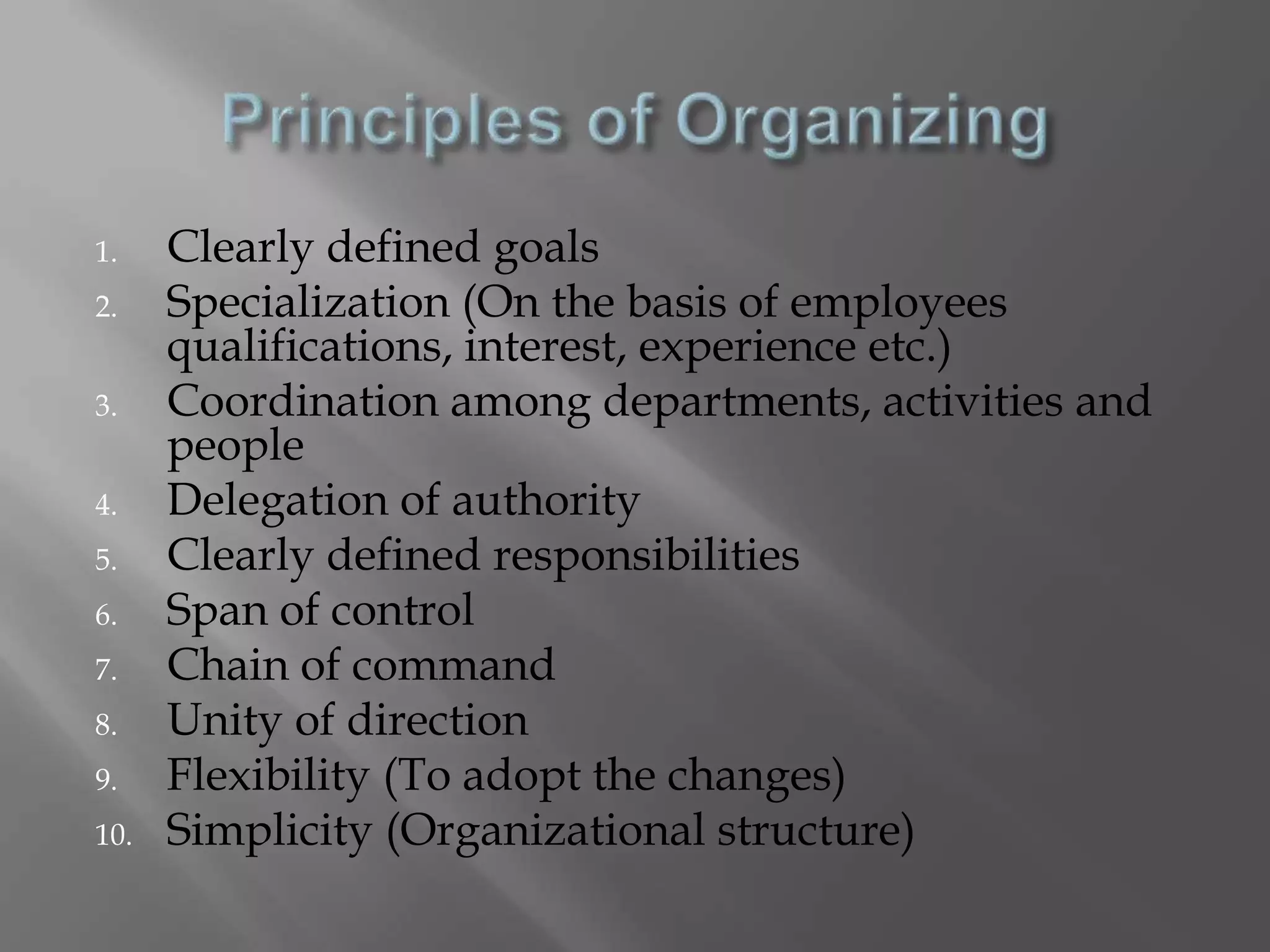
1. Clearly defined goals
2. Specialization (On the basis of employees
qualifications, interest, experience etc.)
3. Coordination among departments, activities and
people
4. Delegation of authority
5. Clearly defined responsibilities
6. Span of control
7. Chain of command
8. Unity of direction
9. Flexibility (To adopt the changes)
10. Simplicity (Organizational structure)
Determining the objectives of the organization
Identifying the activities to be done
Grouping the similar activities
Determining responbilities of each employee
Delegating authority to employees
Fixing authority relationship
Giving all required resources to employees
Coordinating efforts of all to achieve the goals.
Authority: The power or right to give orders,
make decisions, and enforce obedience. It can
be delegated by a senior to his subordinate. It
Responsibility: The state or fact of having a
duty to deal with something or of having
control over someone.
 Definition:
 Koontz and O’ Donnell state that, “The entire
process of delegation involves the determination of
results expected, the assignment of tasks, the
delegation of authority for accomplishment of these
tasks and the exaction of responsibility for their
accomplishment.”
 Management is the art of getting things done
through others which is possible if they delegate the
authority and responsibility.
 Allen puts it very aptly, “How well a manager
delegates determines how well he can manage.”
• A continuous process of delegating the
authority.
• Delegation of authority and responsibility and
not of accountability.
• Delegation of authority can be processed
through written or verbal communication.
• It is an art or skill. (Right person-authority)
• It leads to smooth functioning of organizational
activity.
A. On the part of Management:
1. Less confidence on capability of subordinates
2. Less confidence on self abilities vs over
confidence
3. Fear of loosing control on others
4. Lack of good coordination
5. “I can do Best only” approach of management.
B. On the part of the subordinates:
1. Incompetency in acceptance of authorities
2. Lack of motivation and incentives
3. Fear of criticism
4. Lack of essential information and resources
5. No confidence on self decision making ability
6. Fear of responsibility
7. Pressure or work
Introduction
Definitions
Need and importance
Staffing is the managerial function of
recruitment, selection, training, developing,
promotion and compensation of personnel.
Staffing may be defined as the process of
hiring and developing the required personnel
to fill in the various positions in the
organization.
 According to Koontz and O’Donnell, “The
managerial function of staffing involves
manning the organizational structure through
proper and effective selection, appraisal and
development of personnel to fill the roles
designed into the structure”
 Staffing is a managerial function which involves
obtaining, utilizing and retaining, qualified and
competent personnel to fill all positions of an
organization, from top to operative echelon. In
finer terms, staffing is placing the right person
at the right job.
 It aims at employing, deploying and
monitoring a competent and contented staff,
i.e. daily wage earners, contract employees,
consultants, regular employees, etc., to
undertake various managerial and non-
managerial activities in an organization.
 To obtain qualified personnel for different jobs
position in the organization.
 To focus on maximum productivity and
higher performance.
 To promote the optimum utilization of HRs
 To increase Job satisfaction and morale of the
workers.
 To ensure better utilization of human
resources.
 To ensure the continuity and growth of the
organization, through development managers.
 Efficient performance of other functions
 Effective use of technology and other resources
 Optimum utilization of human resources
 Increase in efficiency
 Development of human capital
 The motivation of human resources
 Building higher morale
 Facilitates control
 Once a determination of staffing has been
made, the process of recruitment begins.
Recruitment involves the process of searching
and attracting potential employees to the
organization.
 In other words, it involves seeking and
attracting qualified candidates from a wide
variety of internal and external sources for job
vacancies.
“Recruitment as process of searching for
prospective employees and stimulating them to
apply for jobs in the organization.” — Edwin B.
Flippo
 “Recruitment is the development and
maintenance of adequate manpower resources.
It involves the creation of a pool of available
labour force upon whom the organization can
draw when it needs additional employees.” —
Dale S. Beach
1. Direct Method
2. Indirect Method
3. Third Party Method
1. Present Employees
2. Former Employees
3. Referrals
4. Data bank of previous applications
 1. Familiarity
 2. Less need of induction, orientation and
training
 3. Economical as no need to do advertisement
 4. Reliable and suitable
 5. Motivational value is more
 6. Opportunity to existing talent
 7. Less risky mode of selection
1. Limited choice for selection
2. Inefficiency (if every one gets promotion as per
the experience not as per the performance)
3. Conflicts (in case of chance to outsiders)
4. Recruitment can not be done only through
internal sources of recruitment
5. Not useful for suitable organization
6. Transfers may hit productivity
7. Stops the entry of Young Blood
8. Encourages favoritism and nepotism
 Campus
 Advertisements
 Employment Exchange
 Consultancies/Contractors
 Labor Unions
 Factory Gates
 E-recruitment
1. Wider choice for selection
2. Infusion of new thinking
3. Competitive spirit
4. Complete source of recruitment
5. Motivation for best performance
6. Long-term benefits
7. Qualified personnel
8. Less chances of favoritism
1. Expensive
2. Time consuming
3. Uncertainty
4. High rate of attrition
5. Negative affect on existing employees
6. High cost of induction, training, orientation
Thank you

Organizing and Staffing

  • 1.
  • 2.
     Once aplan has been created, a manager needs to begin with organize the required structure to achieve a predetermined goal of organization.  Organizing involves assigning tasks, grouping tasks into departments, delegating authority, and allocating resources across the organization.  In organizing process, managers coordinate employees, resources, policies, and procedures to facilitate the goals identified in the plan.  The function includes to arrange, to direct, to coordinate and to control the activities.
  • 3.
    Koontz and O‘Donnell: “Organizing is the establishment of authority relationships with provisions for co-ordination between them, both vertically and horizontally in the enterprise structure”. Louis A. Allen: “Organizing is the process of identifying and grouping the work to be performed, defining and delegating the responsibility and authority and establishing a pattern of relationship for the purpose of enabling people work most effectively to accomplish the objective”.
  • 4.
    1. Clearly definedgoals 2. Specialization (On the basis of employees qualifications, interest, experience etc.) 3. Coordination among departments, activities and people 4. Delegation of authority 5. Clearly defined responsibilities 6. Span of control 7. Chain of command 8. Unity of direction 9. Flexibility (To adopt the changes) 10. Simplicity (Organizational structure)
  • 5.
    Determining the objectivesof the organization Identifying the activities to be done Grouping the similar activities Determining responbilities of each employee Delegating authority to employees Fixing authority relationship Giving all required resources to employees Coordinating efforts of all to achieve the goals.
  • 6.
    Authority: The poweror right to give orders, make decisions, and enforce obedience. It can be delegated by a senior to his subordinate. It Responsibility: The state or fact of having a duty to deal with something or of having control over someone.
  • 8.
     Definition:  Koontzand O’ Donnell state that, “The entire process of delegation involves the determination of results expected, the assignment of tasks, the delegation of authority for accomplishment of these tasks and the exaction of responsibility for their accomplishment.”  Management is the art of getting things done through others which is possible if they delegate the authority and responsibility.  Allen puts it very aptly, “How well a manager delegates determines how well he can manage.”
  • 9.
    • A continuousprocess of delegating the authority. • Delegation of authority and responsibility and not of accountability. • Delegation of authority can be processed through written or verbal communication. • It is an art or skill. (Right person-authority) • It leads to smooth functioning of organizational activity.
  • 10.
    A. On thepart of Management: 1. Less confidence on capability of subordinates 2. Less confidence on self abilities vs over confidence 3. Fear of loosing control on others 4. Lack of good coordination 5. “I can do Best only” approach of management.
  • 11.
    B. On thepart of the subordinates: 1. Incompetency in acceptance of authorities 2. Lack of motivation and incentives 3. Fear of criticism 4. Lack of essential information and resources 5. No confidence on self decision making ability 6. Fear of responsibility 7. Pressure or work
  • 12.
  • 13.
    Staffing is themanagerial function of recruitment, selection, training, developing, promotion and compensation of personnel. Staffing may be defined as the process of hiring and developing the required personnel to fill in the various positions in the organization.
  • 14.
     According toKoontz and O’Donnell, “The managerial function of staffing involves manning the organizational structure through proper and effective selection, appraisal and development of personnel to fill the roles designed into the structure”  Staffing is a managerial function which involves obtaining, utilizing and retaining, qualified and competent personnel to fill all positions of an organization, from top to operative echelon. In finer terms, staffing is placing the right person at the right job.
  • 15.
     It aimsat employing, deploying and monitoring a competent and contented staff, i.e. daily wage earners, contract employees, consultants, regular employees, etc., to undertake various managerial and non- managerial activities in an organization.
  • 16.
     To obtainqualified personnel for different jobs position in the organization.  To focus on maximum productivity and higher performance.  To promote the optimum utilization of HRs  To increase Job satisfaction and morale of the workers.  To ensure better utilization of human resources.  To ensure the continuity and growth of the organization, through development managers.
  • 17.
     Efficient performanceof other functions  Effective use of technology and other resources  Optimum utilization of human resources  Increase in efficiency  Development of human capital  The motivation of human resources  Building higher morale  Facilitates control
  • 18.
     Once adetermination of staffing has been made, the process of recruitment begins. Recruitment involves the process of searching and attracting potential employees to the organization.  In other words, it involves seeking and attracting qualified candidates from a wide variety of internal and external sources for job vacancies.
  • 19.
    “Recruitment as processof searching for prospective employees and stimulating them to apply for jobs in the organization.” — Edwin B. Flippo  “Recruitment is the development and maintenance of adequate manpower resources. It involves the creation of a pool of available labour force upon whom the organization can draw when it needs additional employees.” — Dale S. Beach
  • 20.
    1. Direct Method 2.Indirect Method 3. Third Party Method
  • 21.
    1. Present Employees 2.Former Employees 3. Referrals 4. Data bank of previous applications
  • 22.
     1. Familiarity 2. Less need of induction, orientation and training  3. Economical as no need to do advertisement  4. Reliable and suitable  5. Motivational value is more  6. Opportunity to existing talent  7. Less risky mode of selection
  • 23.
    1. Limited choicefor selection 2. Inefficiency (if every one gets promotion as per the experience not as per the performance) 3. Conflicts (in case of chance to outsiders) 4. Recruitment can not be done only through internal sources of recruitment 5. Not useful for suitable organization 6. Transfers may hit productivity 7. Stops the entry of Young Blood 8. Encourages favoritism and nepotism
  • 24.
     Campus  Advertisements Employment Exchange  Consultancies/Contractors  Labor Unions  Factory Gates  E-recruitment
  • 25.
    1. Wider choicefor selection 2. Infusion of new thinking 3. Competitive spirit 4. Complete source of recruitment 5. Motivation for best performance 6. Long-term benefits 7. Qualified personnel 8. Less chances of favoritism
  • 26.
    1. Expensive 2. Timeconsuming 3. Uncertainty 4. High rate of attrition 5. Negative affect on existing employees 6. High cost of induction, training, orientation
  • 27.