PRESENTATION ON ELEMENTS OF
MANAGEMENT
Presented By
1. Anit
2. Diwakar
3. Jitendra
4. Mausam
5. Ujjwal
ELEMENTS OF MANAGEMENT
• Elements of management includes all managerial activities from
setting objectives to taking essential steps to achieve organizational
goals
• These functions are essential to create a better working environment
• The major functions of management are as follows:
A. Planning
B. Organizing
C. Staffing
D. Directing
E. Controlling
PLANNING
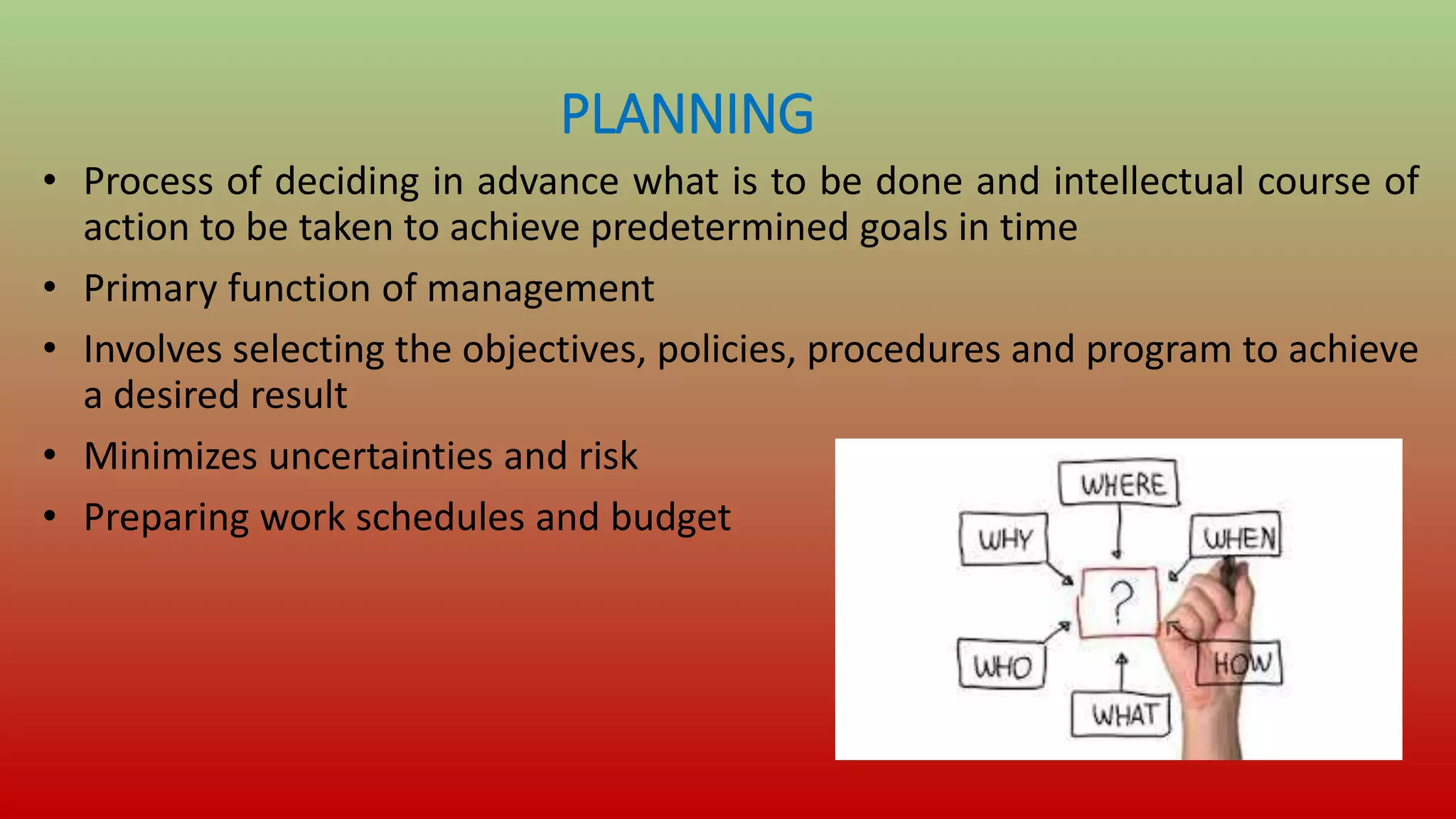
• Process of deciding in advance what is to be done and intellectual course of
action to be taken to achieve predetermined goals in time
• Primary function of management
• Involves selecting the objectives, policies, procedures and program to achieve
a desired result
• Minimizes uncertainties and risk
• Preparing work schedules and budget
ORGANIZING
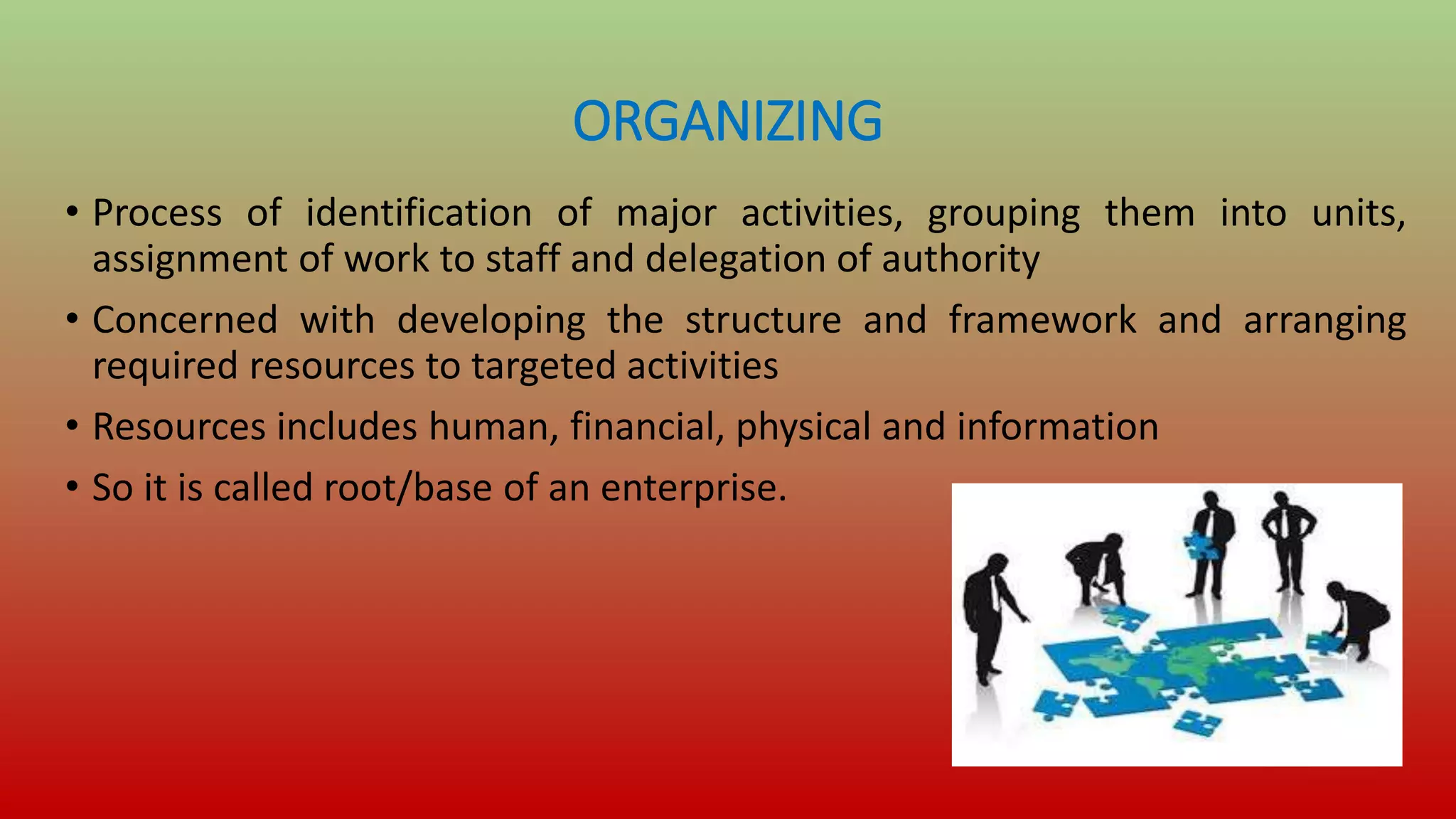
• Process of identification of major activities, grouping them into units,
assignment of work to staff and delegation of authority
• Concerned with developing the structure and framework and arranging
required resources to targeted activities
• Resources includes human, financial, physical and information
• So it is called root/base of an enterprise.
STAFFING
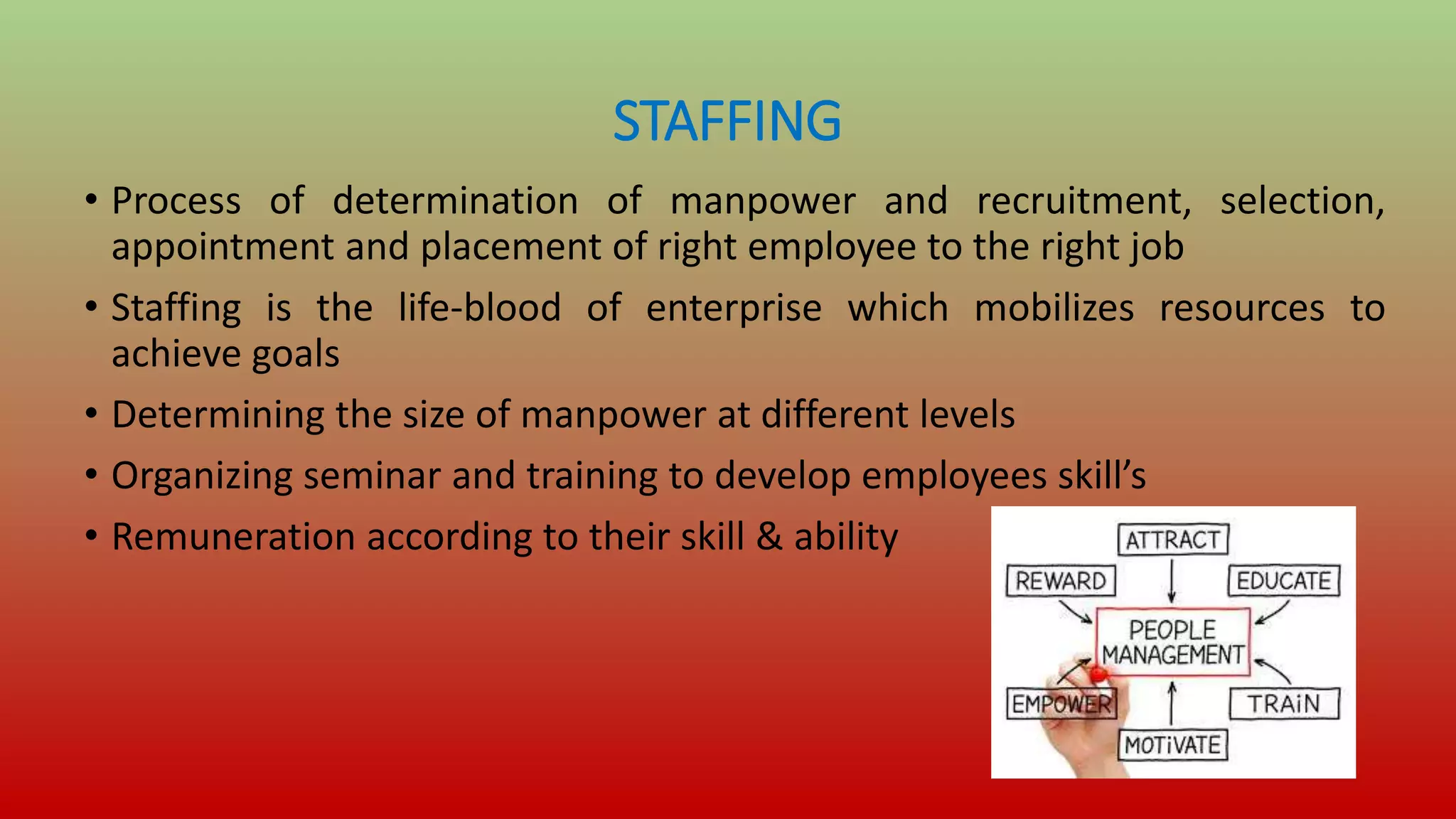
• Process of determination of manpower and recruitment, selection,
appointment and placement of right employee to the right job
• Staffing is the life-blood of enterprise which mobilizes resources to
achieve goals
• Determining the size of manpower at different levels
• Organizing seminar and training to develop employees skill’s
• Remuneration according to their skill & ability
DIRECTING
• Complex function that includes all those activities which are designed to
encourage a subordinate to work effectively and efficiently
• It is instrument to develop a better working environment in organization
• The direction function of management includes:
1. Supervision - Refers to the direct and immediate guidance at assigned works which is
continuous
2. Motivation – process of simulating subordinates to achieve predetermined goals, based on need
and human behavior, motivate through financial and non-financial support
3. Leadership – Ability to persuade others to work willingly to achieve desired goal, a person is said
to be a leader when he is able to guide, give suggestion which are accepted by employees, then
a manager is said to be leader of the organization
4. Communication – Process of exchanging ideas and information from one to another, it is
effective when message is clear, is essential in every successful operation, important on various
management levels
5. Coordination – Process of integrating all the units and departments of an organization to
achieve desired goals, different departments and people perform different functions, but
activities of departments are interrelated , necessary to bring uniformity in action to achieve
organizational goals.
CONTROLLING
• Process of comparing actual performance achieved with that of planned
performance and taking corrective action if any problem is there in actual
performance so that defined goals can be achieved in defined time
• It is main instrument with which uniformity in action is less maintained
• Thus, it is necessary to have a good controlling system for achieving results
according to the plan.
THANK YOU

Elements of Management

  • 1.
    PRESENTATION ON ELEMENTSOF MANAGEMENT Presented By 1. Anit 2. Diwakar 3. Jitendra 4. Mausam 5. Ujjwal
  • 2.
    ELEMENTS OF MANAGEMENT •Elements of management includes all managerial activities from setting objectives to taking essential steps to achieve organizational goals • These functions are essential to create a better working environment • The major functions of management are as follows: A. Planning B. Organizing C. Staffing D. Directing E. Controlling
  • 3.
    PLANNING • Process ofdeciding in advance what is to be done and intellectual course of action to be taken to achieve predetermined goals in time • Primary function of management • Involves selecting the objectives, policies, procedures and program to achieve a desired result • Minimizes uncertainties and risk • Preparing work schedules and budget
  • 4.
    ORGANIZING • Process ofidentification of major activities, grouping them into units, assignment of work to staff and delegation of authority • Concerned with developing the structure and framework and arranging required resources to targeted activities • Resources includes human, financial, physical and information • So it is called root/base of an enterprise.
  • 5.
    STAFFING • Process ofdetermination of manpower and recruitment, selection, appointment and placement of right employee to the right job • Staffing is the life-blood of enterprise which mobilizes resources to achieve goals • Determining the size of manpower at different levels • Organizing seminar and training to develop employees skill’s • Remuneration according to their skill & ability
  • 6.
    DIRECTING • Complex functionthat includes all those activities which are designed to encourage a subordinate to work effectively and efficiently • It is instrument to develop a better working environment in organization • The direction function of management includes: 1. Supervision - Refers to the direct and immediate guidance at assigned works which is continuous 2. Motivation – process of simulating subordinates to achieve predetermined goals, based on need and human behavior, motivate through financial and non-financial support 3. Leadership – Ability to persuade others to work willingly to achieve desired goal, a person is said to be a leader when he is able to guide, give suggestion which are accepted by employees, then a manager is said to be leader of the organization 4. Communication – Process of exchanging ideas and information from one to another, it is effective when message is clear, is essential in every successful operation, important on various management levels 5. Coordination – Process of integrating all the units and departments of an organization to achieve desired goals, different departments and people perform different functions, but activities of departments are interrelated , necessary to bring uniformity in action to achieve organizational goals.
  • 7.
    CONTROLLING • Process ofcomparing actual performance achieved with that of planned performance and taking corrective action if any problem is there in actual performance so that defined goals can be achieved in defined time • It is main instrument with which uniformity in action is less maintained • Thus, it is necessary to have a good controlling system for achieving results according to the plan.
  • 8.