STAFFING
Staffing is the process of hiring eligible candidates in
the organization or company for specific positions. In management, the
meaning of staffing is an operation of recruiting the employees by evaluating
their skills, and knowledge and then offering them specific job roles accordingly.
Staffing is concerned with manning various positions in the organization. Staffing
involves the determination of manpower requirements of the enterprise and
providing it with adequate competent people at all levels. Thus, manpower
planning, procurement (i.e., selection and placement), training and
development, appraisal, and remuneration of workers are included in staffing.
DEFINITION
According to Koontz and O’Donnell, “The managerial function of staffing involves
managing the organization structure through proper and effective selection,
appraisal and development of personnel to fill the roles designed into the
structure.”
S. Benjamin has defined staffing as – “The process involved in identifying,
assessing, placing, evaluating and directing individuals at work.”
According to Theo Hainmann, “Staffing function is concerned with the
placement, growth, and development of all those members of the organization
whose function is to get things done through the efforts of other individuals.”
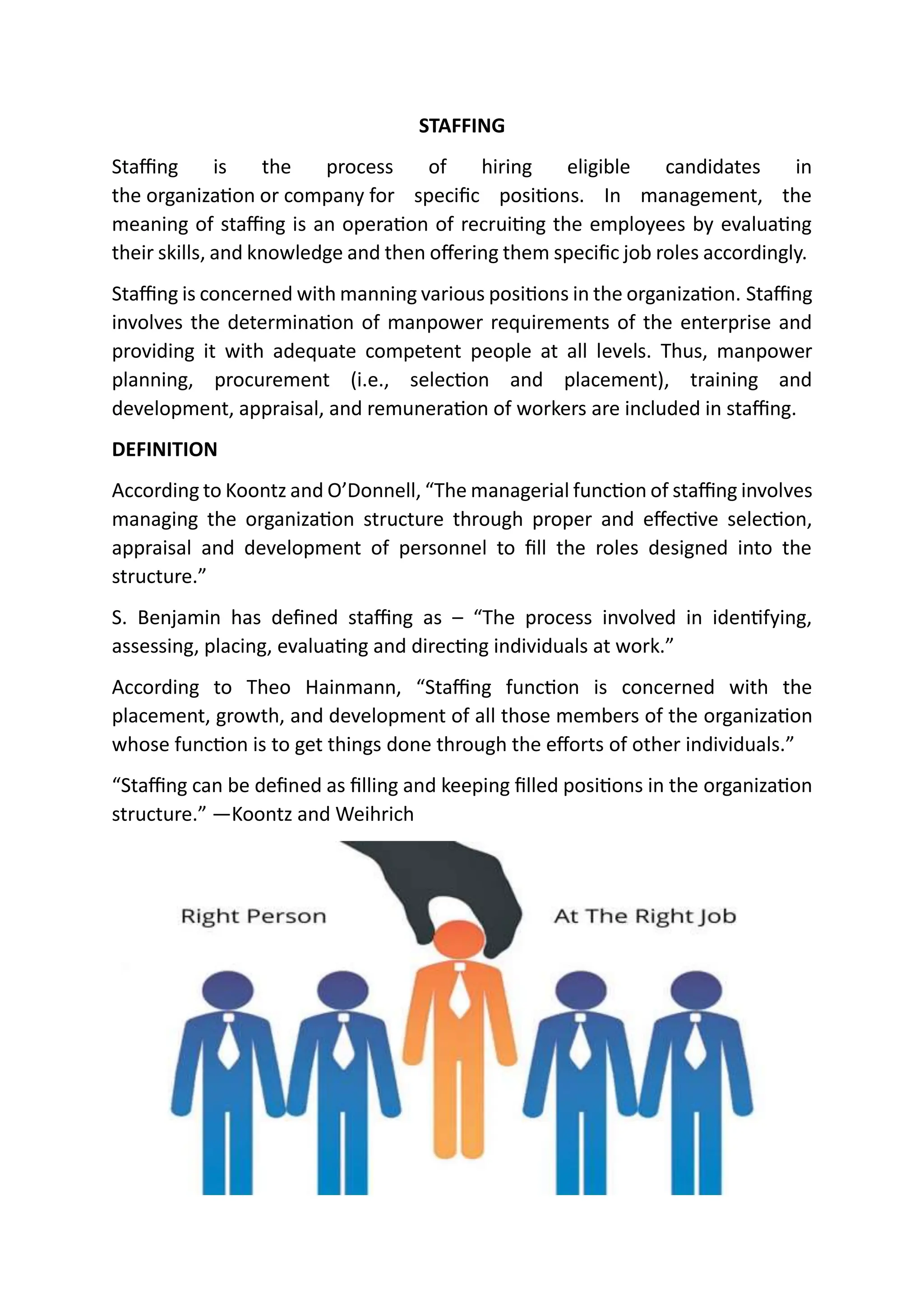
“Staffing can be defined as filling and keeping filled positions in the organization
structure.” —Koontz and Weihrich
ASPECTS OR COMPONENTS OF STAFFING
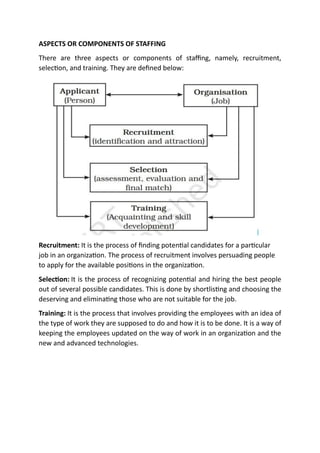
There are three aspects or components of staffing, namely, recruitment,
selection, and training. They are defined below:
Recruitment: It is the process of finding potential candidates for a particular
job in an organization. The process of recruitment involves persuading people
to apply for the available positions in the organization.
Selection: It is the process of recognizing potential and hiring the best people
out of several possible candidates. This is done by shortlisting and choosing the
deserving and eliminating those who are not suitable for the job.
Training: It is the process that involves providing the employees with an idea of
the type of work they are supposed to do and how it is to be done. It is a way of
keeping the employees updated on the way of work in an organization and the
new and advanced technologies.
FEATURES OF STAFFING
The following are the features of staffing:
 Staffing is an integral part of management: Staffing is an integral part of
management because an organization cannot exist without human
resources.
 Pervasive: It is pervasive because staffing is performed by all managers at
all levels and in every department.
 Continuous Process: Staffing is a continuous process because it continues
throughout the life of the organization. It is required to meet the growing
needs of an organization.
 Deals with a human being: Staffing deals with people because it is
concerned with the people at work and their relationships.
 Wide scope: Staffing has a wide scope because it includes a series of
activities, like workforce planning, recruitment, selection, and training.
 Multiple objective activity: It is a multiple objective activity because it has
to fulfill its responsibility towards the organization, employees, and
society.
IMPORTANCE OF STAFFING
The following are the importance of staffing:
 Filling job with competent personnel: Staffing involves with proper
arrangement of people through the proper recruitment and selection
process. It helps with obtaining competent staff for various jobs.
 Better performance: The performance of an organization depends on the
quality of persons employed in the organization. The function of staffing
is significant because it ensures higher performance by putting the right
person in the right job at the right time.
 Survival and growth: Staffing is a very important function of management
compared to other functions because all the functions of an organization
are performed by the people. Competent and efficient workers bring an
organization into existence and ensure its survival and growth.
 Optimum utilization of human resources: The staffing process helps to
ensure optimum use of human resources by avoiding overstaffing. It
prevents the underutilization of personnel and higher labor costs. It also
helps in avoiding disruption of work by indicating in advance the shortage
of personnel.
 Improve job satisfaction and morale: Proper staffing improves job
satisfaction and morale of employees through objective assessment and
fair reward for their contribution. It provides the right kind of work
atmosphere and culture to employees.
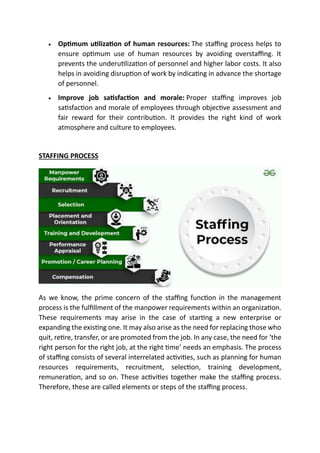
STAFFING PROCESS
As we know, the prime concern of the staffing function in the management
process is the fulfillment of the manpower requirements within an organization.
These requirements may arise in the case of starting a new enterprise or
expanding the existing one. It may also arise as the need for replacing those who
quit, retire, transfer, or are promoted from the job. In any case, the need for ‘the
right person for the right job, at the right time’ needs an emphasis. The process
of staffing consists of several interrelated activities, such as planning for human
resources requirements, recruitment, selection, training development,
remuneration, and so on. These activities together make the staffing process.
Therefore, these are called elements or steps of the staffing process.
 Manpower Planning: Human resource management is a process of
determining the number and type of personnel required to fill the vacant
job in an organization. Manpower requirements involve two kinds of
analysis, i.e., workload analysis and workforce analysis. Workload analysis
involves determining the number and type of employees required to
perform various jobs and achieve organizational objectives. Workforce
analysis shows the number and type of human resources available within
an organization.
The difference between workload and workforce is calculated to
determine the shortage and surplus of manpower. Excess workload
indicates understaffing, i.e., the need to appoint more people and excess
workforce indicates overstaffing, i.e., the need to remove or transfer some
employees to other places.
 Recruitment: After estimating manpower requirements, the second step
in the staffing process is recruitment. Recruitment refers to a process of
searching for prospective employees and encouraging them to apply for
jobs in the organization. It involves identifying various resources of human
force and attracting them to apply for the job. The main purpose of a
requirement is to create a pool of applicants with a large number of
qualified candidates. Recruitment can be done by both internal and
external sources of recruitment. Internal sources may be used to a limited
extent, and to get fresh talent and a wider choice, external sources can be
used.
 Selection: Selection is the process of choosing and appointing the right
candidates for various job positions in the organization. It is treated as a
negative process because it involves the rejection of some candidates.
There are many steps involved in the process of employee selection. These
steps include preliminary screening, filling in applications, written tests,
interviews, medical examination, checking references, and issuing a letter
of appointment to the candidates. The most suitable candidates who
meet the requirements of the vacant job are selected. The process of
selection serves two important purposes, firstly, it ensures that the
organization gets the best among the available candidates, and secondly,
it boosts the self-esteem and prestige of the candidates.
 Placement and Orientation: After selection, an appropriate job is
assigned to each selected person. Placement is the process of matching
the candidates with the jobs in the organization. Under this process, every
selected candidate is assigned a job most suitable for him. The purpose of
placement is to fit the right person to the right job so that the efficiency
of work is high and the employees get personal satisfaction. Correct
placement helps to reduce labor turnover and absenteeism. Here,
orientation means introducing new employees to the organization. It is
the process of introducing and familiarizing newly appointed candidates
with their jobs, work groups, and the organization so that they may feel at
home in the new environment.
 Training and Development: People are in search of careers and not jobs.
Every individual must be given a chance to rise to the top. The most
favorable way for this to happen is to promote employee learning. For this,
organizations either provide training themselves within the organization
or through external institutions. This is beneficial for the organization as
well. If the employees are motivated enough, it will increase their
competence, and will be able to perform even better for the organization
with greater efficiency and productivity. By providing such opportunities
to its employees for career advancement, the organization captivates the
interest and holds on of its talented employees. The majority of the
organization has a distinct department for this purpose, that is, the Human
Resources Department. However, in small organizations, the line manager
has to do all the managerial functions viz, planning, organizing, staffing,
controlling, and directing. The process of staffing further involves three
more stages.
 Performance appraisal: After training the employees and having them on
the job for some time, there should be an evaluation done on their
performance. Every organization has its means of appraisal whether
formal or informal. Appraisal refers to the evaluation of the employees of
the organization based on their past or present performance by some pre-
decided standards. The employee should be well aware of his standards
and his superior is responsible for providing feedback on his performance.
The process of performance appraisal, thus includes specifying the job,
performing appraisal performance, and providing feedback.
 Promotion and Career planning: It has now become important for all
organizations to deal with career-related issues and promotional routes
for employees. The managers should take care of the activities that serve
the long-term interests of the employees. They should be encouraged
from time to time, which will help the employees to grow and find their
true potential. Promotions are an essential part of any employee’s career.
Promotion refers to transferring employees from their current positions
to a higher level, increasing their responsibilities, authority, and pay.
 Compensation: Every organization needs to set up plans for the salary and
wages of the employees. There are several ways to develop payment plans
for the employees depending upon the significance of the job. The worth
of the job needs to be decided. Therefore, all kinds of payments or
rewards provided to the employees are referred to as compensation. The
compensation may be in direct financial payments, such as salary, wages,
bonuses, etc., or indirect payments like insurance or vacations provided to
the employee.
MANPOWER PLANNING
Manpower planning, also known as human resource planning, manpower
management, or workforce planning, is a crucial aspect of human resource
management that enables organizations to effectively plan and allocate their
workforce requirements.
Manpower planning deals with coordinating, motivating, and controlling the
various activities within the organization.
It is no doubt, planning is the most essential factor for every organisation.
Without planning, no organization can fulfill its goals. Generally, Human
Resource planning is also called manpower planning.
Manpower Planning is the development of strategies to match the supply of
manpower to the availability of jobs at the organizational, regional, or national
level.
Manpower planning involves reviewing current manpower resources,
forecasting future requirements and availability, and taking steps to ensure that
the supply of people and skills meets demand.
In the words of Stainer, “Manpower planning is the strategy for the acquisition,
utilization, improvement, and preservation of organization human resources. It
is aimed at coordinating the requirements for and the availability of different
types of employees.”
RECRUITMENT
Recruitment refers to the process of finding possible candidates for a job or a
function. It has been defined as ‘the process of searching for prospective
employees and stimulating them to apply for jobs in an organization.’
According to Edwin B. Flippo, “It is a process of searching for prospective
employees and stimulating and encouraging them to apply for jobs in an
organization.” He further elaborates it, terming it both negative and positive.
In the words of Dale Yoder, Recruitment is the process of “discovering the
sources of manpower to meet the requirements of the staffing schedule and to
employ effective measures for attracting that manpower in adequate numbers
to facilitate effective selection of an efficient working force.”
SOURCES OF RECRUITMENT
INTERNAL SOURCES
There are two important sources of internal recruitment, namely, transfers and
promotions, which are discussed below:
(i) Transfers: It involves shifting of an employee from one job to another, one
department to another, or from one shift to another, without a substantive
change in the responsibilities and status of the employee. It may lead to changes
in duties and responsibilities, working conditions, etc., but not necessarily salary.
Transfer is a good source of filling the vacancies with employees from over-
staffed departments. It is practically a horizontal movement of employees. A
shortage of suitable personnel in one branch may be filled through transfer from
another branch or department. Job transfers are also helpful in avoiding
termination and in removing individual problems and grievances. At the time of
transfer, it should be ensured that the employee to be transferred to another job
is capable of performing it. Transfers can also be used for training employees to
learn different jobs.
(ii) Promotions: Business enterprises generally follow the practice of filling
higher jobs by promoting employees from lower jobs. Promotion leads to
shifting an employee to a higher position, carrying higher responsibilities,
facilities, status, and pay. Promotion is a vertical shifting of employees. This
practice helps to improve the motivation, loyalty, and satisfaction levels of
employees. It has a great psychological impact on the employees because a
promotion at a higher level may lead to a chain of promotions at lower levels in
the organization.
EXTERNAL SOURCES
An enterprise has to tap external sources for various positions because all the
vacancies cannot be filled through internal recruitment. The existing staff may
be insufficient or they may not fulfill the eligibility criteria of the jobs to be filled.
External recruitment provides wide choice and brings new blood to the
organization. The commonly used external sources of recruitment are discussed
below:
(i) Direct Recruitment: Under direct recruitment, a notice is placed on the notice
board of the enterprise specifying the details of the jobs available. Jobseekers
assemble outside the premises of the organisation on the specified date and
selection is done on the spot. The practice of direct recruitment is followed
usually for casual vacancies of unskilled or semi-skilled jobs. Such workers are
known as casual or ‘badli’ workers and are paid daily wages. This method of
recruitment is very inexpensive as it does not involve any cost of advertising the
vacancies. It is suitable for filling casual vacancies when there is a rush of work
or when some permanent workers are absent.
(ii) Casual Callers: Many reputed business organizations keep a database of
unsolicited applicants in their offices. Such job-seekers can be a valuable source
of manpower. A list of such job-seekers can be prepared and can be screened to
fill the vacancies as they arise. The major merit of this source of recruitment is
that it reduces the cost of recruiting the workforce in comparison to other
sources.
(iii) Advertisement: Advertisement in newspapers or trade and professional
journals is generally used when a wider choice is required. Most of the senior
positions in industry as well as commerce are filled by this method. The
advantage of advertising vacancies is that more information about the
organization and job can be given in the advertisement. Advertisement gives the
management a wider range of candidates from which to choose. Advertisements
may be placed in leading newspapers. Its disadvantage is that it may bring in a
flood of responses, and many times, from quite unsuitable candidates.
(iv) Employment Exchange: Employment exchanges run by the Government are
regarded as a good source of recruitment for unskilled and skilled operative jobs.
In some cases, compulsory notification of vacancies to employment exchange is
required by law. Thus, employment exchanges help to match personnel
demands not up to date and many of the candidates referred by them may not
be found suitable.
(v) Placement Agencies and Management Consultants: In technical and
professional areas, private agencies and professional bodies appear to be doing
substantive work. Placement agencies provide a nationwide service in matching
personnel demand and supply. These agencies compile bio-data of a large
number of candidates and recommend suitable names to their clients. Such
agencies charge fees for their services and they are useful where extensive
screening is required. These professional recruiters can entice the needed top
executives from other companies by making the right offers. Management
consultancy firms help organizations recruit technical, professional, and
managerial personnel. They specialize in middle-level and top-level executive
placements. They maintain a data bank of persons with different qualifications
and skills and even advertise the jobs on behalf of their clients to recruit the right
type of personnel.
(vi) Campus Recruitment: Colleges and institutes of management and
technology have become popular sources of recruitment for technical,
professional, and managerial jobs. Many big organizations maintain a close
liaison with the universities, vocational schools, and management institutes to
recruit qualified personnel for various jobs. Recruitment from educational
institutions is a well-established practice of businesses. This is referred to as
campus recruitment.
(vii) Recommendations of Employees: Applicants introduced by present
employees, or their friends and relatives may prove to be a good source of
recruitment. Such applicants are likely to be good employees because their
background is sufficiently known. A type of preliminary screening takes place
because the present employees know both the company and the candidates and
they would try to satisfy both.
(viii) Labour Contractors: Labour contractors maintain close contact with
laborers and they can provide the required number of unskilled workers at short
notice. Workers are recruited through labor contractors who are themselves
employees of the organization. The disadvantage of this system is that if the
contractor himself decides to leave the organization, all the workers employed
through him will follow suit.
(ix) Advertising on Television: The practice of telecasting vacant posts over
Television is gaining importance these days. The detailed requirements of the job
and the qualities required to do it are publicized along with the profile of the
organization where the vacancy exists.
(x) Web Publishing: The Internet is becoming a common source of recruitment
these days. There are certain websites specifically designed and dedicated to
providing information about both job seekers and job openings. Websites are
very commonly visited both by prospective employees and organizations
searching for suitable people.
SELECTION
Selection is the process of identifying and choosing the best person out of
several prospective candidates for a job. For this purpose, the candidates are
required to take a series of employment tests and interviews. At every stage,
many are eliminated, and a few move on to the next stage until the right type is
found. The process may start right from the screening of the applications. It may
continue even after the offer of employment, acceptance, and joining of the
candidate. It is so because the process of selection, like any other managerial
decision, involves judgment about the performance potential of the candidate.
The effectiveness of the selection process would ultimately be tested in terms of
the on-the-job of the chosen person.
PROCESS OF SELECTION
The important steps in the process of selection are as follows:
(1) Preliminary Screening: Preliminary screening helps the manager eliminate
unqualified or unfit job seekers based on the information supplied in the
application forms. Preliminary interviews help reject misfits for reasons, which
did not appear in the application forms.
(2) Selection Tests: An employment test is a mechanism (either a paper and
pencil test or an exercise) that attempts to measure certain characteristics of
individuals. These characteristics range from aptitudes, such as manual
dexterity, to intelligence to personality.
Important Tests Used for Selection of Employees:
(a) Intelligence Tests: This is one of the important psychological tests used to
measure the level of intelligence quotient of an individual. It is an indicator of a
person’s learning ability or the ability to make decisions and judgments.
(b) Aptitude Test: It is a measure of an individual's potential for learning new
skills. It indicates the person’s capacity to develop. Such tests are good indices
of a person’s future success score.
(c) Personality Tests: Personality tests provide clues to a person’s emotions,
reactions, maturity, value system, etc. These tests probe the overall personality.
Hence, these are difficult to design and implement.
(d) Trade Test: These tests measure the existing skills of the individual. They
measure the level of knowledge and proficiency in the area of professions or
technical training. The difference between the aptitude test and trade test is that
the former measures the potential to acquire skills and the latter the actual skills
possessed.
(e) Interest Tests: Every individual has a fascination for some job than the other.
Interest tests are used to know the pattern of interests or involvement of a
person.
(3) Employment Interview: An interview is a formal, in-depth conversation
conducted to evaluate the applicant’s suitability for the job. The role of the
interviewer is to seek information and that of the interviewee is to provide the
same. However, in present times, the interviewee also seeks information from
the interviewer.
(4) Reference and Background Checks: Many employers request names,
addresses, and telephone numbers of references to verify information and, gain
additional information on an applicant. Previous employers, known persons,
teachers, and university professors can act as references.
(5) Selection Decision: The final decision has to be made from among the
candidates who pass the tests, interviews, and reference checks. The views of
the concerned manager will be generally considered in the final selection
because it is he/she who is responsible for the performance of the new
employee.
(6) Medical Examination: After the selection decision and before the job offer is
made, the candidate is required to undergo a medical fitness test. The job offer
is given to the candidate who is declared fit after the medical examination.
(7) Job Offer: The next step in the selection process is a job offer to those
applicants who have passed all the previous hurdles. A job offer is made through
a letter of appointment/confirmation of his acceptance. Such a letter generally
contains a date by which the appointee must report on duty. The appointee must
be given reasonable time for reporting.
(8) Contract of Employment: After the job offer has been made and the
candidate accepts the offer, certain documents need to be executed by the
employer and the candidate. One such document is the attestation form. This
form contains certain vital details about the candidate, which are authenticated
and attested by him or her. The attestation form will be a valid record for future
reference. There is also a need for preparing a contract of employment. Basic
information that should be included in a written contract of employment will
vary according to the level of the job, but the following checklists set out the
typical headings: Job Title, Duties, Responsibilities, Date when continuous
employment starts, and the basis for calculating service, rates of pay, allowances,
hours of work, leave rules, sickness, grievance procedure, disciplinary
procedure, work rules, termination of employment.
PERFORMANCE APPRAISAL
Performance appraisal is defined as a process that systematically measures an
employee’s personality and performance, usually by managers or immediate
supervisors, against predefined attributes like skillset, knowledge about the role,
technical know-how, attitude, punctuality, and so on.
Performance appraisal has many names across organizations. Some call
it performance evaluation, and some prefer performance review, merit rating,
annual performance review, etc.
The term “performance appraisal” refers to the regular review of an employee’s
job performance and overall contribution to a company. Also known as an annual
review, employee appraisal, performance review, or evaluation, a performance
appraisal evaluates an employee’s skills, achievements, and growth, or lack
thereof.

STAFFING.docx

  • 1.
    STAFFING Staffing is theprocess of hiring eligible candidates in the organization or company for specific positions. In management, the meaning of staffing is an operation of recruiting the employees by evaluating their skills, and knowledge and then offering them specific job roles accordingly. Staffing is concerned with manning various positions in the organization. Staffing involves the determination of manpower requirements of the enterprise and providing it with adequate competent people at all levels. Thus, manpower planning, procurement (i.e., selection and placement), training and development, appraisal, and remuneration of workers are included in staffing. DEFINITION According to Koontz and O’Donnell, “The managerial function of staffing involves managing the organization structure through proper and effective selection, appraisal and development of personnel to fill the roles designed into the structure.” S. Benjamin has defined staffing as – “The process involved in identifying, assessing, placing, evaluating and directing individuals at work.” According to Theo Hainmann, “Staffing function is concerned with the placement, growth, and development of all those members of the organization whose function is to get things done through the efforts of other individuals.” “Staffing can be defined as filling and keeping filled positions in the organization structure.” —Koontz and Weihrich
  • 2.
    ASPECTS OR COMPONENTSOF STAFFING There are three aspects or components of staffing, namely, recruitment, selection, and training. They are defined below: Recruitment: It is the process of finding potential candidates for a particular job in an organization. The process of recruitment involves persuading people to apply for the available positions in the organization. Selection: It is the process of recognizing potential and hiring the best people out of several possible candidates. This is done by shortlisting and choosing the deserving and eliminating those who are not suitable for the job. Training: It is the process that involves providing the employees with an idea of the type of work they are supposed to do and how it is to be done. It is a way of keeping the employees updated on the way of work in an organization and the new and advanced technologies.
  • 3.
    FEATURES OF STAFFING Thefollowing are the features of staffing:  Staffing is an integral part of management: Staffing is an integral part of management because an organization cannot exist without human resources.  Pervasive: It is pervasive because staffing is performed by all managers at all levels and in every department.  Continuous Process: Staffing is a continuous process because it continues throughout the life of the organization. It is required to meet the growing needs of an organization.  Deals with a human being: Staffing deals with people because it is concerned with the people at work and their relationships.  Wide scope: Staffing has a wide scope because it includes a series of activities, like workforce planning, recruitment, selection, and training.  Multiple objective activity: It is a multiple objective activity because it has to fulfill its responsibility towards the organization, employees, and society. IMPORTANCE OF STAFFING The following are the importance of staffing:  Filling job with competent personnel: Staffing involves with proper arrangement of people through the proper recruitment and selection process. It helps with obtaining competent staff for various jobs.  Better performance: The performance of an organization depends on the quality of persons employed in the organization. The function of staffing is significant because it ensures higher performance by putting the right person in the right job at the right time.  Survival and growth: Staffing is a very important function of management compared to other functions because all the functions of an organization are performed by the people. Competent and efficient workers bring an organization into existence and ensure its survival and growth.
  • 4.
     Optimum utilizationof human resources: The staffing process helps to ensure optimum use of human resources by avoiding overstaffing. It prevents the underutilization of personnel and higher labor costs. It also helps in avoiding disruption of work by indicating in advance the shortage of personnel.  Improve job satisfaction and morale: Proper staffing improves job satisfaction and morale of employees through objective assessment and fair reward for their contribution. It provides the right kind of work atmosphere and culture to employees. STAFFING PROCESS As we know, the prime concern of the staffing function in the management process is the fulfillment of the manpower requirements within an organization. These requirements may arise in the case of starting a new enterprise or expanding the existing one. It may also arise as the need for replacing those who quit, retire, transfer, or are promoted from the job. In any case, the need for ‘the right person for the right job, at the right time’ needs an emphasis. The process of staffing consists of several interrelated activities, such as planning for human resources requirements, recruitment, selection, training development, remuneration, and so on. These activities together make the staffing process. Therefore, these are called elements or steps of the staffing process.
  • 5.
     Manpower Planning:Human resource management is a process of determining the number and type of personnel required to fill the vacant job in an organization. Manpower requirements involve two kinds of analysis, i.e., workload analysis and workforce analysis. Workload analysis involves determining the number and type of employees required to perform various jobs and achieve organizational objectives. Workforce analysis shows the number and type of human resources available within an organization. The difference between workload and workforce is calculated to determine the shortage and surplus of manpower. Excess workload indicates understaffing, i.e., the need to appoint more people and excess workforce indicates overstaffing, i.e., the need to remove or transfer some employees to other places.  Recruitment: After estimating manpower requirements, the second step in the staffing process is recruitment. Recruitment refers to a process of searching for prospective employees and encouraging them to apply for jobs in the organization. It involves identifying various resources of human force and attracting them to apply for the job. The main purpose of a requirement is to create a pool of applicants with a large number of qualified candidates. Recruitment can be done by both internal and external sources of recruitment. Internal sources may be used to a limited extent, and to get fresh talent and a wider choice, external sources can be used.  Selection: Selection is the process of choosing and appointing the right candidates for various job positions in the organization. It is treated as a negative process because it involves the rejection of some candidates. There are many steps involved in the process of employee selection. These steps include preliminary screening, filling in applications, written tests, interviews, medical examination, checking references, and issuing a letter of appointment to the candidates. The most suitable candidates who meet the requirements of the vacant job are selected. The process of selection serves two important purposes, firstly, it ensures that the organization gets the best among the available candidates, and secondly, it boosts the self-esteem and prestige of the candidates.  Placement and Orientation: After selection, an appropriate job is assigned to each selected person. Placement is the process of matching
  • 6.
    the candidates withthe jobs in the organization. Under this process, every selected candidate is assigned a job most suitable for him. The purpose of placement is to fit the right person to the right job so that the efficiency of work is high and the employees get personal satisfaction. Correct placement helps to reduce labor turnover and absenteeism. Here, orientation means introducing new employees to the organization. It is the process of introducing and familiarizing newly appointed candidates with their jobs, work groups, and the organization so that they may feel at home in the new environment.  Training and Development: People are in search of careers and not jobs. Every individual must be given a chance to rise to the top. The most favorable way for this to happen is to promote employee learning. For this, organizations either provide training themselves within the organization or through external institutions. This is beneficial for the organization as well. If the employees are motivated enough, it will increase their competence, and will be able to perform even better for the organization with greater efficiency and productivity. By providing such opportunities to its employees for career advancement, the organization captivates the interest and holds on of its talented employees. The majority of the organization has a distinct department for this purpose, that is, the Human Resources Department. However, in small organizations, the line manager has to do all the managerial functions viz, planning, organizing, staffing, controlling, and directing. The process of staffing further involves three more stages.  Performance appraisal: After training the employees and having them on the job for some time, there should be an evaluation done on their performance. Every organization has its means of appraisal whether formal or informal. Appraisal refers to the evaluation of the employees of the organization based on their past or present performance by some pre- decided standards. The employee should be well aware of his standards and his superior is responsible for providing feedback on his performance. The process of performance appraisal, thus includes specifying the job, performing appraisal performance, and providing feedback.  Promotion and Career planning: It has now become important for all organizations to deal with career-related issues and promotional routes for employees. The managers should take care of the activities that serve
  • 7.
    the long-term interestsof the employees. They should be encouraged from time to time, which will help the employees to grow and find their true potential. Promotions are an essential part of any employee’s career. Promotion refers to transferring employees from their current positions to a higher level, increasing their responsibilities, authority, and pay.  Compensation: Every organization needs to set up plans for the salary and wages of the employees. There are several ways to develop payment plans for the employees depending upon the significance of the job. The worth of the job needs to be decided. Therefore, all kinds of payments or rewards provided to the employees are referred to as compensation. The compensation may be in direct financial payments, such as salary, wages, bonuses, etc., or indirect payments like insurance or vacations provided to the employee. MANPOWER PLANNING Manpower planning, also known as human resource planning, manpower management, or workforce planning, is a crucial aspect of human resource management that enables organizations to effectively plan and allocate their workforce requirements. Manpower planning deals with coordinating, motivating, and controlling the various activities within the organization. It is no doubt, planning is the most essential factor for every organisation. Without planning, no organization can fulfill its goals. Generally, Human Resource planning is also called manpower planning. Manpower Planning is the development of strategies to match the supply of manpower to the availability of jobs at the organizational, regional, or national level. Manpower planning involves reviewing current manpower resources, forecasting future requirements and availability, and taking steps to ensure that the supply of people and skills meets demand. In the words of Stainer, “Manpower planning is the strategy for the acquisition, utilization, improvement, and preservation of organization human resources. It is aimed at coordinating the requirements for and the availability of different types of employees.”
  • 8.
    RECRUITMENT Recruitment refers tothe process of finding possible candidates for a job or a function. It has been defined as ‘the process of searching for prospective employees and stimulating them to apply for jobs in an organization.’ According to Edwin B. Flippo, “It is a process of searching for prospective employees and stimulating and encouraging them to apply for jobs in an organization.” He further elaborates it, terming it both negative and positive. In the words of Dale Yoder, Recruitment is the process of “discovering the sources of manpower to meet the requirements of the staffing schedule and to employ effective measures for attracting that manpower in adequate numbers to facilitate effective selection of an efficient working force.” SOURCES OF RECRUITMENT INTERNAL SOURCES There are two important sources of internal recruitment, namely, transfers and promotions, which are discussed below: (i) Transfers: It involves shifting of an employee from one job to another, one department to another, or from one shift to another, without a substantive change in the responsibilities and status of the employee. It may lead to changes in duties and responsibilities, working conditions, etc., but not necessarily salary. Transfer is a good source of filling the vacancies with employees from over- staffed departments. It is practically a horizontal movement of employees. A shortage of suitable personnel in one branch may be filled through transfer from another branch or department. Job transfers are also helpful in avoiding termination and in removing individual problems and grievances. At the time of transfer, it should be ensured that the employee to be transferred to another job is capable of performing it. Transfers can also be used for training employees to learn different jobs. (ii) Promotions: Business enterprises generally follow the practice of filling higher jobs by promoting employees from lower jobs. Promotion leads to shifting an employee to a higher position, carrying higher responsibilities, facilities, status, and pay. Promotion is a vertical shifting of employees. This practice helps to improve the motivation, loyalty, and satisfaction levels of employees. It has a great psychological impact on the employees because a
  • 9.
    promotion at ahigher level may lead to a chain of promotions at lower levels in the organization. EXTERNAL SOURCES An enterprise has to tap external sources for various positions because all the vacancies cannot be filled through internal recruitment. The existing staff may be insufficient or they may not fulfill the eligibility criteria of the jobs to be filled. External recruitment provides wide choice and brings new blood to the organization. The commonly used external sources of recruitment are discussed below: (i) Direct Recruitment: Under direct recruitment, a notice is placed on the notice board of the enterprise specifying the details of the jobs available. Jobseekers assemble outside the premises of the organisation on the specified date and selection is done on the spot. The practice of direct recruitment is followed usually for casual vacancies of unskilled or semi-skilled jobs. Such workers are known as casual or ‘badli’ workers and are paid daily wages. This method of recruitment is very inexpensive as it does not involve any cost of advertising the vacancies. It is suitable for filling casual vacancies when there is a rush of work or when some permanent workers are absent. (ii) Casual Callers: Many reputed business organizations keep a database of unsolicited applicants in their offices. Such job-seekers can be a valuable source of manpower. A list of such job-seekers can be prepared and can be screened to fill the vacancies as they arise. The major merit of this source of recruitment is that it reduces the cost of recruiting the workforce in comparison to other sources. (iii) Advertisement: Advertisement in newspapers or trade and professional journals is generally used when a wider choice is required. Most of the senior positions in industry as well as commerce are filled by this method. The advantage of advertising vacancies is that more information about the organization and job can be given in the advertisement. Advertisement gives the management a wider range of candidates from which to choose. Advertisements may be placed in leading newspapers. Its disadvantage is that it may bring in a flood of responses, and many times, from quite unsuitable candidates.
  • 10.
    (iv) Employment Exchange:Employment exchanges run by the Government are regarded as a good source of recruitment for unskilled and skilled operative jobs. In some cases, compulsory notification of vacancies to employment exchange is required by law. Thus, employment exchanges help to match personnel demands not up to date and many of the candidates referred by them may not be found suitable. (v) Placement Agencies and Management Consultants: In technical and professional areas, private agencies and professional bodies appear to be doing substantive work. Placement agencies provide a nationwide service in matching personnel demand and supply. These agencies compile bio-data of a large number of candidates and recommend suitable names to their clients. Such agencies charge fees for their services and they are useful where extensive screening is required. These professional recruiters can entice the needed top executives from other companies by making the right offers. Management consultancy firms help organizations recruit technical, professional, and managerial personnel. They specialize in middle-level and top-level executive placements. They maintain a data bank of persons with different qualifications and skills and even advertise the jobs on behalf of their clients to recruit the right type of personnel. (vi) Campus Recruitment: Colleges and institutes of management and technology have become popular sources of recruitment for technical, professional, and managerial jobs. Many big organizations maintain a close liaison with the universities, vocational schools, and management institutes to recruit qualified personnel for various jobs. Recruitment from educational institutions is a well-established practice of businesses. This is referred to as campus recruitment. (vii) Recommendations of Employees: Applicants introduced by present employees, or their friends and relatives may prove to be a good source of recruitment. Such applicants are likely to be good employees because their background is sufficiently known. A type of preliminary screening takes place because the present employees know both the company and the candidates and they would try to satisfy both. (viii) Labour Contractors: Labour contractors maintain close contact with laborers and they can provide the required number of unskilled workers at short notice. Workers are recruited through labor contractors who are themselves employees of the organization. The disadvantage of this system is that if the
  • 11.
    contractor himself decidesto leave the organization, all the workers employed through him will follow suit. (ix) Advertising on Television: The practice of telecasting vacant posts over Television is gaining importance these days. The detailed requirements of the job and the qualities required to do it are publicized along with the profile of the organization where the vacancy exists. (x) Web Publishing: The Internet is becoming a common source of recruitment these days. There are certain websites specifically designed and dedicated to providing information about both job seekers and job openings. Websites are very commonly visited both by prospective employees and organizations searching for suitable people. SELECTION Selection is the process of identifying and choosing the best person out of several prospective candidates for a job. For this purpose, the candidates are required to take a series of employment tests and interviews. At every stage, many are eliminated, and a few move on to the next stage until the right type is found. The process may start right from the screening of the applications. It may continue even after the offer of employment, acceptance, and joining of the candidate. It is so because the process of selection, like any other managerial decision, involves judgment about the performance potential of the candidate. The effectiveness of the selection process would ultimately be tested in terms of the on-the-job of the chosen person. PROCESS OF SELECTION The important steps in the process of selection are as follows: (1) Preliminary Screening: Preliminary screening helps the manager eliminate unqualified or unfit job seekers based on the information supplied in the application forms. Preliminary interviews help reject misfits for reasons, which did not appear in the application forms. (2) Selection Tests: An employment test is a mechanism (either a paper and pencil test or an exercise) that attempts to measure certain characteristics of individuals. These characteristics range from aptitudes, such as manual dexterity, to intelligence to personality.
  • 12.
    Important Tests Usedfor Selection of Employees: (a) Intelligence Tests: This is one of the important psychological tests used to measure the level of intelligence quotient of an individual. It is an indicator of a person’s learning ability or the ability to make decisions and judgments. (b) Aptitude Test: It is a measure of an individual's potential for learning new skills. It indicates the person’s capacity to develop. Such tests are good indices of a person’s future success score. (c) Personality Tests: Personality tests provide clues to a person’s emotions, reactions, maturity, value system, etc. These tests probe the overall personality. Hence, these are difficult to design and implement. (d) Trade Test: These tests measure the existing skills of the individual. They measure the level of knowledge and proficiency in the area of professions or technical training. The difference between the aptitude test and trade test is that the former measures the potential to acquire skills and the latter the actual skills possessed. (e) Interest Tests: Every individual has a fascination for some job than the other. Interest tests are used to know the pattern of interests or involvement of a person. (3) Employment Interview: An interview is a formal, in-depth conversation conducted to evaluate the applicant’s suitability for the job. The role of the interviewer is to seek information and that of the interviewee is to provide the same. However, in present times, the interviewee also seeks information from the interviewer. (4) Reference and Background Checks: Many employers request names, addresses, and telephone numbers of references to verify information and, gain additional information on an applicant. Previous employers, known persons, teachers, and university professors can act as references. (5) Selection Decision: The final decision has to be made from among the candidates who pass the tests, interviews, and reference checks. The views of the concerned manager will be generally considered in the final selection because it is he/she who is responsible for the performance of the new employee.
  • 13.
    (6) Medical Examination:After the selection decision and before the job offer is made, the candidate is required to undergo a medical fitness test. The job offer is given to the candidate who is declared fit after the medical examination. (7) Job Offer: The next step in the selection process is a job offer to those applicants who have passed all the previous hurdles. A job offer is made through a letter of appointment/confirmation of his acceptance. Such a letter generally contains a date by which the appointee must report on duty. The appointee must be given reasonable time for reporting. (8) Contract of Employment: After the job offer has been made and the candidate accepts the offer, certain documents need to be executed by the employer and the candidate. One such document is the attestation form. This form contains certain vital details about the candidate, which are authenticated and attested by him or her. The attestation form will be a valid record for future reference. There is also a need for preparing a contract of employment. Basic information that should be included in a written contract of employment will vary according to the level of the job, but the following checklists set out the typical headings: Job Title, Duties, Responsibilities, Date when continuous employment starts, and the basis for calculating service, rates of pay, allowances, hours of work, leave rules, sickness, grievance procedure, disciplinary procedure, work rules, termination of employment. PERFORMANCE APPRAISAL Performance appraisal is defined as a process that systematically measures an employee’s personality and performance, usually by managers or immediate supervisors, against predefined attributes like skillset, knowledge about the role, technical know-how, attitude, punctuality, and so on. Performance appraisal has many names across organizations. Some call it performance evaluation, and some prefer performance review, merit rating, annual performance review, etc. The term “performance appraisal” refers to the regular review of an employee’s job performance and overall contribution to a company. Also known as an annual review, employee appraisal, performance review, or evaluation, a performance appraisal evaluates an employee’s skills, achievements, and growth, or lack thereof.