Organizational Learning: 
From Individual Learning to Organizational Change 
Albert Simard 
President 
Integrated Knowledge Systems 
Abstract 
In the rapidly changing knowledge economy, the only sustainable competitive advantage is an organizational capacity to learn and adapt faster than its competition. Organizational learning is portrayed as a four-stage social process: individual learning (cognition), community validation (collaboration), organizational structuring (bureaucracy) and formal authorization (decision making). Organizational learning is an investment that yields a return only when it results in changes to business processes or products (adaptation). Each stage represents a higher-order organizational process that does not scale directly from lower orders. This chapter uses an enterprise architecture approach to integrate unstructured social processes and structured technological applications related to organizational learning. It proposes a five-stage organizational learning / adaptation framework. Each stage incorporates a sequence of steps that describe a process or work flow, including the work being done, the person doing it, what is produced, and knowledge services that support the work. By understanding how individual learning is transformed into organizational change, organizations will be better able to compete and sustain themselves in the knowledge economy. 
1. Introduction 
The long-term competitiveness and sustainability of businesses in the 21st century knowledge economy hinges on their capacity to adapt to an increasingly unpredictable and rapidly changing environment (Haeckel 1999). Organizational learning is an essential prerequisite to adapting to change. Learning must be embedded into every aspect of an organization, ranging from the infrastructure, through the work environment, to strategic planning. The speed with which an organization learns is critical to its competitiveness and sustainability. Many organizations use after-action reviews (US Army, 1993) and lessons learned (Dept. of Energy, 2012) processes to transform learning into action. This chapter will demonstrate that, although these processes are both important and useful, the full range of organizational learning opportunities and the effort required to initiate organization action is both broader and deeper than such activities. 
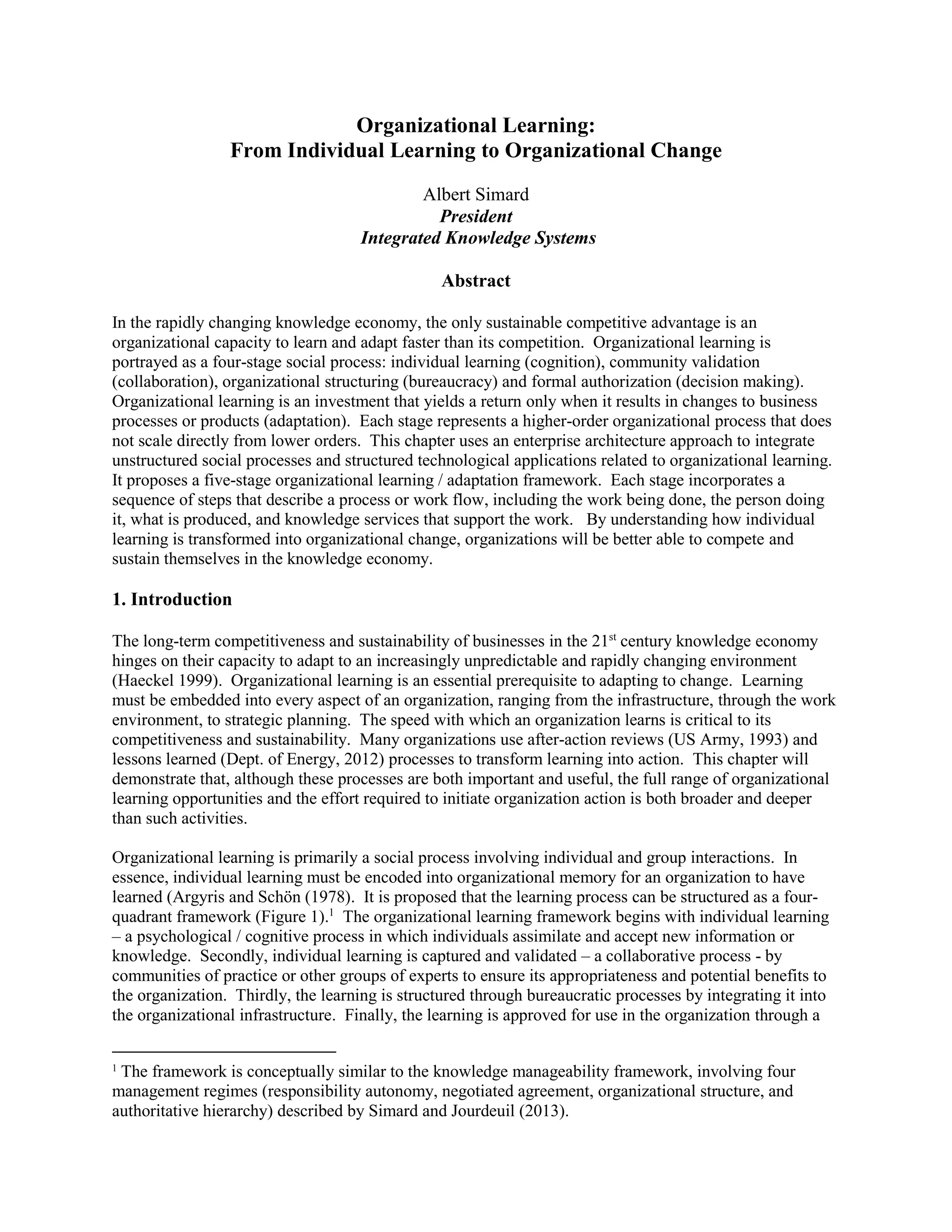
Organizational learning is primarily a social process involving individual and group interactions. In essence, individual learning must be encoded into organizational memory for an organization to have learned (Argyris and Schön (1978). It is proposed that the learning process can be structured as a four- quadrant framework (Figure 1).1 The organizational learning framework begins with individual learning – a psychological / cognitive process in which individuals assimilate and accept new information or knowledge. Secondly, individual learning is captured and validated – a collaborative process - by communities of practice or other groups of experts to ensure its appropriateness and potential benefits to the organization. Thirdly, the learning is structured through bureaucratic processes by integrating it into the organizational infrastructure. Finally, the learning is approved for use in the organization through a 
1 The framework is conceptually similar to the knowledge manageability framework, involving four management regimes (responsibility autonomy, negotiated agreement, organizational structure, and authoritative hierarchy) described by Simard and Jourdeuil (2013).
decision process. Collectively, this framework represents single-loop learning as described by Argyris and Schön, in that it results in action within existing organizational processes and functions. Note that each quadrant includes an action that transfers the learning process to the next quadrant. 
Argyris and Schön (1978) refer to organizational adaptation as double-loop learning. Fundamentally, adaptation involves changes to organizational outputs, strategies, or goals in response to organizational learning. Adaptation is often a response to a past occurrence, although it could also be in anticipation of a future condition. As the pace of global change continues to increase, anticipatory adaptation will become increasingly important. The potential consequences of alternate strategies are analyzed and compared. A plan is developed to integrate validated learning into the organizational infrastructure by committees or task groups. Finally, the learning is implemented through an organizational change management process. Adaptation includes monitoring trends to forecast changing environmental drivers or issues, evaluating their potential impact on the organization and its programs, and implementing change. 
This chapter uses an enterprise architecture approach to describe the transformation of individual learning into organizational action. Weill (2007) defined enterprise architecture as: “The organizing logic for business processes and IT infrastructure reflecting the integration and standardization requirements of a company’s operating model...for delivering goods and services to customers.” The underlying purpose of this work is to integrate inherently unstructured (social) and structured (technological) approaches to knowledge management, in general and organizational learning, in particular. The architecture uses a core model involving the work to be done, the person(s) doing the work, what is produced, and the services required to support the work. 
This chapter describes a five-stage organizational learning / adaptation framework comprising: individual learning, validating learning, structuring learning, approving learning, and organizational change. Each stage represents a higher-order process that does not necessarily scale directly from lower orders.
2. Individual Learning 
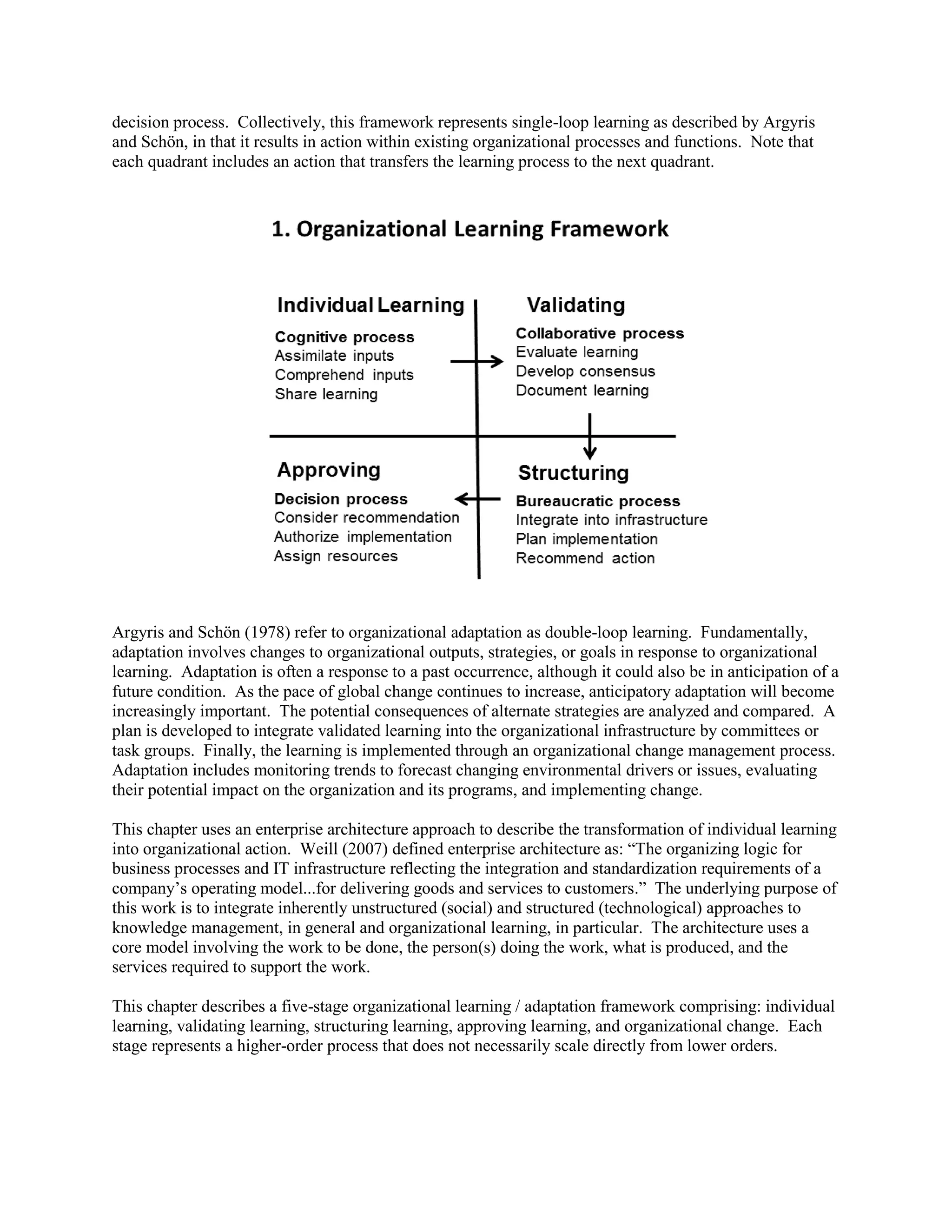
Organizational learning begins with individual learning. Individual learning can be defined as acquiring new or modifying and reinforcing existing knowledge, behaviors, skills, values, or preferences2. Learning is not a one-time event, but occurs continuously, over a lifetime of education, experience, and observation. Learning typically follows a “learning curve” comprising a steep initial rise followed by an asymptotically decreasing rate of learning. Learning involves interpreting new information and knowledge in the context of what an individual already knows. Although many types of learning are recognized, this framework focuses on the cognitive domain (Bloom et. al, 1956). Figure 2 shows Bloom’s seven-step cognitive learning taxonomy of increasing depth of learning, adapted to the format and terminology of this chapter. Each step is briefly described below. 
Increase Awareness receives information about a fact, event, or process of interest to an individual. Individual learning begins by encouraging, facilitating, and supporting increased awareness of explicit and tacit knowledge from a variety of sources, with a variety of methods, supported by appropriate services. Inputs to the senses include being taught, storytelling, self-learning, observing, and experience. Awareness involves perception through one of the five senses: sight, hearing, touch, taste, and smell. 
2 See Wikipedia “Learning” accessed June 11, 2013. In this framework, learning begins as information and progresses through a capacity for practical application. With analysis and synthesis it becomes understood and can be considered knowledge. At the evaluation step, it satisfies the psychological definition of knowledge (Pigeau, 2004), in that it is accepted as true by the learner.
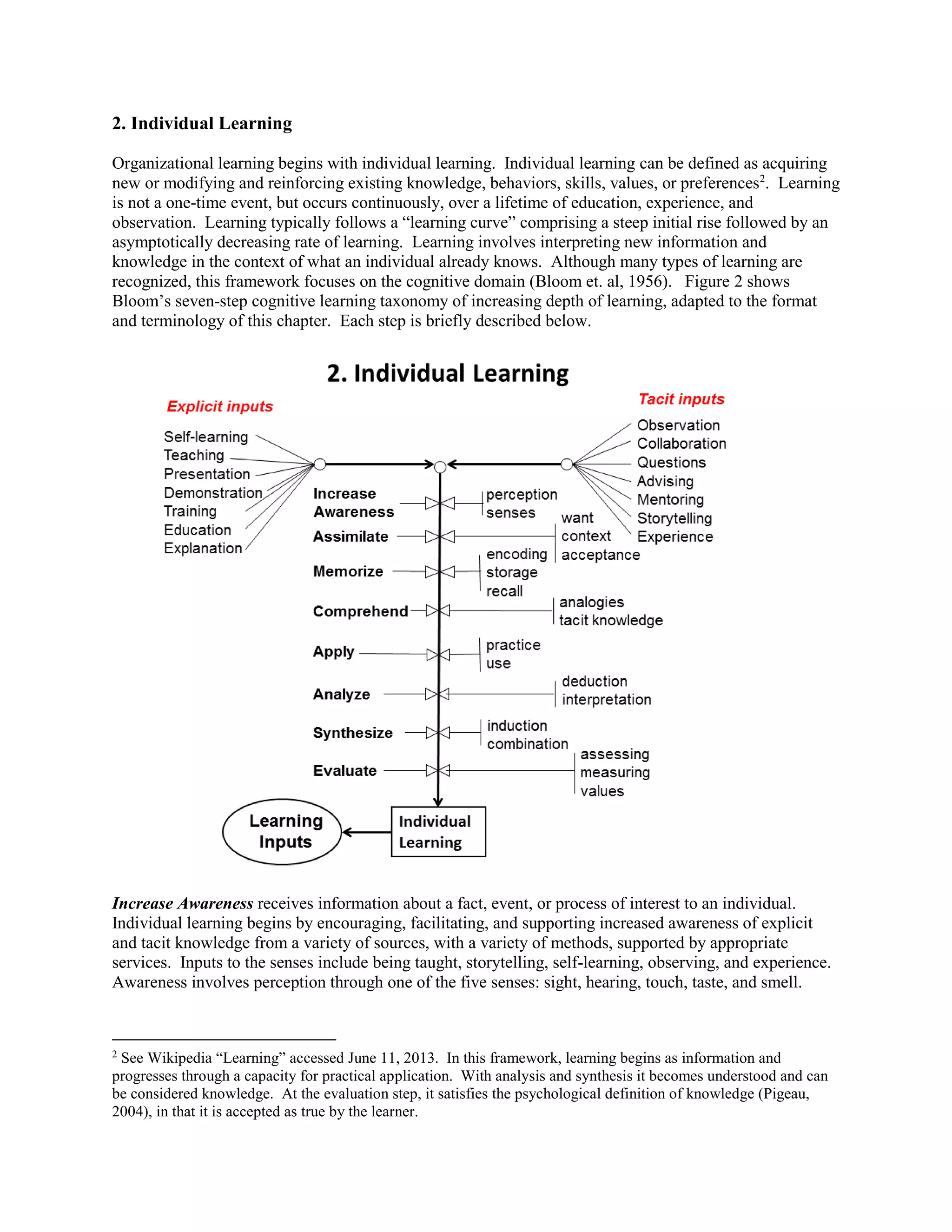
Table 1 Lists several sources of knowledge and methods that can be used to increase individual awareness. The first column lists the source, the second column lists the type of person(s) involved, the third column lists methods of increasing awareness, and the last column lists technology services that could facilitate increasing awareness. 
Table 1.Increase Individual Awareness 
Source 
Person/Group 
Methods 
Services 
Explicit 
individual 
reading, visual aids, audio recording, self-learning 
sharing, library, 
e-mail, repository, 
web portal 
Formal 
teacher to student 
education, teaching, training, 
web portal, 
on-line courses 
Informal 
speaker to audience 
lectures, presentations, speeches, explanation, demonstration 
web portal, 
on-line conferences, workshops, webinars 
Practical 
technician to user 
demonstrating, explaining, describing 
web portal, video, 
Tacit 
individual 
observing, experience, shadowing, practice 
work, activity, event 
Community 
colleagues, peers, groups, communities 
conversations, discussions, dialogue 
collaboration 
Expertise 
expert to novice 
questions and answers, being told, conversation 
expertise directory, blog 
e-mail, collaboration 
Advice 
subordinate to superior 
advising, briefing, recommending 
office applications 
Direction 
superior to subordinate 
mentoring, guiding, showing, direction 
office applications 
Narrative 
teller to listener 
storytelling, narrating, anecdotes 
blog, wiki, personal page 
Experience 
facilitator, group 
after-action-review, lessons learned 
web portal, 
on-line workshop 
Assimilate couples a need, want, or willingness to learn with interpreting new information in the context of truth-acceptance criteria of perception, authoritativeness, consensus, and coherence with what an individual already knows (Pigeau, 2004). It is not necessary that information is initially accepted as “true” for learning to continue. Executing a business process or implementing policy requires knowing how to do it, but does not require that an individual believe in or agree with it. 
Memorize encodes and stores information in the mind for future use. Encoding is receiving, processing and combining received information. Storage is creating a permanent mental record of the encoded information. Recall is calling back the stored information in response to a need for it. Memorization is supported by a variety of mental techniques such as repetition, mnemonics, or association.
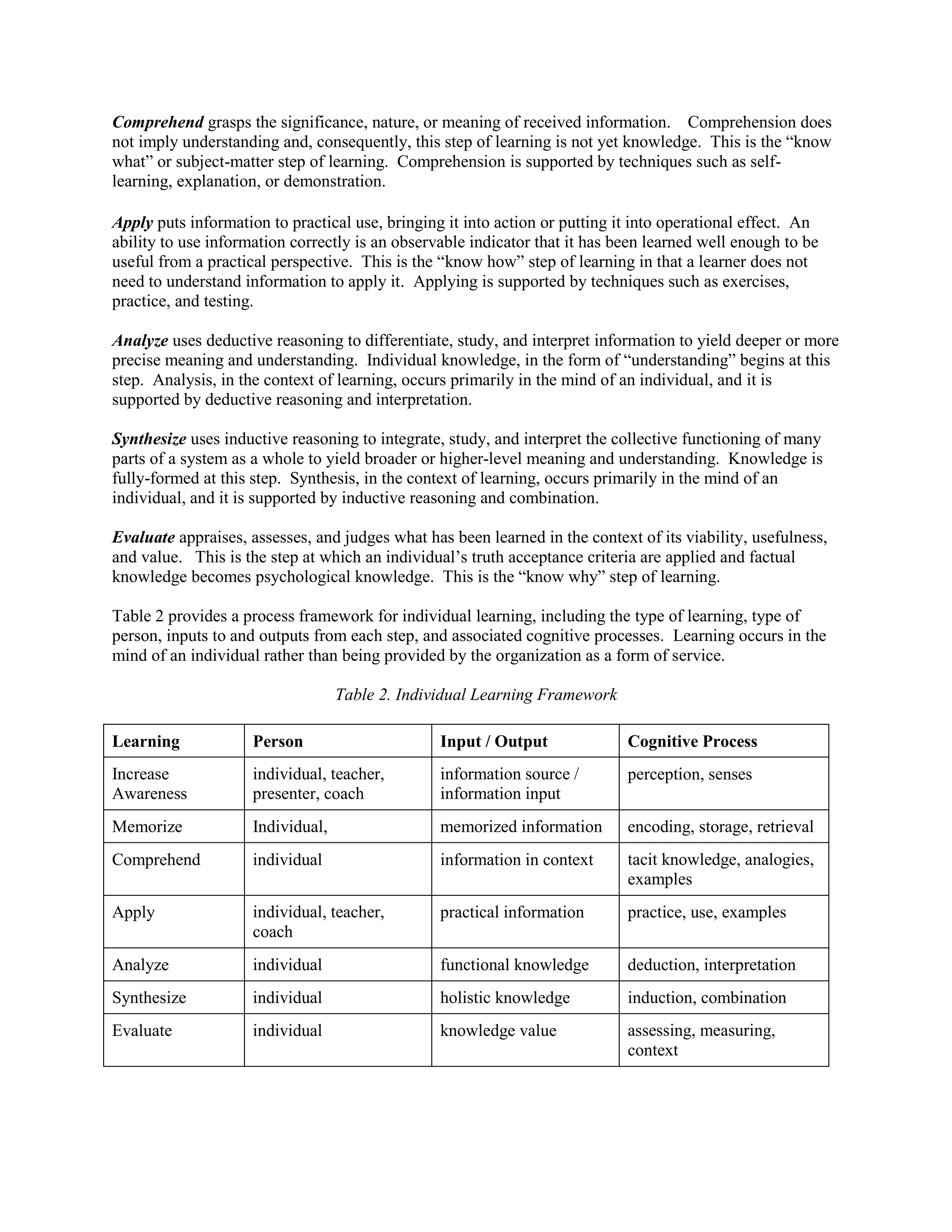
Comprehend grasps the significance, nature, or meaning of received information. Comprehension does not imply understanding and, consequently, this step of learning is not yet knowledge. This is the “know what” or subject-matter step of learning. Comprehension is supported by techniques such as self- learning, explanation, or demonstration. 
Apply puts information to practical use, bringing it into action or putting it into operational effect. An ability to use information correctly is an observable indicator that it has been learned well enough to be useful from a practical perspective. This is the “know how” step of learning in that a learner does not need to understand information to apply it. Applying is supported by techniques such as exercises, practice, and testing. 
Analyze uses deductive reasoning to differentiate, study, and interpret information to yield deeper or more precise meaning and understanding. Individual knowledge, in the form of “understanding” begins at this step. Analysis, in the context of learning, occurs primarily in the mind of an individual, and it is supported by deductive reasoning and interpretation. 
Synthesize uses inductive reasoning to integrate, study, and interpret the collective functioning of many parts of a system as a whole to yield broader or higher-level meaning and understanding. Knowledge is fully-formed at this step. Synthesis, in the context of learning, occurs primarily in the mind of an individual, and it is supported by inductive reasoning and combination. 
Evaluate appraises, assesses, and judges what has been learned in the context of its viability, usefulness, and value. This is the step at which an individual’s truth acceptance criteria are applied and factual knowledge becomes psychological knowledge. This is the “know why” step of learning. 
Table 2 provides a process framework for individual learning, including the type of learning, type of person, inputs to and outputs from each step, and associated cognitive processes. Learning occurs in the mind of an individual rather than being provided by the organization as a form of service. 
Table 2. Individual Learning Framework 
Learning 
Person 
Input / Output 
Cognitive Process 
Increase Awareness 
individual, teacher, presenter, coach 
information source / information input 
perception, senses 
Memorize 
Individual, 
memorized information 
encoding, storage, retrieval 
Comprehend 
individual 
information in context 
tacit knowledge, analogies, examples 
Apply 
individual, teacher, coach 
practical information 
practice, use, examples 
Analyze 
individual 
functional knowledge 
deduction, interpretation 
Synthesize 
individual 
holistic knowledge 
induction, combination 
Evaluate 
individual 
knowledge value 
assessing, measuring, context
3. Validating Learning 
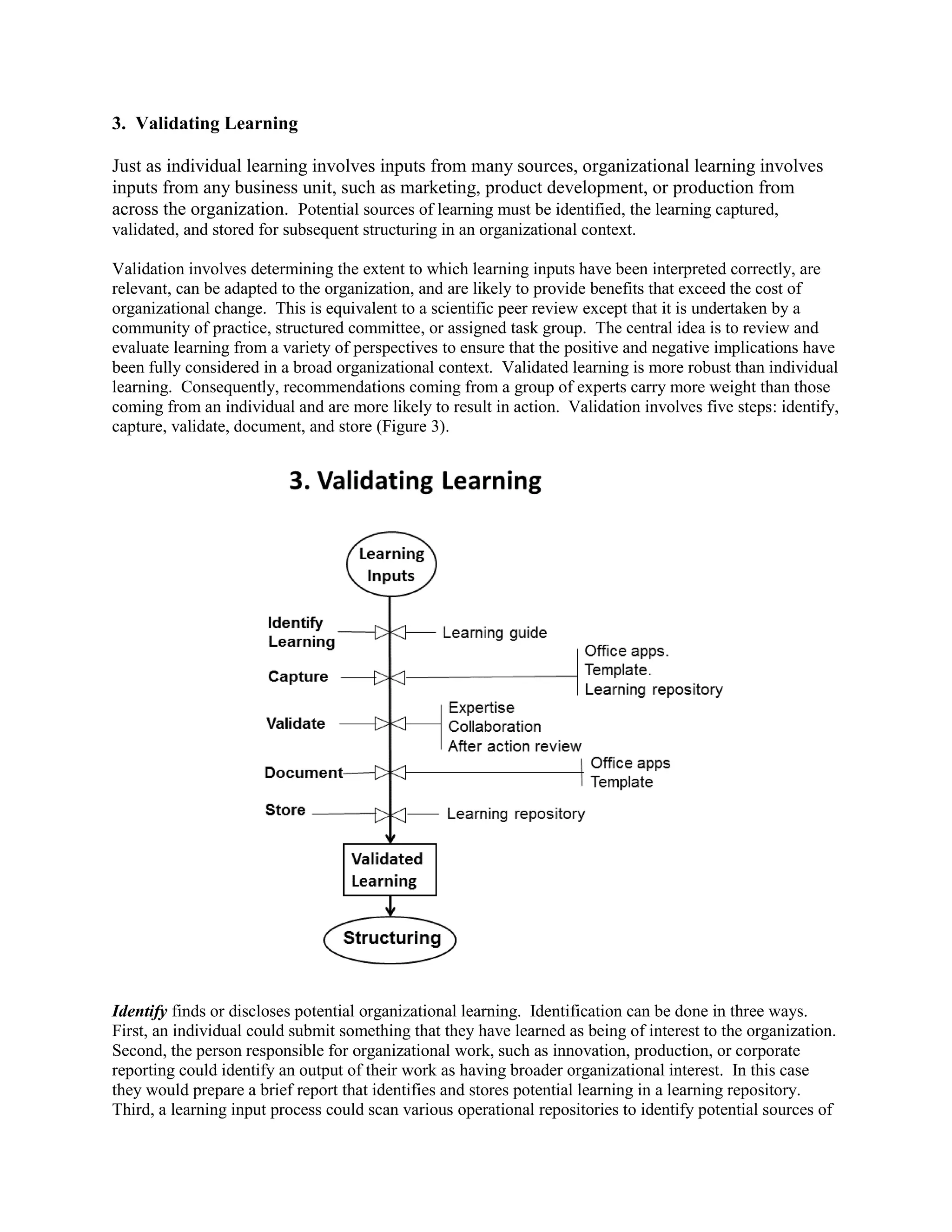
Just as individual learning involves inputs from many sources, organizational learning involves inputs from any business unit, such as marketing, product development, or production from across the organization. Potential sources of learning must be identified, the learning captured, validated, and stored for subsequent structuring in an organizational context. 
Validation involves determining the extent to which learning inputs have been interpreted correctly, are relevant, can be adapted to the organization, and are likely to provide benefits that exceed the cost of organizational change. This is equivalent to a scientific peer review except that it is undertaken by a community of practice, structured committee, or assigned task group. The central idea is to review and evaluate learning from a variety of perspectives to ensure that the positive and negative implications have been fully considered in a broad organizational context. Validated learning is more robust than individual learning. Consequently, recommendations coming from a group of experts carry more weight than those coming from an individual and are more likely to result in action. Validation involves five steps: identify, capture, validate, document, and store (Figure 3). 
Identify finds or discloses potential organizational learning. Identification can be done in three ways. First, an individual could submit something that they have learned as being of interest to the organization. Second, the person responsible for organizational work, such as innovation, production, or corporate reporting could identify an output of their work as having broader organizational interest. In this case they would prepare a brief report that identifies and stores potential learning in a learning repository. Third, a learning input process could scan various operational repositories to identify potential sources of
organizational learning. 
Capture elicits, acquires, or compiles content that describes potential organizational learning, transforming it into coded explicit form, such as a document, report, or learning template and storing it in reproducible and accessible media. Capturing could be supported by office applications, learning templates, lessons learned, and a learning repository. 
Validate determines the extent to which individual learning represents potential value to the organization. It is typically based on characteristics, attributes, or standards that support evaluating, judging, and deciding that individual learning is appropriate for organizational purposes. A significant activity or event could be followed by a formal after-action review that captures and validates experiential learning. Validation could be supported by a directory of expertise, a collaboration site, and after-action review. 
Document prepares a report that describes what was learned, provides a context of the current situation, outlines the organizational costs and benefits of implementing the learning, and recommends that a plan be developed to embed the learning into the organizational infrastructure. Documentation could be supported by office applications and a learning template. 
Store organizes and places the learning report into a learning repository to enable consideration by the structuring stage of the organizational learning process. Storing could be supported by a learning repository. 
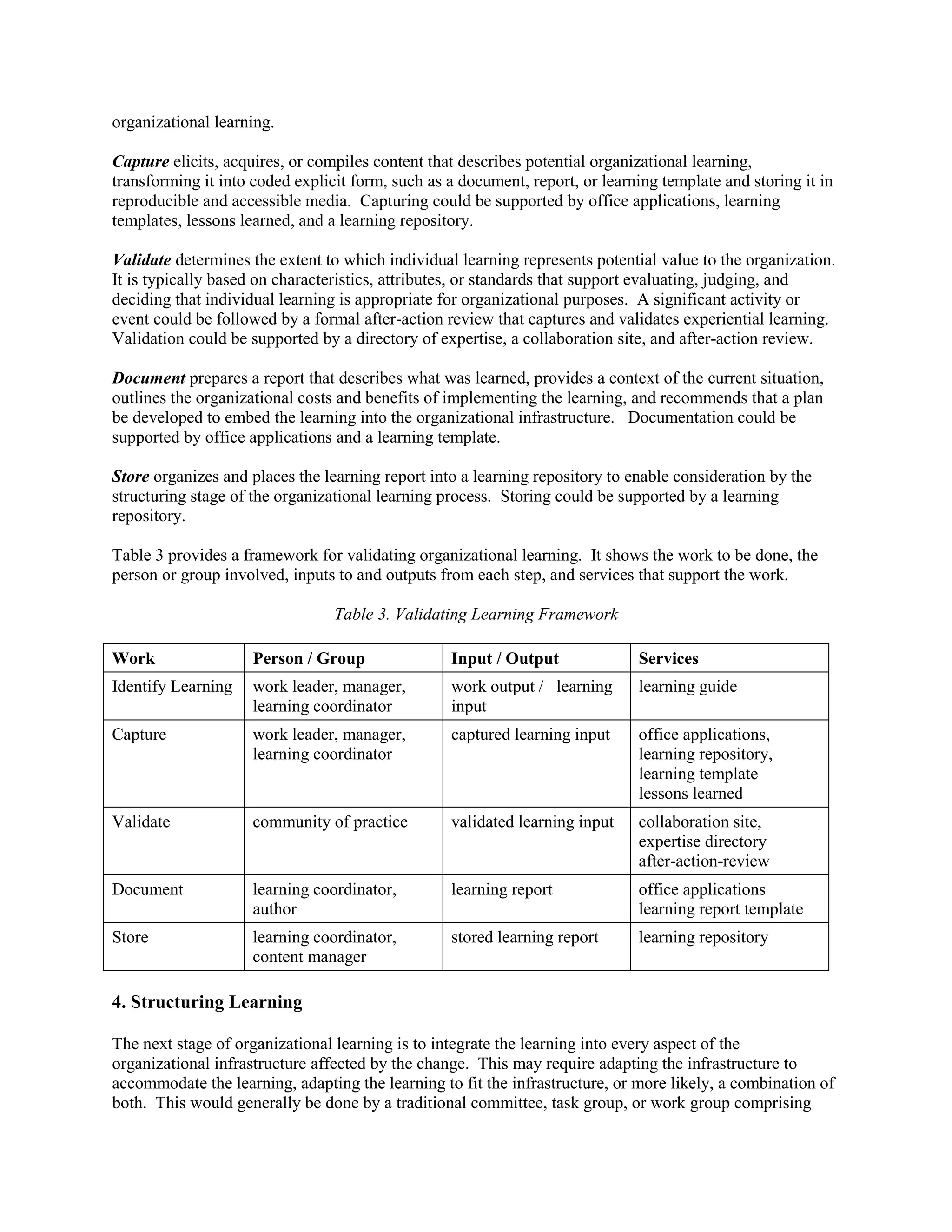
Table 3 provides a framework for validating organizational learning. It shows the work to be done, the person or group involved, inputs to and outputs from each step, and services that support the work. 
Table 3. Validating Learning Framework 
Work 
Person / Group 
Input / Output 
Services 
Identify Learning 
work leader, manager, learning coordinator 
work output / learning input 
learning guide 
Capture 
work leader, manager, learning coordinator 
captured learning input 
office applications, learning repository, learning template lessons learned 
Validate 
community of practice 
validated learning input 
collaboration site, expertise directory after-action-review 
Document 
learning coordinator, author 
learning report 
office applications learning report template 
Store 
learning coordinator, content manager 
stored learning report 
learning repository 
4. Structuring Learning 
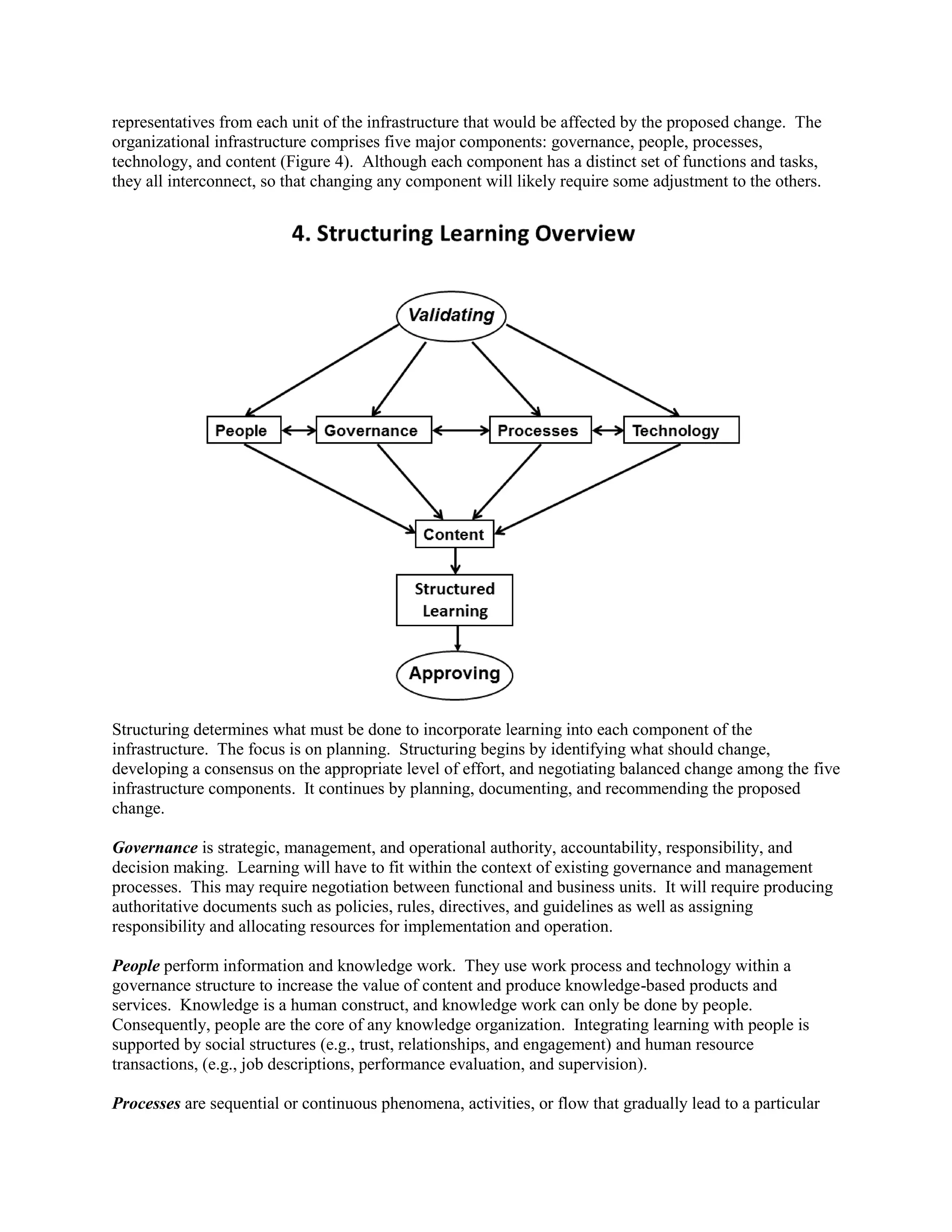
The next stage of organizational learning is to integrate the learning into every aspect of the organizational infrastructure affected by the change. This may require adapting the infrastructure to accommodate the learning, adapting the learning to fit the infrastructure, or more likely, a combination of both. This would generally be done by a traditional committee, task group, or work group comprising
representatives from each unit of the infrastructure that would be affected by the proposed change. The organizational infrastructure comprises five major components: governance, people, processes, technology, and content (Figure 4). Although each component has a distinct set of functions and tasks, they all interconnect, so that changing any component will likely require some adjustment to the others. 
Structuring determines what must be done to incorporate learning into each component of the infrastructure. The focus is on planning. Structuring begins by identifying what should change, developing a consensus on the appropriate level of effort, and negotiating balanced change among the five infrastructure components. It continues by planning, documenting, and recommending the proposed change. 
Governance is strategic, management, and operational authority, accountability, responsibility, and decision making. Learning will have to fit within the context of existing governance and management processes. This may require negotiation between functional and business units. It will require producing authoritative documents such as policies, rules, directives, and guidelines as well as assigning responsibility and allocating resources for implementation and operation. 
People perform information and knowledge work. They use work process and technology within a governance structure to increase the value of content and produce knowledge-based products and services. Knowledge is a human construct, and knowledge work can only be done by people. Consequently, people are the core of any knowledge organization. Integrating learning with people is supported by social structures (e.g., trust, relationships, and engagement) and human resource transactions, (e.g., job descriptions, performance evaluation, and supervision). 
Processes are sequential or continuous phenomena, activities, or flow that gradually lead to a particular
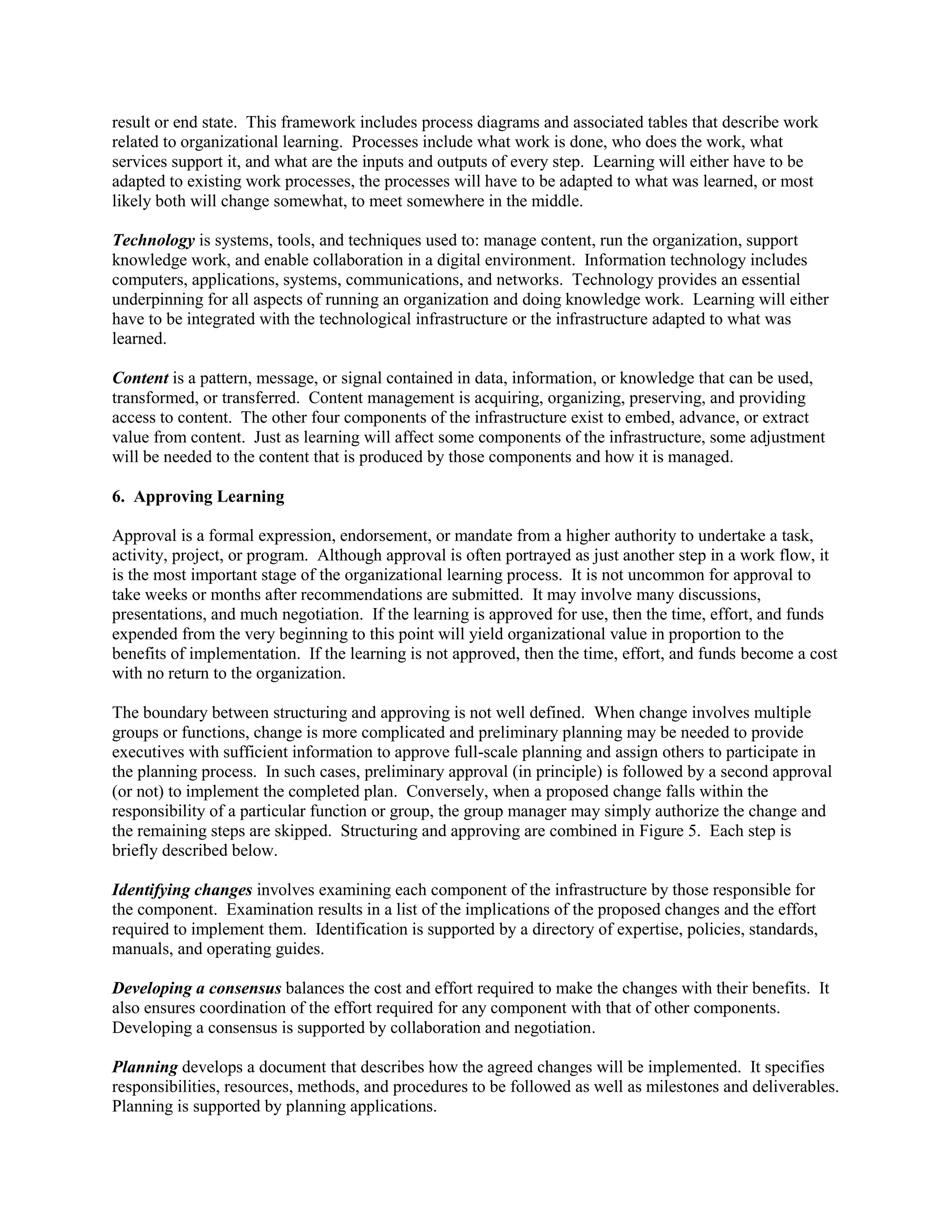
result or end state. This framework includes process diagrams and associated tables that describe work related to organizational learning. Processes include what work is done, who does the work, what services support it, and what are the inputs and outputs of every step. Learning will either have to be adapted to existing work processes, the processes will have to be adapted to what was learned, or most likely both will change somewhat, to meet somewhere in the middle. 
Technology is systems, tools, and techniques used to: manage content, run the organization, support knowledge work, and enable collaboration in a digital environment. Information technology includes computers, applications, systems, communications, and networks. Technology provides an essential underpinning for all aspects of running an organization and doing knowledge work. Learning will either have to be integrated with the technological infrastructure or the infrastructure adapted to what was learned. 
Content is a pattern, message, or signal contained in data, information, or knowledge that can be used, transformed, or transferred. Content management is acquiring, organizing, preserving, and providing access to content. The other four components of the infrastructure exist to embed, advance, or extract value from content. Just as learning will affect some components of the infrastructure, some adjustment will be needed to the content that is produced by those components and how it is managed. 
6. Approving Learning 
Approval is a formal expression, endorsement, or mandate from a higher authority to undertake a task, activity, project, or program. Although approval is often portrayed as just another step in a work flow, it is the most important stage of the organizational learning process. It is not uncommon for approval to take weeks or months after recommendations are submitted. It may involve many discussions, presentations, and much negotiation. If the learning is approved for use, then the time, effort, and funds expended from the very beginning to this point will yield organizational value in proportion to the benefits of implementation. If the learning is not approved, then the time, effort, and funds become a cost with no return to the organization. 
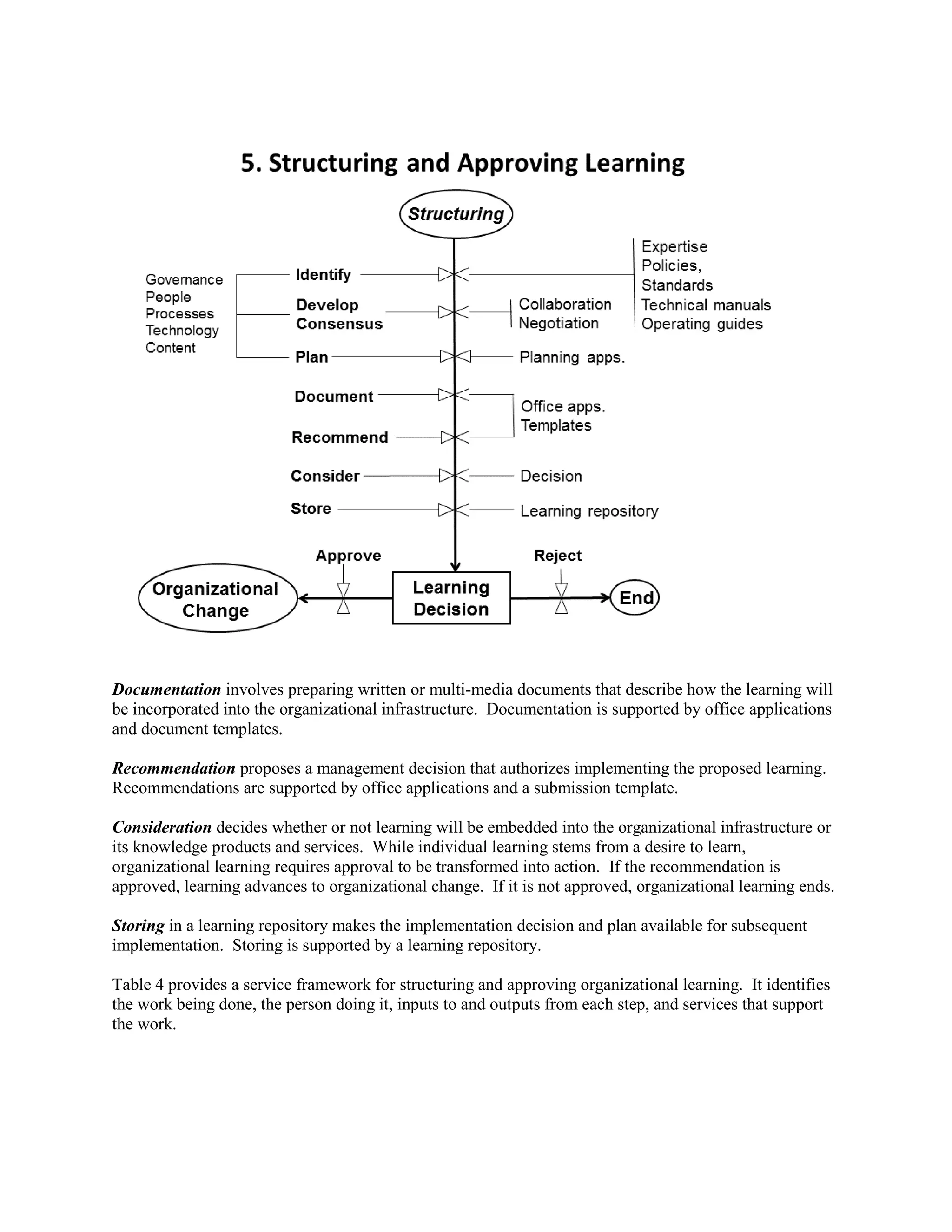
The boundary between structuring and approving is not well defined. When change involves multiple groups or functions, change is more complicated and preliminary planning may be needed to provide executives with sufficient information to approve full-scale planning and assign others to participate in the planning process. In such cases, preliminary approval (in principle) is followed by a second approval (or not) to implement the completed plan. Conversely, when a proposed change falls within the responsibility of a particular function or group, the group manager may simply authorize the change and the remaining steps are skipped. Structuring and approving are combined in Figure 5. Each step is briefly described below. 
Identifying changes involves examining each component of the infrastructure by those responsible for the component. Examination results in a list of the implications of the proposed changes and the effort required to implement them. Identification is supported by a directory of expertise, policies, standards, manuals, and operating guides. 
Developing a consensus balances the cost and effort required to make the changes with their benefits. It also ensures coordination of the effort required for any component with that of other components. Developing a consensus is supported by collaboration and negotiation. 
Planning develops a document that describes how the agreed changes will be implemented. It specifies responsibilities, resources, methods, and procedures to be followed as well as milestones and deliverables. Planning is supported by planning applications.
Documentation involves preparing written or multi-media documents that describe how the learning will be incorporated into the organizational infrastructure. Documentation is supported by office applications and document templates. 
Recommendation proposes a management decision that authorizes implementing the proposed learning. Recommendations are supported by office applications and a submission template. 
Consideration decides whether or not learning will be embedded into the organizational infrastructure or its knowledge products and services. While individual learning stems from a desire to learn, organizational learning requires approval to be transformed into action. If the recommendation is approved, learning advances to organizational change. If it is not approved, organizational learning ends. 
Storing in a learning repository makes the implementation decision and plan available for subsequent implementation. Storing is supported by a learning repository. 
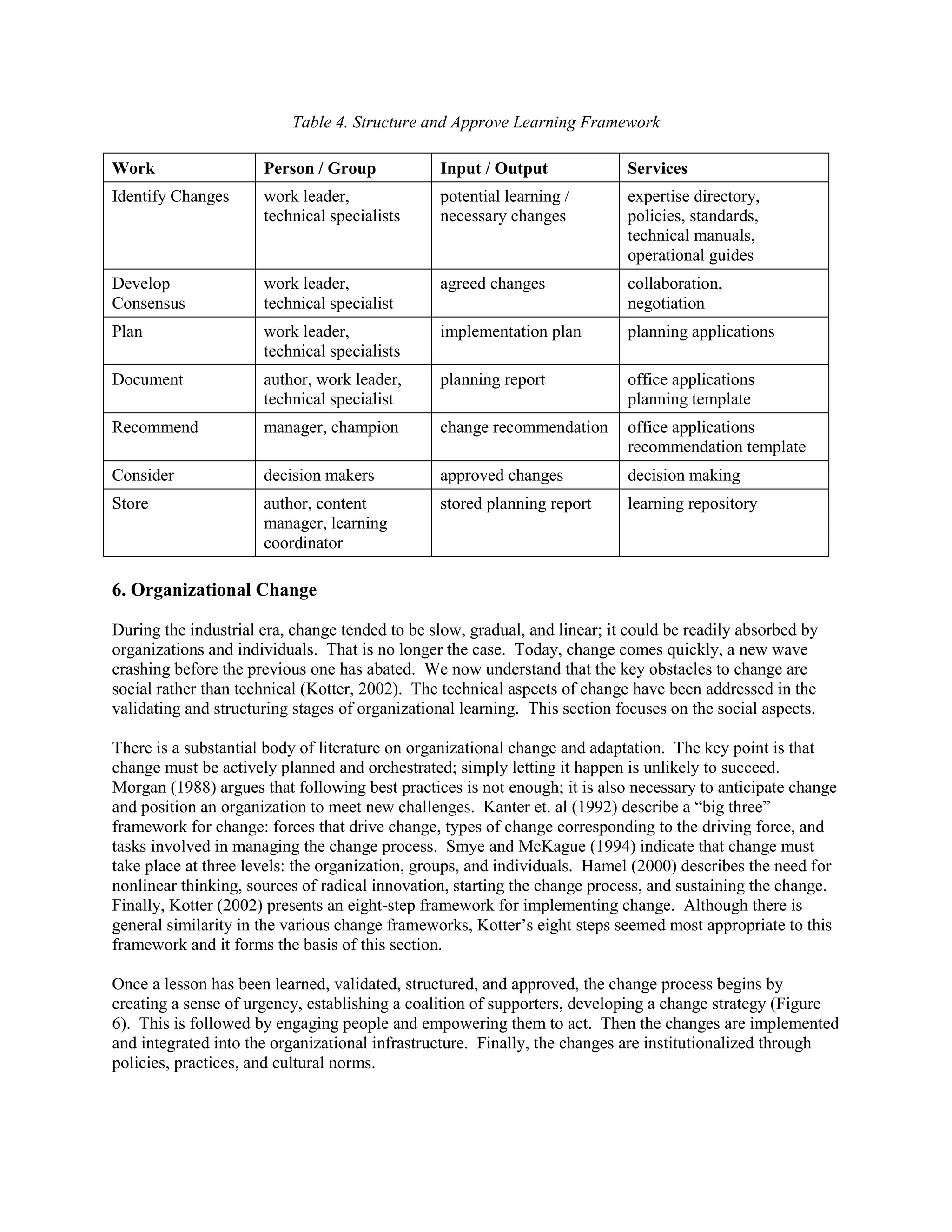
Table 4 provides a service framework for structuring and approving organizational learning. It identifies the work being done, the person doing it, inputs to and outputs from each step, and services that support the work.
Table 4. Structure and Approve Learning Framework 
Work 
Person / Group 
Input / Output 
Services 
Identify Changes 
work leader, technical specialists 
potential learning / necessary changes 
expertise directory, policies, standards, technical manuals, operational guides 
Develop Consensus 
work leader, technical specialist 
agreed changes 
collaboration, negotiation 
Plan 
work leader, technical specialists 
implementation plan 
planning applications 
Document 
author, work leader, technical specialist 
planning report 
office applications planning template 
Recommend 
manager, champion 
change recommendation 
office applications recommendation template 
Consider 
decision makers 
approved changes 
decision making 
Store 
author, content manager, learning coordinator 
stored planning report 
learning repository 
6. Organizational Change 
During the industrial era, change tended to be slow, gradual, and linear; it could be readily absorbed by organizations and individuals. That is no longer the case. Today, change comes quickly, a new wave crashing before the previous one has abated. We now understand that the key obstacles to change are social rather than technical (Kotter, 2002). The technical aspects of change have been addressed in the validating and structuring stages of organizational learning. This section focuses on the social aspects. 
There is a substantial body of literature on organizational change and adaptation. The key point is that change must be actively planned and orchestrated; simply letting it happen is unlikely to succeed. Morgan (1988) argues that following best practices is not enough; it is also necessary to anticipate change and position an organization to meet new challenges. Kanter et. al (1992) describe a “big three” framework for change: forces that drive change, types of change corresponding to the driving force, and tasks involved in managing the change process. Smye and McKague (1994) indicate that change must take place at three levels: the organization, groups, and individuals. Hamel (2000) describes the need for nonlinear thinking, sources of radical innovation, starting the change process, and sustaining the change. Finally, Kotter (2002) presents an eight-step framework for implementing change. Although there is general similarity in the various change frameworks, Kotter’s eight steps seemed most appropriate to this framework and it forms the basis of this section. 
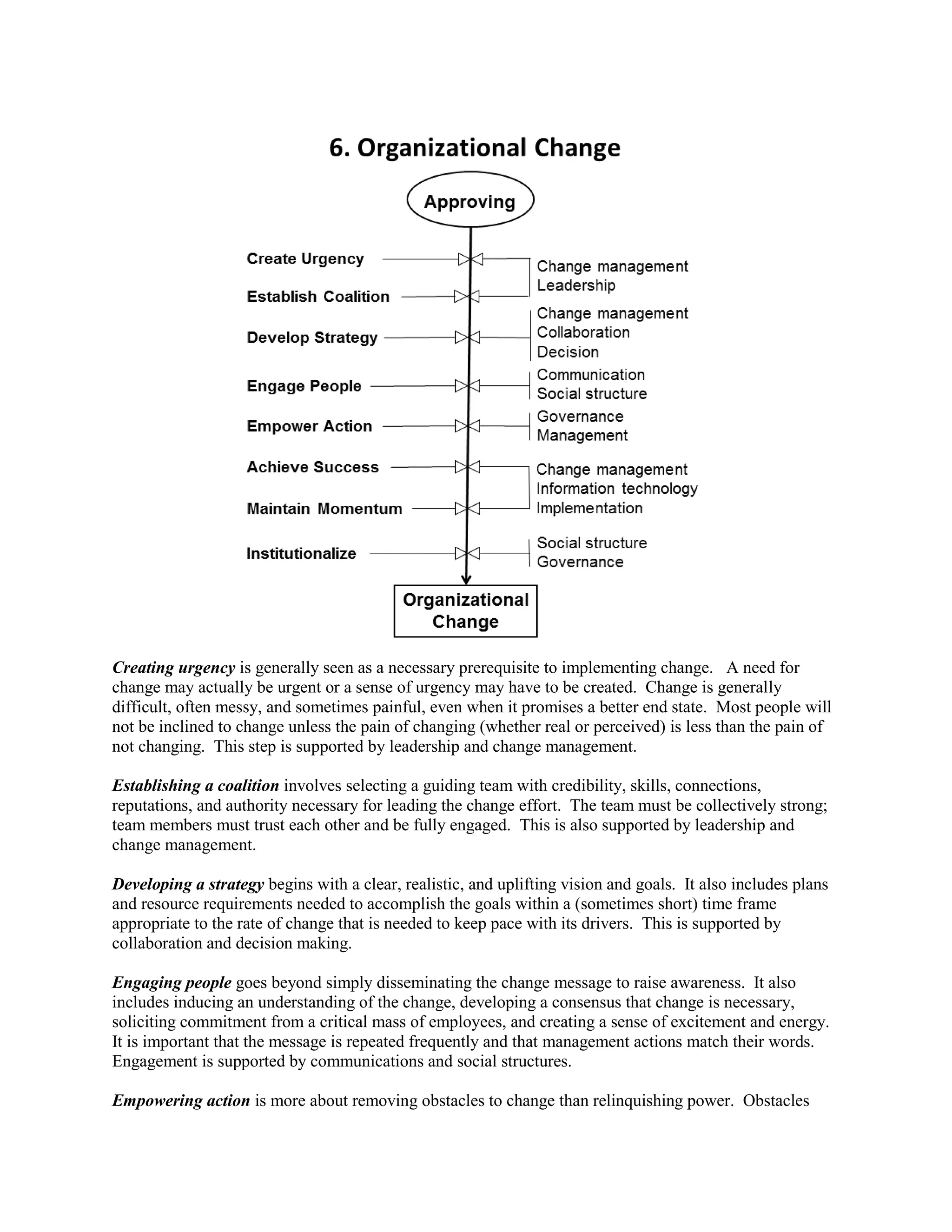
Once a lesson has been learned, validated, structured, and approved, the change process begins by creating a sense of urgency, establishing a coalition of supporters, developing a change strategy (Figure 6). This is followed by engaging people and empowering them to act. Then the changes are implemented and integrated into the organizational infrastructure. Finally, the changes are institutionalized through policies, practices, and cultural norms.
Creating urgency is generally seen as a necessary prerequisite to implementing change. A need for change may actually be urgent or a sense of urgency may have to be created. Change is generally difficult, often messy, and sometimes painful, even when it promises a better end state. Most people will not be inclined to change unless the pain of changing (whether real or perceived) is less than the pain of not changing. This step is supported by leadership and change management. 
Establishing a coalition involves selecting a guiding team with credibility, skills, connections, reputations, and authority necessary for leading the change effort. The team must be collectively strong; team members must trust each other and be fully engaged. This is also supported by leadership and change management. 
Developing a strategy begins with a clear, realistic, and uplifting vision and goals. It also includes plans and resource requirements needed to accomplish the goals within a (sometimes short) time frame appropriate to the rate of change that is needed to keep pace with its drivers. This is supported by collaboration and decision making. 
Engaging people goes beyond simply disseminating the change message to raise awareness. It also includes inducing an understanding of the change, developing a consensus that change is necessary, soliciting commitment from a critical mass of employees, and creating a sense of excitement and energy. It is important that the message is repeated frequently and that management actions match their words. Engagement is supported by communications and social structures. 
Empowering action is more about removing obstacles to change than relinquishing power. Obstacles
include managers who disempower their subordinates, infrastructure and systems that require inordinate effort, and inadequate individual self-confidence. Removing obstacles to change enables action, reduces frustration, and promotes rather than undermines change. Empowerment is supported by governance and change management. 
Early success provides credibility, attracts additional resources, and builds momentum which leads to subsequent success. Slower, less visible or more ambiguous results provide an opportunity for cynics and skeptics to derail the change effort. It is necessary to carefully select initial projects to result in some “quick wins.” Early successes are supported by change management and information technology. 
Maintaining momentum means that good change managers do not let up. They consolidate and build on early success, creating wave after wave of change until the vision is realized. Change managers do not try to do too much at once or unknowingly quit too soon and let momentum slip to the point of becoming bogged down in organizational processes. Maintaining momentum is supported by change management and information technology. 
Institutionalizing change focuses on embedding the change into the organizational culture. Norms of behavior and shared values are developed through consistent successful action over a sufficient period of time. Appropriate rewards, new employee orientation, and continuing engagement gradually overcome the initial fragility of change. Institutionalization is supported by social structures and governance. 
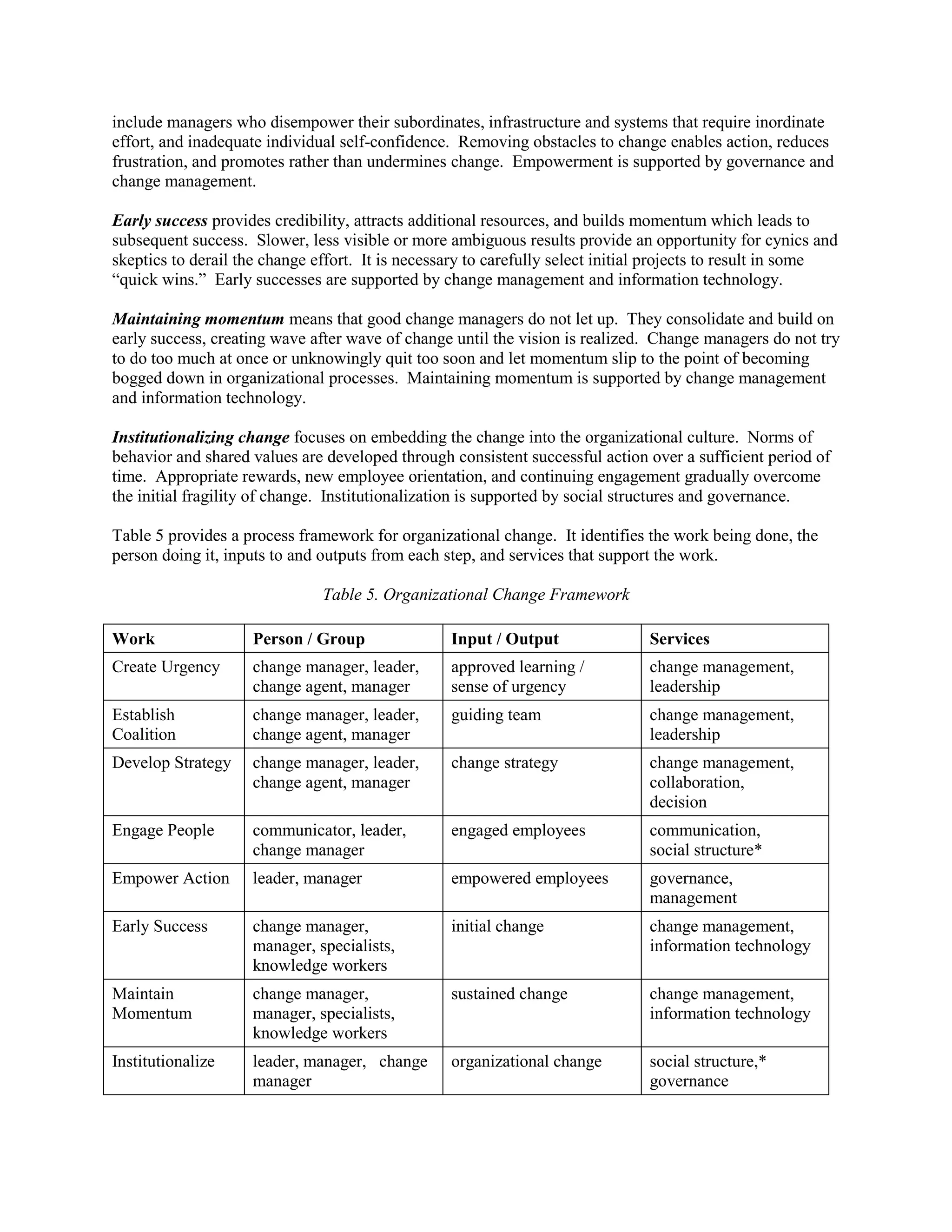
Table 5 provides a process framework for organizational change. It identifies the work being done, the person doing it, inputs to and outputs from each step, and services that support the work. 
Table 5. Organizational Change Framework 
Work 
Person / Group 
Input / Output 
Services 
Create Urgency 
change manager, leader, change agent, manager 
approved learning / sense of urgency 
change management, leadership 
Establish Coalition 
change manager, leader, change agent, manager 
guiding team 
change management, leadership 
Develop Strategy 
change manager, leader, change agent, manager 
change strategy 
change management, collaboration, decision 
Engage People 
communicator, leader, change manager 
engaged employees 
communication, social structure* 
Empower Action 
leader, manager 
empowered employees 
governance, management 
Early Success 
change manager, manager, specialists, knowledge workers 
initial change 
change management, information technology 
Maintain Momentum 
change manager, manager, specialists, knowledge workers 
sustained change 
change management, information technology 
Institutionalize 
leader, manager, change manager 
organizational change 
social structure,* governance
*Social structure includes context (level, attributes, and manageability) and interaction (sharing, collaboration, negotiation, and competition); see Simard (2014) 
6. Conclusions 
Many organizations emphasize “after-action reviews” and “lessons learned” to transform learning into action. As has been shown in this chapter, the full range of organizational learning opportunities and the effort required to initiate organization action is notably broader and deeper. A four-quadrant framework is used to describe single-loop organizational learning: learn, validate, structure, and approve. A fifth stage – organizational change – transforms what was learned into action (double-loop learning). This chapter uses an enterprise architecture approach to describe organizational learning and adaptation. Each stage lists sequence of steps that describe the learning process, including the work being done, the person doing it, what is produced, and services that support the work. 
Any individual or business function can learn something of value to the organization at any time. Learning doesn’t take place only during specific high-profile events or projects. Consequently, facilitating organizational learning begins by understanding how individuals learn so that this process can be enhanced to benefit the organization. Second, individual learning must be captured so that it can be validated by a community of practice to determine its relevance, appropriateness, and potential benefit to the organization. Third, a plan is developed to integrate validated learning into those aspects of the organizational infrastructure that it must interact with. Fourth, the plan is approved for implementation. Finally, a change management process is established to implement the plan. By understanding how individual learning is transformed into organizational change, organizations in the knowledge economy will be better able to learn and adapt faster than their competition, leading to increased competitiveness and sustainability. 
References 
Argyris, Chris and D Schön (1978) Organizational Learning: A Theory of Action perspective, Addison- Wesley, Reading MA 
Bloom, Benjamin. (1956) Taxonomy of Educational Objectives, Handbook I: The Cognitive Domain. David McKay, New York, NY. 
Department of Energy (2012) Preparing a Lessons Learned Document. Department of Energy, Office of Science, Washington DC, 12 p. 
Haeckel, Stephan H. (1999) Adaptive Enterprise. Harvard Business School Press, Boston, MA, 295 p. 
Hamel, Gary (2000) Leading the Digital Revolution. Harvard Business School Press, Boston, MA. 333p. 
Kanter, Rosabeth M. Barry A. Stein, and Todd D. Jack (1992) The Challenge of Organizational Change. The Free Press, New Yorkm NY. 535 p. 
Kotter, John P. (2002) The Heart of Change. Harvard Business School Press. Boston, MA. 187 p. 
Morgan, Gareth (1988) Riding the Waves of Change. Jossey-Bass, Inc. San Francisco, CA. 213 p. 
Pigeau, R. A. (2004) The Human Dimensions of Cyberspace. Pres. to: Defence Research & Development
Canada, Science & Technology Symposium, Ottawa, ON, April 21, 2004 
Simard, Albert J. and Philippe Jourdeuil (2014) Knowledge Manageability: A New paradigm. Ch.1 in: Building a Competitive Public Sector with Knowledge Management Strategy, Al-Bastaki and Shajers eds. IGI GlobalHershey, PA, p 1-52. 
Simard, Albert. Knowledge Services Reference Architecture. Defence Research & Development Canada, Knowledge and Information Directorate, Ottawa, ON, unpublished report February 28, 2014, 206 p. 
Smye, Marti and Anne McKague (1994) You Don’t Change a Company by Memo. Key Porter Books Toronto ON 220 p. 
US Army (1993) A leader’s Guide to After-Action Reviews. Department of the Army, Headquarters, Washington DC, 30p. 
Weill, Peter (2007) Innovating with Information Systems: What do the most agile firms in the world do? Pres. to: Sixth e-Business Conference, Barcelona, Spain, March 27, 2007.

Organizational learning

  • 1.
    Organizational Learning: FromIndividual Learning to Organizational Change Albert Simard President Integrated Knowledge Systems Abstract In the rapidly changing knowledge economy, the only sustainable competitive advantage is an organizational capacity to learn and adapt faster than its competition. Organizational learning is portrayed as a four-stage social process: individual learning (cognition), community validation (collaboration), organizational structuring (bureaucracy) and formal authorization (decision making). Organizational learning is an investment that yields a return only when it results in changes to business processes or products (adaptation). Each stage represents a higher-order organizational process that does not scale directly from lower orders. This chapter uses an enterprise architecture approach to integrate unstructured social processes and structured technological applications related to organizational learning. It proposes a five-stage organizational learning / adaptation framework. Each stage incorporates a sequence of steps that describe a process or work flow, including the work being done, the person doing it, what is produced, and knowledge services that support the work. By understanding how individual learning is transformed into organizational change, organizations will be better able to compete and sustain themselves in the knowledge economy. 1. Introduction The long-term competitiveness and sustainability of businesses in the 21st century knowledge economy hinges on their capacity to adapt to an increasingly unpredictable and rapidly changing environment (Haeckel 1999). Organizational learning is an essential prerequisite to adapting to change. Learning must be embedded into every aspect of an organization, ranging from the infrastructure, through the work environment, to strategic planning. The speed with which an organization learns is critical to its competitiveness and sustainability. Many organizations use after-action reviews (US Army, 1993) and lessons learned (Dept. of Energy, 2012) processes to transform learning into action. This chapter will demonstrate that, although these processes are both important and useful, the full range of organizational learning opportunities and the effort required to initiate organization action is both broader and deeper than such activities. Organizational learning is primarily a social process involving individual and group interactions. In essence, individual learning must be encoded into organizational memory for an organization to have learned (Argyris and Schön (1978). It is proposed that the learning process can be structured as a four- quadrant framework (Figure 1).1 The organizational learning framework begins with individual learning – a psychological / cognitive process in which individuals assimilate and accept new information or knowledge. Secondly, individual learning is captured and validated – a collaborative process - by communities of practice or other groups of experts to ensure its appropriateness and potential benefits to the organization. Thirdly, the learning is structured through bureaucratic processes by integrating it into the organizational infrastructure. Finally, the learning is approved for use in the organization through a 1 The framework is conceptually similar to the knowledge manageability framework, involving four management regimes (responsibility autonomy, negotiated agreement, organizational structure, and authoritative hierarchy) described by Simard and Jourdeuil (2013).
  • 2.
    decision process. Collectively,this framework represents single-loop learning as described by Argyris and Schön, in that it results in action within existing organizational processes and functions. Note that each quadrant includes an action that transfers the learning process to the next quadrant. Argyris and Schön (1978) refer to organizational adaptation as double-loop learning. Fundamentally, adaptation involves changes to organizational outputs, strategies, or goals in response to organizational learning. Adaptation is often a response to a past occurrence, although it could also be in anticipation of a future condition. As the pace of global change continues to increase, anticipatory adaptation will become increasingly important. The potential consequences of alternate strategies are analyzed and compared. A plan is developed to integrate validated learning into the organizational infrastructure by committees or task groups. Finally, the learning is implemented through an organizational change management process. Adaptation includes monitoring trends to forecast changing environmental drivers or issues, evaluating their potential impact on the organization and its programs, and implementing change. This chapter uses an enterprise architecture approach to describe the transformation of individual learning into organizational action. Weill (2007) defined enterprise architecture as: “The organizing logic for business processes and IT infrastructure reflecting the integration and standardization requirements of a company’s operating model...for delivering goods and services to customers.” The underlying purpose of this work is to integrate inherently unstructured (social) and structured (technological) approaches to knowledge management, in general and organizational learning, in particular. The architecture uses a core model involving the work to be done, the person(s) doing the work, what is produced, and the services required to support the work. This chapter describes a five-stage organizational learning / adaptation framework comprising: individual learning, validating learning, structuring learning, approving learning, and organizational change. Each stage represents a higher-order process that does not necessarily scale directly from lower orders.
  • 3.
    2. Individual Learning Organizational learning begins with individual learning. Individual learning can be defined as acquiring new or modifying and reinforcing existing knowledge, behaviors, skills, values, or preferences2. Learning is not a one-time event, but occurs continuously, over a lifetime of education, experience, and observation. Learning typically follows a “learning curve” comprising a steep initial rise followed by an asymptotically decreasing rate of learning. Learning involves interpreting new information and knowledge in the context of what an individual already knows. Although many types of learning are recognized, this framework focuses on the cognitive domain (Bloom et. al, 1956). Figure 2 shows Bloom’s seven-step cognitive learning taxonomy of increasing depth of learning, adapted to the format and terminology of this chapter. Each step is briefly described below. Increase Awareness receives information about a fact, event, or process of interest to an individual. Individual learning begins by encouraging, facilitating, and supporting increased awareness of explicit and tacit knowledge from a variety of sources, with a variety of methods, supported by appropriate services. Inputs to the senses include being taught, storytelling, self-learning, observing, and experience. Awareness involves perception through one of the five senses: sight, hearing, touch, taste, and smell. 2 See Wikipedia “Learning” accessed June 11, 2013. In this framework, learning begins as information and progresses through a capacity for practical application. With analysis and synthesis it becomes understood and can be considered knowledge. At the evaluation step, it satisfies the psychological definition of knowledge (Pigeau, 2004), in that it is accepted as true by the learner.
  • 4.
    Table 1 Listsseveral sources of knowledge and methods that can be used to increase individual awareness. The first column lists the source, the second column lists the type of person(s) involved, the third column lists methods of increasing awareness, and the last column lists technology services that could facilitate increasing awareness. Table 1.Increase Individual Awareness Source Person/Group Methods Services Explicit individual reading, visual aids, audio recording, self-learning sharing, library, e-mail, repository, web portal Formal teacher to student education, teaching, training, web portal, on-line courses Informal speaker to audience lectures, presentations, speeches, explanation, demonstration web portal, on-line conferences, workshops, webinars Practical technician to user demonstrating, explaining, describing web portal, video, Tacit individual observing, experience, shadowing, practice work, activity, event Community colleagues, peers, groups, communities conversations, discussions, dialogue collaboration Expertise expert to novice questions and answers, being told, conversation expertise directory, blog e-mail, collaboration Advice subordinate to superior advising, briefing, recommending office applications Direction superior to subordinate mentoring, guiding, showing, direction office applications Narrative teller to listener storytelling, narrating, anecdotes blog, wiki, personal page Experience facilitator, group after-action-review, lessons learned web portal, on-line workshop Assimilate couples a need, want, or willingness to learn with interpreting new information in the context of truth-acceptance criteria of perception, authoritativeness, consensus, and coherence with what an individual already knows (Pigeau, 2004). It is not necessary that information is initially accepted as “true” for learning to continue. Executing a business process or implementing policy requires knowing how to do it, but does not require that an individual believe in or agree with it. Memorize encodes and stores information in the mind for future use. Encoding is receiving, processing and combining received information. Storage is creating a permanent mental record of the encoded information. Recall is calling back the stored information in response to a need for it. Memorization is supported by a variety of mental techniques such as repetition, mnemonics, or association.
  • 5.
    Comprehend grasps thesignificance, nature, or meaning of received information. Comprehension does not imply understanding and, consequently, this step of learning is not yet knowledge. This is the “know what” or subject-matter step of learning. Comprehension is supported by techniques such as self- learning, explanation, or demonstration. Apply puts information to practical use, bringing it into action or putting it into operational effect. An ability to use information correctly is an observable indicator that it has been learned well enough to be useful from a practical perspective. This is the “know how” step of learning in that a learner does not need to understand information to apply it. Applying is supported by techniques such as exercises, practice, and testing. Analyze uses deductive reasoning to differentiate, study, and interpret information to yield deeper or more precise meaning and understanding. Individual knowledge, in the form of “understanding” begins at this step. Analysis, in the context of learning, occurs primarily in the mind of an individual, and it is supported by deductive reasoning and interpretation. Synthesize uses inductive reasoning to integrate, study, and interpret the collective functioning of many parts of a system as a whole to yield broader or higher-level meaning and understanding. Knowledge is fully-formed at this step. Synthesis, in the context of learning, occurs primarily in the mind of an individual, and it is supported by inductive reasoning and combination. Evaluate appraises, assesses, and judges what has been learned in the context of its viability, usefulness, and value. This is the step at which an individual’s truth acceptance criteria are applied and factual knowledge becomes psychological knowledge. This is the “know why” step of learning. Table 2 provides a process framework for individual learning, including the type of learning, type of person, inputs to and outputs from each step, and associated cognitive processes. Learning occurs in the mind of an individual rather than being provided by the organization as a form of service. Table 2. Individual Learning Framework Learning Person Input / Output Cognitive Process Increase Awareness individual, teacher, presenter, coach information source / information input perception, senses Memorize Individual, memorized information encoding, storage, retrieval Comprehend individual information in context tacit knowledge, analogies, examples Apply individual, teacher, coach practical information practice, use, examples Analyze individual functional knowledge deduction, interpretation Synthesize individual holistic knowledge induction, combination Evaluate individual knowledge value assessing, measuring, context
  • 6.
    3. Validating Learning Just as individual learning involves inputs from many sources, organizational learning involves inputs from any business unit, such as marketing, product development, or production from across the organization. Potential sources of learning must be identified, the learning captured, validated, and stored for subsequent structuring in an organizational context. Validation involves determining the extent to which learning inputs have been interpreted correctly, are relevant, can be adapted to the organization, and are likely to provide benefits that exceed the cost of organizational change. This is equivalent to a scientific peer review except that it is undertaken by a community of practice, structured committee, or assigned task group. The central idea is to review and evaluate learning from a variety of perspectives to ensure that the positive and negative implications have been fully considered in a broad organizational context. Validated learning is more robust than individual learning. Consequently, recommendations coming from a group of experts carry more weight than those coming from an individual and are more likely to result in action. Validation involves five steps: identify, capture, validate, document, and store (Figure 3). Identify finds or discloses potential organizational learning. Identification can be done in three ways. First, an individual could submit something that they have learned as being of interest to the organization. Second, the person responsible for organizational work, such as innovation, production, or corporate reporting could identify an output of their work as having broader organizational interest. In this case they would prepare a brief report that identifies and stores potential learning in a learning repository. Third, a learning input process could scan various operational repositories to identify potential sources of
  • 7.
    organizational learning. Captureelicits, acquires, or compiles content that describes potential organizational learning, transforming it into coded explicit form, such as a document, report, or learning template and storing it in reproducible and accessible media. Capturing could be supported by office applications, learning templates, lessons learned, and a learning repository. Validate determines the extent to which individual learning represents potential value to the organization. It is typically based on characteristics, attributes, or standards that support evaluating, judging, and deciding that individual learning is appropriate for organizational purposes. A significant activity or event could be followed by a formal after-action review that captures and validates experiential learning. Validation could be supported by a directory of expertise, a collaboration site, and after-action review. Document prepares a report that describes what was learned, provides a context of the current situation, outlines the organizational costs and benefits of implementing the learning, and recommends that a plan be developed to embed the learning into the organizational infrastructure. Documentation could be supported by office applications and a learning template. Store organizes and places the learning report into a learning repository to enable consideration by the structuring stage of the organizational learning process. Storing could be supported by a learning repository. Table 3 provides a framework for validating organizational learning. It shows the work to be done, the person or group involved, inputs to and outputs from each step, and services that support the work. Table 3. Validating Learning Framework Work Person / Group Input / Output Services Identify Learning work leader, manager, learning coordinator work output / learning input learning guide Capture work leader, manager, learning coordinator captured learning input office applications, learning repository, learning template lessons learned Validate community of practice validated learning input collaboration site, expertise directory after-action-review Document learning coordinator, author learning report office applications learning report template Store learning coordinator, content manager stored learning report learning repository 4. Structuring Learning The next stage of organizational learning is to integrate the learning into every aspect of the organizational infrastructure affected by the change. This may require adapting the infrastructure to accommodate the learning, adapting the learning to fit the infrastructure, or more likely, a combination of both. This would generally be done by a traditional committee, task group, or work group comprising
  • 8.
    representatives from eachunit of the infrastructure that would be affected by the proposed change. The organizational infrastructure comprises five major components: governance, people, processes, technology, and content (Figure 4). Although each component has a distinct set of functions and tasks, they all interconnect, so that changing any component will likely require some adjustment to the others. Structuring determines what must be done to incorporate learning into each component of the infrastructure. The focus is on planning. Structuring begins by identifying what should change, developing a consensus on the appropriate level of effort, and negotiating balanced change among the five infrastructure components. It continues by planning, documenting, and recommending the proposed change. Governance is strategic, management, and operational authority, accountability, responsibility, and decision making. Learning will have to fit within the context of existing governance and management processes. This may require negotiation between functional and business units. It will require producing authoritative documents such as policies, rules, directives, and guidelines as well as assigning responsibility and allocating resources for implementation and operation. People perform information and knowledge work. They use work process and technology within a governance structure to increase the value of content and produce knowledge-based products and services. Knowledge is a human construct, and knowledge work can only be done by people. Consequently, people are the core of any knowledge organization. Integrating learning with people is supported by social structures (e.g., trust, relationships, and engagement) and human resource transactions, (e.g., job descriptions, performance evaluation, and supervision). Processes are sequential or continuous phenomena, activities, or flow that gradually lead to a particular
  • 9.
    result or endstate. This framework includes process diagrams and associated tables that describe work related to organizational learning. Processes include what work is done, who does the work, what services support it, and what are the inputs and outputs of every step. Learning will either have to be adapted to existing work processes, the processes will have to be adapted to what was learned, or most likely both will change somewhat, to meet somewhere in the middle. Technology is systems, tools, and techniques used to: manage content, run the organization, support knowledge work, and enable collaboration in a digital environment. Information technology includes computers, applications, systems, communications, and networks. Technology provides an essential underpinning for all aspects of running an organization and doing knowledge work. Learning will either have to be integrated with the technological infrastructure or the infrastructure adapted to what was learned. Content is a pattern, message, or signal contained in data, information, or knowledge that can be used, transformed, or transferred. Content management is acquiring, organizing, preserving, and providing access to content. The other four components of the infrastructure exist to embed, advance, or extract value from content. Just as learning will affect some components of the infrastructure, some adjustment will be needed to the content that is produced by those components and how it is managed. 6. Approving Learning Approval is a formal expression, endorsement, or mandate from a higher authority to undertake a task, activity, project, or program. Although approval is often portrayed as just another step in a work flow, it is the most important stage of the organizational learning process. It is not uncommon for approval to take weeks or months after recommendations are submitted. It may involve many discussions, presentations, and much negotiation. If the learning is approved for use, then the time, effort, and funds expended from the very beginning to this point will yield organizational value in proportion to the benefits of implementation. If the learning is not approved, then the time, effort, and funds become a cost with no return to the organization. The boundary between structuring and approving is not well defined. When change involves multiple groups or functions, change is more complicated and preliminary planning may be needed to provide executives with sufficient information to approve full-scale planning and assign others to participate in the planning process. In such cases, preliminary approval (in principle) is followed by a second approval (or not) to implement the completed plan. Conversely, when a proposed change falls within the responsibility of a particular function or group, the group manager may simply authorize the change and the remaining steps are skipped. Structuring and approving are combined in Figure 5. Each step is briefly described below. Identifying changes involves examining each component of the infrastructure by those responsible for the component. Examination results in a list of the implications of the proposed changes and the effort required to implement them. Identification is supported by a directory of expertise, policies, standards, manuals, and operating guides. Developing a consensus balances the cost and effort required to make the changes with their benefits. It also ensures coordination of the effort required for any component with that of other components. Developing a consensus is supported by collaboration and negotiation. Planning develops a document that describes how the agreed changes will be implemented. It specifies responsibilities, resources, methods, and procedures to be followed as well as milestones and deliverables. Planning is supported by planning applications.
  • 10.
    Documentation involves preparingwritten or multi-media documents that describe how the learning will be incorporated into the organizational infrastructure. Documentation is supported by office applications and document templates. Recommendation proposes a management decision that authorizes implementing the proposed learning. Recommendations are supported by office applications and a submission template. Consideration decides whether or not learning will be embedded into the organizational infrastructure or its knowledge products and services. While individual learning stems from a desire to learn, organizational learning requires approval to be transformed into action. If the recommendation is approved, learning advances to organizational change. If it is not approved, organizational learning ends. Storing in a learning repository makes the implementation decision and plan available for subsequent implementation. Storing is supported by a learning repository. Table 4 provides a service framework for structuring and approving organizational learning. It identifies the work being done, the person doing it, inputs to and outputs from each step, and services that support the work.
  • 11.
    Table 4. Structureand Approve Learning Framework Work Person / Group Input / Output Services Identify Changes work leader, technical specialists potential learning / necessary changes expertise directory, policies, standards, technical manuals, operational guides Develop Consensus work leader, technical specialist agreed changes collaboration, negotiation Plan work leader, technical specialists implementation plan planning applications Document author, work leader, technical specialist planning report office applications planning template Recommend manager, champion change recommendation office applications recommendation template Consider decision makers approved changes decision making Store author, content manager, learning coordinator stored planning report learning repository 6. Organizational Change During the industrial era, change tended to be slow, gradual, and linear; it could be readily absorbed by organizations and individuals. That is no longer the case. Today, change comes quickly, a new wave crashing before the previous one has abated. We now understand that the key obstacles to change are social rather than technical (Kotter, 2002). The technical aspects of change have been addressed in the validating and structuring stages of organizational learning. This section focuses on the social aspects. There is a substantial body of literature on organizational change and adaptation. The key point is that change must be actively planned and orchestrated; simply letting it happen is unlikely to succeed. Morgan (1988) argues that following best practices is not enough; it is also necessary to anticipate change and position an organization to meet new challenges. Kanter et. al (1992) describe a “big three” framework for change: forces that drive change, types of change corresponding to the driving force, and tasks involved in managing the change process. Smye and McKague (1994) indicate that change must take place at three levels: the organization, groups, and individuals. Hamel (2000) describes the need for nonlinear thinking, sources of radical innovation, starting the change process, and sustaining the change. Finally, Kotter (2002) presents an eight-step framework for implementing change. Although there is general similarity in the various change frameworks, Kotter’s eight steps seemed most appropriate to this framework and it forms the basis of this section. Once a lesson has been learned, validated, structured, and approved, the change process begins by creating a sense of urgency, establishing a coalition of supporters, developing a change strategy (Figure 6). This is followed by engaging people and empowering them to act. Then the changes are implemented and integrated into the organizational infrastructure. Finally, the changes are institutionalized through policies, practices, and cultural norms.
  • 12.
    Creating urgency isgenerally seen as a necessary prerequisite to implementing change. A need for change may actually be urgent or a sense of urgency may have to be created. Change is generally difficult, often messy, and sometimes painful, even when it promises a better end state. Most people will not be inclined to change unless the pain of changing (whether real or perceived) is less than the pain of not changing. This step is supported by leadership and change management. Establishing a coalition involves selecting a guiding team with credibility, skills, connections, reputations, and authority necessary for leading the change effort. The team must be collectively strong; team members must trust each other and be fully engaged. This is also supported by leadership and change management. Developing a strategy begins with a clear, realistic, and uplifting vision and goals. It also includes plans and resource requirements needed to accomplish the goals within a (sometimes short) time frame appropriate to the rate of change that is needed to keep pace with its drivers. This is supported by collaboration and decision making. Engaging people goes beyond simply disseminating the change message to raise awareness. It also includes inducing an understanding of the change, developing a consensus that change is necessary, soliciting commitment from a critical mass of employees, and creating a sense of excitement and energy. It is important that the message is repeated frequently and that management actions match their words. Engagement is supported by communications and social structures. Empowering action is more about removing obstacles to change than relinquishing power. Obstacles
  • 13.
    include managers whodisempower their subordinates, infrastructure and systems that require inordinate effort, and inadequate individual self-confidence. Removing obstacles to change enables action, reduces frustration, and promotes rather than undermines change. Empowerment is supported by governance and change management. Early success provides credibility, attracts additional resources, and builds momentum which leads to subsequent success. Slower, less visible or more ambiguous results provide an opportunity for cynics and skeptics to derail the change effort. It is necessary to carefully select initial projects to result in some “quick wins.” Early successes are supported by change management and information technology. Maintaining momentum means that good change managers do not let up. They consolidate and build on early success, creating wave after wave of change until the vision is realized. Change managers do not try to do too much at once or unknowingly quit too soon and let momentum slip to the point of becoming bogged down in organizational processes. Maintaining momentum is supported by change management and information technology. Institutionalizing change focuses on embedding the change into the organizational culture. Norms of behavior and shared values are developed through consistent successful action over a sufficient period of time. Appropriate rewards, new employee orientation, and continuing engagement gradually overcome the initial fragility of change. Institutionalization is supported by social structures and governance. Table 5 provides a process framework for organizational change. It identifies the work being done, the person doing it, inputs to and outputs from each step, and services that support the work. Table 5. Organizational Change Framework Work Person / Group Input / Output Services Create Urgency change manager, leader, change agent, manager approved learning / sense of urgency change management, leadership Establish Coalition change manager, leader, change agent, manager guiding team change management, leadership Develop Strategy change manager, leader, change agent, manager change strategy change management, collaboration, decision Engage People communicator, leader, change manager engaged employees communication, social structure* Empower Action leader, manager empowered employees governance, management Early Success change manager, manager, specialists, knowledge workers initial change change management, information technology Maintain Momentum change manager, manager, specialists, knowledge workers sustained change change management, information technology Institutionalize leader, manager, change manager organizational change social structure,* governance
  • 14.
    *Social structure includescontext (level, attributes, and manageability) and interaction (sharing, collaboration, negotiation, and competition); see Simard (2014) 6. Conclusions Many organizations emphasize “after-action reviews” and “lessons learned” to transform learning into action. As has been shown in this chapter, the full range of organizational learning opportunities and the effort required to initiate organization action is notably broader and deeper. A four-quadrant framework is used to describe single-loop organizational learning: learn, validate, structure, and approve. A fifth stage – organizational change – transforms what was learned into action (double-loop learning). This chapter uses an enterprise architecture approach to describe organizational learning and adaptation. Each stage lists sequence of steps that describe the learning process, including the work being done, the person doing it, what is produced, and services that support the work. Any individual or business function can learn something of value to the organization at any time. Learning doesn’t take place only during specific high-profile events or projects. Consequently, facilitating organizational learning begins by understanding how individuals learn so that this process can be enhanced to benefit the organization. Second, individual learning must be captured so that it can be validated by a community of practice to determine its relevance, appropriateness, and potential benefit to the organization. Third, a plan is developed to integrate validated learning into those aspects of the organizational infrastructure that it must interact with. Fourth, the plan is approved for implementation. Finally, a change management process is established to implement the plan. By understanding how individual learning is transformed into organizational change, organizations in the knowledge economy will be better able to learn and adapt faster than their competition, leading to increased competitiveness and sustainability. References Argyris, Chris and D Schön (1978) Organizational Learning: A Theory of Action perspective, Addison- Wesley, Reading MA Bloom, Benjamin. (1956) Taxonomy of Educational Objectives, Handbook I: The Cognitive Domain. David McKay, New York, NY. Department of Energy (2012) Preparing a Lessons Learned Document. Department of Energy, Office of Science, Washington DC, 12 p. Haeckel, Stephan H. (1999) Adaptive Enterprise. Harvard Business School Press, Boston, MA, 295 p. Hamel, Gary (2000) Leading the Digital Revolution. Harvard Business School Press, Boston, MA. 333p. Kanter, Rosabeth M. Barry A. Stein, and Todd D. Jack (1992) The Challenge of Organizational Change. The Free Press, New Yorkm NY. 535 p. Kotter, John P. (2002) The Heart of Change. Harvard Business School Press. Boston, MA. 187 p. Morgan, Gareth (1988) Riding the Waves of Change. Jossey-Bass, Inc. San Francisco, CA. 213 p. Pigeau, R. A. (2004) The Human Dimensions of Cyberspace. Pres. to: Defence Research & Development
  • 15.
    Canada, Science &Technology Symposium, Ottawa, ON, April 21, 2004 Simard, Albert J. and Philippe Jourdeuil (2014) Knowledge Manageability: A New paradigm. Ch.1 in: Building a Competitive Public Sector with Knowledge Management Strategy, Al-Bastaki and Shajers eds. IGI GlobalHershey, PA, p 1-52. Simard, Albert. Knowledge Services Reference Architecture. Defence Research & Development Canada, Knowledge and Information Directorate, Ottawa, ON, unpublished report February 28, 2014, 206 p. Smye, Marti and Anne McKague (1994) You Don’t Change a Company by Memo. Key Porter Books Toronto ON 220 p. US Army (1993) A leader’s Guide to After-Action Reviews. Department of the Army, Headquarters, Washington DC, 30p. Weill, Peter (2007) Innovating with Information Systems: What do the most agile firms in the world do? Pres. to: Sixth e-Business Conference, Barcelona, Spain, March 27, 2007.