Organizational Behavior
Dr. Gopal Thapa
Tribhuvan University
Organizational Behavior
 Organization
 Behavior
4/8/2023 Copy right reserved 2
Organization
 An organization is purposeful combination of two
or more people who independent with each other
to achieve specific goal.
 It is composed of people, structure and technology
for the purpose of attainment of a common
purpose in a changing enviornment
4/8/2023 Copy right reserved 3
Organization
4/8/2023 Copy right reserved 4
An organization is a
consciously coordinated social
unit, composed of two or more
people that functions on a
relatively continuous basis to
achieve a common goal or set
of goals.
Stephen P. Robbins
San Diego State University
Characteristics of Organization
 Goal oriented
 People
 Structure
 Technology
 Continuity
 Environment
4/8/2023 Copy right reserved 5
Behavior
4/8/2023 Copy right reserved 6
Behavior is anything that the
human does.
Fred Luthans
University of Nebraska
Organizational Behavior
 Organizational behavior is directly concerned with
the understanding, prediction, and control of
human behavior in organizations.
 Organizational behavior is the study of both group
and individual performance and activity within an
organization.
4/8/2023 Copy right reserved 7
Organizational Behavior
4/8/2023 Copy right reserved 8
Organizational behavior is the
understanding, prediction and
management of human
behavior in organization
Fred Luthans
University of Nebraska
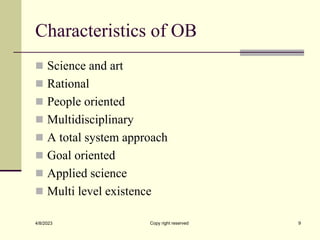
Characteristics of OB
 Science and art
 Rational
 People oriented
 Multidisciplinary
 A total system approach
 Goal oriented
 Applied science
 Multi level existence
4/8/2023 Copy right reserved 9
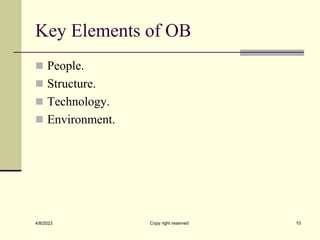
Key Elements of OB
 People.
 Structure.
 Technology.
 Environment.
4/8/2023 Copy right reserved 10
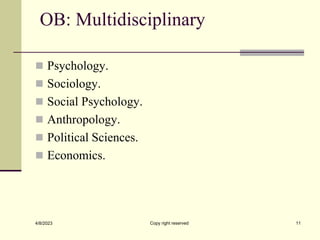
OB: Multidisciplinary
 Psychology.
 Sociology.
 Social Psychology.
 Anthropology.
 Political Sciences.
 Economics.
4/8/2023 Copy right reserved 11
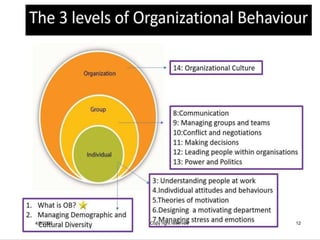
Levels of OB
4/8/2023 Copy right reserved 12
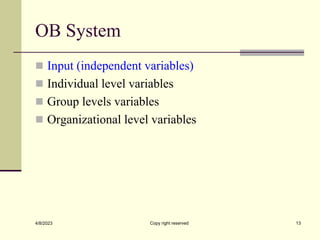
OB System
 Input (independent variables)
 Individual level variables
 Group levels variables
 Organizational level variables
4/8/2023 Copy right reserved 13
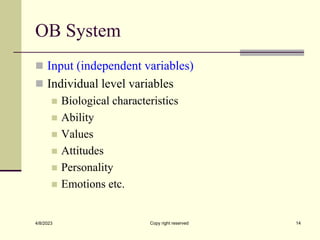
OB System
 Input (independent variables)
 Individual level variables
 Biological characteristics
 Ability
 Values
 Attitudes
 Personality
 Emotions etc.
4/8/2023 Copy right reserved 14
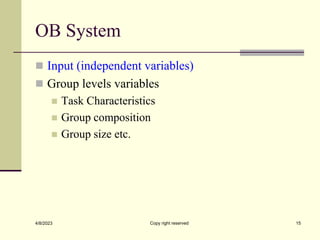
OB System
 Input (independent variables)
 Group levels variables
 Task Characteristics
 Group composition
 Group size etc.
4/8/2023 Copy right reserved 15
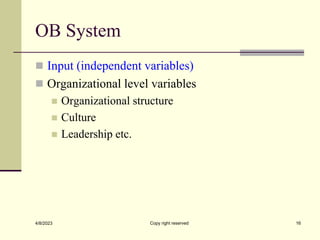
OB System
 Input (independent variables)
 Organizational level variables
 Organizational structure
 Culture
 Leadership etc.
4/8/2023 Copy right reserved 16
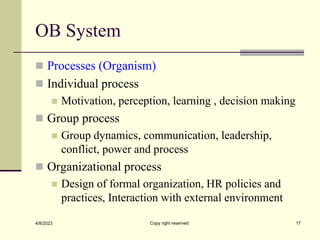
OB System
 Processes (Organism)
 Individual process
 Motivation, perception, learning , decision making
 Group process
 Group dynamics, communication, leadership,
conflict, power and process
 Organizational process
 Design of formal organization, HR policies and
practices, Interaction with external environment
4/8/2023 Copy right reserved 17
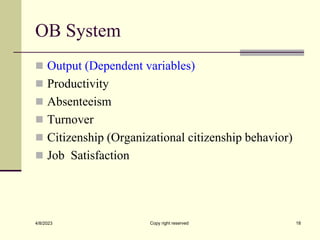
OB System
 Output (Dependent variables)
 Productivity
 Absenteeism
 Turnover
 Citizenship (Organizational citizenship behavior)
 Job Satisfaction
4/8/2023 Copy right reserved 18
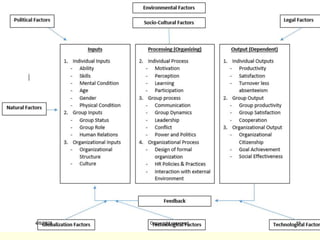
OB System
4/8/2023 Copy right reserved 19
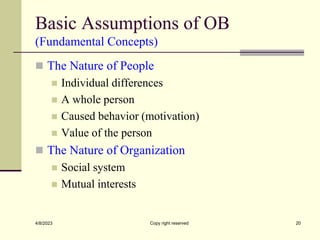
Basic Assumptions of OB
(Fundamental Concepts)
 The Nature of People
 Individual differences
 A whole person
 Caused behavior (motivation)
 Value of the person
 The Nature of Organization
 Social system
 Mutual interests
4/8/2023 Copy right reserved 20

organizational behavior.ppt

  • 1.
    Organizational Behavior Dr. GopalThapa Tribhuvan University
  • 2.
    Organizational Behavior  Organization Behavior 4/8/2023 Copy right reserved 2
  • 3.
    Organization  An organizationis purposeful combination of two or more people who independent with each other to achieve specific goal.  It is composed of people, structure and technology for the purpose of attainment of a common purpose in a changing enviornment 4/8/2023 Copy right reserved 3
  • 4.
    Organization 4/8/2023 Copy rightreserved 4 An organization is a consciously coordinated social unit, composed of two or more people that functions on a relatively continuous basis to achieve a common goal or set of goals. Stephen P. Robbins San Diego State University
  • 5.
    Characteristics of Organization Goal oriented  People  Structure  Technology  Continuity  Environment 4/8/2023 Copy right reserved 5
  • 6.
    Behavior 4/8/2023 Copy rightreserved 6 Behavior is anything that the human does. Fred Luthans University of Nebraska
  • 7.
    Organizational Behavior  Organizationalbehavior is directly concerned with the understanding, prediction, and control of human behavior in organizations.  Organizational behavior is the study of both group and individual performance and activity within an organization. 4/8/2023 Copy right reserved 7
  • 8.
    Organizational Behavior 4/8/2023 Copyright reserved 8 Organizational behavior is the understanding, prediction and management of human behavior in organization Fred Luthans University of Nebraska
  • 9.
    Characteristics of OB Science and art  Rational  People oriented  Multidisciplinary  A total system approach  Goal oriented  Applied science  Multi level existence 4/8/2023 Copy right reserved 9
  • 10.
    Key Elements ofOB  People.  Structure.  Technology.  Environment. 4/8/2023 Copy right reserved 10
  • 11.
    OB: Multidisciplinary  Psychology. Sociology.  Social Psychology.  Anthropology.  Political Sciences.  Economics. 4/8/2023 Copy right reserved 11
  • 12.
    Levels of OB 4/8/2023Copy right reserved 12
  • 13.
    OB System  Input(independent variables)  Individual level variables  Group levels variables  Organizational level variables 4/8/2023 Copy right reserved 13
  • 14.
    OB System  Input(independent variables)  Individual level variables  Biological characteristics  Ability  Values  Attitudes  Personality  Emotions etc. 4/8/2023 Copy right reserved 14
  • 15.
    OB System  Input(independent variables)  Group levels variables  Task Characteristics  Group composition  Group size etc. 4/8/2023 Copy right reserved 15
  • 16.
    OB System  Input(independent variables)  Organizational level variables  Organizational structure  Culture  Leadership etc. 4/8/2023 Copy right reserved 16
  • 17.
    OB System  Processes(Organism)  Individual process  Motivation, perception, learning , decision making  Group process  Group dynamics, communication, leadership, conflict, power and process  Organizational process  Design of formal organization, HR policies and practices, Interaction with external environment 4/8/2023 Copy right reserved 17
  • 18.
    OB System  Output(Dependent variables)  Productivity  Absenteeism  Turnover  Citizenship (Organizational citizenship behavior)  Job Satisfaction 4/8/2023 Copy right reserved 18
  • 19.
    OB System 4/8/2023 Copyright reserved 19
  • 20.
    Basic Assumptions ofOB (Fundamental Concepts)  The Nature of People  Individual differences  A whole person  Caused behavior (motivation)  Value of the person  The Nature of Organization  Social system  Mutual interests 4/8/2023 Copy right reserved 20