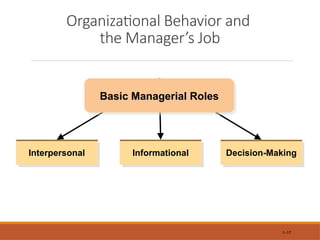
Organizational Behaviour
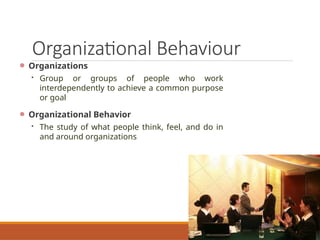
Organizations
Groupor groups of people who work
interdependently to achieve a common purpose
or goal
Organizational Behavior
The study of what people think, feel, and do in
and around organizations
3.
Organizational Behavior
A fieldof study that investigates the impact
that individuals, groups, and structure have on
behavior within organizations, for the purpose
of applying such knowledge toward improving
an organization’s effectiveness.
1-3
4.
What is Organizational
Behavior?
Organizationalbehavior (OB) is the study of:
◦ Human behavior in organizational settings
◦ The interface between human behavior and the organization
◦ The organization itself
1–4
5.
The Importance of
OrganizationalBehavior
Organizations can have a powerful influence on our lives:
◦ Most people are born and educated in organizations
◦ Most people acquire most of their material possessions from organizations
◦ Most people die as members of organizations
◦ Many of our activities are regulated by governmental organizations
◦ Most people spend most of their lives in organizations
1–5
6.
Why Study OB?
Studyingorganizational behavior can clarify factors that affect how
managers manage by:
◦ Describing the complex human context of organizations
◦ Defining the associated opportunities, problems, challenges, and issues
◦ Isolating important aspects of the manager’s job
◦ Offering specific perspectives on the human side of management
1–6
7.
Why Study OB?(cont’d)
Studying OB helps managers understand:
◦ The behaviors of others in the organization
◦ Personal needs, motives, behaviors, feelings and career dynamics
◦ Attitudinal processes, individual differences, group dynamics, inter group dynamics, organization
culture, power, and political behavior
◦ Interactions with people outside of the organization and other organizations
◦ The environment, technology, and global issues
1–7
8.
Why study OB?
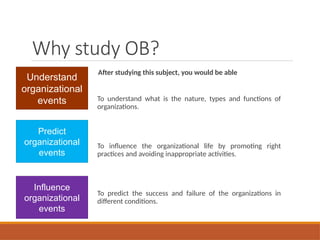
Afterstudying this subject, you would be able
To understand what is the nature, types and functions of
organizations.
To influence the organizational life by promoting right
practices and avoiding inappropriate activities.
To predict the success and failure of the organizations in
different conditions.
Understand
organizational
events
Predict
organizational
events
Influence
organizational
events
9.
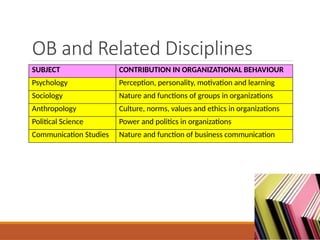
OB and RelatedDisciplines
SUBJECT CONTRIBUTION IN ORGANIZATIONAL BEHAVIOUR
Psychology Perception, personality, motivation and learning
Sociology Nature and functions of groups in organizations
Anthropology Culture, norms, values and ethics in organizations
Political Science Power and politics in organizations
Communication Studies Nature and function of business communication
10.
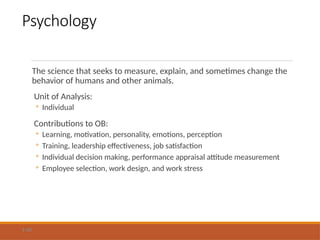
Psychology
The science thatseeks to measure, explain, and sometimes change the
behavior of humans and other animals.
Unit of Analysis:
◦ Individual
Contributions to OB:
◦ Learning, motivation, personality, emotions, perception
◦ Training, leadership effectiveness, job satisfaction
◦ Individual decision making, performance appraisal attitude measurement
◦ Employee selection, work design, and work stress
1-10
11.
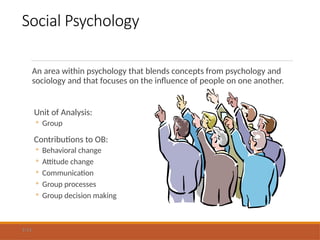
Social Psychology
An areawithin psychology that blends concepts from psychology and
sociology and that focuses on the influence of people on one another.
Unit of Analysis:
◦ Group
Contributions to OB:
◦ Behavioral change
◦ Attitude change
◦ Communication
◦ Group processes
◦ Group decision making
1-11
12.
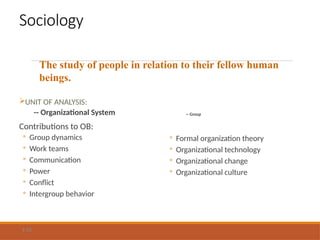
Sociology
UNIT OF ANALYSIS:
--Organizational System
Contributions to OB:
◦ Group dynamics
◦ Work teams
◦ Communication
◦ Power
◦ Conflict
◦ Intergroup behavior
-- Group
◦ Formal organization theory
◦ Organizational technology
◦ Organizational change
◦ Organizational culture
1-12
The study of people in relation to their fellow human
beings.
13.
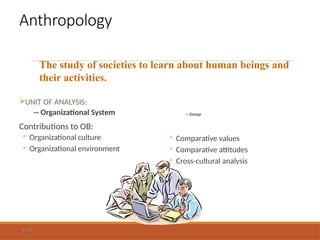
Anthropology
UNIT OF ANALYSIS:
--Organizational System
Contributions to OB:
◦ Organizational culture
◦ Organizational environment
-- Group
◦ Comparative values
◦ Comparative attitudes
◦ Cross-cultural analysis
1-13
The study of societies to learn about human beings and
their activities.
14.
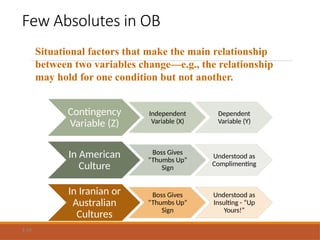
Few Absolutes inOB
Contingency
Variable (Z)
Independent
Variable (X)
Dependent
Variable (Y)
In American
Culture
Boss Gives
“Thumbs Up”
Sign
Understood as
Complimenting
In Iranian or
Australian
Cultures
Boss Gives
“Thumbs Up”
Sign
Understood as
Insulting - “Up
Yours!”
1-14
Situational factors that make the main relationship
between two variables change—e.g., the relationship
may hold for one condition but not another.
15.
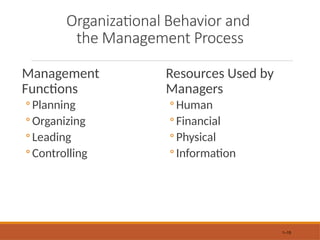
Organizational Behavior and
theManagement Process
Management
Functions
◦ Planning
◦ Organizing
◦ Leading
◦ Controlling
Resources Used by
Managers
◦ Human
◦ Financial
◦ Physical
◦ Information
1–15
16.
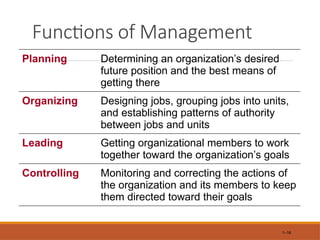
Functions of Management
1–16
PlanningDetermining an organization’s desired
future position and the best means of
getting there
Organizing Designing jobs, grouping jobs into units,
and establishing patterns of authority
between jobs and units
Leading Getting organizational members to work
together toward the organization’s goals
Controlling Monitoring and correcting the actions of
the organization and its members to keep
them directed toward their goals
1–18
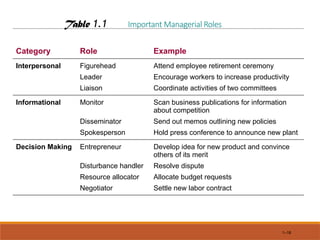
Table 1.1 ImportantManagerial Roles
Category Role Example
Interpersonal Figurehead Attend employee retirement ceremony
Leader Encourage workers to increase productivity
Liaison Coordinate activities of two committees
Informational Monitor Scan business publications for information
about competition
Disseminator Send out memos outlining new policies
Spokesperson Hold press conference to announce new plant
Decision Making Entrepreneur Develop idea for new product and convince
others of its merit
Disturbance handler Resolve dispute
Resource allocator Allocate budget requests
Negotiator Settle new labor contract
19.
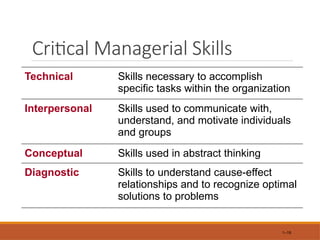
Critical Managerial Skills
1–19
TechnicalSkills necessary to accomplish
specific tasks within the organization
Interpersonal Skills used to communicate with,
understand, and motivate individuals
and groups
Conceptual Skills used in abstract thinking
Diagnostic Skills to understand cause-effect
relationships and to recognize optimal
solutions to problems
20.
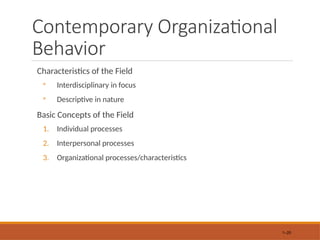
Contemporary Organizational
Behavior
Characteristics ofthe Field
◦ Interdisciplinary in focus
◦ Descriptive in nature
Basic Concepts of the Field
1. Individual processes
2. Interpersonal processes
3. Organizational processes/characteristics
1–20
21.
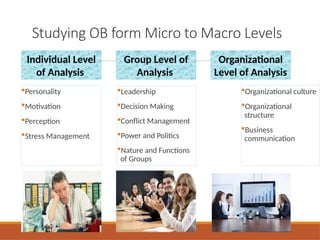
Studying OB formMicro to Macro Levels
Personality
Motivation
Perception
Stress Management
Leadership
Decision Making
Conflict Management
Power and Politics
Nature and Functions
of Groups
Organizational culture
Organizational
structure
Business
communication
Individual Level
of Analysis
Group Level of
Analysis
Organizational
Level of Analysis
22.
Methods of Researchin OB
Case Studies
Survey Research
Qualitative Research
Experimental Research
Observational Research
#10 Psychology focuses on the individual level by seeking to measure, explain, and sometimes change behaviors in individuals. This area of study offers insights in such areas as learning, training, decision making, and employee selection.
#11 Social Psychology moves beyond individual analysis to look at group behavior and how individuals can influence on another. It blends together sociology and psychology and looks primarily at change, communication, and group interactions.
#12 Sociology looks at the relationship between individuals and their environment. Sociologists’ main contribution to OB is through offering a better understanding of group behavior. It looks more at how a group operates within an organizational system. One key area that sociologists contribute to in OB is culture, a key factor in OB studies.
#13 An Anthropologist studies societies to learn about the human beings and their activities. They help us understand the differences between different groups in terms of their values, attitudes, and behaviors.
#14 There are few absolutes in organizational behavior. When making decisions, you must always take into account situational factors that can change the relationship between two variables. For example, as seen in this chart, one message from a boss in an American culture can mean a completely different thing in another culture. It is always important to take context into account.