16-1

Organizational Structure and
Design

McGraw-Hill/Irwin

© 2005 The McGraw-Hill Companies, Inc. All rights reserved.
16-2

Organization structure – the pattern
of jobs and groups of jobs in an
organization.
It is an important cause of individual
and group behavior.

McGraw-Hill/Irwin

© 2005 The McGraw-Hill Companies, Inc. All rights reserved.
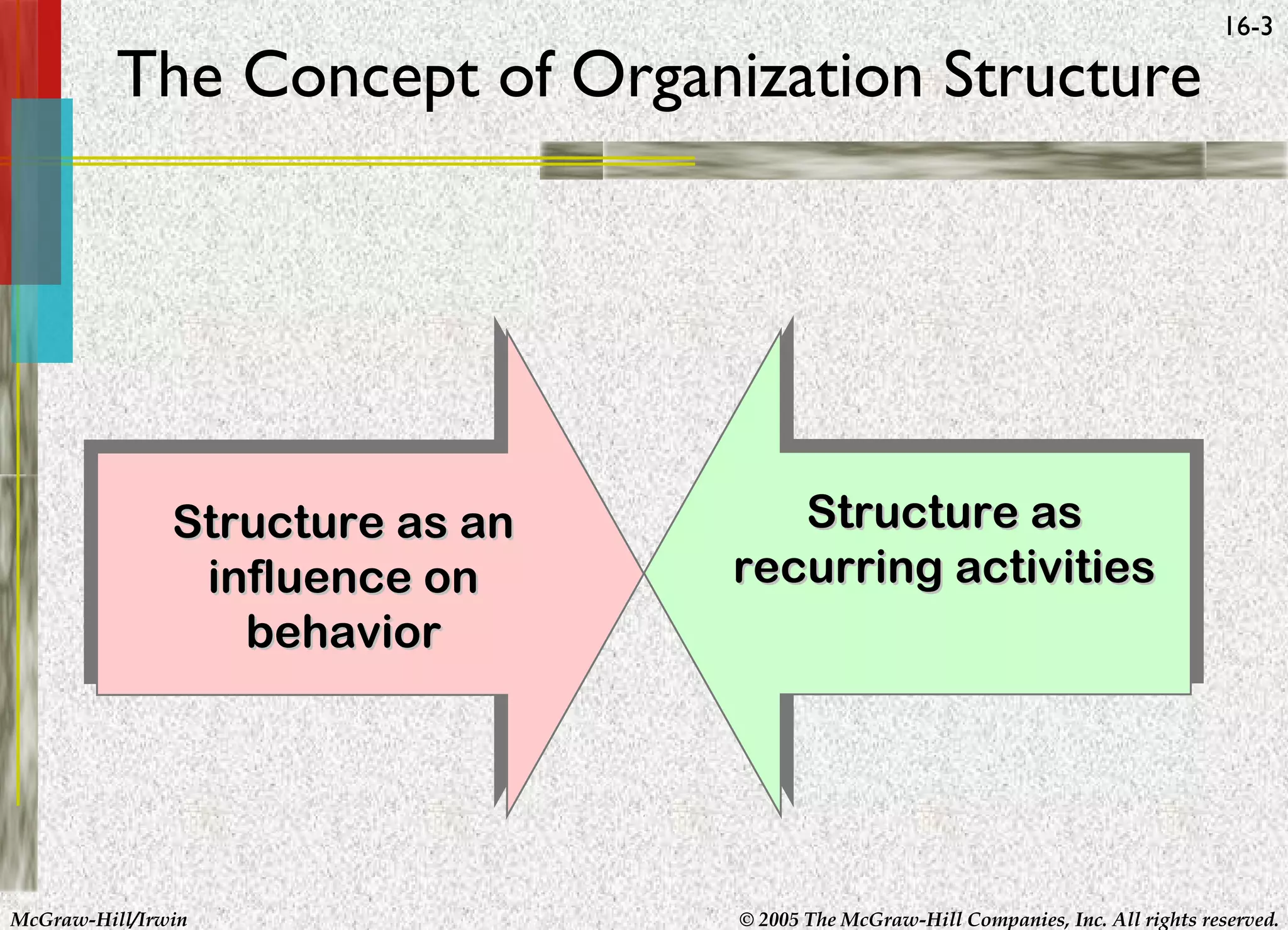
The Concept of Organization Structure

Structure as an
influence on
behavior

McGraw-Hill/Irwin

16-3

Structure as
recurring activities

© 2005 The McGraw-Hill Companies, Inc. All rights reserved.
16-4

Organization design – management
decisions and actions that result in a
specific organization structure.

McGraw-Hill/Irwin

© 2005 The McGraw-Hill Companies, Inc. All rights reserved.
Organizational Design Decisions

16-5

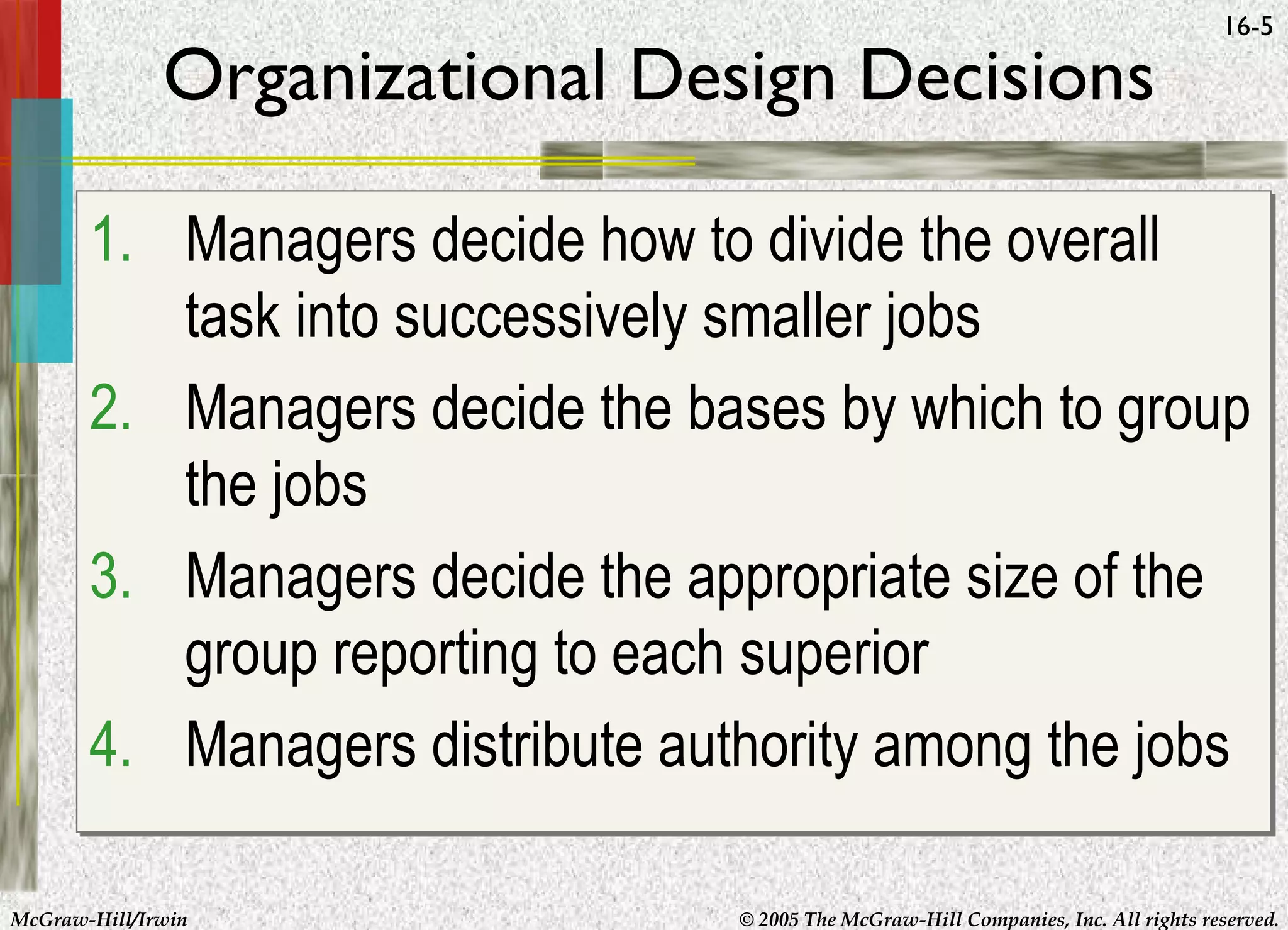
1. Managers decide how to divide the overall
task into successively smaller jobs
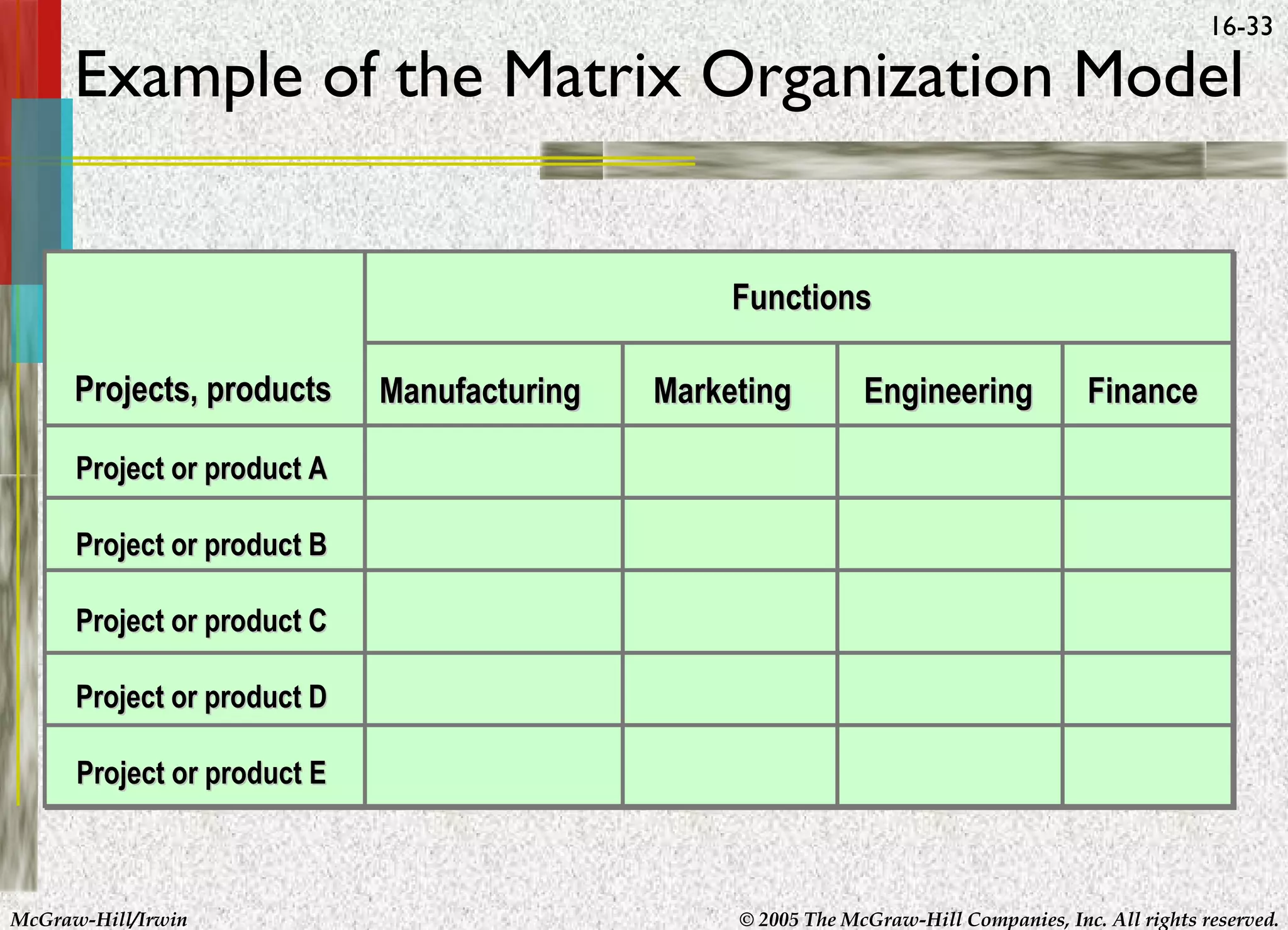
2. Managers decide the bases by which to group
the jobs
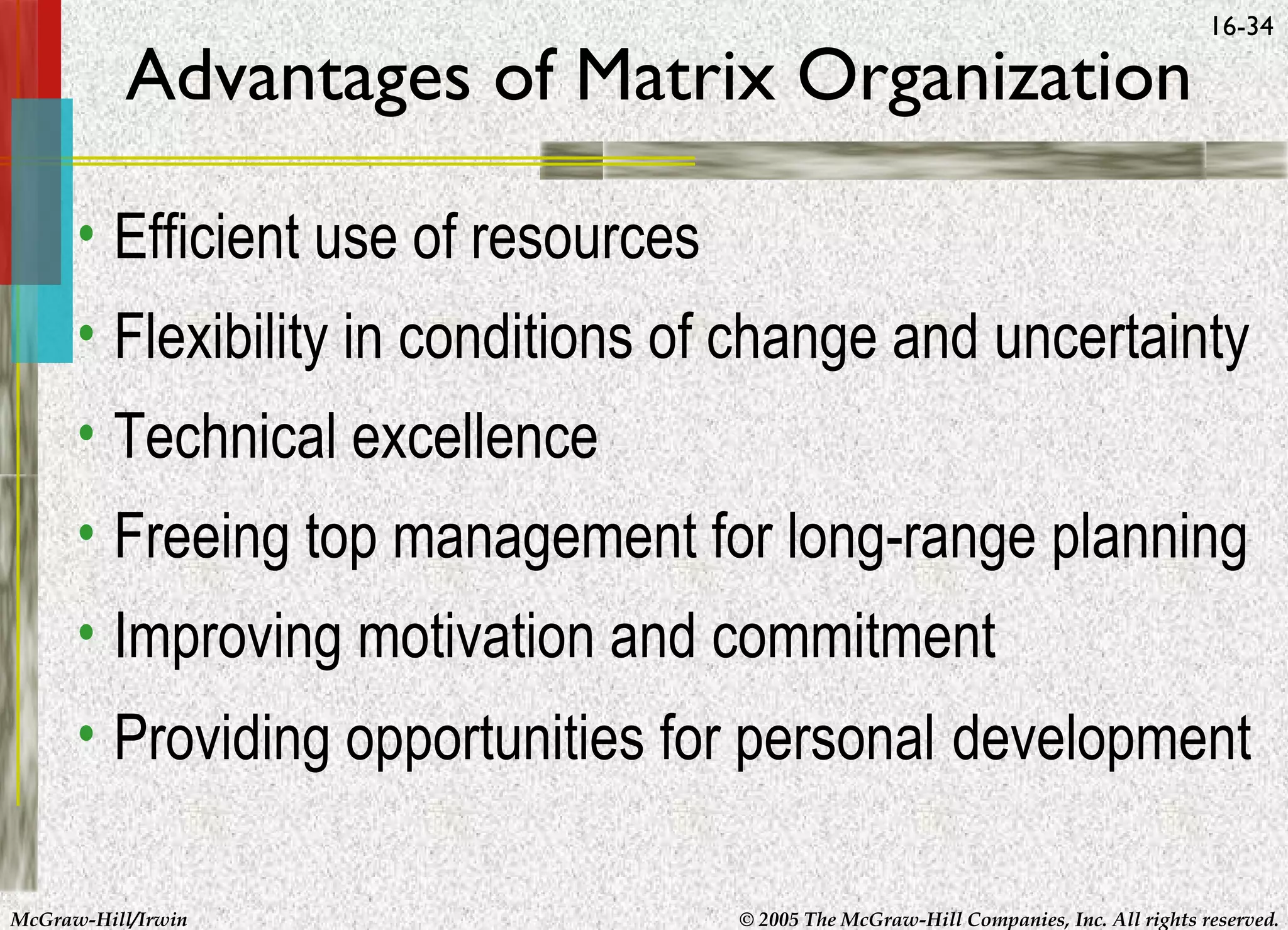
3. Managers decide the appropriate size of the
group reporting to each superior
4. Managers distribute authority among the jobs
McGraw-Hill/Irwin

© 2005 The McGraw-Hill Companies, Inc. All rights reserved.
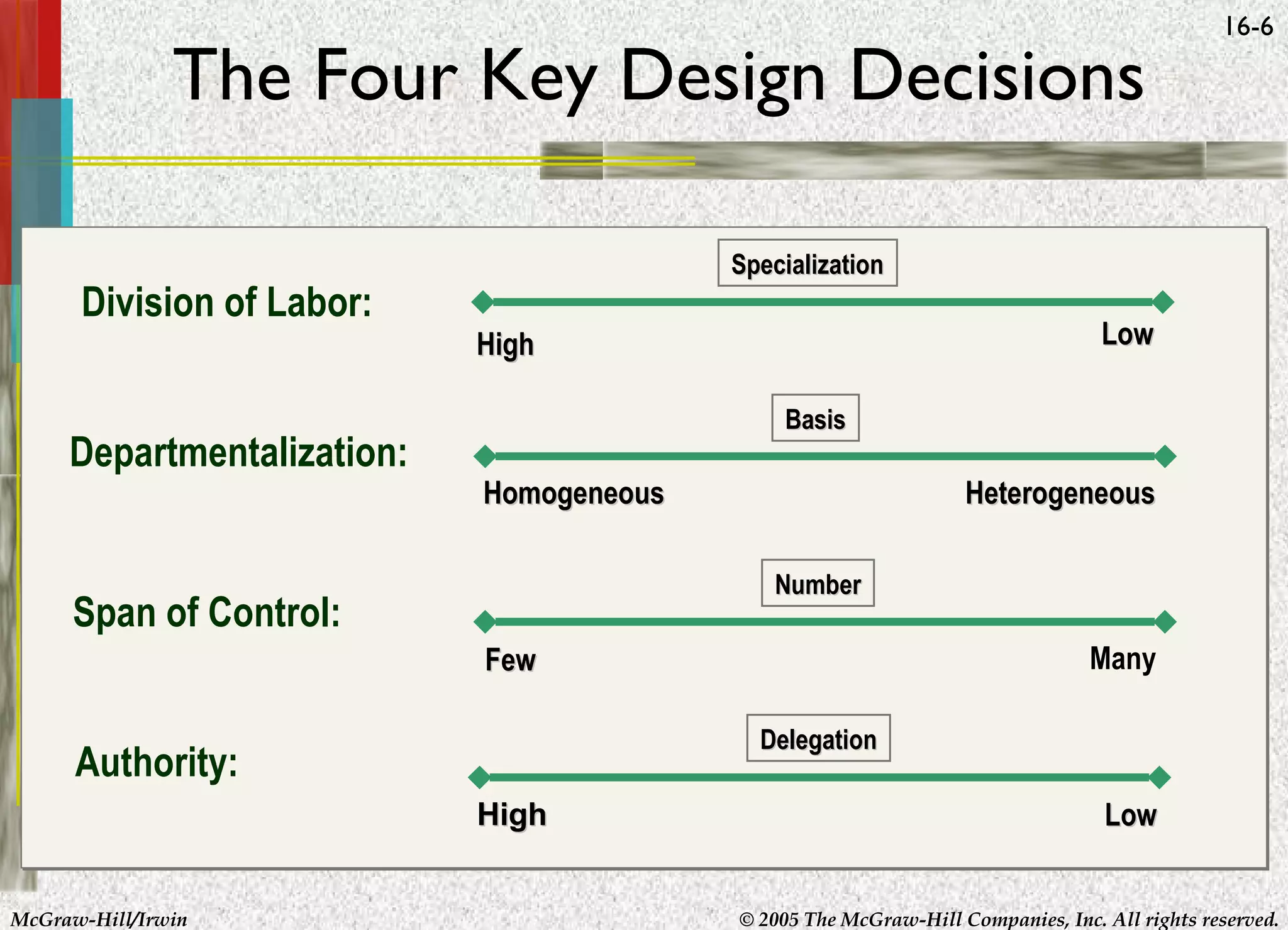
The Four Key Design Decisions
Specialization

Division of Labor:

Low

High

Departmentalization:

Basis

Homogeneous

Heterogeneous
Number

Span of Control:

Many

Few
Delegation

Authority:
High
McGraw-Hill/Irwin

16-6

Low
© 2005 The McGraw-Hill Companies, Inc. All rights reserved.
Division of Labor

16-7

• Division of labor – concerns the extent
to which jobs are specialized
• It is the process of dividing work into
relatively specialized jobs to achieve
advantages of specialization

McGraw-Hill/Irwin

© 2005 The McGraw-Hill Companies, Inc. All rights reserved.
Division of Labor Occurs in Three
Different Ways:

16-8

1. Personal specialties
• e.g., accountants, software engineers, graphic
designers, scientists, etc.

2. Natural sequence of work
• e.g., dividing work in a manufacturing plant into
fabricating and assembly (horizontal specialization)

3. Vertical plane
• e.g., hierarchy of authority from lowest-level manager
to highest-level manager
McGraw-Hill/Irwin

© 2005 The McGraw-Hill Companies, Inc. All rights reserved.
Delegation of Authority

16-9

• Managers decide how much authority
should be delegated to each job and to
each jobholder
• Delegation of authority – process of
distributing authority downward in an
organization

McGraw-Hill/Irwin

© 2005 The McGraw-Hill Companies, Inc. All rights reserved.
Reasons to Decentralize Authority

16-10

1. Relatively high delegation of authority
encourages the development of professional
managers
2. High delegation of authority can lead to a
competitive climate within the organization
3. Managers who have relatively high authority
can exercise more autonomy, and thus satisfy
their desires to participate in problem solving
McGraw-Hill/Irwin

© 2005 The McGraw-Hill Companies, Inc. All rights reserved.
16-11

Reasons to Centralize Authority (1 of 2)
1. Managers must be trained to make the
decisions that go with delegated authority
2. Many managers are accustomed to making
decisions and resist delegating authority to
their subordinates

McGraw-Hill/Irwin

© 2005 The McGraw-Hill Companies, Inc. All rights reserved.
16-12

Reasons to Centralize Authority (2 of 2)

3. Administrative costs are incurred because new
control systems must be developed to provide
top management with information about the
effects of subordinates’ decisions
4. Decentralization means duplication of
functions

McGraw-Hill/Irwin

© 2005 The McGraw-Hill Companies, Inc. All rights reserved.
16-13

Delegation Decision Guidelines (1 of 2)
• How routine and straightforward are the job’s or
unit’s required decisions?
• The authority for routine decisions can be
centralized

• Are individuals competent to make the decision?
• Even if the decision is non-routine, if the local
manager is not capable, then the decision should be
centralized
• Delegation of authority can differ among individuals
depending upon each one’s ability to make the
decision

McGraw-Hill/Irwin

© 2005 The McGraw-Hill Companies, Inc. All rights reserved.
16-14

Delegation Decision Guidelines (2 of 2)
• Are individuals motivated to make the decision?
• Capable individuals are not always motivated
individuals
• Motivation must accompany competency to create
conducive conditions for decentralization

• Do the benefits of decentralization outweigh its
costs?

McGraw-Hill/Irwin

© 2005 The McGraw-Hill Companies, Inc. All rights reserved.
16-15

Departmentalization – process in
which an organization is
structurally divided by combining
jobs in departments according to
some shared characteristic or
basis.

McGraw-Hill/Irwin

© 2005 The McGraw-Hill Companies, Inc. All rights reserved.
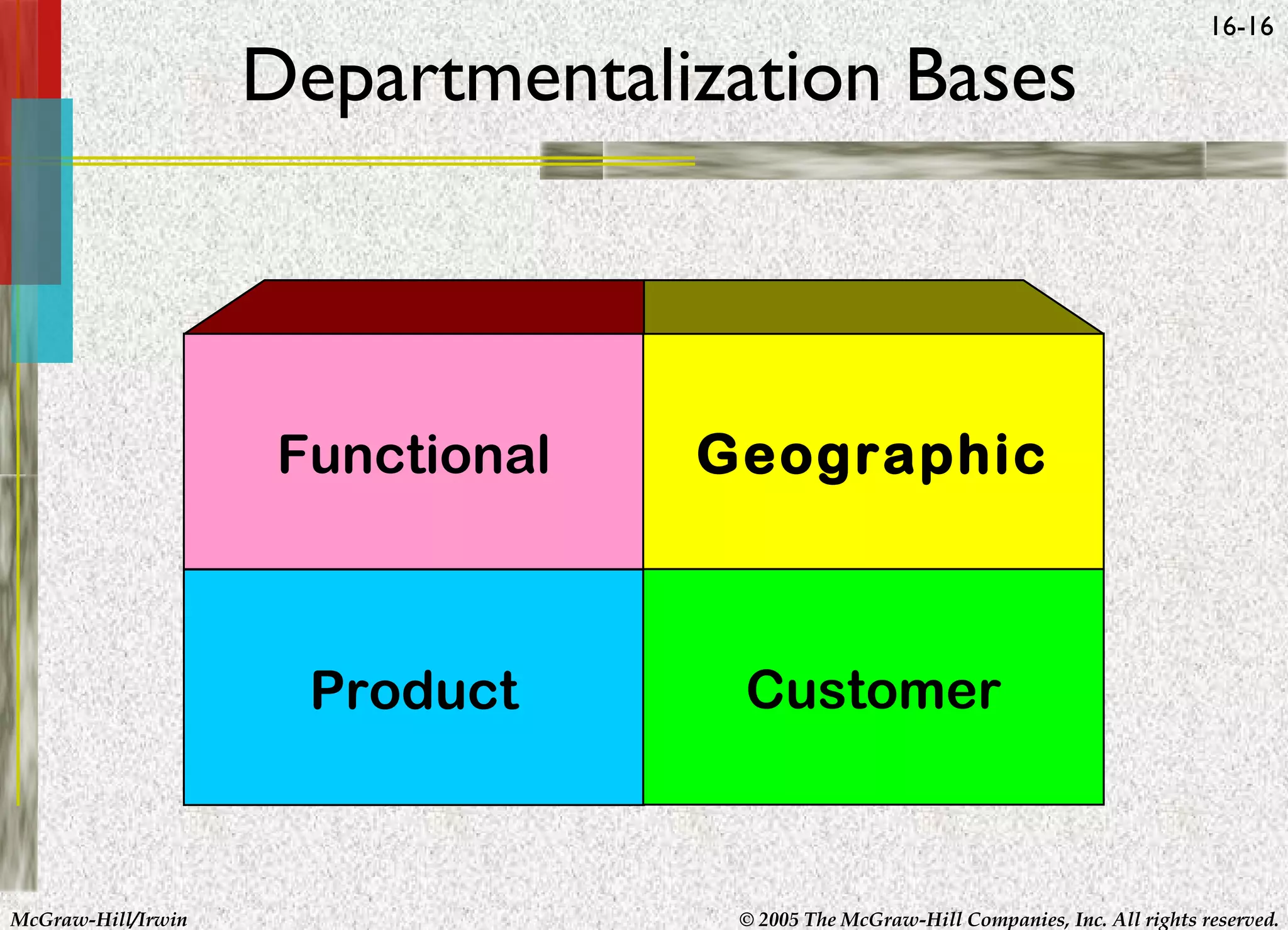
Departmentalization Bases

Functional

McGraw-Hill/Irwin

Geographic

Product

16-16

Customer

© 2005 The McGraw-Hill Companies, Inc. All rights reserved.
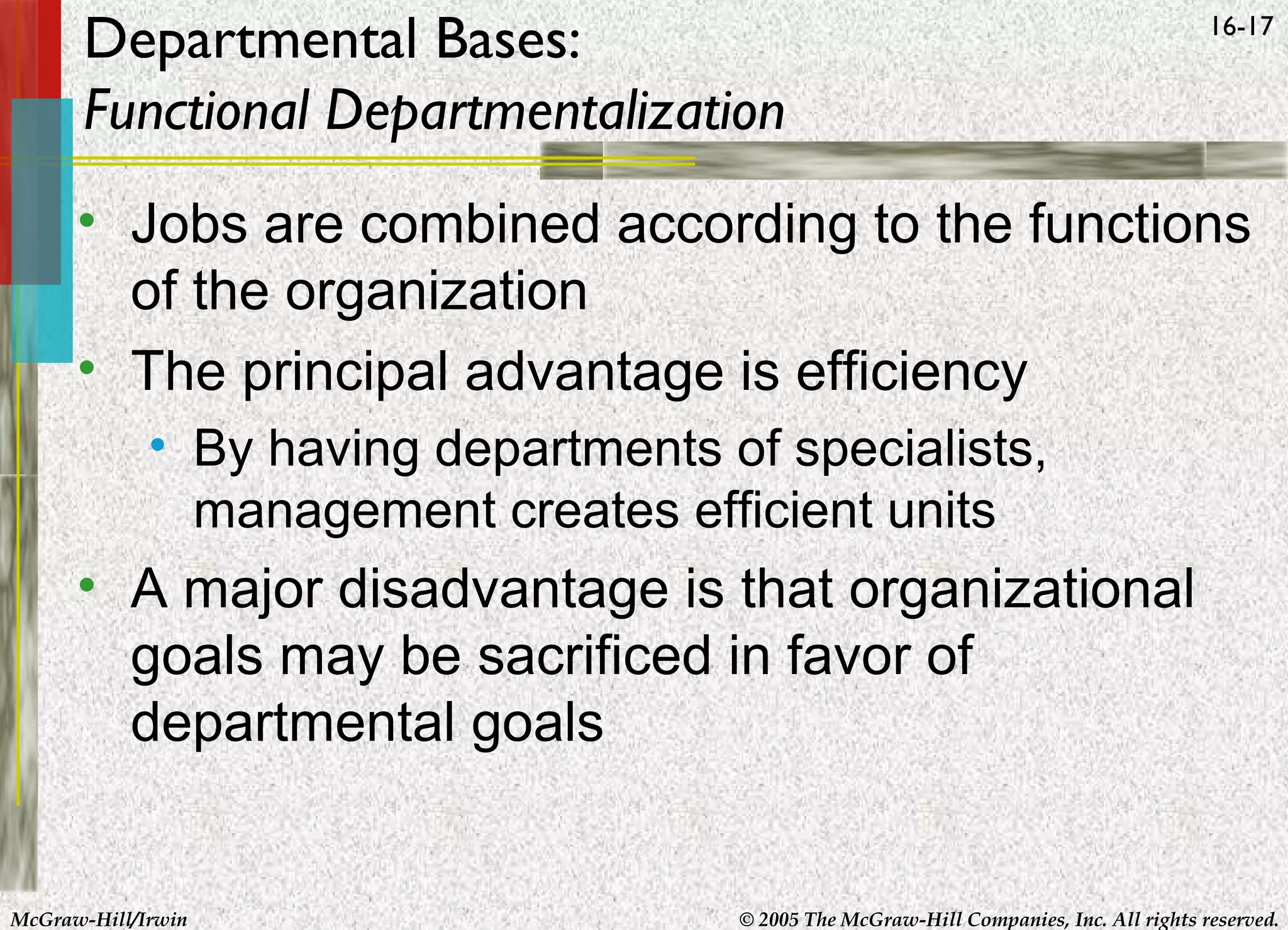
Departmental Bases:
Functional Departmentalization

16-17

• Jobs are combined according to the functions
of the organization
• The principal advantage is efficiency
• By having departments of specialists,
management creates efficient units

• A major disadvantage is that organizational
goals may be sacrificed in favor of
departmental goals

McGraw-Hill/Irwin

© 2005 The McGraw-Hill Companies, Inc. All rights reserved.
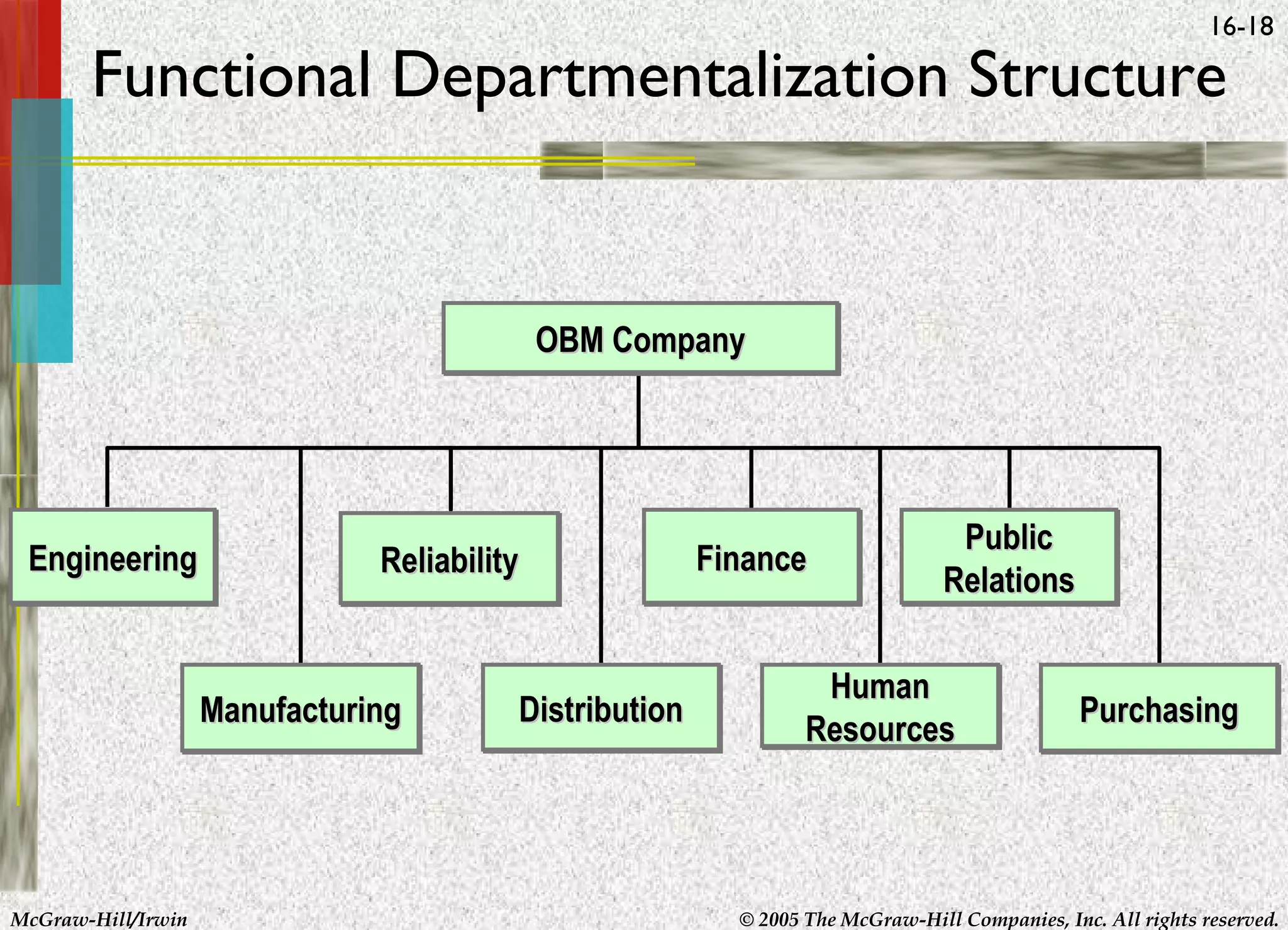
16-18

Functional Departmentalization Structure

OBM Company
OBM

Engineering
Engineering

Reliability

Manufacturing

McGraw-Hill/Irwin

Distribution
Distribution

Finance
Finance

Public
Public
Relations
Relations

Human
Human
Resources
Resources

Purchasing

© 2005 The McGraw-Hill Companies, Inc. All rights reserved.
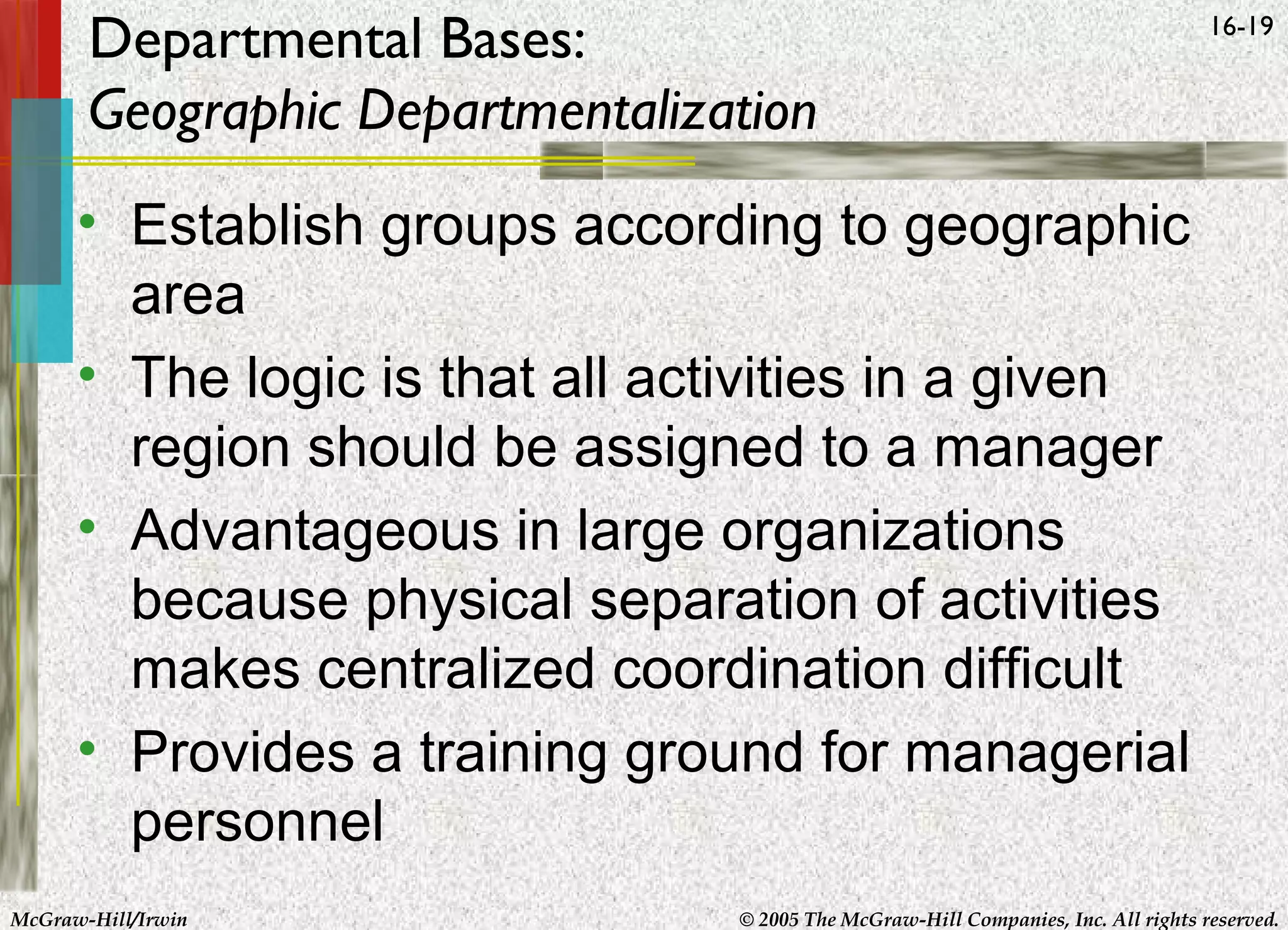
Departmental Bases:
Geographic Departmentalization

16-19

• Establish groups according to geographic
area
• The logic is that all activities in a given
region should be assigned to a manager
• Advantageous in large organizations
because physical separation of activities
makes centralized coordination difficult
• Provides a training ground for managerial
personnel
McGraw-Hill/Irwin

© 2005 The McGraw-Hill Companies, Inc. All rights reserved.
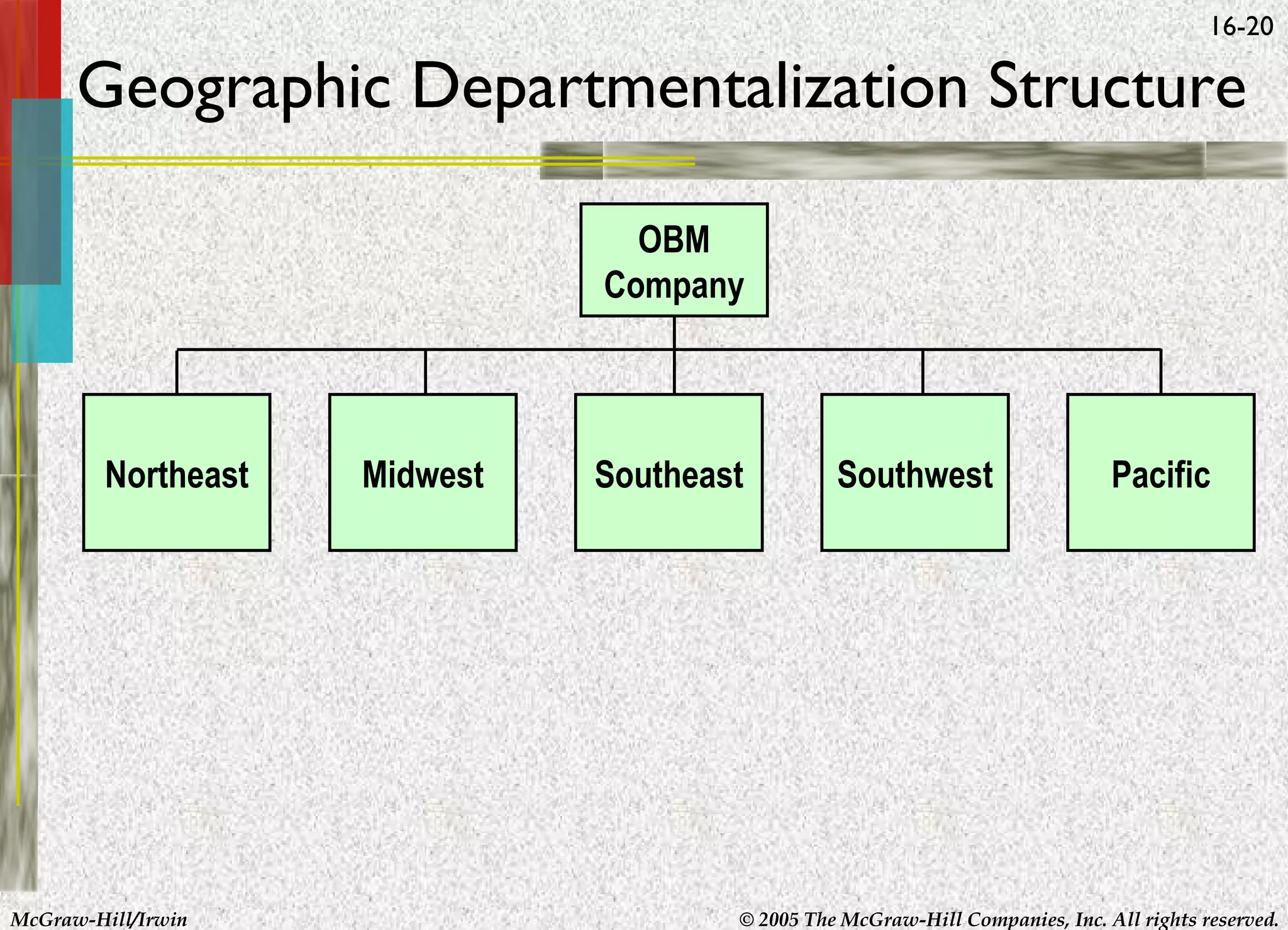
16-20

Geographic Departmentalization Structure
OBM
Company

Northeast

McGraw-Hill/Irwin

Midwest

Southeast

Southwest

Pacific

© 2005 The McGraw-Hill Companies, Inc. All rights reserved.
Departmental Bases:
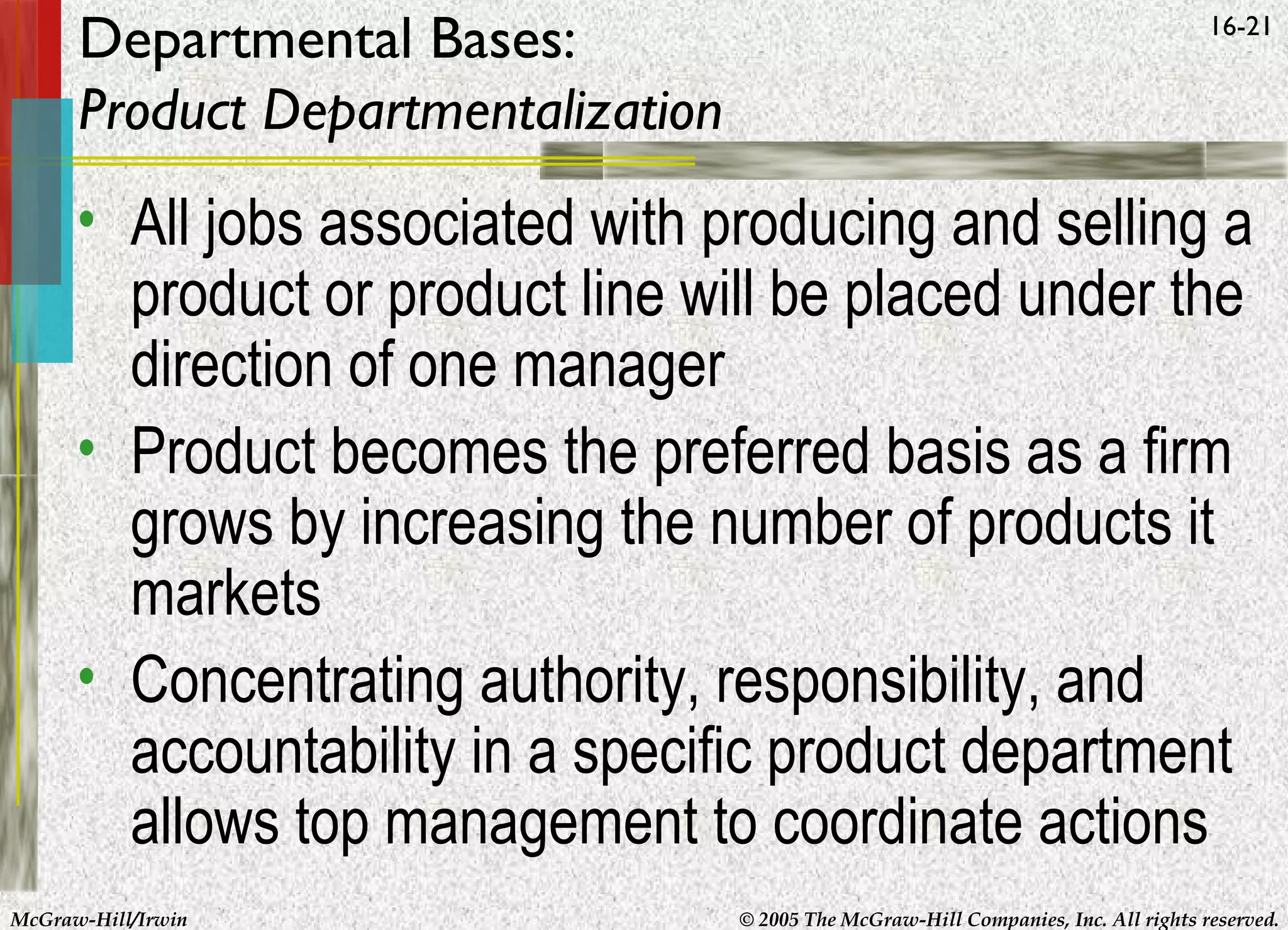
Product Departmentalization

16-21

• All jobs associated with producing and selling a
product or product line will be placed under the
direction of one manager
• Product becomes the preferred basis as a firm
grows by increasing the number of products it
markets
• Concentrating authority, responsibility, and
accountability in a specific product department
allows top management to coordinate actions
McGraw-Hill/Irwin

© 2005 The McGraw-Hill Companies, Inc. All rights reserved.
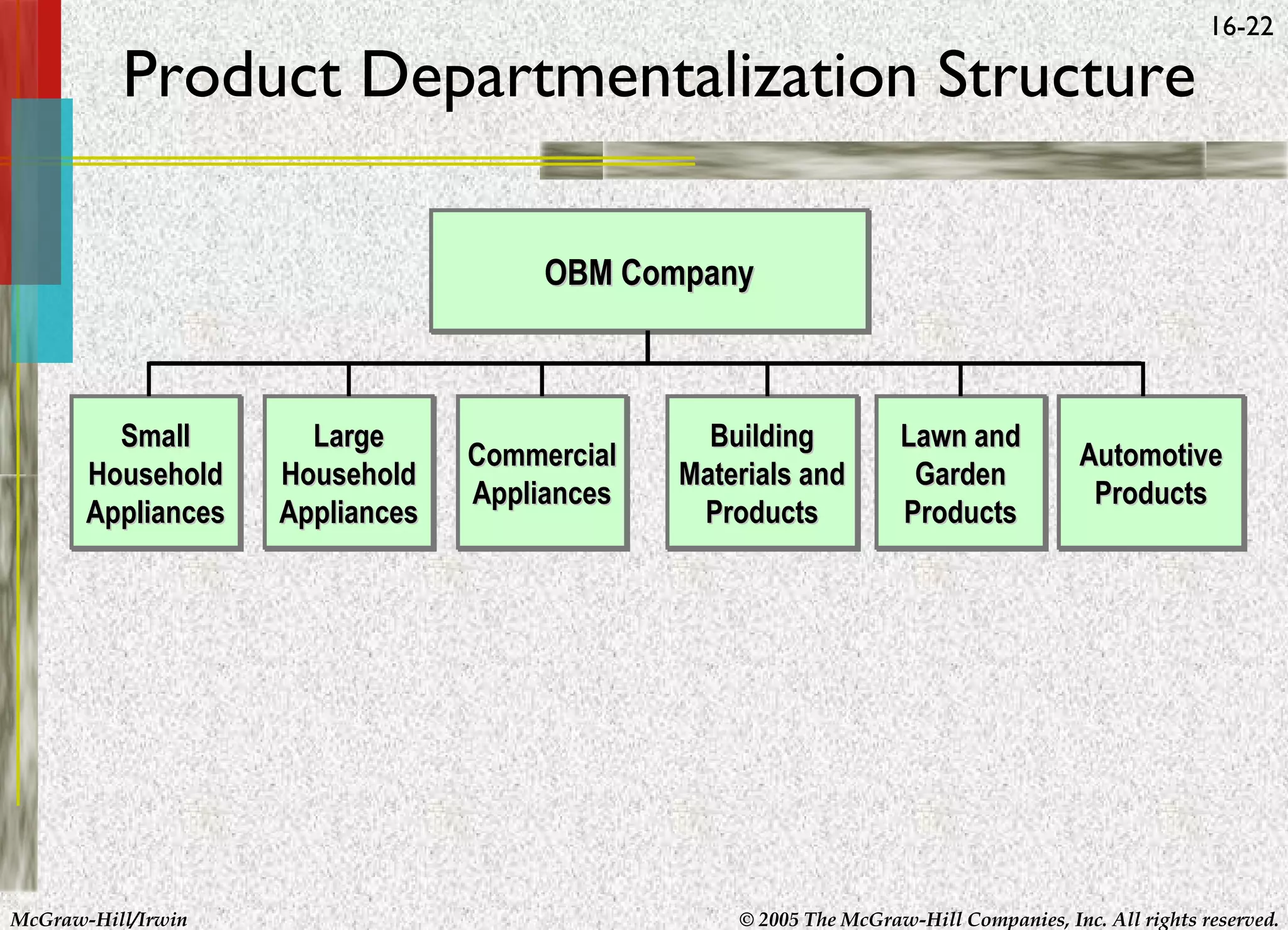
Product Departmentalization Structure

16-22

OBM Company
OBM Company

Small
Small
Household
Household
Appliances
Appliances
McGraw-Hill/Irwin

Large
Large
Household
Household
Appliances
Appliances

Commercial
Commercial
Appliances
Appliances

Building
Building
Materials and
Materials and
Products
Products

Lawn and
Lawn and
Garden
Garden
Products
Products

Automotive
Automotive
Products
Products

© 2005 The McGraw-Hill Companies, Inc. All rights reserved.
Departmental Bases:
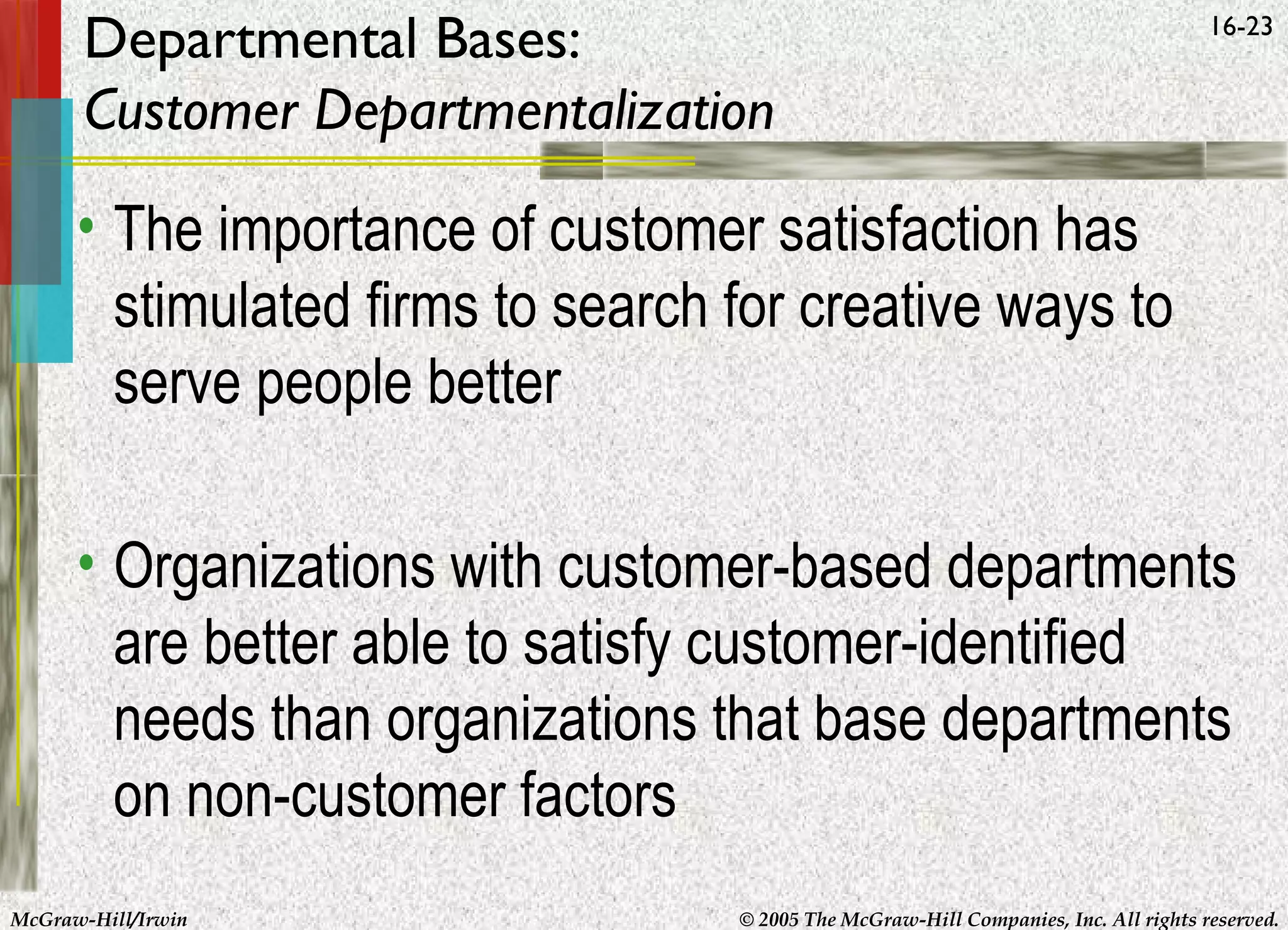
Customer Departmentalization

16-23

• The importance of customer satisfaction has
stimulated firms to search for creative ways to
serve people better
• Organizations with customer-based departments
are better able to satisfy customer-identified
needs than organizations that base departments
on non-customer factors
McGraw-Hill/Irwin

© 2005 The McGraw-Hill Companies, Inc. All rights reserved.
16-24

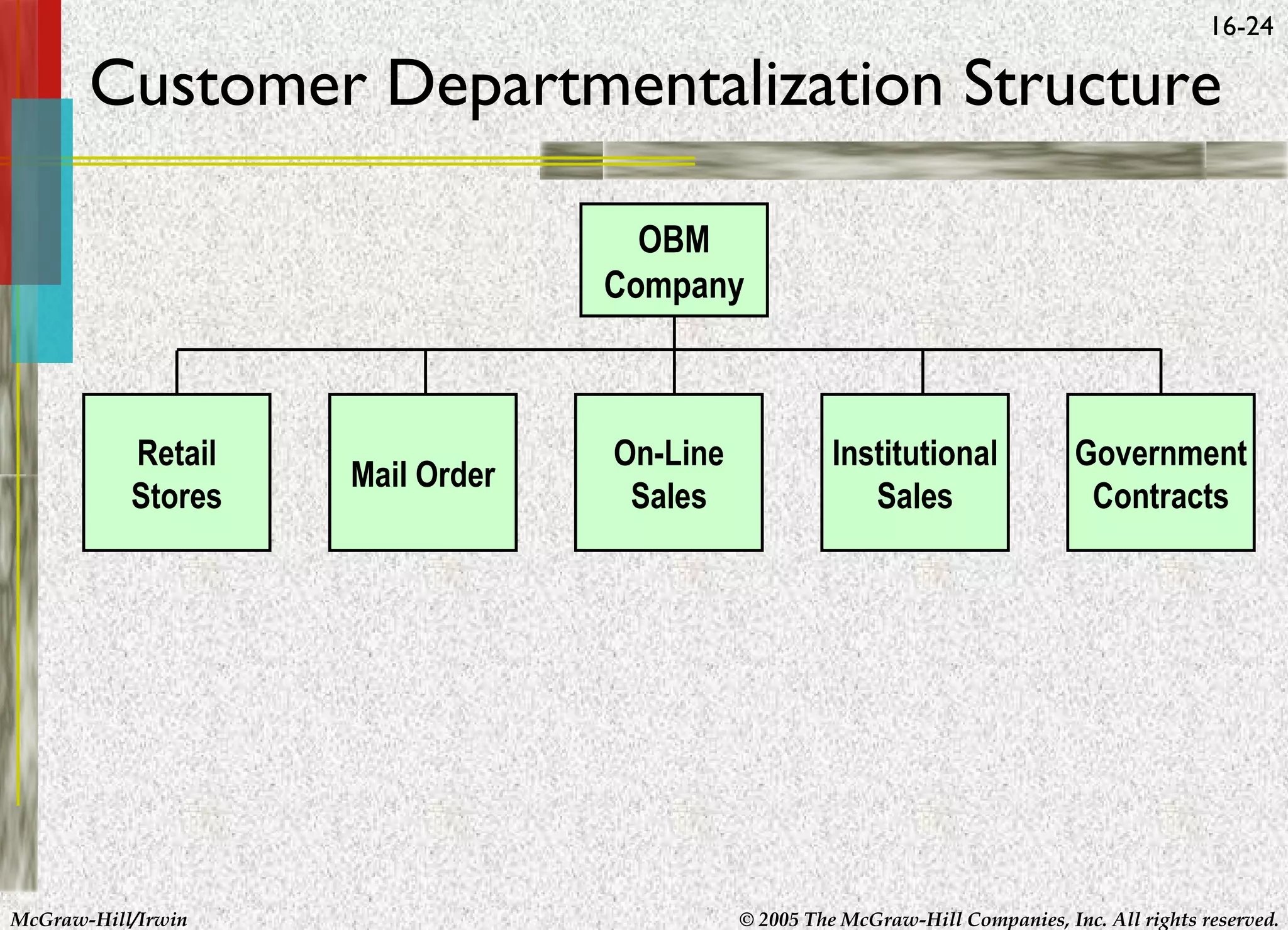
Customer Departmentalization Structure
OBM
Company

Retail
Stores

McGraw-Hill/Irwin

Mail Order

On-Line
Sales

Institutional
Sales

Government
Contracts

© 2005 The McGraw-Hill Companies, Inc. All rights reserved.
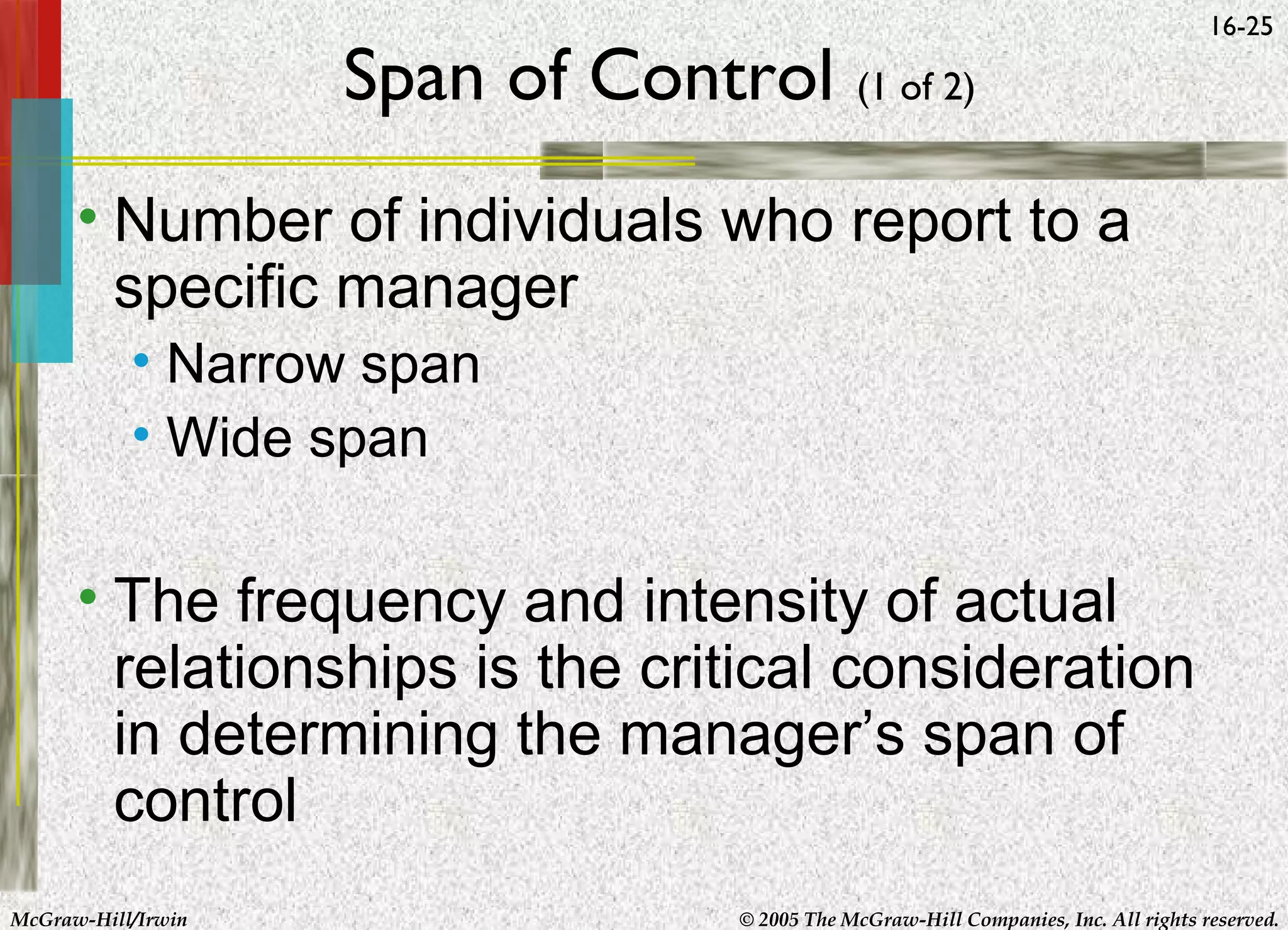
Span of Control (1 of 2)

16-25

• Number of individuals who report to a
specific manager
• Narrow span
• Wide span

• The frequency and intensity of actual
relationships is the critical consideration
in determining the manager’s span of
control
McGraw-Hill/Irwin

© 2005 The McGraw-Hill Companies, Inc. All rights reserved.
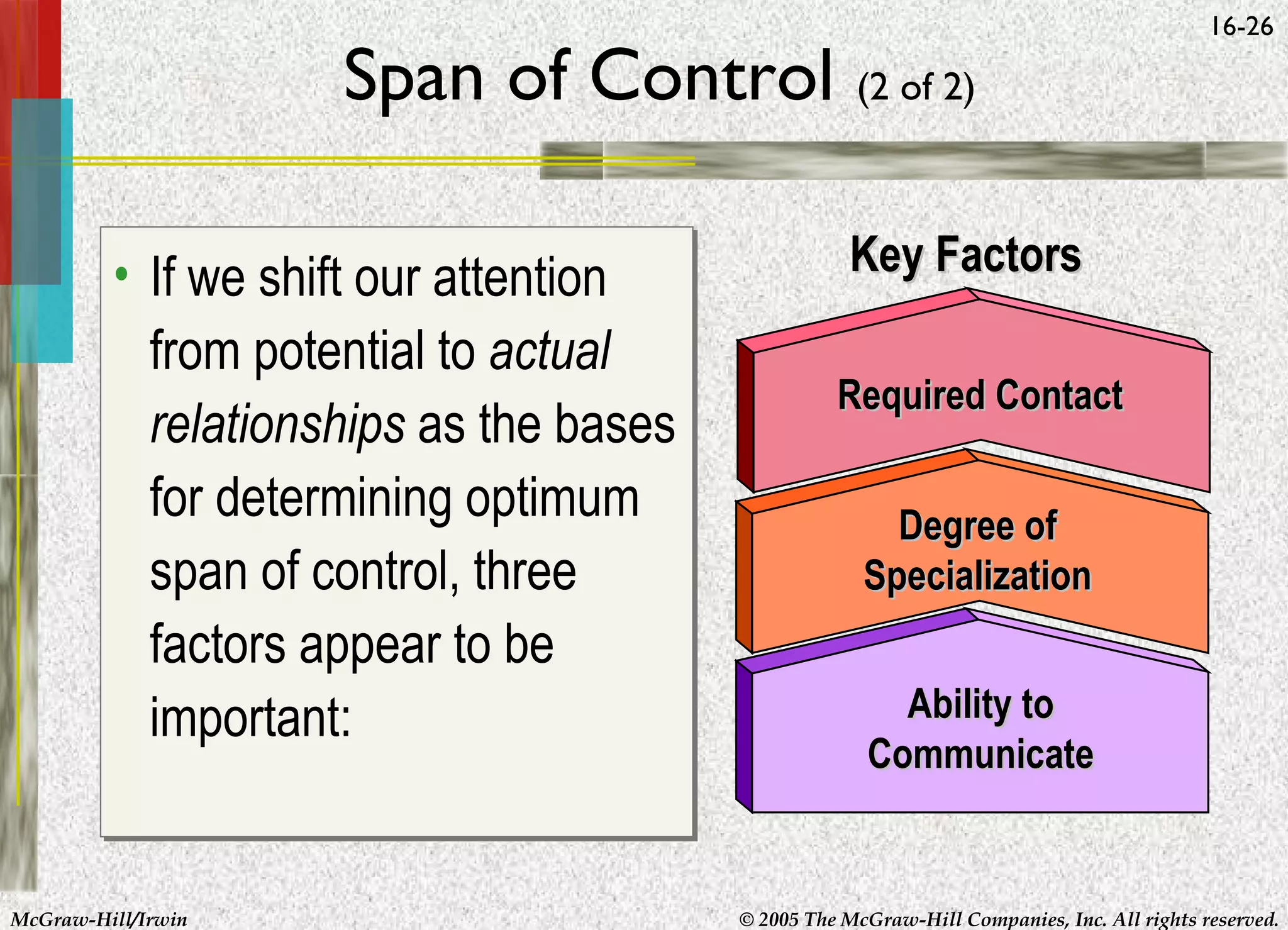
Span of Control (2 of 2)
• If we shift our attention
from potential to actual
relationships as the bases
for determining optimum
span of control, three
factors appear to be
important:

McGraw-Hill/Irwin

16-26

Key Factors
Required Contact
Degree of
Specialization
Ability to
Communicate

© 2005 The McGraw-Hill Companies, Inc. All rights reserved.
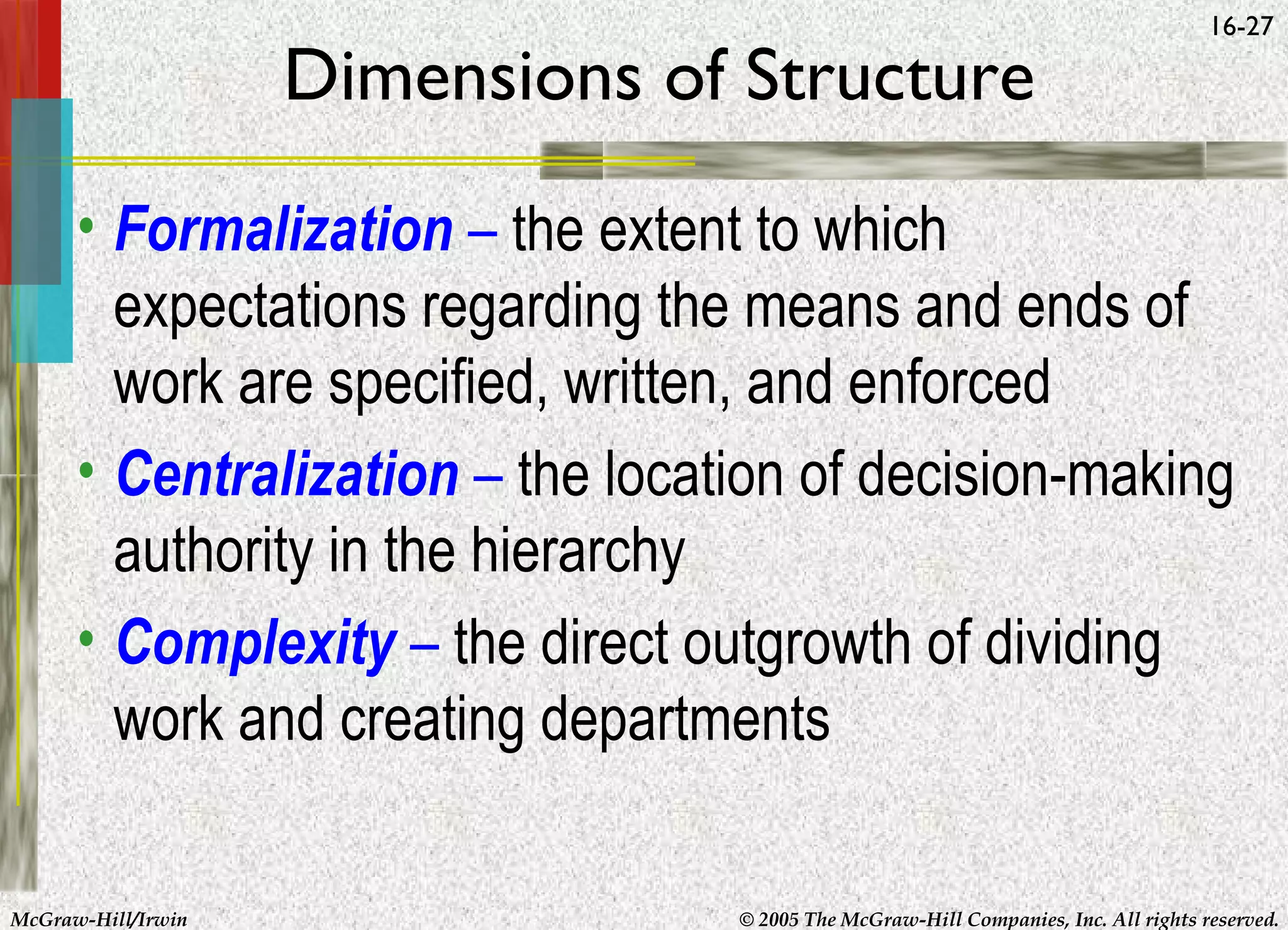
Dimensions of Structure

16-27

• Formalization – the extent to which
expectations regarding the means and ends of
work are specified, written, and enforced
• Centralization – the location of decision-making
authority in the hierarchy
• Complexity – the direct outgrowth of dividing
work and creating departments
McGraw-Hill/Irwin

© 2005 The McGraw-Hill Companies, Inc. All rights reserved.
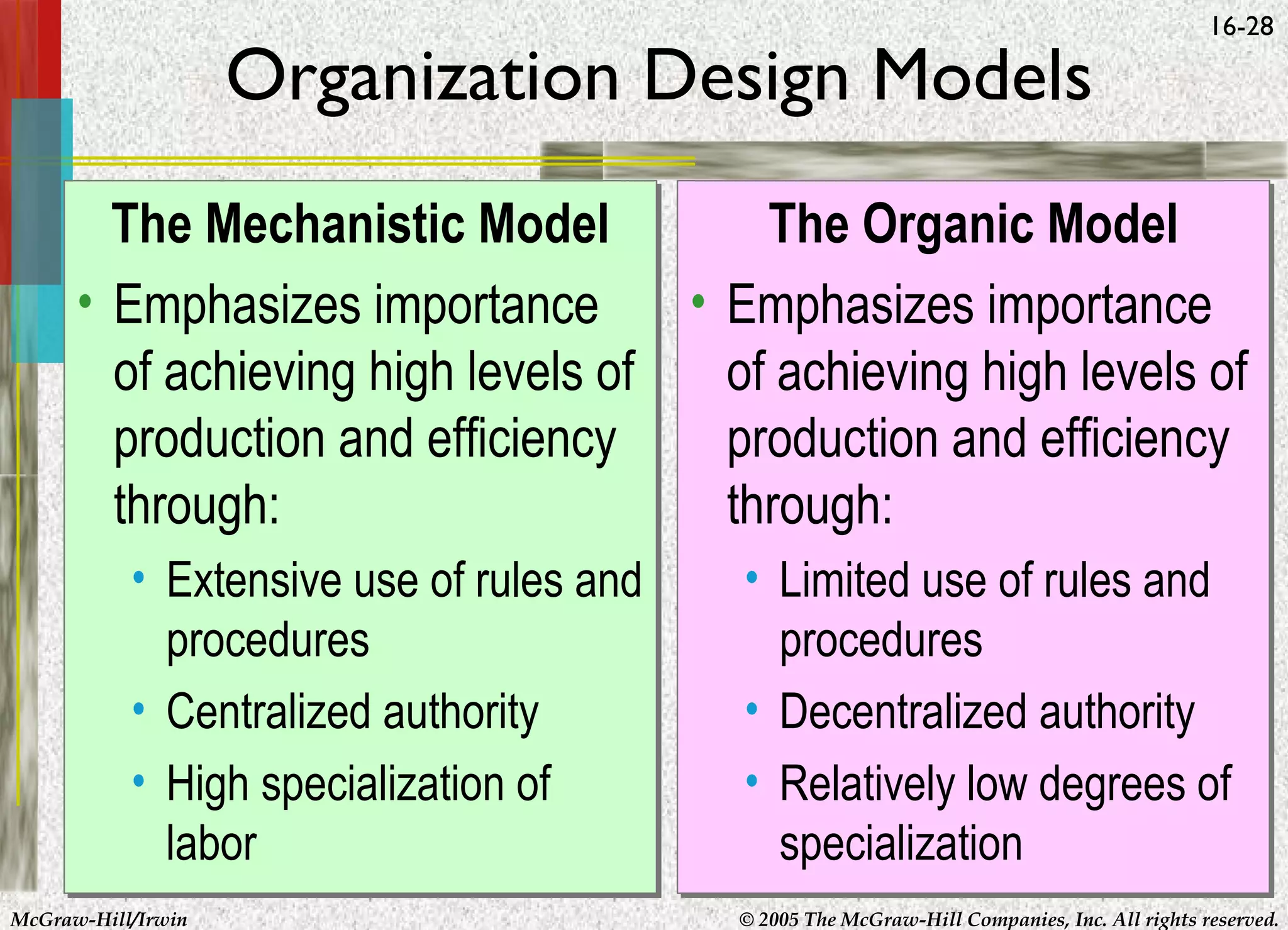
Organization Design Models

16-28

The Mechanistic Model
The Organic Model
• Emphasizes importance
of achieving high levels of
production and efficiency
through:
through:
• Extensive use of rules and
procedures
• Centralized authority
• High specialization of
labor
McGraw-Hill/Irwin

• Limited use of rules and
procedures
• Decentralized authority
• Relatively low degrees of
specialization
© 2005 The McGraw-Hill Companies, Inc. All rights reserved.
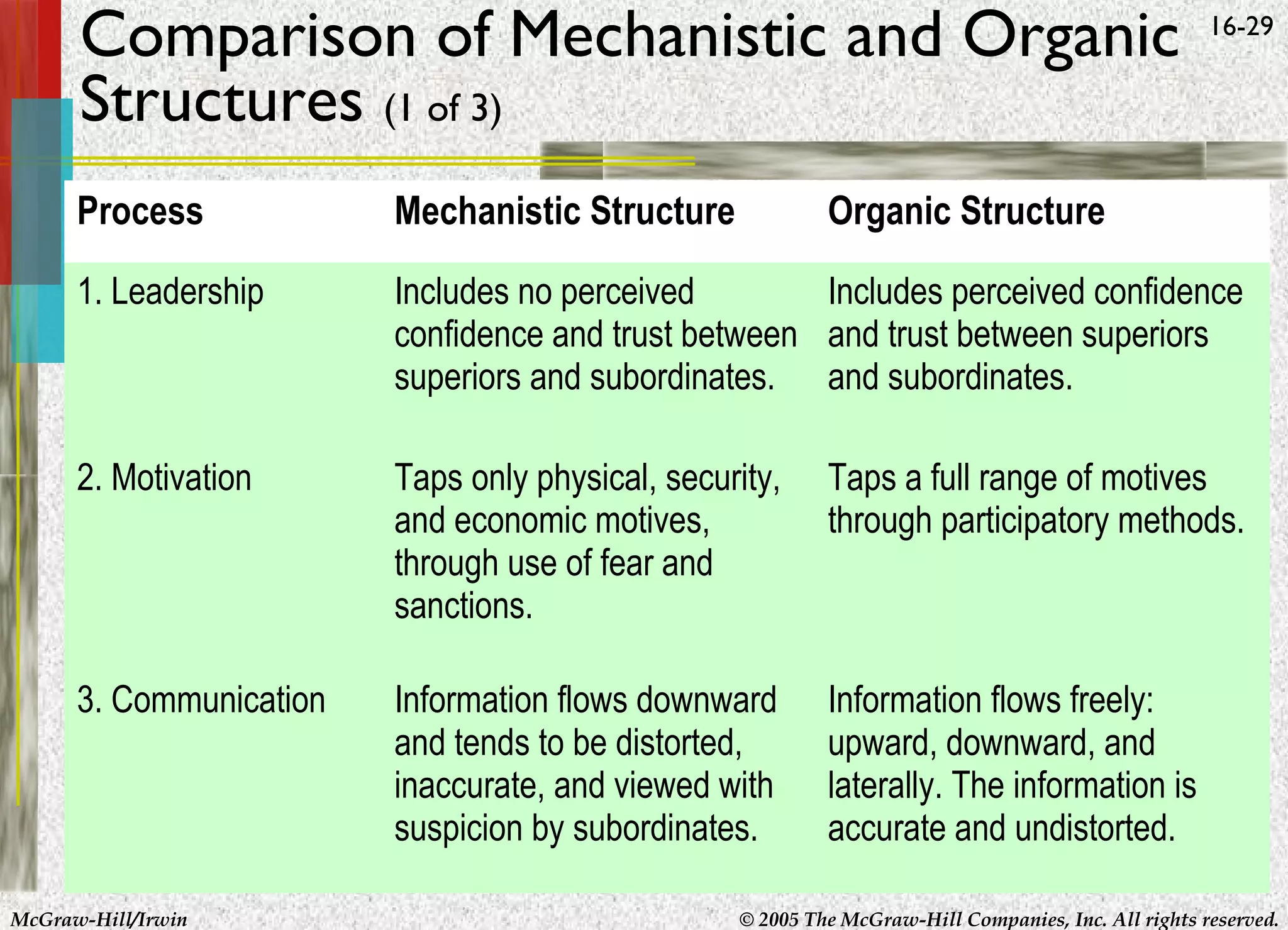
Comparison of Mechanistic and Organic
Structures (1 of 3)

16-29

Process

Mechanistic Structure

1. Leadership

Includes no perceived
Includes perceived confidence
confidence and trust between and trust between superiors
superiors and subordinates. and subordinates.

2. Motivation

Taps only physical, security,
and economic motives,
through use of fear and
sanctions.

Taps a full range of motives
through participatory methods.

3. Communication

Information flows downward
and tends to be distorted,
inaccurate, and viewed with
suspicion by subordinates.

Information flows freely:
upward, downward, and
laterally. The information is
accurate and undistorted.

McGraw-Hill/Irwin

Organic Structure

© 2005 The McGraw-Hill Companies, Inc. All rights reserved.
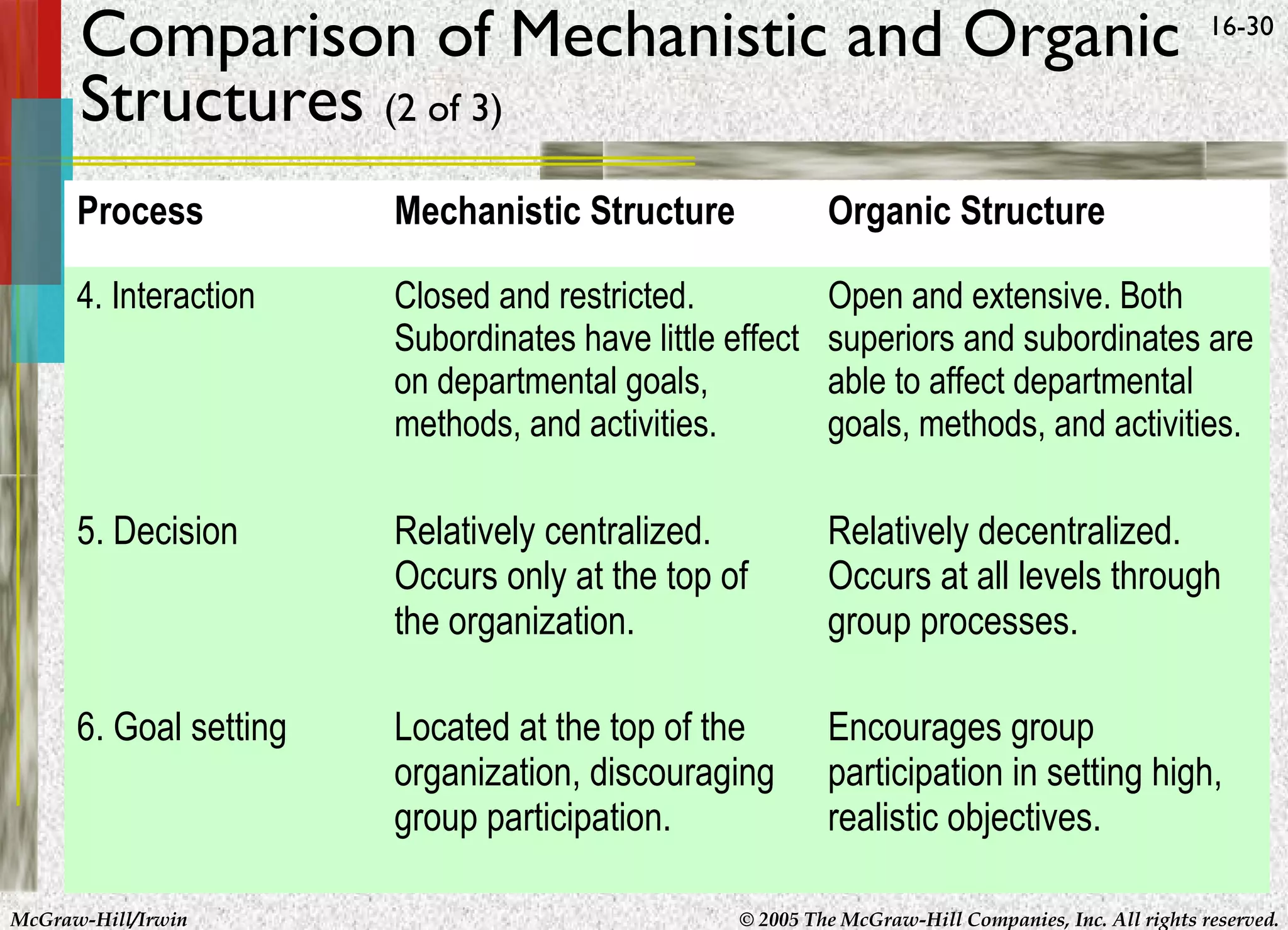
Comparison of Mechanistic and Organic
Structures (2 of 3)

16-30

Process

Mechanistic Structure

Organic Structure

4. Interaction

Closed and restricted.
Subordinates have little effect
on departmental goals,
methods, and activities.

Open and extensive. Both
superiors and subordinates are
able to affect departmental
goals, methods, and activities.

5. Decision

Relatively centralized.
Occurs only at the top of
the organization.

Relatively decentralized.
Occurs at all levels through
group processes.

6. Goal setting

Located at the top of the
organization, discouraging
group participation.

Encourages group
participation in setting high,
realistic objectives.

McGraw-Hill/Irwin

© 2005 The McGraw-Hill Companies, Inc. All rights reserved.
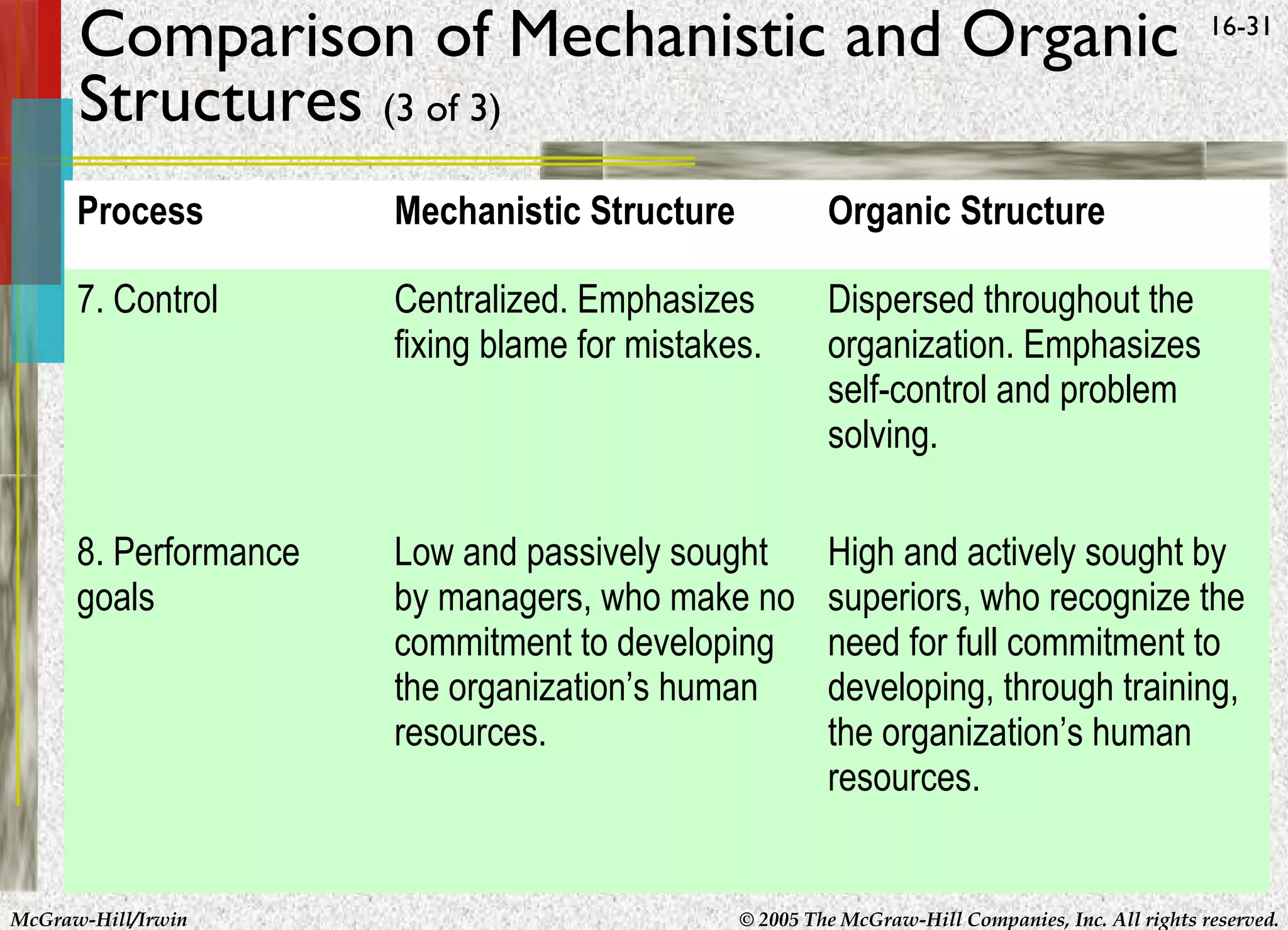
Comparison of Mechanistic and Organic
Structures (3 of 3)

16-31

Process

Mechanistic Structure

Organic Structure

7. Control

Centralized. Emphasizes
fixing blame for mistakes.

Dispersed throughout the
organization. Emphasizes
self-control and problem
solving.

8. Performance
goals

Low and passively sought
by managers, who make no
commitment to developing
the organization’s human
resources.

High and actively sought by
superiors, who recognize the
need for full commitment to
developing, through training,
the organization’s human
resources.

McGraw-Hill/Irwin

© 2005 The McGraw-Hill Companies, Inc. All rights reserved.
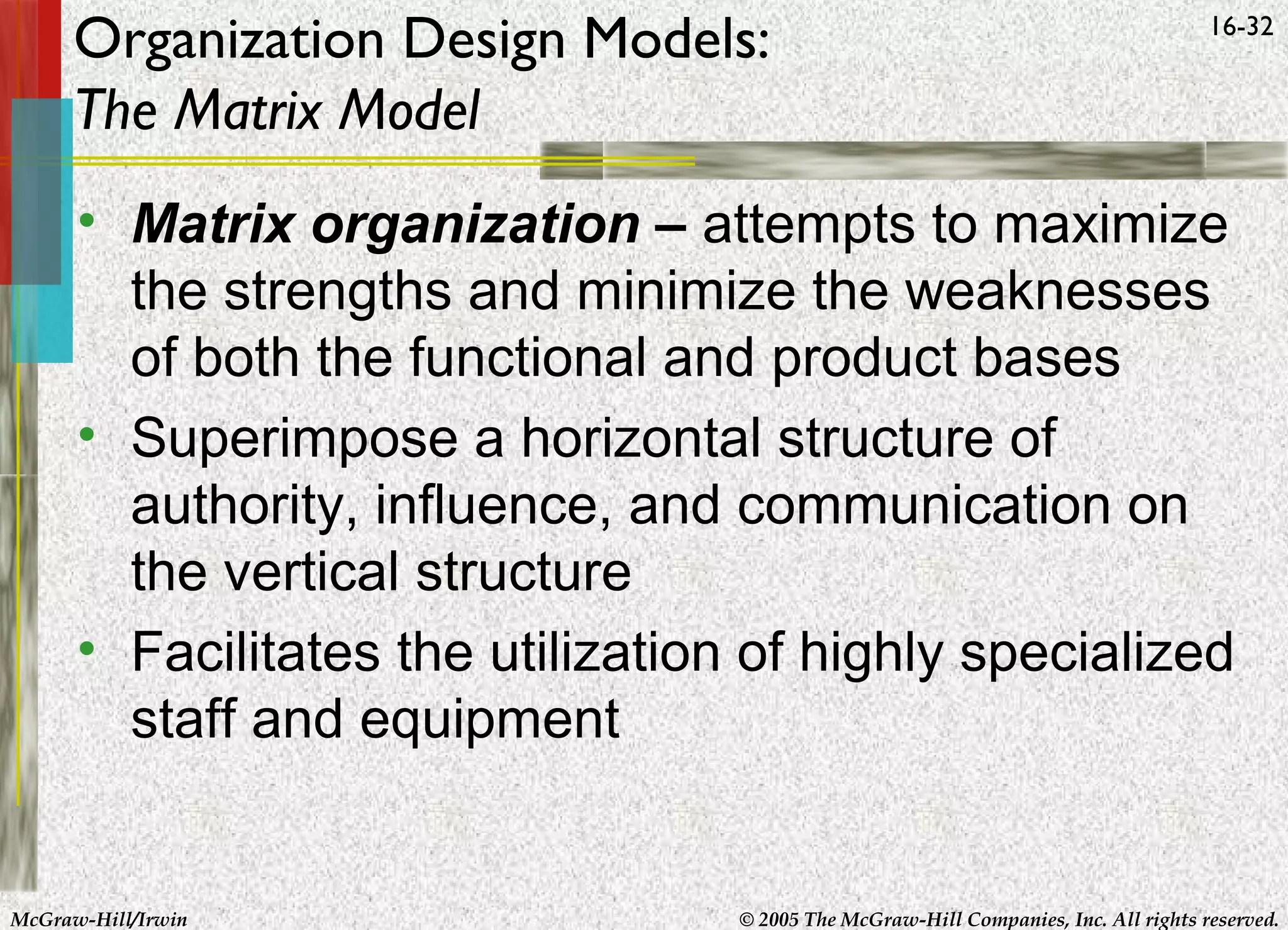
Organization Design Models:
The Matrix Model

16-32

• Matrix organization – attempts to maximize
the strengths and minimize the weaknesses
of both the functional and product bases
• Superimpose a horizontal structure of
authority, influence, and communication on
the vertical structure
• Facilitates the utilization of highly specialized
staff and equipment

McGraw-Hill/Irwin

© 2005 The McGraw-Hill Companies, Inc. All rights reserved.
16-33

Example of the Matrix Organization Model
Functions
Projects, products

Manufacturing

Marketing

Engineering

Finance

Project or product A
Project or product B
Project or product C
Project or product D
Project or product E

McGraw-Hill/Irwin

© 2005 The McGraw-Hill Companies, Inc. All rights reserved.
Advantages of Matrix Organization

16-34

• Efficient use of resources
• Flexibility in conditions of change and uncertainty
• Technical excellence
• Freeing top management for long-range planning
• Improving motivation and commitment
• Providing opportunities for personal development
McGraw-Hill/Irwin

© 2005 The McGraw-Hill Companies, Inc. All rights reserved.
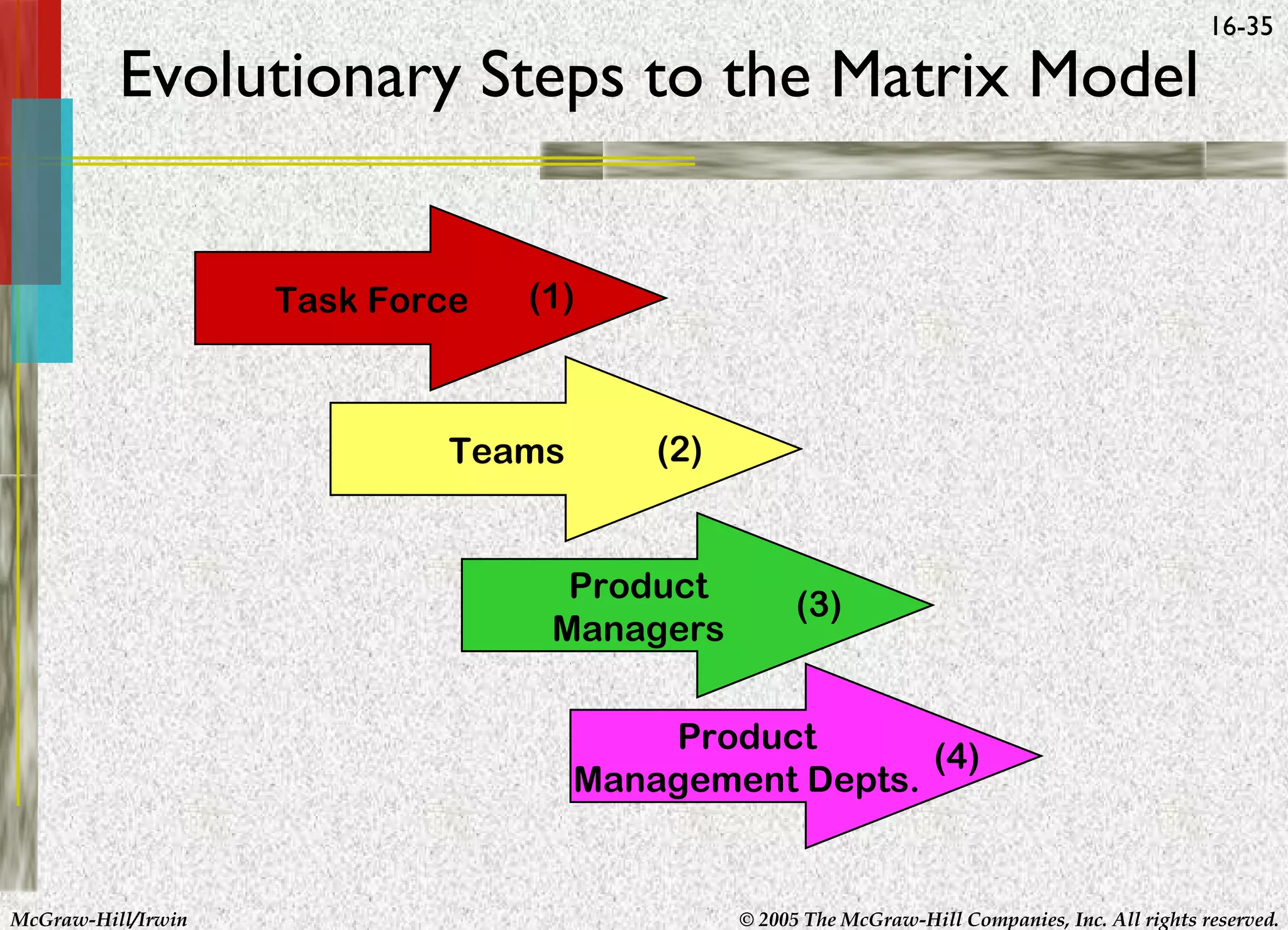
Evolutionary Steps to the Matrix Model
Task Force

16-35

(1)

Teams

(2)

Product
Managers

(3)

Product
(4)
Management Depts.

McGraw-Hill/Irwin

© 2005 The McGraw-Hill Companies, Inc. All rights reserved.
Multinational Structure and Design

16-36

• Multinational corporation – consists of a
group of geographically dispersed
organizations with different national
subsidiaries
• Multinational corporations frequently exist in
very divergent environments
• The most prevalent departmental basis is
geographic

McGraw-Hill/Irwin

© 2005 The McGraw-Hill Companies, Inc. All rights reserved.
Multinational Corporations: Implications
for Organizational Design (1 of 2)

16-37

1. National boundaries are an important force in
defining organizational environments
2. Subsidiaries or affiliates of multinational
corporations can act as conduits that introduce
changes into the host country’s environment

McGraw-Hill/Irwin

© 2005 The McGraw-Hill Companies, Inc. All rights reserved.
Multinational Corporations: Implications
for Organizational Design (2 of 2)

16-38

3. Subsidiaries of multinational corporations can
act as conduits through which features of the
host country culture are introduced throughout
the multinational organization

McGraw-Hill/Irwin

© 2005 The McGraw-Hill Companies, Inc. All rights reserved.
Virtual Organizations

16-39

• Virtual organization – a collection of
geographically distributed, functionally
and/or culturally diverse aggregations of
individuals that is linked by electronic
forms of communication
• Assembled and disassembled according
to needs
McGraw-Hill/Irwin

© 2005 The McGraw-Hill Companies, Inc. All rights reserved.
Virtual Organizations:
Factors in Design Considerations

16-40

•• Personnel distributed geographically
Personnel distributed geographically
•• Electronically connected
Electronically connected
•• Differences in expertise and function
Differences in expertise and function
•• Culturally diverse
Culturally diverse
•• Work schedule differences
Work schedule differences
•• Horizontally arranged with little emphasis on
Horizontally arranged with little emphasis on
command and control authority
McGraw-Hill/Irwin

© 2005 The McGraw-Hill Companies, Inc. All rights reserved.
Virtual Organizations:
Design Implications

16-41

•• Contractual relationships
Contractual relationships
•• Constant change and reconfiguration
Constant change and reconfiguration
•• No rigid boundaries
No rigid boundaries
•• Flexible
Flexible
•• Little or personal and social contact
Little or personal and social contact

McGraw-Hill/Irwin

© 2005 The McGraw-Hill Companies, Inc. All rights reserved.
Virtual Organizations:
Consequences

16-42

•
•
•
•

Increase in overall communication and messages
Relationships are tenuous
Continual surety of roles, tasks, and assignments
Caution needed in managing feedback,
discussion, performance review, and reward
systems
• Greater equity of participation
McGraw-Hill/Irwin

© 2005 The McGraw-Hill Companies, Inc. All rights reserved.
Boundaryless Organizations

16-43

• Organizations in which:
• the hierarchy and chain of command are
minimized
• rigidly structured departments are
eliminated

• Implemented to reduce barriers between
people and constituencies
McGraw-Hill/Irwin

© 2005 The McGraw-Hill Companies, Inc. All rights reserved.

Organizational Structure and Design

  • 1.
    16-1 Organizational Structure and Design McGraw-Hill/Irwin ©2005 The McGraw-Hill Companies, Inc. All rights reserved.
  • 2.
    16-2 Organization structure –the pattern of jobs and groups of jobs in an organization. It is an important cause of individual and group behavior. McGraw-Hill/Irwin © 2005 The McGraw-Hill Companies, Inc. All rights reserved.
  • 3.
    The Concept ofOrganization Structure Structure as an influence on behavior McGraw-Hill/Irwin 16-3 Structure as recurring activities © 2005 The McGraw-Hill Companies, Inc. All rights reserved.
  • 4.
    16-4 Organization design –management decisions and actions that result in a specific organization structure. McGraw-Hill/Irwin © 2005 The McGraw-Hill Companies, Inc. All rights reserved.
  • 5.
    Organizational Design Decisions 16-5 1.Managers decide how to divide the overall task into successively smaller jobs 2. Managers decide the bases by which to group the jobs 3. Managers decide the appropriate size of the group reporting to each superior 4. Managers distribute authority among the jobs McGraw-Hill/Irwin © 2005 The McGraw-Hill Companies, Inc. All rights reserved.
  • 6.
    The Four KeyDesign Decisions Specialization Division of Labor: Low High Departmentalization: Basis Homogeneous Heterogeneous Number Span of Control: Many Few Delegation Authority: High McGraw-Hill/Irwin 16-6 Low © 2005 The McGraw-Hill Companies, Inc. All rights reserved.
  • 7.
    Division of Labor 16-7 •Division of labor – concerns the extent to which jobs are specialized • It is the process of dividing work into relatively specialized jobs to achieve advantages of specialization McGraw-Hill/Irwin © 2005 The McGraw-Hill Companies, Inc. All rights reserved.
  • 8.
    Division of LaborOccurs in Three Different Ways: 16-8 1. Personal specialties • e.g., accountants, software engineers, graphic designers, scientists, etc. 2. Natural sequence of work • e.g., dividing work in a manufacturing plant into fabricating and assembly (horizontal specialization) 3. Vertical plane • e.g., hierarchy of authority from lowest-level manager to highest-level manager McGraw-Hill/Irwin © 2005 The McGraw-Hill Companies, Inc. All rights reserved.
  • 9.
    Delegation of Authority 16-9 •Managers decide how much authority should be delegated to each job and to each jobholder • Delegation of authority – process of distributing authority downward in an organization McGraw-Hill/Irwin © 2005 The McGraw-Hill Companies, Inc. All rights reserved.
  • 10.
    Reasons to DecentralizeAuthority 16-10 1. Relatively high delegation of authority encourages the development of professional managers 2. High delegation of authority can lead to a competitive climate within the organization 3. Managers who have relatively high authority can exercise more autonomy, and thus satisfy their desires to participate in problem solving McGraw-Hill/Irwin © 2005 The McGraw-Hill Companies, Inc. All rights reserved.
  • 11.
    16-11 Reasons to CentralizeAuthority (1 of 2) 1. Managers must be trained to make the decisions that go with delegated authority 2. Many managers are accustomed to making decisions and resist delegating authority to their subordinates McGraw-Hill/Irwin © 2005 The McGraw-Hill Companies, Inc. All rights reserved.
  • 12.
    16-12 Reasons to CentralizeAuthority (2 of 2) 3. Administrative costs are incurred because new control systems must be developed to provide top management with information about the effects of subordinates’ decisions 4. Decentralization means duplication of functions McGraw-Hill/Irwin © 2005 The McGraw-Hill Companies, Inc. All rights reserved.
  • 13.
    16-13 Delegation Decision Guidelines(1 of 2) • How routine and straightforward are the job’s or unit’s required decisions? • The authority for routine decisions can be centralized • Are individuals competent to make the decision? • Even if the decision is non-routine, if the local manager is not capable, then the decision should be centralized • Delegation of authority can differ among individuals depending upon each one’s ability to make the decision McGraw-Hill/Irwin © 2005 The McGraw-Hill Companies, Inc. All rights reserved.
  • 14.
    16-14 Delegation Decision Guidelines(2 of 2) • Are individuals motivated to make the decision? • Capable individuals are not always motivated individuals • Motivation must accompany competency to create conducive conditions for decentralization • Do the benefits of decentralization outweigh its costs? McGraw-Hill/Irwin © 2005 The McGraw-Hill Companies, Inc. All rights reserved.
  • 15.
    16-15 Departmentalization – processin which an organization is structurally divided by combining jobs in departments according to some shared characteristic or basis. McGraw-Hill/Irwin © 2005 The McGraw-Hill Companies, Inc. All rights reserved.
  • 16.
  • 17.
    Departmental Bases: Functional Departmentalization 16-17 •Jobs are combined according to the functions of the organization • The principal advantage is efficiency • By having departments of specialists, management creates efficient units • A major disadvantage is that organizational goals may be sacrificed in favor of departmental goals McGraw-Hill/Irwin © 2005 The McGraw-Hill Companies, Inc. All rights reserved.
  • 18.
    16-18 Functional Departmentalization Structure OBMCompany OBM Engineering Engineering Reliability Manufacturing McGraw-Hill/Irwin Distribution Distribution Finance Finance Public Public Relations Relations Human Human Resources Resources Purchasing © 2005 The McGraw-Hill Companies, Inc. All rights reserved.
  • 19.
    Departmental Bases: Geographic Departmentalization 16-19 •Establish groups according to geographic area • The logic is that all activities in a given region should be assigned to a manager • Advantageous in large organizations because physical separation of activities makes centralized coordination difficult • Provides a training ground for managerial personnel McGraw-Hill/Irwin © 2005 The McGraw-Hill Companies, Inc. All rights reserved.
  • 20.
  • 21.
    Departmental Bases: Product Departmentalization 16-21 •All jobs associated with producing and selling a product or product line will be placed under the direction of one manager • Product becomes the preferred basis as a firm grows by increasing the number of products it markets • Concentrating authority, responsibility, and accountability in a specific product department allows top management to coordinate actions McGraw-Hill/Irwin © 2005 The McGraw-Hill Companies, Inc. All rights reserved.
  • 22.
    Product Departmentalization Structure 16-22 OBMCompany OBM Company Small Small Household Household Appliances Appliances McGraw-Hill/Irwin Large Large Household Household Appliances Appliances Commercial Commercial Appliances Appliances Building Building Materials and Materials and Products Products Lawn and Lawn and Garden Garden Products Products Automotive Automotive Products Products © 2005 The McGraw-Hill Companies, Inc. All rights reserved.
  • 23.
    Departmental Bases: Customer Departmentalization 16-23 •The importance of customer satisfaction has stimulated firms to search for creative ways to serve people better • Organizations with customer-based departments are better able to satisfy customer-identified needs than organizations that base departments on non-customer factors McGraw-Hill/Irwin © 2005 The McGraw-Hill Companies, Inc. All rights reserved.
  • 24.
    16-24 Customer Departmentalization Structure OBM Company Retail Stores McGraw-Hill/Irwin MailOrder On-Line Sales Institutional Sales Government Contracts © 2005 The McGraw-Hill Companies, Inc. All rights reserved.
  • 25.
    Span of Control(1 of 2) 16-25 • Number of individuals who report to a specific manager • Narrow span • Wide span • The frequency and intensity of actual relationships is the critical consideration in determining the manager’s span of control McGraw-Hill/Irwin © 2005 The McGraw-Hill Companies, Inc. All rights reserved.
  • 26.
    Span of Control(2 of 2) • If we shift our attention from potential to actual relationships as the bases for determining optimum span of control, three factors appear to be important: McGraw-Hill/Irwin 16-26 Key Factors Required Contact Degree of Specialization Ability to Communicate © 2005 The McGraw-Hill Companies, Inc. All rights reserved.
  • 27.
    Dimensions of Structure 16-27 •Formalization – the extent to which expectations regarding the means and ends of work are specified, written, and enforced • Centralization – the location of decision-making authority in the hierarchy • Complexity – the direct outgrowth of dividing work and creating departments McGraw-Hill/Irwin © 2005 The McGraw-Hill Companies, Inc. All rights reserved.
  • 28.
    Organization Design Models 16-28 TheMechanistic Model The Organic Model • Emphasizes importance • Emphasizes importance of achieving high levels of of achieving high levels of production and efficiency production and efficiency through: through: • Extensive use of rules and procedures • Centralized authority • High specialization of labor McGraw-Hill/Irwin • Limited use of rules and procedures • Decentralized authority • Relatively low degrees of specialization © 2005 The McGraw-Hill Companies, Inc. All rights reserved.
  • 29.
    Comparison of Mechanisticand Organic Structures (1 of 3) 16-29 Process Mechanistic Structure 1. Leadership Includes no perceived Includes perceived confidence confidence and trust between and trust between superiors superiors and subordinates. and subordinates. 2. Motivation Taps only physical, security, and economic motives, through use of fear and sanctions. Taps a full range of motives through participatory methods. 3. Communication Information flows downward and tends to be distorted, inaccurate, and viewed with suspicion by subordinates. Information flows freely: upward, downward, and laterally. The information is accurate and undistorted. McGraw-Hill/Irwin Organic Structure © 2005 The McGraw-Hill Companies, Inc. All rights reserved.
  • 30.
    Comparison of Mechanisticand Organic Structures (2 of 3) 16-30 Process Mechanistic Structure Organic Structure 4. Interaction Closed and restricted. Subordinates have little effect on departmental goals, methods, and activities. Open and extensive. Both superiors and subordinates are able to affect departmental goals, methods, and activities. 5. Decision Relatively centralized. Occurs only at the top of the organization. Relatively decentralized. Occurs at all levels through group processes. 6. Goal setting Located at the top of the organization, discouraging group participation. Encourages group participation in setting high, realistic objectives. McGraw-Hill/Irwin © 2005 The McGraw-Hill Companies, Inc. All rights reserved.
  • 31.
    Comparison of Mechanisticand Organic Structures (3 of 3) 16-31 Process Mechanistic Structure Organic Structure 7. Control Centralized. Emphasizes fixing blame for mistakes. Dispersed throughout the organization. Emphasizes self-control and problem solving. 8. Performance goals Low and passively sought by managers, who make no commitment to developing the organization’s human resources. High and actively sought by superiors, who recognize the need for full commitment to developing, through training, the organization’s human resources. McGraw-Hill/Irwin © 2005 The McGraw-Hill Companies, Inc. All rights reserved.
  • 32.
    Organization Design Models: TheMatrix Model 16-32 • Matrix organization – attempts to maximize the strengths and minimize the weaknesses of both the functional and product bases • Superimpose a horizontal structure of authority, influence, and communication on the vertical structure • Facilitates the utilization of highly specialized staff and equipment McGraw-Hill/Irwin © 2005 The McGraw-Hill Companies, Inc. All rights reserved.
  • 33.
    16-33 Example of theMatrix Organization Model Functions Projects, products Manufacturing Marketing Engineering Finance Project or product A Project or product B Project or product C Project or product D Project or product E McGraw-Hill/Irwin © 2005 The McGraw-Hill Companies, Inc. All rights reserved.
  • 34.
    Advantages of MatrixOrganization 16-34 • Efficient use of resources • Flexibility in conditions of change and uncertainty • Technical excellence • Freeing top management for long-range planning • Improving motivation and commitment • Providing opportunities for personal development McGraw-Hill/Irwin © 2005 The McGraw-Hill Companies, Inc. All rights reserved.
  • 35.
    Evolutionary Steps tothe Matrix Model Task Force 16-35 (1) Teams (2) Product Managers (3) Product (4) Management Depts. McGraw-Hill/Irwin © 2005 The McGraw-Hill Companies, Inc. All rights reserved.
  • 36.
    Multinational Structure andDesign 16-36 • Multinational corporation – consists of a group of geographically dispersed organizations with different national subsidiaries • Multinational corporations frequently exist in very divergent environments • The most prevalent departmental basis is geographic McGraw-Hill/Irwin © 2005 The McGraw-Hill Companies, Inc. All rights reserved.
  • 37.
    Multinational Corporations: Implications forOrganizational Design (1 of 2) 16-37 1. National boundaries are an important force in defining organizational environments 2. Subsidiaries or affiliates of multinational corporations can act as conduits that introduce changes into the host country’s environment McGraw-Hill/Irwin © 2005 The McGraw-Hill Companies, Inc. All rights reserved.
  • 38.
    Multinational Corporations: Implications forOrganizational Design (2 of 2) 16-38 3. Subsidiaries of multinational corporations can act as conduits through which features of the host country culture are introduced throughout the multinational organization McGraw-Hill/Irwin © 2005 The McGraw-Hill Companies, Inc. All rights reserved.
  • 39.
    Virtual Organizations 16-39 • Virtualorganization – a collection of geographically distributed, functionally and/or culturally diverse aggregations of individuals that is linked by electronic forms of communication • Assembled and disassembled according to needs McGraw-Hill/Irwin © 2005 The McGraw-Hill Companies, Inc. All rights reserved.
  • 40.
    Virtual Organizations: Factors inDesign Considerations 16-40 •• Personnel distributed geographically Personnel distributed geographically •• Electronically connected Electronically connected •• Differences in expertise and function Differences in expertise and function •• Culturally diverse Culturally diverse •• Work schedule differences Work schedule differences •• Horizontally arranged with little emphasis on Horizontally arranged with little emphasis on command and control authority command and control authority McGraw-Hill/Irwin © 2005 The McGraw-Hill Companies, Inc. All rights reserved.
  • 41.
    Virtual Organizations: Design Implications 16-41 ••Contractual relationships Contractual relationships •• Constant change and reconfiguration Constant change and reconfiguration •• No rigid boundaries No rigid boundaries •• Flexible Flexible •• Little or personal and social contact Little or personal and social contact McGraw-Hill/Irwin © 2005 The McGraw-Hill Companies, Inc. All rights reserved.
  • 42.
    Virtual Organizations: Consequences 16-42 • • • • Increase inoverall communication and messages Relationships are tenuous Continual surety of roles, tasks, and assignments Caution needed in managing feedback, discussion, performance review, and reward systems • Greater equity of participation McGraw-Hill/Irwin © 2005 The McGraw-Hill Companies, Inc. All rights reserved.
  • 43.
    Boundaryless Organizations 16-43 • Organizationsin which: • the hierarchy and chain of command are minimized • rigidly structured departments are eliminated • Implemented to reduce barriers between people and constituencies McGraw-Hill/Irwin © 2005 The McGraw-Hill Companies, Inc. All rights reserved.