MODULE 1
Organizational Behaviour
MEANING AND DEFINITIONS
Definitions of organisational Behaviour
Stephen P. Robbins defines Organisational Behaviour as “a
field of study that investigates the impact that individuals,
groups and structures have on behaviour within
organisations for the purpose of applying such knowledge
toward improving an organisation's effectiveness.”A
What is Organizational Behaviour ?
“Organizational Behavior Is Directly Concerned With The Understanding, Prediction, And
Control Of Human Behavior In Organizations.”
Fred Luthans.
According to Keith Davis “Organisational behaviour is the study and application of
knowledge about how people act within organisations”.
.
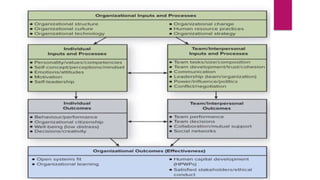
 Organizational behavior (OB) is the study of human behavior in organizational settings,
the interface between human behavior and the organization, and the organization itself.
 This area of study examines human behavior in a work environment and determines its
impact on job structure, performance, communication, motivation, leadership, etc.
 One of the main goals of organizational behavior is to revitalize organizational theory
and develop a better conceptualization of organizational life.
What is
Organizational
Behaviour ?
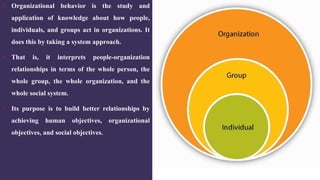
 Organizational behavior is the study and
application of knowledge about how people,
individuals, and groups act in organizations. It
does this by taking a system approach.
 That is, it interprets people-organization
relationships in terms of the whole person, the
whole group, the whole organization, and the
whole social system.
 Its purpose is to build better relationships by
achieving human objectives, organizational
objectives, and social objectives.
Organizational Behavior is;
 A Separate Field of Study and not a Discipline
Only.
 An Interdisciplinary Approach.
 Applied Science.
 Normative Science.
 A Humanistic and Optimistic Approach.
 A Total System Approach.
The nature of OB is identified as follows:
1. A Separate Field of Study and Not a Discipline Only:
By definition, a discipline is an accepted science that is based on a theoretical foundation. But,
O.B. has a multi- interdisciplinary orientation and is, thus, not based on a specific theoretical
background. Therefore, it is better reasonable to call O.B. a separate field of study rather than a
discipline only.
2. An Interdisciplinary Approach:
Organizational behaviour is essentially an interdisci­
plinary approach to study human behaviour
at work. It tries to integrate the relevant knowledge drawn from re­
lated disciplines like
psychology, sociology and anthro­
pology to make them applicable for studying and analyzing
organizational behaviour.
Nature of OB :
3. An Applied Science:
The very nature of O.B. is applied. What O.B. basically does is the application of various researches to solve the organizational
problems related to human behaviour. The basic line of difference between pure science and O.B. is that while the former
concentrates of fundamental researches, the latter concentrates on applied researches. O.B. involves both applied research and its
application in organizational analysis. Hence, O.B. can be called both science as well as art.
4. A Normative Science:
Organizational Behaviour is a normative science also. While the positive science discusses only cause effect relationship, O.B.
prescribes how the findings of applied researches can be applied to socially accepted organizational goals. Thus, O.B. deals with
what is accepted by individuals and society engaged in an organization. Yes, it is not that O.B. is not normative at all. In fact,
O.B. is normative as well that is well underscored by the proliferation of management theories.
Nature of OB :
5. A Humanistic and Optimistic Approach:
Organizational Behaviour applies humanistic approach towards people working in the organization. It, deals
with the thinking and feeling of human beings. O.B. is based on the belief that people have an innate desire to
be independent, creative and productive. It also realizes that people working in the organization can and will
actualize these potentials if they are given proper conditions and environment. Environment affects
performance or workers working in an organization.
6 . A Total System Approach:
The system approach is one that integrates all the variables, affecting organizational functioning. The systems
approach has been developed by the behavioural scientists to analyse human behaviour in view of his/her
socio-psychological framework. Man’s socio- psychological framework makes man a complex one and the
systems approach tries to study his/her complexity and find solution to it.
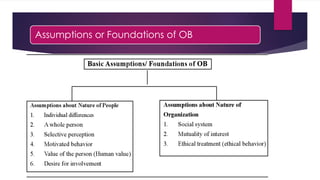
Assumptions or Foundations of OB
A. The Assumptions about Nature of People
It is necessary to understand basic assumptions about the nature of people for
understanding organizational behavior. The following are the basic assumptions about
nature of people:
1. Individual Differences
Organizational behavior assumes that all the individuals are differences from each other.
The difference in individuals can be in several ways like physical characteristics,
intelligence, perception, personality, attitudes, aptitudes, emotion, learning capability and
communicative ability.
2. A Whole Person
Organizational behavior assumes that an individual should be considered as a whole
person. We cannot separate individual’s psychology, beliefs, values, attitude from
physical work settings.
A. The Assumptions about Nature of People
3. Selective Perception
Perception is a process by which individuals organize and interpret their sensory
impressions in order to give meaning to the environment (Robbins, 1997).
Perception is an individual’s own view. Each person has a unique way to see,
organize and interpret about event, people and things.
4. Motivated Behavior
Motivation is the willingness to do something to achieve organizational goals
and, at the same time, to satisfy individual needs. Every employee expects
motivated behavior from manager. Manager need to understand about how
employees can be motivated for better performance.
A. The Assumptions about Nature of People
5. Value of the Person
Organizational behavior assumes that people are more valuable and different
than non-living things. Employees should be treated with respect, dignity and
equity by the organizations. Employees should not be treated only economic
tools.
6. Desire for Involvement
Individuals have desire for involvement in work. They want to show their
creativity, skills, and efficiency while doing the work. People have capabilities
for task performance, role fulfillment, and meaningful contribution and to meet
challenging situations.
B. The assumptions about Nature of
Organizations
The nature of organizations is the area of study of organizational behavior. There
are following basic assumption about nature of organizations.
1. Social System
Organizations are the part of social system. Organizations are operated by
social and psychological laws. Organizational behavior assumes that
organizations are open social system. These systems affect behavior of
individual.
B. The assumptions about Nature of Organizations
2. Mutuality of Interest
Organizational behavior assumes mutuality of individual and organization
interests. Interests flow both ways. Organizations need people and people need
organizations. Mutual interest provides a common goal for all the participants,
which results in encouragement of the people to solve problems of the
organization.
B. The assumptions about Nature of Organizations
.
3. Ethical Treatment
Ethics involves moral issues and choices. It deals with right or wrong behavior
about event, people and things. Ethical behavior of an individual depends on the
moral standard or codes of conduct determined by society. Managerial ethics is
the standard of behavior that guides individuals’ managers in their work.
Organizational should establish rules, code of conduct, working procedures and
system
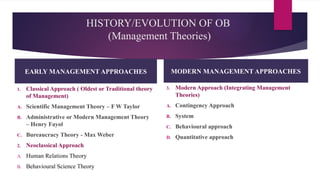
HISTORY/EVOLUTION OF OB
(Management Theories)
EARLY MANAGEMENT APPROACHES
1. Classical Approach ( Oldest or Traditional theory
of Management)
A. Scientific Management Theory – F W Taylor
B. Administrative or Modern Management Theory
– Henry Fayol
C. Bureaucracy Theory - Max Weber
2. Neoclassical Approach
A. Human Relations Theory
B. Behavioural Science Theory
MODERN MANAGEMENT APPROACHES
3. Modern Approach (Integrating Management
Theories)
A. Contingency Approach
B. System
C. Behavioural approach
D. Quantitative approach
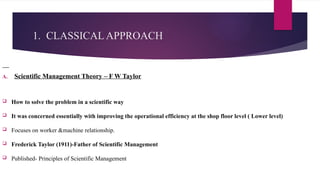
1. CLASSICAL APPROACH
A. Scientific Management Theory – F W Taylor
 How to solve the problem in a scientific way
 It was concerned essentially with improving the operational efficiency at the shop floor level ( Lower level)
 Focuses on worker &machine relationship.
 Frederick Taylor (1911)-Father of Scientific Management
 Published- Principles of Scientific Management
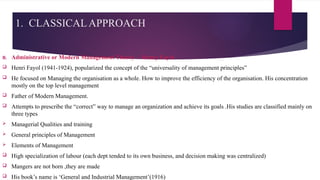
1. CLASSICAL APPROACH
B. Administrative or Modern Management Theory – Henry Fayol
 Henri Fayol (1941-1924), popularized the concept of the “universality of management principles”
 He focused on Managing the organisation as a whole. How to improve the efficiency of the organisation. His concentration
mostly on the top level management
 Father of Modern Management.
 Attempts to prescribe the “correct” way to manage an organization and achieve its goals .His studies are classified mainly on
three types
 Managerial Qualities and training
 General principles of Management
 Elements of Management
 High specialization of labour (each dept tended to its own business, and decision making was centralized)
 Mangers are not born ,they are made
 His book’s name is ‘General and Industrial Management’(1916)
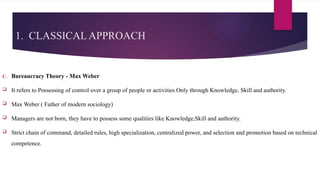
1. CLASSICAL APPROACH
C. Bureaucracy Theory - Max Weber
 It refers to Possessing of control over a group of people or activities Only through Knowledge, Skill and authority.
 Max Weber ( Father of modern sociology)
 Managers are not born, they have to possess some qualities like Knowledge,Skill and authority.
 Strict chain of command, detailed rules, high specialization, centralized power, and selection and promotion based on technical
competence.
2. NEOCLASSICAL APPROACH
A. Human Relations Theory –Elton Mayo (Organisational Scientist).Hawthorne Studies (Western Electric Company) -1924-
1933.(Marry Parker Follet and Douglas McGregor are other main contributors)
B. Behavioural Science Theory - Chester Barnard (1886-1961)
2. NEOCLASSICAL APPROACH
A. Human Relations Theory –Elton Mayo (Organisational Scientist).Hawthorne Studies (Western Electric Company) -1924-
1933.(Marry Parker Follet and Douglas McGregor are other main contributors)
B. Behavioural Science Theory - Chester Barnard (1886-1961)
2. NEOCLASSICAL APPROACH
A. Human Relations Theory
 How to improve the Human relations in an organisation.
 George elton mayo is considered as one of the pioneers of the human relations approach to organisation. His main hypothesis
is that relations between employers and employees should be humanistic, not mechanistic.
 Advocates management styles that are more participative and oriented towards employee needs.
 Hawthorne Studies - Hawthorne Works of the Western Electric Company;1924-1932
1.Illumination Experiment 2 .Changes in working conditions 3.Mass Interview
Human Relations Theory
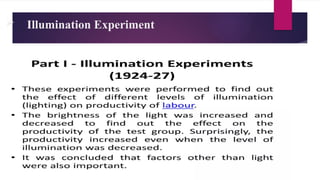
 Illumination Experiment - Effect of changing illumination on productivity. Initiated as an attempt to investigate how characteristics
of the work setting affect employee fatigue and performance(ie.lighting). Found that productivity increased regardless of whether
illumination was raised or lowered.
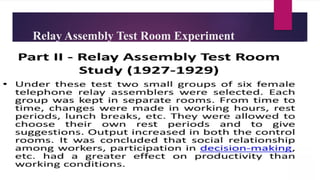
 Relay Assembly Test Room Experiment
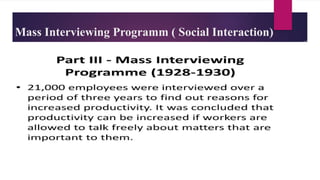
 Mass Interviewing Programm ( Social Interaction)
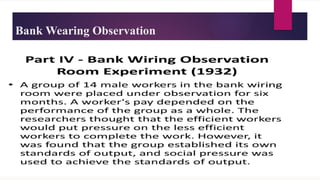
 Bank Wearing Observation
“PRODUCTIVITY CAN INCREASED BY UNDERSTANDING THE HUMAN BEHAVIOUR.”Employees are more
influenced by social needs (self actualisation,ego satisfaction,prestige,participation in management) rather than the
monetary incentives.
 Illumination Experiment
Relay Assembly Test Room Experiment
Mass Interviewing Programm ( Social Interaction)
Bank Wearing Observation
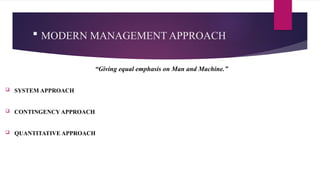
 MODERN MANAGEMENT APPROACH
“Giving equal emphasis on Man and Machine.”
 SYSTEM APPROACH
 CONTINGENCY APPROACH
 QUANTITATIVE APPROACH
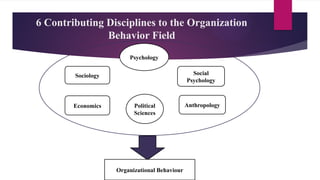
6 Contributing Disciplines to the Organization
Behavior Field
Psychology
Sociology Social
Psychology
Political
Sciences
Organizational Behaviour
Economics Anthropology
1. Psychology
• Psychology has perhaps the first influence on the field of organizational Behaviour because it is a science of
behavior. A psychologist studies almost all aspects Of behavior. It is the deep study of human behaviour
• Psychology deals with studying human behavior that seeks to explain and sometimes change the behavior of
humans and other animals.
• Psychologists are primarily interested in predicting the behavior of individuals to a great extent by observing the
dynamics of personal factors.
• Those who have contributed and continued to add to the knowledge of OB are teaching theorists, personality
theorists, counseling psychologists and primary, industrial and organizational psychologists.
Main contributions of Psychology
1. Learning
2. Motivation
3. Personality
4. Training and development
5. Individual Decision Making
6. Leadership
7. Job satisfaction
8. Performance Appraisal
9. Attitude
10. Ego State
11. Job design
12. Work Stress
13. Conflict Management
2.Sociology
 The major focus of sociologists is on studying the social systems in which individuals fill their
roles. The focus is on group dynamics.
 They have made their greatest contribution to OB through their study of group behavior in
organizations, particularly formal and sophisticated organizations.
 Sociological concepts, theories, models, and techniques help significantly to understand better
the group dynamics, organizational culture, formal organization theory and structure, corporate
technology, bureaucracy, communications, power, conflict, and intergroup behavior.
Main contributions of Sociology
1. Communication
2. Power
3. Conflict
4. Inter Group Behaviour
3. Social Psychology
• It is a blend concepts from Psychology and Sociology. It has been defined as the scientific investigation of how the thoughts,
feelings, and behavior of individuals are influenced by the actual, imagined or implied the presence of others.
• It deals with how people are affected by other individuals who are physically present or who are imagined to be present or
even whose presence is implied.
• In general, sociology focuses on how groups, organizations, social categories, and societies are organized, how they function,
how they change.
• The unit of analysis is the group as a whole rather than the individuals who compose the group.
• Social Psychology deals with many of the same phenomena but seeks to explain whole individual human interaction and
human cognition influences culture and is influenced by culture.
Social Psychology
• In reality, some forms of sociology are closely related to social psychology.
• Social Psychologists study an enormous range of topics including conformity, persuasion, power, influence,
obedience, prejudice, discrimination, stereotyping, sexism and racism, small groups, social categories, inter-group
behavior, crowd behavior, social conflict, social change, decision making, etc.
• Among them, the most important topics relevant to the organizational behavior field are behavioral change, attitude
change, communication, group process, and group decision making.
Main contributions of Social Psychology
1. Changing Attitudes
2. Communication Patterns
4.Anthropology
• It is the study of Societies to learn about human beings and their activities. The main aim of anthropology is to
acquire a better understanding of the relationship between the human being and the environment.
• Adaptations to surroundings constitute culture. The manner in which people view their surroundings is a part of the
culture.
• Culture includes those ideas shared by groups of individuals and languages by which these ideas are communicated.
In essence, culture is a system of learned behavior.
• Their work on culture and environment has helped us to understand differences in fundamental values, attitudes, and
behavior among people in different countries and within different organizations.
• The world is the laboratory of anthropologists, and human beings must be studied in the natural habitat.
Understanding the importance of studying man in natural settings over time enables one to grasp the range of
anthropology.
Anthropology
• Familiarity within some of the cultural differences of employees can lead to greater managerial objectivity and depth
in the interpretation of behavior and performance.
• Anthropologists contribute to study some aspects of organizational settings – similar values, comparative attitudes,
cross-cultural analysis between or among the employees.
Anthropology
• Familiarity within some of the cultural differences of employees can lead to greater managerial objectivity and depth
in the interpretation of behavior and performance.
• Anthropologists contribute to study some aspects of organizational settings – similar values, comparative attitudes,
cross-cultural analysis between or among the employees.
Main contributions of Anthropology
1. Comparative values
2. Comparative attitudes
3. Cross Cultural Analysis
5. Political Sciences
• It is the study of human behaviour within a political environment. Contributions of political scientists are
significant to the understanding of behavior in organizations. Political scientists study the behavior of individuals
and groups within a political environment.
• They contribute to understanding the dynamics of power centers, structuring of conflict and conflict resolution
tactics, allocation of power and how people manipulate power for individual self-interest.
• In a business field, organizations wanted to attain supremacy in their field and indulge in politicking activities to
gain maximum advantages by following certain tasks like Machiavellianism, coalition formation, malpractices,
etc.
• The knowledge of political science can be utilized in the study the behavior of employees, executives at micro as
well as macro level.
Main contributions of Political Sciences
1. Power
2. Conflict
6. Economics
• Economics contributes to organizational behavior to a great extent in designing the organizational structure.
Transaction cost economics influence the organization and its structure.
• Transaction costs economics implies cost components to make an exchange on the market.
• This transaction cost economics examines the extent to which the organization structure and size of an organization
varies in response to attempts to avoid market failures through minimizing production and transaction costs within
the constraints of human and environmental factors.
• Costs of transactions include both costs of market transactions and internal coordination.
• A transaction occurs when a good or service is transferred across a ‘technologically separable barrier’ Transaction
costs arise for many reasons.
Summary
To sum up, it can be said that Organisational Behaviour is the
study of human behaviour in organisational settings. It is a
multidisciplinary subject and includes principles and concepts
from psychology, sociology, anthropology, social psychology,
political science, etc. The basic fundamentals of organisational
behaviour are interpersonal differences, whole person concept,
human dignity, and instigated behaviour, mutuality of interest,
social systems and holistic concept.
Challenges and Opportunities of
Organizational Behavior
Challenges and opportunities for organizational behavior are massive and
rapidly changing for improving productivity and meeting business goals.
Although the problems with organizations and the solutions over the ages
have not changed, the emphasis and surrounding environmental context
certainly have changed.
Challenges and Opportunities of
Organizational Behavior
Main challenges and opportunities of organizational behavior are;
1. Improving Peoples’ Skills.
2. Improving Quality and Productivity.
3. Total Quality Management (TQM).
4. Managing Workforce Diversity.
5. Responding to Globalization.
6. Empowering People.
Challenges and Opportunities of
Organizational Behavior
7. Coping with Temporariness.
8. Stimulating Innovation and Change.
9. Emergence of E-Organisation & E-Commerce.
10. Improving Ethical Behavior.
11. Improving Customer Service.
12. Helping Employees Balance Work-Life Conflicts.
13. Flattening World.
1.Improving People’s Skills
Technological changes, structural changes, environmental changes are accelerated
at a faster rate in the business field.
Unless employees and executives are equipped to possess the required skills to
adapt to those changes, the targeted goals cannot be achieved in time.
These two different categories of skills – managerial skills and technical skills.
Some of the managerial skills include listening skills, motivating skills,
planning and organizing skills, leading skills, problem-solving skills,
decision-making skills.
These skills can be enhanced by organizing a series of training and development
programs, career development programs, induction, and socialization.
2.Improving Quality and Productivity
Quality is the extent to which the customers or users believe the product or service
surpasses their needs and expectations.
3.Total Quality Management (TQM)
Total Quality Management (TQM) is a philosophy of management that
is driven by the constant attainment of customer satisfaction through
the continuous improvement of all organizational processes.
The components of TQM are;
(a) An intense focus on the customer,
(b) Concern for continual improvement,
(c) Improvement in the quality of everything the organization does,
(d) Accurate measurement and,
(e) Empowerment of employees.
4.Managing Workforce Diversity
This refers to employing different categories of employees who are
heterogeneous in terms of gender, race, ethnicity, relation, community,
physically disadvantaged, elderly people, etc.
The primary reason to employ the heterogeneous category of employees is to
tap the talents and potentialities, harnessing the innovativeness, obtaining
synergetic effect among the diverse workforce.
4.Managing Workforce Diversity
In general, employees wanted to retain their individual and cultural identity,
values and lifestyles even though they are working in the same
organization with common rules and regulations.
The major challenge for organizations is to become more accommodating to
diverse groups of people by addressing their different lifestyles, family
needs, and work styles.
5. Responding to Globalization
Today’s business is mostly market-driven; wherever the demands exist
irrespective of distance, locations, climatic conditions, the business
operations are expanded to gain their market share and to remain in the top
rank, etc. Business operations are no longer restricted to a particular
locality or region.
The company’s products or services are spreading across nations using mass
communication, the internet, faster transportation, etc.
6. Empowering People
The main issue is delegating more power and responsibility to the lower level
cadre of employees and assigning more freedom to make choices about their
schedules, operations, procedures and the method of solving their work-related
problems.
Encouraging the employees to participate in the work-related decision will
sizable enhance their commitment to work.
Empowerment is defined as putting employees in charge of what they do by
eliciting some sort of ownership in them.
Managers are doing considerably further by allowing employees full control of
their work.
6. Empowering People
Movement implies constant change an increasing number of organizations
are using self-managed teams, where workers operate largely without a
boss.
Due to the implementation of empowerment concepts across all the levels,
the relationship between managers and the employees is reshaped.
Managers will act as coaches, advisors, sponsors, facilitators and help their
subordinates to do their tasks with minimal guidance.
7.Coping with Temporariness
In recent times, the product life cycles are slimming, the methods of
operations are improving, and fashions are changing very fast. In those
days, the managers needed to introduce major change programs once or
twice a decade.
Today, change is an ongoing activity for most managers.
The concept of continuous improvement implies constant change.
7.Coping with Temporariness
In yesteryears, there used to be a long period of stability and occasionally
interrupted by a short period of change, but at present, the change process
is an ongoing activity due to competitiveness in developing new products
and services with better features.
Everyone in the organization faces today is one of permanent temporariness.
The actual jobs that workers perform are in a permanent state of flux.
So, workers need to continually update their knowledge and skills to perform
new job requirements.
8.Stimulating Innovation and Change
Today’s successful organizations must foster innovation and be proficient in
the art of change; otherwise, they will become candidates for extinction in
due course of time and vanished from their field of business.
Victory will go to those organizations that maintain flexibility, continually
improve their quality, and beat the competition to the market place with a
constant stream of innovative products and services.
9.The emergence of E-Organisation & E-
Commerce
In e-commerce, the following activities are being taken place quite often – the
tremendous numbers of people who are shopping on the Internet, business
houses are setting up websites where they can sell goods, conducting the
following transactions such as getting paid and fulfilling orders.
It is a dramatic change in the way a company relates to its customers. At
present e-commerce is exploding. Globally, e-commerce spending was
increasing at a tremendous rate.
10.Improving Ethical Behavior
The ground rules governing the constituents of good ethical behavior has
not been clearly defined, Differentiating right things from wrong behavior
has become more blurred.
Following unethical practices have become a common practice such as
successful executives who use insider information for personal financial
gain, employees in competitor businesses participating in massive cover-
ups of defective products, etc.
11. Improving Customer Service
OB can contribute to improving organizational performance by showing
that how employees’ attitudes and behavior are associated with customer
satisfaction.
In that case, service should be the first.
To improve customer service we need to provide sales service and also
the after-sales service.
12. Helping Employees Balance Work-Life
Conflicts
The typical employee in the 1960s or 1970s showed up at the workplace
Monday through Friday and did his or her job 8 or 9-hour chunk of time.
The workplace and hours were specified. That’s no longer true for a large
segment of today’s workforce.
Employees are increasingly complaining that the line between work and non-
work time has become blurred, creating personal conflict and stress.
Many forces have contributed to blurring the lines between employees’ work
life and personal life.
12. Helping Employees Balance Work-Life
Conflicts
First, the creation of global organizations means their world never sleeps. At
any time and on any day, for instance, thousands of General Electric
employees are working somewhere.
Second, communication technology allows employees to do their work at
home, in their cars, or anywhere.
This lets many people in technical and professional jobs do their work
anytime and from any place.
Third, organizations are asking employees to put in longer hours.
12. Helping Employees Balance Work-Life
Conflicts
Finally, fewer families have only a single breadwinner. Today’s married
employee is typically part of a dual-career couple. This makes it
increasingly difficult for married employees to find the time to fulfill
commitments to home, spouse, children, parents, and friends.
Employees are increasingly recognizing that work is squeezing out personal
lives and they’re not happy about it.
For example, recent studies suggest that employees want jobs that give them
flexibility in their work schedules so they can better manage work/life
conflicts.
12. Helping Employees Balance Work-
Life Conflicts
Also, the next generation of employees is likely to show similar concerns.
A majority of college and university students say that attaining a balance
between personal life and work is a primary career goal. They want a life
as well as a job.
13.Flattening World
 Thomas Friedman’s book The World Is Flat: A Brief History of the
Twenty-First Century makes the point that the Internet has “flattened” the
world and created an environment in which there is a more level playing
field in terms of access to information.
 This access to information has led to an increase in innovation, as
knowledge can be shared instantly across time zones and cultures.
13.Flattening World
 It has also created intense competition, as the speed of business is growing
faster and faster all the time.
 In his book Wikinomics, Don Tapscott notes that mass collaboration has
changed the way work gets done, how products are created, and the ability
of people to work together without ever meeting.
Limitations of Organizational Behaviour
3 major limitations of OB are;
1. Behavioral Bias.
2. The Law of Diminishing Returns.
3. Unethical Manipulation of People.
1.Behavioral Bias
 Behavioral Bias is a condition that is a reflection of tunnel vision, in which
people have narrow viewpoints as if they were looking through a tunnel.
They see only the tiny view at the other end of the tunnel while missing the
broader landscape.
 Following the behavioral bias, people who lack system understanding may
develop a behavioral bias, which leads them to develop a narrow
viewpoint .
1.Behavioral Bias
 It should be clear that the concern for employees can be so greatly
overdone that the original purpose of bringing people together, which is
“productivity organizational outputs for society” could be lost.
 An effective organizational behavior should help accomplish
organizational purposes. It should not replace them.
 The person who does not consider the needs of people as consumers of
organizational output while fighting for employee needs is not applying
the ideas of organizational behavior correctly.
2. The Law of Diminishing Returns
 Overemphasis on organizational behavior, the practice may produce
negative results, as indicated by the law of diminishing returns.
 It places an overemphasis on an OB practice that may produce negative
results. It is a limiting factor in organizational behavior in the same way
that it is in economics.
 In economics, the law of diminishing return refers to a declining amount
of extra outputs when more of a desirable input is added to an economic
situation.
2. The Law of Diminishing Returns
 After a certain point, the output from each unit of added input tends to
become smaller. The added output eventually may reach zero and even
continue to decline when more units of input are added.
 The law of diminishing returns in organizational behavior works similarly.
 According to the law of diminishing returns, at some point, increases of a
desirable practice produce declining returns, finally resulting in zero
returns, and then follows negative returns as more increases are added.
2. The Law of Diminishing Returns
 More of a good thing is not necessarily good. The concept means that for
any situation there is an optimum level of a desirable practice, such as
recognition or participation.
 When that point is exceeded, there is a decline in returns realized. To put it
differently, the fact that a practice is desirable does not necessarily imply
that more of the same practice is more desirable.
3. Unethical Manipulation of People
 A significant concern about organizational behavior is that its knowledge
and techniques can be used to manipulate people unethically as well as to
help them develop their potential.
 People who lack respect for the basic dignity of the human being could
learn organizational behavior ideas and use them for selfish ends.
 They could use what they know about motivation or communication in the
manipulation of people without regard for human welfare. People who lack
ethical values could use people in unethical ways.
Conclusion
The philosophy of organizational behavior is supportive and
oriented toward human resources. It takes to improve the
human environment and help people grow toward their
potential.
Organisational Behaviour Introduction for MBA

Organisational Behaviour Introduction for MBA

  • 1.
  • 2.
    Definitions of organisationalBehaviour Stephen P. Robbins defines Organisational Behaviour as “a field of study that investigates the impact that individuals, groups and structures have on behaviour within organisations for the purpose of applying such knowledge toward improving an organisation's effectiveness.”A
  • 3.
    What is OrganizationalBehaviour ? “Organizational Behavior Is Directly Concerned With The Understanding, Prediction, And Control Of Human Behavior In Organizations.” Fred Luthans. According to Keith Davis “Organisational behaviour is the study and application of knowledge about how people act within organisations”. .
  • 4.
     Organizational behavior(OB) is the study of human behavior in organizational settings, the interface between human behavior and the organization, and the organization itself.  This area of study examines human behavior in a work environment and determines its impact on job structure, performance, communication, motivation, leadership, etc.  One of the main goals of organizational behavior is to revitalize organizational theory and develop a better conceptualization of organizational life.
  • 5.
    What is Organizational Behaviour ? Organizational behavior is the study and application of knowledge about how people, individuals, and groups act in organizations. It does this by taking a system approach.  That is, it interprets people-organization relationships in terms of the whole person, the whole group, the whole organization, and the whole social system.  Its purpose is to build better relationships by achieving human objectives, organizational objectives, and social objectives.
  • 6.
    Organizational Behavior is; A Separate Field of Study and not a Discipline Only.  An Interdisciplinary Approach.  Applied Science.  Normative Science.  A Humanistic and Optimistic Approach.  A Total System Approach.
  • 7.
    The nature ofOB is identified as follows: 1. A Separate Field of Study and Not a Discipline Only: By definition, a discipline is an accepted science that is based on a theoretical foundation. But, O.B. has a multi- interdisciplinary orientation and is, thus, not based on a specific theoretical background. Therefore, it is better reasonable to call O.B. a separate field of study rather than a discipline only. 2. An Interdisciplinary Approach: Organizational behaviour is essentially an interdisci­ plinary approach to study human behaviour at work. It tries to integrate the relevant knowledge drawn from re­ lated disciplines like psychology, sociology and anthro­ pology to make them applicable for studying and analyzing organizational behaviour.
  • 8.
    Nature of OB: 3. An Applied Science: The very nature of O.B. is applied. What O.B. basically does is the application of various researches to solve the organizational problems related to human behaviour. The basic line of difference between pure science and O.B. is that while the former concentrates of fundamental researches, the latter concentrates on applied researches. O.B. involves both applied research and its application in organizational analysis. Hence, O.B. can be called both science as well as art. 4. A Normative Science: Organizational Behaviour is a normative science also. While the positive science discusses only cause effect relationship, O.B. prescribes how the findings of applied researches can be applied to socially accepted organizational goals. Thus, O.B. deals with what is accepted by individuals and society engaged in an organization. Yes, it is not that O.B. is not normative at all. In fact, O.B. is normative as well that is well underscored by the proliferation of management theories.
  • 9.
    Nature of OB: 5. A Humanistic and Optimistic Approach: Organizational Behaviour applies humanistic approach towards people working in the organization. It, deals with the thinking and feeling of human beings. O.B. is based on the belief that people have an innate desire to be independent, creative and productive. It also realizes that people working in the organization can and will actualize these potentials if they are given proper conditions and environment. Environment affects performance or workers working in an organization. 6 . A Total System Approach: The system approach is one that integrates all the variables, affecting organizational functioning. The systems approach has been developed by the behavioural scientists to analyse human behaviour in view of his/her socio-psychological framework. Man’s socio- psychological framework makes man a complex one and the systems approach tries to study his/her complexity and find solution to it.
  • 10.
  • 11.
    A. The Assumptionsabout Nature of People It is necessary to understand basic assumptions about the nature of people for understanding organizational behavior. The following are the basic assumptions about nature of people: 1. Individual Differences Organizational behavior assumes that all the individuals are differences from each other. The difference in individuals can be in several ways like physical characteristics, intelligence, perception, personality, attitudes, aptitudes, emotion, learning capability and communicative ability. 2. A Whole Person Organizational behavior assumes that an individual should be considered as a whole person. We cannot separate individual’s psychology, beliefs, values, attitude from physical work settings.
  • 12.
    A. The Assumptionsabout Nature of People 3. Selective Perception Perception is a process by which individuals organize and interpret their sensory impressions in order to give meaning to the environment (Robbins, 1997). Perception is an individual’s own view. Each person has a unique way to see, organize and interpret about event, people and things. 4. Motivated Behavior Motivation is the willingness to do something to achieve organizational goals and, at the same time, to satisfy individual needs. Every employee expects motivated behavior from manager. Manager need to understand about how employees can be motivated for better performance.
  • 13.
    A. The Assumptionsabout Nature of People 5. Value of the Person Organizational behavior assumes that people are more valuable and different than non-living things. Employees should be treated with respect, dignity and equity by the organizations. Employees should not be treated only economic tools. 6. Desire for Involvement Individuals have desire for involvement in work. They want to show their creativity, skills, and efficiency while doing the work. People have capabilities for task performance, role fulfillment, and meaningful contribution and to meet challenging situations.
  • 14.
    B. The assumptionsabout Nature of Organizations The nature of organizations is the area of study of organizational behavior. There are following basic assumption about nature of organizations. 1. Social System Organizations are the part of social system. Organizations are operated by social and psychological laws. Organizational behavior assumes that organizations are open social system. These systems affect behavior of individual.
  • 15.
    B. The assumptionsabout Nature of Organizations 2. Mutuality of Interest Organizational behavior assumes mutuality of individual and organization interests. Interests flow both ways. Organizations need people and people need organizations. Mutual interest provides a common goal for all the participants, which results in encouragement of the people to solve problems of the organization.
  • 16.
    B. The assumptionsabout Nature of Organizations . 3. Ethical Treatment Ethics involves moral issues and choices. It deals with right or wrong behavior about event, people and things. Ethical behavior of an individual depends on the moral standard or codes of conduct determined by society. Managerial ethics is the standard of behavior that guides individuals’ managers in their work. Organizational should establish rules, code of conduct, working procedures and system
  • 17.
    HISTORY/EVOLUTION OF OB (ManagementTheories) EARLY MANAGEMENT APPROACHES 1. Classical Approach ( Oldest or Traditional theory of Management) A. Scientific Management Theory – F W Taylor B. Administrative or Modern Management Theory – Henry Fayol C. Bureaucracy Theory - Max Weber 2. Neoclassical Approach A. Human Relations Theory B. Behavioural Science Theory MODERN MANAGEMENT APPROACHES 3. Modern Approach (Integrating Management Theories) A. Contingency Approach B. System C. Behavioural approach D. Quantitative approach
  • 18.
    1. CLASSICAL APPROACH A.Scientific Management Theory – F W Taylor  How to solve the problem in a scientific way  It was concerned essentially with improving the operational efficiency at the shop floor level ( Lower level)  Focuses on worker &machine relationship.  Frederick Taylor (1911)-Father of Scientific Management  Published- Principles of Scientific Management
  • 19.
    1. CLASSICAL APPROACH B.Administrative or Modern Management Theory – Henry Fayol  Henri Fayol (1941-1924), popularized the concept of the “universality of management principles”  He focused on Managing the organisation as a whole. How to improve the efficiency of the organisation. His concentration mostly on the top level management  Father of Modern Management.  Attempts to prescribe the “correct” way to manage an organization and achieve its goals .His studies are classified mainly on three types  Managerial Qualities and training  General principles of Management  Elements of Management  High specialization of labour (each dept tended to its own business, and decision making was centralized)  Mangers are not born ,they are made  His book’s name is ‘General and Industrial Management’(1916)
  • 20.
    1. CLASSICAL APPROACH C.Bureaucracy Theory - Max Weber  It refers to Possessing of control over a group of people or activities Only through Knowledge, Skill and authority.  Max Weber ( Father of modern sociology)  Managers are not born, they have to possess some qualities like Knowledge,Skill and authority.  Strict chain of command, detailed rules, high specialization, centralized power, and selection and promotion based on technical competence.
  • 21.
    2. NEOCLASSICAL APPROACH A.Human Relations Theory –Elton Mayo (Organisational Scientist).Hawthorne Studies (Western Electric Company) -1924- 1933.(Marry Parker Follet and Douglas McGregor are other main contributors) B. Behavioural Science Theory - Chester Barnard (1886-1961)
  • 22.
    2. NEOCLASSICAL APPROACH A.Human Relations Theory –Elton Mayo (Organisational Scientist).Hawthorne Studies (Western Electric Company) -1924- 1933.(Marry Parker Follet and Douglas McGregor are other main contributors) B. Behavioural Science Theory - Chester Barnard (1886-1961)
  • 23.
    2. NEOCLASSICAL APPROACH A.Human Relations Theory  How to improve the Human relations in an organisation.  George elton mayo is considered as one of the pioneers of the human relations approach to organisation. His main hypothesis is that relations between employers and employees should be humanistic, not mechanistic.  Advocates management styles that are more participative and oriented towards employee needs.  Hawthorne Studies - Hawthorne Works of the Western Electric Company;1924-1932 1.Illumination Experiment 2 .Changes in working conditions 3.Mass Interview
  • 24.
    Human Relations Theory Illumination Experiment - Effect of changing illumination on productivity. Initiated as an attempt to investigate how characteristics of the work setting affect employee fatigue and performance(ie.lighting). Found that productivity increased regardless of whether illumination was raised or lowered.  Relay Assembly Test Room Experiment  Mass Interviewing Programm ( Social Interaction)  Bank Wearing Observation “PRODUCTIVITY CAN INCREASED BY UNDERSTANDING THE HUMAN BEHAVIOUR.”Employees are more influenced by social needs (self actualisation,ego satisfaction,prestige,participation in management) rather than the monetary incentives.
  • 25.
  • 26.
    Relay Assembly TestRoom Experiment
  • 27.
    Mass Interviewing Programm( Social Interaction)
  • 28.
  • 29.
     MODERN MANAGEMENTAPPROACH “Giving equal emphasis on Man and Machine.”  SYSTEM APPROACH  CONTINGENCY APPROACH  QUANTITATIVE APPROACH
  • 32.
    6 Contributing Disciplinesto the Organization Behavior Field Psychology Sociology Social Psychology Political Sciences Organizational Behaviour Economics Anthropology
  • 33.
    1. Psychology • Psychologyhas perhaps the first influence on the field of organizational Behaviour because it is a science of behavior. A psychologist studies almost all aspects Of behavior. It is the deep study of human behaviour • Psychology deals with studying human behavior that seeks to explain and sometimes change the behavior of humans and other animals. • Psychologists are primarily interested in predicting the behavior of individuals to a great extent by observing the dynamics of personal factors. • Those who have contributed and continued to add to the knowledge of OB are teaching theorists, personality theorists, counseling psychologists and primary, industrial and organizational psychologists.
  • 34.
    Main contributions ofPsychology 1. Learning 2. Motivation 3. Personality 4. Training and development 5. Individual Decision Making 6. Leadership 7. Job satisfaction 8. Performance Appraisal 9. Attitude 10. Ego State 11. Job design 12. Work Stress 13. Conflict Management
  • 35.
    2.Sociology  The majorfocus of sociologists is on studying the social systems in which individuals fill their roles. The focus is on group dynamics.  They have made their greatest contribution to OB through their study of group behavior in organizations, particularly formal and sophisticated organizations.  Sociological concepts, theories, models, and techniques help significantly to understand better the group dynamics, organizational culture, formal organization theory and structure, corporate technology, bureaucracy, communications, power, conflict, and intergroup behavior.
  • 36.
    Main contributions ofSociology 1. Communication 2. Power 3. Conflict 4. Inter Group Behaviour
  • 37.
    3. Social Psychology •It is a blend concepts from Psychology and Sociology. It has been defined as the scientific investigation of how the thoughts, feelings, and behavior of individuals are influenced by the actual, imagined or implied the presence of others. • It deals with how people are affected by other individuals who are physically present or who are imagined to be present or even whose presence is implied. • In general, sociology focuses on how groups, organizations, social categories, and societies are organized, how they function, how they change. • The unit of analysis is the group as a whole rather than the individuals who compose the group. • Social Psychology deals with many of the same phenomena but seeks to explain whole individual human interaction and human cognition influences culture and is influenced by culture.
  • 38.
    Social Psychology • Inreality, some forms of sociology are closely related to social psychology. • Social Psychologists study an enormous range of topics including conformity, persuasion, power, influence, obedience, prejudice, discrimination, stereotyping, sexism and racism, small groups, social categories, inter-group behavior, crowd behavior, social conflict, social change, decision making, etc. • Among them, the most important topics relevant to the organizational behavior field are behavioral change, attitude change, communication, group process, and group decision making.
  • 39.
    Main contributions ofSocial Psychology 1. Changing Attitudes 2. Communication Patterns
  • 40.
    4.Anthropology • It isthe study of Societies to learn about human beings and their activities. The main aim of anthropology is to acquire a better understanding of the relationship between the human being and the environment. • Adaptations to surroundings constitute culture. The manner in which people view their surroundings is a part of the culture. • Culture includes those ideas shared by groups of individuals and languages by which these ideas are communicated. In essence, culture is a system of learned behavior. • Their work on culture and environment has helped us to understand differences in fundamental values, attitudes, and behavior among people in different countries and within different organizations. • The world is the laboratory of anthropologists, and human beings must be studied in the natural habitat. Understanding the importance of studying man in natural settings over time enables one to grasp the range of anthropology.
  • 41.
    Anthropology • Familiarity withinsome of the cultural differences of employees can lead to greater managerial objectivity and depth in the interpretation of behavior and performance. • Anthropologists contribute to study some aspects of organizational settings – similar values, comparative attitudes, cross-cultural analysis between or among the employees.
  • 42.
    Anthropology • Familiarity withinsome of the cultural differences of employees can lead to greater managerial objectivity and depth in the interpretation of behavior and performance. • Anthropologists contribute to study some aspects of organizational settings – similar values, comparative attitudes, cross-cultural analysis between or among the employees.
  • 43.
    Main contributions ofAnthropology 1. Comparative values 2. Comparative attitudes 3. Cross Cultural Analysis
  • 44.
    5. Political Sciences •It is the study of human behaviour within a political environment. Contributions of political scientists are significant to the understanding of behavior in organizations. Political scientists study the behavior of individuals and groups within a political environment. • They contribute to understanding the dynamics of power centers, structuring of conflict and conflict resolution tactics, allocation of power and how people manipulate power for individual self-interest. • In a business field, organizations wanted to attain supremacy in their field and indulge in politicking activities to gain maximum advantages by following certain tasks like Machiavellianism, coalition formation, malpractices, etc. • The knowledge of political science can be utilized in the study the behavior of employees, executives at micro as well as macro level.
  • 45.
    Main contributions ofPolitical Sciences 1. Power 2. Conflict
  • 46.
    6. Economics • Economicscontributes to organizational behavior to a great extent in designing the organizational structure. Transaction cost economics influence the organization and its structure. • Transaction costs economics implies cost components to make an exchange on the market. • This transaction cost economics examines the extent to which the organization structure and size of an organization varies in response to attempts to avoid market failures through minimizing production and transaction costs within the constraints of human and environmental factors. • Costs of transactions include both costs of market transactions and internal coordination. • A transaction occurs when a good or service is transferred across a ‘technologically separable barrier’ Transaction costs arise for many reasons.
  • 47.
    Summary To sum up,it can be said that Organisational Behaviour is the study of human behaviour in organisational settings. It is a multidisciplinary subject and includes principles and concepts from psychology, sociology, anthropology, social psychology, political science, etc. The basic fundamentals of organisational behaviour are interpersonal differences, whole person concept, human dignity, and instigated behaviour, mutuality of interest, social systems and holistic concept.
  • 48.
    Challenges and Opportunitiesof Organizational Behavior Challenges and opportunities for organizational behavior are massive and rapidly changing for improving productivity and meeting business goals. Although the problems with organizations and the solutions over the ages have not changed, the emphasis and surrounding environmental context certainly have changed.
  • 49.
    Challenges and Opportunitiesof Organizational Behavior Main challenges and opportunities of organizational behavior are; 1. Improving Peoples’ Skills. 2. Improving Quality and Productivity. 3. Total Quality Management (TQM). 4. Managing Workforce Diversity. 5. Responding to Globalization. 6. Empowering People.
  • 50.
    Challenges and Opportunitiesof Organizational Behavior 7. Coping with Temporariness. 8. Stimulating Innovation and Change. 9. Emergence of E-Organisation & E-Commerce. 10. Improving Ethical Behavior. 11. Improving Customer Service. 12. Helping Employees Balance Work-Life Conflicts. 13. Flattening World.
  • 51.
    1.Improving People’s Skills Technologicalchanges, structural changes, environmental changes are accelerated at a faster rate in the business field. Unless employees and executives are equipped to possess the required skills to adapt to those changes, the targeted goals cannot be achieved in time. These two different categories of skills – managerial skills and technical skills. Some of the managerial skills include listening skills, motivating skills, planning and organizing skills, leading skills, problem-solving skills, decision-making skills. These skills can be enhanced by organizing a series of training and development programs, career development programs, induction, and socialization.
  • 52.
    2.Improving Quality andProductivity Quality is the extent to which the customers or users believe the product or service surpasses their needs and expectations.
  • 53.
    3.Total Quality Management(TQM) Total Quality Management (TQM) is a philosophy of management that is driven by the constant attainment of customer satisfaction through the continuous improvement of all organizational processes. The components of TQM are; (a) An intense focus on the customer, (b) Concern for continual improvement, (c) Improvement in the quality of everything the organization does, (d) Accurate measurement and, (e) Empowerment of employees.
  • 54.
  • 55.
    4.Managing Workforce Diversity Thisrefers to employing different categories of employees who are heterogeneous in terms of gender, race, ethnicity, relation, community, physically disadvantaged, elderly people, etc. The primary reason to employ the heterogeneous category of employees is to tap the talents and potentialities, harnessing the innovativeness, obtaining synergetic effect among the diverse workforce.
  • 56.
    4.Managing Workforce Diversity Ingeneral, employees wanted to retain their individual and cultural identity, values and lifestyles even though they are working in the same organization with common rules and regulations. The major challenge for organizations is to become more accommodating to diverse groups of people by addressing their different lifestyles, family needs, and work styles.
  • 57.
    5. Responding toGlobalization Today’s business is mostly market-driven; wherever the demands exist irrespective of distance, locations, climatic conditions, the business operations are expanded to gain their market share and to remain in the top rank, etc. Business operations are no longer restricted to a particular locality or region. The company’s products or services are spreading across nations using mass communication, the internet, faster transportation, etc.
  • 58.
    6. Empowering People Themain issue is delegating more power and responsibility to the lower level cadre of employees and assigning more freedom to make choices about their schedules, operations, procedures and the method of solving their work-related problems. Encouraging the employees to participate in the work-related decision will sizable enhance their commitment to work. Empowerment is defined as putting employees in charge of what they do by eliciting some sort of ownership in them. Managers are doing considerably further by allowing employees full control of their work.
  • 59.
    6. Empowering People Movementimplies constant change an increasing number of organizations are using self-managed teams, where workers operate largely without a boss. Due to the implementation of empowerment concepts across all the levels, the relationship between managers and the employees is reshaped. Managers will act as coaches, advisors, sponsors, facilitators and help their subordinates to do their tasks with minimal guidance.
  • 60.
    7.Coping with Temporariness Inrecent times, the product life cycles are slimming, the methods of operations are improving, and fashions are changing very fast. In those days, the managers needed to introduce major change programs once or twice a decade. Today, change is an ongoing activity for most managers. The concept of continuous improvement implies constant change.
  • 61.
    7.Coping with Temporariness Inyesteryears, there used to be a long period of stability and occasionally interrupted by a short period of change, but at present, the change process is an ongoing activity due to competitiveness in developing new products and services with better features. Everyone in the organization faces today is one of permanent temporariness. The actual jobs that workers perform are in a permanent state of flux. So, workers need to continually update their knowledge and skills to perform new job requirements.
  • 62.
    8.Stimulating Innovation andChange Today’s successful organizations must foster innovation and be proficient in the art of change; otherwise, they will become candidates for extinction in due course of time and vanished from their field of business. Victory will go to those organizations that maintain flexibility, continually improve their quality, and beat the competition to the market place with a constant stream of innovative products and services.
  • 63.
    9.The emergence ofE-Organisation & E- Commerce In e-commerce, the following activities are being taken place quite often – the tremendous numbers of people who are shopping on the Internet, business houses are setting up websites where they can sell goods, conducting the following transactions such as getting paid and fulfilling orders. It is a dramatic change in the way a company relates to its customers. At present e-commerce is exploding. Globally, e-commerce spending was increasing at a tremendous rate.
  • 64.
    10.Improving Ethical Behavior Theground rules governing the constituents of good ethical behavior has not been clearly defined, Differentiating right things from wrong behavior has become more blurred. Following unethical practices have become a common practice such as successful executives who use insider information for personal financial gain, employees in competitor businesses participating in massive cover- ups of defective products, etc.
  • 65.
    11. Improving CustomerService OB can contribute to improving organizational performance by showing that how employees’ attitudes and behavior are associated with customer satisfaction. In that case, service should be the first. To improve customer service we need to provide sales service and also the after-sales service.
  • 66.
    12. Helping EmployeesBalance Work-Life Conflicts The typical employee in the 1960s or 1970s showed up at the workplace Monday through Friday and did his or her job 8 or 9-hour chunk of time. The workplace and hours were specified. That’s no longer true for a large segment of today’s workforce. Employees are increasingly complaining that the line between work and non- work time has become blurred, creating personal conflict and stress. Many forces have contributed to blurring the lines between employees’ work life and personal life.
  • 67.
    12. Helping EmployeesBalance Work-Life Conflicts First, the creation of global organizations means their world never sleeps. At any time and on any day, for instance, thousands of General Electric employees are working somewhere. Second, communication technology allows employees to do their work at home, in their cars, or anywhere. This lets many people in technical and professional jobs do their work anytime and from any place. Third, organizations are asking employees to put in longer hours.
  • 68.
    12. Helping EmployeesBalance Work-Life Conflicts Finally, fewer families have only a single breadwinner. Today’s married employee is typically part of a dual-career couple. This makes it increasingly difficult for married employees to find the time to fulfill commitments to home, spouse, children, parents, and friends. Employees are increasingly recognizing that work is squeezing out personal lives and they’re not happy about it. For example, recent studies suggest that employees want jobs that give them flexibility in their work schedules so they can better manage work/life conflicts.
  • 69.
    12. Helping EmployeesBalance Work- Life Conflicts Also, the next generation of employees is likely to show similar concerns. A majority of college and university students say that attaining a balance between personal life and work is a primary career goal. They want a life as well as a job.
  • 70.
    13.Flattening World  ThomasFriedman’s book The World Is Flat: A Brief History of the Twenty-First Century makes the point that the Internet has “flattened” the world and created an environment in which there is a more level playing field in terms of access to information.  This access to information has led to an increase in innovation, as knowledge can be shared instantly across time zones and cultures.
  • 71.
    13.Flattening World  Ithas also created intense competition, as the speed of business is growing faster and faster all the time.  In his book Wikinomics, Don Tapscott notes that mass collaboration has changed the way work gets done, how products are created, and the ability of people to work together without ever meeting.
  • 72.
    Limitations of OrganizationalBehaviour 3 major limitations of OB are; 1. Behavioral Bias. 2. The Law of Diminishing Returns. 3. Unethical Manipulation of People.
  • 73.
    1.Behavioral Bias  BehavioralBias is a condition that is a reflection of tunnel vision, in which people have narrow viewpoints as if they were looking through a tunnel. They see only the tiny view at the other end of the tunnel while missing the broader landscape.  Following the behavioral bias, people who lack system understanding may develop a behavioral bias, which leads them to develop a narrow viewpoint .
  • 74.
    1.Behavioral Bias  Itshould be clear that the concern for employees can be so greatly overdone that the original purpose of bringing people together, which is “productivity organizational outputs for society” could be lost.  An effective organizational behavior should help accomplish organizational purposes. It should not replace them.  The person who does not consider the needs of people as consumers of organizational output while fighting for employee needs is not applying the ideas of organizational behavior correctly.
  • 75.
    2. The Lawof Diminishing Returns  Overemphasis on organizational behavior, the practice may produce negative results, as indicated by the law of diminishing returns.  It places an overemphasis on an OB practice that may produce negative results. It is a limiting factor in organizational behavior in the same way that it is in economics.  In economics, the law of diminishing return refers to a declining amount of extra outputs when more of a desirable input is added to an economic situation.
  • 76.
    2. The Lawof Diminishing Returns  After a certain point, the output from each unit of added input tends to become smaller. The added output eventually may reach zero and even continue to decline when more units of input are added.  The law of diminishing returns in organizational behavior works similarly.  According to the law of diminishing returns, at some point, increases of a desirable practice produce declining returns, finally resulting in zero returns, and then follows negative returns as more increases are added.
  • 77.
    2. The Lawof Diminishing Returns  More of a good thing is not necessarily good. The concept means that for any situation there is an optimum level of a desirable practice, such as recognition or participation.  When that point is exceeded, there is a decline in returns realized. To put it differently, the fact that a practice is desirable does not necessarily imply that more of the same practice is more desirable.
  • 78.
    3. Unethical Manipulationof People  A significant concern about organizational behavior is that its knowledge and techniques can be used to manipulate people unethically as well as to help them develop their potential.  People who lack respect for the basic dignity of the human being could learn organizational behavior ideas and use them for selfish ends.  They could use what they know about motivation or communication in the manipulation of people without regard for human welfare. People who lack ethical values could use people in unethical ways.
  • 79.
    Conclusion The philosophy oforganizational behavior is supportive and oriented toward human resources. It takes to improve the human environment and help people grow toward their potential.