BY: SYEDA TOOBA SALEEM
Environmental Context for
Organizational Behavior
Theroleofinformationtechnology
 Newer types of IT such as electronic-mail and
groupware (app. Software to help people in achieving
their common goals) are creating significant changes
in the way that information flows around groupware,
and between them and their customers and suppliers.
 It provides more effective ways of accessing
information from multiple sources, including use of
external information on databases and on the Internet.
 Group decision support systems that operate in a
meeting room environment can help enhance decision
making, but it does need someone who is an expert
facilitator to help the group master the technique of
structured discussion.
Theroleofinformationtechnology
 Intense competition is forcing the organization to
become more efficient and effective. One way to
increase efficiency and effectiveness is the use of
information technology. (comp. edge)
 As the industry becomes more global in its
procurement, manufacturing and marketing
operations, it requires greater use of information
technology to reduce time and space barriers.
 With constant reorganization as well as increased
mergers and acquisitions, top management recognizes
the need for flexibility through compatible
information technologies. (BPR)
Globalization
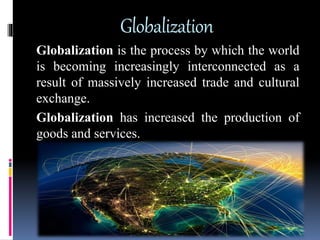
Globalization is the process by which the world
is becoming increasingly interconnected as a
result of massively increased trade and cultural
exchange.
Globalization has increased the production of
goods and services.
Globalization
The head of Brunswick Corporation declared,
“Financial resources are not the problem. We
have the money, products, and position to be a
dominant global player. What we lack are the
human resources. We just don’t have enough
people with needed global leadership
capabilities.”
Diversityinworkplace
 Diversity in the workplace means that a company's workforce
includes people of varying gender, age, religion, race,
ethnicity, cultural background, religion, languages, education,
abilities, etc.
 Diversity and social issues have had a dramatic effect on the
study and application of management and organizational
behavior.
 Diversity must be recognized and nurtured as the
organization’s greatest asset, and the ability to attract and
work with diverse talent must be seen as a critical competitive
advantage as it plays a central role in today’s environmental
context.
 Diversity means much more than ethnicity (tradition &
customs) , gender, or sexual orientation. New and evolving
diverse populations include a full range of ages, as well as
career and geographic experiences.
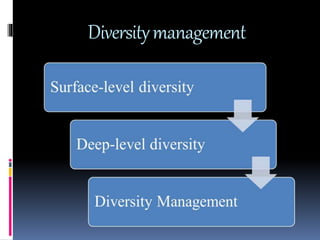
Diversitymanagement
Effectivediversitymanagement
SHRM identified some outcomes such as
following for “effective diversity management”:
 Creating a work environment or culture that
allows everyone to contribute all that they can
to the organization.
 Leveraging differences and similarities in the
workforce for the strategic advantage of the
organization.
 Enhancing the ability of people from different
backgrounds to work effectively together.
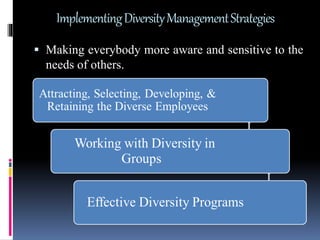
ImplementingDiversityManagementStrategies
 Making everybody more aware and sensitive to the
needs of others.
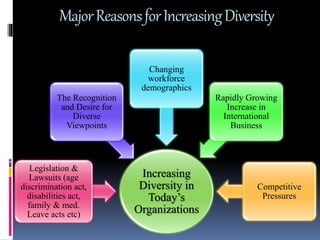
MajorReasonsforIncreasingDiversity
Increasing
Diversity in
Today’s
Organizations
Legislation &
Lawsuits (age
discrimination act,
disabilities act,
family & med.
Leave acts etc)
The Recognition
and Desire for
Diverse
Viewpoints
Changing
workforce
demographics
Rapidly Growing
Increase in
International
Business
Competitive
Pressures
ethics
Ethics involves moral issues and choices
and deals with right and wrong behavior.
In other words, moral principles that
govern a person's behavior or the conducting of
an activity is called ethics.
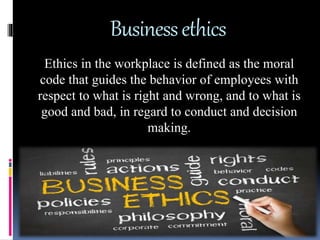
Businessethics
Ethics in the workplace is defined as the moral
code that guides the behavior of employees with
respect to what is right and wrong, and to what is
good and bad, in regard to conduct and decision
making.
ImportanceofEthicalbehavior
 In order to prohibit the ethical issues such as
illegal practices, looting, and frauds in an
organization, implementation of ethical
conducts are essential.
 the challenges that organizations faces
include but aren't limited to discrimination, as
well as social responsibility are related to
ethics and to cope up with them the ethical
codes & conducts should be reflected in their
policies.
Ethicalbehaviorinorganizations
 A number of cultural (family, friends, neighbors,
education, religion, and the media), organizational
(ethical codes, role models, policies and practices,
and reward and punishment systems), and external
forces (political, legal, economic, and international
developments) help determine ethical behavior.
 These influences, acting interdependently, serve to
help identify and shape ethical behavior in today’s
organizations (individuals and groups both).
Reinforcementofethicalbehavior
 Clear communication of the boundaries of
ethical conduct
 Selection of employees who support the
ethical culture
 Reward of ethical behavior
 Conspicuous punishment of members who
engage in unethical behavior.
Thankyou…!!!!


Environmental context for OB

  • 1.
    BY: SYEDA TOOBASALEEM Environmental Context for Organizational Behavior
  • 2.
    Theroleofinformationtechnology  Newer typesof IT such as electronic-mail and groupware (app. Software to help people in achieving their common goals) are creating significant changes in the way that information flows around groupware, and between them and their customers and suppliers.  It provides more effective ways of accessing information from multiple sources, including use of external information on databases and on the Internet.  Group decision support systems that operate in a meeting room environment can help enhance decision making, but it does need someone who is an expert facilitator to help the group master the technique of structured discussion.
  • 3.
    Theroleofinformationtechnology  Intense competitionis forcing the organization to become more efficient and effective. One way to increase efficiency and effectiveness is the use of information technology. (comp. edge)  As the industry becomes more global in its procurement, manufacturing and marketing operations, it requires greater use of information technology to reduce time and space barriers.  With constant reorganization as well as increased mergers and acquisitions, top management recognizes the need for flexibility through compatible information technologies. (BPR)
  • 4.
    Globalization Globalization is theprocess by which the world is becoming increasingly interconnected as a result of massively increased trade and cultural exchange. Globalization has increased the production of goods and services.
  • 5.
    Globalization The head ofBrunswick Corporation declared, “Financial resources are not the problem. We have the money, products, and position to be a dominant global player. What we lack are the human resources. We just don’t have enough people with needed global leadership capabilities.”
  • 6.
    Diversityinworkplace  Diversity inthe workplace means that a company's workforce includes people of varying gender, age, religion, race, ethnicity, cultural background, religion, languages, education, abilities, etc.  Diversity and social issues have had a dramatic effect on the study and application of management and organizational behavior.  Diversity must be recognized and nurtured as the organization’s greatest asset, and the ability to attract and work with diverse talent must be seen as a critical competitive advantage as it plays a central role in today’s environmental context.  Diversity means much more than ethnicity (tradition & customs) , gender, or sexual orientation. New and evolving diverse populations include a full range of ages, as well as career and geographic experiences.
  • 7.
  • 8.
    Effectivediversitymanagement SHRM identified someoutcomes such as following for “effective diversity management”:  Creating a work environment or culture that allows everyone to contribute all that they can to the organization.  Leveraging differences and similarities in the workforce for the strategic advantage of the organization.  Enhancing the ability of people from different backgrounds to work effectively together.
  • 9.
    ImplementingDiversityManagementStrategies  Making everybodymore aware and sensitive to the needs of others.
  • 10.
    MajorReasonsforIncreasingDiversity Increasing Diversity in Today’s Organizations Legislation & Lawsuits(age discrimination act, disabilities act, family & med. Leave acts etc) The Recognition and Desire for Diverse Viewpoints Changing workforce demographics Rapidly Growing Increase in International Business Competitive Pressures
  • 11.
    ethics Ethics involves moralissues and choices and deals with right and wrong behavior. In other words, moral principles that govern a person's behavior or the conducting of an activity is called ethics.
  • 12.
    Businessethics Ethics in theworkplace is defined as the moral code that guides the behavior of employees with respect to what is right and wrong, and to what is good and bad, in regard to conduct and decision making.
  • 13.
    ImportanceofEthicalbehavior  In orderto prohibit the ethical issues such as illegal practices, looting, and frauds in an organization, implementation of ethical conducts are essential.  the challenges that organizations faces include but aren't limited to discrimination, as well as social responsibility are related to ethics and to cope up with them the ethical codes & conducts should be reflected in their policies.
  • 14.
    Ethicalbehaviorinorganizations  A numberof cultural (family, friends, neighbors, education, religion, and the media), organizational (ethical codes, role models, policies and practices, and reward and punishment systems), and external forces (political, legal, economic, and international developments) help determine ethical behavior.  These influences, acting interdependently, serve to help identify and shape ethical behavior in today’s organizations (individuals and groups both).
  • 15.
    Reinforcementofethicalbehavior  Clear communicationof the boundaries of ethical conduct  Selection of employees who support the ethical culture  Reward of ethical behavior  Conspicuous punishment of members who engage in unethical behavior.
  • 16.

Editor's Notes

  • #3 Market system > info. Flow point #2 > example Competitive intelligence systems (C.I).
  • #4 Space = distance & BPR (Business Process Re-engineering) SAP. Point 1> comp. adv.
  • #8 Everybody brings differences to an organization where they work. These differences can create energy and excitement in the workplace, but they can also cause conflict. So it is important that we have an understanding of how diversity works in organizations. When we look at the workplace we can recognize two levels of diversity. Surface-level diversity represents the characteristics that are easily observed such as race, gender, age etc. Deep-level diversity represents the aspects that are more difficult to see at first glance such as values, personality, and work preferences. Organizations need to engage in Diversity Management to eliminate unfair discrimination. By understanding what diversity is and helping employees with training and development opportunities, the negative impact of discrimination can be minimized.
  • #9 Diversity Management is the application of the organization’s understanding of diversity. It is the way that organizations recognize and utilize the differences that will allow them to create a culture that capitalizes on their workforce diversity to be a leader in the marketplace. Must be an ongoing commitment at all levels of the organization. Policies must include multiple perspectives and be long term in their orientation to be effective.
  • #10 Knowing that people are different is not enough for organizations to operate effectively with differences. Managers must work to develop strategies to develop ways to utilize differences to achieve work outcomes. Managers start by attracting, selecting, developing, and retaining employees who can operate and excel in a workplace with diverse individuals, viewpoints, and ideas. Gaining a diverse workforce through the selection process and developing that workforce through organizational training and development programs will help to provide for an environment that fosters creativity and effectiveness by tapping into the potential of all employees. More and more organizations are requiring employees to work in groups. Diversity can aid in group effectiveness and it can diminish it. Organizations must provide the tools to leverage the differences to obtain superior performance. Effective workforce programs that encourage diversity contain three components. First, they teach managers about the laws they need to follow and equal employment opportunity requirements. Second, they help managers and employees to see that a diverse workforce is better able to serve diverse markets. Third, they take into account personal differences and approach the differences as strengths that can be utilized to enhance performance.
  • #11 Demographic >> Age, gender, education & ethnicity. IB>> International Business. Age discrimination & pregnancy discrimination 1978 ‘s act.