Chapter 7:
                                    Organizational Factors: The
                                    Role of Ethical Culture and
                                    Relationships

                                                Part Three:
                                                The Decision Making Process


© 2013 Cengage Learning. All Rights Reserved.                                 1
Ethical Corporate Culture
                            Corporate culture has many definitions
                                        A set of values, norms, and artifacts, including ways
                                         of solving problems shared by organizational
                                         members
                                        The shared beliefs top managers have about how
                                         they should manage themselves and other
                                         employees and how they should conduct their
                                         business
                             Gives organizational members meaning and
                              sets the internal rules of behavior
                                       All organizations have culture
© 2013 Cengage Learning. All Rights Reserved.                                                    2
Sarbanes-Oxley 404

                            Culture is codified by the Sarbanes-Oxley
                            404 compliance section
                             Includes assessment of effectiveness of
                              controls by management and external auditors
                             Forces firms to adopt a set of values that make
                              up part of the culture

                                       Compliance with 404 requires cultural change,
                                       not only accounting changes

© 2013 Cengage Learning. All Rights Reserved.                                          3
Corporate Culture
                             May be formal through statements of values,
                              beliefs, and customs
                                        Comes from upper management
                                        Memos, codes, manuals, forms, ceremonies
                             May be informal through direct or indirect
                              comments conveying management’s wishes
                                        Dress codes, promotions, extracurricular activities


                                       The “tone at the top” is crucial in creating
                                       ethical corporate culture
© 2013 Cengage Learning. All Rights Reserved.                                                  4
Two Dimensions of Organizational
                                           Culture


                             Concern for people
                                        The organization’s efforts to care for its
                                         employees’ well-being
                             Concern for performance
                                        The organization’s efforts to focus on
                                         output and employee productivity


© 2013 Cengage Learning. All Rights Reserved.                                         5
Perceived Tone and Culture of the CEO and
                                              other Executives


© 2013 Cengage Learning. All Rights Reserved.                                 6
Four Organizational Culture Types
                             Apathetic: Minimal concern for people or
                              performance
                             Caring: High concern for people; minimal
                              concern for performance
                             Exacting: Minimal concern for people; high
                              concern for performance
                             Integrative: High concern for people and
                              performance
                                       A cultural audit is an assessment of the organization’s
                                       values
                                       • Usually conducted by outside consultants; can be
                                           handled internally
© 2013 Cengage Learning. All Rights Reserved.                                                    7
Company Examples of Organizational Culture
                                              Types


© 2013 Cengage Learning. All Rights Reserved.                              8
Ethics and Corporate Culture


                             Ethical corporate culture is a significant factor
                              in ethical decision making
                             If a firm’s culture encourages/rewards/does
                              not monitor unethical behavior, employees
                              may act unethically
                             Management’s sense of an organizational
                              culture may differ from that guiding employees


© 2013 Cengage Learning. All Rights Reserved.                                     9
Compliance versus Values-Based
                                               Culture

                             Compliance-based cultures use a legalistic
                              approach to ethics
                                        Revolve around risk management, not ethics
                                        Lack of long-term focus and integrity
                             Values-based cultures rely on mission
                              statements that define the firm and
                              stakeholder relations
                                        Focus on values, not laws
                                        Top-down integrity is critical


© 2013 Cengage Learning. All Rights Reserved.                                         10
Differential Association

                            The idea that people learn ethical/unethical
                            behavior while interacting with others
                             Studies support that differential association
                              supports ethical decision making
                             Superiors have a strong influence on
                              subordinates
                             Employees may go along with superiors’ moral
                              judgments to show loyalty

© 2013 Cengage Learning. All Rights Reserved.                                 11
Whistle-Blowing

                            Exposing an employer’s wrongdoing to
                            company outsiders
                                        Some legal protections exist
                             The Sarbanes-Oxley Act, the FSGO, and the
                              Dodd-Frank Act have institutionalized whistle-
                              blowing protections to encourage discovery of
                              misconduct
                                        Whistle-blowers fear retaliation


© 2013 Cengage Learning. All Rights Reserved.                                  12
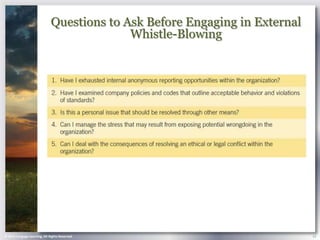
Questions to Ask Before Engaging in External
                                            Whistle-Blowing


© 2013 Cengage Learning. All Rights Reserved.                                13
Forms of Retaliation Experienced as a Result
                                         of Reported Misconduct


© 2013 Cengage Learning. All Rights Reserved.                                 14
To Whom Do Employees Report Misconduct?


© 2013 Cengage Learning. All Rights Reserved.                           15
Leaders Can Influence Corporate
                                                Culture
                             An effective leader is one who does well for
                              the stakeholders of the corporation
                                        Effective leaders are good at getting followers to
                                         common goals effectively and efficiently
                             Power refers to the influence that leaders and
                              managers have over the behavior and
                              decisions of subordinates
                                        An individual has power when his/her presence
                                         causes people to behave differently


                                       Power and influence shape corporate culture
© 2013 Cengage Learning. All Rights Reserved.                                                 16
Five Power Bases
                             Reward power: Offering something desirable
                              to influence behavior
                             Coercive power: Penalizing negative behavior
                             Legitimate power: The consensus that a
                              person has the right to exert influence over
                              others
                             Expert power: Derives from knowledge and
                              credibility with subordinates
                             Referent power: Exists when goals or
                              objectives are similar
© 2013 Cengage Learning. All Rights Reserved.                                17
Motivation
                            A force within the individual that focuses
                            behavior toward achieving a goal
                             Job performance: A function of ability and
                              motivation
                             An individual’s hierarchy of needs may influence
                              motivation and ethical behavior
                                        Relatedness needs: Satisfied by social and interpersonal
                                         relationships
                                        Growth needs: Satisfied by creative or productive
                                         activities


                                       Needs or goals may change over time
© 2013 Cengage Learning. All Rights Reserved.                                                       18
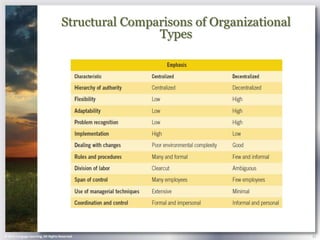
Centralized Organizational
                                                         Structure
                            Decision making authority is concentrated
                            in the hands of top-level managers
                             Little authority delegated to lower levels
                             Best for organizations
                                        That make high-risk decisions
                                        Whose lower-level managers are not skilled in
                                         decision-making
                                        Where processes are routine


                                       May have a harder time responding to ethical
                                       issues
© 2013 Cengage Learning. All Rights Reserved.                                            19
Decentralized Organizational
                                                     Structure
                            Decision making authority is delegated as
                            far down the chain of command as possible
                             Flexible and quicker to recognize external
                              change
                             Can be slow to recognize organizational policy
                              changes

                                       Units may diverge and develop different
                                       value systems
                                       •        Ethical misconduct may result
© 2013 Cengage Learning. All Rights Reserved.                                    20
Structural Comparisons of Organizational
                                                     Types


© 2013 Cengage Learning. All Rights Reserved.                                   21
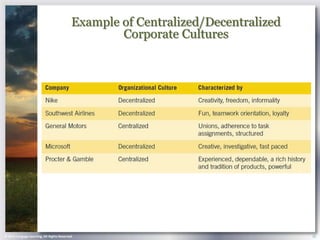
Example of Centralized/Decentralized
                                                   Corporate Cultures


© 2013 Cengage Learning. All Rights Reserved.                                     22
Groups in Corporate Structure and
                                             Culture

                             Formal groups
                                        Committees, work groups, and teams
                             Informal groups
                                        The grapevine
                             Group norms
                                        Standards of behavior that groups expect of
                                         members
                                        Define acceptable/unacceptable behavior within
                                         the group


© 2013 Cengage Learning. All Rights Reserved.                                             23
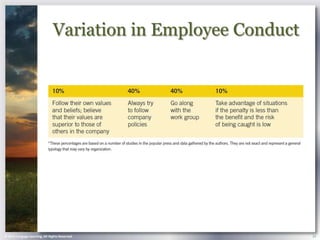
Variation in Employee Conduct


© 2013 Cengage Learning. All Rights Reserved.                  24
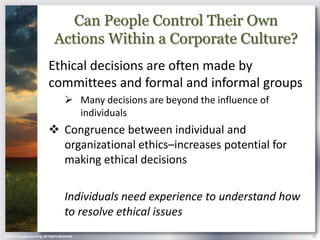
Can People Control Their Own
                                Actions Within a Corporate Culture?
                            Ethical decisions are often made by
                            committees and formal and informal groups
                                        Many decisions are beyond the influence of
                                         individuals
                             Congruence between individual and
                              organizational ethics–increases potential for
                              making ethical decisions

                                       Individuals need experience to understand how
                                       to resolve ethical issues
© 2013 Cengage Learning. All Rights Reserved.                                          25

Chapter 7

  • 1.
    Chapter 7: Organizational Factors: The Role of Ethical Culture and Relationships Part Three: The Decision Making Process © 2013 Cengage Learning. All Rights Reserved. 1
  • 2.
    Ethical Corporate Culture Corporate culture has many definitions  A set of values, norms, and artifacts, including ways of solving problems shared by organizational members  The shared beliefs top managers have about how they should manage themselves and other employees and how they should conduct their business  Gives organizational members meaning and sets the internal rules of behavior All organizations have culture © 2013 Cengage Learning. All Rights Reserved. 2
  • 3.
    Sarbanes-Oxley 404 Culture is codified by the Sarbanes-Oxley 404 compliance section  Includes assessment of effectiveness of controls by management and external auditors  Forces firms to adopt a set of values that make up part of the culture Compliance with 404 requires cultural change, not only accounting changes © 2013 Cengage Learning. All Rights Reserved. 3
  • 4.
    Corporate Culture  May be formal through statements of values, beliefs, and customs  Comes from upper management  Memos, codes, manuals, forms, ceremonies  May be informal through direct or indirect comments conveying management’s wishes  Dress codes, promotions, extracurricular activities The “tone at the top” is crucial in creating ethical corporate culture © 2013 Cengage Learning. All Rights Reserved. 4
  • 5.
    Two Dimensions ofOrganizational Culture  Concern for people  The organization’s efforts to care for its employees’ well-being  Concern for performance  The organization’s efforts to focus on output and employee productivity © 2013 Cengage Learning. All Rights Reserved. 5
  • 6.
    Perceived Tone andCulture of the CEO and other Executives © 2013 Cengage Learning. All Rights Reserved. 6
  • 7.
    Four Organizational CultureTypes  Apathetic: Minimal concern for people or performance  Caring: High concern for people; minimal concern for performance  Exacting: Minimal concern for people; high concern for performance  Integrative: High concern for people and performance A cultural audit is an assessment of the organization’s values • Usually conducted by outside consultants; can be handled internally © 2013 Cengage Learning. All Rights Reserved. 7
  • 8.
    Company Examples ofOrganizational Culture Types © 2013 Cengage Learning. All Rights Reserved. 8
  • 9.
    Ethics and CorporateCulture  Ethical corporate culture is a significant factor in ethical decision making  If a firm’s culture encourages/rewards/does not monitor unethical behavior, employees may act unethically  Management’s sense of an organizational culture may differ from that guiding employees © 2013 Cengage Learning. All Rights Reserved. 9
  • 10.
    Compliance versus Values-Based Culture  Compliance-based cultures use a legalistic approach to ethics  Revolve around risk management, not ethics  Lack of long-term focus and integrity  Values-based cultures rely on mission statements that define the firm and stakeholder relations  Focus on values, not laws  Top-down integrity is critical © 2013 Cengage Learning. All Rights Reserved. 10
  • 11.
    Differential Association The idea that people learn ethical/unethical behavior while interacting with others  Studies support that differential association supports ethical decision making  Superiors have a strong influence on subordinates  Employees may go along with superiors’ moral judgments to show loyalty © 2013 Cengage Learning. All Rights Reserved. 11
  • 12.
    Whistle-Blowing Exposing an employer’s wrongdoing to company outsiders  Some legal protections exist  The Sarbanes-Oxley Act, the FSGO, and the Dodd-Frank Act have institutionalized whistle- blowing protections to encourage discovery of misconduct  Whistle-blowers fear retaliation © 2013 Cengage Learning. All Rights Reserved. 12
  • 13.
    Questions to AskBefore Engaging in External Whistle-Blowing © 2013 Cengage Learning. All Rights Reserved. 13
  • 14.
    Forms of RetaliationExperienced as a Result of Reported Misconduct © 2013 Cengage Learning. All Rights Reserved. 14
  • 15.
    To Whom DoEmployees Report Misconduct? © 2013 Cengage Learning. All Rights Reserved. 15
  • 16.
    Leaders Can InfluenceCorporate Culture  An effective leader is one who does well for the stakeholders of the corporation  Effective leaders are good at getting followers to common goals effectively and efficiently  Power refers to the influence that leaders and managers have over the behavior and decisions of subordinates  An individual has power when his/her presence causes people to behave differently Power and influence shape corporate culture © 2013 Cengage Learning. All Rights Reserved. 16
  • 17.
    Five Power Bases  Reward power: Offering something desirable to influence behavior  Coercive power: Penalizing negative behavior  Legitimate power: The consensus that a person has the right to exert influence over others  Expert power: Derives from knowledge and credibility with subordinates  Referent power: Exists when goals or objectives are similar © 2013 Cengage Learning. All Rights Reserved. 17
  • 18.
    Motivation A force within the individual that focuses behavior toward achieving a goal  Job performance: A function of ability and motivation  An individual’s hierarchy of needs may influence motivation and ethical behavior  Relatedness needs: Satisfied by social and interpersonal relationships  Growth needs: Satisfied by creative or productive activities Needs or goals may change over time © 2013 Cengage Learning. All Rights Reserved. 18
  • 19.
    Centralized Organizational Structure Decision making authority is concentrated in the hands of top-level managers  Little authority delegated to lower levels  Best for organizations  That make high-risk decisions  Whose lower-level managers are not skilled in decision-making  Where processes are routine May have a harder time responding to ethical issues © 2013 Cengage Learning. All Rights Reserved. 19
  • 20.
    Decentralized Organizational Structure Decision making authority is delegated as far down the chain of command as possible  Flexible and quicker to recognize external change  Can be slow to recognize organizational policy changes Units may diverge and develop different value systems • Ethical misconduct may result © 2013 Cengage Learning. All Rights Reserved. 20
  • 21.
    Structural Comparisons ofOrganizational Types © 2013 Cengage Learning. All Rights Reserved. 21
  • 22.
    Example of Centralized/Decentralized Corporate Cultures © 2013 Cengage Learning. All Rights Reserved. 22
  • 23.
    Groups in CorporateStructure and Culture  Formal groups  Committees, work groups, and teams  Informal groups  The grapevine  Group norms  Standards of behavior that groups expect of members  Define acceptable/unacceptable behavior within the group © 2013 Cengage Learning. All Rights Reserved. 23
  • 24.
    Variation in EmployeeConduct © 2013 Cengage Learning. All Rights Reserved. 24
  • 25.
    Can People ControlTheir Own Actions Within a Corporate Culture? Ethical decisions are often made by committees and formal and informal groups  Many decisions are beyond the influence of individuals  Congruence between individual and organizational ethics–increases potential for making ethical decisions Individuals need experience to understand how to resolve ethical issues © 2013 Cengage Learning. All Rights Reserved. 25