©2013 Cengage Learning. All Rights Reserved. May not be scanned, copied or duplicated, or posted to a publicly accessible website, in whole or in part.
3
©2013 Cengage Learning. All Rights Reserved.
May not be scanned, copied or duplicated, or posted to a publicly accessible website, in whole or in
part.
Personality,
Perception, and
Attribution
©2013 Cengage Learning. All Rights Reserved. May not be scanned, copied or duplicated, or posted to a publicly accessible website, in whole or in part.
Learning Objectives
©2013 Cengage Learning. All Rights Reserved. May not be scanned, copied or duplicated, or posted to a publicly accessible website, in whole or in part.
1 Describe individual differences and their
importance in understanding behavior.
2 Define personality.
3 Identify several personality characteristics and their
influences on behavior in organizations.
4 Give examples of each personality characteristic
from your own work experience and how you
would apply your knowledge in managing
personality differences.
5 Discuss Carl Jung’s contribution to our
understanding of individual differences, and explain
how his theory is used in the Myers–Briggs Type
Indicator (MBTI®) instrument.
2
©2013 Cengage Learning. All Rights Reserved. May not be scanned, copied or duplicated, or posted to a publicly accessible website, in whole or in part.
Learning Objectives continued
©2013 Cengage Learning. All Rights Reserved. May not be scanned, copied or duplicated, or posted to a publicly accessible website, in whole or in part.
6 Evaluate the importance of the MBTI® to
managers.
7 Define social perception and explain how
characteristics of the perceiver, the target, and
the situation affect it.
8 Identify five common barriers to social
perception.
9 Explain the attribution process and how
attributions affect managerial behavior.
10 Evaluate the accuracy of managerial
attributions from the standpoint of attribution
biases and errors.
3
©2013 Cengage Learning. All Rights Reserved. May not be scanned, copied or duplicated, or posted to a publicly accessible website, in whole or in part.©2013 Cengage Learning. All Rights Reserved. May not be scanned, copied or duplicated, or posted to a publicly accessible website, in whole or in part.
^
^
Individual Differences
• Individuals are unique in terms of their
• Skills
• Abilities
• Personalities
• Perceptions
• Attitudes
• Emotions
• Ethics
• No two people are completely alike
4
©2013 Cengage Learning. All Rights Reserved. May not be scanned, copied or duplicated, or posted to a publicly accessible website, in whole or in part.©2013 Cengage Learning. All Rights Reserved. May not be scanned, copied or duplicated, or posted to a publicly accessible website, in whole or in part.
^
^
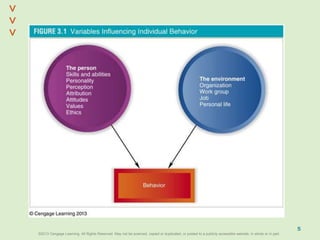
5
©2013 Cengage Learning. All Rights Reserved. May not be scanned, copied or duplicated, or posted to a publicly accessible website, in whole or in part.©2013 Cengage Learning. All Rights Reserved. May not be scanned, copied or duplicated, or posted to a publicly accessible website, in whole or in part.
^
^
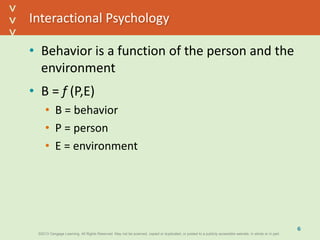
Interactional Psychology
• Behavior is a function of the person and the
environment
• B = f (P,E)
• B = behavior
• P = person
• E = environment
6
©2013 Cengage Learning. All Rights Reserved. May not be scanned, copied or duplicated, or posted to a publicly accessible website, in whole or in part.©2013 Cengage Learning. All Rights Reserved. May not be scanned, copied or duplicated, or posted to a publicly accessible website, in whole or in part.
^
^
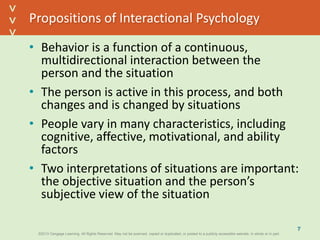
Propositions of Interactional Psychology
• Behavior is a function of a continuous,
multidirectional interaction between the
person and the situation
• The person is active in this process, and both
changes and is changed by situations
• People vary in many characteristics, including
cognitive, affective, motivational, and ability
factors
• Two interpretations of situations are important:
the objective situation and the person’s
subjective view of the situation
7
©2013 Cengage Learning. All Rights Reserved. May not be scanned, copied or duplicated, or posted to a publicly accessible website, in whole or in part.©2013 Cengage Learning. All Rights Reserved. May not be scanned, copied or duplicated, or posted to a publicly accessible website, in whole or in part.
^
^
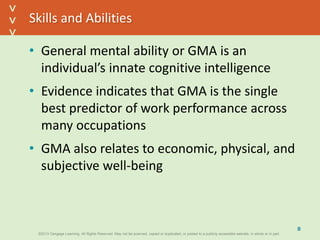
Skills and Abilities
• General mental ability or GMA is an
individual’s innate cognitive intelligence
• Evidence indicates that GMA is the single
best predictor of work performance across
many occupations
• GMA also relates to economic, physical, and
subjective well-being
8
©2013 Cengage Learning. All Rights Reserved. May not be scanned, copied or duplicated, or posted to a publicly accessible website, in whole or in part.©2013 Cengage Learning. All Rights Reserved. May not be scanned, copied or duplicated, or posted to a publicly accessible website, in whole or in part.
^
^
Personality
Personality : a relatively stable set of
characteristics that influence an
individual’s behavior
9
Trait
theory
Integrative
approach
©2013 Cengage Learning. All Rights Reserved. May not be scanned, copied or duplicated, or posted to a publicly accessible website, in whole or in part.©2013 Cengage Learning. All Rights Reserved. May not be scanned, copied or duplicated, or posted to a publicly accessible website, in whole or in part.
^
^
Trait Theory
• To understand individuals we must break
down behavior patterns into a series of
observable traits
• The Big Five traits:
• Extraversion
• Agreeableness
• Conscientiousness
• Emotional stability
• Openness to experience
10
©2013 Cengage Learning. All Rights Reserved. May not be scanned, copied or duplicated, or posted to a publicly accessible website, in whole or in part.©2013 Cengage Learning. All Rights Reserved. May not be scanned, copied or duplicated, or posted to a publicly accessible website, in whole or in part.
^
^
11
©2013 Cengage Learning. All Rights Reserved. May not be scanned, copied or duplicated, or posted to a publicly accessible website, in whole or in part.©2013 Cengage Learning. All Rights Reserved. May not be scanned, copied or duplicated, or posted to a publicly accessible website, in whole or in part.
^
^
Integrative Approach
• Personality is described as a composite of the
individual’s psychological processes
• Personality dispositions include
• Emotions
• Cognitions
• Attitudes
• Expectancies
• Fantasies
• Considers both the person and situational
variables as combined predictors of behavior
12
©2013 Cengage Learning. All Rights Reserved. May not be scanned, copied or duplicated, or posted to a publicly accessible website, in whole or in part.©2013 Cengage Learning. All Rights Reserved. May not be scanned, copied or duplicated, or posted to a publicly accessible website, in whole or in part.
^
^
Personality Characteristics in Organizations
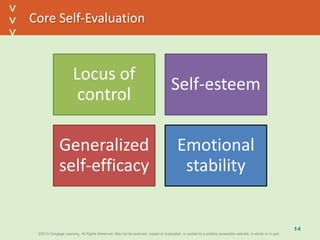
• Core Self Evaluations (CSE), is a broad set of
personality traits that refers to self-concept
• Self-monitoring is the extent to which
people base their behavior on cues from
other people and situations
• Positive/negative effect describes the extent
to which individuals focus on the positive or
negative aspects of themselves, other
people, and the world in general
13
©2013 Cengage Learning. All Rights Reserved. May not be scanned, copied or duplicated, or posted to a publicly accessible website, in whole or in part.©2013 Cengage Learning. All Rights Reserved. May not be scanned, copied or duplicated, or posted to a publicly accessible website, in whole or in part.
^
^
Core Self-Evaluation
14
Locus of
control
Self-esteem
Generalized
self-efficacy
Emotional
stability
©2013 Cengage Learning. All Rights Reserved. May not be scanned, copied or duplicated, or posted to a publicly accessible website, in whole or in part.©2013 Cengage Learning. All Rights Reserved. May not be scanned, copied or duplicated, or posted to a publicly accessible website, in whole or in part.
^
^
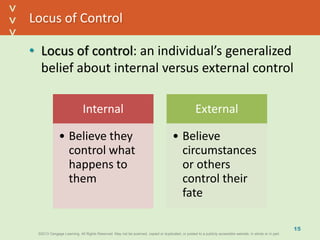
Locus of Control
• Locus of control: an individual’s generalized
belief about internal versus external control
15
Internal
• Believe they
control what
happens to
them
External
• Believe
circumstances
or others
control their
fate
©2013 Cengage Learning. All Rights Reserved. May not be scanned, copied or duplicated, or posted to a publicly accessible website, in whole or in part.©2013 Cengage Learning. All Rights Reserved. May not be scanned, copied or duplicated, or posted to a publicly accessible website, in whole or in part.
^
^
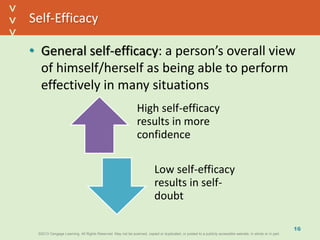
Self-Efficacy
• General self-efficacy: a person’s overall view
of himself/herself as being able to perform
effectively in many situations
16
High self-efficacy
results in more
confidence
Low self-efficacy
results in self-
doubt
©2013 Cengage Learning. All Rights Reserved. May not be scanned, copied or duplicated, or posted to a publicly accessible website, in whole or in part.©2013 Cengage Learning. All Rights Reserved. May not be scanned, copied or duplicated, or posted to a publicly accessible website, in whole or in part.
^
^
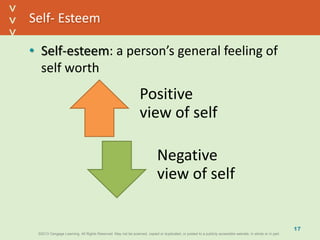
Self- Esteem
• Self-esteem: a person’s general feeling of
self worth
17
Positive
view of self
Negative
view of self
©2013 Cengage Learning. All Rights Reserved. May not be scanned, copied or duplicated, or posted to a publicly accessible website, in whole or in part.©2013 Cengage Learning. All Rights Reserved. May not be scanned, copied or duplicated, or posted to a publicly accessible website, in whole or in part.
^
^
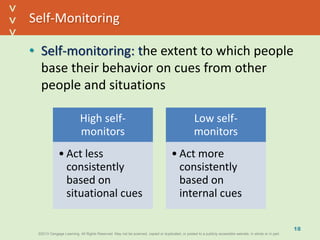
Self-Monitoring
• Self-monitoring: the extent to which people
base their behavior on cues from other
people and situations
18
High self-
monitors
• Act less
consistently
based on
situational cues
Low self-
monitors
• Act more
consistently
based on
internal cues
©2013 Cengage Learning. All Rights Reserved. May not be scanned, copied or duplicated, or posted to a publicly accessible website, in whole or in part.©2013 Cengage Learning. All Rights Reserved. May not be scanned, copied or duplicated, or posted to a publicly accessible website, in whole or in part.
^
^
Positive/Negative Affect
• Positive affect: an individual’s tendency to
accentuate the positive aspects of
himself/herself, other people, and the world
• Negative affect: an individual’s tendency to
accentuate the negative aspects of
himself/herself, other people, and the world
19
©2013 Cengage Learning. All Rights Reserved. May not be scanned, copied or duplicated, or posted to a publicly accessible website, in whole or in part.©2013 Cengage Learning. All Rights Reserved. May not be scanned, copied or duplicated, or posted to a publicly accessible website, in whole or in part.
^
^
Measuring Personality
• Self-report questionnaire: a series of
questions designed to assess individual
personality
• Projective test: a personality test that
involves responses to abstract stimuli
• Behavioral measures: personality
assessments that involve observing behavior
in a controlled situation
20
©2013 Cengage Learning. All Rights Reserved. May not be scanned, copied or duplicated, or posted to a publicly accessible website, in whole or in part.©2013 Cengage Learning. All Rights Reserved. May not be scanned, copied or duplicated, or posted to a publicly accessible website, in whole or in part.
^
^
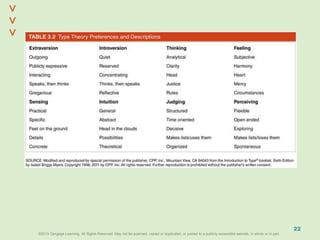
The MBTI Instrument
• Human similarities and differences can be
understood by combining preferences
• Extraverted/Introverted
• Sensing/Intuition
• Thinking/Feeling
• Perceiving/Judging
• Briggs & Myers developed the MBTI to
understand individual differences by
analyzing the combinations of preferences
21
©2013 Cengage Learning. All Rights Reserved. May not be scanned, copied or duplicated, or posted to a publicly accessible website, in whole or in part.©2013 Cengage Learning. All Rights Reserved. May not be scanned, copied or duplicated, or posted to a publicly accessible website, in whole or in part.
^
^
22
©2013 Cengage Learning. All Rights Reserved. May not be scanned, copied or duplicated, or posted to a publicly accessible website, in whole or in part.©2013 Cengage Learning. All Rights Reserved. May not be scanned, copied or duplicated, or posted to a publicly accessible website, in whole or in part.
^
^
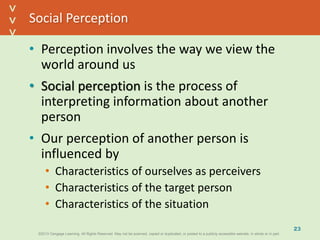
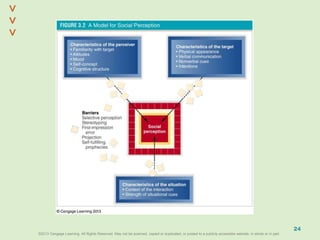
Social Perception
• Perception involves the way we view the
world around us
• Social perception is the process of
interpreting information about another
person
• Our perception of another person is
influenced by
• Characteristics of ourselves as perceivers
• Characteristics of the target person
• Characteristics of the situation
23
©2013 Cengage Learning. All Rights Reserved. May not be scanned, copied or duplicated, or posted to a publicly accessible website, in whole or in part.©2013 Cengage Learning. All Rights Reserved. May not be scanned, copied or duplicated, or posted to a publicly accessible website, in whole or in part.
^
^
24
©2013 Cengage Learning. All Rights Reserved. May not be scanned, copied or duplicated, or posted to a publicly accessible website, in whole or in part.©2013 Cengage Learning. All Rights Reserved. May not be scanned, copied or duplicated, or posted to a publicly accessible website, in whole or in part.
^
^
Barriers to Social Perception
• Selective perception
• Stereotyping
• First-impression error
• Projection
• Self-fulfilling prophecies
25
©2013 Cengage Learning. All Rights Reserved. May not be scanned, copied or duplicated, or posted to a publicly accessible website, in whole or in part.©2013 Cengage Learning. All Rights Reserved. May not be scanned, copied or duplicated, or posted to a publicly accessible website, in whole or in part.
^
^
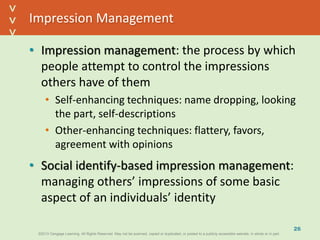
Impression Management
• Impression management: the process by which
people attempt to control the impressions
others have of them
• Self-enhancing techniques: name dropping, looking
the part, self-descriptions
• Other-enhancing techniques: flattery, favors,
agreement with opinions
• Social identify-based impression management:
managing others’ impressions of some basic
aspect of an individuals’ identity
26
©2013 Cengage Learning. All Rights Reserved. May not be scanned, copied or duplicated, or posted to a publicly accessible website, in whole or in part.©2013 Cengage Learning. All Rights Reserved. May not be scanned, copied or duplicated, or posted to a publicly accessible website, in whole or in part.
^
^
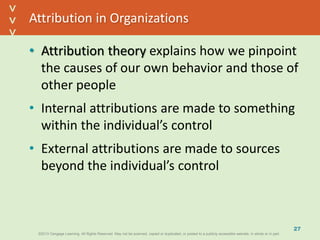
Attribution in Organizations
• Attribution theory explains how we pinpoint
the causes of our own behavior and those of
other people
• Internal attributions are made to something
within the individual’s control
• External attributions are made to sources
beyond the individual’s control
27
©2013 Cengage Learning. All Rights Reserved. May not be scanned, copied or duplicated, or posted to a publicly accessible website, in whole or in part.©2013 Cengage Learning. All Rights Reserved. May not be scanned, copied or duplicated, or posted to a publicly accessible website, in whole or in part.
^
^
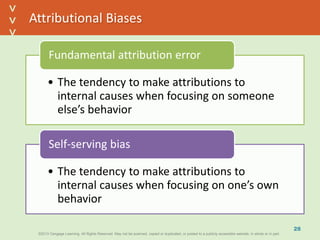
Attributional Biases
• The tendency to make attributions to
internal causes when focusing on someone
else’s behavior
Fundamental attribution error
• The tendency to make attributions to
internal causes when focusing on one’s own
behavior
Self-serving bias
28
©2013 Cengage Learning. All Rights Reserved. May not be scanned, copied or duplicated, or posted to a publicly accessible website, in whole or in part.©2013 Cengage Learning. All Rights Reserved. May not be scanned, copied or duplicated, or posted to a publicly accessible website, in whole or in part.
^
^
^
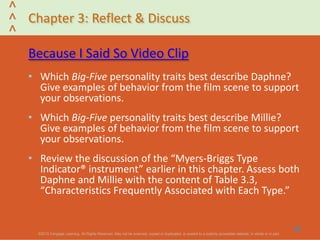
Chapter 3: Reflect & Discuss
Because I Said So Video Clip
• Which Big-Five personality traits best describe Daphne?
Give examples of behavior from the film scene to support
your observations.
• Which Big-Five personality traits best describe Millie?
Give examples of behavior from the film scene to support
your observations.
• Review the discussion of the “Myers-Briggs Type
Indicator® instrument” earlier in this chapter. Assess both
Daphne and Millie with the content of Table 3.3,
“Characteristics Frequently Associated with Each Type.”
29

MBA 635 chapter 3

  • 1.
    ©2013 Cengage Learning.All Rights Reserved. May not be scanned, copied or duplicated, or posted to a publicly accessible website, in whole or in part. 3 ©2013 Cengage Learning. All Rights Reserved. May not be scanned, copied or duplicated, or posted to a publicly accessible website, in whole or in part. Personality, Perception, and Attribution
  • 2.
    ©2013 Cengage Learning.All Rights Reserved. May not be scanned, copied or duplicated, or posted to a publicly accessible website, in whole or in part. Learning Objectives ©2013 Cengage Learning. All Rights Reserved. May not be scanned, copied or duplicated, or posted to a publicly accessible website, in whole or in part. 1 Describe individual differences and their importance in understanding behavior. 2 Define personality. 3 Identify several personality characteristics and their influences on behavior in organizations. 4 Give examples of each personality characteristic from your own work experience and how you would apply your knowledge in managing personality differences. 5 Discuss Carl Jung’s contribution to our understanding of individual differences, and explain how his theory is used in the Myers–Briggs Type Indicator (MBTI®) instrument. 2
  • 3.
    ©2013 Cengage Learning.All Rights Reserved. May not be scanned, copied or duplicated, or posted to a publicly accessible website, in whole or in part. Learning Objectives continued ©2013 Cengage Learning. All Rights Reserved. May not be scanned, copied or duplicated, or posted to a publicly accessible website, in whole or in part. 6 Evaluate the importance of the MBTI® to managers. 7 Define social perception and explain how characteristics of the perceiver, the target, and the situation affect it. 8 Identify five common barriers to social perception. 9 Explain the attribution process and how attributions affect managerial behavior. 10 Evaluate the accuracy of managerial attributions from the standpoint of attribution biases and errors. 3
  • 4.
    ©2013 Cengage Learning.All Rights Reserved. May not be scanned, copied or duplicated, or posted to a publicly accessible website, in whole or in part.©2013 Cengage Learning. All Rights Reserved. May not be scanned, copied or duplicated, or posted to a publicly accessible website, in whole or in part. ^ ^ Individual Differences • Individuals are unique in terms of their • Skills • Abilities • Personalities • Perceptions • Attitudes • Emotions • Ethics • No two people are completely alike 4
  • 5.
    ©2013 Cengage Learning.All Rights Reserved. May not be scanned, copied or duplicated, or posted to a publicly accessible website, in whole or in part.©2013 Cengage Learning. All Rights Reserved. May not be scanned, copied or duplicated, or posted to a publicly accessible website, in whole or in part. ^ ^ 5
  • 6.
    ©2013 Cengage Learning.All Rights Reserved. May not be scanned, copied or duplicated, or posted to a publicly accessible website, in whole or in part.©2013 Cengage Learning. All Rights Reserved. May not be scanned, copied or duplicated, or posted to a publicly accessible website, in whole or in part. ^ ^ Interactional Psychology • Behavior is a function of the person and the environment • B = f (P,E) • B = behavior • P = person • E = environment 6
  • 7.
    ©2013 Cengage Learning.All Rights Reserved. May not be scanned, copied or duplicated, or posted to a publicly accessible website, in whole or in part.©2013 Cengage Learning. All Rights Reserved. May not be scanned, copied or duplicated, or posted to a publicly accessible website, in whole or in part. ^ ^ Propositions of Interactional Psychology • Behavior is a function of a continuous, multidirectional interaction between the person and the situation • The person is active in this process, and both changes and is changed by situations • People vary in many characteristics, including cognitive, affective, motivational, and ability factors • Two interpretations of situations are important: the objective situation and the person’s subjective view of the situation 7
  • 8.
    ©2013 Cengage Learning.All Rights Reserved. May not be scanned, copied or duplicated, or posted to a publicly accessible website, in whole or in part.©2013 Cengage Learning. All Rights Reserved. May not be scanned, copied or duplicated, or posted to a publicly accessible website, in whole or in part. ^ ^ Skills and Abilities • General mental ability or GMA is an individual’s innate cognitive intelligence • Evidence indicates that GMA is the single best predictor of work performance across many occupations • GMA also relates to economic, physical, and subjective well-being 8
  • 9.
    ©2013 Cengage Learning.All Rights Reserved. May not be scanned, copied or duplicated, or posted to a publicly accessible website, in whole or in part.©2013 Cengage Learning. All Rights Reserved. May not be scanned, copied or duplicated, or posted to a publicly accessible website, in whole or in part. ^ ^ Personality Personality : a relatively stable set of characteristics that influence an individual’s behavior 9 Trait theory Integrative approach
  • 10.
    ©2013 Cengage Learning.All Rights Reserved. May not be scanned, copied or duplicated, or posted to a publicly accessible website, in whole or in part.©2013 Cengage Learning. All Rights Reserved. May not be scanned, copied or duplicated, or posted to a publicly accessible website, in whole or in part. ^ ^ Trait Theory • To understand individuals we must break down behavior patterns into a series of observable traits • The Big Five traits: • Extraversion • Agreeableness • Conscientiousness • Emotional stability • Openness to experience 10
  • 11.
    ©2013 Cengage Learning.All Rights Reserved. May not be scanned, copied or duplicated, or posted to a publicly accessible website, in whole or in part.©2013 Cengage Learning. All Rights Reserved. May not be scanned, copied or duplicated, or posted to a publicly accessible website, in whole or in part. ^ ^ 11
  • 12.
    ©2013 Cengage Learning.All Rights Reserved. May not be scanned, copied or duplicated, or posted to a publicly accessible website, in whole or in part.©2013 Cengage Learning. All Rights Reserved. May not be scanned, copied or duplicated, or posted to a publicly accessible website, in whole or in part. ^ ^ Integrative Approach • Personality is described as a composite of the individual’s psychological processes • Personality dispositions include • Emotions • Cognitions • Attitudes • Expectancies • Fantasies • Considers both the person and situational variables as combined predictors of behavior 12
  • 13.
    ©2013 Cengage Learning.All Rights Reserved. May not be scanned, copied or duplicated, or posted to a publicly accessible website, in whole or in part.©2013 Cengage Learning. All Rights Reserved. May not be scanned, copied or duplicated, or posted to a publicly accessible website, in whole or in part. ^ ^ Personality Characteristics in Organizations • Core Self Evaluations (CSE), is a broad set of personality traits that refers to self-concept • Self-monitoring is the extent to which people base their behavior on cues from other people and situations • Positive/negative effect describes the extent to which individuals focus on the positive or negative aspects of themselves, other people, and the world in general 13
  • 14.
    ©2013 Cengage Learning.All Rights Reserved. May not be scanned, copied or duplicated, or posted to a publicly accessible website, in whole or in part.©2013 Cengage Learning. All Rights Reserved. May not be scanned, copied or duplicated, or posted to a publicly accessible website, in whole or in part. ^ ^ Core Self-Evaluation 14 Locus of control Self-esteem Generalized self-efficacy Emotional stability
  • 15.
    ©2013 Cengage Learning.All Rights Reserved. May not be scanned, copied or duplicated, or posted to a publicly accessible website, in whole or in part.©2013 Cengage Learning. All Rights Reserved. May not be scanned, copied or duplicated, or posted to a publicly accessible website, in whole or in part. ^ ^ Locus of Control • Locus of control: an individual’s generalized belief about internal versus external control 15 Internal • Believe they control what happens to them External • Believe circumstances or others control their fate
  • 16.
    ©2013 Cengage Learning.All Rights Reserved. May not be scanned, copied or duplicated, or posted to a publicly accessible website, in whole or in part.©2013 Cengage Learning. All Rights Reserved. May not be scanned, copied or duplicated, or posted to a publicly accessible website, in whole or in part. ^ ^ Self-Efficacy • General self-efficacy: a person’s overall view of himself/herself as being able to perform effectively in many situations 16 High self-efficacy results in more confidence Low self-efficacy results in self- doubt
  • 17.
    ©2013 Cengage Learning.All Rights Reserved. May not be scanned, copied or duplicated, or posted to a publicly accessible website, in whole or in part.©2013 Cengage Learning. All Rights Reserved. May not be scanned, copied or duplicated, or posted to a publicly accessible website, in whole or in part. ^ ^ Self- Esteem • Self-esteem: a person’s general feeling of self worth 17 Positive view of self Negative view of self
  • 18.
    ©2013 Cengage Learning.All Rights Reserved. May not be scanned, copied or duplicated, or posted to a publicly accessible website, in whole or in part.©2013 Cengage Learning. All Rights Reserved. May not be scanned, copied or duplicated, or posted to a publicly accessible website, in whole or in part. ^ ^ Self-Monitoring • Self-monitoring: the extent to which people base their behavior on cues from other people and situations 18 High self- monitors • Act less consistently based on situational cues Low self- monitors • Act more consistently based on internal cues
  • 19.
    ©2013 Cengage Learning.All Rights Reserved. May not be scanned, copied or duplicated, or posted to a publicly accessible website, in whole or in part.©2013 Cengage Learning. All Rights Reserved. May not be scanned, copied or duplicated, or posted to a publicly accessible website, in whole or in part. ^ ^ Positive/Negative Affect • Positive affect: an individual’s tendency to accentuate the positive aspects of himself/herself, other people, and the world • Negative affect: an individual’s tendency to accentuate the negative aspects of himself/herself, other people, and the world 19
  • 20.
    ©2013 Cengage Learning.All Rights Reserved. May not be scanned, copied or duplicated, or posted to a publicly accessible website, in whole or in part.©2013 Cengage Learning. All Rights Reserved. May not be scanned, copied or duplicated, or posted to a publicly accessible website, in whole or in part. ^ ^ Measuring Personality • Self-report questionnaire: a series of questions designed to assess individual personality • Projective test: a personality test that involves responses to abstract stimuli • Behavioral measures: personality assessments that involve observing behavior in a controlled situation 20
  • 21.
    ©2013 Cengage Learning.All Rights Reserved. May not be scanned, copied or duplicated, or posted to a publicly accessible website, in whole or in part.©2013 Cengage Learning. All Rights Reserved. May not be scanned, copied or duplicated, or posted to a publicly accessible website, in whole or in part. ^ ^ The MBTI Instrument • Human similarities and differences can be understood by combining preferences • Extraverted/Introverted • Sensing/Intuition • Thinking/Feeling • Perceiving/Judging • Briggs & Myers developed the MBTI to understand individual differences by analyzing the combinations of preferences 21
  • 22.
    ©2013 Cengage Learning.All Rights Reserved. May not be scanned, copied or duplicated, or posted to a publicly accessible website, in whole or in part.©2013 Cengage Learning. All Rights Reserved. May not be scanned, copied or duplicated, or posted to a publicly accessible website, in whole or in part. ^ ^ 22
  • 23.
    ©2013 Cengage Learning.All Rights Reserved. May not be scanned, copied or duplicated, or posted to a publicly accessible website, in whole or in part.©2013 Cengage Learning. All Rights Reserved. May not be scanned, copied or duplicated, or posted to a publicly accessible website, in whole or in part. ^ ^ Social Perception • Perception involves the way we view the world around us • Social perception is the process of interpreting information about another person • Our perception of another person is influenced by • Characteristics of ourselves as perceivers • Characteristics of the target person • Characteristics of the situation 23
  • 24.
    ©2013 Cengage Learning.All Rights Reserved. May not be scanned, copied or duplicated, or posted to a publicly accessible website, in whole or in part.©2013 Cengage Learning. All Rights Reserved. May not be scanned, copied or duplicated, or posted to a publicly accessible website, in whole or in part. ^ ^ 24
  • 25.
    ©2013 Cengage Learning.All Rights Reserved. May not be scanned, copied or duplicated, or posted to a publicly accessible website, in whole or in part.©2013 Cengage Learning. All Rights Reserved. May not be scanned, copied or duplicated, or posted to a publicly accessible website, in whole or in part. ^ ^ Barriers to Social Perception • Selective perception • Stereotyping • First-impression error • Projection • Self-fulfilling prophecies 25
  • 26.
    ©2013 Cengage Learning.All Rights Reserved. May not be scanned, copied or duplicated, or posted to a publicly accessible website, in whole or in part.©2013 Cengage Learning. All Rights Reserved. May not be scanned, copied or duplicated, or posted to a publicly accessible website, in whole or in part. ^ ^ Impression Management • Impression management: the process by which people attempt to control the impressions others have of them • Self-enhancing techniques: name dropping, looking the part, self-descriptions • Other-enhancing techniques: flattery, favors, agreement with opinions • Social identify-based impression management: managing others’ impressions of some basic aspect of an individuals’ identity 26
  • 27.
    ©2013 Cengage Learning.All Rights Reserved. May not be scanned, copied or duplicated, or posted to a publicly accessible website, in whole or in part.©2013 Cengage Learning. All Rights Reserved. May not be scanned, copied or duplicated, or posted to a publicly accessible website, in whole or in part. ^ ^ Attribution in Organizations • Attribution theory explains how we pinpoint the causes of our own behavior and those of other people • Internal attributions are made to something within the individual’s control • External attributions are made to sources beyond the individual’s control 27
  • 28.
    ©2013 Cengage Learning.All Rights Reserved. May not be scanned, copied or duplicated, or posted to a publicly accessible website, in whole or in part.©2013 Cengage Learning. All Rights Reserved. May not be scanned, copied or duplicated, or posted to a publicly accessible website, in whole or in part. ^ ^ Attributional Biases • The tendency to make attributions to internal causes when focusing on someone else’s behavior Fundamental attribution error • The tendency to make attributions to internal causes when focusing on one’s own behavior Self-serving bias 28
  • 29.
    ©2013 Cengage Learning.All Rights Reserved. May not be scanned, copied or duplicated, or posted to a publicly accessible website, in whole or in part.©2013 Cengage Learning. All Rights Reserved. May not be scanned, copied or duplicated, or posted to a publicly accessible website, in whole or in part. ^ ^ ^ Chapter 3: Reflect & Discuss Because I Said So Video Clip • Which Big-Five personality traits best describe Daphne? Give examples of behavior from the film scene to support your observations. • Which Big-Five personality traits best describe Millie? Give examples of behavior from the film scene to support your observations. • Review the discussion of the “Myers-Briggs Type Indicator® instrument” earlier in this chapter. Assess both Daphne and Millie with the content of Table 3.3, “Characteristics Frequently Associated with Each Type.” 29