Approaches of Organizational
Behavior
Presented by :
Salim Papuani
Submitted to :
Prof. Milap Vaishnav
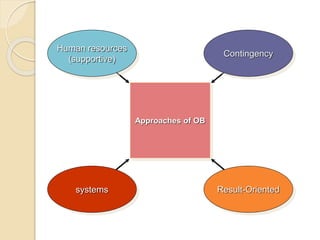
Approaches of OB
Human resources
(supportive)
Contingency
Result-Orientedsystems
Human Resources (supportive)
approach
 Employee growth and development toward
higher levels of competency, creativity and
fulfilment are encouraged and supported
because people are the central resource in any
organization and society.
 It helps employees be come better, more
responsible people, and then it tries to create a
climate in which they may contribute the limits
of their improved abilities.
 “ Give a person a fish, and you feed that
person for a day; Teach a person to fish, and
you feed that person for life. ”
 Another name for the human resources approach
is the supportive approach, because the
manager’s primary role changes from control of
employees to active support of their growth and
performance.
Contingency approach
 Different situations require different behavioral
practices for greatest effectiveness.
 Managers need to know under what condition
they should choose one behavioral approach
over another, and the contingency framework
can help them do this.
 The contingency approach also is more
interdisciplinary, more system-oriented, and
more research-oriented than the traditional
approach.
Result-oriented approach
 Outcomes of organizational behaviour programs
are assessed in terms of their efficiency.
 Productivity, at its simplest, is a ratio that
compares unit of output with unit of input, often
against a predetermined standard.
 TQM is an integrated attempt to improve the
quality of a firm’s products or services through a
variety of techniques and training.
 Ability can be improved through hiring better
workers or providing existing employees with
job-related training. Motivation results from a
person’s attitudes reacting in a specific situation.
Systems Approach
 Treating an organization as a system is critically
important to its success.
 Holistic Organizational Behavior interprets
people-organization relationships in terms of the
whole person, whole group, whole organization, and
whole social system. It takes an across the board
view of people in organizations in an effort to
understand as many of the factors as possible that
influence people’s behavior.
 Cost-benefit analysis is needed to determine
whether potential actions will have a net positive or
net negative effect. These costs can include work
slowdowns, higher absenteeism rates.
Organization Behaviour Approaches

Organization Behaviour Approaches

  • 1.
    Approaches of Organizational Behavior Presentedby : Salim Papuani Submitted to : Prof. Milap Vaishnav
  • 2.
    Approaches of OB Humanresources (supportive) Contingency Result-Orientedsystems
  • 3.
    Human Resources (supportive) approach Employee growth and development toward higher levels of competency, creativity and fulfilment are encouraged and supported because people are the central resource in any organization and society.  It helps employees be come better, more responsible people, and then it tries to create a climate in which they may contribute the limits of their improved abilities.
  • 4.
     “ Givea person a fish, and you feed that person for a day; Teach a person to fish, and you feed that person for life. ”  Another name for the human resources approach is the supportive approach, because the manager’s primary role changes from control of employees to active support of their growth and performance.
  • 5.
    Contingency approach  Differentsituations require different behavioral practices for greatest effectiveness.  Managers need to know under what condition they should choose one behavioral approach over another, and the contingency framework can help them do this.  The contingency approach also is more interdisciplinary, more system-oriented, and more research-oriented than the traditional approach.
  • 6.
    Result-oriented approach  Outcomesof organizational behaviour programs are assessed in terms of their efficiency.  Productivity, at its simplest, is a ratio that compares unit of output with unit of input, often against a predetermined standard.  TQM is an integrated attempt to improve the quality of a firm’s products or services through a variety of techniques and training.  Ability can be improved through hiring better workers or providing existing employees with job-related training. Motivation results from a person’s attitudes reacting in a specific situation.
  • 7.
    Systems Approach  Treatingan organization as a system is critically important to its success.  Holistic Organizational Behavior interprets people-organization relationships in terms of the whole person, whole group, whole organization, and whole social system. It takes an across the board view of people in organizations in an effort to understand as many of the factors as possible that influence people’s behavior.  Cost-benefit analysis is needed to determine whether potential actions will have a net positive or net negative effect. These costs can include work slowdowns, higher absenteeism rates.