ORGANIZATIONAL BEHAVIOUR
By
Dr. Utkarsh Kumar Verma
Chapter 1
Organizational Behaviour
By
Utkarsh
Meaning and Definition of Organizational Behaviour
 Organizational Behavior (OB) is the study of human behavior in organizational
settings, the interface between human behavior and the organization, and the
organization itself.
 OB is the systematic study and careful application of knowledge about how people-
as individuals and as groups act within the organizations.
 According to Stephen Robbins, “Organizational Behaviour is a field of Study that
Investigates the impact the individuals, groups and structure have on behaviour in
organizations for the purpose of applying such knowledge towards improving an
organization’s effectiveness.”
Scope of the organizational behaviour
 Impact of personality on performance
 Employee motivation
 Leadership
 How to create effective teams and group
 Study of different organizational structures
 Individual behavior, attitude, and learning
 The field of organizational behavior does not depend upon deductions based on gut
feelings but attempts to gather information regarding an issue scientifically under
controlled conditions. It uses information and interprets the findings so that the
behavior of an individual and group can be canalized as desired.
 OB involves integration of studies undertaken relating to behavioural sciences
like psychology, sociology, anthropology, economics, social psychology and
political science. Therefore, organizational behaviour is a comprehensive field of
study in which individual, group and organizational structure is studied in
relation to organizational growth and organizational culture, in an environment
where impact of modern technology is great. The aim of the study is to ensure
that the human behaviour contributes towards growth of the organization and
greater efficiency is achieved.
Importance of OB
Skill Improvement
Study of Organisational Behaviour helps to improve skills.
This includes the ability of employees and use of knowledge to become more efficient.
Organizational Behaviour study also improves managers as well as other employees work-skill.
Understanding Consumer Buying Behaviour
It also an important part to improve the marketing process by understanding consumer buying
behaviour.
Employee Motivation
 Organisational Behaviour (OB) helps to understand the basis of Motivation and different
ways to motivate employees properly.
Nature of Employees
 Understanding of personnel and employee nature is important to manage them properly.
 With the help of Organizational behaviour, we can understand whether employees or
people are –
 Introvert, Extrovert, Motivated,Dominating,Other.
Anticipating Organisational events
 The scientific study of behaviour helps to understand and predict organisational events.
 For example Annual Business Planning, Demand Management, Product line
management, Production Planning, Resources Scheduling, Logistics etc.
Efficiency & Effectiveness
 Study of organisational behaviour helps to increase efficiency and effectiveness of the
organisation
Better Environment of Organisation
 OB helps to create a healthy, ethical and smooth environment in an organisation.
Optimum or Better Utilization of Resources
 Study of OB helps to understand employees and their work style and skill better
way.
 By understanding this, management can train and motivate employees for
optimum utilization of resources.
The Goodwill of organization
Organisational Behaviour helps to improve Goodwill of organization
Approaches to OB
 Human resources (supportive) approach
The human resources approach is developmental. It is concerned with the growth and
development of people towards higher levels of competency, creativity, and fulfillment because
people are the central resource in any organization and society. The nature of the human resources
approach can be understood by comparing it with the traditional management approach in the
early 1900s.
In the traditional approach, managers decided what should be done, and management was
directive and controlling. The human resources approach, on the other hand, is supportive. It
helps employees become better, more responsible people and then tries to create a climate in
which they may contribute to the limits of their improved abilities. The human resources approach
means that better people achieve better results.
Give a person a fish, and you feed that person for a day,
Teach a person to fish, and you provide that person with life
Contingency approach
 The contingency approach to organizational behavior means that different
situations require different behavioral practices for effectiveness.
 No longer is there one best way. Each situation must be analyzed carefully to
determine the significant variables that exist to establish the practices that will be
more effective. The strength of the contingency approach is that it encourages
analysis of each situation before action while at the same time discouraging
habitual practice based on Universal assumptions about people.
 The contingency approach also is more interdisciplinary, system-oriented, and
research-oriented than the traditional approach. Thus it helps to use most
appropriately all the current knowledge about people in organizations.
Productivity Approach
Productivity is a ratio that compares units of output with units of input. Suppose
more results can be produced from the same amount of information. In that case,
productivity is improved, or if fewer inputs can be used to make the same
amount of outputs, productivity has increased.
For Example- if better organizational behavior can reduce workers turnover or
the number of absenteeism, a human output of benefit occurs.
Systems Approach
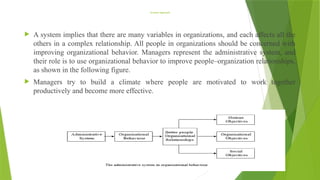
 A system implies that there are many variables in organizations, and each affects all the
others in a complex relationship. All people in organizations should be concerned with
improving organizational behavior. Managers represent the administrative system, and
their role is to use organizational behavior to improve people–organization relationships,
as shown in the following figure.
 Managers try to build a climate where people are motivated to work together
productively and become more effective.
limitation of OB
Behavioral Bias further causes dependence, discontentment, indiscipline, and irresponsibility. (Initial
stage predicts I am very hard working, Misguide with his behavior),For example- if someone is watching
us will perform
Law of diminishing Return- It says that beyond a certain point, there is a decline in output even after
each additional good or positive factor.
The same routine followed will decline your output. This cant is studied.
Dynamic Behavior - Behavior is not stable
Descriptive, not Prescriptive – it does not offer solutions, offer, commands, and instruction for problem-
solving.
TYPES OF MODELS OF ORGANIZATIONAL BEHAVIOUR
Autocratic Model-:
The autocratic model is based on the concept that managers are superior. They have
the power to hire and fire any employees. Managers’ words are considered final. The
autocratic model believes in the power and authority of the manager. Employee have
to obey the orders of the boss. The authoritarian model proposes that minimum
employee needs are met. It believes that higher salaries given to employees are a
waste of resources as they spend money on unproductive needs. Managers control
individuals based on the official authority and power attached to them. Employees are
driven to work as this model assumes that nobody wants to work unless he is forced to
do so.
Custodial Model:
Custodial model implies that owners are the custodian of resources in the organization
and are bound to look after the welfare of employees. It considers that the assets of
organization belong to industrialists, managers, and employees in equal measures and
that nobody has monopoly rights. Employees are given opportunities to bring their
problems to the employer’s notice, and the latter must solve the same. Redressal of
grievance procedures exists in the organization. Employees depend on the organization
for security and welfare, The organizations provide wages and salary while employees
are in service. They also provide pensionary benefits to the employees so that they can
sustain their post retirement life comfortably. While in service employees get fair wages
rather than subsistence wages
Collegial Model:
The collegial model refers to the body of persons having a common objective. The
model's basis is the employees' partnership with the owners. The emphasis is on
team management between workers and owners. Employees are given responsible
and trustworthy jobs. They are self-disciplined and self-motivated. Managers and
workers have similar activities, work environments, and understanding. The
managerial cadre is not considered superior to the employees. They contribute
jointly rather than bosses or leaders. They must develop as a team with employees
and impress upon quality and performance. Combined efforts contribute to the
growth and implementation of the organization.
Supportive Model:
Employees are considered active workers with values, attitudes, desires, and
preferences. Leaders use the philosophy and value system of employees to motivate
them. The supportive model believes that employees are active and that they can
channel their energies and skills to increase organizational productivity with the right
environment and support. If employees are given opportunities, they can improve their
capacity to do a particular job. The owner has to provide and support various activities
for individuals, groups, and organizations. ( encourage ). The model helps in the
development of individuals, groups, and organizations. It is more effective in
developed countries.
OB is interdisciplinary in Nature
 OB is interdisciplinary in nature. It draws on psychology, sociology, communication, and other fields to holistically
understand an organization's people.
 Psychology tells us about the organization's various individual and group processes and aspects. ( emotions,
perceptions, job satisfaction, work stress).
 Sociology- Group dynamics, work teams, power intergroup behavior, essential aspects of OB.
 Political science- Human is a political animal; tell us to behave in the organization to personal interest, help to
understand the conflict.
 Anthropology- To understand human beings and activities.
Challenges and Opportunities of OB
Improving People's Skills
Technological changes, structural changes, and environmental changes occur at a
rapid pace in the business sector. Unless employees and executives have the
necessary skills to adapt to those changes, targeted goals may not be achieved
promptly. These are two different categories of skills – managerial skills and
technical skills. Some of the administrative skills include listening, motivational,
planning, organizing, leading, problem-solving, and decision-making skills. These
skills can be enhanced by conducting a range of training and development
programs, career development programs, induction, and socialization
 Improving Quality and Productivity: – Quality is the extent to which customers or users
believe the product or service exceeds their needs and expectations. For example, a
customer who buys an automobile is confident that the car will start when the engine is
started. If the engine does not start, the customer’s expectations will not be met, and the
customer will find the quality of the car to be poor.
.
 More and more managers are facing challenges in meeting customers’ specific needs. To
improve quality and productivity, they implement total quality management and
reengineering programs requiring extensive employee participation.
 Total Quality Management (TQM):-
Total Quality Management (TQM) is a philosophy of management driven by
continuous achievement of customer satisfaction through continuous improvement
of all organizational processes. The components of TQM are: –an intense focus on
the customer,
 concern for continuous improvement,
 improving the quality of what the organization does,
 accurate measurement and,
 Empowerment of employees
 Managing Workforce Diversity: – It refers to employing different categories of
employees who are heterogeneous in terms of gender, caste, ethnicity, affiliation,
community, physically disadvantaged, elderly people etc. The primary reason for
employing a heterogeneous range of employees is to harness talent and potential,
harness innovation, to achieve synergistic effects among the divorced workforce.
In general, employees wanted to maintain their personal and cultural identity,
values, and lifestyle, even if they worked in the same organization with similar
rules and regulations. The biggest challenge for organizations is to become more
accommodating to different groups of people by addressing their different
lifestyles, family needs and work styles.
 Responding to Globalization: – Today’s business is primarily market-driven;
wherever the demands exist, irrespective of distance, location, climatic
conditions, the business operations are expanded to gain their market share and to
remain in the top rank, etc. Business operations are no longer restricted to a
particular locality or region. The company’s products or services are spread
across nations through mass communication, the Internet, fast transportation, etc.
 Empowering People: Encouraging employees to participate in work-related
decisions will significantly increase their commitment to work. Empowerment
means putting employees in charge of their work by gaining some ownership.
Managers are going far ahead by allowing employees complete control over their
work. The movement implies constant change, with many organizations using
self-managed teams, where workers work without bosses.
 Improving Customer Service: OBs can improve organizational performance by
showing how employee attitudes and behaviors correlate with customer satisfaction. In
that case, the service must first be production-oriented, using technological opportunities
such as computers, the Internet, etc. We also need to provide sales and after-sales
services to improve customer service.
 Improving Ethical Behaviour
Better ethical behavior in the working culture is a must for an organization to increase its
productivity. It should always be ensured that employees behave positively & abide by all
rules & regulations of the organisation. A healthy working environment for employees with
minimal ambiguity should be created.
This will help in increasing their productivity & reducing conflicts. Clear-cut instructions
should be given regarding what is proper behavior & what is wrong. All unethical
practices, like the use of insider information for personal gain, should be avoided.
Managers should organize workshops, seminars & training programs to improve
employees’ ethical behavior.
 Helping Employees Balance Work-Life Conflicts- In the 1960s
or 1970s, average workers showed up from Monday to Friday
and worked 8 or 9 hours daily. Workplaces and hours were
specified. This is no longer true for a large part of today’s
workforce. Employees are increasingly complaining that the line
between work and non-work time has become blurred, leading to
personal conflict and tension.
PERSONALITY
 The definition of personality has arrived at so far. Every individual defines
personality differently, including trait factors and physical appearance.”
Personality is a dynamic organization within an individual of those psychological
systems that determine his unique adjustment to the environment. It is a total of
how an individual reacts and interacts with others.
 The word personality comes from the Latin word persona. In the ancient world,
a persona was a mask worn by an actor.
Determinants of Personality
 Personality is determined by heredity, environment (culture), and the situation under
which an individual works.
 Every defines personality differently, including trait factors and physical appearance.”
Personality is a dynamic organization within an individual of those psychological
systems that determine his unique adjustment to the environment. It is a total of how an
individual reacts and interacts with others.
 Uma Sekaran states that one can examine personality in terms of a set of relatively stable
characteristics and tendencies that determine our thoughts, feelings and behaviour and
have some continuity or consistency over time.
 Personality is a stable set of characteristics and tendencies that determine those
commonalities and differences in the psychological behaviour (thoughts, feelings, and
actions) of people that have continuity in time and that may not be easily understood as
the sole result of the social and biological pressures of the moment
Heredity
Heredity is transmitted through genes, which determine hormone balance and later
determine the personality's physique. Heredity refers to acquiring certain biological,
physical, and psychological commonalities from parents, which are further reflected
in physical stature, facial attractiveness, sex, temperament, muscle composition, and
even remember. They often decide on an energy level. These factors influence how
a person in an organization would display his reactions in a particular situation.
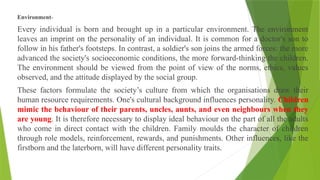
Environment-
Every individual is born and brought up in a particular environment. The environment
leaves an imprint on the personality of an individual. It is common for a doctor's son to
follow in his father's footsteps. In contrast, a soldier's son joins the armed forces: the more
advanced the society's socioeconomic conditions, the more forward-thinking the children.
The environment should be viewed from the point of view of the norms, ethics, values
observed, and the attitude displayed by the social group.
These factors formulate the society’s culture from which the organisations draw their
human resource requirements. One's cultural background influences personality. Children
mimic the behaviour of their parents, uncles, aunts, and even neighbours when they
are young. It is therefore necessary to display ideal behaviour on the part of all the adults
who come in direct contact with the children. Family moulds the character of children
through role models, reinforcement, rewards, and punishments. Other influences, like the
firstborn and the laterborn, will have different personality traits.
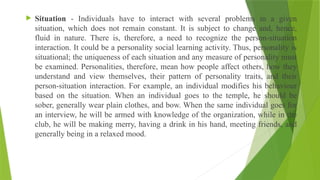
 Situation - Individuals have to interact with several problems in a given
situation, which does not remain constant. It is subject to change and, hence,
fluid in nature. There is, therefore, a need to recognize the person-situation
interaction. It could be a personality social learning activity. Thus, personality is
situational; the uniqueness of each situation and any measure of personality must
be examined. Personalities, therefore, mean how people affect others, how they
understand and view themselves, their pattern of personality traits, and their
person-situation interaction. For example, an individual modifies his behaviour
based on the situation. When an individual goes to the temple, he should be
sober, generally wear plain clothes, and bow. When the same individual goes for
an interview, he will be armed with knowledge of the organization, while in the
club, he will be making merry, having a drink in his hand, meeting friends, and
generally being in a relaxed mood.
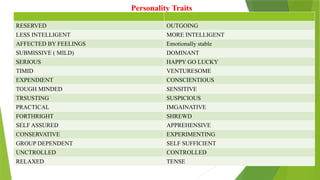
Personality Traits
RESERVED OUTGOING
LESS INTELLIGENT MORE INTELLIGENT
AFFECTED BY FEELINGS Emotionally stable
SUBMISSIVE ( MILD) DOMINANT
SERIOUS HAPPY GO LUCKY
TIMID VENTURESOME
EXPENDIENT CONSCIENTIOUS
TOUGH MINDED SENSITIVE
TRSUSTING SUSPICIOUS
PRACTICAL IMGAINATIVE
FORTHRIGHT SHREWD
SELF ASSURED APPREHENSIVE
CONSERVATIVE EXPERIMENTING
GROUP DEPENDENT SELF SUFFICIENT
UNCTROLLED CONTROLLED
RELAXED TENSE
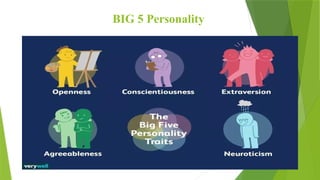
BIG 5 Personality
BIG 5 Personality
 Openness- imaginative, spontaneous, creative, and insightful. Think of that person who’s always ordering the
most exotic thing on the menu, going to different places, and having interests that you would never have
thought of… that is someone with a high openness trait.
 Conscientiousness- disciplined and careful, includes high levels of thoughtfulness, reasonable impulse control,
and goal-directed behaviours. A highly conscientious person will regularly plan and analyse their behaviour to
see how it affects others.
 Extraversion- sociable, fun-loving, someone who gets energized in the company of others ( Ranveer
Singh)
 Agreeableness- trusting, helpful, showing signs of trust, altruism, kindness, and affection. Highly agreeable
people tend to have high prosocial behaviours, which means they’re more inclined to be helping other people.
 Neuroticism- anxious, pessimistic. Individuals who exhibit high levels of neuroticism will tend to experience
mood swings, anxiety, and irritability
Sigmund Freud
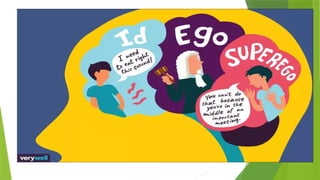
In his famous psychoanalytic theory, Freud states that personality is composed of
three elements: the id, the ego, and the superego. These elements work together to
create complex human behaviors.
Each component adds its own unique contribution to personality, and the three
interact in ways that have a powerful influence on an individual. Each element of
personality emerges at different points in life.
The Id- Pleasure principle
The id is driven by the pleasure principle, which strives for immediate gratification of all desires,
wants, and needs. If these needs are not satisfied immediately, the result is a state of anxiety or
tension. For example, an increase in hunger or thirst should produce an immediate attempt to eat or
drink.
The id is very important early in life because it ensures that an infant's needs are met. If the infant is
hungry or uncomfortable, they will cry until the demands of the id are satisfied. Young infants are
ruled entirely by the id; there is no reasoning with them when these needs demand satisfaction.
Examples of the Id
Imagine convincing a baby to wait until lunchtime to eat their meal. The id requires immediate
satisfaction, and because the other components of personality are not yet present, the infant will cry
until these needs are fulfilled.
( newborn baby)
The Ego- Reality Principle- risk- self-attention
According to Freud, the ego develops from the id and ensures that the impulses of the id can be
expressed in a manner acceptable in the real world.
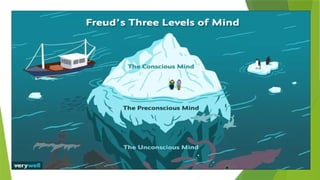
The ego functions in the preconscious, conscious mind and unconscious mind.
The ego is the personality component responsible for dealing with reality
The ego operates based on the reality principle, which strives to satisfy the id's desires in realistic
and socially appropriate ways. The reality principle weighs the costs and benefits of an action
before deciding to act upon or abandon impulses.
Example - imagine that you are stuck in a long meeting at work. You find yourself growing
increasingly hungry as the meeting drags on. While the id might compel you to jump up from your
seat and rush to the break room for a snack, the ego guides you to sit quietly and wait for the
meeting to end.
The Superego- the principle of pleasure, chooses the right
 The superego holds the internalized moral standards and ideals that we acquire from our parents
and society (our sense of right and wrong).
 The superego provides guidelines for making judgments
 The superego tries to perfect and civilize our behavior. It suppresses all the id's unacceptable urges
and struggles to make the ego act upon idealistic standards rather than on realistic principles. The
superego is present in the conscious, preconscious, and unconscious.
 Examples of the Superego
 For example, if you give in to the urges of the id, the superego is what will cause you to feel a
sense of guilt or even shame about your actions. The superego may help you feel good about your
behavior when you suppress your most primal urges.
 A woman feels an urge to steal office supplies from work. However, her superego counteracts this
urge by focusing on the fact that such behaviors are wrong.
The Freudian Slip
 One way to understand how the conscious and unconscious minds operate is to look at
what is known as a slip of the tongue. Many of us have experienced what is commonly
referred to as a Freudian slip at some point or another. These misstatements are believed
to reveal underlying, unconscious thoughts or feelings.
 Freud believed that while the unconscious mind is largely inaccessible, the contents can
sometimes bubble up unexpectedly, such as in dreams or slips of the tongue.
 An example of a Freudian slip is a man who accidentally uses a former girlfriend's name
when referring to a current girlfriend. While most of us might believe this to be a simple
error, Freud believed that the slip showed the sudden intrusion of the unconscious mind
into the conscious mind, often due to unresolved or repressed feelings.
 The conscious mind contains all of the thoughts, memories, feelings, and wishes we are aware
of at any given moment. This is the aspect of our mental processing that we can think and talk
about rationally. This also includes our memory, which is not always part of consciousness but
can be retrieved quickly and brought into awareness.
 The preconscious consists of anything that could potentially be brought into the conscious
mind.
 The unconscious mind is a reservoir of feelings, thoughts, urges, and memories outside our
conscious awareness. The unconscious contains contents that are unacceptable or unpleasant,
such as feelings of pain, anxiety, or conflict.
THE MYERS-BRIGGS TYPE INDICATOR-MBTI
This is one of the most commonly used personality tests,
consisting of 100 questions. Based on the answers, the
individuals are classified into the following categories.
Developed by Cook Briggs and Isabel Brigg Myer.
It was inspired by the theory of Carl Jung’s book Psychological
Types Extraverted Rational Types, extraverted irrational Types,
Introverted Rational Types, and Introverted Irrational Types.
Purpose of MBTI
Extensive research has
proven that personality
affects behavior in various
situations.
Personality assessment tools.
It has 100 questions to asses
someone's personality across
various situations.
How it works
 Based on their responses, the MBTI tool divides people into four categories.
 Extrovert or introvert (E or I) is outgoing, social, and assertive, while introverts are quiet or
shy.
 Sensing or intuitive (S or N), Practical, routine life, order, unconscious processes, and
looking at the big picture are all examples of sense
 Thinking or feeling (T or F) is based on logic and reasoning, whereas feeling (Dil Se) is
emotional and personal.
 Judging or perceiving (J or P): judging wants to control and is structured and rigid, while
perceiving is flexible and spontaneous.
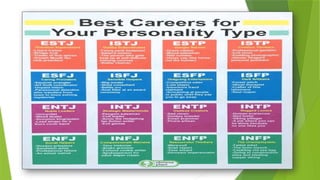
 Based on permutation and combination of these categories, the MBTI instrument
develops 16n different personality types.
 For example- INTJs were considered visionaries. (future perspective)
 ESTJ- are organizers
 ENTP –are conceptualizers, startup
Implication and Limitations
 Many companies use this test to identify the excellent personality candidate
 Force to classify a person in one of the categories. However, a person may lie in between
as well.
This tool can be used for self-awareness but should not be used for selecting or
rejecting a job candidate.
Chapter 2
Perception / Motivation
By
Utkarsh
Perception
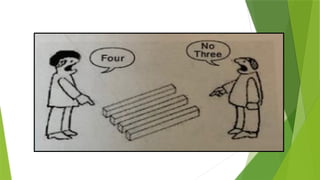
Perception is like beauty that lies in the eyes of the beholder. Individuals differ in how they see,
interpret, and understand a particular event. A manager may perceive nonattendance of duty by the
subordinate differently. Individuals may also differ in opinion, though the event or situation may
be the same.
Definition
Perception is “a process by which individuals organize and interpret their sensory impressions to
give meaning to their environment (Robbins).
What one perceives may be different from objective reality. A person coming late on duty may be
perceived as casual and tardy while facing social problems.
Perceptual Process
 Receiving- The human body comprises five sensory organs, like. Eyes, ears, nose, tongue and
skin. These sensory organs help sense the environment through vision, hearing, smell, touch
and taste. The sensory organs receive the stimuli from the outer environment. Anything
we notice in the environment is a stimulus, e.g., the noise of vehicles, the smell of food, the
sound of rain, the sense of heat or cold, etc. The stimuli which we receive serve as inputs for
the process of perception.
 Selecting - Many things happen in the environment simultaneously, but the human mind
cannot pay equal attention to all events or things equally. Therefore, individuals filter or
screen out the irrelevant things and select the relevant ones with their existing beliefs, values
and needs. This process of selecting relevant stuff from the environment for paying attention
is called perceptual selectivity. The following factors influence the process of choosing
stimuli from the environment:
Organising - After receiving and selecting the stimuli from the environment, the data must
be organised in a particular fashion to extract some meaning from it. This aspect of
organizing the information into a meaningful whole is called perceptual organization.
Perceptual organization is an entirely cognitive process and is based on the following
principles:
Interpreting – Perceptual interpretation is an essential part of the perceptual process. After
selecting and organizing the information, the perceiver interprets it to assign meaning.
Perception is said to be formed only when the information is interpreted. Several factors
contribute ( errors) to the interpretation of the information.
Reacting - Reacting is the last stage of the perceptual process. The process ends when the
perceiver indulges in some action with the perception. The action of perception is also called
perceptual output. The outcome of the perceptual process is the attitude, opinion, beliefs and
feelings of the perceiver regarding the perceived object or event or person. The action will
be based on whether the perception is favourable or unfavourable. If the perception is
positive, the action will be favourable, but if the perception is negative, the action will be
unfavourable.
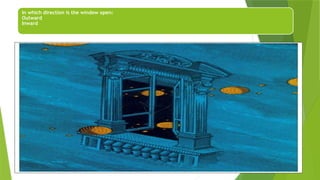
In which direction is the window open:
Outward
Inward
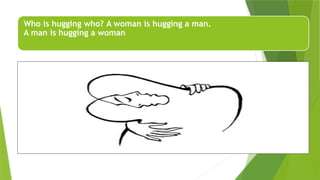
Who is hugging who? A woman is hugging a man.
A man is hugging a woman
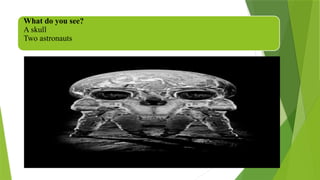
What do you see?
A skull
Two astronauts
What do you see?
A cat
A face
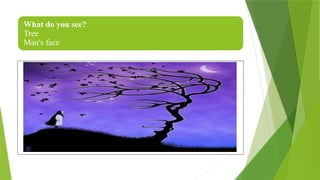
What do you see?
Tree
Man's face
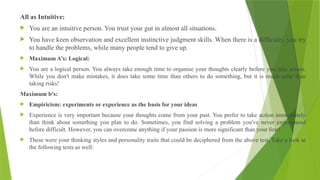
All as Intuitive:
 You are an intuitive person. You trust your gut in almost all situations.
 You have keen observation and excellent instinctive judgment skills. When there is a difficulty, you try
to handle the problems, while many people tend to give up.
 Maximum A’s: Logical:
 You are a logical person. You always take enough time to organise your thoughts clearly before you take action.
While you don't make mistakes, it does take some time than others to do something, but it is much safer than
taking risks!
Maximum b's:
 Empiricism: experiments or experience as the basis for your ideas
 Experience is very important because your thoughts come from your past. You prefer to take action immediately
than think about something you plan to do. Sometimes, you find solving a problem you've never experienced
before difficult. However, you can overcome anything if your passion is more significant than your fear!
 These were your thinking styles and personality traits that could be deciphered from the above test. Take a look at
the following tests as well:
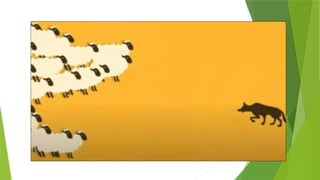
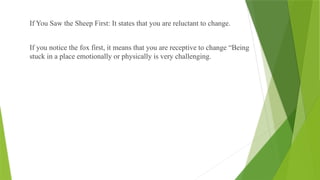
If You Saw the Sheep First: It states that you are reluctant to change.
If you notice the fox first, it means that you are receptive to change “Being
stuck in a place emotionally or physically is very challenging.
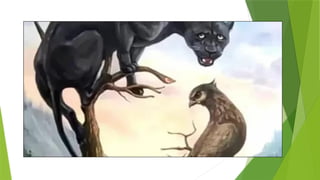
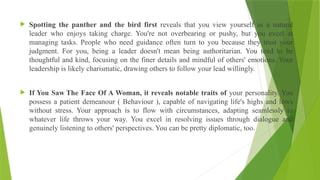
 Spotting the panther and the bird first reveals that you view yourself as a natural
leader who enjoys taking charge. You're not overbearing or pushy, but you excel at
managing tasks. People who need guidance often turn to you because they trust your
judgment. For you, being a leader doesn't mean being authoritarian. You tend to be
thoughtful and kind, focusing on the finer details and mindful of others' emotions. Your
leadership is likely charismatic, drawing others to follow your lead willingly.
 If You Saw The Face Of A Woman, it reveals notable traits of your personality. You
possess a patient demeanour ( Behaviour ), capable of navigating life's highs and lows
without stress. Your approach is to flow with circumstances, adapting seamlessly to
whatever life throws your way. You excel in resolving issues through dialogue and
genuinely listening to others' perspectives. You can be pretty diplomatic, too.
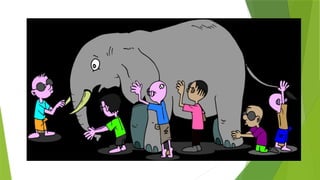
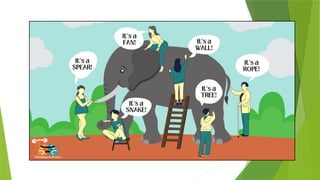
 Long after the elephant moved on, the blind men continued to argue about what an
elephant was. They called each other names, accused the others of lying, and scoffed at
their stupidity.
 Each was convinced they were right, and the others were foolish. Of course, each man
was partly right, but all were wrong. Listening to each other’s perspectives would have
helped them better understand the true nature of an elephant.
 External Factors: External factors influencing selection are the following.
 Size: Size always catches the attention of an individual. Generally, more oversized
objects are more likely to grab attention than smaller objects. For example, A very
big animal in a zoo will always see the attention of the visitors than a smaller one.
 Intensity: The stimuli with high intensity are more likely to be perceived than those
with low intensity. Very bright colours, very bright lights, loud noise, and pungent
odour are noticed faster than light colours, dim lights, soft sound, weak odour, etc.
 Repetition: Repeated stimuli draw more attention than those not repeated.
Instructions which a plant supervisor repeats are retained in the memory of
employees for a longer period of time than those instructions which are conveyed
only once.
Internal Factors: Internal factors influencing the process of perception are:
Learning: Learning is a cognitive factor that strongly influences perception. Learning creates
expectancy in individuals, and they tend to perceive what they want to perceive. Take the
following example: Read the text given in the above figure; the individual will most likely read
the last word as ‘Mac-Hinery’ instead of ‘machinery’. This is because individuals tend to be
caught up in verbal response sets.
Needs: Needs also play a significant role in perceptual selectivity. A thirsty person will always
be sensitive towards the sources of water and a hungry person will always tend to see eating
points everywhere. A person with a high need for affiliation will always join a group of friends in
his leisure time, and a person with a high need for achievement will tend to work hard even in
his leisure time to accomplish his goals.
Interest: Perception is also unconsciously influenced by the person’s interest. A fashion designer
will notice so many details in an outfit hanging on a statue of a shop in a casual look. Still, a
routine visitor cannot observe the exact information in the same outfit even if he looks at it ten
times more.
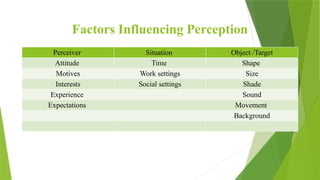
Factors Influencing Perception
Perceiver Situation Object /Target
Attitude Time Shape
Motives Work settings Size
Interests Social settings Shade
Experience Sound
Expectations Movement
Background
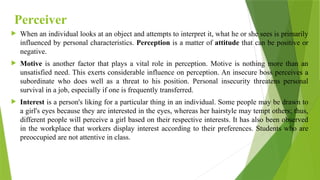
Perceiver
 When an individual looks at an object and attempts to interpret it, what he or she sees is primarily
influenced by personal characteristics. Perception is a matter of attitude that can be positive or
negative.
 Motive is another factor that plays a vital role in perception. Motive is nothing more than an
unsatisfied need. This exerts considerable influence on perception. An insecure boss perceives a
subordinate who does well as a threat to his position. Personal insecurity threatens personal
survival in a job, especially if one is frequently transferred.
 Interest is a person's liking for a particular thing in an individual. Some people may be drawn to
a girl's eyes because they are interested in the eyes, whereas her hairstyle may tempt others; thus,
different people will perceive a girl based on their respective interests. It has also been observed
in the workplace that workers display interest according to their preferences. Students who are
preoccupied are not attentive in class.
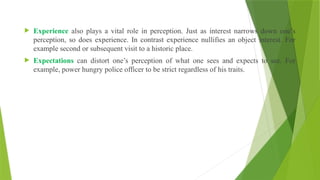
 Experience also plays a vital role in perception. Just as interest narrows down one’s
perception, so does experience. In contrast experience nullifies an object interest. For
example second or subsequent visit to a historic place.
 Expectations can distort one’s perception of what one sees and expects to see. For
example, power hungry police officer to be strict regardless of his traits.
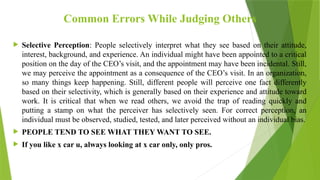
Common Errors While Judging Others
 Selective Perception: People selectively interpret what they see based on their attitude,
interest, background, and experience. An individual might have been appointed to a critical
position on the day of the CEO’s visit, and the appointment may have been incidental. Still,
we may perceive the appointment as a consequence of the CEO’s visit. In an organization,
so many things keep happening. Still, different people will perceive one fact differently
based on their selectivity, which is generally based on their experience and attitude toward
work. It is critical that when we read others, we avoid the trap of reading quickly and
putting a stamp on what the perceiver has selectively seen. For correct perception, an
individual must be observed, studied, tested, and later perceived without an individual bias.
 PEOPLE TEND TO SEE WHAT THEY WANT TO SEE.
 If you like x car u, always looking at x car only, only pros.
The Situation
Change in situation leads to incorrect perception about a person. Time is one factor that
influences perception. Time is related to work and social settings. A person decked up for
a party may not be noticeable, but the same dress in the office would be noticed
distinctly, though the person has not changed. You would have frequently heard people
say their manager is different during working hours and the opposite in a social setting. An
infected person is the same, but the perceiver perceives the manager as per business setup
while at work, while the person is observed on a private or personal platform when
meeting him in the club or at home. What is essential to that remember is that the
perception should be done correctly, not to be led due to work or social setting, that the
situation is not allowed to perceive wrongly. Its size, shade, and shape can identify an
object, as well as the sound it makes and the background. It can be distinguished based on
its movement. It may be determined in the darkness by its silhouette, for example, a
caravan moving on the skyline at dawn.
Attribution Theory of Perception
 Fundamental error or attribution effect- Underestimating the influence of situational
factors and overestimating the power of the personal element in evaluating a person’s
behavior. “ Blaming the people first, not the situation.
 Self - Serving bias – Attributing their success to internal factors while blaming failure
on external factors.
Attribution Theory of Perception
 In day-to-day life, we come across people with whom we interact. People's motives, intentions,
beliefs, and attitudes impact their behavior. It has been seen that our perceptions of people are
greatly influenced by our assumptions about them and not by reality. Two factors have an
impact on human behavior. There are two types of behavior: "internally caused behavior,"
which refers to internal factors over which the individual has complete control, and "externally
caused behavior," which refers to behavior caused by external factors over which the
individual has no control. Attribution theory suggests that when we evaluate human behavior, it
is either internally caused or it is caused due to external factors. ( Behavior internal or
external).
 Distinctiveness- (Different situation, different behavior) If an employee comes late and has
many complaints (Natural Behavior of employee )
 Consensus – One employee is late, but the rest is on time with the same route
(external causes not responsible ).
Perception Errors
Halo Effect: The “Halo effect" refers to judging an individual based on single characteristics,
such as intellectual ability, sociability, and appearance. A sales manager’s visit to a sales territory
and the consequent increase in sales volume may be attributed to the sales manager's visit to a
particular region. The perceiver in this situation overlooked the cause of increased sales, which
was probably higher demand, a change in market forces, subordinate sales employees' past efforts
to woo customers to buy the product, and a host of other factors that go with an increase in sales
volume. This type of perception is quite common in any organization and is called the "halo
effect" in perceiving an individual or situation. A rater may rate a subordinate based on the
dominance of a single trait of the aid. The halo effect has been very frequently noticed in
performance appraisals.
 Projection: You assume a person is based on your traits, not what he possesses. If you were hard-
working and dependable, you would expect others to be so.
 Contrast Effect: We generally hear people say that Mr. X’s presentation was good, meaning it was
better than others who would have made presentations in a particular session.
 Stereotyping: Classify people and events into To simplify matters, we often organize people and events
into already-known categories. For example, we generally perceive men as executives and women as
secretaries, even if the situation may be different. For police officers, it is usually believed that they are
typically strict and law-abiding, which may need to be revised.
Ex. -All police officials are corrupt.
 Perceptual Set/ Mental Set- Perceiving based on previously held beliefs for the same object/person.
( Adipurush)
 First Impression – The first impression is the last ???
Implicit Personality - Associated one trait of an individual with his other characteristics.
For example - if a person is honest, he will work hard.
Expectancy – Also known as a self-fulfilling prophecy, Perceiving the people based on
perceiver expectations
Example - A person of high status is perceived based on an expectation that he has certain
desirable traits.
INDIVIDUAL DECISION MAKING
 Managers must make decisions and communicate the same to subordinates for
implementation. Decisions can be of a routine nature or may have strategic
consequences. It is the judgment of the individual to arrive at a particular solution. The
process that takes place in mind is fast and based on the individual's ability, nature, skill,
and experience. Hilter decided to attack Europe in the West while he had captured half of
Russia. Opening war on two fronts led him to defeat
Factors Affecting Decisions
 Information: Adequate information must be available to the decision maker. Due to
computers, much information may now be available, but it has little consequence. What
is essential is the amount, quality and format in which the information is made available
to the decision-maker. Inadequate information is as dangerous as too much information.
 Bias: Every individual’s decision is highly affected by values, attitudes, and beliefs.
Individuals have preconceived ideas about an issue, accept what they want , and throw
away information that is unacceptable to them. Prejudice and bias that may lead to faulty
decisions.
 Personal habits: Some people are rigid and stick to their own decisions, even if wrong.
Others blame their subordinates for failure and take credit for successful jobs.
 Time constraints: A problem is identified, and a solution is sought within a
specified time. Enhanced time may be required due to the complexity of the
impact of external variables. In the fast-moving era, carrying out time and space
appreciation of the problem involved is necessary. A rigid time schedule may be
required that can be followed.
 Risk Taking: Risk is related to various factors. A manager’s risk-taking attitude
is dependent on personal characteristics, an organizational culture where risk is
rewarded and not penalized for failed decisions, intelligence level and the
expectations of the decision maker. High-intelligent managers are found to be
generally conservative and do not take bold steps.
 One day, the father of a very wealthy family took his son on a trip to the country to show him how poor people Live.
They spent a couple of days and nights on the farm of what would be considered a very poor family.
On their return from their trip, the father asked his son, "How was the trip?"
"It was great, Dad.“, "Did you see how poor people live?" the father asked.
"Oh yeah," said the son.
"So, tell me, what you learned from the trip?" asked the father.
The son answered:
"I saw that we have one dog, and they have four.
We have a pool that reaches the middle of our garden, and they have
A creek that has no end.
We have imported lanterns in our garden, which have the stars at night.
Our patio reaches the front yard, and they have a vast horizon.
We have a small piece of land to live on, and they have fields that go
Beyond our sight.
We have servants who serve us, but they serve others.
We buy our food, but they grow theirs.
We have walls around our property to protect us, and they have friends to
protect them."
The boy's father was speechless.
Then his son added, “Thanks, Dad, for showing me how poor we are."
Isn't perception a wonderful thing?
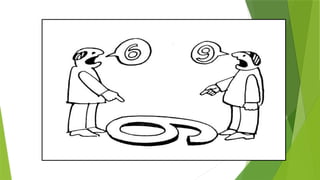
If we all saw everything the same way, there is hardly anything to learn.
Next time someone disagrees with you, remember that it is an
Opportunity to learn a new perception.
Enjoy
Motivation
 Motivation is the willingness of a person to make intense and persistent efforts to achieve desired goals.
 You are thirsty
 You will drink water
 Content-Based - How the motivation occurs
 Process Based- What Motivates People
 Motivation is derived from the Latin word “Movere,” which means TO MOVE.
 Motivation is a psychological term that cannot be forced on employees.
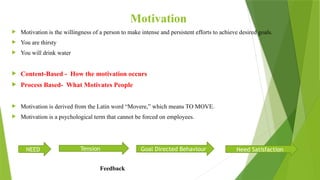
Feedback
NEED Tension Goal Directed Behaviour Need Satisfaction
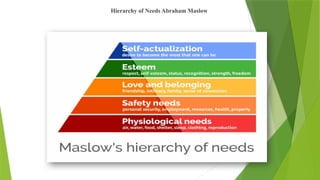
Hierarchy of Needs Abraham Maslow
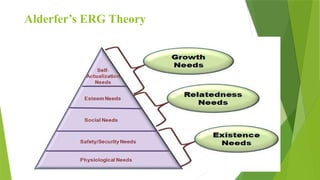
Alderfer’s ERG Theory
Theory X and Y
 Earlier theories were related to organizations, but according to McGregor, employees are good
or bad.
 Theory X- employed dislikes the work, is lazy, must be coerced to perform, low commitment.
 Theory Y – Employees like work, are creative, seek responsibility and can exercise self-
direction.
Two factor Theory , 1959, Two Factor Theory / Dual
structure theory
 Interviewed over 200 professionals – including Highly satisfied or less satisfied.
 Identified factors: first, Hygiene factors, and second motivational factors.
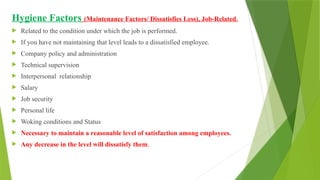
Hygiene Factors (Maintenance Factors/ Dissatisfies Less), Job-Related.
 Related to the condition under which the job is performed.
 If you have not maintaining that level leads to a dissatisfied employee.
 Company policy and administration
 Technical supervision
 Interpersonal relationship
 Salary
 Job security
 Personal life
 Woking conditions and Status
 Necessary to maintain a reasonable level of satisfaction among employees.
 Any decrease in the level will dissatisfy them.
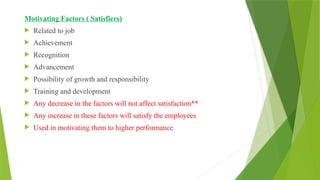
Motivating Factors ( Satisfiers)
 Related to job
 Achievement
 Recognition
 Advancement
 Possibility of growth and responsibility
 Training and development
 Any decrease in the factors will not affect satisfaction**
 Any increase in these factors will satisfy the employees
 Used in motivating them to higher performance
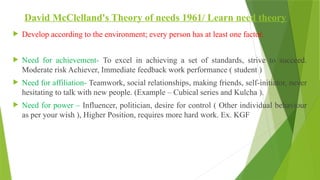
David McClelland's Theory of needs 1961/ Learn need theory
 Develop according to the environment; every person has at least one factor.
 Need for achievement- To excel in achieving a set of standards, strive to succeed.
Moderate risk Achiever, Immediate feedback work performance ( student )
 Need for affiliation- Teamwork, social relationships, making friends, self-initiator, never
hesitating to talk with new people. (Example – Cubical series and Kulcha ).
 Need for power – Influencer, politician, desire for control ( Other individual behaviour
as per your wish ), Higher Position, requires more hard work. Ex. KGF
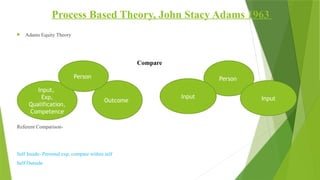
Process Based Theory, John Stacy Adams 1963
 Adams Equity Theory
Compare
Referent Comparison-
Self Inside- Personal exp, compare within self
Self Outside
Outcome
Input,
Exp,
Qualification,
Competence
Person Person
Input Input
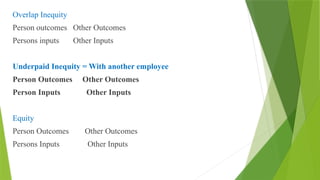
Overlap Inequity
Person outcomes Other Outcomes
Persons inputs Other Inputs
Underpaid Inequity = With another employee
Person Outcomes Other Outcomes
Person Inputs Other Inputs
Equity
Person Outcomes Other Outcomes
Persons Inputs Other Inputs
What happens if things aren’t fair
Adams’ Equity Theory of Motivation says people experience “distress” when things are perceived as
unfair. Furthermore, the greater the level of unfairness that people perceive, the greater their levels of
distress.
2- Individuals who feel over-compensated
It might seem strange that individuals who perceive they are overcompensated for their contributions
feel distressed, but they do. Individuals in this situation often feel a sense of shame or guilt for their
circumstances and seek to reintroduce a sense of fairness.
3- Individuals who feel under-compensated
 Many people can relate to feeling underappreciated or undervalued at some point in their life. It comes as no surprise
that when this happens, people feel distressed. Individuals in this situation often feel a sense of humiliation, anger or
injustice. When this is the case individuals are often driven to try to reintroduce a sense of fairness
Goal Setting Theory
 Goal Setting Involves establishing “SMART” Goals.
 Specific, measurable, Attainable, Relevant, Time-bound.
 Goal Setting and feedback go hand in hand, making feedback a two-way communication
process.
Reinforcement theory, Operant Conditioning by BF
SKINNER
 Positive Behaviors- Positive Reinforcement ( manager praises the employee)
 Negative Reinforcement – Positive behaviour followed by removal of negative consequences
(Manager stops nagging the employees )
 Punishment- Negative behavior followed by adverse effects ( Manager demotes the employees)
 Extinction- Negative behavior followed by removal of positive consequences ( manager
ignores the behavior )
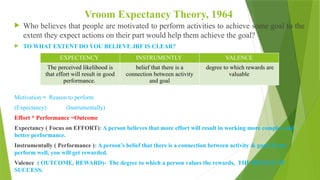
Vroom Expectancy Theory, 1964
 Who believes that people are motivated to perform activities to achieve some goal to the
extent they expect actions on their part would help them achieve the goal?
 TO WHAT EXTENT DO YOU BELIEVE JRF IS CLEAR?
Motivation = Reason to perform
(Expectancy) (Instrumentally)
Effort * Performance =Outcome
Expectancy ( Focus on EFFORT): A person believes that more effort will result in working more complex and
better performance.
Instrumentally ( Performance ): A person’s belief that there is a connection between activity & goal. If you
perform well, you will get rewarded.
Valence ( OUTCOME, REWARD)- The degree to which a person values the rewards, THE RESULT OF
SUCCESS.
EXPECTENCY INSTRUMENTLY VALENCE
The perceived likelihood is
that effort will result in good
performance.
belief that there is a
connection between activity
and goal
degree to which rewards are
valuable
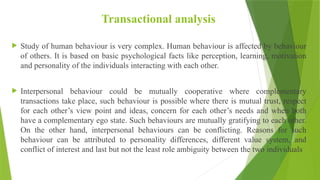
Transactional analysis
 Study of human behaviour is very complex. Human behaviour is affected by behaviour
of others. It is based on basic psychological facts like perception, learning, motivation
and personality of the individuals interacting with each other.
 Interpersonal behaviour could be mutually cooperative where complementary
transactions take place, such behaviour is possible where there is mutual trust, respect
for each other’s view point and ideas, concern for each other’s needs and when both
have a complementary ego state. Such behaviours are mutually gratifying to each other.
On the other hand, interpersonal behaviours can be conflicting. Reasons for such
behaviour can be attributed to personality differences, different value system, and
conflict of interest and last but not the least role ambiguity between the two individuals
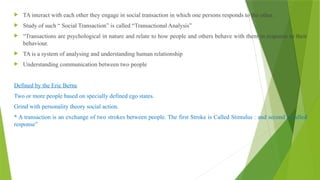
 TA interact with each other they engage in social transaction in which one persons responds to the other.
 Study of such “ Social Transaction” is called “Transactional Analysis”
 “Transactions are psychological in nature and relate to how people and others behave with them in response to their
behaviour.
 TA is a system of analysing and understanding human relationship
 Understanding communication between two people
Defined by the Eric Berne
Two or more people based on specially defined ego states.
Grind with personality theory social action.
* A transaction is an exchange of two strokes between people. The first Stroke is Called Stimulus : and second is called
response”
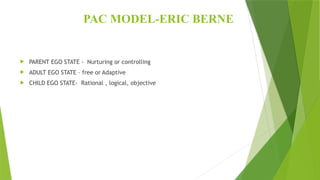
PAC MODEL-ERIC BERNE
 PARENT EGO STATE - Nurturing or controlling
 ADULT EGO STATE – free or Adaptive
 CHILD EGO STATE- Rational , logical, objective
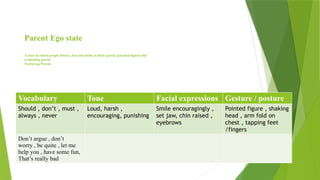
Parent Ego state
A state in which people behave, feel and think as their parent /parental figures did
evaluating parent
Nurturing Parent
Vocabulary Tone Facial expressions Gesture / posture
Should , don’t , must ,
always , never
Loud, harsh ,
encouraging, punishing
Smile encouragingly ,
set jaw, chin raised ,
eyebrows
Pointed figure , shaking
head , arm fold on
chest , tapping feet
/fingers
Don’t argue , don’t
worry , be quite , let me
help you , have some fun,
That’s really bad
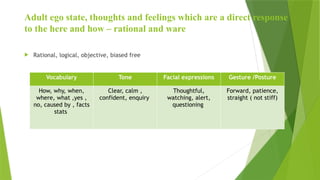
Adult ego state, thoughts and feelings which are a direct response
to the here and how – rational and ware
 Rational, logical, objective, biased free
Vocabulary Tone Facial expressions Gesture /Posture
How, why, when,
where, what ,yes ,
no, caused by , facts
stats
Clear, calm ,
confident, enquiry
Thoughtful,
watching, alert,
questioning
Forward, patience,
straight ( not stiff)
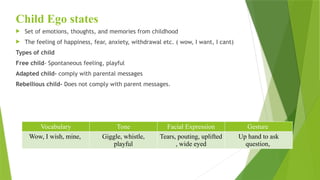
Child Ego states
 Set of emotions, thoughts, and memories from childhood
 The feeling of happiness, fear, anxiety, withdrawal etc. ( wow, I want, I cant)
Types of child
Free child- Spontaneous feeling, playful
Adapted child- comply with parental messages
Rebellious child- Does not comply with parent messages.
Vocabulary Tone Facial Expression Gesture
Wow, I wish, mine, Giggle, whistle,
playful
Tears, pouting, uplifted
, wide eyed
Up hand to ask
question,
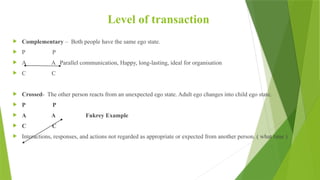
Level of transaction
 Complementary – Both people have the same ego state.
 P P
 A A Parallel communication, Happy, long-lasting, ideal for organisation
 C C
 Crossed- The other person reacts from an unexpected ego state. Adult ego changes into child ego state.
 P P
 A A Fukrey Example
 C C
 Interactions, responses, and actions not regarded as appropriate or expected from another person. ( what time )
 Ulterior - Two ego state within the same person but one disguise the other ( mind game ). Hot blood ,
react,
 Is dual personality , 2 ego dominating
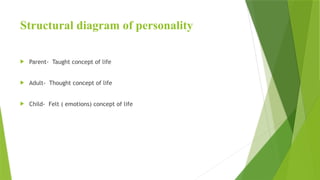
Structural diagram of personality
 Parent- Taught concept of life
 Adult- Thought concept of life
 Child- Felt ( emotions) concept of life
 Stroke Analysis- How people recognize each other- when one person recognizes another. Lack of stroking can
negatively affect a person's physiological and psychological well-being. Positive, negative, and mixed
stokes
 Game analysis- Ulterior transaction (mind games)- when people fail to get enough strokes at work, they try various
things. One of the most things is that they play psychological games. ( leg pulling, political games)
 Script Analysis
 The life script f a person is the life plan with which he lives and behaves, a complete plan of living. ( understanding
the environment ), it may be a positive and negative or daily routine. ( modelling, it kind of role model), rural area
govt job preference.
 Life Position- In growing up, people make the basic assumption about their self-worth and the worth of significant
people in their environment.
 The combination of assumptions about the self and the other person is called a “life position.”
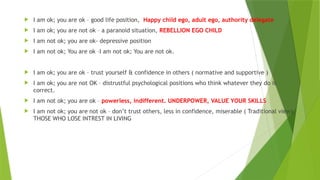
 I am ok; you are ok – good life position, Happy child ego, adult ego, authority delegate
 I am ok; you are not ok – a paranoid situation, REBELLION EGO CHILD
 I am not ok; you are ok- depressive position
 I am not ok; You are ok –I am not ok; You are not ok.
 I am ok; you are ok – trust yourself & confidence in others ( normative and supportive )
 I am ok; you are not OK – distrustful psychological positions who think whatever they do is
correct.
 I am not ok; you are ok – powerless, indifferent. UNDERPOWER, VALUE YOUR SKILLS
 I am not ok; you are not ok – don’t trust others, less in confidence, miserable ( Traditional view),
THOSE WHO LOSE INTREST IN LIVING
Johari Window
 Founder- Joseph luft, Harry Ingham, 1955, University of California
 The Johari window model can also assess and improve group relationships with other groups. (WHO ONE IS AND HOW
SIMILAR TO OR DIFFERENT FROM OTHER )
 The Johari model is a simple and helpful tool for illustrating and improving self-awareness and mutual understanding
between individuals within a group.
 Johari window is a model of different degrees of openness between two people.
 It is based on the degree of self-disclosure and solicitation of feedback when sharing information with another person.
 Johari window is an HRM tool to evaluate his awareness of self.
 Relationship developed
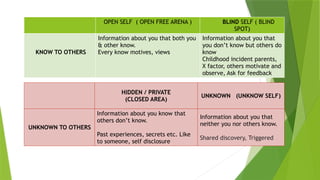
OPEN SELF ( OPEN FREE ARENA ) BLIND SELF ( BLIND
SPOT)
KNOW TO OTHERS
Information about you that both you
& other know.
Every know motives, views
Information about you that
you don’t know but others do
know
Childhood incident parents,
X factor, others motivate and
observe, Ask for feedback
HIDDEN / PRIVATE
(CLOSED AREA)
UNKNOWN (UNKNOW SELF)
UNKNOWN TO OTHERS
Information about you know that
others don’t know.
Past experiences, secrets etc. Like
to someone, self disclosure
Information about you that
neither you nor others know.
Shared discovery, Triggered

CHAPTER 1 OB.pptx MBA STUDENTS ORGANISATION

  • 1.
  • 2.
  • 3.
    Meaning and Definitionof Organizational Behaviour  Organizational Behavior (OB) is the study of human behavior in organizational settings, the interface between human behavior and the organization, and the organization itself.  OB is the systematic study and careful application of knowledge about how people- as individuals and as groups act within the organizations.  According to Stephen Robbins, “Organizational Behaviour is a field of Study that Investigates the impact the individuals, groups and structure have on behaviour in organizations for the purpose of applying such knowledge towards improving an organization’s effectiveness.”
  • 4.
    Scope of theorganizational behaviour  Impact of personality on performance  Employee motivation  Leadership  How to create effective teams and group  Study of different organizational structures  Individual behavior, attitude, and learning  The field of organizational behavior does not depend upon deductions based on gut feelings but attempts to gather information regarding an issue scientifically under controlled conditions. It uses information and interprets the findings so that the behavior of an individual and group can be canalized as desired.
  • 5.
     OB involvesintegration of studies undertaken relating to behavioural sciences like psychology, sociology, anthropology, economics, social psychology and political science. Therefore, organizational behaviour is a comprehensive field of study in which individual, group and organizational structure is studied in relation to organizational growth and organizational culture, in an environment where impact of modern technology is great. The aim of the study is to ensure that the human behaviour contributes towards growth of the organization and greater efficiency is achieved.
  • 6.
    Importance of OB SkillImprovement Study of Organisational Behaviour helps to improve skills. This includes the ability of employees and use of knowledge to become more efficient. Organizational Behaviour study also improves managers as well as other employees work-skill. Understanding Consumer Buying Behaviour It also an important part to improve the marketing process by understanding consumer buying behaviour.
  • 7.
    Employee Motivation  OrganisationalBehaviour (OB) helps to understand the basis of Motivation and different ways to motivate employees properly. Nature of Employees  Understanding of personnel and employee nature is important to manage them properly.  With the help of Organizational behaviour, we can understand whether employees or people are –  Introvert, Extrovert, Motivated,Dominating,Other.
  • 8.
    Anticipating Organisational events The scientific study of behaviour helps to understand and predict organisational events.  For example Annual Business Planning, Demand Management, Product line management, Production Planning, Resources Scheduling, Logistics etc. Efficiency & Effectiveness  Study of organisational behaviour helps to increase efficiency and effectiveness of the organisation Better Environment of Organisation  OB helps to create a healthy, ethical and smooth environment in an organisation.
  • 9.
    Optimum or BetterUtilization of Resources  Study of OB helps to understand employees and their work style and skill better way.  By understanding this, management can train and motivate employees for optimum utilization of resources. The Goodwill of organization Organisational Behaviour helps to improve Goodwill of organization
  • 10.
    Approaches to OB Human resources (supportive) approach The human resources approach is developmental. It is concerned with the growth and development of people towards higher levels of competency, creativity, and fulfillment because people are the central resource in any organization and society. The nature of the human resources approach can be understood by comparing it with the traditional management approach in the early 1900s. In the traditional approach, managers decided what should be done, and management was directive and controlling. The human resources approach, on the other hand, is supportive. It helps employees become better, more responsible people and then tries to create a climate in which they may contribute to the limits of their improved abilities. The human resources approach means that better people achieve better results. Give a person a fish, and you feed that person for a day, Teach a person to fish, and you provide that person with life
  • 11.
    Contingency approach  Thecontingency approach to organizational behavior means that different situations require different behavioral practices for effectiveness.  No longer is there one best way. Each situation must be analyzed carefully to determine the significant variables that exist to establish the practices that will be more effective. The strength of the contingency approach is that it encourages analysis of each situation before action while at the same time discouraging habitual practice based on Universal assumptions about people.  The contingency approach also is more interdisciplinary, system-oriented, and research-oriented than the traditional approach. Thus it helps to use most appropriately all the current knowledge about people in organizations.
  • 12.
    Productivity Approach Productivity isa ratio that compares units of output with units of input. Suppose more results can be produced from the same amount of information. In that case, productivity is improved, or if fewer inputs can be used to make the same amount of outputs, productivity has increased. For Example- if better organizational behavior can reduce workers turnover or the number of absenteeism, a human output of benefit occurs.
  • 13.
    Systems Approach  Asystem implies that there are many variables in organizations, and each affects all the others in a complex relationship. All people in organizations should be concerned with improving organizational behavior. Managers represent the administrative system, and their role is to use organizational behavior to improve people–organization relationships, as shown in the following figure.  Managers try to build a climate where people are motivated to work together productively and become more effective.
  • 14.
    limitation of OB BehavioralBias further causes dependence, discontentment, indiscipline, and irresponsibility. (Initial stage predicts I am very hard working, Misguide with his behavior),For example- if someone is watching us will perform Law of diminishing Return- It says that beyond a certain point, there is a decline in output even after each additional good or positive factor. The same routine followed will decline your output. This cant is studied. Dynamic Behavior - Behavior is not stable Descriptive, not Prescriptive – it does not offer solutions, offer, commands, and instruction for problem- solving.
  • 15.
    TYPES OF MODELSOF ORGANIZATIONAL BEHAVIOUR Autocratic Model-: The autocratic model is based on the concept that managers are superior. They have the power to hire and fire any employees. Managers’ words are considered final. The autocratic model believes in the power and authority of the manager. Employee have to obey the orders of the boss. The authoritarian model proposes that minimum employee needs are met. It believes that higher salaries given to employees are a waste of resources as they spend money on unproductive needs. Managers control individuals based on the official authority and power attached to them. Employees are driven to work as this model assumes that nobody wants to work unless he is forced to do so.
  • 16.
    Custodial Model: Custodial modelimplies that owners are the custodian of resources in the organization and are bound to look after the welfare of employees. It considers that the assets of organization belong to industrialists, managers, and employees in equal measures and that nobody has monopoly rights. Employees are given opportunities to bring their problems to the employer’s notice, and the latter must solve the same. Redressal of grievance procedures exists in the organization. Employees depend on the organization for security and welfare, The organizations provide wages and salary while employees are in service. They also provide pensionary benefits to the employees so that they can sustain their post retirement life comfortably. While in service employees get fair wages rather than subsistence wages
  • 17.
    Collegial Model: The collegialmodel refers to the body of persons having a common objective. The model's basis is the employees' partnership with the owners. The emphasis is on team management between workers and owners. Employees are given responsible and trustworthy jobs. They are self-disciplined and self-motivated. Managers and workers have similar activities, work environments, and understanding. The managerial cadre is not considered superior to the employees. They contribute jointly rather than bosses or leaders. They must develop as a team with employees and impress upon quality and performance. Combined efforts contribute to the growth and implementation of the organization.
  • 18.
    Supportive Model: Employees areconsidered active workers with values, attitudes, desires, and preferences. Leaders use the philosophy and value system of employees to motivate them. The supportive model believes that employees are active and that they can channel their energies and skills to increase organizational productivity with the right environment and support. If employees are given opportunities, they can improve their capacity to do a particular job. The owner has to provide and support various activities for individuals, groups, and organizations. ( encourage ). The model helps in the development of individuals, groups, and organizations. It is more effective in developed countries.
  • 19.
    OB is interdisciplinaryin Nature  OB is interdisciplinary in nature. It draws on psychology, sociology, communication, and other fields to holistically understand an organization's people.  Psychology tells us about the organization's various individual and group processes and aspects. ( emotions, perceptions, job satisfaction, work stress).  Sociology- Group dynamics, work teams, power intergroup behavior, essential aspects of OB.  Political science- Human is a political animal; tell us to behave in the organization to personal interest, help to understand the conflict.  Anthropology- To understand human beings and activities.
  • 20.
    Challenges and Opportunitiesof OB Improving People's Skills Technological changes, structural changes, and environmental changes occur at a rapid pace in the business sector. Unless employees and executives have the necessary skills to adapt to those changes, targeted goals may not be achieved promptly. These are two different categories of skills – managerial skills and technical skills. Some of the administrative skills include listening, motivational, planning, organizing, leading, problem-solving, and decision-making skills. These skills can be enhanced by conducting a range of training and development programs, career development programs, induction, and socialization
  • 21.
     Improving Qualityand Productivity: – Quality is the extent to which customers or users believe the product or service exceeds their needs and expectations. For example, a customer who buys an automobile is confident that the car will start when the engine is started. If the engine does not start, the customer’s expectations will not be met, and the customer will find the quality of the car to be poor. .  More and more managers are facing challenges in meeting customers’ specific needs. To improve quality and productivity, they implement total quality management and reengineering programs requiring extensive employee participation.
  • 22.
     Total QualityManagement (TQM):- Total Quality Management (TQM) is a philosophy of management driven by continuous achievement of customer satisfaction through continuous improvement of all organizational processes. The components of TQM are: –an intense focus on the customer,  concern for continuous improvement,  improving the quality of what the organization does,  accurate measurement and,  Empowerment of employees
  • 23.
     Managing WorkforceDiversity: – It refers to employing different categories of employees who are heterogeneous in terms of gender, caste, ethnicity, affiliation, community, physically disadvantaged, elderly people etc. The primary reason for employing a heterogeneous range of employees is to harness talent and potential, harness innovation, to achieve synergistic effects among the divorced workforce. In general, employees wanted to maintain their personal and cultural identity, values, and lifestyle, even if they worked in the same organization with similar rules and regulations. The biggest challenge for organizations is to become more accommodating to different groups of people by addressing their different lifestyles, family needs and work styles.
  • 24.
     Responding toGlobalization: – Today’s business is primarily market-driven; wherever the demands exist, irrespective of distance, location, climatic conditions, the business operations are expanded to gain their market share and to remain in the top rank, etc. Business operations are no longer restricted to a particular locality or region. The company’s products or services are spread across nations through mass communication, the Internet, fast transportation, etc.  Empowering People: Encouraging employees to participate in work-related decisions will significantly increase their commitment to work. Empowerment means putting employees in charge of their work by gaining some ownership. Managers are going far ahead by allowing employees complete control over their work. The movement implies constant change, with many organizations using self-managed teams, where workers work without bosses.
  • 25.
     Improving CustomerService: OBs can improve organizational performance by showing how employee attitudes and behaviors correlate with customer satisfaction. In that case, the service must first be production-oriented, using technological opportunities such as computers, the Internet, etc. We also need to provide sales and after-sales services to improve customer service.  Improving Ethical Behaviour Better ethical behavior in the working culture is a must for an organization to increase its productivity. It should always be ensured that employees behave positively & abide by all rules & regulations of the organisation. A healthy working environment for employees with minimal ambiguity should be created. This will help in increasing their productivity & reducing conflicts. Clear-cut instructions should be given regarding what is proper behavior & what is wrong. All unethical practices, like the use of insider information for personal gain, should be avoided. Managers should organize workshops, seminars & training programs to improve employees’ ethical behavior.
  • 26.
     Helping EmployeesBalance Work-Life Conflicts- In the 1960s or 1970s, average workers showed up from Monday to Friday and worked 8 or 9 hours daily. Workplaces and hours were specified. This is no longer true for a large part of today’s workforce. Employees are increasingly complaining that the line between work and non-work time has become blurred, leading to personal conflict and tension.
  • 27.
    PERSONALITY  The definitionof personality has arrived at so far. Every individual defines personality differently, including trait factors and physical appearance.” Personality is a dynamic organization within an individual of those psychological systems that determine his unique adjustment to the environment. It is a total of how an individual reacts and interacts with others.  The word personality comes from the Latin word persona. In the ancient world, a persona was a mask worn by an actor.
  • 28.
    Determinants of Personality Personality is determined by heredity, environment (culture), and the situation under which an individual works.  Every defines personality differently, including trait factors and physical appearance.” Personality is a dynamic organization within an individual of those psychological systems that determine his unique adjustment to the environment. It is a total of how an individual reacts and interacts with others.  Uma Sekaran states that one can examine personality in terms of a set of relatively stable characteristics and tendencies that determine our thoughts, feelings and behaviour and have some continuity or consistency over time.
  • 29.
     Personality isa stable set of characteristics and tendencies that determine those commonalities and differences in the psychological behaviour (thoughts, feelings, and actions) of people that have continuity in time and that may not be easily understood as the sole result of the social and biological pressures of the moment
  • 30.
    Heredity Heredity is transmittedthrough genes, which determine hormone balance and later determine the personality's physique. Heredity refers to acquiring certain biological, physical, and psychological commonalities from parents, which are further reflected in physical stature, facial attractiveness, sex, temperament, muscle composition, and even remember. They often decide on an energy level. These factors influence how a person in an organization would display his reactions in a particular situation.
  • 31.
    Environment- Every individual isborn and brought up in a particular environment. The environment leaves an imprint on the personality of an individual. It is common for a doctor's son to follow in his father's footsteps. In contrast, a soldier's son joins the armed forces: the more advanced the society's socioeconomic conditions, the more forward-thinking the children. The environment should be viewed from the point of view of the norms, ethics, values observed, and the attitude displayed by the social group. These factors formulate the society’s culture from which the organisations draw their human resource requirements. One's cultural background influences personality. Children mimic the behaviour of their parents, uncles, aunts, and even neighbours when they are young. It is therefore necessary to display ideal behaviour on the part of all the adults who come in direct contact with the children. Family moulds the character of children through role models, reinforcement, rewards, and punishments. Other influences, like the firstborn and the laterborn, will have different personality traits.
  • 32.
     Situation -Individuals have to interact with several problems in a given situation, which does not remain constant. It is subject to change and, hence, fluid in nature. There is, therefore, a need to recognize the person-situation interaction. It could be a personality social learning activity. Thus, personality is situational; the uniqueness of each situation and any measure of personality must be examined. Personalities, therefore, mean how people affect others, how they understand and view themselves, their pattern of personality traits, and their person-situation interaction. For example, an individual modifies his behaviour based on the situation. When an individual goes to the temple, he should be sober, generally wear plain clothes, and bow. When the same individual goes for an interview, he will be armed with knowledge of the organization, while in the club, he will be making merry, having a drink in his hand, meeting friends, and generally being in a relaxed mood.
  • 33.
    Personality Traits RESERVED OUTGOING LESSINTELLIGENT MORE INTELLIGENT AFFECTED BY FEELINGS Emotionally stable SUBMISSIVE ( MILD) DOMINANT SERIOUS HAPPY GO LUCKY TIMID VENTURESOME EXPENDIENT CONSCIENTIOUS TOUGH MINDED SENSITIVE TRSUSTING SUSPICIOUS PRACTICAL IMGAINATIVE FORTHRIGHT SHREWD SELF ASSURED APPREHENSIVE CONSERVATIVE EXPERIMENTING GROUP DEPENDENT SELF SUFFICIENT UNCTROLLED CONTROLLED RELAXED TENSE
  • 34.
  • 35.
    BIG 5 Personality Openness- imaginative, spontaneous, creative, and insightful. Think of that person who’s always ordering the most exotic thing on the menu, going to different places, and having interests that you would never have thought of… that is someone with a high openness trait.  Conscientiousness- disciplined and careful, includes high levels of thoughtfulness, reasonable impulse control, and goal-directed behaviours. A highly conscientious person will regularly plan and analyse their behaviour to see how it affects others.  Extraversion- sociable, fun-loving, someone who gets energized in the company of others ( Ranveer Singh)  Agreeableness- trusting, helpful, showing signs of trust, altruism, kindness, and affection. Highly agreeable people tend to have high prosocial behaviours, which means they’re more inclined to be helping other people.  Neuroticism- anxious, pessimistic. Individuals who exhibit high levels of neuroticism will tend to experience mood swings, anxiety, and irritability
  • 36.
    Sigmund Freud In hisfamous psychoanalytic theory, Freud states that personality is composed of three elements: the id, the ego, and the superego. These elements work together to create complex human behaviors. Each component adds its own unique contribution to personality, and the three interact in ways that have a powerful influence on an individual. Each element of personality emerges at different points in life.
  • 38.
    The Id- Pleasureprinciple The id is driven by the pleasure principle, which strives for immediate gratification of all desires, wants, and needs. If these needs are not satisfied immediately, the result is a state of anxiety or tension. For example, an increase in hunger or thirst should produce an immediate attempt to eat or drink. The id is very important early in life because it ensures that an infant's needs are met. If the infant is hungry or uncomfortable, they will cry until the demands of the id are satisfied. Young infants are ruled entirely by the id; there is no reasoning with them when these needs demand satisfaction. Examples of the Id Imagine convincing a baby to wait until lunchtime to eat their meal. The id requires immediate satisfaction, and because the other components of personality are not yet present, the infant will cry until these needs are fulfilled. ( newborn baby)
  • 39.
    The Ego- RealityPrinciple- risk- self-attention According to Freud, the ego develops from the id and ensures that the impulses of the id can be expressed in a manner acceptable in the real world. The ego functions in the preconscious, conscious mind and unconscious mind. The ego is the personality component responsible for dealing with reality The ego operates based on the reality principle, which strives to satisfy the id's desires in realistic and socially appropriate ways. The reality principle weighs the costs and benefits of an action before deciding to act upon or abandon impulses. Example - imagine that you are stuck in a long meeting at work. You find yourself growing increasingly hungry as the meeting drags on. While the id might compel you to jump up from your seat and rush to the break room for a snack, the ego guides you to sit quietly and wait for the meeting to end.
  • 40.
    The Superego- theprinciple of pleasure, chooses the right  The superego holds the internalized moral standards and ideals that we acquire from our parents and society (our sense of right and wrong).  The superego provides guidelines for making judgments  The superego tries to perfect and civilize our behavior. It suppresses all the id's unacceptable urges and struggles to make the ego act upon idealistic standards rather than on realistic principles. The superego is present in the conscious, preconscious, and unconscious.  Examples of the Superego  For example, if you give in to the urges of the id, the superego is what will cause you to feel a sense of guilt or even shame about your actions. The superego may help you feel good about your behavior when you suppress your most primal urges.  A woman feels an urge to steal office supplies from work. However, her superego counteracts this urge by focusing on the fact that such behaviors are wrong.
  • 41.
    The Freudian Slip One way to understand how the conscious and unconscious minds operate is to look at what is known as a slip of the tongue. Many of us have experienced what is commonly referred to as a Freudian slip at some point or another. These misstatements are believed to reveal underlying, unconscious thoughts or feelings.  Freud believed that while the unconscious mind is largely inaccessible, the contents can sometimes bubble up unexpectedly, such as in dreams or slips of the tongue.  An example of a Freudian slip is a man who accidentally uses a former girlfriend's name when referring to a current girlfriend. While most of us might believe this to be a simple error, Freud believed that the slip showed the sudden intrusion of the unconscious mind into the conscious mind, often due to unresolved or repressed feelings.
  • 43.
     The consciousmind contains all of the thoughts, memories, feelings, and wishes we are aware of at any given moment. This is the aspect of our mental processing that we can think and talk about rationally. This also includes our memory, which is not always part of consciousness but can be retrieved quickly and brought into awareness.  The preconscious consists of anything that could potentially be brought into the conscious mind.  The unconscious mind is a reservoir of feelings, thoughts, urges, and memories outside our conscious awareness. The unconscious contains contents that are unacceptable or unpleasant, such as feelings of pain, anxiety, or conflict.
  • 44.
    THE MYERS-BRIGGS TYPEINDICATOR-MBTI This is one of the most commonly used personality tests, consisting of 100 questions. Based on the answers, the individuals are classified into the following categories. Developed by Cook Briggs and Isabel Brigg Myer. It was inspired by the theory of Carl Jung’s book Psychological Types Extraverted Rational Types, extraverted irrational Types, Introverted Rational Types, and Introverted Irrational Types.
  • 45.
    Purpose of MBTI Extensiveresearch has proven that personality affects behavior in various situations. Personality assessment tools. It has 100 questions to asses someone's personality across various situations.
  • 46.
    How it works Based on their responses, the MBTI tool divides people into four categories.  Extrovert or introvert (E or I) is outgoing, social, and assertive, while introverts are quiet or shy.  Sensing or intuitive (S or N), Practical, routine life, order, unconscious processes, and looking at the big picture are all examples of sense  Thinking or feeling (T or F) is based on logic and reasoning, whereas feeling (Dil Se) is emotional and personal.  Judging or perceiving (J or P): judging wants to control and is structured and rigid, while perceiving is flexible and spontaneous.
  • 47.
     Based onpermutation and combination of these categories, the MBTI instrument develops 16n different personality types.  For example- INTJs were considered visionaries. (future perspective)  ESTJ- are organizers  ENTP –are conceptualizers, startup
  • 49.
    Implication and Limitations Many companies use this test to identify the excellent personality candidate  Force to classify a person in one of the categories. However, a person may lie in between as well. This tool can be used for self-awareness but should not be used for selecting or rejecting a job candidate.
  • 50.
    Chapter 2 Perception /Motivation By Utkarsh
  • 51.
    Perception Perception is likebeauty that lies in the eyes of the beholder. Individuals differ in how they see, interpret, and understand a particular event. A manager may perceive nonattendance of duty by the subordinate differently. Individuals may also differ in opinion, though the event or situation may be the same. Definition Perception is “a process by which individuals organize and interpret their sensory impressions to give meaning to their environment (Robbins). What one perceives may be different from objective reality. A person coming late on duty may be perceived as casual and tardy while facing social problems.
  • 52.
    Perceptual Process  Receiving-The human body comprises five sensory organs, like. Eyes, ears, nose, tongue and skin. These sensory organs help sense the environment through vision, hearing, smell, touch and taste. The sensory organs receive the stimuli from the outer environment. Anything we notice in the environment is a stimulus, e.g., the noise of vehicles, the smell of food, the sound of rain, the sense of heat or cold, etc. The stimuli which we receive serve as inputs for the process of perception.  Selecting - Many things happen in the environment simultaneously, but the human mind cannot pay equal attention to all events or things equally. Therefore, individuals filter or screen out the irrelevant things and select the relevant ones with their existing beliefs, values and needs. This process of selecting relevant stuff from the environment for paying attention is called perceptual selectivity. The following factors influence the process of choosing stimuli from the environment:
  • 53.
    Organising - Afterreceiving and selecting the stimuli from the environment, the data must be organised in a particular fashion to extract some meaning from it. This aspect of organizing the information into a meaningful whole is called perceptual organization. Perceptual organization is an entirely cognitive process and is based on the following principles: Interpreting – Perceptual interpretation is an essential part of the perceptual process. After selecting and organizing the information, the perceiver interprets it to assign meaning. Perception is said to be formed only when the information is interpreted. Several factors contribute ( errors) to the interpretation of the information. Reacting - Reacting is the last stage of the perceptual process. The process ends when the perceiver indulges in some action with the perception. The action of perception is also called perceptual output. The outcome of the perceptual process is the attitude, opinion, beliefs and feelings of the perceiver regarding the perceived object or event or person. The action will be based on whether the perception is favourable or unfavourable. If the perception is positive, the action will be favourable, but if the perception is negative, the action will be unfavourable.
  • 54.
    In which directionis the window open: Outward Inward
  • 55.
    Who is huggingwho? A woman is hugging a man. A man is hugging a woman
  • 56.
    What do yousee? A skull Two astronauts
  • 57.
    What do yousee? A cat A face
  • 58.
    What do yousee? Tree Man's face
  • 59.
    All as Intuitive: You are an intuitive person. You trust your gut in almost all situations.  You have keen observation and excellent instinctive judgment skills. When there is a difficulty, you try to handle the problems, while many people tend to give up.  Maximum A’s: Logical:  You are a logical person. You always take enough time to organise your thoughts clearly before you take action. While you don't make mistakes, it does take some time than others to do something, but it is much safer than taking risks! Maximum b's:  Empiricism: experiments or experience as the basis for your ideas  Experience is very important because your thoughts come from your past. You prefer to take action immediately than think about something you plan to do. Sometimes, you find solving a problem you've never experienced before difficult. However, you can overcome anything if your passion is more significant than your fear!  These were your thinking styles and personality traits that could be deciphered from the above test. Take a look at the following tests as well:
  • 61.
    If You Sawthe Sheep First: It states that you are reluctant to change. If you notice the fox first, it means that you are receptive to change “Being stuck in a place emotionally or physically is very challenging.
  • 63.
     Spotting thepanther and the bird first reveals that you view yourself as a natural leader who enjoys taking charge. You're not overbearing or pushy, but you excel at managing tasks. People who need guidance often turn to you because they trust your judgment. For you, being a leader doesn't mean being authoritarian. You tend to be thoughtful and kind, focusing on the finer details and mindful of others' emotions. Your leadership is likely charismatic, drawing others to follow your lead willingly.  If You Saw The Face Of A Woman, it reveals notable traits of your personality. You possess a patient demeanour ( Behaviour ), capable of navigating life's highs and lows without stress. Your approach is to flow with circumstances, adapting seamlessly to whatever life throws your way. You excel in resolving issues through dialogue and genuinely listening to others' perspectives. You can be pretty diplomatic, too.
  • 67.
     Long afterthe elephant moved on, the blind men continued to argue about what an elephant was. They called each other names, accused the others of lying, and scoffed at their stupidity.  Each was convinced they were right, and the others were foolish. Of course, each man was partly right, but all were wrong. Listening to each other’s perspectives would have helped them better understand the true nature of an elephant.
  • 69.
     External Factors:External factors influencing selection are the following.  Size: Size always catches the attention of an individual. Generally, more oversized objects are more likely to grab attention than smaller objects. For example, A very big animal in a zoo will always see the attention of the visitors than a smaller one.  Intensity: The stimuli with high intensity are more likely to be perceived than those with low intensity. Very bright colours, very bright lights, loud noise, and pungent odour are noticed faster than light colours, dim lights, soft sound, weak odour, etc.  Repetition: Repeated stimuli draw more attention than those not repeated. Instructions which a plant supervisor repeats are retained in the memory of employees for a longer period of time than those instructions which are conveyed only once.
  • 70.
    Internal Factors: Internalfactors influencing the process of perception are: Learning: Learning is a cognitive factor that strongly influences perception. Learning creates expectancy in individuals, and they tend to perceive what they want to perceive. Take the following example: Read the text given in the above figure; the individual will most likely read the last word as ‘Mac-Hinery’ instead of ‘machinery’. This is because individuals tend to be caught up in verbal response sets. Needs: Needs also play a significant role in perceptual selectivity. A thirsty person will always be sensitive towards the sources of water and a hungry person will always tend to see eating points everywhere. A person with a high need for affiliation will always join a group of friends in his leisure time, and a person with a high need for achievement will tend to work hard even in his leisure time to accomplish his goals. Interest: Perception is also unconsciously influenced by the person’s interest. A fashion designer will notice so many details in an outfit hanging on a statue of a shop in a casual look. Still, a routine visitor cannot observe the exact information in the same outfit even if he looks at it ten times more.
  • 71.
    Factors Influencing Perception PerceiverSituation Object /Target Attitude Time Shape Motives Work settings Size Interests Social settings Shade Experience Sound Expectations Movement Background
  • 72.
    Perceiver  When anindividual looks at an object and attempts to interpret it, what he or she sees is primarily influenced by personal characteristics. Perception is a matter of attitude that can be positive or negative.  Motive is another factor that plays a vital role in perception. Motive is nothing more than an unsatisfied need. This exerts considerable influence on perception. An insecure boss perceives a subordinate who does well as a threat to his position. Personal insecurity threatens personal survival in a job, especially if one is frequently transferred.  Interest is a person's liking for a particular thing in an individual. Some people may be drawn to a girl's eyes because they are interested in the eyes, whereas her hairstyle may tempt others; thus, different people will perceive a girl based on their respective interests. It has also been observed in the workplace that workers display interest according to their preferences. Students who are preoccupied are not attentive in class.
  • 73.
     Experience alsoplays a vital role in perception. Just as interest narrows down one’s perception, so does experience. In contrast experience nullifies an object interest. For example second or subsequent visit to a historic place.  Expectations can distort one’s perception of what one sees and expects to see. For example, power hungry police officer to be strict regardless of his traits.
  • 74.
    Common Errors WhileJudging Others  Selective Perception: People selectively interpret what they see based on their attitude, interest, background, and experience. An individual might have been appointed to a critical position on the day of the CEO’s visit, and the appointment may have been incidental. Still, we may perceive the appointment as a consequence of the CEO’s visit. In an organization, so many things keep happening. Still, different people will perceive one fact differently based on their selectivity, which is generally based on their experience and attitude toward work. It is critical that when we read others, we avoid the trap of reading quickly and putting a stamp on what the perceiver has selectively seen. For correct perception, an individual must be observed, studied, tested, and later perceived without an individual bias.  PEOPLE TEND TO SEE WHAT THEY WANT TO SEE.  If you like x car u, always looking at x car only, only pros.
  • 75.
    The Situation Change insituation leads to incorrect perception about a person. Time is one factor that influences perception. Time is related to work and social settings. A person decked up for a party may not be noticeable, but the same dress in the office would be noticed distinctly, though the person has not changed. You would have frequently heard people say their manager is different during working hours and the opposite in a social setting. An infected person is the same, but the perceiver perceives the manager as per business setup while at work, while the person is observed on a private or personal platform when meeting him in the club or at home. What is essential to that remember is that the perception should be done correctly, not to be led due to work or social setting, that the situation is not allowed to perceive wrongly. Its size, shade, and shape can identify an object, as well as the sound it makes and the background. It can be distinguished based on its movement. It may be determined in the darkness by its silhouette, for example, a caravan moving on the skyline at dawn.
  • 76.
    Attribution Theory ofPerception  Fundamental error or attribution effect- Underestimating the influence of situational factors and overestimating the power of the personal element in evaluating a person’s behavior. “ Blaming the people first, not the situation.  Self - Serving bias – Attributing their success to internal factors while blaming failure on external factors.
  • 77.
    Attribution Theory ofPerception  In day-to-day life, we come across people with whom we interact. People's motives, intentions, beliefs, and attitudes impact their behavior. It has been seen that our perceptions of people are greatly influenced by our assumptions about them and not by reality. Two factors have an impact on human behavior. There are two types of behavior: "internally caused behavior," which refers to internal factors over which the individual has complete control, and "externally caused behavior," which refers to behavior caused by external factors over which the individual has no control. Attribution theory suggests that when we evaluate human behavior, it is either internally caused or it is caused due to external factors. ( Behavior internal or external).  Distinctiveness- (Different situation, different behavior) If an employee comes late and has many complaints (Natural Behavior of employee )  Consensus – One employee is late, but the rest is on time with the same route (external causes not responsible ).
  • 78.
  • 79.
    Halo Effect: The“Halo effect" refers to judging an individual based on single characteristics, such as intellectual ability, sociability, and appearance. A sales manager’s visit to a sales territory and the consequent increase in sales volume may be attributed to the sales manager's visit to a particular region. The perceiver in this situation overlooked the cause of increased sales, which was probably higher demand, a change in market forces, subordinate sales employees' past efforts to woo customers to buy the product, and a host of other factors that go with an increase in sales volume. This type of perception is quite common in any organization and is called the "halo effect" in perceiving an individual or situation. A rater may rate a subordinate based on the dominance of a single trait of the aid. The halo effect has been very frequently noticed in performance appraisals.
  • 80.
     Projection: Youassume a person is based on your traits, not what he possesses. If you were hard- working and dependable, you would expect others to be so.  Contrast Effect: We generally hear people say that Mr. X’s presentation was good, meaning it was better than others who would have made presentations in a particular session.  Stereotyping: Classify people and events into To simplify matters, we often organize people and events into already-known categories. For example, we generally perceive men as executives and women as secretaries, even if the situation may be different. For police officers, it is usually believed that they are typically strict and law-abiding, which may need to be revised. Ex. -All police officials are corrupt.  Perceptual Set/ Mental Set- Perceiving based on previously held beliefs for the same object/person. ( Adipurush)  First Impression – The first impression is the last ???
  • 81.
    Implicit Personality -Associated one trait of an individual with his other characteristics. For example - if a person is honest, he will work hard. Expectancy – Also known as a self-fulfilling prophecy, Perceiving the people based on perceiver expectations Example - A person of high status is perceived based on an expectation that he has certain desirable traits.
  • 82.
    INDIVIDUAL DECISION MAKING Managers must make decisions and communicate the same to subordinates for implementation. Decisions can be of a routine nature or may have strategic consequences. It is the judgment of the individual to arrive at a particular solution. The process that takes place in mind is fast and based on the individual's ability, nature, skill, and experience. Hilter decided to attack Europe in the West while he had captured half of Russia. Opening war on two fronts led him to defeat
  • 83.
    Factors Affecting Decisions Information: Adequate information must be available to the decision maker. Due to computers, much information may now be available, but it has little consequence. What is essential is the amount, quality and format in which the information is made available to the decision-maker. Inadequate information is as dangerous as too much information.  Bias: Every individual’s decision is highly affected by values, attitudes, and beliefs. Individuals have preconceived ideas about an issue, accept what they want , and throw away information that is unacceptable to them. Prejudice and bias that may lead to faulty decisions.  Personal habits: Some people are rigid and stick to their own decisions, even if wrong. Others blame their subordinates for failure and take credit for successful jobs.
  • 84.
     Time constraints:A problem is identified, and a solution is sought within a specified time. Enhanced time may be required due to the complexity of the impact of external variables. In the fast-moving era, carrying out time and space appreciation of the problem involved is necessary. A rigid time schedule may be required that can be followed.  Risk Taking: Risk is related to various factors. A manager’s risk-taking attitude is dependent on personal characteristics, an organizational culture where risk is rewarded and not penalized for failed decisions, intelligence level and the expectations of the decision maker. High-intelligent managers are found to be generally conservative and do not take bold steps.
  • 85.
     One day,the father of a very wealthy family took his son on a trip to the country to show him how poor people Live. They spent a couple of days and nights on the farm of what would be considered a very poor family. On their return from their trip, the father asked his son, "How was the trip?" "It was great, Dad.“, "Did you see how poor people live?" the father asked. "Oh yeah," said the son. "So, tell me, what you learned from the trip?" asked the father. The son answered: "I saw that we have one dog, and they have four. We have a pool that reaches the middle of our garden, and they have A creek that has no end. We have imported lanterns in our garden, which have the stars at night. Our patio reaches the front yard, and they have a vast horizon. We have a small piece of land to live on, and they have fields that go Beyond our sight.
  • 86.
    We have servantswho serve us, but they serve others. We buy our food, but they grow theirs. We have walls around our property to protect us, and they have friends to protect them." The boy's father was speechless. Then his son added, “Thanks, Dad, for showing me how poor we are." Isn't perception a wonderful thing? If we all saw everything the same way, there is hardly anything to learn. Next time someone disagrees with you, remember that it is an Opportunity to learn a new perception. Enjoy
  • 87.
    Motivation  Motivation isthe willingness of a person to make intense and persistent efforts to achieve desired goals.  You are thirsty  You will drink water  Content-Based - How the motivation occurs  Process Based- What Motivates People  Motivation is derived from the Latin word “Movere,” which means TO MOVE.  Motivation is a psychological term that cannot be forced on employees. Feedback NEED Tension Goal Directed Behaviour Need Satisfaction
  • 88.
    Hierarchy of NeedsAbraham Maslow
  • 89.
  • 90.
    Theory X andY  Earlier theories were related to organizations, but according to McGregor, employees are good or bad.  Theory X- employed dislikes the work, is lazy, must be coerced to perform, low commitment.  Theory Y – Employees like work, are creative, seek responsibility and can exercise self- direction.
  • 91.
    Two factor Theory, 1959, Two Factor Theory / Dual structure theory  Interviewed over 200 professionals – including Highly satisfied or less satisfied.  Identified factors: first, Hygiene factors, and second motivational factors.
  • 92.
    Hygiene Factors (MaintenanceFactors/ Dissatisfies Less), Job-Related.  Related to the condition under which the job is performed.  If you have not maintaining that level leads to a dissatisfied employee.  Company policy and administration  Technical supervision  Interpersonal relationship  Salary  Job security  Personal life  Woking conditions and Status  Necessary to maintain a reasonable level of satisfaction among employees.  Any decrease in the level will dissatisfy them.
  • 93.
    Motivating Factors (Satisfiers)  Related to job  Achievement  Recognition  Advancement  Possibility of growth and responsibility  Training and development  Any decrease in the factors will not affect satisfaction**  Any increase in these factors will satisfy the employees  Used in motivating them to higher performance
  • 94.
    David McClelland's Theoryof needs 1961/ Learn need theory  Develop according to the environment; every person has at least one factor.  Need for achievement- To excel in achieving a set of standards, strive to succeed. Moderate risk Achiever, Immediate feedback work performance ( student )  Need for affiliation- Teamwork, social relationships, making friends, self-initiator, never hesitating to talk with new people. (Example – Cubical series and Kulcha ).  Need for power – Influencer, politician, desire for control ( Other individual behaviour as per your wish ), Higher Position, requires more hard work. Ex. KGF
  • 95.
    Process Based Theory,John Stacy Adams 1963  Adams Equity Theory Compare Referent Comparison- Self Inside- Personal exp, compare within self Self Outside Outcome Input, Exp, Qualification, Competence Person Person Input Input
  • 96.
    Overlap Inequity Person outcomesOther Outcomes Persons inputs Other Inputs Underpaid Inequity = With another employee Person Outcomes Other Outcomes Person Inputs Other Inputs Equity Person Outcomes Other Outcomes Persons Inputs Other Inputs
  • 97.
    What happens ifthings aren’t fair Adams’ Equity Theory of Motivation says people experience “distress” when things are perceived as unfair. Furthermore, the greater the level of unfairness that people perceive, the greater their levels of distress. 2- Individuals who feel over-compensated It might seem strange that individuals who perceive they are overcompensated for their contributions feel distressed, but they do. Individuals in this situation often feel a sense of shame or guilt for their circumstances and seek to reintroduce a sense of fairness. 3- Individuals who feel under-compensated  Many people can relate to feeling underappreciated or undervalued at some point in their life. It comes as no surprise that when this happens, people feel distressed. Individuals in this situation often feel a sense of humiliation, anger or injustice. When this is the case individuals are often driven to try to reintroduce a sense of fairness
  • 98.
    Goal Setting Theory Goal Setting Involves establishing “SMART” Goals.  Specific, measurable, Attainable, Relevant, Time-bound.  Goal Setting and feedback go hand in hand, making feedback a two-way communication process.
  • 99.
    Reinforcement theory, OperantConditioning by BF SKINNER  Positive Behaviors- Positive Reinforcement ( manager praises the employee)  Negative Reinforcement – Positive behaviour followed by removal of negative consequences (Manager stops nagging the employees )  Punishment- Negative behavior followed by adverse effects ( Manager demotes the employees)  Extinction- Negative behavior followed by removal of positive consequences ( manager ignores the behavior )
  • 100.
    Vroom Expectancy Theory,1964  Who believes that people are motivated to perform activities to achieve some goal to the extent they expect actions on their part would help them achieve the goal?  TO WHAT EXTENT DO YOU BELIEVE JRF IS CLEAR? Motivation = Reason to perform (Expectancy) (Instrumentally) Effort * Performance =Outcome Expectancy ( Focus on EFFORT): A person believes that more effort will result in working more complex and better performance. Instrumentally ( Performance ): A person’s belief that there is a connection between activity & goal. If you perform well, you will get rewarded. Valence ( OUTCOME, REWARD)- The degree to which a person values the rewards, THE RESULT OF SUCCESS. EXPECTENCY INSTRUMENTLY VALENCE The perceived likelihood is that effort will result in good performance. belief that there is a connection between activity and goal degree to which rewards are valuable
  • 101.
    Transactional analysis  Studyof human behaviour is very complex. Human behaviour is affected by behaviour of others. It is based on basic psychological facts like perception, learning, motivation and personality of the individuals interacting with each other.  Interpersonal behaviour could be mutually cooperative where complementary transactions take place, such behaviour is possible where there is mutual trust, respect for each other’s view point and ideas, concern for each other’s needs and when both have a complementary ego state. Such behaviours are mutually gratifying to each other. On the other hand, interpersonal behaviours can be conflicting. Reasons for such behaviour can be attributed to personality differences, different value system, and conflict of interest and last but not the least role ambiguity between the two individuals
  • 102.
     TA interactwith each other they engage in social transaction in which one persons responds to the other.  Study of such “ Social Transaction” is called “Transactional Analysis”  “Transactions are psychological in nature and relate to how people and others behave with them in response to their behaviour.  TA is a system of analysing and understanding human relationship  Understanding communication between two people Defined by the Eric Berne Two or more people based on specially defined ego states. Grind with personality theory social action. * A transaction is an exchange of two strokes between people. The first Stroke is Called Stimulus : and second is called response”
  • 103.
    PAC MODEL-ERIC BERNE PARENT EGO STATE - Nurturing or controlling  ADULT EGO STATE – free or Adaptive  CHILD EGO STATE- Rational , logical, objective
  • 104.
    Parent Ego state Astate in which people behave, feel and think as their parent /parental figures did evaluating parent Nurturing Parent Vocabulary Tone Facial expressions Gesture / posture Should , don’t , must , always , never Loud, harsh , encouraging, punishing Smile encouragingly , set jaw, chin raised , eyebrows Pointed figure , shaking head , arm fold on chest , tapping feet /fingers Don’t argue , don’t worry , be quite , let me help you , have some fun, That’s really bad
  • 105.
    Adult ego state,thoughts and feelings which are a direct response to the here and how – rational and ware  Rational, logical, objective, biased free Vocabulary Tone Facial expressions Gesture /Posture How, why, when, where, what ,yes , no, caused by , facts stats Clear, calm , confident, enquiry Thoughtful, watching, alert, questioning Forward, patience, straight ( not stiff)
  • 106.
    Child Ego states Set of emotions, thoughts, and memories from childhood  The feeling of happiness, fear, anxiety, withdrawal etc. ( wow, I want, I cant) Types of child Free child- Spontaneous feeling, playful Adapted child- comply with parental messages Rebellious child- Does not comply with parent messages. Vocabulary Tone Facial Expression Gesture Wow, I wish, mine, Giggle, whistle, playful Tears, pouting, uplifted , wide eyed Up hand to ask question,
  • 107.
    Level of transaction Complementary – Both people have the same ego state.  P P  A A Parallel communication, Happy, long-lasting, ideal for organisation  C C  Crossed- The other person reacts from an unexpected ego state. Adult ego changes into child ego state.  P P  A A Fukrey Example  C C  Interactions, responses, and actions not regarded as appropriate or expected from another person. ( what time )
  • 108.
     Ulterior -Two ego state within the same person but one disguise the other ( mind game ). Hot blood , react,  Is dual personality , 2 ego dominating
  • 109.
    Structural diagram ofpersonality  Parent- Taught concept of life  Adult- Thought concept of life  Child- Felt ( emotions) concept of life
  • 110.
     Stroke Analysis-How people recognize each other- when one person recognizes another. Lack of stroking can negatively affect a person's physiological and psychological well-being. Positive, negative, and mixed stokes  Game analysis- Ulterior transaction (mind games)- when people fail to get enough strokes at work, they try various things. One of the most things is that they play psychological games. ( leg pulling, political games)  Script Analysis  The life script f a person is the life plan with which he lives and behaves, a complete plan of living. ( understanding the environment ), it may be a positive and negative or daily routine. ( modelling, it kind of role model), rural area govt job preference.  Life Position- In growing up, people make the basic assumption about their self-worth and the worth of significant people in their environment.  The combination of assumptions about the self and the other person is called a “life position.”
  • 111.
     I amok; you are ok – good life position, Happy child ego, adult ego, authority delegate  I am ok; you are not ok – a paranoid situation, REBELLION EGO CHILD  I am not ok; you are ok- depressive position  I am not ok; You are ok –I am not ok; You are not ok.  I am ok; you are ok – trust yourself & confidence in others ( normative and supportive )  I am ok; you are not OK – distrustful psychological positions who think whatever they do is correct.  I am not ok; you are ok – powerless, indifferent. UNDERPOWER, VALUE YOUR SKILLS  I am not ok; you are not ok – don’t trust others, less in confidence, miserable ( Traditional view), THOSE WHO LOSE INTREST IN LIVING
  • 112.
    Johari Window  Founder-Joseph luft, Harry Ingham, 1955, University of California  The Johari window model can also assess and improve group relationships with other groups. (WHO ONE IS AND HOW SIMILAR TO OR DIFFERENT FROM OTHER )  The Johari model is a simple and helpful tool for illustrating and improving self-awareness and mutual understanding between individuals within a group.  Johari window is a model of different degrees of openness between two people.  It is based on the degree of self-disclosure and solicitation of feedback when sharing information with another person.  Johari window is an HRM tool to evaluate his awareness of self.  Relationship developed
  • 113.
    OPEN SELF (OPEN FREE ARENA ) BLIND SELF ( BLIND SPOT) KNOW TO OTHERS Information about you that both you & other know. Every know motives, views Information about you that you don’t know but others do know Childhood incident parents, X factor, others motivate and observe, Ask for feedback HIDDEN / PRIVATE (CLOSED AREA) UNKNOWN (UNKNOW SELF) UNKNOWN TO OTHERS Information about you know that others don’t know. Past experiences, secrets etc. Like to someone, self disclosure Information about you that neither you nor others know. Shared discovery, Triggered