
   Aggregation of small number of persons who
    work for common goals, develop a shared
    attitude, are aware that they are part of group
    and perceive themselves as such
   Two or more individuals interacting with each
    other to achieve common objectives
   Two or more people
   Collective Identity
   Interaction
   Shared goal interest
   Well set goals
   Proper rules and guidelines for behavior
   Pooling of knowledge and experience
   Fulfill the tasks that cant be achieved
    individually
   To bring a number of skills an talents to
    accomplish difficult tasks
   Status symbol
   Protection from external threats
   Desire to socialize and satisfy emotional
    needs
Forming              Norming                Adjourning


          Storming             Performing
   For temporary groups who have a deadline of
    work performance
                                       Completion

Performance


                          Transition


              First Meeting


                                              Time
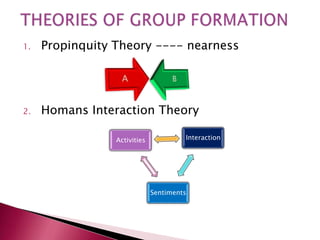
1.   Propinquity Theory ---- nearness


2.   Homans Interaction Theory

                 Activities            Interaction


                              Sentiments
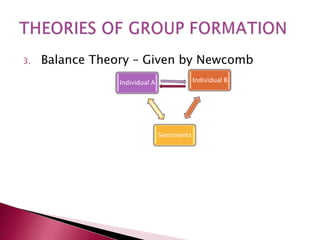
3.   Balance Theory – Given by Newcomb
                 Individual A                Individual B


                                Sentiments
4. Exchange Theory
Based on Reward (R) and Cost (c)

If R>C, individual joins group
If R<C, individual leaves group
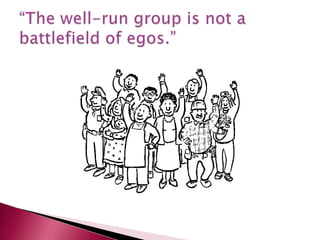
“We must remember that one determined
person can make a significant difference, and
that a small group of determined people can
change the course of history.”

Group and its formation

  • 2.
    Aggregation of small number of persons who work for common goals, develop a shared attitude, are aware that they are part of group and perceive themselves as such  Two or more individuals interacting with each other to achieve common objectives
  • 3.
    Two or more people  Collective Identity  Interaction  Shared goal interest  Well set goals  Proper rules and guidelines for behavior
  • 4.
    Pooling of knowledge and experience  Fulfill the tasks that cant be achieved individually  To bring a number of skills an talents to accomplish difficult tasks  Status symbol  Protection from external threats  Desire to socialize and satisfy emotional needs
  • 6.
    Forming Norming Adjourning Storming Performing
  • 7.
    For temporary groups who have a deadline of work performance Completion Performance Transition First Meeting Time
  • 8.
    1. Propinquity Theory ---- nearness 2. Homans Interaction Theory Activities Interaction Sentiments
  • 9.
    3. Balance Theory – Given by Newcomb Individual A Individual B Sentiments
  • 10.
    4. Exchange Theory Basedon Reward (R) and Cost (c) If R>C, individual joins group If R<C, individual leaves group
  • 11.
    “We must rememberthat one determined person can make a significant difference, and that a small group of determined people can change the course of history.”