
Organ 
transplantation 
 History 
 Organs and tissues transplanted 
 Types of transplant 
 Types of donor 
 Allocation of donated organs 
 Reasons for donation and ethical issues 
 Statistics. 
By: 
Enid 
Torres 
& 
Alex 
Melgar
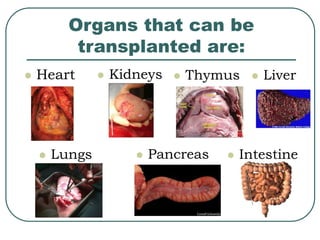
Organs that can be 
transplanted are: 
 Heart  Kidneys  Thymus  Liver 
 Lungs  Pancreas  Intestine
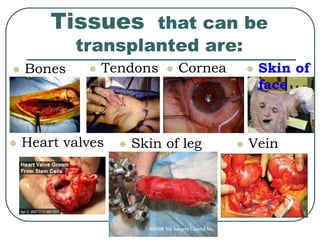
Tissues that can be 
transplanted are: 
 Bones  Tendons  Cornea 
 Skin of 
face 
 Heart valves  Skin of leg  Vein
•History
01/01/0300 
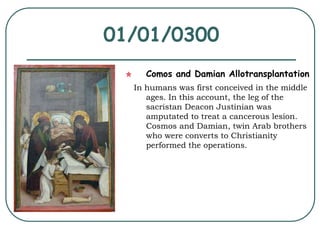
Comos and Damian Allotransplantation 
In humans was first conceived in the middle 
ages. In this account, the leg of the 
sacristan Deacon Justinian was 
amputated to treat a cancerous lesion. 
Cosmos and Damian, twin Arab brothers 
who were converts to Christianity 
performed the operations.
01/01/1878 
First Sucessful Human to Human Bone 
Transplant 
This operation, which used bone from a 
cadaver, remained unusual because there 
was no way to process and preserve human 
tissues.
09/07/1905 
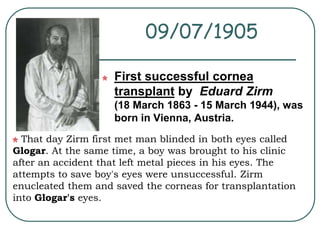
First successful cornea 
transplant by Eduard Zirm 
(18 March 1863 - 15 March 1944), was 
born in Vienna, Austria. 
That day Zirm first met man blinded in both eyes called 
Glogar. At the same time, a boy was brought to his clinic 
after an accident that left metal pieces in his eyes. The 
attempts to save boy's eyes were unsuccessful. Zirm 
enucleated them and saved the corneas for transplantation 
into Glogar's eyes.
December 
1954 
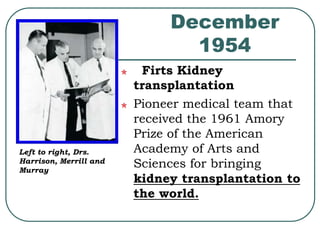
Firts Kidney 
transplantation 
Pioneer medical team that 
received the 1961 Amory 
Prize of the American 
Academy of Arts and 
Sciences for bringing 
kidney transplantation to 
the world. 
Left to right, Drs. 
Harrison, Merrill and 
Murray
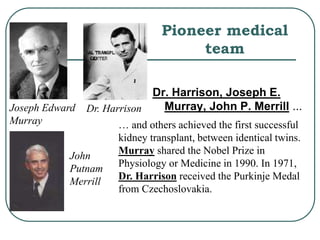
Pioneer medical 
team 
Dr. Harrison, Joseph E. 
Joseph Edward Dr. Harrison Murray, John P. Merrill ... 
Murray 
John 
Putnam 
Merrill 
… and others achieved the first successful 
kidney transplant, between identical twins. 
Murray shared the Nobel Prize in 
Physiology or Medicine in 1990. In 1971, 
Dr. Harrison received the Purkinje Medal 
from Czechoslovakia.
1966 
The first pancreas transplantation 
by Richard Lillehei and William Kelly 
(Minnesota, U.S.A.) 
A pancreas along with kidney and duodenum was 
transplanted into a 28-year-old woman and her 
blood sugar levels decreased immediately after 
transplantation, but eventually she died three 
months later from pulmonary embolism.
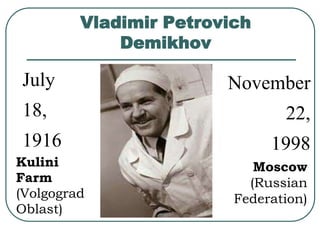
Vladimir Petrovich 
Demikhov 
July 
18, 
1916 
November 
22, 
1998 
Kulini 
Farm 
(Volgograd 
Oblast) 
Moscow 
(Russian 
Federation)
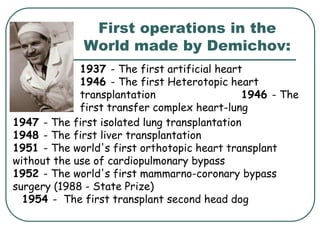
First operations in the 
World made by Demichov: 
1937 - The first artificial heart 
1946 - The first Heterotopic heart 
transplantation 1946 - The 
first transfer complex heart-lung 
1947 - The first isolated lung transplantation 
1948 - The first liver transplantation 
1951 - The world's first orthotopic heart transplant 
without the use of cardiopulmonary bypass 
1952 - The world's first mammarno-coronary bypass 
surgery (1988 - State Prize) 
1954 - The first transplant second head dog
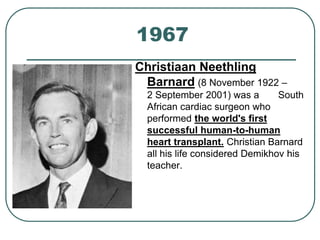
1967 
Christiaan Neethling 
Barnard (8 November 1922 – 
2 September 2001) was a South 
African cardiac surgeon who 
performed the world's first 
successful human-to-human 
heart transplant. Christian Barnard 
all his life considered Demikhov his 
teacher.
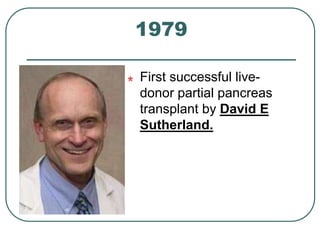
1979 
First successful live-donor 
partial pancreas 
transplant by David E 
Sutherland.
2005 
First successful ovarian transplant 
by Dr P N Mhatre (wadia hospital 
mumbai,India)
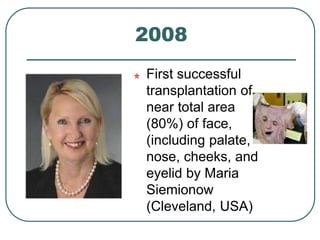
2008 
First successful 
transplantation of 
near total area 
(80%) of face, 
(including palate, 
nose, cheeks, and 
eyelid by Maria 
Siemionow 
(Cleveland, USA)
• Types of transplant 
Autograft 
Allograft and allotransplantation 
Isograft 
Xenograft and xenotransplantation 
Split transplants 
Domino transplants
Autotransplantation 
Transplant of tissue to the same person. Sometimes this is 
done with surplus tissue, or tissue that can regenerate, or 
tissues more desperately needed elsewhere (examples 
include skin grafts, vein extraction for CABG, etc.)
Allotransplantation 
and 
Allograft 
An allograft is a transplant of an organ or tissue 
between two genetically non-identical members of 
the same species. 
Due to the genetic difference between the organ 
and the recipient, the recipient's immune system 
will identify the organ as foreign and attempt to 
destroy it, causing transplant rejection.
Isograft 
Isografts are differentiated from other 
types of transplants because while they 
are anatomically identical to allografts, 
they do not trigger an immune response.
Xenograft 
and 
xenotransplantation 
A transplant of organs or tissue from one species to 
another. An example is porcine heart valve transplant, 
which is quite common and successful.
Split transplants 
Sometimes a deceased-donor organ, 
usually a liver, may be divided between 
two recipients, especially an adult and a 
child.
Domino transplants 
This term also refers to a series of living donor 
transplants in which one donor donates to the highest 
recipient on the waiting list and the transplant center 
utilizes that donation to facilitate multiple transplants. 
These other transplants are otherwise impossible due 
to blood type or antibody barriers to transplantation.
•Types of donor 
• Living donor Deceased donor 
Organ donors may be living, or brain dead. That is, 
their breathing and heartbeat has ceased. They are 
referred to as cadaveric donors.
Living donor 
In "living donors", the donor remains alive 
and donates a renewable tissue, cell, or fluid 
(e.g. blood, skin), or donates an organ or part of 
an organ in which the remaining organ can 
regenerate or take on the workload of the rest of 
the organ.
Deceased donor 
Deceased (formerly cadaveric) are donors who 
have been declared brain-dead and whose organs 
are kept viable by ventilators or other mechanical 
mechanisms until they can be excised for 
transplantation. These organs have inferior 
outcomes to organs from a brain-dead donor.
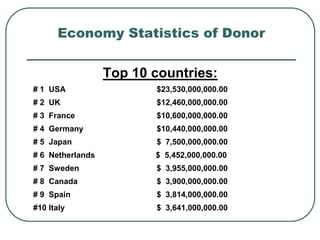
Economy Statistics of Donor 
Top 10 countries: 
# 1 USA $23,530,000,000.00 
# 2 UK $12,460,000,000.00 
# 3 France $10,600,000,000.00 
# 4 Germany $10,440,000,000.00 
# 5 Japan $ 7,500,000,000.00 
# 6 Netherlands $ 5,452,000,000.00 
# 7 Sweden $ 3,955,000,000.00 
# 8 Canada $ 3,900,000,000.00 
# 9 Spain $ 3,814,000,000.00 
#10 Italy $ 3,641,000,000.00
Here are some statistics and facts 
about organ donation for people over 
50 
Two thirds of the individuals waiting for an organ transplant 
in 2011 were 50 years old or older. That year 2,242 
deceased donors were between 50–64 years of age. Five 
hundred and ninety-five deceased donors were 65 or older.
Donation Problems 
In USA over 78,000 men, women, and children waiting for organ 
transplants, and 14 of these people die every day while waiting to 
receive an organ transplant.. 
More and more people with HIV and/or hepatitis B and/or hepatitis 
C are going to need organ transplants, particularly liver 
transplants.
Problems of 
Transplantation 
The number of donated organs hasstayed fairly constant 
over the last few years while the number of people 
needing organs continues to increase. 
Infection. 
CMV Infection. This is a viral infection which usually 
comes on about four weeks after transplant.
THANKS…

Organs transplant

  • 1.
    Organ transplantation History  Organs and tissues transplanted  Types of transplant  Types of donor  Allocation of donated organs  Reasons for donation and ethical issues  Statistics. By: Enid Torres & Alex Melgar
  • 2.
    Organs that canbe transplanted are:  Heart  Kidneys  Thymus  Liver  Lungs  Pancreas  Intestine
  • 3.
    Tissues that canbe transplanted are:  Bones  Tendons  Cornea  Skin of face  Heart valves  Skin of leg  Vein
  • 4.
  • 5.
    01/01/0300 Comos andDamian Allotransplantation In humans was first conceived in the middle ages. In this account, the leg of the sacristan Deacon Justinian was amputated to treat a cancerous lesion. Cosmos and Damian, twin Arab brothers who were converts to Christianity performed the operations.
  • 6.
    01/01/1878 First SucessfulHuman to Human Bone Transplant This operation, which used bone from a cadaver, remained unusual because there was no way to process and preserve human tissues.
  • 7.
    09/07/1905 First successfulcornea transplant by Eduard Zirm (18 March 1863 - 15 March 1944), was born in Vienna, Austria. That day Zirm first met man blinded in both eyes called Glogar. At the same time, a boy was brought to his clinic after an accident that left metal pieces in his eyes. The attempts to save boy's eyes were unsuccessful. Zirm enucleated them and saved the corneas for transplantation into Glogar's eyes.
  • 8.
    December 1954 FirtsKidney transplantation Pioneer medical team that received the 1961 Amory Prize of the American Academy of Arts and Sciences for bringing kidney transplantation to the world. Left to right, Drs. Harrison, Merrill and Murray
  • 9.
    Pioneer medical team Dr. Harrison, Joseph E. Joseph Edward Dr. Harrison Murray, John P. Merrill ... Murray John Putnam Merrill … and others achieved the first successful kidney transplant, between identical twins. Murray shared the Nobel Prize in Physiology or Medicine in 1990. In 1971, Dr. Harrison received the Purkinje Medal from Czechoslovakia.
  • 10.
    1966 The firstpancreas transplantation by Richard Lillehei and William Kelly (Minnesota, U.S.A.) A pancreas along with kidney and duodenum was transplanted into a 28-year-old woman and her blood sugar levels decreased immediately after transplantation, but eventually she died three months later from pulmonary embolism.
  • 11.
    Vladimir Petrovich Demikhov July 18, 1916 November 22, 1998 Kulini Farm (Volgograd Oblast) Moscow (Russian Federation)
  • 12.
    First operations inthe World made by Demichov: 1937 - The first artificial heart 1946 - The first Heterotopic heart transplantation 1946 - The first transfer complex heart-lung 1947 - The first isolated lung transplantation 1948 - The first liver transplantation 1951 - The world's first orthotopic heart transplant without the use of cardiopulmonary bypass 1952 - The world's first mammarno-coronary bypass surgery (1988 - State Prize) 1954 - The first transplant second head dog
  • 13.
    1967 Christiaan Neethling Barnard (8 November 1922 – 2 September 2001) was a South African cardiac surgeon who performed the world's first successful human-to-human heart transplant. Christian Barnard all his life considered Demikhov his teacher.
  • 14.
    1979 First successfullive-donor partial pancreas transplant by David E Sutherland.
  • 15.
    2005 First successfulovarian transplant by Dr P N Mhatre (wadia hospital mumbai,India)
  • 16.
    2008 First successful transplantation of near total area (80%) of face, (including palate, nose, cheeks, and eyelid by Maria Siemionow (Cleveland, USA)
  • 17.
    • Types oftransplant Autograft Allograft and allotransplantation Isograft Xenograft and xenotransplantation Split transplants Domino transplants
  • 18.
    Autotransplantation Transplant oftissue to the same person. Sometimes this is done with surplus tissue, or tissue that can regenerate, or tissues more desperately needed elsewhere (examples include skin grafts, vein extraction for CABG, etc.)
  • 19.
    Allotransplantation and Allograft An allograft is a transplant of an organ or tissue between two genetically non-identical members of the same species. Due to the genetic difference between the organ and the recipient, the recipient's immune system will identify the organ as foreign and attempt to destroy it, causing transplant rejection.
  • 20.
    Isograft Isografts aredifferentiated from other types of transplants because while they are anatomically identical to allografts, they do not trigger an immune response.
  • 21.
    Xenograft and xenotransplantation A transplant of organs or tissue from one species to another. An example is porcine heart valve transplant, which is quite common and successful.
  • 22.
    Split transplants Sometimesa deceased-donor organ, usually a liver, may be divided between two recipients, especially an adult and a child.
  • 23.
    Domino transplants Thisterm also refers to a series of living donor transplants in which one donor donates to the highest recipient on the waiting list and the transplant center utilizes that donation to facilitate multiple transplants. These other transplants are otherwise impossible due to blood type or antibody barriers to transplantation.
  • 24.
    •Types of donor • Living donor Deceased donor Organ donors may be living, or brain dead. That is, their breathing and heartbeat has ceased. They are referred to as cadaveric donors.
  • 25.
    Living donor In"living donors", the donor remains alive and donates a renewable tissue, cell, or fluid (e.g. blood, skin), or donates an organ or part of an organ in which the remaining organ can regenerate or take on the workload of the rest of the organ.
  • 26.
    Deceased donor Deceased(formerly cadaveric) are donors who have been declared brain-dead and whose organs are kept viable by ventilators or other mechanical mechanisms until they can be excised for transplantation. These organs have inferior outcomes to organs from a brain-dead donor.
  • 27.
    Economy Statistics ofDonor Top 10 countries: # 1 USA $23,530,000,000.00 # 2 UK $12,460,000,000.00 # 3 France $10,600,000,000.00 # 4 Germany $10,440,000,000.00 # 5 Japan $ 7,500,000,000.00 # 6 Netherlands $ 5,452,000,000.00 # 7 Sweden $ 3,955,000,000.00 # 8 Canada $ 3,900,000,000.00 # 9 Spain $ 3,814,000,000.00 #10 Italy $ 3,641,000,000.00
  • 28.
    Here are somestatistics and facts about organ donation for people over 50 Two thirds of the individuals waiting for an organ transplant in 2011 were 50 years old or older. That year 2,242 deceased donors were between 50–64 years of age. Five hundred and ninety-five deceased donors were 65 or older.
  • 29.
    Donation Problems InUSA over 78,000 men, women, and children waiting for organ transplants, and 14 of these people die every day while waiting to receive an organ transplant.. More and more people with HIV and/or hepatitis B and/or hepatitis C are going to need organ transplants, particularly liver transplants.
  • 30.
    Problems of Transplantation The number of donated organs hasstayed fairly constant over the last few years while the number of people needing organs continues to increase. Infection. CMV Infection. This is a viral infection which usually comes on about four weeks after transplant.
  • 31.