Platt’s 22nd Annual
Coal Properties And
Investment
Demand and Production of
Thermal and Met Coal
Palm Beach Gardens, Florida
March 17 – 18, 2014
Alan K. Stagg
Stagg Resource Consultants, Inc.
U.S Metallurgical
Coal – An Industry
Sector In Transition
Palm Beach Gardens, Florida
March 17, 2014
Alan K. Stagg
Stagg Resource Consultants, Inc.
Background
 All That Glitters Is Not Gold
Background
 All That’s Black Is Not Met
Coal
Background
 Two Basic Types of Coal
Agglomerating
Non-Agglomerating
Background
 Agglomerating
“Coal that, during volatile matter
determinations, produces either an
agglomerate button capable of
supporting a 500-gram weight
without pulverizing, or a button
showing swelling or cell structure.”
(USGS Circular 891)
Background
 Coking coals are thus those
that pass through a plastic
state when heated and fuse
into an amorphous material
that is predominantly
carbon.
Background
 Resultant coke requires certain
characteristics for use in blast
furnaces
Strength (resists crushing)
Lack of impurities
Background
These characteristics are, in
large part, a function of the
coal’s rank.
Background
 Specific characteristics of
individual coals affect the
blending and coking process
Background
 Coal’s rank is basically defined
by carbon and heat content.
As rank increases, carbon
content increases and volatile
matter content decreases.
Background
 Ranking System
Lignite (non-agglomerating)
Subbituminous (non-agglomerating)
Bituminous (agglomerating)
Anthracite (non-agglomerating)
Background
 Bituminous
High-volatile
Medium-volatile
Low-volatile
Subcategories and grades occur
within these broad categories.
Background
 Key determinants in
establishing rank
Temperature
Pressure
Background
 Key drivers influencing
these determinants
Depth of burial
Age
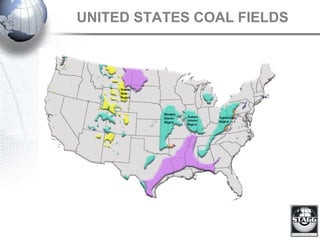
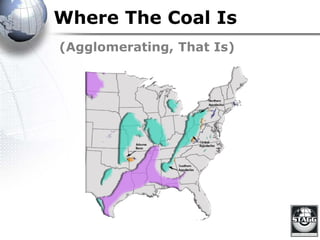
UNITED STATES COAL FIELDS
(Agglomerating, That Is)
Where The Coal Is
Regional Overview
Central Appalachian Region
Northern Appalachian Region
Southern Appalachian Region
Western Interior Region
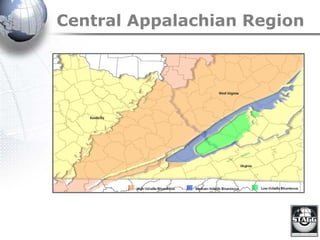
Central Appalachian Region
Good news – well established
source of high-quality
metallurgical coal with long
mining history.
Central Appalachian Region
Bad news – well established
source of high-quality
metallurgical coal with long
mining history.
Central Appalachian Region
As a result -
Surface and near-subsurface
reserves heavily mined.
Both surface and underground
mining methods.
Result - scattered smaller blocks
left for the most part.
Central Appalachian Region
Summing it up – two types of
coal remain –
Thin and clean
Thick and dirty
Central Appalachian Region
Other factors -
Substantial portion of production
requires long transportation
distances to reach preparation plant
Geology increasingly becoming an
issue
Central Appalachian Region
Low-Vol Belt – West Virginia
Relatively narrow belt at surface
and in near-subsurface.
Pocahontas Formation pinches
out to northwest – no deep
potential.
No substantial new production
likely.
Central Appalachian Region
Low-Vol Belt - Virginia
Deep reserves remain in Buchanan
and Tazewell Counties.
Primary Producer is CONSOL
Energy’s Buchanan Mine.
Central Appalachian Region
Mid-Vol Belt –
Substantial reserve depletion in
both West Virginia and Virginia.
Production used to “sweeten”
high-vol coals, bring volatile
matter content down.
No substantial new production
likely.
Central Appalachian Region
High-Vol Belt –
Production historically able to move
between met coal and high-quality
thermal coal in both West Virginia
and Virginia, dependent on market
conditions.
High mining costs and low thermal
coal prices precluding this as an
option.
Central Appalachian Region
High-Vol Belt –
Significant reserve depletion in
both West Virginia and Virginia.
Has experienced substantial mine
idling and closure.
No substantial new production
likely.
Central Appalachian Region
High-Vol Belt – Kentucky
Marginal met coal along much of
southeastern edge of coal field
within the state.
No substantial new production
likely.
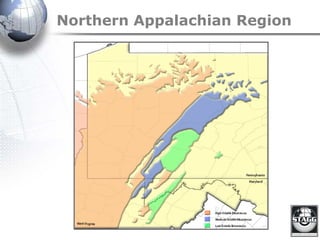
Northern Appalachian Region
Region contains much thinner
section of coal beds than in
Central App.
Northern Appalachian Region
Deposited on broad shelf area
and did not have deep burial
as in Central App.
Northern Appalachian Region
Generally higher sulfur coals,
which affects use in coke
making.
Northern Appalachian Region
Area has history of met coal
production, particularly from
Pittsburgh bed in western
Pennsylvania.
 In recent decades dominant
use has been as thermal coal.
Northern Appalachian Region
Mid and low-vol belt -
Relatively narrow.
Increased rank a function of
location along eastern margin of
coal field adjacent to Ridge and
Valley province.
Several producers but no
significant increase in production
likely.
Northern Appalachian Region
High-vol belt –
Modest production from existing
producers.
Northern Appalachian Region
High-vol belt –
New high-vol production –
Pittsburgh coal – CONSOL
Energy’s Bailey Mine in western
Pennsylvania.
Lower Kittaning coal - Arch Coal’s
Leer Mine in northern West
Virgina.
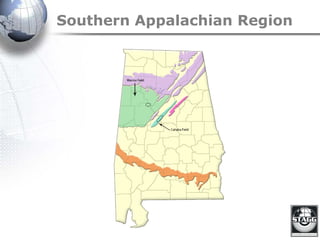
Southern Appalachian Region
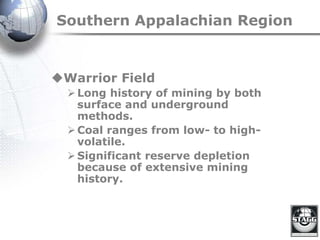
Warrior Field
Long history of mining by both
surface and underground
methods.
Coal ranges from low- to high-
volatile.
Significant reserve depletion
because of extensive mining
history.
Southern Appalachian Region
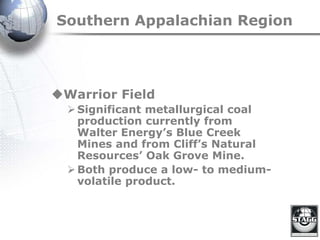
Warrior Field
Significant metallurgical coal
production currently from
Walter Energy’s Blue Creek
Mines and from Cliff’s Natural
Resources’ Oak Grove Mine.
Both produce a low- to medium-
volatile product.
Southern Appalachian Region
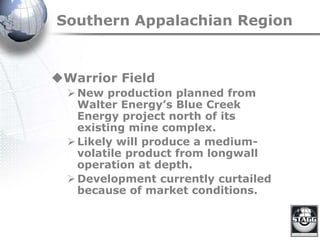
Warrior Field
New production planned from
Walter Energy’s Blue Creek
Energy project north of its
existing mine complex.
Likely will produce a medium-
volatile product from longwall
operation at depth.
Development currently curtailed
because of market conditions.
Southern Appalachian Region
Cahaba Field
Long history of mining dating
back to Civil War days.
Underground mining in early to
mid-Twentieth Century.
Southern Appalachian Region
Cahaba Field
Extensive surface mining in
1960’s.
Underground mining in 1990’s for
thermal coal.
Renewed interest in high-vol
metallurgical potential.
Southern Appalachian Region
Cahaba Field
New production currently in
development phase.
Underground and highwall mining
at Jessie Creek Mining’s
operations.
Extensive exploration program and
feasibility studies being conducted
at Kodiak Mining Company’s
holdings.
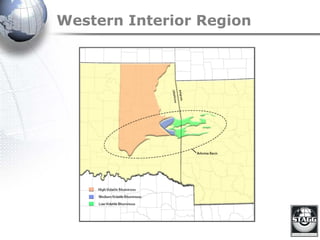
Western Interior Region
Arkoma Basin – Oklahoma and
Arkansas
Deep structural basin.
Target coal bed is Hartshorne.
Produces low- to medium-volatile
product.
Western Interior Region
Arkoma Basin – Oklahoma and
Arkansas
Geologically complex
High methane content.
Western Interior Region
Arkoma Basin – Oklahoma and
Arkansas
New production in development /
planning stage.
Ouro Mining, Inc.
Paringa Resources, Limited
Texas & Oklahoma Coal Company
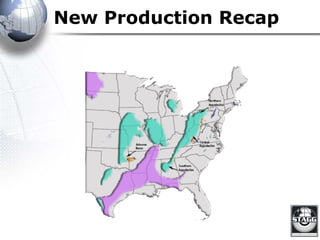
New Production Recap
Alan K. Stagg, PG, CMA
Stagg Resource Consultants, Inc.
5457 Big Tyler Road
Cross Lanes, WV 25313
(304) 776-6660
astagg@staggconsultants.com

Thermal vs Metallurgical Coal