PROJECT
IN

ENTOMOLOGY
“DERMAPTERA”
Submitted to:
Ms. Linsay Panoy
Prepared by:
Christiana Lyn Caole
prepared by: Christiana Lyn Caole

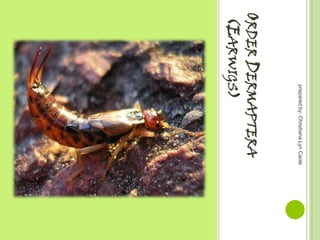
ORDER DERMAPTERA
(EARWIGS)
I. A. ORIGIN


OF NAME

prepared by: Christiana Lyn Caole

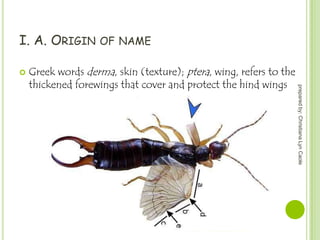
Greek words derma, skin (texture); ptera, wing, refers to the
thickened forewings that cover and protect the hind wings
B. DISTINGUISHING
CHARACTERISTICS








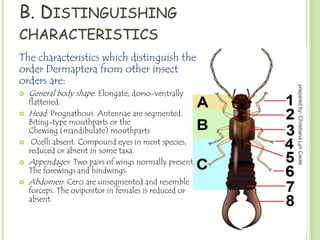
General body shape: Elongate; dorso-ventrally

flattened.
Head: Prognathous. Antennae are segmented.
Biting-type mouthparts or the
Chewing (mandibulate) mouthparts
Ocelli absent. Compound eyes in most species,
reduced or absent in some taxa.
Appendages: Two pairs of wings normally present.
The forewings and hindwings.
Abdomen: Cerci are unsegmented and resemble
forceps. The ovipositor in females is reduced or
absent.

prepared by: Christiana Lyn Caole

The characteristics which distinguish the
order Dermaptera from other insect
orders are:
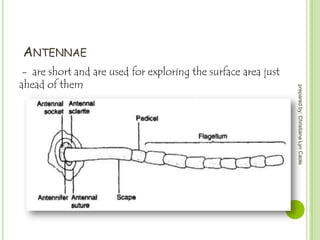
ANTENNAE
prepared by: Christiana Lyn Caole

- are short and are used for exploring the surface area just
ahead of them
PRESENCE OF WINGS


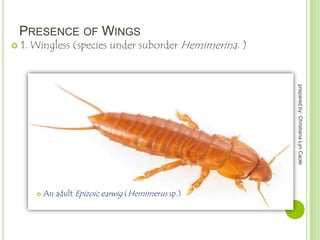
1. Wingless (species under suborder Hemimerina. )

prepared by: Christiana Lyn Caole



An adult Epizoic earwig (Hemimerus sp.)


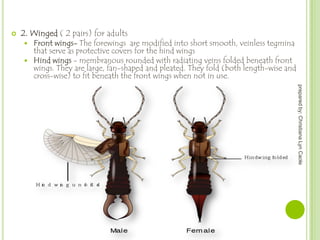
2. Winged ( 2 pairs) for adults

Front wings- The forewings are modified into short smooth, veinless tegmina
that serve as protective covers for the hind wings
 Hind wings - membranous rounded with radiating veins folded beneath front
wings. They are large, fan-shaped and pleated. They fold (both length-wise and
cross-wise) to fit beneath the front wings when not in use.


prepared by: Christiana Lyn Caole
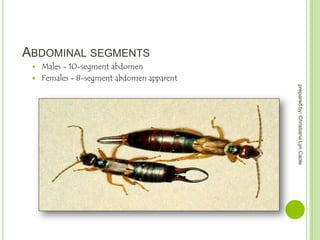
ABDOMINAL SEGMENTS
Males - 10-segment abdomen
 Females - 8-segment abdomen apparent


prepared by: Christiana Lyn Caole
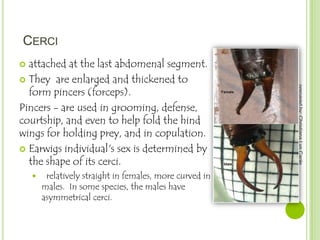
CERCI
attached at the last abdomenal segment.
 They are enlarged and thickened to
form pincers (forceps).
Pincers - are used in grooming, defense,
courtship, and even to help fold the hind
wings for holding prey, and in copulation.
 Earwigs individual's sex is determined by
the shape of its cerci.


relatively straight in females, more curved in
males. In some species, the males have
asymmetrical cerci.

prepared by: Christiana Lyn Caole


C. CLASSIFICATION


prepared by: Christiana Lyn Caole

Kingdom Animalia (Animals)
Phylum Arthropoda (Arthropods)
Subphylum Hexapoda (Hexapods)
 Class Insecta (Insects)
•Order Dermaptera (Earwigs)
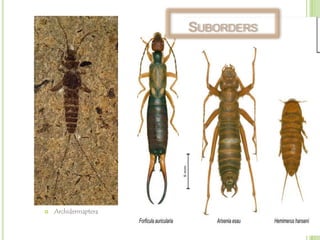
SUBORDERS
1.

3.

4.

group. The cerci are unsegmented, and modified into large,
forcep-like structures.
Arixeniinae is represented by two
genera, Arixenia andXeniaria with a total of five species in
them:Arixenia esau and Xeniaria jacobsoni being the most
well-known.
Archidermaptera - the only extinct suborder of earwigs,
known only from Jurassic fossils.Also known as Fossil
Dermaptera. The suborder is classified on the basis of general
similarities. They have unsegmented cerci and tarsi with four
to five segments.
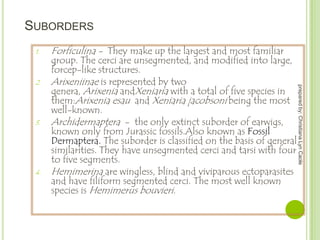
Hemimerina are wingless, blind and viviparous ectoparasites
and have filiform segmented cerci. The most well known
species is Hemimerus bouvieri.

prepared by: Christiana Lyn Caole

2.

Forficulina - They make up the largest and most familiar
SUBORDERS

prepared by: Christiana Lyn Caole

Archidermaptera

FAMILIES

prepared by: Christiana Lyn Caole

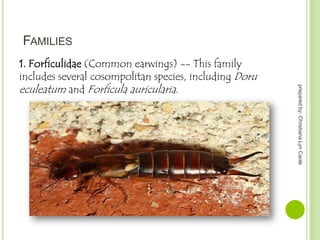
1. Forficulidae (Common earwings) -- This family
includes several cosompolitan species, including Doru
eculeatum and Forficula auricularia.


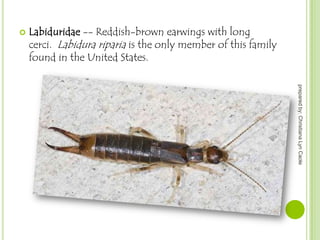
Labiduridae -- Reddish-brown earwings with long
cerci. Labidura riparia is the only member of this family
found in the United States.
prepared by: Christiana Lyn Caole


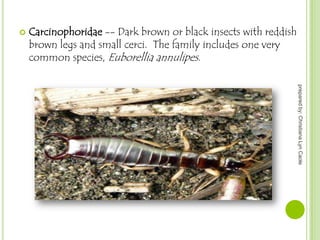
Carcinophoridae -- Dark brown or black insects with reddish
brown legs and small cerci. The family includes one very
common species, Euborellia annulipes.
prepared by: Christiana Lyn Caole


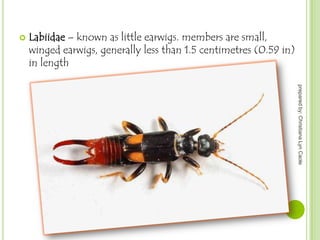
Labiidae – known as little earwigs. members are small,
winged earwigs, generally less than 1.5 centimetres (0.59 in)
in length
prepared by: Christiana Lyn Caole
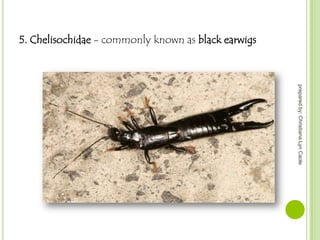
5. Chelisochidae - commonly known as black earwigs

prepared by: Christiana Lyn Caole
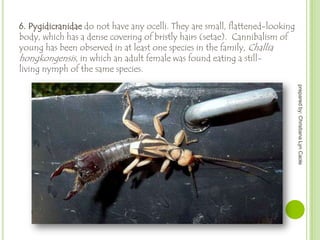
6. Pygidicranidae do not have any ocelli. They are small, flattened-looking
body, which has a dense covering of bristly hairs (setae). Cannibalism of
young has been observed in at least one species in the family, Challia
hongkongensis, in which an adult female was found eating a stillliving nymph of the same species.
prepared by: Christiana Lyn Caole
D. L IFE CYCLE


prepared by: Christiana Lyn Caole

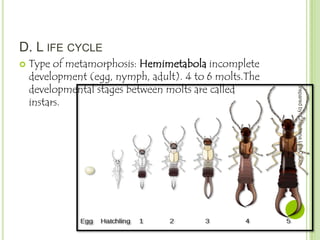
Type of metamorphosis: Hemimetabola incomplete
development (egg, nymph, adult). 4 to 6 molts.The
developmental stages between molts are called
instars.
II. PHYSICAL FEATURES

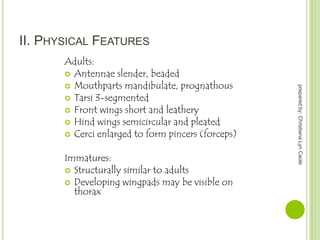
Immatures:
 Structurally similar to adults
 Developing wingpads may be visible on
thorax

prepared by: Christiana Lyn Caole

Adults:
 Antennae slender, beaded
 Mouthparts mandibulate, prognathous
 Tarsi 3-segmented
 Front wings short and leathery
 Hind wings semicircular and pleated
 Cerci enlarged to form pincers (forceps)
III. BIOLOGICAL SUMMARY FOR THE ORDER
A. Life history


overwinter as adults, usually one generation/year

C. Significance
 Most are not pests, except for Forficula Auricularia
(European earwig); substantial damage to vegetable crops,
ornamentals and fruit trees

prepared by: Christiana Lyn Caole

B. Collecting and preserving
 Collect in alcohol or pin (most in right tegman or wing,
like a beetle)
 Collect from under bark, grasses, roots, mullin, some from
light pit-fall traps
prepared by: Christiana Lyn Caole

D. Habitat and Habits
 Nocturnal . Earwigs are sensitive to heat and dryness, so they
usually hide in cool, dark places during the day and come
out at night.Hide during day - cracks, crevices, under bark,
protected places (e.g., under my deck)
 Eating habits: Mostly Scavengers - dead and decaying plant
material, but also on tender plants but some are omnivorous
or predatory


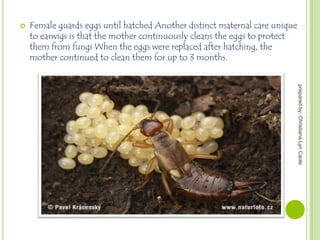
Female guards eggs until hatched Another distinct maternal care unique
to earwigs is that the mother continuously cleans the eggs to protect
them from fungi When the eggs were replaced after hatching, the
mother continued to clean them for up to 3 months.
prepared by: Christiana Lyn Caole
FACTS:
Most earwigs are flattened (which allows them to fit
inside tight crevices, such as under bark) with an
elongated body generally 7–50 millimetres (0.28–
1.97 in) long.
 The largest certainly extant species is the Australian
giant earwig (Titanolabis colossea).
 The possibly extinct Saint Helena earwig (Labidura
herculeana) .


prepared by: Christiana Lyn Caole

Order dermaptera by Christiana :)

  • 1.
  • 2.
    prepared by: ChristianaLyn Caole ORDER DERMAPTERA (EARWIGS)
  • 3.
    I. A. ORIGIN  OFNAME prepared by: Christiana Lyn Caole Greek words derma, skin (texture); ptera, wing, refers to the thickened forewings that cover and protect the hind wings
  • 4.
    B. DISTINGUISHING CHARACTERISTICS      General bodyshape: Elongate; dorso-ventrally flattened. Head: Prognathous. Antennae are segmented. Biting-type mouthparts or the Chewing (mandibulate) mouthparts Ocelli absent. Compound eyes in most species, reduced or absent in some taxa. Appendages: Two pairs of wings normally present. The forewings and hindwings. Abdomen: Cerci are unsegmented and resemble forceps. The ovipositor in females is reduced or absent. prepared by: Christiana Lyn Caole The characteristics which distinguish the order Dermaptera from other insect orders are:
  • 5.
    ANTENNAE prepared by: ChristianaLyn Caole - are short and are used for exploring the surface area just ahead of them
  • 6.
    PRESENCE OF WINGS  1.Wingless (species under suborder Hemimerina. ) prepared by: Christiana Lyn Caole  An adult Epizoic earwig (Hemimerus sp.)
  • 7.
     2. Winged (2 pairs) for adults Front wings- The forewings are modified into short smooth, veinless tegmina that serve as protective covers for the hind wings  Hind wings - membranous rounded with radiating veins folded beneath front wings. They are large, fan-shaped and pleated. They fold (both length-wise and cross-wise) to fit beneath the front wings when not in use.  prepared by: Christiana Lyn Caole
  • 8.
    ABDOMINAL SEGMENTS Males -10-segment abdomen  Females - 8-segment abdomen apparent  prepared by: Christiana Lyn Caole
  • 9.
    CERCI attached at thelast abdomenal segment.  They are enlarged and thickened to form pincers (forceps). Pincers - are used in grooming, defense, courtship, and even to help fold the hind wings for holding prey, and in copulation.  Earwigs individual's sex is determined by the shape of its cerci.  relatively straight in females, more curved in males. In some species, the males have asymmetrical cerci. prepared by: Christiana Lyn Caole 
  • 10.
    C. CLASSIFICATION  prepared by:Christiana Lyn Caole Kingdom Animalia (Animals) Phylum Arthropoda (Arthropods) Subphylum Hexapoda (Hexapods)  Class Insecta (Insects) •Order Dermaptera (Earwigs)
  • 11.
    SUBORDERS 1. 3. 4. group. The cerciare unsegmented, and modified into large, forcep-like structures. Arixeniinae is represented by two genera, Arixenia andXeniaria with a total of five species in them:Arixenia esau and Xeniaria jacobsoni being the most well-known. Archidermaptera - the only extinct suborder of earwigs, known only from Jurassic fossils.Also known as Fossil Dermaptera. The suborder is classified on the basis of general similarities. They have unsegmented cerci and tarsi with four to five segments. Hemimerina are wingless, blind and viviparous ectoparasites and have filiform segmented cerci. The most well known species is Hemimerus bouvieri. prepared by: Christiana Lyn Caole 2. Forficulina - They make up the largest and most familiar
  • 12.
    SUBORDERS prepared by: ChristianaLyn Caole Archidermaptera 
  • 13.
    FAMILIES prepared by: ChristianaLyn Caole 1. Forficulidae (Common earwings) -- This family includes several cosompolitan species, including Doru eculeatum and Forficula auricularia.
  • 14.
     Labiduridae -- Reddish-brownearwings with long cerci. Labidura riparia is the only member of this family found in the United States. prepared by: Christiana Lyn Caole
  • 15.
     Carcinophoridae -- Darkbrown or black insects with reddish brown legs and small cerci. The family includes one very common species, Euborellia annulipes. prepared by: Christiana Lyn Caole
  • 16.
     Labiidae – knownas little earwigs. members are small, winged earwigs, generally less than 1.5 centimetres (0.59 in) in length prepared by: Christiana Lyn Caole
  • 17.
    5. Chelisochidae -commonly known as black earwigs prepared by: Christiana Lyn Caole
  • 18.
    6. Pygidicranidae donot have any ocelli. They are small, flattened-looking body, which has a dense covering of bristly hairs (setae). Cannibalism of young has been observed in at least one species in the family, Challia hongkongensis, in which an adult female was found eating a stillliving nymph of the same species. prepared by: Christiana Lyn Caole
  • 19.
    D. L IFECYCLE  prepared by: Christiana Lyn Caole Type of metamorphosis: Hemimetabola incomplete development (egg, nymph, adult). 4 to 6 molts.The developmental stages between molts are called instars.
  • 20.
    II. PHYSICAL FEATURES Immatures: Structurally similar to adults  Developing wingpads may be visible on thorax prepared by: Christiana Lyn Caole Adults:  Antennae slender, beaded  Mouthparts mandibulate, prognathous  Tarsi 3-segmented  Front wings short and leathery  Hind wings semicircular and pleated  Cerci enlarged to form pincers (forceps)
  • 21.
    III. BIOLOGICAL SUMMARYFOR THE ORDER A. Life history  overwinter as adults, usually one generation/year C. Significance  Most are not pests, except for Forficula Auricularia (European earwig); substantial damage to vegetable crops, ornamentals and fruit trees prepared by: Christiana Lyn Caole B. Collecting and preserving  Collect in alcohol or pin (most in right tegman or wing, like a beetle)  Collect from under bark, grasses, roots, mullin, some from light pit-fall traps
  • 22.
    prepared by: ChristianaLyn Caole D. Habitat and Habits  Nocturnal . Earwigs are sensitive to heat and dryness, so they usually hide in cool, dark places during the day and come out at night.Hide during day - cracks, crevices, under bark, protected places (e.g., under my deck)  Eating habits: Mostly Scavengers - dead and decaying plant material, but also on tender plants but some are omnivorous or predatory
  • 23.
     Female guards eggsuntil hatched Another distinct maternal care unique to earwigs is that the mother continuously cleans the eggs to protect them from fungi When the eggs were replaced after hatching, the mother continued to clean them for up to 3 months. prepared by: Christiana Lyn Caole
  • 24.
    FACTS: Most earwigs areflattened (which allows them to fit inside tight crevices, such as under bark) with an elongated body generally 7–50 millimetres (0.28– 1.97 in) long.  The largest certainly extant species is the Australian giant earwig (Titanolabis colossea).  The possibly extinct Saint Helena earwig (Labidura herculeana) .  prepared by: Christiana Lyn Caole