 Shujahat Earaj
 Abdullah
 Mattiullah
 Muhammad Usman
 Muhammad Numan
 Defination
 Purpose of soil investigation
 Exploration Program
 Types of boring
 The process of determining the layers of
natural soil deposits that will underlie a
proposed structure and their physical
properties is generally referred to as site
investigation.
1. Selection of the type and the depth of
foundation suitable for a given structure.
2. Evaluation of the load-bearing capacity of the
foundation.
3. Estimation of the probable settlement of a
structure.
4. Determination of potential foundation problems
(for example, expansive soil, collapsible soil,
sanitary landfill, and so on).
5. Establishment of ground water table.
6. Prediction of lateral earth pressure for
structures like retaining walls, sheet pile
bulkheads, and braced cuts.
7. Establishment of construction methods for
changing subsoil conditions.
 The purpose of the exploration program is to
determine, the stratification and engineering
properties of the soils underlying the site.
The principal properties of interest will be the
strength, deformation, and hydraulic
characteristics. The program should be
planned so that the maximum amount of
information can be obtained at minimum
cost.
 1. Assembly of all available information on
dimensions, column spacing, type and use of the
structure, basement requirements, and any special
architectural considerations of the proposed
building. For bridges the soil engineer should have
access to type and span lengths as well as pier
loadings. This information will indicate any
settlement limitations, and can be used to estimate
foundation loads.
2.Reconnaissance of the area:
This may be in the form of a field trip to the
site which can reveal information on the type
and behavior of adjacent structures such as
cracks. The type of local existing structure
may influence, the exploration program and
the best foundation type for the proposed
adjacent structure.
3.A preliminary site investigation:
In this phase a few borings are made or a test pit is
opened to establish in a general manner the
stratification, types of soil to be expected, and
possibly the location of the groundwater table. This
amount of exploration is usually the extent of the
site investigation for small structures.
 4.A detailed site investigation:
 Where the preliminary site investigation has established
the feasibility of the project, a more detailed exploration
program is undertaken. The preliminary borings and
data are used as a basis for locating additional borings,
which should be confirmatory in nature, and determining
the additional samples required.
 The approximate required minimum depth of
the borings should be predetermined. The
estimated depths can be changed during the
drilling operation, depending on the subsoil
encountered. To determine the approximate
minimum depth of boring
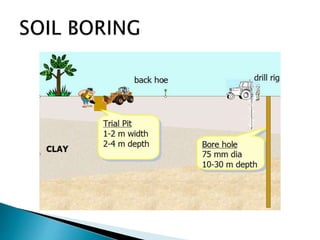
 The earliest method of obtaining a test hole was to
excavate a test pit using a pick and shovel. Because
of economics, the current procedure is to use
power-excavation equipment such as a backhoe to
excavate the pit and then to use hand tools to
remove a block sample or shape the site for in situ
testing. This is the best method at present for
obtaining quality undisturbed samples or samples
for testing at other than vertical orientation.
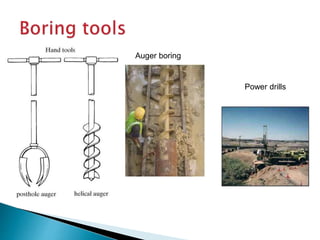
Auger boring
Power drills
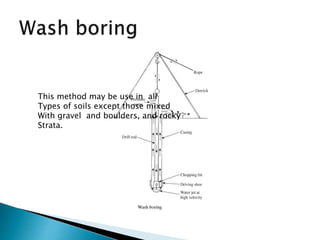
This method may be use in all
Types of soils except those mixed
With gravel and boulders, and rocky
Strata.
 The equipment used for drilling bore holes is
generally
 Known as ‘boring rig ’.The hand operated
boring rigs may
 Be use for boring hole up to a depth of 25 m,
and power
 Driven or mechanical boring rigs for boring
holes up to a Depth of 50 m.
 This method is a of drilling holes in rock
formations. A hollow drill bit,
 Fixed to the lower end of a hollow drill rod , is
rotated by power while
 Being kept in firm contact with the bottom of the
hole. Drilling fluid
 Usually bentonite clay slurry is force under
pressure through the drill
 Rod and it comes up bringing the cuttings to the
surface.
 This method is then known as core drilling or
core boring.
The following are the major field tests for
determining the soil strength:
Standard Penetration Test (SPT).
Vane shear test (VST).
The Plate Load Test (PLT).
Cone Penetration Test (CPT).
The Pressure-meter Test (PMT).
 The Standard Penetration test (SPT) is a
common in situ testing method used to
determine the engineering properties of
subsurface soils. It is a simple and
inexpensive test to estimate the relative
density of soils and approximate shear
strength
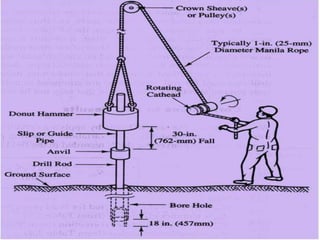
 The test uses a thick-walled sample tube, with an outside
diameter of 50.8 mm and an inside diameter of 35 mm,
and a length of around 650 mm. This is driven into the
ground at the bottom of a borehole by blows from a slide
hammer with a mass of 63.5 kg falling through a distance
of 760 mm (30 in). The sample tube is driven 150 mm into
the ground and then the number of blows needed for the
tube to penetrate each 150 mm (6 in) up to a depth of
450 mm (18 in) is recorded. The sum of the number of
blows required for the second and third 6 in. of
penetration is termed the "standard penetration
resistance" or the "N-value". In cases where 50 blows are
insufficient to advance it through a 150 mm (6 in) interval
the penetration after 50 blows is recorded. The blow count
provides an indication of the density of the ground, and it
is used in many empirical geotechnical engineering
formulae.
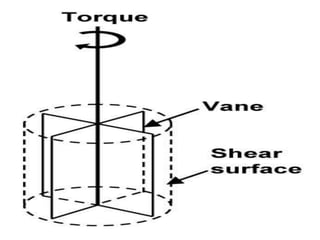
 The vane shear test is an in-situ geotechnical
testing methods used to estimate the
undrained shear strength of fully saturated
clays without disturbance. The test is
relatively simple, quick, and provides a cost-
effective way of estimating the soil shear
strength; therefore, it is widely used in
geotechnical investigations
 The test can be conducted either from the ground surface
or from the bottom of a borehole or a test pit. If
conducted from the bottom of a bore hole, the test area
should be should be at the depth of least three times the
borehole diameter lower that the borehole bottom in order
to avoid the borehole disturbance effects.
 The test starts by pushing the vane and the rod vertically
into the soft soil. The vane is then rotated at a slow rate of
6° to 12° per minute. The torque is measured at regular
time intervals and the test continues until a maximum
torque is reached and the vane rotates rapidly for several
revolutions.
 At this time, the soil fails in shear on a cylindrical surface
around the vane. The rotation is usually continued after
shearing and the torque is measured to estimate the
remoulded shear strength.
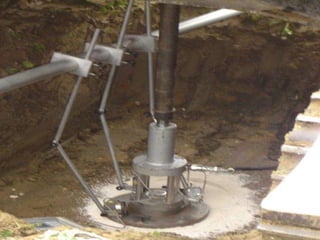
Plate Load Test is a field test for determining
the ultimate bearing capacity of soil and the
likely settlement under a given load.
The Plate Load Test basically consists of
loading a steel plate placed at the foundation
level and recording the settlements
corresponding to each load increment.
 The test load is gradually increased till the
plate starts to sink at a rapid rate. The total
value of load on the plate in such a stage
divided by the area of the steel plate gives
the value of the ultimate bearing capacity of
soil. The ultimate bearing capacity of soil is
divided by suitable factor of safety (which
varies from 2 to 3) to arrive at the value of
safe bearing capacity of soil.
 The cone penetration or cone penetrometer
test (CPT) is a method used to determine the
geotechnical engineering properties of soils .
It was initially developed in the 1950s at the
Dutch Laboratory for Soil Mechanics in Delft
to investigate soft soils. Based on this history
it has also been called the "Dutch cone test".
Today, the CPT is one of the most used and
accepted soil methods for soil investigation
worldwide.
 The Cone penetration test can be carried out
from the ground surface with a need for a
borehole. The test is carried out by first pushing
the cone into the ground at a standard velocity of
1 to 2 cm/s while keeping the sleeve stationary.
 For any depth, the resistance of the cone, called
cone penetration resistance q_c , is recorded
using the force probes provided for this purpose
in the cone. Then the cone and the sleeve and
moved and penetrated together into the soil and
the combined cone and sleeve resistance,
indicated by q_t , is recorded at any depth using
tension load cells embedded in the sleeve.
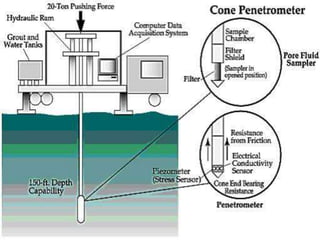
This procedure is repeated and the measurements are
made at regular depth intervals during penetration. In
addition to the stress on the tip and the sleeve friction,
the typical CPT probe measures as well the porewater
pressure. Some equiped CPT probles are also able to
measures shear wave velocity and temperature.
The cone penetration resistance values can be then
correlated to shear strength parameters using
proposed empirical curves. There are also
some design methods associated with CPT results
which directly use the CPT results to estimate the
settlement is soils under a given pressure
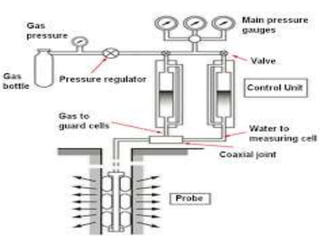
 A pressure meter is a meter constructed to
measure the “at-rest horizontal earth
pressure”. The pressure meter has two major
components.The first component is a read-
out unit that remains above ground. The
second component of the pressure meter is a
probe that is inserted into the borehole
(ground) to read the pressure.
The original Ménard-type pressure meter was designed
to be lowered into a performed hole and to apply
uniform pressure to the borehole walls by means of
inflatable flexible membrane. As the pressure
increases, the borehole walls deform. The pressure is
held constant for a given period and the increase in
volume required for maintaining the constant pressure
is recorded. A load-deformation diagram and soil
characteristics can be deduced by measurement of the
applied pressure and change in the volume of the
expanding membrane.
Site investigation

Site investigation

  • 3.
     Shujahat Earaj Abdullah  Mattiullah  Muhammad Usman  Muhammad Numan
  • 4.
     Defination  Purposeof soil investigation  Exploration Program  Types of boring
  • 5.
     The processof determining the layers of natural soil deposits that will underlie a proposed structure and their physical properties is generally referred to as site investigation.
  • 6.
    1. Selection ofthe type and the depth of foundation suitable for a given structure. 2. Evaluation of the load-bearing capacity of the foundation. 3. Estimation of the probable settlement of a structure. 4. Determination of potential foundation problems (for example, expansive soil, collapsible soil, sanitary landfill, and so on). 5. Establishment of ground water table. 6. Prediction of lateral earth pressure for structures like retaining walls, sheet pile bulkheads, and braced cuts. 7. Establishment of construction methods for changing subsoil conditions.
  • 7.
     The purposeof the exploration program is to determine, the stratification and engineering properties of the soils underlying the site. The principal properties of interest will be the strength, deformation, and hydraulic characteristics. The program should be planned so that the maximum amount of information can be obtained at minimum cost.
  • 8.
     1. Assemblyof all available information on dimensions, column spacing, type and use of the structure, basement requirements, and any special architectural considerations of the proposed building. For bridges the soil engineer should have access to type and span lengths as well as pier loadings. This information will indicate any settlement limitations, and can be used to estimate foundation loads.
  • 9.
    2.Reconnaissance of thearea: This may be in the form of a field trip to the site which can reveal information on the type and behavior of adjacent structures such as cracks. The type of local existing structure may influence, the exploration program and the best foundation type for the proposed adjacent structure.
  • 10.
    3.A preliminary siteinvestigation: In this phase a few borings are made or a test pit is opened to establish in a general manner the stratification, types of soil to be expected, and possibly the location of the groundwater table. This amount of exploration is usually the extent of the site investigation for small structures.
  • 11.
     4.A detailedsite investigation:  Where the preliminary site investigation has established the feasibility of the project, a more detailed exploration program is undertaken. The preliminary borings and data are used as a basis for locating additional borings, which should be confirmatory in nature, and determining the additional samples required.
  • 12.
     The approximaterequired minimum depth of the borings should be predetermined. The estimated depths can be changed during the drilling operation, depending on the subsoil encountered. To determine the approximate minimum depth of boring
  • 13.
     The earliestmethod of obtaining a test hole was to excavate a test pit using a pick and shovel. Because of economics, the current procedure is to use power-excavation equipment such as a backhoe to excavate the pit and then to use hand tools to remove a block sample or shape the site for in situ testing. This is the best method at present for obtaining quality undisturbed samples or samples for testing at other than vertical orientation.
  • 15.
  • 16.
    This method maybe use in all Types of soils except those mixed With gravel and boulders, and rocky Strata.
  • 17.
     The equipmentused for drilling bore holes is generally  Known as ‘boring rig ’.The hand operated boring rigs may  Be use for boring hole up to a depth of 25 m, and power  Driven or mechanical boring rigs for boring holes up to a Depth of 50 m.
  • 18.
     This methodis a of drilling holes in rock formations. A hollow drill bit,  Fixed to the lower end of a hollow drill rod , is rotated by power while  Being kept in firm contact with the bottom of the hole. Drilling fluid  Usually bentonite clay slurry is force under pressure through the drill  Rod and it comes up bringing the cuttings to the surface.  This method is then known as core drilling or core boring.
  • 19.
    The following arethe major field tests for determining the soil strength: Standard Penetration Test (SPT). Vane shear test (VST). The Plate Load Test (PLT). Cone Penetration Test (CPT). The Pressure-meter Test (PMT).
  • 20.
     The StandardPenetration test (SPT) is a common in situ testing method used to determine the engineering properties of subsurface soils. It is a simple and inexpensive test to estimate the relative density of soils and approximate shear strength
  • 21.
     The testuses a thick-walled sample tube, with an outside diameter of 50.8 mm and an inside diameter of 35 mm, and a length of around 650 mm. This is driven into the ground at the bottom of a borehole by blows from a slide hammer with a mass of 63.5 kg falling through a distance of 760 mm (30 in). The sample tube is driven 150 mm into the ground and then the number of blows needed for the tube to penetrate each 150 mm (6 in) up to a depth of 450 mm (18 in) is recorded. The sum of the number of blows required for the second and third 6 in. of penetration is termed the "standard penetration resistance" or the "N-value". In cases where 50 blows are insufficient to advance it through a 150 mm (6 in) interval the penetration after 50 blows is recorded. The blow count provides an indication of the density of the ground, and it is used in many empirical geotechnical engineering formulae.
  • 23.
     The vaneshear test is an in-situ geotechnical testing methods used to estimate the undrained shear strength of fully saturated clays without disturbance. The test is relatively simple, quick, and provides a cost- effective way of estimating the soil shear strength; therefore, it is widely used in geotechnical investigations
  • 24.
     The testcan be conducted either from the ground surface or from the bottom of a borehole or a test pit. If conducted from the bottom of a bore hole, the test area should be should be at the depth of least three times the borehole diameter lower that the borehole bottom in order to avoid the borehole disturbance effects.  The test starts by pushing the vane and the rod vertically into the soft soil. The vane is then rotated at a slow rate of 6° to 12° per minute. The torque is measured at regular time intervals and the test continues until a maximum torque is reached and the vane rotates rapidly for several revolutions.  At this time, the soil fails in shear on a cylindrical surface around the vane. The rotation is usually continued after shearing and the torque is measured to estimate the remoulded shear strength.
  • 26.
    Plate Load Testis a field test for determining the ultimate bearing capacity of soil and the likely settlement under a given load. The Plate Load Test basically consists of loading a steel plate placed at the foundation level and recording the settlements corresponding to each load increment.
  • 27.
     The testload is gradually increased till the plate starts to sink at a rapid rate. The total value of load on the plate in such a stage divided by the area of the steel plate gives the value of the ultimate bearing capacity of soil. The ultimate bearing capacity of soil is divided by suitable factor of safety (which varies from 2 to 3) to arrive at the value of safe bearing capacity of soil.
  • 29.
     The conepenetration or cone penetrometer test (CPT) is a method used to determine the geotechnical engineering properties of soils . It was initially developed in the 1950s at the Dutch Laboratory for Soil Mechanics in Delft to investigate soft soils. Based on this history it has also been called the "Dutch cone test". Today, the CPT is one of the most used and accepted soil methods for soil investigation worldwide.
  • 30.
     The Conepenetration test can be carried out from the ground surface with a need for a borehole. The test is carried out by first pushing the cone into the ground at a standard velocity of 1 to 2 cm/s while keeping the sleeve stationary.  For any depth, the resistance of the cone, called cone penetration resistance q_c , is recorded using the force probes provided for this purpose in the cone. Then the cone and the sleeve and moved and penetrated together into the soil and the combined cone and sleeve resistance, indicated by q_t , is recorded at any depth using tension load cells embedded in the sleeve.
  • 31.
    This procedure isrepeated and the measurements are made at regular depth intervals during penetration. In addition to the stress on the tip and the sleeve friction, the typical CPT probe measures as well the porewater pressure. Some equiped CPT probles are also able to measures shear wave velocity and temperature. The cone penetration resistance values can be then correlated to shear strength parameters using proposed empirical curves. There are also some design methods associated with CPT results which directly use the CPT results to estimate the settlement is soils under a given pressure
  • 33.
     A pressuremeter is a meter constructed to measure the “at-rest horizontal earth pressure”. The pressure meter has two major components.The first component is a read- out unit that remains above ground. The second component of the pressure meter is a probe that is inserted into the borehole (ground) to read the pressure.
  • 34.
    The original Ménard-typepressure meter was designed to be lowered into a performed hole and to apply uniform pressure to the borehole walls by means of inflatable flexible membrane. As the pressure increases, the borehole walls deform. The pressure is held constant for a given period and the increase in volume required for maintaining the constant pressure is recorded. A load-deformation diagram and soil characteristics can be deduced by measurement of the applied pressure and change in the volume of the expanding membrane.