Precision
Attachments
Faryal Habibullah
Roll # 76
Objectives






Understanding how attachments
preserve hard and soft tissue
Selection of the appropriate
attachments
Understand the uses of attachments
Familarization with different
attachments
Maintenance and hygiene
What is a Precision
Attachment?


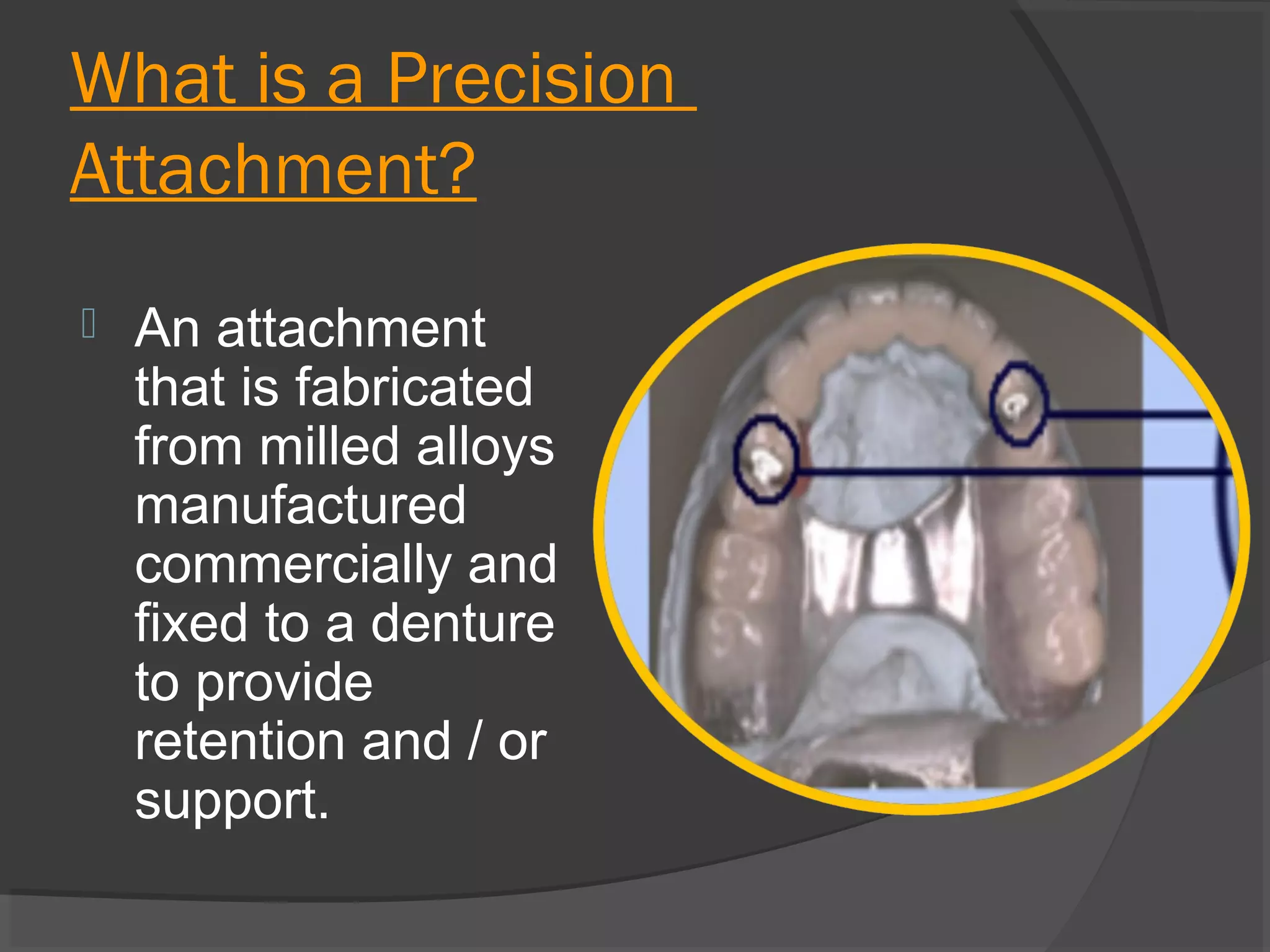
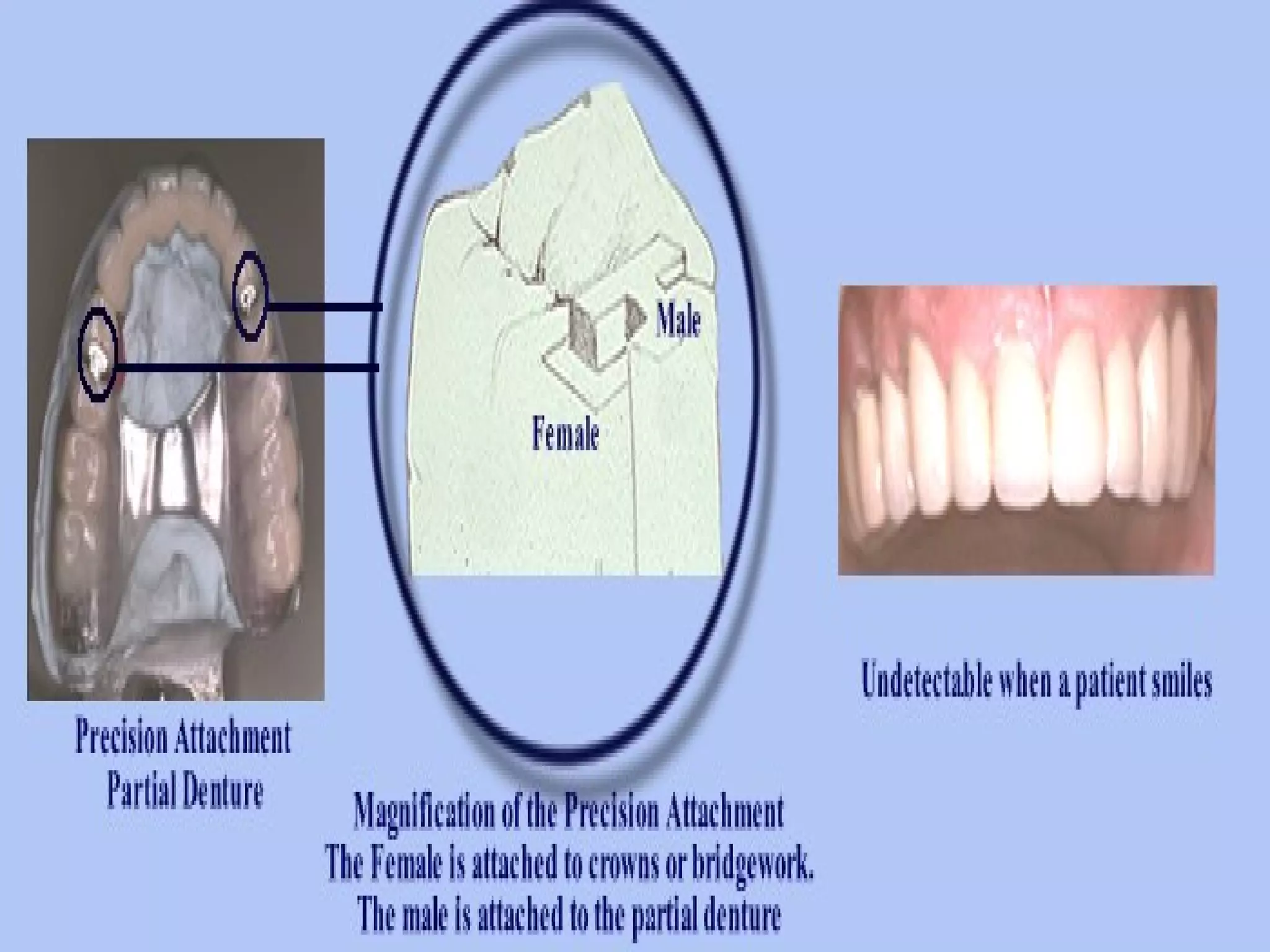
An attachment
that is fabricated
from milled alloys
manufactured
commercially and
fixed to a denture
to provide
retention and / or
support.
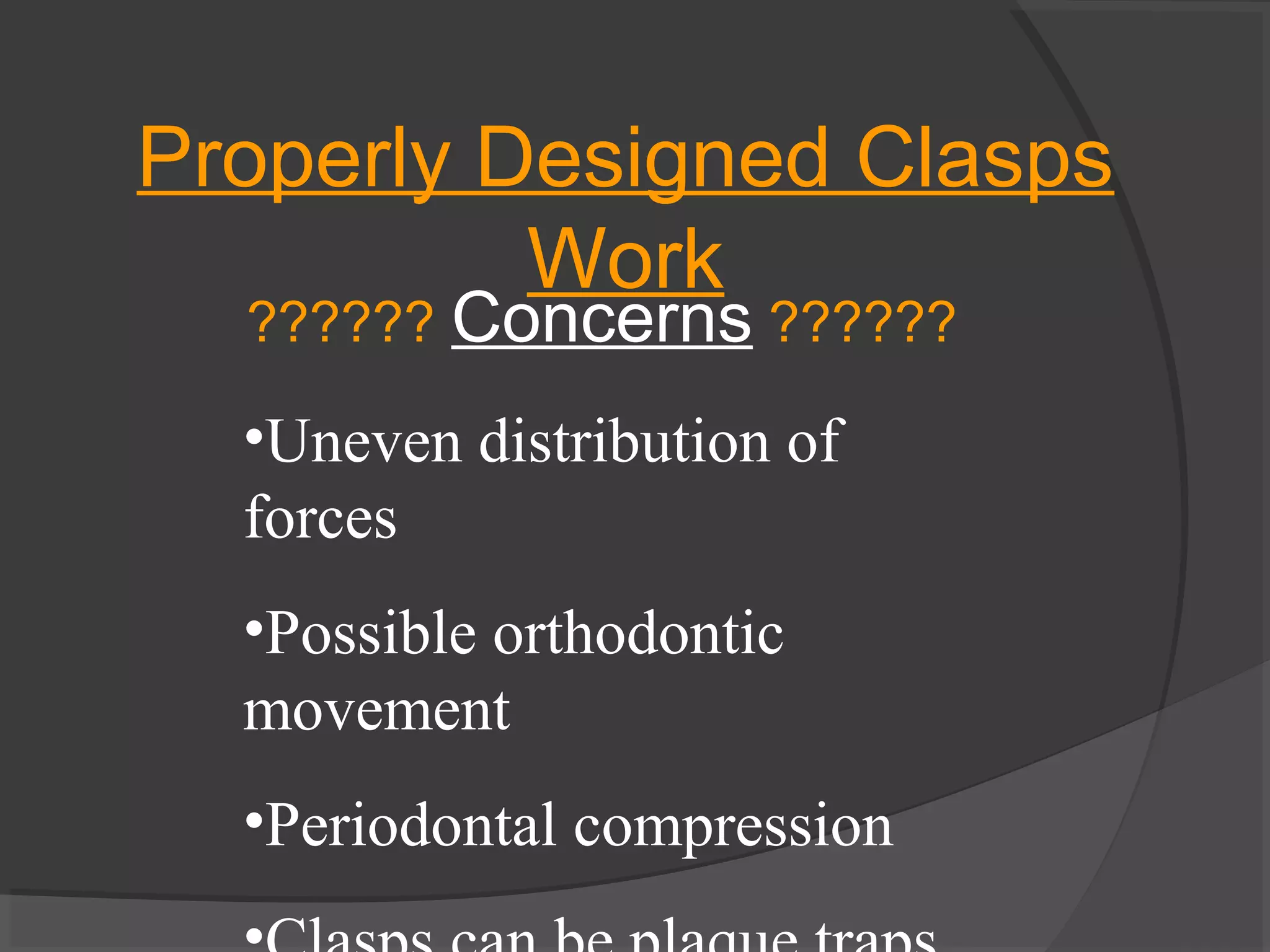
Properly Designed Clasps
Work
?????? Concerns ??????

•Uneven distribution of
forces
•Possible orthodontic
movement
•Periodontal compression
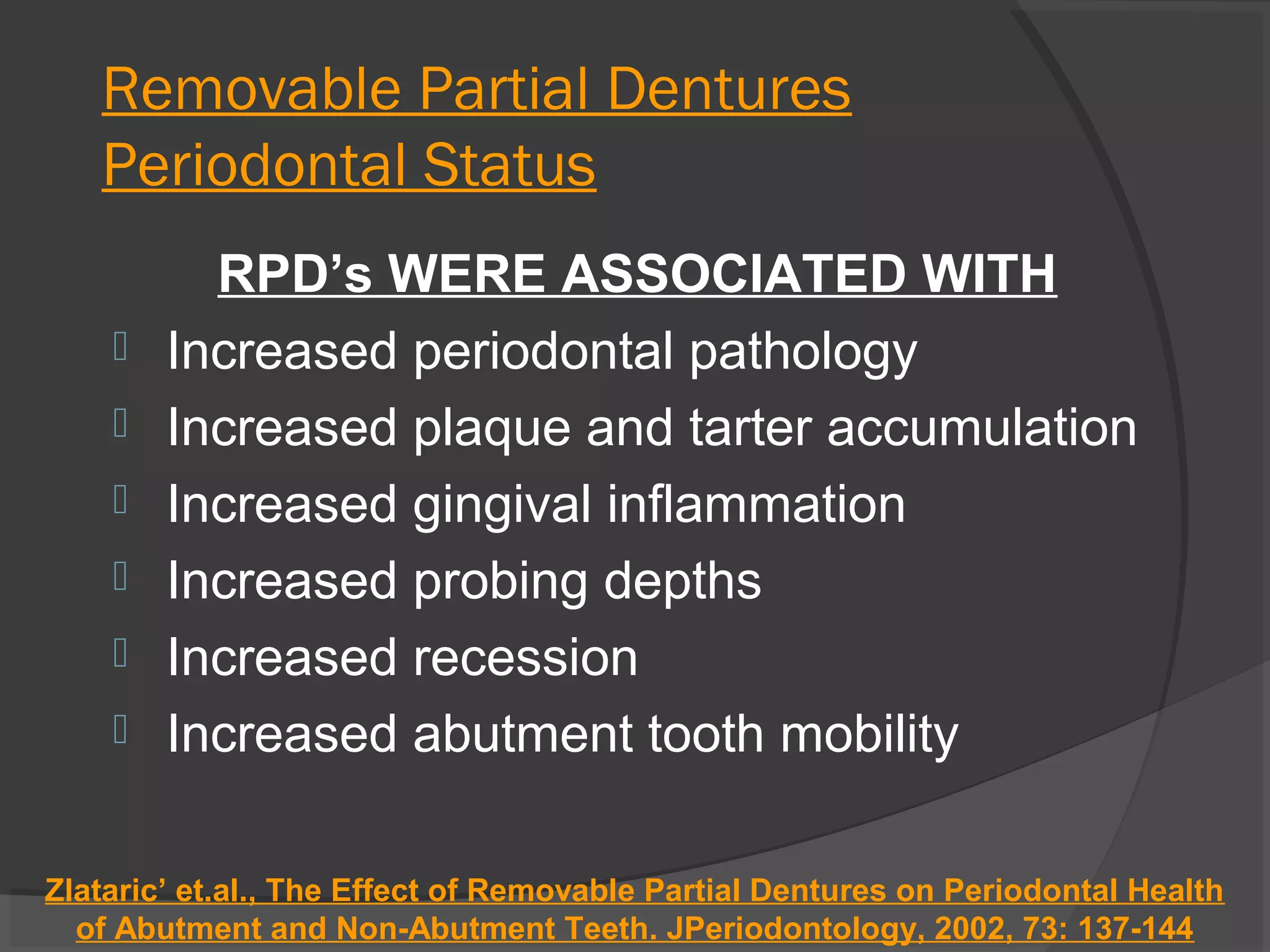
Removable Partial Dentures
Periodontal Status







RPD’s WERE ASSOCIATED WITH
Increased periodontal pathology
Increased plaque and tarter accumulation
Increased gingival inflammation
Increased probing depths
Increased recession
Increased abutment tooth mobility

Zlataric’ et.al., The Effect of Removable Partial Dentures on Periodontal Health
of Abutment and Non-Abutment Teeth. JPeriodontology, 2002, 73: 137-144
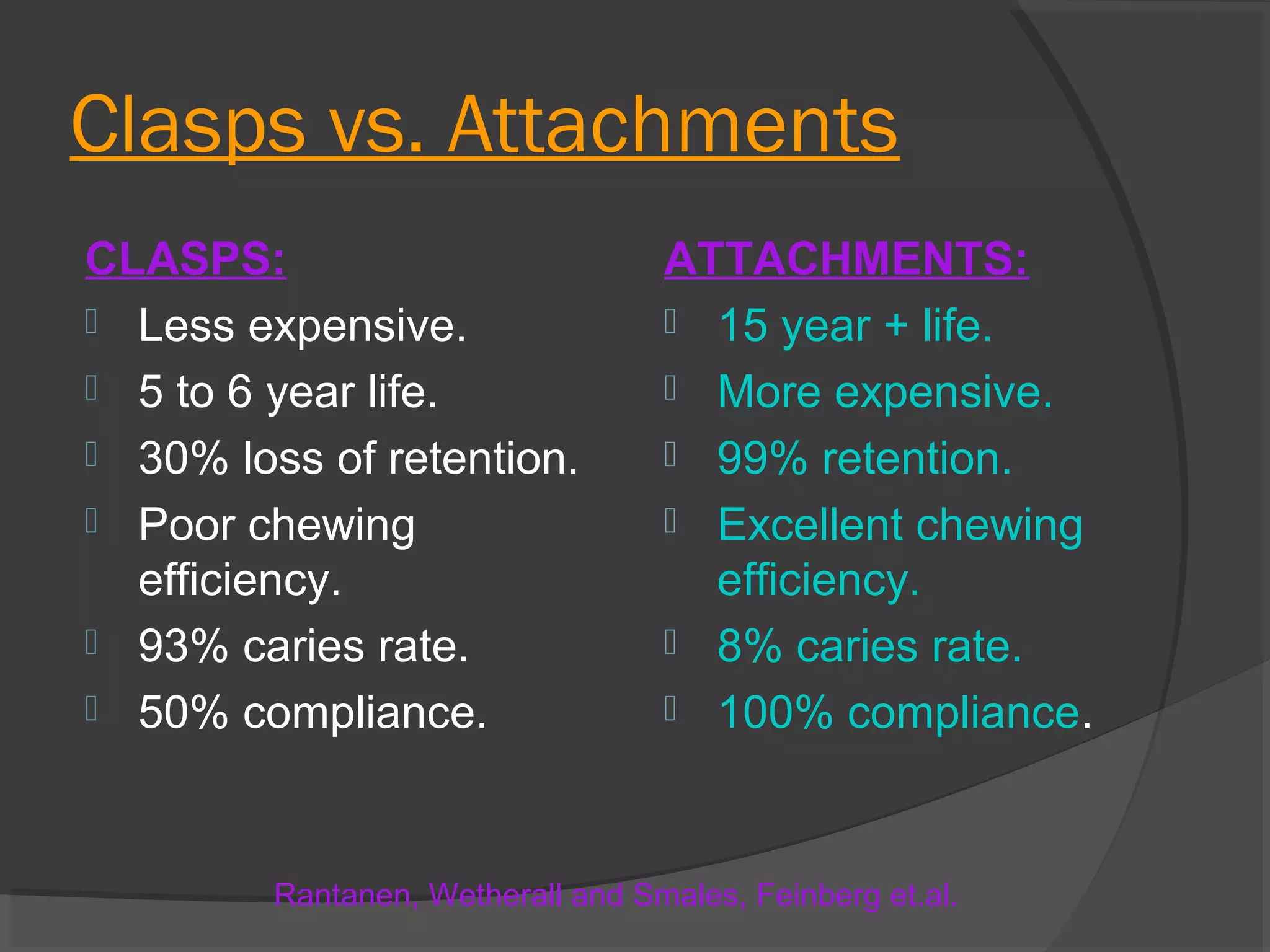
Clasps vs. Attachments
CLASPS:
 Less expensive.
 5 to 6 year life.
 30% loss of retention.
 Poor chewing
efficiency.
 93% caries rate.
 50% compliance.

ATTACHMENTS:
 15 year + life.
 More expensive.
 99% retention.
 Excellent chewing
efficiency.
 8% caries rate.
 100% compliance.

Rantanen, Wetherall and Smales, Feinberg et.al.
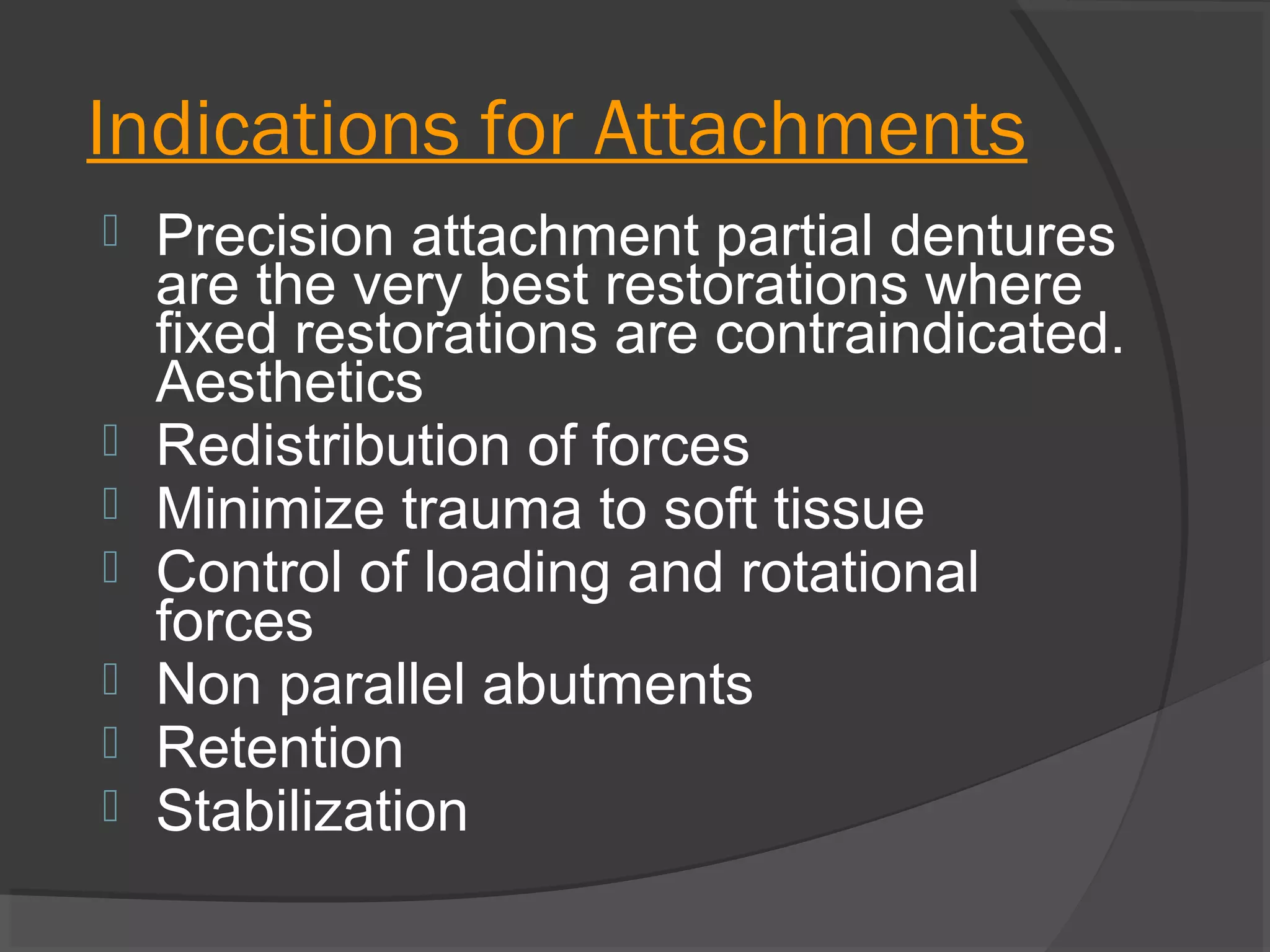
Indications for Attachments









Precision attachment partial dentures
are the very best restorations where
fixed restorations are contraindicated.
Aesthetics
Redistribution of forces
Minimize trauma to soft tissue
Control of loading and rotational
forces
Non parallel abutments
Retention
Stabilization
Patient Dexterity and Attachment
Wear
Insertion and removal cause wear
 Poor dexterity
 Avoid multiple attachments with
complex a complex path of insertion
 Use lingual “guiding arms”

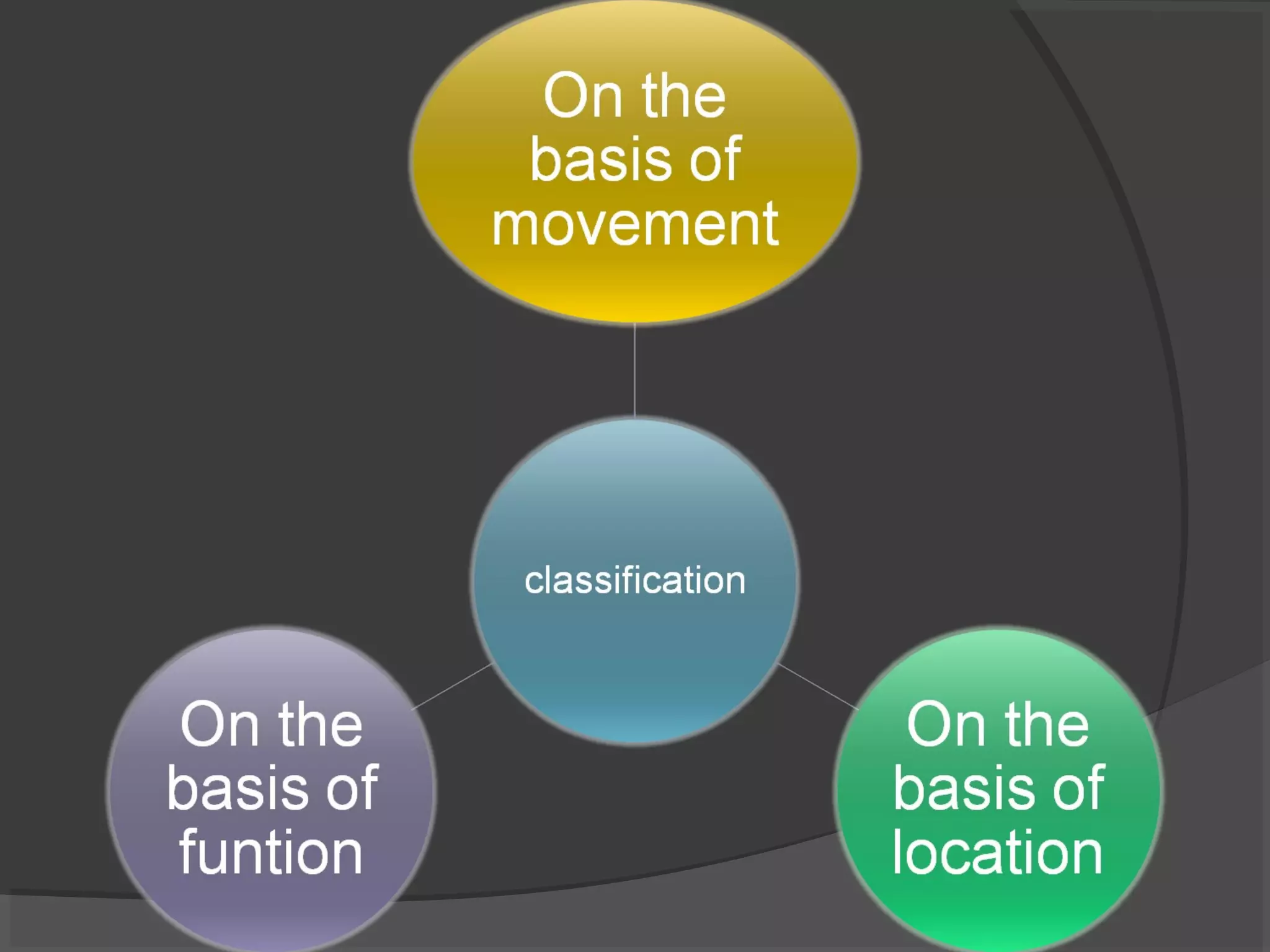
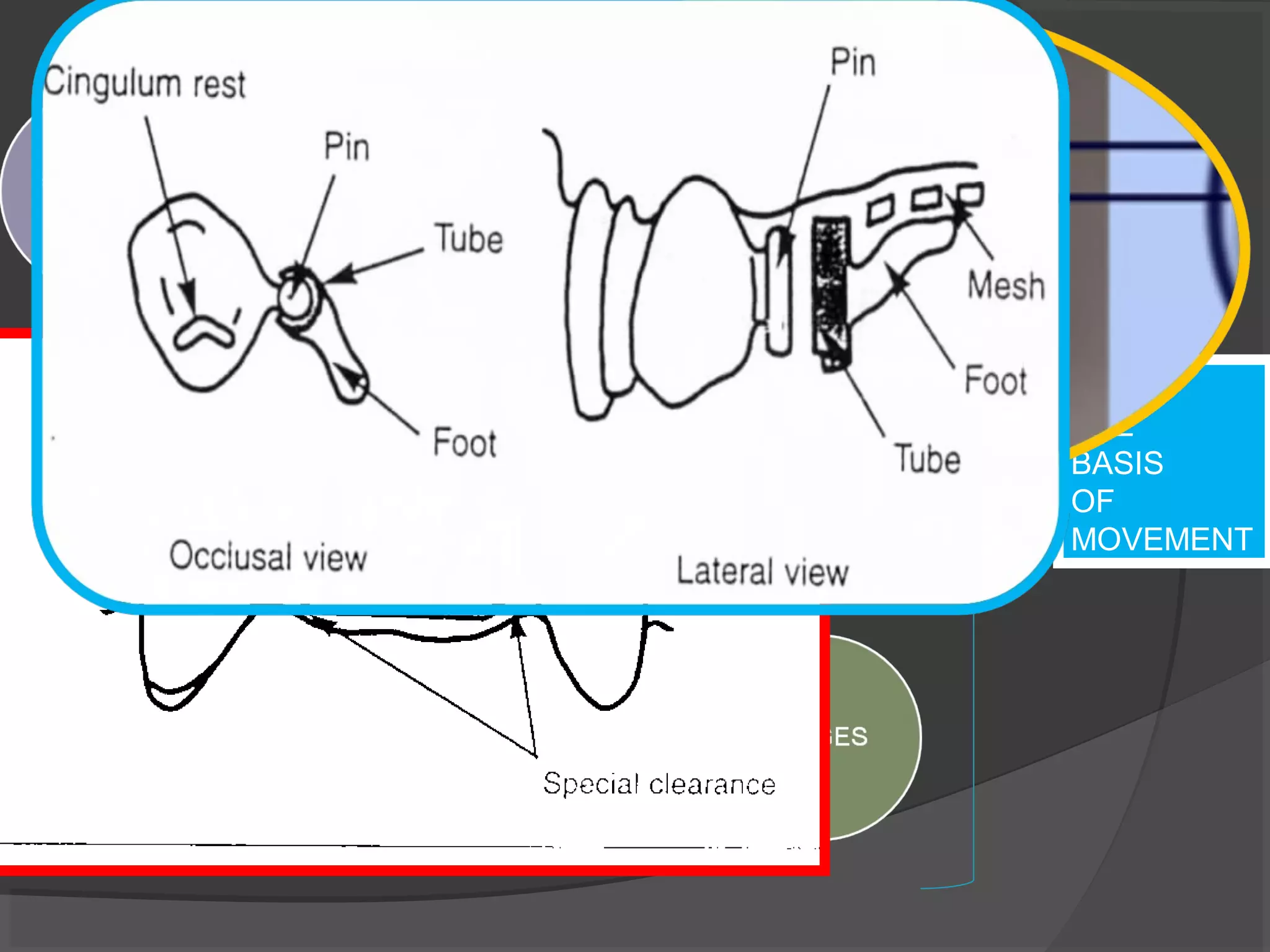
ON
THE
BASIS
OF
MOVEMENT
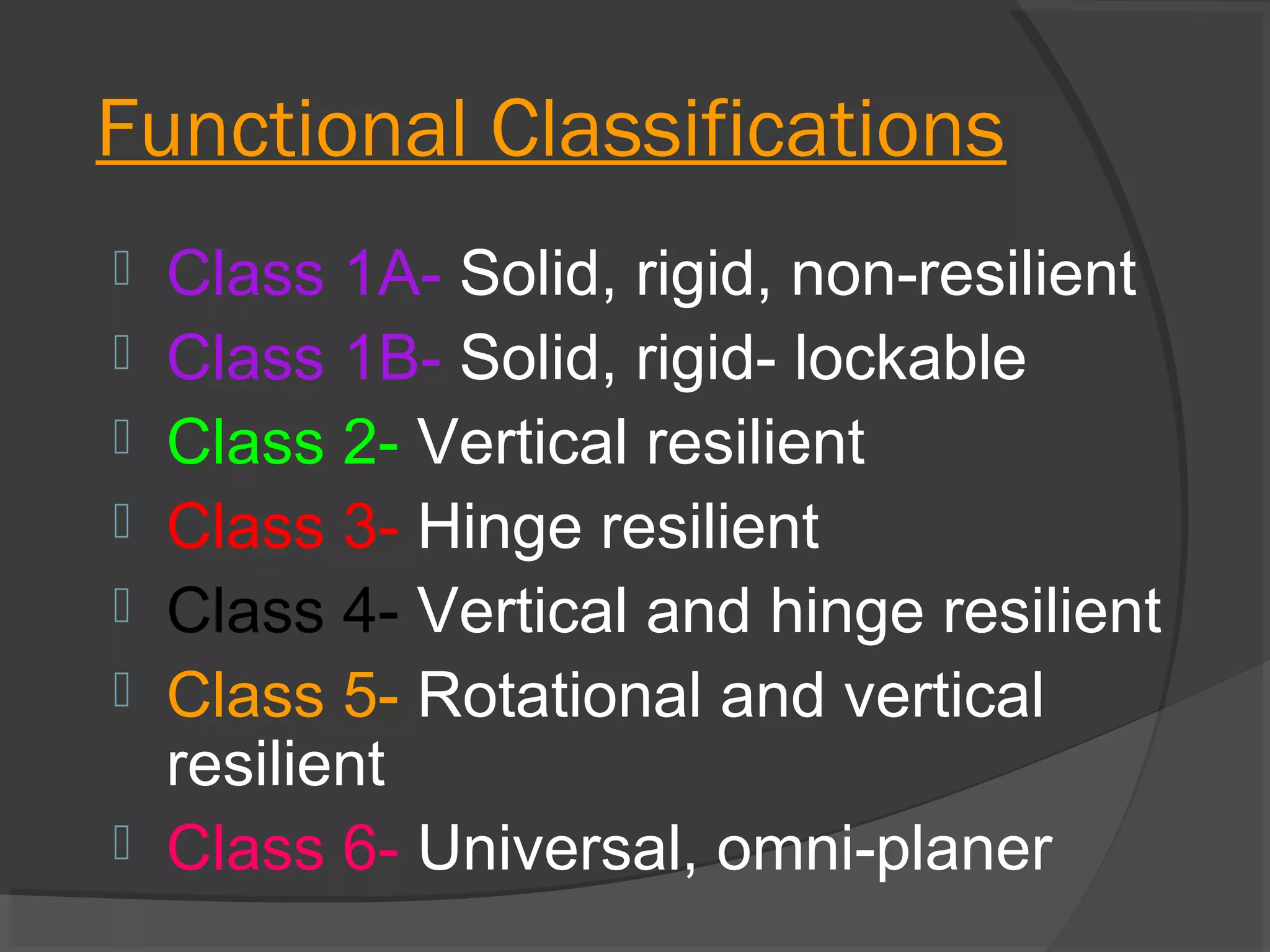
Functional Classifications








Class 1A- Solid, rigid, non-resilient
Class 1B- Solid, rigid- lockable
Class 2- Vertical resilient
Class 3- Hinge resilient
Class 4- Vertical and hinge resilient
Class 5- Rotational and vertical
resilient
Class 6- Universal, omni-planer
Selection of Attachments







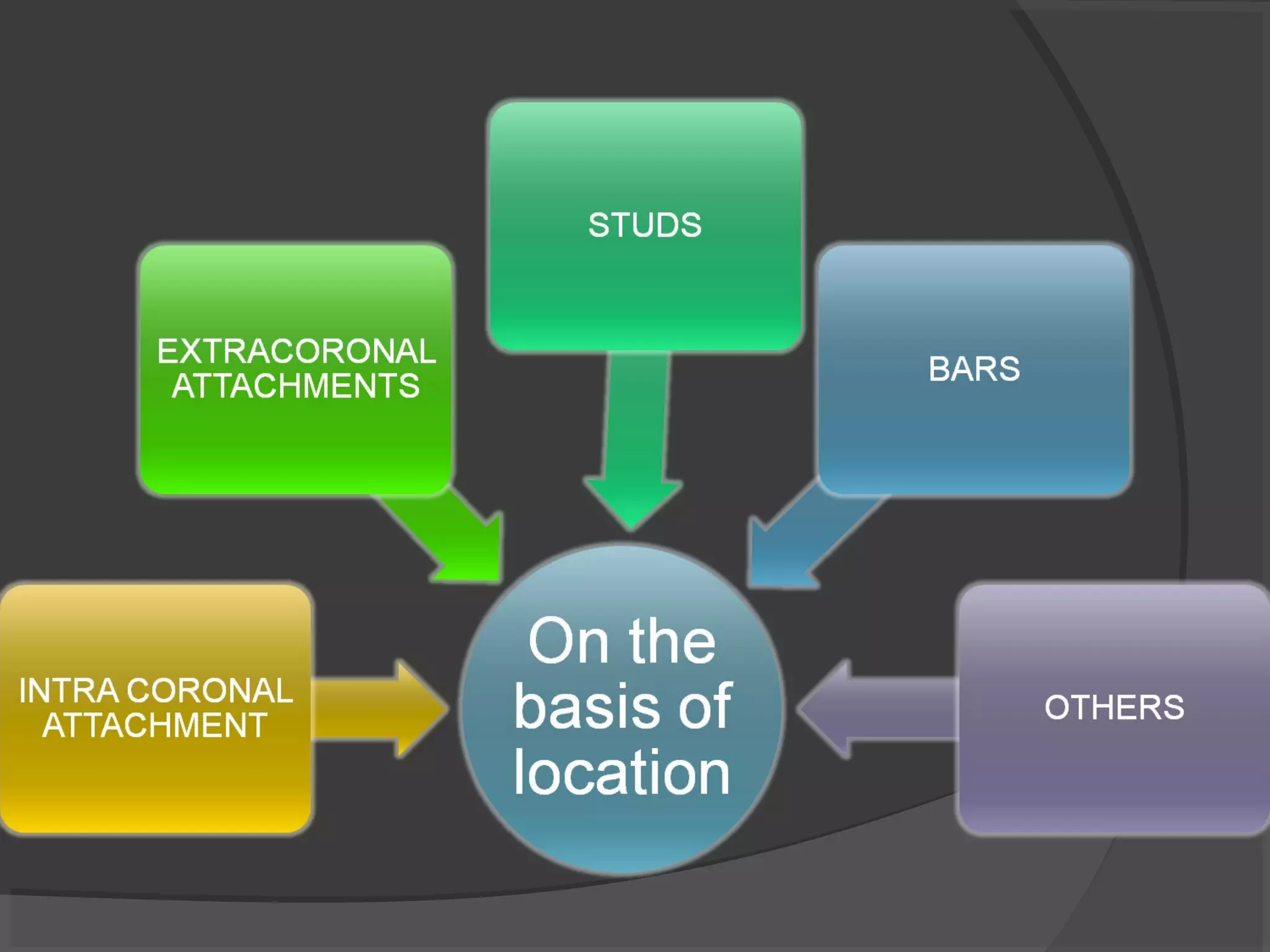
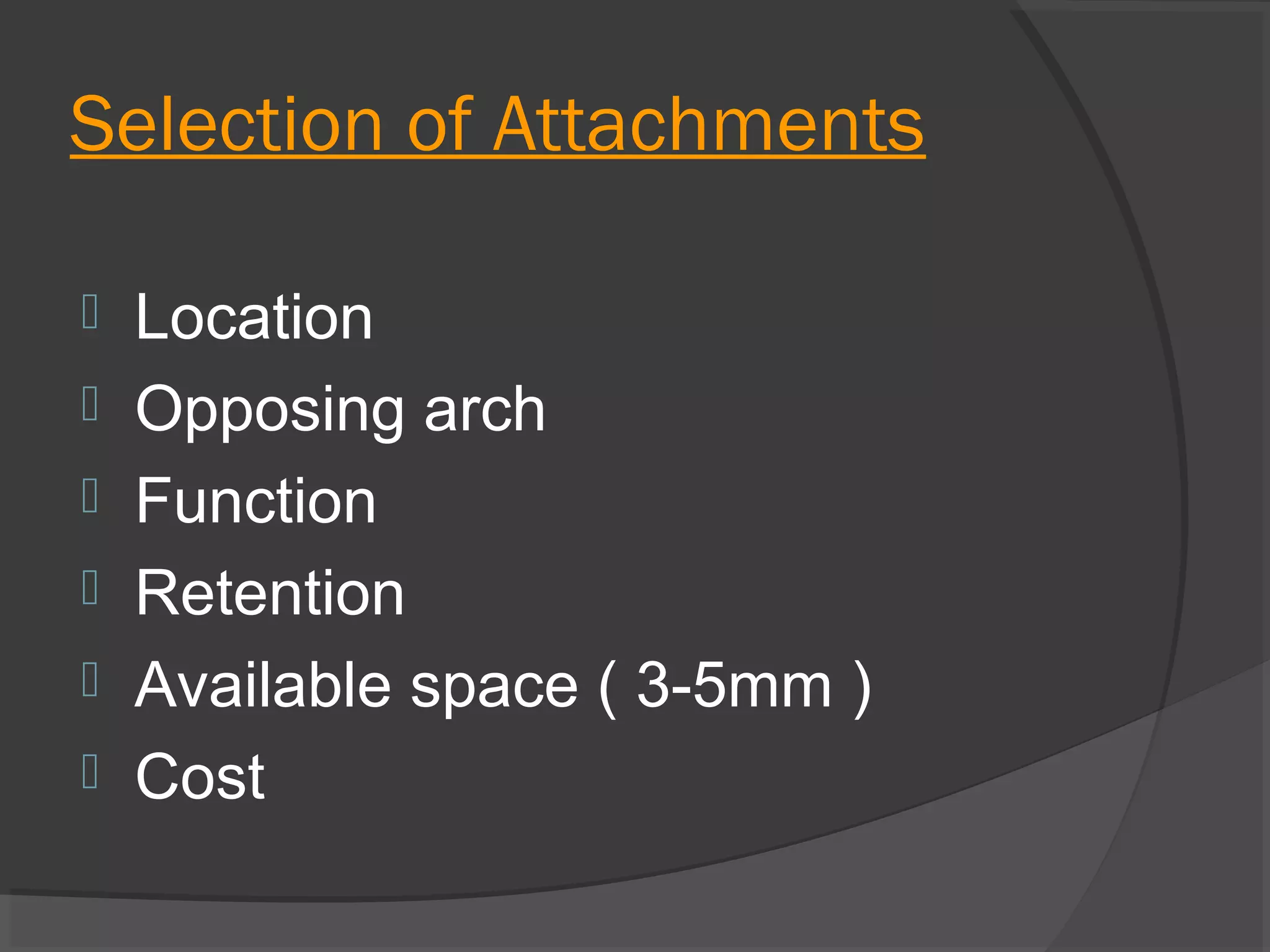
Location
Opposing arch
Function
Retention
Available space ( 3-5mm )
Cost
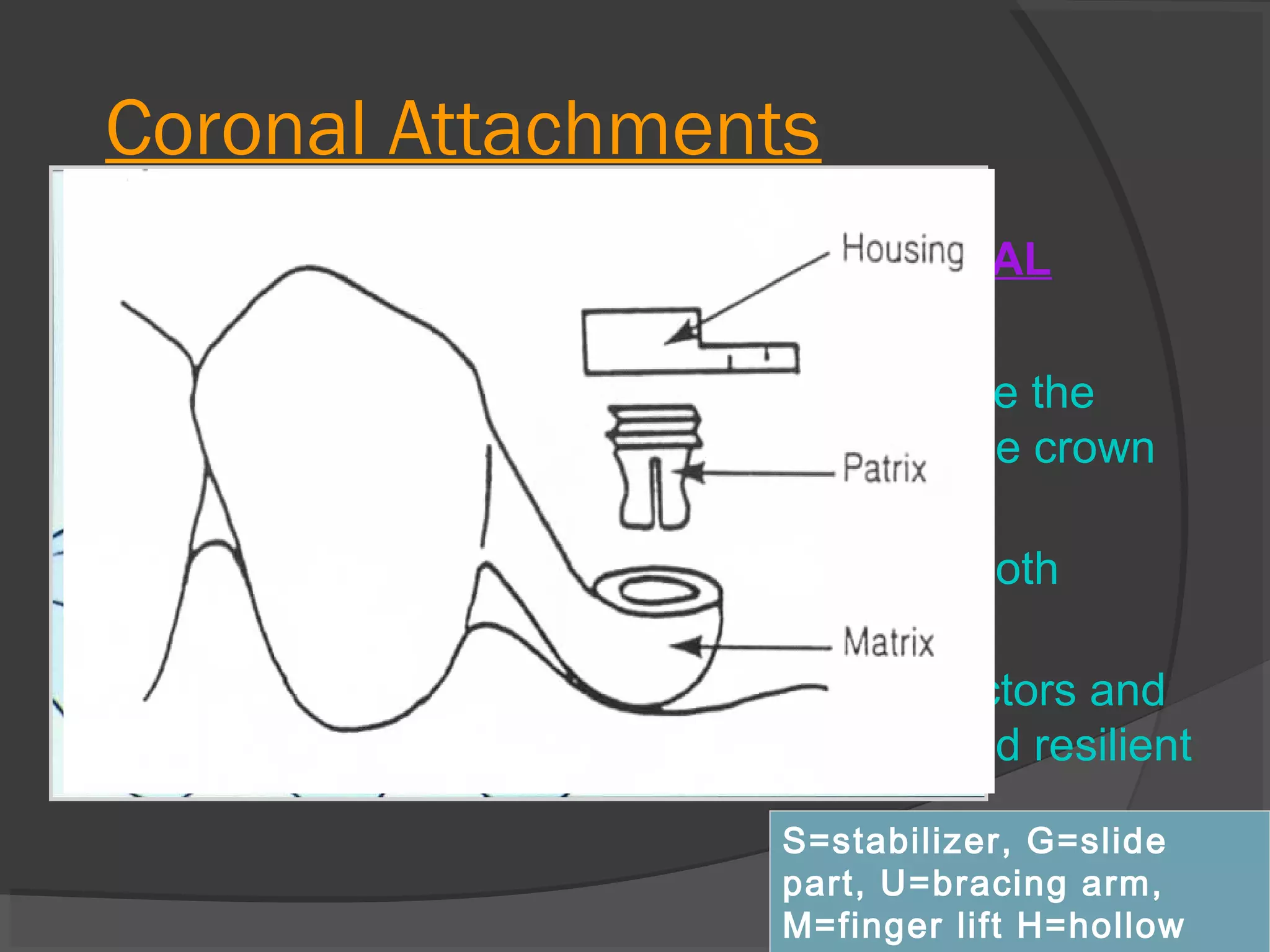
Coronal Attachments
INTRACORONAL:

EXTRACORONAL

Placed within the
contours of the crown
form
 Needs more tooth
reduction
 Rigid connectors





Placed outside the
contours of the crown
form
 Needs less tooth
reduction
 Stress redirectors and
are considered resilient
S=stabilizer, G=slide
part, U=bracing arm,
M=finger lift H=hollow
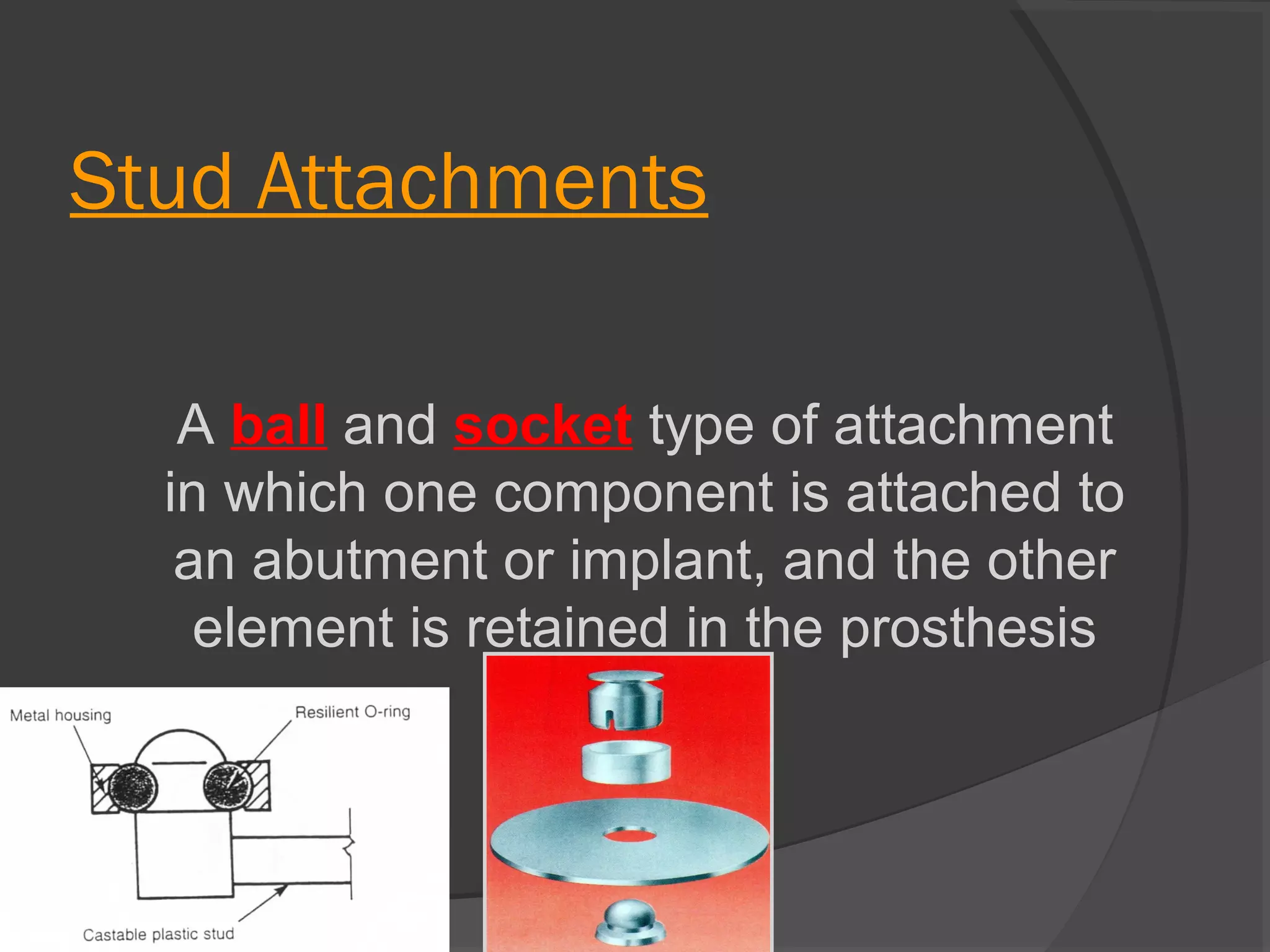
Stud Attachments
A ball and socket type of attachment
in which one component is attached to
an abutment or implant, and the other
element is retained in the prosthesis
Advantages
Stud Attachments




Low profile
Easy hygiene maintenance
Enhanced crown/root ratio
Accessory Attachments
Plunger
Screw Type
Frictional
Magnetic Attachments



Processing magnet- in denture
Intraradicular keeper
All magnetic attachments should be
processed chairside in the denture
Magnetic Indications



Overdentures
Implant restorations
Magnetic Realities





Provide little lateral stability
Used in limited applications
Heat curing will weaken magnets
Corrosion
Benefits of Precision
Attachments






Consistent quality
Controlled wear
Less wear
Easier repair
Standard parts are interchangeable
Drawbacks





Tooth preparation required.
Tooth with large vital pulps at risk.
Crowns with short height are usually
unfavourable
Cost and time

precision attachment in prosthodontics

Editor's Notes