WORLD BANK
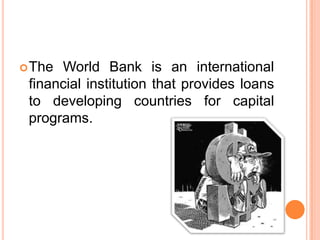
 The

World Bank is an international
financial institution that provides loans
to developing countries for capital
programs.
Overview of the world bank
 The

World Bank was originally established to
support reconstruction in Europe after World War
II.



On July 1, 2012, Jim Yong Kim became the 12th president
of the World Bank Group.
WORLD BANK


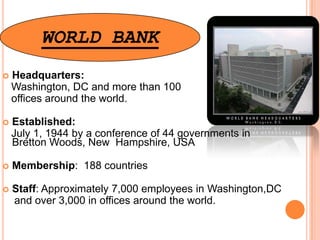
Headquarters:
Washington, DC and more than 100
offices around the world.



Established:
July 1, 1944 by a conference of 44 governments in
Bretton Woods, New Hampshire, USA



Membership: 188 countries



Staff: Approximately 7,000 employees in Washington,DC
and over 3,000 in offices around the world.
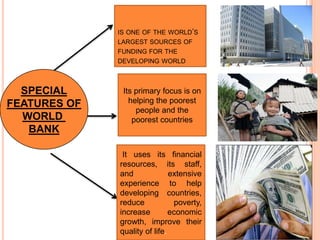
IS ONE OF THE WORLD’S
LARGEST SOURCES OF
FUNDING FOR THE
DEVELOPING WORLD

SPECIAL
FEATURES OF
WORLD
BANK

Its primary focus is on
helping the poorest
people and the
poorest countries

It uses its financial
resources, its staff,
and
extensive
experience to help
developing countries,
reduce
poverty,
increase
economic
growth, improve their
quality of life.
FUNCTIONS
 Reconstruction

and development.
 Promotion of investment.
 Promotion of long range balanced growth of
international trade.
 Arranging the loans through other channels
for priority.
THE WORLD BANK GROUP HAS SET TWO GOALS
FOR THE WORLD TO ACHIEVE BY 2030
The World Bank Group has set two goals for the
world to achieve by 2030:
 End extreme poverty by decreasing the percentage
of people living on less than $1.25 a day to no more
than 3%
 Promote shared prosperity by fostering the income
growth of the bottom 40% for every country

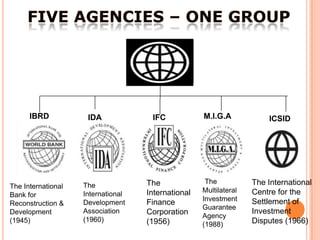
IBRD

The International
Bank for
Reconstruction &
Development
(1945)

IDA

The
International
Development
Association
(1960)

IFC

The
International
Finance
Corporation
(1956)

M.I.G.A

The
Multilateral
Investment
Guarantee
Agency
(1988)

ICSID

The International
Centre for the
Settlement of
Investment
Disputes (1966)
THE WORLD BANK GROUP
1. International Bank for Reconstruction and Development (IBRD)
Founded: 1944 Members: 176
―Aims to reduce poverty in middle-income and creditworthy poorer
countries by promoting sustainable development through loans,
guarantees, risk management products, and analytical and advisory
services‖



2. International Development Association (IDA)




Founded: 1960 Members: 185

The International Development Association (IDA)
provides interest-free loans—called credits— and grants
to governments of the poorest countries.
reign investors
www.worldbank.org
THE INTERNATIONAL FINANCE CORPORATION (IFC),
FOUNDED: 1956
MEMBERS: 185TWEEN GOER
THE INTERNATIONAL FINANCE CORPORATION (IFC), A MEMBER OF
THE WORLD BANK GROUP, IS THE LARGEST GLOBAL
DEVELOPMENT INSTITUTION FOCUSED EXCLUSIVELY ON THE
PRIVATE SECTOR. WE HELP DEVELOPING COUNTRIES ACHIEVE
SUSTAINABLE GROWTH BY FINANCING INVESTMENT, MOBILIZING
CAPITAL IN INTERNATIONAL FINANCIAL MARKETS, AND PROVIDING
ADVISORY SERVICES TO BUSINESSES AND GOVERNMENTS
CONTD.
4. Multilateral Investment Guarantee Agency (MIGA)
Founded: 1988 Members: 101
 The Multilateral Investment Guarantee Agency (MIGA) was created in
1988 as a member of the World Bank Group
 Promote foreign direct investment into developing countries
 To support economic growth, reduce poverty, and improve people’s
lives.


5. The International Centre for Settlement of Investment
Disputes (ICSID)


The International Centre for Settlement of Investment Disputes (ICSID)
provides international facilities for conciliation and arbitration of investment
disputes
MEMBER COUNTRIES








The organizations that make up the World Bank Group are
owned by the governments of member nations
They have the ultimate decision-making power within the
organizations on all matters, including policy, financial or
membership issues.
Member countries govern the World Bank Group through
the Boards of Governors and the Boards of Executive
Directors.
These bodies make all major decisions for the organizations.
HOW TO BECOME MEMBER OF WB


To become a member of the Bank, under the IBRD
Articles of Agreement, a country must first join the
International Monetary Fund (IMF).



Membership in IDA, IFC and MIGA are conditional on
membership in IBRD.



In tandem with the IMF, and in consultation with other
World Bank Group staff, the Corporate Secretariat Vice
Presidency coordinates the process for new
membership and maintains the information relating to
the status of membership which includes the
membership lists.
o
o
o

o

WHO GOVERNS THE WORLD
BANK?
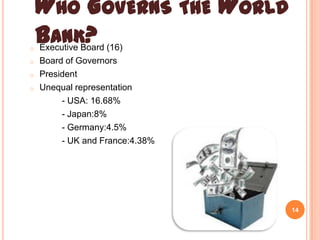
Executive Board (16)
Board of Governors
President
Unequal representation
- USA: 16.68%
- Japan:8%
- Germany:4.5%
- UK and France:4.38%

14
BOARDS OF GOVERNORS









The Boards of Governors consist of one Governor and one
Alternate Governor appointed by each member country.
The office is usually held by the country's minister of finance,
governor of its central bank, or a senior official of similar rank.
The Governors and Alternates serve for terms of five years and
can be reappointed.
If the country is a member of the Bank and is also a member of
the International Finance Corporation (IFC) or the International
Development Association (IDA), then the appointed Governor
and his or her alternate serve ex-officio as the Governor and
Alternate on the IFC and IDA Boards of Governors.
They also serve as representatives of their country on the
Administrative Council of the International Center for Settlement
of Investment Disputes (ICSID) unless otherwise noted.
Multilateral Investment Guarantee Agency (MIGA) Governors
and Alternates are appointed separately.
ROLE OF BOARD OF
GOVERNERS










All powers of the Bank are vested in the Boards of
Governors, it is the Bank's senior decision-making body
The Boards of Governors has delegated all powers to the
Executive Directors except those mentioned in the
Articles of Agreement. These powers include:
Admit and suspend members
Increase or decrease the authorized capital stock
Determine the distribution of the net income of the Bank
Make formal comprehensive arrangements to cooperate
with other international organizations
Suspend permanently the operations of the Bank
Approve amendments to the Articles of Agreement.
WHO PAYS FOR THE WORLD
BANK?


(5%) IBRD - paid-in capital subscription(USA: 16.98%)
AAA rated bonds & debt securities
(25%) IDA – concessional loans – periodic replenishments
 USA – 20.86%, Japan – 18.7%, UK & France – 7.3%
 Tail has been used to shake the dog:
- 1970s :- forced not to lend to Vietnam
- 1993 :- Inspection Panel




17
THE WORLD BANK AND ON WHAT
CONDITIONS?
 Any

member country can propose a loan
 Staffs carefully prepare the proposal
 A detailed proposal goes to the Board
 A simple majority of votes. No one country can veto
a loan
 Apparently, all decisions are taken on technical and
economic grounds with no potential political
influence.
18
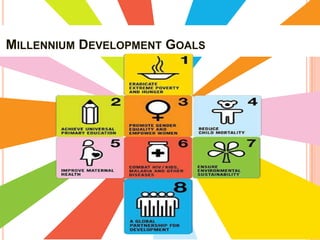
MILLENNIUM DEVELOPMENT GOALS
ACTIVE AREAS
The World Bank is active in the
following areas:







Agriculture and Rural Development



Conflict and Development



Development Operations and
Activities





Economic Policy





Education





Energy



Environment



Financial Sector





Gender





Governance





Health, Nutrition and Population



Industry














International Economics and Trade
Labor and Social Protections
Law and Justice
Macroeconomic and Economic
Growth
Mining
Poverty Reduction
Poverty
Private Sector
Public Sector Governance
Rural Development
Social Development
Social Protection
Trade
Transport
Urban Development
Water Resources
Water Supply and Sanitation
THE WORLD BANK GROUP IS:
The world’s largest funder of education
 The world’s largest external funder of the fight
against HIV/AIDS
 A leader in the fight against corruption worldwide
 A strong supporter of debt relief
 The largest international financier of biodiversity
projects
 The largest international financier of water supply
and sanitation projects

SIMILARITIES BETWEEN IMF & WB










The Bank and the IMF are twin intergovernmental pillars supporting
the structure of the world's economic and financial order
Both are in a sense owned and directed by the governments of
member nations.
Both institutions concern themselves with economic issues and
concentrate their efforts on broadening and strengthening the
economies of their member nations.
Staff members of both the Bank and IMF often appear at
international conferences,
Share a common library and other facilities, regularly exchange
economic data, sometimes present joint seminars, daily hold
informal meetings, and occasionally send out joint missions to
member countries.
DISTINCTION BETWEEN IMF & WB
World Bank is primarily a development institution
 IMF is a cooperative institution that seeks to maintain an
orderly system of payments and receipts between
nations.
 Receives its funding from different sources
 Assists different categories of members, and strives to
achieve distinct goals through methods peculiar to itself
 A distinct size & structure

MILLENNIUM DEVELOPMENT GOALS
Targets and Goals set for 2015
1.
Reducing Poverty and Hunger—global poverty is
projected to fall to 12 percent
2.
Educating All Children—ensure that all children
complete primary education.
3.
Empowering Women—eliminate gender disparity in
primary and secondary education.
4.
Saving Children—reduce the under 5 mortality rate.
www.web.worldbank.org ―Millennium Development Goals‖
MILLENNIUM DEVELOPMENT GOALS
5.

Caring for Mothers—reduce the maternal mortality rate.

6.

Combating Diseases—such as AIDS/HIV,
Tuberculosis, malaria, and other major diseases.

5.

Using Resources Wisely—improvements in slum
dwellings, create sustainable access to drinking
water, and sustainable access to basic sanitation.

5.

Working Together—make available technological
advancements in information and communication.
Allow affordable access to essential drugs in developing
countries. Address the particular need of developing
countries.

www.web.worldbank.org ―Millennium Development Goals‖
POVERTY REDUCTION STRATEGIES
Forty-five countries pledged US$25.1 billion in "aid
for the world's poorest countries―
 The World Bank International Development
Association (IDA) which distributes the loans to
eighty poorer countries.

CLIMATE CHANGE
Climate change Report 2012: Even with the current
mitigation commitments and pledges fully
implemented, there is roughly a 20 percent
likelihood of exceeding 4°C by 2100.
 Report 2013: The World Bank doubled its aid for
climate change adaptation from $2.3bn (£1.47bn) in
2011 to $4.6bn in 2012. The planet is now 0.8 ºC
warmer than in pre-industrial times. 2ºC warming is
reached in 20 to 30 years.

PROJECTS IN INDIA
NATIONAL AIDS CONTROL SUPPORT
PROJECT
The government of India and the World Bank
signed a $255 million credit agreement to support
the National AIDS Control Support Project to help
accelerate AIDS prevention programs by targeting
vulnerable groups at high risk of infection.
 So far the World Bank has provided a total of $525
million under the last three projects.

INDIA LOW-INCOME HOUSING FINANCE
The development objective of the Low Income
Housing Finance Project for India is to provide
access to sustainable housing finance for low
income households
 Approval Date (as of board presentation)-:May 14,
2013.
 Closing Date-:December 31, 2018
 Total Project Cost-:US$ 100.00 million

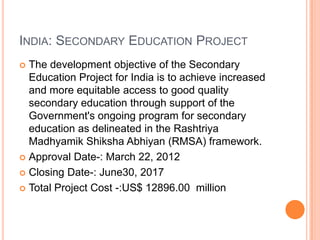
INDIA: SECONDARY EDUCATION PROJECT
The development objective of the Secondary
Education Project for India is to achieve increased
and more equitable access to good quality
secondary education through support of the
Government's ongoing program for secondary
education as delineated in the Rashtriya
Madhyamik Shiksha Abhiyan (RMSA) framework.
 Approval Date-: March 22, 2012
 Closing Date-: June30, 2017
 Total Project Cost -:US$ 12896.00 million

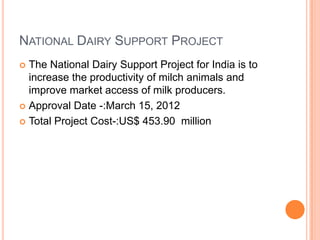
NATIONAL DAIRY SUPPORT PROJECT
The National Dairy Support Project for India is to
increase the productivity of milch animals and
improve market access of milk producers.
 Approval Date -:March 15, 2012
 Total Project Cost-:US$ 453.90 million

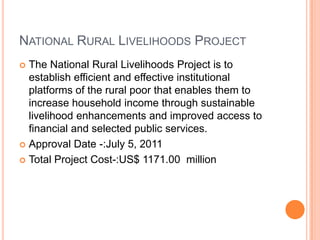
NATIONAL RURAL LIVELIHOODS PROJECT
The National Rural Livelihoods Project is to
establish efficient and effective institutional
platforms of the rural poor that enables them to
increase household income through sustainable
livelihood enhancements and improved access to
financial and selected public services.
 Approval Date -:July 5, 2011
 Total Project Cost-:US$ 1171.00 million

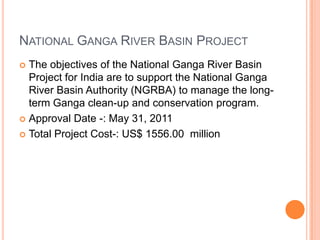
NATIONAL GANGA RIVER BASIN PROJECT
The objectives of the National Ganga River Basin
Project for India are to support the National Ganga
River Basin Authority (NGRBA) to manage the longterm Ganga clean-up and conservation program.
 Approval Date -: May 31, 2011
 Total Project Cost-: US$ 1556.00 million

Presented by-:
Anuj
Avneet
Pardeep kaur
Ramandeep(95)
Shagun(CR)

World bank

  • 1.
  • 2.
     The World Bankis an international financial institution that provides loans to developing countries for capital programs.
  • 3.
    Overview of theworld bank  The World Bank was originally established to support reconstruction in Europe after World War II.  On July 1, 2012, Jim Yong Kim became the 12th president of the World Bank Group.
  • 4.
    WORLD BANK  Headquarters: Washington, DCand more than 100 offices around the world.  Established: July 1, 1944 by a conference of 44 governments in Bretton Woods, New Hampshire, USA  Membership: 188 countries  Staff: Approximately 7,000 employees in Washington,DC and over 3,000 in offices around the world.
  • 5.
    IS ONE OFTHE WORLD’S LARGEST SOURCES OF FUNDING FOR THE DEVELOPING WORLD SPECIAL FEATURES OF WORLD BANK Its primary focus is on helping the poorest people and the poorest countries It uses its financial resources, its staff, and extensive experience to help developing countries, reduce poverty, increase economic growth, improve their quality of life.
  • 6.
    FUNCTIONS  Reconstruction and development. Promotion of investment.  Promotion of long range balanced growth of international trade.  Arranging the loans through other channels for priority.
  • 7.
    THE WORLD BANKGROUP HAS SET TWO GOALS FOR THE WORLD TO ACHIEVE BY 2030 The World Bank Group has set two goals for the world to achieve by 2030:  End extreme poverty by decreasing the percentage of people living on less than $1.25 a day to no more than 3%  Promote shared prosperity by fostering the income growth of the bottom 40% for every country 
  • 8.
    IBRD The International Bank for Reconstruction& Development (1945) IDA The International Development Association (1960) IFC The International Finance Corporation (1956) M.I.G.A The Multilateral Investment Guarantee Agency (1988) ICSID The International Centre for the Settlement of Investment Disputes (1966)
  • 9.
    THE WORLD BANKGROUP 1. International Bank for Reconstruction and Development (IBRD) Founded: 1944 Members: 176 ―Aims to reduce poverty in middle-income and creditworthy poorer countries by promoting sustainable development through loans, guarantees, risk management products, and analytical and advisory services‖   2. International Development Association (IDA)   Founded: 1960 Members: 185 The International Development Association (IDA) provides interest-free loans—called credits— and grants to governments of the poorest countries. reign investors www.worldbank.org
  • 10.
    THE INTERNATIONAL FINANCECORPORATION (IFC), FOUNDED: 1956 MEMBERS: 185TWEEN GOER THE INTERNATIONAL FINANCE CORPORATION (IFC), A MEMBER OF THE WORLD BANK GROUP, IS THE LARGEST GLOBAL DEVELOPMENT INSTITUTION FOCUSED EXCLUSIVELY ON THE PRIVATE SECTOR. WE HELP DEVELOPING COUNTRIES ACHIEVE SUSTAINABLE GROWTH BY FINANCING INVESTMENT, MOBILIZING CAPITAL IN INTERNATIONAL FINANCIAL MARKETS, AND PROVIDING ADVISORY SERVICES TO BUSINESSES AND GOVERNMENTS
  • 11.
    CONTD. 4. Multilateral InvestmentGuarantee Agency (MIGA) Founded: 1988 Members: 101  The Multilateral Investment Guarantee Agency (MIGA) was created in 1988 as a member of the World Bank Group  Promote foreign direct investment into developing countries  To support economic growth, reduce poverty, and improve people’s lives.  5. The International Centre for Settlement of Investment Disputes (ICSID)  The International Centre for Settlement of Investment Disputes (ICSID) provides international facilities for conciliation and arbitration of investment disputes
  • 12.
    MEMBER COUNTRIES     The organizationsthat make up the World Bank Group are owned by the governments of member nations They have the ultimate decision-making power within the organizations on all matters, including policy, financial or membership issues. Member countries govern the World Bank Group through the Boards of Governors and the Boards of Executive Directors. These bodies make all major decisions for the organizations.
  • 13.
    HOW TO BECOMEMEMBER OF WB  To become a member of the Bank, under the IBRD Articles of Agreement, a country must first join the International Monetary Fund (IMF).  Membership in IDA, IFC and MIGA are conditional on membership in IBRD.  In tandem with the IMF, and in consultation with other World Bank Group staff, the Corporate Secretariat Vice Presidency coordinates the process for new membership and maintains the information relating to the status of membership which includes the membership lists.
  • 14.
    o o o o WHO GOVERNS THEWORLD BANK? Executive Board (16) Board of Governors President Unequal representation - USA: 16.68% - Japan:8% - Germany:4.5% - UK and France:4.38% 14
  • 15.
    BOARDS OF GOVERNORS       TheBoards of Governors consist of one Governor and one Alternate Governor appointed by each member country. The office is usually held by the country's minister of finance, governor of its central bank, or a senior official of similar rank. The Governors and Alternates serve for terms of five years and can be reappointed. If the country is a member of the Bank and is also a member of the International Finance Corporation (IFC) or the International Development Association (IDA), then the appointed Governor and his or her alternate serve ex-officio as the Governor and Alternate on the IFC and IDA Boards of Governors. They also serve as representatives of their country on the Administrative Council of the International Center for Settlement of Investment Disputes (ICSID) unless otherwise noted. Multilateral Investment Guarantee Agency (MIGA) Governors and Alternates are appointed separately.
  • 16.
    ROLE OF BOARDOF GOVERNERS         All powers of the Bank are vested in the Boards of Governors, it is the Bank's senior decision-making body The Boards of Governors has delegated all powers to the Executive Directors except those mentioned in the Articles of Agreement. These powers include: Admit and suspend members Increase or decrease the authorized capital stock Determine the distribution of the net income of the Bank Make formal comprehensive arrangements to cooperate with other international organizations Suspend permanently the operations of the Bank Approve amendments to the Articles of Agreement.
  • 17.
    WHO PAYS FORTHE WORLD BANK?  (5%) IBRD - paid-in capital subscription(USA: 16.98%) AAA rated bonds & debt securities (25%) IDA – concessional loans – periodic replenishments  USA – 20.86%, Japan – 18.7%, UK & France – 7.3%  Tail has been used to shake the dog: - 1970s :- forced not to lend to Vietnam - 1993 :- Inspection Panel   17
  • 18.
    THE WORLD BANKAND ON WHAT CONDITIONS?  Any member country can propose a loan  Staffs carefully prepare the proposal  A detailed proposal goes to the Board  A simple majority of votes. No one country can veto a loan  Apparently, all decisions are taken on technical and economic grounds with no potential political influence. 18
  • 19.
  • 20.
    ACTIVE AREAS The WorldBank is active in the following areas:     Agriculture and Rural Development  Conflict and Development  Development Operations and Activities   Economic Policy   Education   Energy  Environment  Financial Sector   Gender   Governance   Health, Nutrition and Population  Industry         International Economics and Trade Labor and Social Protections Law and Justice Macroeconomic and Economic Growth Mining Poverty Reduction Poverty Private Sector Public Sector Governance Rural Development Social Development Social Protection Trade Transport Urban Development Water Resources Water Supply and Sanitation
  • 21.
    THE WORLD BANKGROUP IS: The world’s largest funder of education  The world’s largest external funder of the fight against HIV/AIDS  A leader in the fight against corruption worldwide  A strong supporter of debt relief  The largest international financier of biodiversity projects  The largest international financier of water supply and sanitation projects 
  • 22.
    SIMILARITIES BETWEEN IMF& WB      The Bank and the IMF are twin intergovernmental pillars supporting the structure of the world's economic and financial order Both are in a sense owned and directed by the governments of member nations. Both institutions concern themselves with economic issues and concentrate their efforts on broadening and strengthening the economies of their member nations. Staff members of both the Bank and IMF often appear at international conferences, Share a common library and other facilities, regularly exchange economic data, sometimes present joint seminars, daily hold informal meetings, and occasionally send out joint missions to member countries.
  • 23.
    DISTINCTION BETWEEN IMF& WB World Bank is primarily a development institution  IMF is a cooperative institution that seeks to maintain an orderly system of payments and receipts between nations.  Receives its funding from different sources  Assists different categories of members, and strives to achieve distinct goals through methods peculiar to itself  A distinct size & structure 
  • 24.
    MILLENNIUM DEVELOPMENT GOALS Targetsand Goals set for 2015 1. Reducing Poverty and Hunger—global poverty is projected to fall to 12 percent 2. Educating All Children—ensure that all children complete primary education. 3. Empowering Women—eliminate gender disparity in primary and secondary education. 4. Saving Children—reduce the under 5 mortality rate. www.web.worldbank.org ―Millennium Development Goals‖
  • 25.
    MILLENNIUM DEVELOPMENT GOALS 5. Caringfor Mothers—reduce the maternal mortality rate. 6. Combating Diseases—such as AIDS/HIV, Tuberculosis, malaria, and other major diseases. 5. Using Resources Wisely—improvements in slum dwellings, create sustainable access to drinking water, and sustainable access to basic sanitation. 5. Working Together—make available technological advancements in information and communication. Allow affordable access to essential drugs in developing countries. Address the particular need of developing countries. www.web.worldbank.org ―Millennium Development Goals‖
  • 26.
    POVERTY REDUCTION STRATEGIES Forty-fivecountries pledged US$25.1 billion in "aid for the world's poorest countries―  The World Bank International Development Association (IDA) which distributes the loans to eighty poorer countries. 
  • 27.
    CLIMATE CHANGE Climate changeReport 2012: Even with the current mitigation commitments and pledges fully implemented, there is roughly a 20 percent likelihood of exceeding 4°C by 2100.  Report 2013: The World Bank doubled its aid for climate change adaptation from $2.3bn (£1.47bn) in 2011 to $4.6bn in 2012. The planet is now 0.8 ºC warmer than in pre-industrial times. 2ºC warming is reached in 20 to 30 years. 
  • 28.
  • 29.
    NATIONAL AIDS CONTROLSUPPORT PROJECT The government of India and the World Bank signed a $255 million credit agreement to support the National AIDS Control Support Project to help accelerate AIDS prevention programs by targeting vulnerable groups at high risk of infection.  So far the World Bank has provided a total of $525 million under the last three projects. 
  • 30.
    INDIA LOW-INCOME HOUSINGFINANCE The development objective of the Low Income Housing Finance Project for India is to provide access to sustainable housing finance for low income households  Approval Date (as of board presentation)-:May 14, 2013.  Closing Date-:December 31, 2018  Total Project Cost-:US$ 100.00 million 
  • 31.
    INDIA: SECONDARY EDUCATIONPROJECT The development objective of the Secondary Education Project for India is to achieve increased and more equitable access to good quality secondary education through support of the Government's ongoing program for secondary education as delineated in the Rashtriya Madhyamik Shiksha Abhiyan (RMSA) framework.  Approval Date-: March 22, 2012  Closing Date-: June30, 2017  Total Project Cost -:US$ 12896.00 million 
  • 32.
    NATIONAL DAIRY SUPPORTPROJECT The National Dairy Support Project for India is to increase the productivity of milch animals and improve market access of milk producers.  Approval Date -:March 15, 2012  Total Project Cost-:US$ 453.90 million 
  • 33.
    NATIONAL RURAL LIVELIHOODSPROJECT The National Rural Livelihoods Project is to establish efficient and effective institutional platforms of the rural poor that enables them to increase household income through sustainable livelihood enhancements and improved access to financial and selected public services.  Approval Date -:July 5, 2011  Total Project Cost-:US$ 1171.00 million 
  • 34.
    NATIONAL GANGA RIVERBASIN PROJECT The objectives of the National Ganga River Basin Project for India are to support the National Ganga River Basin Authority (NGRBA) to manage the longterm Ganga clean-up and conservation program.  Approval Date -: May 31, 2011  Total Project Cost-: US$ 1556.00 million 
  • 35.