ORAL COMMUNICATION
SKILLS AND
ORAL DEFENCE
Presented by
K C Mythili
Department of English & other Foreign Languages
SRM IST, Ramapuram
WHAT ARE COMMUNICATION SKILLS?
DO WE POSSESS COMMUNICATION SKILLS?
WHY DO WE NEED TO MASTER THIS SKILL?
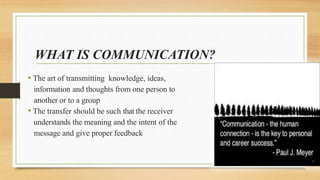
WHAT IS COMMUNICATION?
• The art of transmitting knowledge, ideas,
information and thoughts from one person to
another or to a group
• The transfer should be such that the receiver
understands the meaning and the intent of the
message and give proper feedback
COMMUNICATION TYPES
 ORAL COMMUNICATION
 WRITTEN COMMUNICATION
ORAL COMMUNICATION
• Oral communication skills- refer to the
ability to verbally or orally communicate
information or ideas to an individual or a
group
• Refer to the transmission of information to
the audience for a greater understanding
You can have brilliant
ideas, but if you can’t
get them across, your
ideas won’t get you
anywhere.
Lee Iacocca
No matter what job you have in life,
your success is determined 5% by your
academic credentials, 15% by your
professional experiences and 80% by
your communication skills.
TYPES OF ORAL COMMUNICATION
• Informal - Face to face conversations
- Telephone conversations
- Business meetings
• Formal - Presentations
- Classroom lectures
- Conferences/Interviews
Your verbal communications skills are just as important as the
written quality of your manuscript
MERITS OF ORAL COMMUNICATION
 An effective tool of persuasion
 Saves time
 Conveys various shades of meaning
 Offers immediate Feedback & Clarification
 Promotes informal communication
 Conveys feelings & emotions
 Conceives the purposes in terms of audience’s perspective
“Whatever words we utter
should be chosen with care
for people will hear them and
be influenced by them for
good or ill.” Buddha
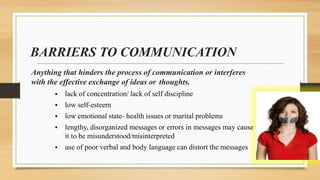
BARRIERS TO COMMUNICATION
Anything that hinders the process of communication or interferes
with the effective exchange of ideas or thoughts.
 lack of concentration/ lack of self discipline
 low self-esteem
 low emotional state- health issues or marital problems
 lengthy, disorganized messages or errors in messages may cause
it to be misunderstood/misinterpreted
 use of poor verbal and body language can distort the messages
BARRIERS
 fear of being judged/insecurity
 unwillingness to say things differently/to relate to others
differently
 unwillingness to learn new approaches
 lack of self-confidence/ enthusiasm
 voice quality
 poor knowledge in the use of technology
 external noise
BARRIERS
 improper time
 using jargons
 not being specific
 gender discrimination- biased attitude-women are underrated- "glass
ceiling“ and that there are no societies in which women enjoy the same
opportunities as men
("glass ceiling" is used to describe a perceived barrier to advancement in
employment based on discrimination)
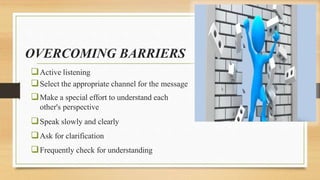
OVERCOMING BARRIERS
Active listening
Select the appropriate channel for the message
Make a special effort to understand each
other's perspective
Speak slowly and clearly
Ask for clarification
Frequently check for understanding
OVERCOMING BARRIERS
Be specific
Be patient
Choose your medium of communication effectively
Semantic and language barriers can be overcome only by being
careful with the use of language & by using words which have clear
meaning, by using short and simple sentences, and also by using
visual aid whenever possible
LIMITATIONS OF ORAL COMMUNICATION
 Distance- a major hurdle (in the absence of
mechanical device)
 Unsuitable for lengthy messages
 Message cannot be retained for long
 Word once uttered cannot be taken back
 Hard to control voice pitch & tone
 Demands thinking coherently as one speaks
 May lead to misunderstandings
ORAL COMMUNICATION SKILLS.pptx

ORAL COMMUNICATION SKILLS.pptx

  • 1.
    ORAL COMMUNICATION SKILLS AND ORALDEFENCE Presented by K C Mythili Department of English & other Foreign Languages SRM IST, Ramapuram
  • 2.
    WHAT ARE COMMUNICATIONSKILLS? DO WE POSSESS COMMUNICATION SKILLS? WHY DO WE NEED TO MASTER THIS SKILL?
  • 3.
    WHAT IS COMMUNICATION? •The art of transmitting knowledge, ideas, information and thoughts from one person to another or to a group • The transfer should be such that the receiver understands the meaning and the intent of the message and give proper feedback
  • 4.
    COMMUNICATION TYPES  ORALCOMMUNICATION  WRITTEN COMMUNICATION
  • 5.
    ORAL COMMUNICATION • Oralcommunication skills- refer to the ability to verbally or orally communicate information or ideas to an individual or a group • Refer to the transmission of information to the audience for a greater understanding You can have brilliant ideas, but if you can’t get them across, your ideas won’t get you anywhere. Lee Iacocca No matter what job you have in life, your success is determined 5% by your academic credentials, 15% by your professional experiences and 80% by your communication skills.
  • 6.
    TYPES OF ORALCOMMUNICATION • Informal - Face to face conversations - Telephone conversations - Business meetings • Formal - Presentations - Classroom lectures - Conferences/Interviews Your verbal communications skills are just as important as the written quality of your manuscript
  • 7.
    MERITS OF ORALCOMMUNICATION  An effective tool of persuasion  Saves time  Conveys various shades of meaning  Offers immediate Feedback & Clarification  Promotes informal communication  Conveys feelings & emotions  Conceives the purposes in terms of audience’s perspective “Whatever words we utter should be chosen with care for people will hear them and be influenced by them for good or ill.” Buddha
  • 8.
    BARRIERS TO COMMUNICATION Anythingthat hinders the process of communication or interferes with the effective exchange of ideas or thoughts.  lack of concentration/ lack of self discipline  low self-esteem  low emotional state- health issues or marital problems  lengthy, disorganized messages or errors in messages may cause it to be misunderstood/misinterpreted  use of poor verbal and body language can distort the messages
  • 9.
    BARRIERS  fear ofbeing judged/insecurity  unwillingness to say things differently/to relate to others differently  unwillingness to learn new approaches  lack of self-confidence/ enthusiasm  voice quality  poor knowledge in the use of technology  external noise
  • 10.
    BARRIERS  improper time using jargons  not being specific  gender discrimination- biased attitude-women are underrated- "glass ceiling“ and that there are no societies in which women enjoy the same opportunities as men ("glass ceiling" is used to describe a perceived barrier to advancement in employment based on discrimination)
  • 11.
    OVERCOMING BARRIERS Active listening Selectthe appropriate channel for the message Make a special effort to understand each other's perspective Speak slowly and clearly Ask for clarification Frequently check for understanding
  • 12.
    OVERCOMING BARRIERS Be specific Bepatient Choose your medium of communication effectively Semantic and language barriers can be overcome only by being careful with the use of language & by using words which have clear meaning, by using short and simple sentences, and also by using visual aid whenever possible
  • 13.
    LIMITATIONS OF ORALCOMMUNICATION  Distance- a major hurdle (in the absence of mechanical device)  Unsuitable for lengthy messages  Message cannot be retained for long  Word once uttered cannot be taken back  Hard to control voice pitch & tone  Demands thinking coherently as one speaks  May lead to misunderstandings