Oral Communication in
Context
Lesson 8
Cathlene Mae R. Sanglay, LPT
English Language Teacher
• Good speaking does not call attention to itself.
It conveys the speaker’s ideas clearly,
interestingly, and without distracting the
audience.
• If you mumble your words, shuffle your
feet, gaze out the window, or talk in
monotone, you will not get your message
across.
• Most listeners prefer delivery that combines a
certain degree of formality with the best
attributes of communicative strategy—
directness, spontaneity, animation, emphasis,
and lively sense of communication.
• When face with difficulty, he uses the ad-
lib techniques:
1. Nomination
A speaker carries out nomination to
collaboratively and productively establish a topic.
Basically , when you employ this strategy, you try
to open a topic with the people you are talking to.
Let
Expressions for Nomination
“ Let’s talk about _________.”
“ Would you like to talk about __________ ? “
“ I’m interested to know about _______ .”
“ Do you know _______?”
“ How about discussing ________?”
“ Why don’t we talk about _______?”
“ I’d like to talk about _________?”
“ Talking / discussing _________ is one idea.”
“ It would be nice to talk/ discuss
__________?”
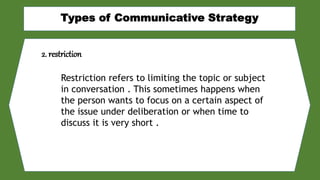
2. restriction
Restriction refers to limiting the topic or subject
in conversation . This sometimes happens when
the person wants to focus on a certain aspect of
the issue under deliberation or when time to
discuss it is very short .
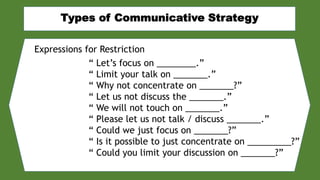
Expressions for Restriction
“ Let’s focus on ________.”
“ Limit your talk on _______.”
“ Why not concentrate on _______?”
“ Let us not discuss the _______.”
“ We will not touch on _______.”
“ Please let us not talk / discuss _______.”
“ Could we just focus on _______?”
“ Is it possible to just concentrate on _________?”
“ Could you limit your discussion on _______?”
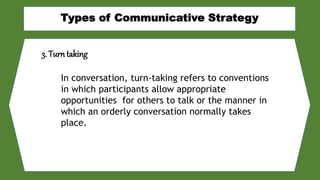
3. Turn taking
In conversation, turn-taking refers to conventions
in which participants allow appropriate
opportunities for others to talk or the manner in
which an orderly conversation normally takes
place.
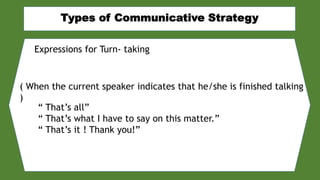
“ That’s all”
“ That’s what I have to say on this matter.”
“ That’s it ! Thank you!”
( When the current speaker indicates that he/she is finished talking
)
Expressions for Turn- taking
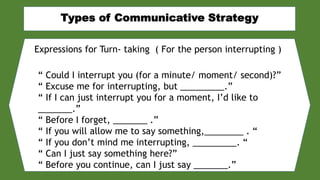
Expressions for Turn- taking ( For the person interrupting )
“ Could I interrupt you (for a minute/ moment/ second)?”
“ Excuse me for interrupting, but _________.”
“ If I can just interrupt you for a moment, I’d like to
_______.”
“ Before I forget, _______ .”
“ If you will allow me to say something,________ . “
“ If you don’t mind me interrupting, _________. “
“ Can I just say something here?”
“ Before you continue, can I just say _______.”
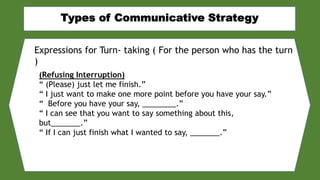
Expressions for Turn- taking ( For the person who has the turn
)
(Refusing Interruption)
“ (Please) just let me finish.”
“ I just want to make one more point before you have your say.”
“ Before you have your say, ________.”
“ I can see that you want to say something about this,
but_______.”
“ If I can just finish what I wanted to say, _______.”
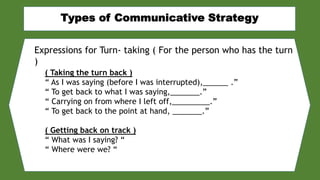
Expressions for Turn- taking ( For the person who has the turn
)
( Taking the turn back )
“ As I was saying (before I was interrupted),______ .”
“ To get back to what I was saying,_______.”
“ Carrying on from where I left off,_________.”
“ To get back to the point at hand, _______.”
( Getting back on track )
“ What was I saying? “
“ Where were we? “
4. Topic control
It means regulating or manipulating the topic of
conversation and how long we want the other
person may talk.
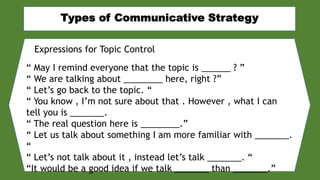
Expressions for Topic Control
“ May I remind everyone that the topic is ______ ? ”
“ We are talking about ________ here, right ?”
“ Let’s go back to the topic. “
“ You know , I’m not sure about that . However , what I can
tell you is _______.
“ The real question here is ________.”
“ Let us talk about something I am more familiar with _______.
“
“ Let’s not talk about it , instead let’s talk _______. “
“It would be a good idea if we talk _______ than _______.”
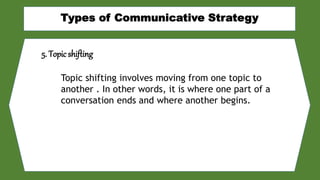
5. Topic shifting
Topic shifting involves moving from one topic to
another . In other words, it is where one part of a
conversation ends and where another begins.
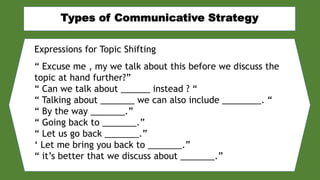
Expressions for Topic Shifting
“ Excuse me , my we talk about this before we discuss the
topic at hand further?”
“ Can we talk about ______ instead ? “
“ Talking about _______ we can also include ________. “
“ By the way _______.”
“ Going back to _______.”
“ Let us go back _______.”
‘ Let me bring you back to _______.”
“ it’s better that we discuss about _______.”
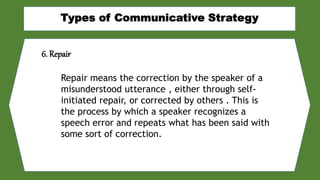
6. Repair
Repair means the correction by the speaker of a
misunderstood utterance , either through self-
initiated repair, or corrected by others . This is
the process by which a speaker recognizes a
speech error and repeats what has been said with
some sort of correction.
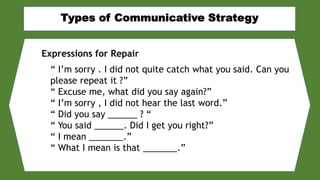
Expressions for Repair
“ I’m sorry . I did not quite catch what you said. Can you
please repeat it ?”
“ Excuse me, what did you say again?”
“ I’m sorry , I did not hear the last word.”
“ Did you say ______ ? “
“ You said ______. Did I get you right?”
“ I mean _______.”
“ What I mean is that _______.”
7. termination
Termination refers to the conversation
participants’ close-initiating expressions that
end a topic in a conversation .
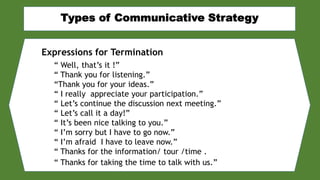
Expressions for Termination
“ Well, that’s it !”
“ Thank you for listening.”
“Thank you for your ideas.”
“ I really appreciate your participation.”
“ Let’s continue the discussion next meeting.”
“ Let’s call it a day!”
“ It’s been nice talking to you.”
“ I’m sorry but I have to go now.”
“ I’m afraid I have to leave now.”
“ Thanks for the information/ tour /time .
“ Thanks for taking the time to talk with us.”
– COMMUNICATIVE STRATEGY –
Choose 5 ad-lib techniques among
the given strategy.

ORAL COMM Lesson 8.pptx

  • 1.
    Oral Communication in Context Lesson8 Cathlene Mae R. Sanglay, LPT English Language Teacher
  • 3.
    • Good speakingdoes not call attention to itself. It conveys the speaker’s ideas clearly, interestingly, and without distracting the audience.
  • 4.
    • If youmumble your words, shuffle your feet, gaze out the window, or talk in monotone, you will not get your message across.
  • 5.
    • Most listenersprefer delivery that combines a certain degree of formality with the best attributes of communicative strategy— directness, spontaneity, animation, emphasis, and lively sense of communication.
  • 6.
    • When facewith difficulty, he uses the ad- lib techniques:
  • 7.
    1. Nomination A speakercarries out nomination to collaboratively and productively establish a topic. Basically , when you employ this strategy, you try to open a topic with the people you are talking to.
  • 8.
    Let Expressions for Nomination “Let’s talk about _________.” “ Would you like to talk about __________ ? “ “ I’m interested to know about _______ .” “ Do you know _______?” “ How about discussing ________?” “ Why don’t we talk about _______?” “ I’d like to talk about _________?” “ Talking / discussing _________ is one idea.” “ It would be nice to talk/ discuss __________?”
  • 9.
    2. restriction Restriction refersto limiting the topic or subject in conversation . This sometimes happens when the person wants to focus on a certain aspect of the issue under deliberation or when time to discuss it is very short .
  • 10.
    Expressions for Restriction “Let’s focus on ________.” “ Limit your talk on _______.” “ Why not concentrate on _______?” “ Let us not discuss the _______.” “ We will not touch on _______.” “ Please let us not talk / discuss _______.” “ Could we just focus on _______?” “ Is it possible to just concentrate on _________?” “ Could you limit your discussion on _______?”
  • 11.
    3. Turn taking Inconversation, turn-taking refers to conventions in which participants allow appropriate opportunities for others to talk or the manner in which an orderly conversation normally takes place.
  • 12.
    “ That’s all” “That’s what I have to say on this matter.” “ That’s it ! Thank you!” ( When the current speaker indicates that he/she is finished talking ) Expressions for Turn- taking
  • 13.
    Expressions for Turn-taking ( For the person interrupting ) “ Could I interrupt you (for a minute/ moment/ second)?” “ Excuse me for interrupting, but _________.” “ If I can just interrupt you for a moment, I’d like to _______.” “ Before I forget, _______ .” “ If you will allow me to say something,________ . “ “ If you don’t mind me interrupting, _________. “ “ Can I just say something here?” “ Before you continue, can I just say _______.”
  • 14.
    Expressions for Turn-taking ( For the person who has the turn ) (Refusing Interruption) “ (Please) just let me finish.” “ I just want to make one more point before you have your say.” “ Before you have your say, ________.” “ I can see that you want to say something about this, but_______.” “ If I can just finish what I wanted to say, _______.”
  • 15.
    Expressions for Turn-taking ( For the person who has the turn ) ( Taking the turn back ) “ As I was saying (before I was interrupted),______ .” “ To get back to what I was saying,_______.” “ Carrying on from where I left off,_________.” “ To get back to the point at hand, _______.” ( Getting back on track ) “ What was I saying? “ “ Where were we? “
  • 16.
    4. Topic control Itmeans regulating or manipulating the topic of conversation and how long we want the other person may talk.
  • 17.
    Expressions for TopicControl “ May I remind everyone that the topic is ______ ? ” “ We are talking about ________ here, right ?” “ Let’s go back to the topic. “ “ You know , I’m not sure about that . However , what I can tell you is _______. “ The real question here is ________.” “ Let us talk about something I am more familiar with _______. “ “ Let’s not talk about it , instead let’s talk _______. “ “It would be a good idea if we talk _______ than _______.”
  • 18.
    5. Topic shifting Topicshifting involves moving from one topic to another . In other words, it is where one part of a conversation ends and where another begins.
  • 19.
    Expressions for TopicShifting “ Excuse me , my we talk about this before we discuss the topic at hand further?” “ Can we talk about ______ instead ? “ “ Talking about _______ we can also include ________. “ “ By the way _______.” “ Going back to _______.” “ Let us go back _______.” ‘ Let me bring you back to _______.” “ it’s better that we discuss about _______.”
  • 20.
    6. Repair Repair meansthe correction by the speaker of a misunderstood utterance , either through self- initiated repair, or corrected by others . This is the process by which a speaker recognizes a speech error and repeats what has been said with some sort of correction.
  • 21.
    Expressions for Repair “I’m sorry . I did not quite catch what you said. Can you please repeat it ?” “ Excuse me, what did you say again?” “ I’m sorry , I did not hear the last word.” “ Did you say ______ ? “ “ You said ______. Did I get you right?” “ I mean _______.” “ What I mean is that _______.”
  • 22.
    7. termination Termination refersto the conversation participants’ close-initiating expressions that end a topic in a conversation .
  • 23.
    Expressions for Termination “Well, that’s it !” “ Thank you for listening.” “Thank you for your ideas.” “ I really appreciate your participation.” “ Let’s continue the discussion next meeting.” “ Let’s call it a day!” “ It’s been nice talking to you.” “ I’m sorry but I have to go now.” “ I’m afraid I have to leave now.” “ Thanks for the information/ tour /time . “ Thanks for taking the time to talk with us.”
  • 24.
    – COMMUNICATIVE STRATEGY– Choose 5 ad-lib techniques among the given strategy.