http://www.free-powerpoint-templates-design.com
WELCOME TO OUR
ENGLISH
COMMUNICATION
CLASS
GRADE 11- RUBY
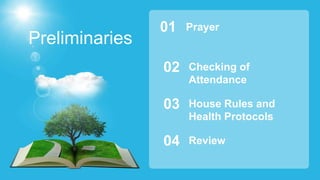
Preliminaries
Prayer
01
Checking of
Attendance
02
House Rules and
Health Protocols
03
Review
04
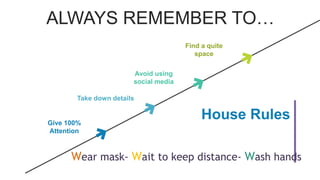
ALWAYS REMEMBER TO…
Avoid using
social media
Take down details
House Rules
Give 100%
Attention
Find a quite
space
Wear mask- Wait to keep distance- Wash hands
Three (3) types of Speech Act
Locutionary Act refers to the actual
utterance of the speaker.
Illocutionary Act refers to the intended
utterance by the speaker (performance).
Perlocutionary Act refers to the actions
that result from the locution or what we
bring about or achieve by saying
something such as convincing,
persuading, deterring or surprising.
R E V I E W
MOVIE TIME!
noun
INTERVIEW
1: a formal consultation usually to evaluate
qualifications (as of a prospective student or
employee)
2: a meeting at which information is obtained
(as by a reporter, television commentator, or
pollster from a person)
Verb
1: to question or talk with (someone) to get
information
P R E S E N TAT I O N
Word of the day
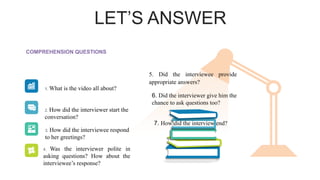
LET’S ANSWER
1. What is the video all about?
2. How did the interviewer start the
conversation?
3. How did the interviewee respond
to her greetings?
COMPREHENSION QUESTIONS
4. Was the interviewer polite in
asking questions? How about the
interviewee’s response?
5. Did the interviewee provide
appropriate answers?
6. Did the interviewer give him the
chance to ask questions too?
7. How did the interview end?
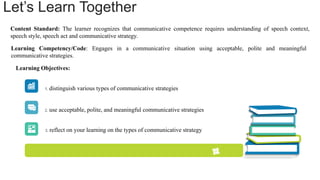
Let’s Learn Together
1. distinguish various types of communicative strategies
2. use acceptable, polite, and meaningful communicative strategies
3. reflect on your learning on the types of communicative strategy
Content Standard: The learner recognizes that communicative competence requires understanding of speech context,
speech style, speech act and communicative strategy.
Learning Competency/Code: Engages in a communicative situation using acceptable, polite and meaningful
communicative strategies.
Learning Objectives:
COMMUNICATIVE
STRATEGIES
QUARTER 2 (MODULE 1, LESSON 1)
LET’S DISCUSS
Communicative strategies are
techniques on how to deal with
difficulties encountered when
communicating.
Being able to use such strategies make
certain not only the achievement of the
Speech Purpose but also the enrichment
of the communication experience for
both Speaker and Listener.
The Seven Communicative Strategies
 Is the ability of taking attention of the hearers and trying to
commence, or to begin or nominate or propose speaker’s ideas in
conversation.
 Opening a topic (like news inquiries and news announcements as
they promise extended talk.)
1. NOMINATION
Examples:
 Hi, how are you?
 How’s the weather there?
 What’s the latest news?
1. NOMINATION
LET’S DISCUSS
 A strategy that constrains or restricts the RESPONSE of the other
person involved in the communication situation.
 Listener is forced to respond only within a set of categories that is
made by the speaker.
2. RESTRICTION
Examples:
 Homily of a priest in a mass
 Commencement speaker during graduation
 A political talking during the proclamation rally
 When teacher says, “Do you agree with the character’s action? Yes
or No.”
2.
RESTRICTION
LET’S DISCUSS
 requires that each Speaker speaks only when it is his/her turn during an
interaction.
 Knowing when to talk depends on watching out for the verbal and nonverbal
cues that signal the next Speaker that the previous Speaker has finished or the
topic under discussion has been exhausted and a new topic may be
introduced.
 It is important that other speakers should be given a time to talk.
3. Turn-Taking
Examples:
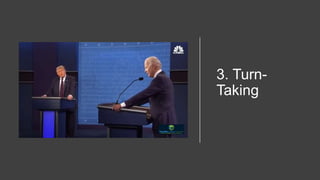
 In meetings, “May I have the floor, please.”
 In debate, speakers do not need to talk at the same time
3. Turn-Taking
3. Turn-
Taking
LET’S DISCUSS
 This is simply a question-answer formula that moves the
discussion forward. This also allows the Listener or other
participants to take turns, contribute, ideas, and continue the
discussion.
 Topic control covers how procedural formality and informality
affects the development of topics in conversation. This only
means that when a topic is initiated, it should be collectively
developed by avoiding unnecessary interruptions and topic
shifts.
4. TOPIC CONTROL
Examples:
 I think let’s go back to the topic.
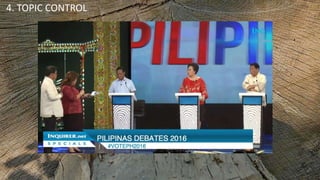
 In debate, if a speaker is on the affirmative side, he/she will only talk about
the positive points of the topic.
4. TOPIC CONTROL
LET’S DISCUSS
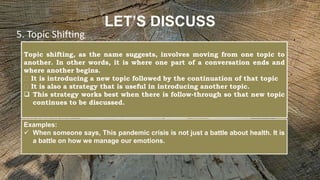
Topic shifting, as the name suggests, involves moving from one topic to
another. In other words, it is where one part of a conversation ends and
where another begins.
It is introducing a new topic followed by the continuation of that topic
It is also a strategy that is useful in introducing another topic.
 This strategy works best when there is follow-through so that new topic
continues to be discussed.
5. Topic Shifting
Examples:
 When someone says, This pandemic crisis is not just a battle about health. It is
a battle on how we manage our emotions.
5. Topic Shifting
LET’S DISCUSS
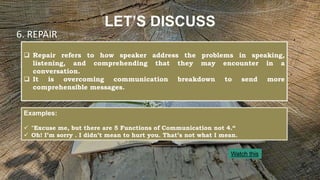
 Repair refers to how speaker address the problems in speaking,
listening, and comprehending that they may encounter in a
conversation.
 It is overcoming communication breakdown to send more
comprehensible messages.
6. REPAIR
Examples:
 "Excuse me, but there are 5 Functions of Communication not 4.“
 Oh! I’m sorry . I didn’t mean to hurt you. That’s not what I mean.
Watch this
6. REPAIR
LET’S DISCUSS
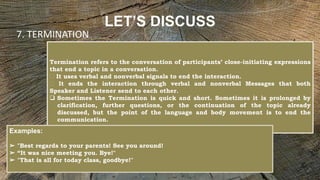
Termination refers to the conversation of participants’ close-initiating expressions
that end a topic in a conversation.
It uses verbal and nonverbal signals to end the interaction.
It ends the interaction through verbal and nonverbal Messages that both
Speaker and Listener send to each other.
 Sometimes the Termination is quick and short. Sometimes it is prolonged by
clarification, further questions, or the continuation of the topic already
discussed, but the point of the language and body movement is to end the
communication.
7. TERMINATION
Examples:
➢ "Best regards to your parents! See you around!
➢ “It was nice meeting you. Bye!"
➢ "That is all for today class, goodbye!"
7. TERMINATION
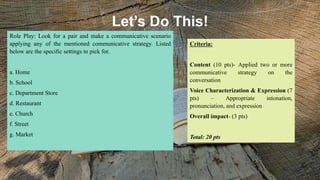
Let’s Do This!
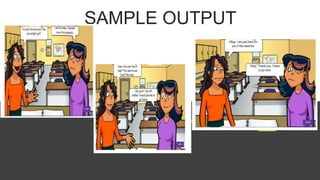
Role Play: Look for a pair and make a communicative scenario
applying any of the mentioned communicative strategy. Listed
below are the specific settings to pick for.
a. Home
b. School
c. Department Store
d. Restaurant
e. Church
f. Street
g. Market
Criteria:
Content (10 pts)- Applied two or more
communicative strategy on the
conversation
Voice Characterization & Expression (7
pts) – Appropriate intonation,
pronunciation, and expression
Overall impact- (3 pts)
Total: 20 pts
SAMPLE OUTPUT
Name Here
Director
Name Here
Developer Designer
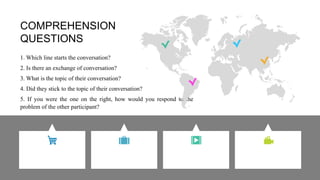
1. Which line starts the conversation?
2. Is there an exchange of conversation?
3. What is the topic of their conversation?
4. Did they stick to the topic of their conversation?
5. If you were the one on the right, how would you respond to the
problem of the other participant?
COMPREHENSION
QUESTIONS
Enumerate the 7(seven) types of communicative strategies and give one
example for each.
1._______________
2._______________
3._______________
4._______________
5._______________
6._______________
7._______________
LET’S TRY!
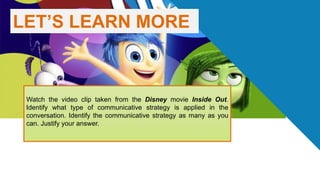
LET’S LEARN MORE
Watch the video clip taken from the Disney movie Inside Out.
Identify what type of communicative strategy is applied in the
conversation. Identify the communicative strategy as many as you
can. Justify your answer.
Make comic strips and write a script for each of the following scenarios
presented below. Make sure to employ the different communicative strategies
along the dialogues of your characters.
Scene 1: Act like a tourist guide and decide on the final itinerary of the field trip
in Davao City and discuss the details such as transportation, accommodation,
meals, and itinerary.
Scene 2: You ask a police officer and a street vendor (on two different instances)
for directions to the Davao People’s Park because your group of friends are lost
somewhere in town.
Scene 3: You have a free half day before your trip back home, so you decide on
what to do as members of the field trip committee. Your ideas and suggestions
clash, but ultimately everything is cleared out and you present the final plan to
your classmates in going to the city’s Night Market.
LET’S APPLY
A. Directions: Recognize the type of communicative strategy
used in the following statements. Write only the letter of your
choice on a separate sheet of paper.
1.“Do you have anything to say?”
A. Nomination
B. Turn Taking
C. Topic Control
D. Termination
2. “One of the essential lessons I gained from the discussion is
the importance of sports and wellness to a healthy lifestyle.”
A. Restriction
B. Nomination
C. Turn Taking
D. Topic Shifting
3. “Excuse me? I think we should speak one at a time, so we can
clearly understand what we want to say about the issue.”
A. Termination
B. Topic Shifting
C. Repair
D. Turn taking
LET’S EVALUATE
4.“Go on with your ideas. I’ll let you finish first before I say
something.”
A. Topic Control
B. Nomination
C. Topic shifting
D. Repair
5. “Have you heard the news about the latest achievement of our
government?”
A. Repair
B. Nomination
C. Topic Control
D. Turn taking
ASSIGNMENT
Directions: Pretend that you were travelling alone to another country. You were
not familiar with the language. Make a spiel or dialogues using the types of
communicative strategy to ask for directions politely from a group of locals
successfully.
LET’S REFLECT
LET’S REFLECT
When you are at home…
Normalize NOMINATING conversation with your loved ones.
To sustain good communication, ask them by adding more open-
ended questions; as much as possible lessen or RESTRICT giving
yes-no questions.
Divide the time equally when talking. TAKE TURN in asking and
answering. Speak as you listen. Do not CONTROL your TOPIC of
conversation only on the things you like or want. SHIFT the flow of
your topic; ask them exciting questions too- everything under the sun!
Open your heart. Speak your words. Be REPAIRED inside and out.
Multiply the beautiful and wonderful words of emotions.
Whisper. Talk. Speak. Communicate. Do not TERMINATE.
WORDS BY: BRYAN L. CABATINGAN
THANK YOU

COMMUNICATIVE STRATEGY.pptx

  • 1.
  • 2.
  • 3.
  • 4.
    ALWAYS REMEMBER TO… Avoidusing social media Take down details House Rules Give 100% Attention Find a quite space Wear mask- Wait to keep distance- Wash hands
  • 5.
    Three (3) typesof Speech Act Locutionary Act refers to the actual utterance of the speaker. Illocutionary Act refers to the intended utterance by the speaker (performance). Perlocutionary Act refers to the actions that result from the locution or what we bring about or achieve by saying something such as convincing, persuading, deterring or surprising. R E V I E W
  • 6.
  • 7.
    noun INTERVIEW 1: a formalconsultation usually to evaluate qualifications (as of a prospective student or employee) 2: a meeting at which information is obtained (as by a reporter, television commentator, or pollster from a person) Verb 1: to question or talk with (someone) to get information P R E S E N TAT I O N Word of the day
  • 8.
    LET’S ANSWER 1. Whatis the video all about? 2. How did the interviewer start the conversation? 3. How did the interviewee respond to her greetings? COMPREHENSION QUESTIONS 4. Was the interviewer polite in asking questions? How about the interviewee’s response? 5. Did the interviewee provide appropriate answers? 6. Did the interviewer give him the chance to ask questions too? 7. How did the interview end?
  • 9.
    Let’s Learn Together 1.distinguish various types of communicative strategies 2. use acceptable, polite, and meaningful communicative strategies 3. reflect on your learning on the types of communicative strategy Content Standard: The learner recognizes that communicative competence requires understanding of speech context, speech style, speech act and communicative strategy. Learning Competency/Code: Engages in a communicative situation using acceptable, polite and meaningful communicative strategies. Learning Objectives:

  • 10.
  • 11.
    LET’S DISCUSS Communicative strategiesare techniques on how to deal with difficulties encountered when communicating. Being able to use such strategies make certain not only the achievement of the Speech Purpose but also the enrichment of the communication experience for both Speaker and Listener.
  • 12.
    The Seven CommunicativeStrategies  Is the ability of taking attention of the hearers and trying to commence, or to begin or nominate or propose speaker’s ideas in conversation.  Opening a topic (like news inquiries and news announcements as they promise extended talk.) 1. NOMINATION Examples:  Hi, how are you?  How’s the weather there?  What’s the latest news?
  • 13.
  • 14.
    LET’S DISCUSS  Astrategy that constrains or restricts the RESPONSE of the other person involved in the communication situation.  Listener is forced to respond only within a set of categories that is made by the speaker. 2. RESTRICTION Examples:  Homily of a priest in a mass  Commencement speaker during graduation  A political talking during the proclamation rally  When teacher says, “Do you agree with the character’s action? Yes or No.”
  • 15.
  • 16.
    LET’S DISCUSS  requiresthat each Speaker speaks only when it is his/her turn during an interaction.  Knowing when to talk depends on watching out for the verbal and nonverbal cues that signal the next Speaker that the previous Speaker has finished or the topic under discussion has been exhausted and a new topic may be introduced.  It is important that other speakers should be given a time to talk. 3. Turn-Taking Examples:  In meetings, “May I have the floor, please.”  In debate, speakers do not need to talk at the same time
  • 17.
  • 18.
  • 19.
    LET’S DISCUSS  Thisis simply a question-answer formula that moves the discussion forward. This also allows the Listener or other participants to take turns, contribute, ideas, and continue the discussion.  Topic control covers how procedural formality and informality affects the development of topics in conversation. This only means that when a topic is initiated, it should be collectively developed by avoiding unnecessary interruptions and topic shifts. 4. TOPIC CONTROL Examples:  I think let’s go back to the topic.  In debate, if a speaker is on the affirmative side, he/she will only talk about the positive points of the topic.
  • 20.
  • 21.
    LET’S DISCUSS Topic shifting,as the name suggests, involves moving from one topic to another. In other words, it is where one part of a conversation ends and where another begins. It is introducing a new topic followed by the continuation of that topic It is also a strategy that is useful in introducing another topic.  This strategy works best when there is follow-through so that new topic continues to be discussed. 5. Topic Shifting Examples:  When someone says, This pandemic crisis is not just a battle about health. It is a battle on how we manage our emotions.
  • 22.
  • 23.
    LET’S DISCUSS  Repairrefers to how speaker address the problems in speaking, listening, and comprehending that they may encounter in a conversation.  It is overcoming communication breakdown to send more comprehensible messages. 6. REPAIR Examples:  "Excuse me, but there are 5 Functions of Communication not 4.“  Oh! I’m sorry . I didn’t mean to hurt you. That’s not what I mean. Watch this
  • 24.
  • 25.
    LET’S DISCUSS Termination refersto the conversation of participants’ close-initiating expressions that end a topic in a conversation. It uses verbal and nonverbal signals to end the interaction. It ends the interaction through verbal and nonverbal Messages that both Speaker and Listener send to each other.  Sometimes the Termination is quick and short. Sometimes it is prolonged by clarification, further questions, or the continuation of the topic already discussed, but the point of the language and body movement is to end the communication. 7. TERMINATION Examples: ➢ "Best regards to your parents! See you around! ➢ “It was nice meeting you. Bye!" ➢ "That is all for today class, goodbye!"
  • 26.
  • 27.
    Let’s Do This! RolePlay: Look for a pair and make a communicative scenario applying any of the mentioned communicative strategy. Listed below are the specific settings to pick for. a. Home b. School c. Department Store d. Restaurant e. Church f. Street g. Market Criteria: Content (10 pts)- Applied two or more communicative strategy on the conversation Voice Characterization & Expression (7 pts) – Appropriate intonation, pronunciation, and expression Overall impact- (3 pts) Total: 20 pts
  • 28.
  • 29.
    1. Which linestarts the conversation? 2. Is there an exchange of conversation? 3. What is the topic of their conversation? 4. Did they stick to the topic of their conversation? 5. If you were the one on the right, how would you respond to the problem of the other participant? COMPREHENSION QUESTIONS
  • 30.
    Enumerate the 7(seven)types of communicative strategies and give one example for each. 1._______________ 2._______________ 3._______________ 4._______________ 5._______________ 6._______________ 7._______________ LET’S TRY!
  • 31.
    LET’S LEARN MORE Watchthe video clip taken from the Disney movie Inside Out. Identify what type of communicative strategy is applied in the conversation. Identify the communicative strategy as many as you can. Justify your answer.
  • 33.
    Make comic stripsand write a script for each of the following scenarios presented below. Make sure to employ the different communicative strategies along the dialogues of your characters. Scene 1: Act like a tourist guide and decide on the final itinerary of the field trip in Davao City and discuss the details such as transportation, accommodation, meals, and itinerary. Scene 2: You ask a police officer and a street vendor (on two different instances) for directions to the Davao People’s Park because your group of friends are lost somewhere in town. Scene 3: You have a free half day before your trip back home, so you decide on what to do as members of the field trip committee. Your ideas and suggestions clash, but ultimately everything is cleared out and you present the final plan to your classmates in going to the city’s Night Market. LET’S APPLY

  • 34.
    A. Directions: Recognizethe type of communicative strategy used in the following statements. Write only the letter of your choice on a separate sheet of paper. 1.“Do you have anything to say?” A. Nomination B. Turn Taking C. Topic Control D. Termination 2. “One of the essential lessons I gained from the discussion is the importance of sports and wellness to a healthy lifestyle.” A. Restriction B. Nomination C. Turn Taking D. Topic Shifting 3. “Excuse me? I think we should speak one at a time, so we can clearly understand what we want to say about the issue.” A. Termination B. Topic Shifting C. Repair D. Turn taking LET’S EVALUATE 4.“Go on with your ideas. I’ll let you finish first before I say something.” A. Topic Control B. Nomination C. Topic shifting D. Repair 5. “Have you heard the news about the latest achievement of our government?” A. Repair B. Nomination C. Topic Control D. Turn taking
  • 35.
    ASSIGNMENT Directions: Pretend thatyou were travelling alone to another country. You were not familiar with the language. Make a spiel or dialogues using the types of communicative strategy to ask for directions politely from a group of locals successfully.
  • 36.
  • 37.
    LET’S REFLECT When youare at home… Normalize NOMINATING conversation with your loved ones. To sustain good communication, ask them by adding more open- ended questions; as much as possible lessen or RESTRICT giving yes-no questions. Divide the time equally when talking. TAKE TURN in asking and answering. Speak as you listen. Do not CONTROL your TOPIC of conversation only on the things you like or want. SHIFT the flow of your topic; ask them exciting questions too- everything under the sun! Open your heart. Speak your words. Be REPAIRED inside and out. Multiply the beautiful and wonderful words of emotions. Whisper. Talk. Speak. Communicate. Do not TERMINATE. WORDS BY: BRYAN L. CABATINGAN
  • 38.