ELEMENTS OF FICTION
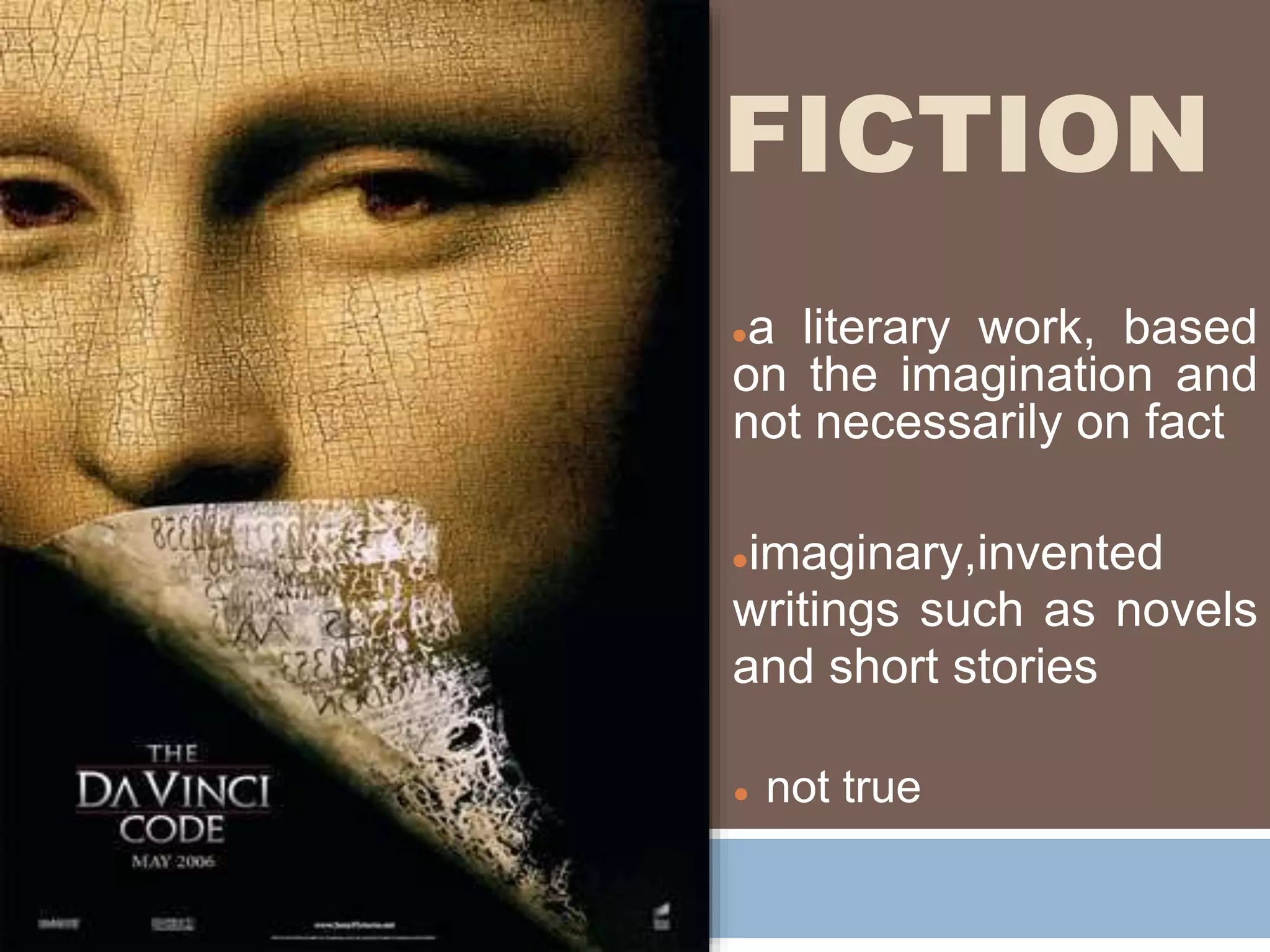
FICTION
●a literary work, based
on the imagination and
not necessarily on fact
●imaginary,invented
writings such as novels
and short stories
● not true
ORAL FICTION
◻ MYTH
◻ FABLES
◻ FOLKTALES
◻ FAIRYTALE
S
◻ PARABLES
LITERAR
Y
FICTION
◻ SHORT STORIES
◻ NOVELS
NONFICTION
(BASED ON FACTS)
◻ BIOGRAPHY
◻ AUTOBIOGRAPHY
◻ ESSAYS
◻ TEXTS FROM
NEWSPAPERS ,
MAGAZINES,ETC.
ELEMENTS OF
FICTION
AUTHOR’S PURPOSE
- His or her reason for creating a work.
-The purpose may be to explain or inform,
entertain, persuade, or reveal an important
truth.
SETTING
The setting is the place where
the story takes place. Setting
includes the following:
◻ the geographical location
◻ the time period
the socio-economic
characteristics of the location
( for example, wealthy suburbs,
depressed society)
CHARACTE
RS
- a person, an animal, or an imaginary
creature that takes the part in the action
of the story.
Characterization
- the techniques an author uses to
develop the personality of a character in a
literary work.
An author can give information about a character by
describing several aspects of the character:
- physical appearance and personality
- speech, behavior , and actions
- thoughts and feelings
- interactions with other characters
These are the
common types of
characters we see in
literature.
• Round characters
• Flat characters
• Dynamic characters
• Static characters
• Stereotype
•Round
characters have
various
characteristics or
traits.
•A round character
can change or
grow.
•Readers see
more than one
• Readers see one side of
a flat character.
• Flat characters are
usually minor characters
and reveal one or two
traits.
• Flat characters may
be used as a contrast
to a major character.
CHARACTERS WHO DEVELOP AND CHANGE
ARE NOT ONLY ROUND CHARACTERS, BUT
OFTEN DYNAMIC.
Scrooge changes from a tight-
fisted, greedy unhappy man
to one who was generous and
loved life.
Gru changes from
a villain set on
destroying the
world to a loving
father.
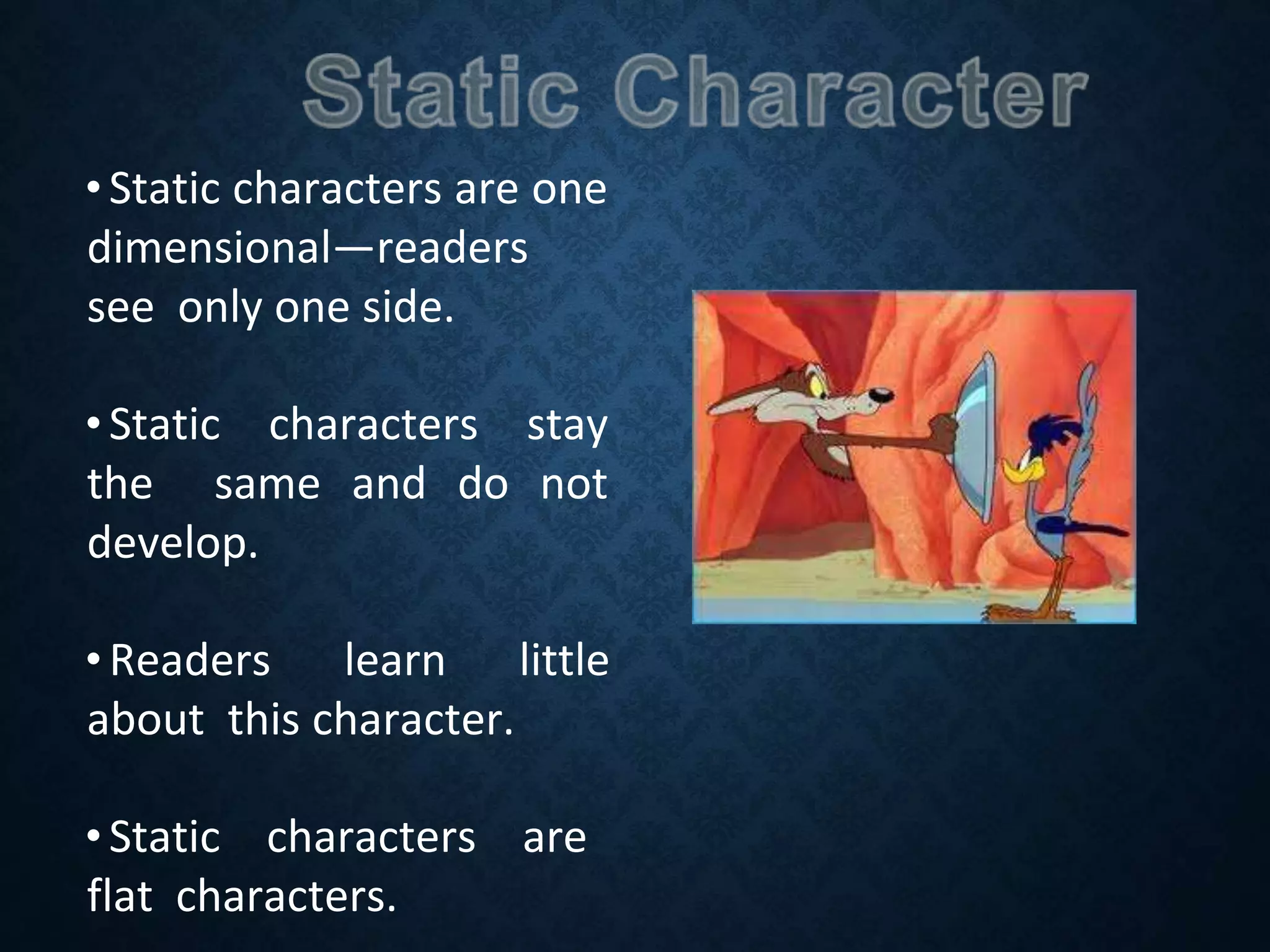
• Static characters are one
dimensional—readers
see only one side.
• Static characters stay
the same and do not
develop.
• Readers learn little
about this character.
• Static characters are
flat characters.
• Sometimes characters with
common, generalized traits
are repeatedly found in
unrelated stories.
• These characters are known
by what they do and how
they act.
• The author doesn’t need
to tell us much about the
character because we’ve
encountered the
stereotype before and can
make some inferences.
THE PROTAGONIST IS CENTRAL
TO THE ACTION OF A STORY AND
MOVES AGAINST THE
ANTAGONIST.
CHARACTERS
◻ Protagonist
The main character in a
literary work (for instance,
Harry Potter in “Harry
Potter” series, Cinderella
or Snow White in the fairy
tales named for their
characters)
THE
ANTAGONIST IS
THE VILLAIN OR
A FORCE
WHICH
OPPOSES THE
PROTAGONIST.
CHARACTERS
◻ Antagonist
The character who
opposes the protagonist
(for instance, Draco
Malfoy in “Harry
Potter” series or the
wicked stepmothers in
the fairy tales
Can you figure out what kind of character these
are?
MEET MEGAMIND!
◻ His nemesis is Metro
Man (the city’s big
hero and defender)
◻ He wants to ruin Metro
City and defeat Metro
Man.
◻ He falls in love with
Roxanne.
◻ He stops Tighten
from destroying
Metro City.
◻ He becomes the new
hero of Metro City.
A)Flat Character
B)Static Character
C)Stereotype
D)Dynamic
Character
MEET MOTHER
GOTHEL
◻ Gothel kidnaps baby
Rapunzel so she can use
her magic hair to stay
young.
◻ Gothel keeps the truth
from Rapunzel about her
real parents.
◻ Gothel won’t let Rapunzel
out of the tower.
◻ Gothel stabs Flynn, the
man Rapunzel loves.
A)Round Character
B)Protagonist
C)Antagonist
D)Dynamic
Character
MEET KATNISS!
◻ She is strong, independent
and able to provide for herself,
but can also feel vulnerable.
◻ She can be snarly but she can
also be kind.
◻ She is tough but gets scared.
◻ She is smart, but can make
mistakes when she’s
impulsive.
◻ She loves her family but finds
it hard to open herself to
romantic love.
A) Stereotype
B) Flat character
C) Round character
D) Static character
MEET MRS WEASLY!
◻ She’s a mother to 7
children.
◻ She washes their clothes
and takes care of the
house.
◻ She fusses over her
children and wants them
safe.
◻ She’s a great cook.
◻ She’s proud of her
children’s achievements.
A) Flat Character
B) Round Character
C) Dynamic Character
D) Protagonist
MEET PERCY JACKSON!
◻ He’s a hero.
◻ His friends look up to
him.
◻ He goes on a lot of
quests.
◻ It’s up to him to save
the world.
◻ He has to fight
monsters.
A)Antagonist
B)Stereotype
C)Static Character
D)Protagonist
MEET SNOW WHITE!
◻ She’s sweet and kind.
◻ She’s good and loving.
◻ Her Step-mother is cruel
to her.
◻ She helps out some
dwarves.
◻ She almost dies.
◻ When she awakens,
she’s good, sweet, kind
and loving.
A) Stereotype
B) Static Character
C) Round Character
D) Dynamic Character
MEET ANAKIN/DARTH VADER
◻ He was a precocious boy who had the “force” in him.
◻ He fought with the Jedi’s for good.
◻ Because of jealousy
fear, he
went to
“the
Dark
and
over
Side”
◻ He sacrifices his own
life to save his son’s
A) Static Character
B) Stereotype
C) Flat Character
D) Dynamic Character
METHODS OF CHARACTERIZATION
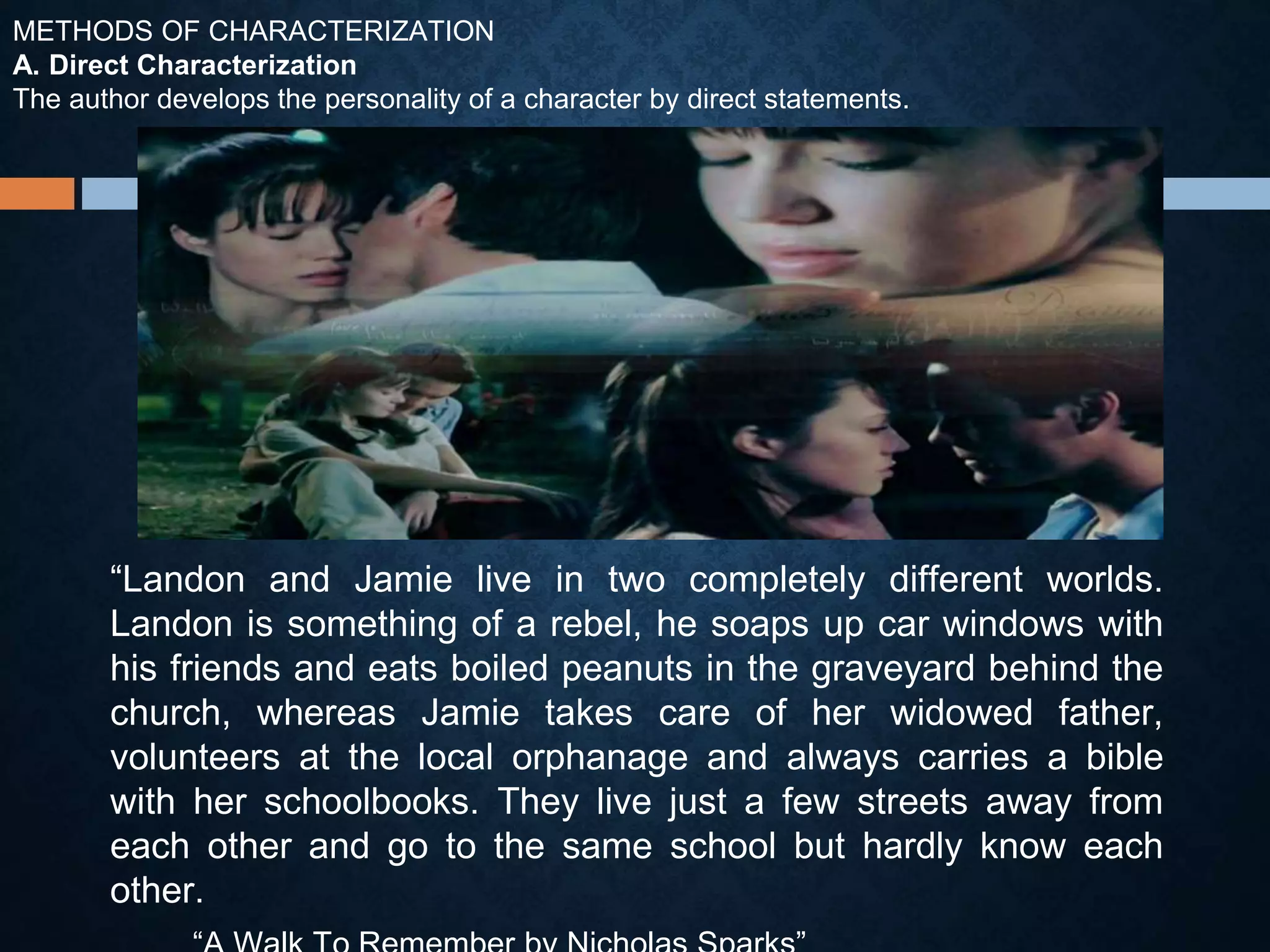
A. Direct Characterization
The author develops the personality of a character by direct statements.
“Landon and Jamie live in two completely different worlds.
Landon is something of a rebel, he soaps up car windows with
his friends and eats boiled peanuts in the graveyard behind the
church, whereas Jamie takes care of her widowed father,
volunteers at the local orphanage and always carries a bible
with her schoolbooks. They live just a few streets away from
each other and go to the same school but hardly know each
other.
METHODS OF CHARACTERIZATION
B. Indirect Characterization
Revealing a character’s personality through
- the character’s thoughts, words and actions
- the comments of other characters
- the character’s physical appearance
INDIRECT
CHARACTERIZATION
THROUGH THOUGHTS
“ Moonbeam closed his eyes and pretended to
sleep the rest of the way to Bamfield. He couldn’t
believe what he had gotten himself into.How had
this happened? He’d never held a gun in his life,
much less gone hunting for animals.”
“ Moonbeam Dawson and The Killer
Bear” By Jean Okimoto
INDIRECT
CHARACTERIZATION
THROUGH WORDS
“It was Kenny Griffen smiling
complacently.’Miss Bird sent me after you
‘cause you’ve been gone for six years.
You’re in trouble…your constipated!
Kenny chortled gleefully.’Wait’ll I tell
Caaathy!”
“Here There Be Tygers”
by Stephen King
INDIRECT
CHARACTERIZATION
THROUGH ACTIONS
“The boy held his breath; he wondered whether
his father would hear his heart beating…Through a
crack in the counter he could see his father where
he stood, one hand held to his high stiff collar.”
“ I Spy” by Graham Greene”
INDIRECT CHARACTERIZATION
THROUGH APPEARANCE
Miss Kinney was young
and blonde and bouncy
and had a boyfriend who
picked her up after
school in a blue
Camaro.”
“Here There Be Tygers”
by Stephen King
SETTING
•The time and place in which the
action occurs.
•Look for clues in the opening
paragraphs of the story or novel.
PLOT
Climax
Rising
Action
Falling Action
Exposition Resolution
Plot is the literary element that describes the structure
of a story. It shows
PLOT COMPONENTS
Climax: The turning point- the most
intense moment.
Falling Action: All of
the action which follows
the climax.
Rising Action: The
series conflicts and crisis
in the story that leads to
the climax.
Exposition: The start
conclusion,
of the story, the
situation before the
action starts.
Resolution: The
the tying together of all
the threads.
PLOT: CONFLICT
Conflict is the
dramatic struggle
between two forces
in a story. Without
conflict, there is no
plot.
PLOT: TYPES OF
CONFLICT
Interpersonal Conflict
Human vs. Human
Human vs. Nature
Human vs. Society
Internal Conflict
Human vs. Self
POINT OF VIEW
The perspectivefrom
which the story is told.
🞑 Who is telling the
story?(for instance, is it a
player on the home
team, someone watching
the game?)
🞑 How do we know what is
happening?
(forinstance, does a
character tell us?)
OMNISCIENT POINT OF VIEW
The author is telling the story
directly.
“Myop carried a short, knobby
stick. She struck out at random
at chickens she liked, and
worked out the beat of a song
on the fence around the pigpen.
She felt light and good in the
warm sun. She was ten, and
nothing existed for her but her
song, the stick clutched in her
dark brown hand, and the tat-
de-ta-ta-ta of accompaniment.”
“The Flowers” by Alice
OMNISCIENT POINT OF VIEW
“The boy with fair hair lowered
himself down the last few
feet of rock and began to
pick his way toward the
lagoon. Though he had
taken off his school sweater
and trailed it now from one
hand, his grey shirt stuck to
him and his hair was
plastered to his forehead.
All around him the long scar
smashed into the jungle
was a bath of heat.”
“The Lord of Flies”
LIMITED OMNISCIENT POINT OF VIEW
Third person, told from the viewpoint of
a character in the story.
“They all laughed, and while they were
laughing, the quiet boy moved his bare
foot on the sidewalk and merely
touched, brushed against a number of
red ants that were scurrying about on
the sidewalk. Secretly, his eyes were
shining, while his parents chatted with
the old man, he saw the ants hesitate,
quiver, and lie still on the cement. He
sensed they were cold.”
“Fever Dream”
by Ray Bradbury
LIMITED OMNISCIENT POINT OF VIEW
“In his black suit he stood in the
dark glass where the
lilies
leaned so palely from
their
wasted cut glass vase.
He
looked down at the guttered
candle stub. He pressed
his
thumbprint in the
warm was
pooled on the oak
veneer.
Lastly, he looked at the face
so caved and drawn
among
the folds of funeral cloth, the
yellowed mustache,
the
eyelids paper thin. That was
FIRST PERSON POINT OF VIEW
Told from the viewpoint of one
of the characters, using the first
person pronoun “I”.
“The thousands of injuries of
Fortunato I had borne as I best
could, but when he ventured upon
insult I vowed revenge. You, who
so will know the nature of my soul,
will not suppose, however, that I
give utterance to a threat.”
The Cask of
Amontillado” byEdgar
THEME
◻ The theme is the central
idea or central message
of the story. It usually
contains some insight into
the human condition-
telling something about
human and life.
◻ The theme can be stated
directly or implied by the
events and actions in the
story.
SYMBOLISM
A SYMBOL REPRESENTS AN IDEA,
QUALITY, OR CONCEPT LARGER THAN
ITSELF.
A journey can symbolize
life.
Water may
represent
cleanliness and
renewal.
A lion can be a symbol
of
courage.
OTHER FICTION
ELEMENTS
• Allusion: a reference to a person, place or literary,
historical, artistic, mythological source or event.
“It was in St. Louis, Missouri, where they
have that giant McDonald’s thing towering over the
city…”(Bean Trees 15)
• Atmosphere: the prevailing emotional and mental
climate of a piece of fiction.
• Dialogue:the reproduction of a
conversation between two of the characters.
OTHER ELEMENTS CONTINUED
• Foreshadowing: early clues about what will
happen later in a piece of fiction.
• Irony: a difference between what is expected
and reality.
• Style: a writer’s individual and distinct way of
writing. The total of the qualities that
distinguish one author’s writing from another’s.
• Structure: the way time moves through a novel.
•Chronological: starts at the beginning and moves
through time.
•Flashback: starts in the present and then goes
back to the past.
•Circular or Anticipatory: starts in the present,
flashes back to the past, and returns to the present
at the conclusion.
•Panel: same story told from different viewpoints.
(Lou Ann and Taylor chapters in The Bean Trees.

WEEK 4 ELEMENTS OF CREATIVE WRITING.pptx

  • 1.
  • 2.
    FICTION ●a literary work,based on the imagination and not necessarily on fact ●imaginary,invented writings such as novels and short stories ● not true
  • 3.
    ORAL FICTION ◻ MYTH ◻FABLES ◻ FOLKTALES ◻ FAIRYTALE S ◻ PARABLES
  • 4.
    LITERAR Y FICTION ◻ SHORT STORIES ◻NOVELS NONFICTION (BASED ON FACTS) ◻ BIOGRAPHY ◻ AUTOBIOGRAPHY ◻ ESSAYS ◻ TEXTS FROM NEWSPAPERS , MAGAZINES,ETC.
  • 5.
  • 6.
    AUTHOR’S PURPOSE - Hisor her reason for creating a work. -The purpose may be to explain or inform, entertain, persuade, or reveal an important truth.
  • 7.
    SETTING The setting isthe place where the story takes place. Setting includes the following: ◻ the geographical location ◻ the time period the socio-economic characteristics of the location ( for example, wealthy suburbs, depressed society)
  • 8.
  • 9.
    - a person,an animal, or an imaginary creature that takes the part in the action of the story. Characterization - the techniques an author uses to develop the personality of a character in a literary work.
  • 10.
    An author cangive information about a character by describing several aspects of the character: - physical appearance and personality - speech, behavior , and actions - thoughts and feelings - interactions with other characters
  • 11.
    These are the commontypes of characters we see in literature. • Round characters • Flat characters • Dynamic characters • Static characters • Stereotype
  • 12.
    •Round characters have various characteristics or traits. •Around character can change or grow. •Readers see more than one
  • 13.
    • Readers seeone side of a flat character. • Flat characters are usually minor characters and reveal one or two traits. • Flat characters may be used as a contrast to a major character.
  • 14.
    CHARACTERS WHO DEVELOPAND CHANGE ARE NOT ONLY ROUND CHARACTERS, BUT OFTEN DYNAMIC. Scrooge changes from a tight- fisted, greedy unhappy man to one who was generous and loved life. Gru changes from a villain set on destroying the world to a loving father.
  • 15.
    • Static charactersare one dimensional—readers see only one side. • Static characters stay the same and do not develop. • Readers learn little about this character. • Static characters are flat characters.
  • 16.
    • Sometimes characterswith common, generalized traits are repeatedly found in unrelated stories. • These characters are known by what they do and how they act. • The author doesn’t need to tell us much about the character because we’ve encountered the stereotype before and can make some inferences.
  • 17.
    THE PROTAGONIST ISCENTRAL TO THE ACTION OF A STORY AND MOVES AGAINST THE ANTAGONIST.
  • 18.
    CHARACTERS ◻ Protagonist The maincharacter in a literary work (for instance, Harry Potter in “Harry Potter” series, Cinderella or Snow White in the fairy tales named for their characters)
  • 19.
    THE ANTAGONIST IS THE VILLAINOR A FORCE WHICH OPPOSES THE PROTAGONIST.
  • 20.
    CHARACTERS ◻ Antagonist The characterwho opposes the protagonist (for instance, Draco Malfoy in “Harry Potter” series or the wicked stepmothers in the fairy tales
  • 22.
    Can you figureout what kind of character these are?
  • 23.
    MEET MEGAMIND! ◻ Hisnemesis is Metro Man (the city’s big hero and defender) ◻ He wants to ruin Metro City and defeat Metro Man. ◻ He falls in love with Roxanne. ◻ He stops Tighten from destroying Metro City. ◻ He becomes the new hero of Metro City. A)Flat Character B)Static Character C)Stereotype D)Dynamic Character
  • 24.
    MEET MOTHER GOTHEL ◻ Gothelkidnaps baby Rapunzel so she can use her magic hair to stay young. ◻ Gothel keeps the truth from Rapunzel about her real parents. ◻ Gothel won’t let Rapunzel out of the tower. ◻ Gothel stabs Flynn, the man Rapunzel loves. A)Round Character B)Protagonist C)Antagonist D)Dynamic Character
  • 25.
    MEET KATNISS! ◻ Sheis strong, independent and able to provide for herself, but can also feel vulnerable. ◻ She can be snarly but she can also be kind. ◻ She is tough but gets scared. ◻ She is smart, but can make mistakes when she’s impulsive. ◻ She loves her family but finds it hard to open herself to romantic love. A) Stereotype B) Flat character C) Round character D) Static character
  • 26.
    MEET MRS WEASLY! ◻She’s a mother to 7 children. ◻ She washes their clothes and takes care of the house. ◻ She fusses over her children and wants them safe. ◻ She’s a great cook. ◻ She’s proud of her children’s achievements. A) Flat Character B) Round Character C) Dynamic Character D) Protagonist
  • 27.
    MEET PERCY JACKSON! ◻He’s a hero. ◻ His friends look up to him. ◻ He goes on a lot of quests. ◻ It’s up to him to save the world. ◻ He has to fight monsters. A)Antagonist B)Stereotype C)Static Character D)Protagonist
  • 28.
    MEET SNOW WHITE! ◻She’s sweet and kind. ◻ She’s good and loving. ◻ Her Step-mother is cruel to her. ◻ She helps out some dwarves. ◻ She almost dies. ◻ When she awakens, she’s good, sweet, kind and loving. A) Stereotype B) Static Character C) Round Character D) Dynamic Character
  • 29.
    MEET ANAKIN/DARTH VADER ◻He was a precocious boy who had the “force” in him. ◻ He fought with the Jedi’s for good. ◻ Because of jealousy fear, he went to “the Dark and over Side” ◻ He sacrifices his own life to save his son’s A) Static Character B) Stereotype C) Flat Character D) Dynamic Character
  • 30.
    METHODS OF CHARACTERIZATION A.Direct Characterization The author develops the personality of a character by direct statements. “Landon and Jamie live in two completely different worlds. Landon is something of a rebel, he soaps up car windows with his friends and eats boiled peanuts in the graveyard behind the church, whereas Jamie takes care of her widowed father, volunteers at the local orphanage and always carries a bible with her schoolbooks. They live just a few streets away from each other and go to the same school but hardly know each other.
  • 31.
    METHODS OF CHARACTERIZATION B.Indirect Characterization Revealing a character’s personality through - the character’s thoughts, words and actions - the comments of other characters - the character’s physical appearance
  • 32.
    INDIRECT CHARACTERIZATION THROUGH THOUGHTS “ Moonbeamclosed his eyes and pretended to sleep the rest of the way to Bamfield. He couldn’t believe what he had gotten himself into.How had this happened? He’d never held a gun in his life, much less gone hunting for animals.” “ Moonbeam Dawson and The Killer Bear” By Jean Okimoto
  • 33.
    INDIRECT CHARACTERIZATION THROUGH WORDS “It wasKenny Griffen smiling complacently.’Miss Bird sent me after you ‘cause you’ve been gone for six years. You’re in trouble…your constipated! Kenny chortled gleefully.’Wait’ll I tell Caaathy!” “Here There Be Tygers” by Stephen King
  • 34.
    INDIRECT CHARACTERIZATION THROUGH ACTIONS “The boyheld his breath; he wondered whether his father would hear his heart beating…Through a crack in the counter he could see his father where he stood, one hand held to his high stiff collar.” “ I Spy” by Graham Greene”
  • 35.
    INDIRECT CHARACTERIZATION THROUGH APPEARANCE MissKinney was young and blonde and bouncy and had a boyfriend who picked her up after school in a blue Camaro.” “Here There Be Tygers” by Stephen King
  • 36.
    SETTING •The time andplace in which the action occurs. •Look for clues in the opening paragraphs of the story or novel.
  • 37.
    PLOT Climax Rising Action Falling Action Exposition Resolution Plotis the literary element that describes the structure of a story. It shows
  • 38.
    PLOT COMPONENTS Climax: Theturning point- the most intense moment. Falling Action: All of the action which follows the climax. Rising Action: The series conflicts and crisis in the story that leads to the climax. Exposition: The start conclusion, of the story, the situation before the action starts. Resolution: The the tying together of all the threads.
  • 39.
    PLOT: CONFLICT Conflict isthe dramatic struggle between two forces in a story. Without conflict, there is no plot.
  • 40.
    PLOT: TYPES OF CONFLICT InterpersonalConflict Human vs. Human Human vs. Nature Human vs. Society Internal Conflict Human vs. Self
  • 41.
    POINT OF VIEW Theperspectivefrom which the story is told. 🞑 Who is telling the story?(for instance, is it a player on the home team, someone watching the game?) 🞑 How do we know what is happening? (forinstance, does a character tell us?)
  • 42.
    OMNISCIENT POINT OFVIEW The author is telling the story directly. “Myop carried a short, knobby stick. She struck out at random at chickens she liked, and worked out the beat of a song on the fence around the pigpen. She felt light and good in the warm sun. She was ten, and nothing existed for her but her song, the stick clutched in her dark brown hand, and the tat- de-ta-ta-ta of accompaniment.” “The Flowers” by Alice
  • 43.
    OMNISCIENT POINT OFVIEW “The boy with fair hair lowered himself down the last few feet of rock and began to pick his way toward the lagoon. Though he had taken off his school sweater and trailed it now from one hand, his grey shirt stuck to him and his hair was plastered to his forehead. All around him the long scar smashed into the jungle was a bath of heat.” “The Lord of Flies”
  • 44.
    LIMITED OMNISCIENT POINTOF VIEW Third person, told from the viewpoint of a character in the story. “They all laughed, and while they were laughing, the quiet boy moved his bare foot on the sidewalk and merely touched, brushed against a number of red ants that were scurrying about on the sidewalk. Secretly, his eyes were shining, while his parents chatted with the old man, he saw the ants hesitate, quiver, and lie still on the cement. He sensed they were cold.” “Fever Dream” by Ray Bradbury
  • 45.
    LIMITED OMNISCIENT POINTOF VIEW “In his black suit he stood in the dark glass where the lilies leaned so palely from their wasted cut glass vase. He looked down at the guttered candle stub. He pressed his thumbprint in the warm was pooled on the oak veneer. Lastly, he looked at the face so caved and drawn among the folds of funeral cloth, the yellowed mustache, the eyelids paper thin. That was
  • 46.
    FIRST PERSON POINTOF VIEW Told from the viewpoint of one of the characters, using the first person pronoun “I”. “The thousands of injuries of Fortunato I had borne as I best could, but when he ventured upon insult I vowed revenge. You, who so will know the nature of my soul, will not suppose, however, that I give utterance to a threat.” The Cask of Amontillado” byEdgar
  • 47.
    THEME ◻ The themeis the central idea or central message of the story. It usually contains some insight into the human condition- telling something about human and life. ◻ The theme can be stated directly or implied by the events and actions in the story.
  • 48.
    SYMBOLISM A SYMBOL REPRESENTSAN IDEA, QUALITY, OR CONCEPT LARGER THAN ITSELF. A journey can symbolize life. Water may represent cleanliness and renewal. A lion can be a symbol of courage.
  • 49.
    OTHER FICTION ELEMENTS • Allusion:a reference to a person, place or literary, historical, artistic, mythological source or event. “It was in St. Louis, Missouri, where they have that giant McDonald’s thing towering over the city…”(Bean Trees 15) • Atmosphere: the prevailing emotional and mental climate of a piece of fiction. • Dialogue:the reproduction of a conversation between two of the characters.
  • 50.
    OTHER ELEMENTS CONTINUED •Foreshadowing: early clues about what will happen later in a piece of fiction. • Irony: a difference between what is expected and reality. • Style: a writer’s individual and distinct way of writing. The total of the qualities that distinguish one author’s writing from another’s.
  • 51.
    • Structure: theway time moves through a novel. •Chronological: starts at the beginning and moves through time. •Flashback: starts in the present and then goes back to the past. •Circular or Anticipatory: starts in the present, flashes back to the past, and returns to the present at the conclusion. •Panel: same story told from different viewpoints. (Lou Ann and Taylor chapters in The Bean Trees.