TYPES OF
COMMUNICATIVE
STRATEGY
Learning Objectives
a) distinguish various types of
communicative strategies;
b) use acceptable, polite, and
meaningful communicative
strategies;
c) engage in a communicative
situation;
d) explain the effects of a shift in
communicative strategy.
Communicative strategy
• Means used to overcome various problems in
communication which may arise from linguistic
lapses or lack of understanding (Mariani, 2010).
• Some communicative strategies include topic
avoidance, message abandonment,
paraphrasing, language switching, using
gestures, or asking for assistance from other
participant (Dobao and Martinez, 2007).
• Strategies that we can used to start and
maintain conversation.
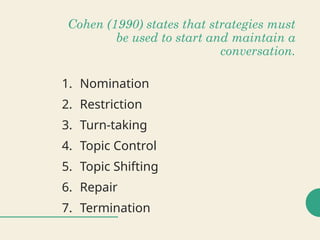
Cohen (1990) states that strategies must
be used to start and maintain a
conversation.
1. Nomination
2. Restriction
3. Turn-taking
4. Topic Control
5. Topic Shifting
6. Repair
7. Termination
1. Nomination
• A speaker carries out nomination to
collaboratively and productively establish a
topic.
• You try to open a topic with people you are
talking to.
• You can try the following strategy in
establishing a topic:
– News inquiries and news announcements.
– Keep the conversation environment open
for opinions.
2. Restriction
• It refers to any limitation (what, when,
how) you may have as a speaker
(Heritage, 2013)
• You are given specific instructions that
you must follow.
– In a courtroom, witness can only answer
the lawyer’s question and vice versa.
– In a meeting, you are only allowed to
speak when you will be asked to.
3. Turn – taking
• It pertains to the process by which people
decide who takes the conversational floor.
• The primary goal is to give all communicators a
chance to speak.
• Keep your words relevant and reasonably short
enough to express your views or feelings.
• Try to be polite even if you are trying to take
the floor from another speaker.
• “What do you think?” You were saying
something?”
4. Topic Control
• Happens when the subject of the
conversation is restricted by one of
the communicators (Warren, 2006).
• Depends on the formality of the
situation.
• Example: A teacher usually prescribes
the topic which will be discussed but
the students can still share their own
idea.
5. Topic Shifting
• It involves moving from one topic to
another (Warren, 2006).
• It is where one part of a conversation
ends and where another begins.
• Example: using “By the way…” “In
addition to what you said,…” Which
reminds me of…”
6. Repair
• Repair refers to how speaker address the
problems in speaking, listening, and
comprehending that they may encounter in
a conversation (Liddicoat, 2007).
• Repair is the self-righting mechanism in any
social interaction (Schegloff et al, 1997)
• Always seek to initiate the repair.
• The speaker may slow down until the word
is understood or use more familiar words to
be easily understood.
7. Termination
• Refers to the conversational practices
which are used to close a topic (Wong
and Waring, 2010).
• The topic initiator takes responsibility
to signal the end of the discussion as
well.
- use concluding cues (sharing what you have
learned from the conversation)
- share what you learned from the
conversation
Identify the type of communicative strategy in
each statement
1. “Do you have anything to say?”
2. “Sorry, I can’t talk to you right now. I’ll call
you to discuss about that matter.”
3. “Have you heard the latest achievement of
our president?”
4. “Please narrate to us what you have
experience during that day.”
5. Hey! How is life going on?”
ANNOUNCEMENT
• QUIZ # 5
• Wednesday, October 3, 2018
• Coverage: LESSON 4: Speech Acts,
LESSON 5: Types of Communicative
Strategy
Performance Task
• With your group, think of three scenes from a movie or a
TV show where various communicative strategies were
employed. Watch and re-enact the scenes and evaluate
the effect of the strategy applied to the conversation and
to the characters.
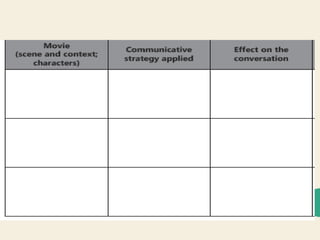
• List your evaluations in the table below. Prepare a
creative visual aid for your table.
• Presentation will be on Monday. Friday will be used for
preparation.
LESSON-5-Communicative-strategy oral com.pptx

LESSON-5-Communicative-strategy oral com.pptx

  • 1.
  • 2.
    Learning Objectives a) distinguishvarious types of communicative strategies; b) use acceptable, polite, and meaningful communicative strategies; c) engage in a communicative situation; d) explain the effects of a shift in communicative strategy.
  • 3.
    Communicative strategy • Meansused to overcome various problems in communication which may arise from linguistic lapses or lack of understanding (Mariani, 2010). • Some communicative strategies include topic avoidance, message abandonment, paraphrasing, language switching, using gestures, or asking for assistance from other participant (Dobao and Martinez, 2007). • Strategies that we can used to start and maintain conversation.
  • 4.
    Cohen (1990) statesthat strategies must be used to start and maintain a conversation. 1. Nomination 2. Restriction 3. Turn-taking 4. Topic Control 5. Topic Shifting 6. Repair 7. Termination
  • 5.
    1. Nomination • Aspeaker carries out nomination to collaboratively and productively establish a topic. • You try to open a topic with people you are talking to. • You can try the following strategy in establishing a topic: – News inquiries and news announcements. – Keep the conversation environment open for opinions.
  • 6.
    2. Restriction • Itrefers to any limitation (what, when, how) you may have as a speaker (Heritage, 2013) • You are given specific instructions that you must follow. – In a courtroom, witness can only answer the lawyer’s question and vice versa. – In a meeting, you are only allowed to speak when you will be asked to.
  • 7.
    3. Turn –taking • It pertains to the process by which people decide who takes the conversational floor. • The primary goal is to give all communicators a chance to speak. • Keep your words relevant and reasonably short enough to express your views or feelings. • Try to be polite even if you are trying to take the floor from another speaker. • “What do you think?” You were saying something?”
  • 8.
    4. Topic Control •Happens when the subject of the conversation is restricted by one of the communicators (Warren, 2006). • Depends on the formality of the situation. • Example: A teacher usually prescribes the topic which will be discussed but the students can still share their own idea.
  • 9.
    5. Topic Shifting •It involves moving from one topic to another (Warren, 2006). • It is where one part of a conversation ends and where another begins. • Example: using “By the way…” “In addition to what you said,…” Which reminds me of…”
  • 10.
    6. Repair • Repairrefers to how speaker address the problems in speaking, listening, and comprehending that they may encounter in a conversation (Liddicoat, 2007). • Repair is the self-righting mechanism in any social interaction (Schegloff et al, 1997) • Always seek to initiate the repair. • The speaker may slow down until the word is understood or use more familiar words to be easily understood.
  • 11.
    7. Termination • Refersto the conversational practices which are used to close a topic (Wong and Waring, 2010). • The topic initiator takes responsibility to signal the end of the discussion as well. - use concluding cues (sharing what you have learned from the conversation) - share what you learned from the conversation
  • 12.
    Identify the typeof communicative strategy in each statement 1. “Do you have anything to say?” 2. “Sorry, I can’t talk to you right now. I’ll call you to discuss about that matter.” 3. “Have you heard the latest achievement of our president?” 4. “Please narrate to us what you have experience during that day.” 5. Hey! How is life going on?”
  • 13.
    ANNOUNCEMENT • QUIZ #5 • Wednesday, October 3, 2018 • Coverage: LESSON 4: Speech Acts, LESSON 5: Types of Communicative Strategy
  • 14.
    Performance Task • Withyour group, think of three scenes from a movie or a TV show where various communicative strategies were employed. Watch and re-enact the scenes and evaluate the effect of the strategy applied to the conversation and to the characters. • List your evaluations in the table below. Prepare a creative visual aid for your table. • Presentation will be on Monday. Friday will be used for preparation.

Editor's Notes

  • #5 “Have you heard the news today?” “Hey, how’s life going?”
  • #7 For example, in a meeting, you may only have a turn to speak after the chairperson directs you to do so. Unlike when having a casual conversation with friends over lunch or coffee where you may take the conversational floor anytime.
  • #8 When topic is initiated, it should be developed by avoiding unnecessary interruptions and topic shifts. Avoid minimal responses like “yes”, asking tag questions to clarify information like “you are excited, arent you?”
  • #9 Ex. Use of “by the way”, “in addition to what you said”, “which reminds me of”,
  • #10 1. For example, if everybody in the conversation seems to talk at the same time, give way and appreciate other’s initiative to see the conversation back to its topic.